Japan Inlet Manifold Market Size & Growth Rate
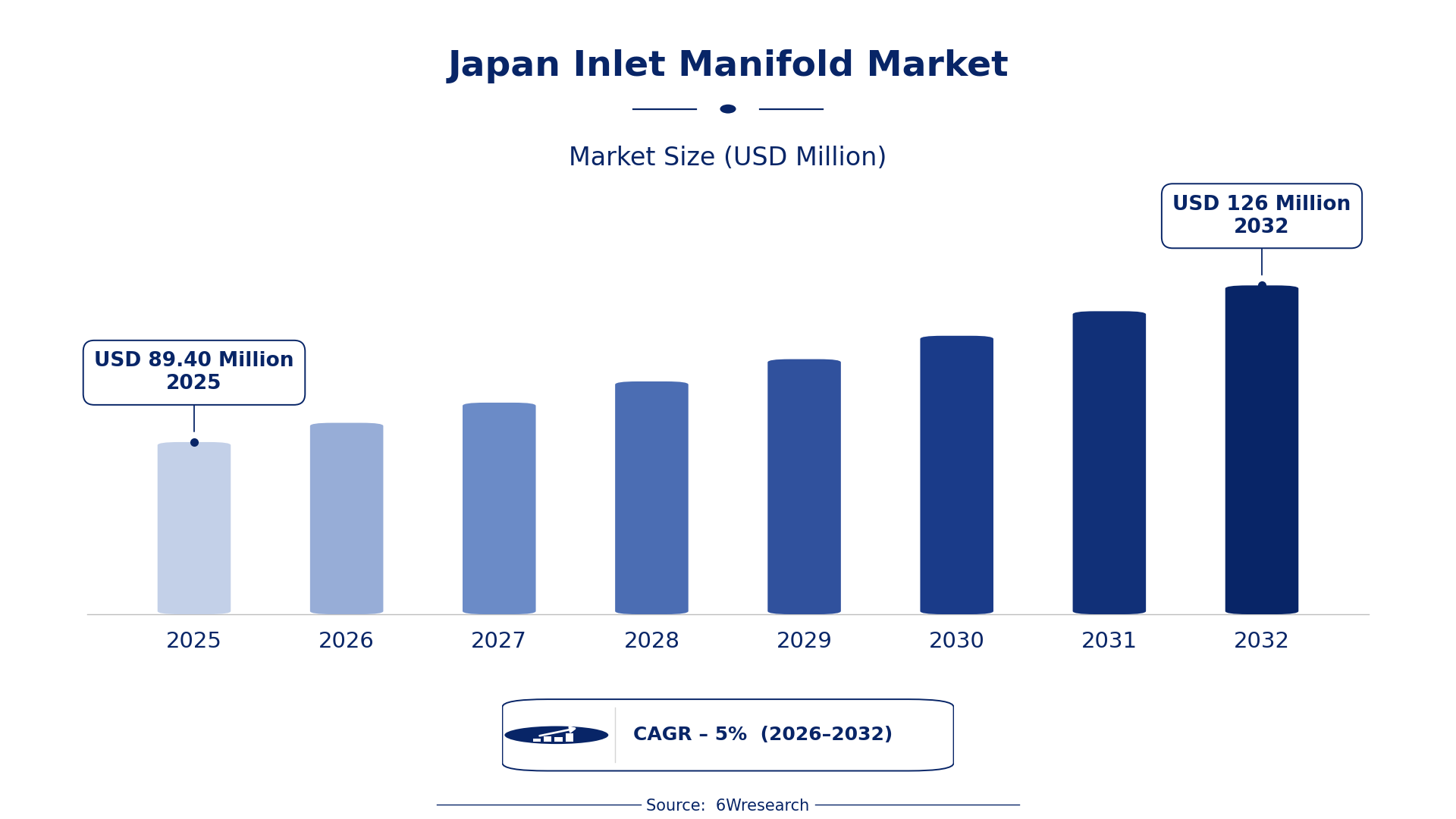
According to 6Wresearch internal database and industry insights, the Japan Inlet Manifold Market was valued at USD 89.40 Million in 2025 and is projected to reach USD 126 Million by 2032, growing at a CAGR of approximately 5% during 2026–2032.
Japan Inlet Manifold Market Highlights
| Report Metric | Details |
| Report Name | Japan Inlet Manifold Market (2026-2032) |
| Market Size 2025 | USD 89.40 Million |
| Market Size 2032 | USD 126 Million |
| Absolute Growth 2025–2032 | USD 36.60 Million |
| CAGR 2026–2032 | 5% |
| Peak Annual Growth | 6.9% in 2032 |
| Forecast Period | 2026–2032 |
| Historical Data | 2022–2025 |
| Base Year | 2025 |
| Leading Vehicle Type, 2025 | Passenger Car (43% share) |
| Leading Manifold Type, 2025 | Standard AIM (63% share) |
| Leading Material, 2025 | Composites (47% share) |
| Leading Manufacturing Process, 2025 | Injection-Moulded AIM (64% share) |
| Fastest-Growing Vehicle Type | Light Commercial Vehicle (7.0% CAGR) |
| Fastest-Growing Manifold Type | Variable AIM (6.8% CAGR) |
| Fastest-Growing Material | Aluminium (7.5% CAGR) |
| Fastest-Growing Manufacturing Process | Casting-based AIM (6.9% CAGR) |
| Growing Sector | Automotive |
| Key End Users | Automotive manufacturers, vehicle assemblers, aftermarket suppliers, performance tuning specialists |
Japan Inlet Manifold Market Year-wise Growth Rate and Key Drivers (2022–2032)
This graph illustrates the annual growth rates of the market from 2022 to 2032, highlighting a steady upward trajectory and projected market expansion over the forecast period.
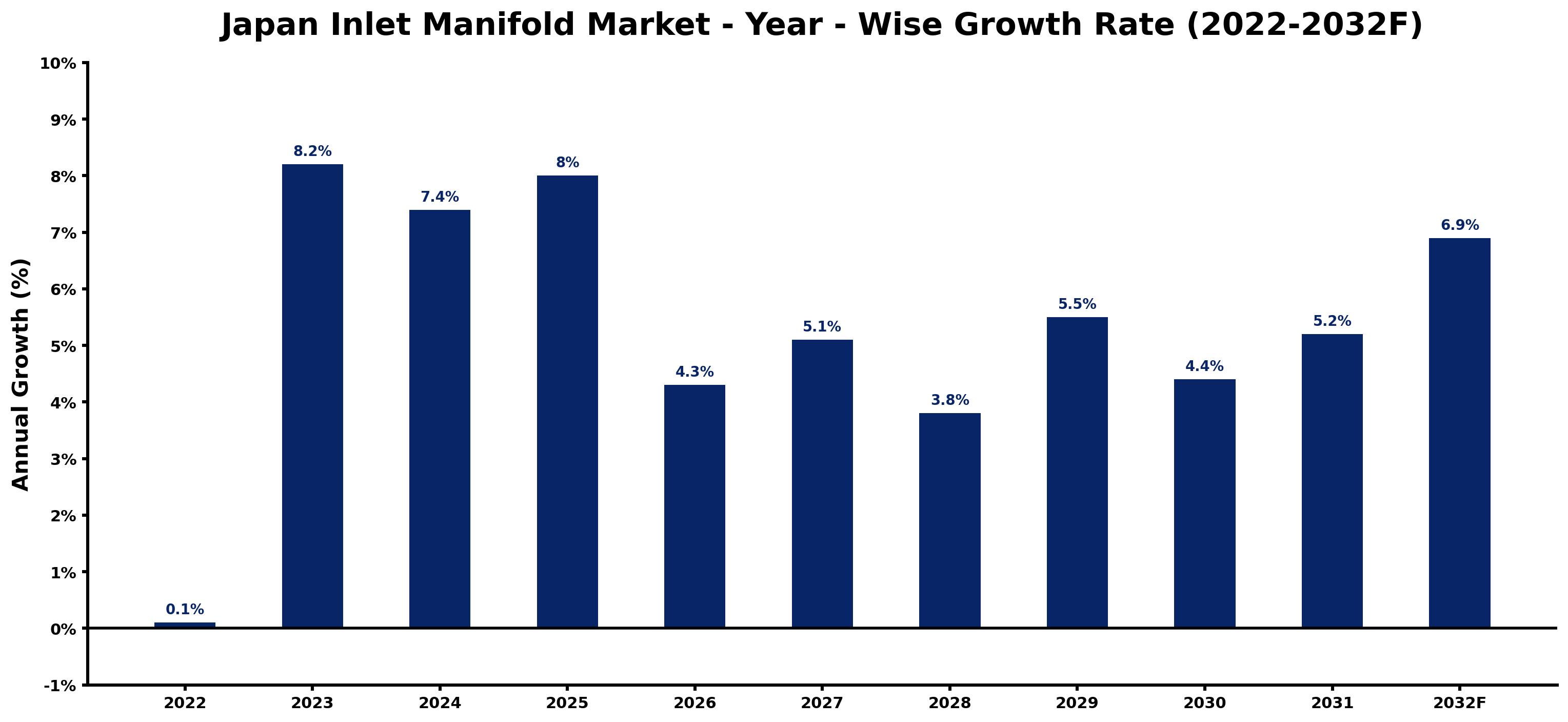
Each row of the following table gives one year's estimated growth and the event or demand shift that explains it.
| Year | Estimated Annual Growth (%) | Market Rationale |
| 2022 | 0.1 | The market showed minimal growth due to stable demand from established automotive manufacturers. |
| 2023 | 8.2 | Demand surged as automotive production rebounded, reflecting strong recovery in the sector. |
| 2024 | 7.4 | Growth slowed as production stabilised after the previous year's peak in vehicle output. |
| 2025 | 8.0 | The market experienced renewed growth driven by increased demand for passenger vehicles. |
| 2026 | 4.3 | Growth is expected to slow again as supply chain challenges begin to impact production rates. |
| 2027 | 5.1 | Demand is projected to increase as manufacturers adapt to supply chain constraints and resume production. |
| 2028 | 3.8 | A slowdown in growth is anticipated as market conditions normalise after previous fluctuations. |
| 2029 | 5.5 | The market is expected to see a resurgence in demand as new vehicle models are introduced. |
| 2030 | 4.4 | Growth is projected to moderate as manufacturers adjust to changing consumer preferences and economic conditions. |
| 2031 | 5.2 | Demand is expected to increase again as the automotive sector focuses on performance and efficiency. |
| 2032 | 6.9 | The market is projected to peak as stricter emissions regulations drive demand for advanced inlet manifolds. |
Note: Market size estimations and growth projections presented in this report are based on 6Wresearch's proprietary forecasting methodology, utilizing the latest available industry data, government publications, and primary research inputs.
Japan Inlet Manifold Market Synopsis
Inlet manifolds are essential components in internal combustion engines, responsible for distributing air or air-fuel mixtures to cylinders. They are primarily manufactured from aluminum or composites using injection molding or casting techniques. The Japan Inlet Manifold Market is experiencing growth due to robust demand from the automotive sector, which produced approximately 8.3 million vehicles in 2022. Factors such as the shift towards variable inlet manifolds, influenced by stricter emission regulations, and a heightened focus on engine performance are stimulating market expansion.
Market Dynamics Impact Analysis (2026–2032)
| Factor | Type | Impact | Primary Segment Affected |
| Rising vehicle production in Japan | Driver | High | Passenger Car |
| Increased adoption of variable inlet manifolds | Driver | High | Variable AIM |
| Growing demand for lightweight materials in automotive applications | Opportunity | Medium | Composites |
| Expansion of automotive manufacturing in the Tokyo region | Opportunity | High | Light Commercial Vehicle |
| Supply chain disruptions affecting material availability | Restraint | High | Injection-Moulded AIM |
| Stricter regulations on emissions impacting production costs | Restraint | Medium | Standard AIM |
| Competition from alternative engine technologies | Challenge | High | Heavy Commercial Vehicle |
| Fluctuations in raw material prices affecting profitability | Challenge | Medium | Aluminium |
Evaluation of Drivers in Japan Inlet Manifold Market (2026–2032)
The following drivers explain most of the expected growth.
| Drivers | Primary Segment Affected | Why It Matters (Evidence) |
| Increased vehicle production | Passenger Car | Japan's automotive sector produced approximately 8.3 million vehicles in 2022, stimulating demand for inlet manifolds. |
| Shift towards variable inlet manifolds | Variable AIM | The growing adoption of variable inlet manifolds aligns with stricter emission regulations, enhancing performance and compliance. |
| Rising demand for lightweight materials | Composites | The Japan Aluminum Association advocates for aluminum use in manifolds due to its lightweight and durable properties. |
| Advancements in injection molding technology | Injection-Moulded AIM | Injection-moulded components account for over 30% of the inlet manifold market, appealing to cost-sensitive manufacturers. |
| Growth in light commercial vehicles | Light Commercial Vehicle | Japan has over 5 million registered light commercial vehicles as of 2023, increasing demand for inlet manifolds. |
Behind the steady rise in orders sits Japan's automotive production, which reached approximately 8.3 million vehicles in 2022, stimulating demand for inlet manifolds. The shift towards variable inlet manifolds reflects the need for improved performance and compliance with emissions standards. The use of aluminum is emphasised for its lightweight and durable properties, critical for enhancing engine efficiency. Advancements in injection molding technology have made injection-moulded components more appealing, accounting for over 30% of the market share. Additionally, the light commercial vehicle segment, with over 5 million registered units, is further driving demand.
Evaluation of Restraints in Japan Inlet Manifold Market
These are the pressures that could keep growth below its potential.
| Market Restraint | Primary Segment Affected | Why It Matters (Evidence) |
| Supply chain disruptions affecting material availability | Injection-Moulded AIM | Recent supply chain challenges have led to material shortages, impacting production timelines for inlet manifolds. |
| Stricter regulations on emissions impacting production costs | Standard AIM | Compliance with new emissions standards has increased production costs, affecting pricing strategies for manufacturers. |
| Limited innovation in traditional manifold designs | Standard AIM | The lack of advancements in standard designs is hindering market growth opportunities. |
| Competition from alternative engine technologies | Heavy Commercial Vehicle | The rise of electric vehicles is diverting investment away from traditional combustion engine components. |
| Fluctuations in raw material prices affecting profitability | Aluminium | Volatility in aluminum prices has made budgeting for production more challenging for manufacturers. |
Japan Inlet Manifold Market Challenges
Aging vehicles dominate the market, with the average passenger car age at 11.5 years, leading to increased maintenance costs for owners. Suppliers experience intense competition, which results in price wars that diminish profit margins and limit their ability to invest in new technologies. A skills gap exists, as the automotive industry employs over 5 million people, yet the demand for advanced manufacturing skills exceeds supply, causing production delays. Regulatory pressures are rising, particularly with the JIS B 2401 standard, imposing compliance costs that burden producers and slow down innovation.
Trends in the Japan Inlet Manifold Market
Below are the shifts with the largest effect on the Japan Inlet Manifold Market.
- Shift towards Variable Inlet Manifolds: The adoption of variable inlet manifolds is on the rise due to stricter emission regulations. This trend started in 2023, with manufacturers striving to enhance engine performance while adhering to compliance standards.
- Increased Use of Lightweight Materials: The automotive industry is progressively using lightweight materials like composites to boost fuel efficiency. This trend gained traction in 2022, with composites representing 47% of the manifold market.
- Focus on Emission Reduction Technologies: The drive for emission reduction technologies has sparked innovations in manifold design. This emphasis began in 2021, aligning with Japan's Green Growth Strategy targeting carbon neutrality by 2050.
- Expansion of Automotive Manufacturing in Tokyo: The Tokyo region is emerging as a centre for automotive manufacturing, attracting a multitude of suppliers. This trend has been noted since 2022, with substantial investments in local production facilities.
Investment Opportunities in the Japan Inlet Manifold Market
Below are the investment opportunities with the strongest case in the Japan Inlet Manifold Market.
- Tokyo Automotive Manufacturing Hub: The Tokyo region is currently broadening its automotive manufacturing capabilities, offering opportunities for suppliers. With over 5 million registered light commercial vehicles, collaborations with local manufacturers can ease market entry.
- Investment in Green Technology: The emphasis on green technology in the automotive sector is generating opportunities for suppliers. With government investments in carbon neutrality initiatives, companies can seek partnerships with local manufacturers.
- Growing Demand for Composites: The appetite for lightweight materials is increasing, especially in high-performance applications. Suppliers can target automotive manufacturers in Japan, taking advantage of the growth in composite materials.
- Focus on Injection-Moulded Components: The market for injection-moulded components is growing due to cost-effectiveness. Suppliers can penetrate this segment by partnering with local automotive manufacturers.
Government Initiatives in the Japan Inlet Manifold Market
The Economic Security Promotion Act, enacted in 2022, impacts buyers of inlet manifolds by supporting supply-chain resilience for critical automotive components. This measure encourages manufacturers to invest in local production, ensuring a stable supply of materials necessary for the automotive sector. The government has allocated funding of over USD 50 million to support local suppliers, promoting innovation and competitiveness in the market.
The Ministry of Land, Infrastructure, Transport and Tourism oversees automotive regulations, approving standards like the JIS B 2401 for inlet manifolds. This agency ensures compliance with safety and performance standards, providing manufacturers with guidelines to meet market expectations. The ministry also conducts regular assessments to maintain high-quality standards in the industry, approving over 100 new automotive components annually.
Future Insight of the Japan Inlet Manifold Market
By 2032, advancements in injection moulding technology will revolutionise the inlet manifold market, enhancing production efficiency. The shift towards variable inlet manifolds will improve engine performance while adhering to stricter emission standards. Government backing for green technology initiatives will spur innovation in the automotive sector. As the automotive environment evolves, the focus on upgrading the vehicle fleet will present substantial opportunities for buyers seeking enhanced efficiency.
Market Segmentation Analysis
Japan Inlet Manifold Market report covers a detailed analysis of the following market segments:
By Vehicle Type – Passenger Car Leads, Light Commercial Vehicle Expected to Grow Fastest
According to Ravi Bhandari, Research Head at 6Wresearch, the largest vehicle type category in 2025 was Passenger Car, at 43% of revenue. Passenger cars represent the largest segment for inlet manifolds in Japan, supported by the production of approximately 8.3 million vehicles in 2022. This category benefits from a well-established market and consistent demand from domestic automotive manufacturers. Over 2026–2032, Light Commercial Vehicle is expected to post the fastest growth, at a CAGR of 7.0%. Light commercial vehicles are experiencing rapid growth due to the increasing need for efficient transport solutions, with over 5 million registered vehicles in Japan as of 2023. This trend highlights a shift towards logistics and delivery services, which is expected to drive further expansion in this segment. Suppliers should focus on developing tailored solutions for light commercial vehicles to capitalise on this growth opportunity.
By Manifold Type – Standard AIM Leads, Variable AIM Expected to Grow Fastest
In 2025, Standard AIM led the manifold type split with a 63% share. Standard AIMs hold the largest share in the market as they are commonly used in conventional engine designs, which are prevalent in Japan's automotive sector. The compliance with the JIS B 2401 standard reinforces their reliability and widespread adoption. The quickest growth will come from Variable AIM, forecast to expand at a CAGR of 6.8% between 2026 and 2032. Variable AIMs are rapidly gaining popularity as manufacturers adapt to stricter emission regulations, which require more efficient engine technologies. This growing trend indicates a strong commitment to environmental sustainability within the industry. Manufacturers should invest in variable AIM technologies to stay competitive and meet regulatory demands.
By Material – Composites Lead, Aluminium Expected to Grow Fastest
Composites took 47% of material revenue in 2025, more than any other category. Composites are the preferred material for inlet manifolds due to their lightweight characteristics, which are essential for enhancing vehicle performance and fuel efficiency. This preference aligns with the automotive industry's focus on reducing vehicle weight to improve overall efficiency. Aluminium is projected to grow fastest, at a CAGR of 7.5% during 2026–2032. Aluminium is increasingly favoured for its durability and weight advantages, making it a popular choice in modern engine designs. The support from the Japan Aluminum Association further accelerates its integration into the automotive sector. Suppliers should prioritise aluminium solutions to meet the rising demand for lightweight and durable components.
By Manufacturing Process – Injection-Moulded AIM Leads, Casting-based AIM Expected to Grow Fastest
Injection-Moulded AIM held 64% of the Japan Inlet Manifold Market by manufacturing process in 2025. Injection-moulded AIMs are the leading manufacturing process due to their cost-effectiveness and capability to produce components in high volumes. This method aligns well with the production needs of the automotive industry, ensuring a reliable supply of parts. Casting-based AIM is set to record the highest CAGR in this split, 6.9% over 2026–2032. Casting-based AIMs are seeing growth as they are traditionally trusted in the industry, particularly for applications requiring robust components. Their established presence ensures continued demand as manufacturers seek reliable solutions. Investing in advanced casting techniques may provide manufacturers with a competitive edge in this traditional segment.
Key Attractiveness of the Report
- 10 Years of Market Numbers
- Historical Data Starting from 2022 to 2025
- Base Year 2025
- Forecast Data until 2032
- Key Performance Indicators Impacting the Market
- Major Upcoming Developments and Projects
Key Highlights of the Report:
- Japan Inlet Manifold Market Outlook
- Market Size of Japan Inlet Manifold Market, 2025
- Forecast of Japan Inlet Manifold Market, 2032
- Historical Data and Forecast of Japan Inlet Manifold Revenues & Volume for the Period 2022-2032
- Japan Inlet Manifold Market Trend Evolution
- Japan Inlet Manifold Market Drivers and Challenges
- Japan Inlet Manifold Price Trends
- Japan Inlet Manifold Porter's Five Forces
- Japan Inlet Manifold Industry Life Cycle
- Historical Data and Forecast of Japan Inlet Manifold Market Revenues & Volume By Vehicle Type for the Period 2022-2032
- Historical Data and Forecast of Japan Inlet Manifold Market Revenues & Volume By Passenger Car for the Period 2022-2032
- Historical Data and Forecast of Japan Inlet Manifold Market Revenues & Volume By Light Commercial Vehicle for the Period 2022-2032
- Historical Data and Forecast of Japan Inlet Manifold Market Revenues & Volume By Heavy Commercial Vehicle for the Period 2022-2032
- Historical Data and Forecast of Japan Inlet Manifold Market Revenues & Volume By Manifold Type for the Period 2022-2032
- Historical Data and Forecast of Japan Inlet Manifold Market Revenues & Volume By Standard AIM for the Period 2022-2032
- Historical Data and Forecast of Japan Inlet Manifold Market Revenues & Volume By Variable AIM for the Period 2022-2032
- Historical Data and Forecast of Japan Inlet Manifold Market Revenues & Volume By Material for the Period 2022-2032
- Historical Data and Forecast of Japan Inlet Manifold Market Revenues & Volume By Composites for the Period 2022-2032
- Historical Data and Forecast of Japan Inlet Manifold Market Revenues & Volume By Aluminium for the Period 2022-2032
- Historical Data and Forecast of Japan Inlet Manifold Market Revenues & Volume By Plastic for the Period 2022-2032
- Historical Data and Forecast of Japan Inlet Manifold Market Revenues & Volume By Others for the Period 2022-2032
- Historical Data and Forecast of Japan Inlet Manifold Market Revenues & Volume By Manufacturing Process for the Period 2022-2032
- Historical Data and Forecast of Japan Inlet Manifold Market Revenues & Volume By Injection-Moulded AIM for the Period 2022-2032
- Historical Data and Forecast of Japan Inlet Manifold Market Revenues & Volume By Casting-based AIM for the Period 2022-2032
- Japan Inlet Manifold Import Export Trade Statistics
- Market Opportunity Assessment By Vehicle Type
- Market Opportunity Assessment By Manifold Type
- Market Opportunity Assessment By Material
- Market Opportunity Assessment By Manufacturing Process
- Japan Inlet Manifold Top Companies Market Share
- Japan Inlet Manifold Competitive Benchmarking By Technical and Operational Parameters
- Japan Inlet Manifold Company Profiles
- Japan Inlet Manifold Key Strategic Recommendations
Market Covered
This report examines the market across the segments below.
By Vehicle Type
- Passenger Car
- Light Commercial Vehicle
- Heavy Commercial Vehicle
By Manifold Type
- Standard AIM
- Variable AIM
By Material
- Composites
- Aluminium
- Plastic
- Others
By Manufacturing Process
- Injection-Moulded AIM
- Casting-based AIM































