Japan Internal combustion engine components Market Size & Growth Rate
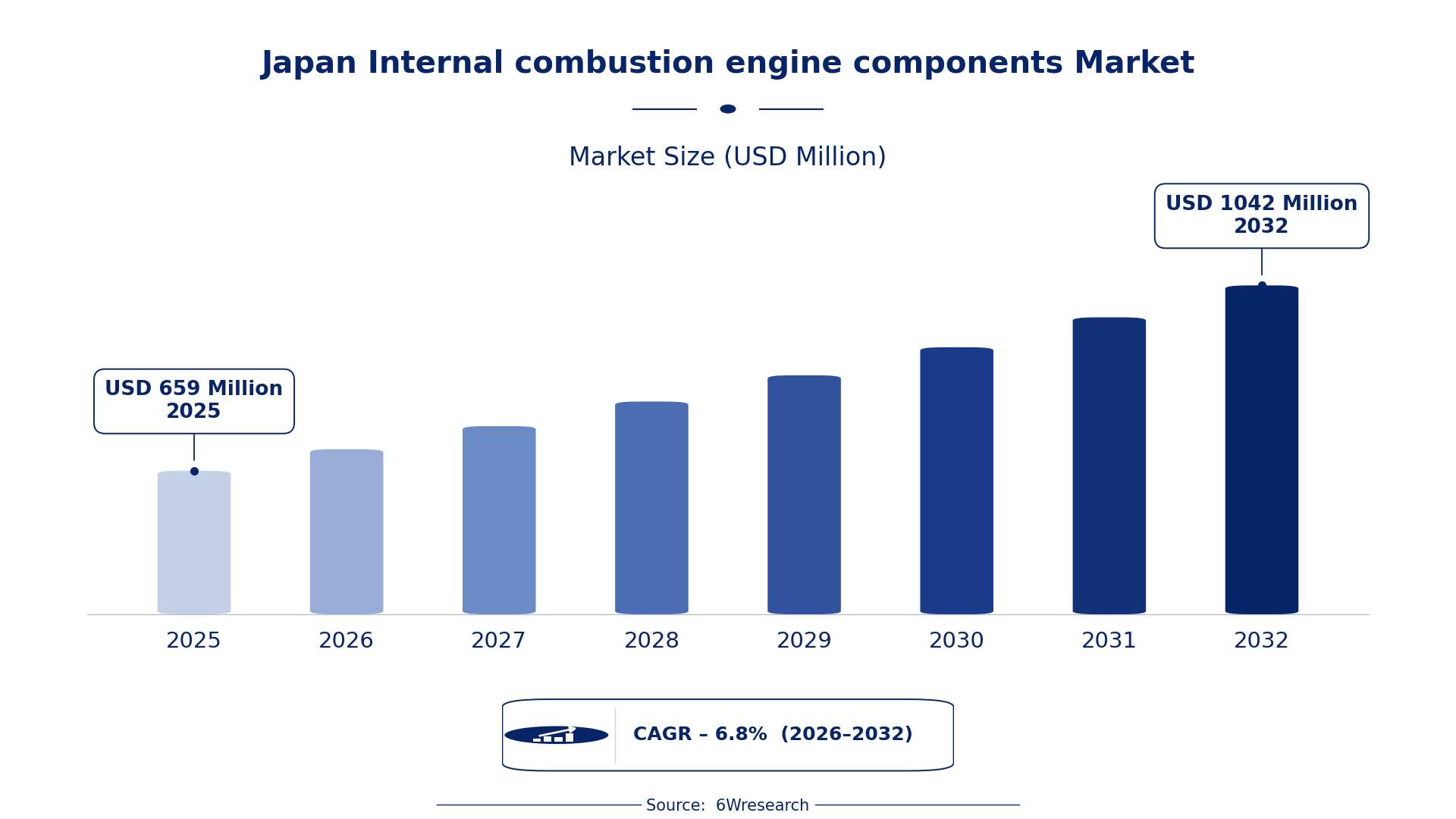
According to 6Wresearch internal database and industry insights, the Japan Internal combustion engine components Market was valued at USD 659 Million in 2025 and is projected to reach USD 1,042 Million by 2032, growing at a CAGR of approximately 6.8% during 2026–2032.
Japan Internal combustion engine components Market Highlights
| Report Metric | Details |
| Report Name | Japan Internal combustion engine components Market (2026-2032) |
| Market Size 2025 | USD 659 Million |
| Market Size 2032 | USD 1,042 Million |
| Absolute Growth 2025–2032 | USD 383 Million |
| CAGR 2026–2032 | 6.8% |
| Peak Annual Growth | 8.3% in 2026 |
| Forecast Period | 2026–2032 |
| Historical Data | 2022–2025 |
| Base Year | 2025 |
| Leading Type, 2025 | Low-speed Engine (44% share) |
| Leading End-Users, 2025 | Automotive (49% share) |
| Leading Fuel, 2025 | Petroleum (57% share) |
| Leading Component Types, 2025 | Cylinder (39% share) |
| Fastest-Growing Type | Medium-speed Engine (9.0% CAGR) |
| Fastest-Growing End-Users | Marine (8.3% CAGR) |
| Fastest-Growing Fuel | Natural Gas (8.9% CAGR) |
| Fastest-Growing Component Types | Piston (9.1% CAGR) |
| Growing Sector | Automotive |
| Key End Users | Automotive manufacturers, marine engine producers, aircraft manufacturers, fuel suppliers |
Japan Internal combustion engine components Market Year-wise Growth Rate and Key Drivers (2022–2032)
This graph illustrates the annual growth rates of the market from 2022 to 2032, highlighting a steady upward trajectory and projected market expansion over the forecast period.
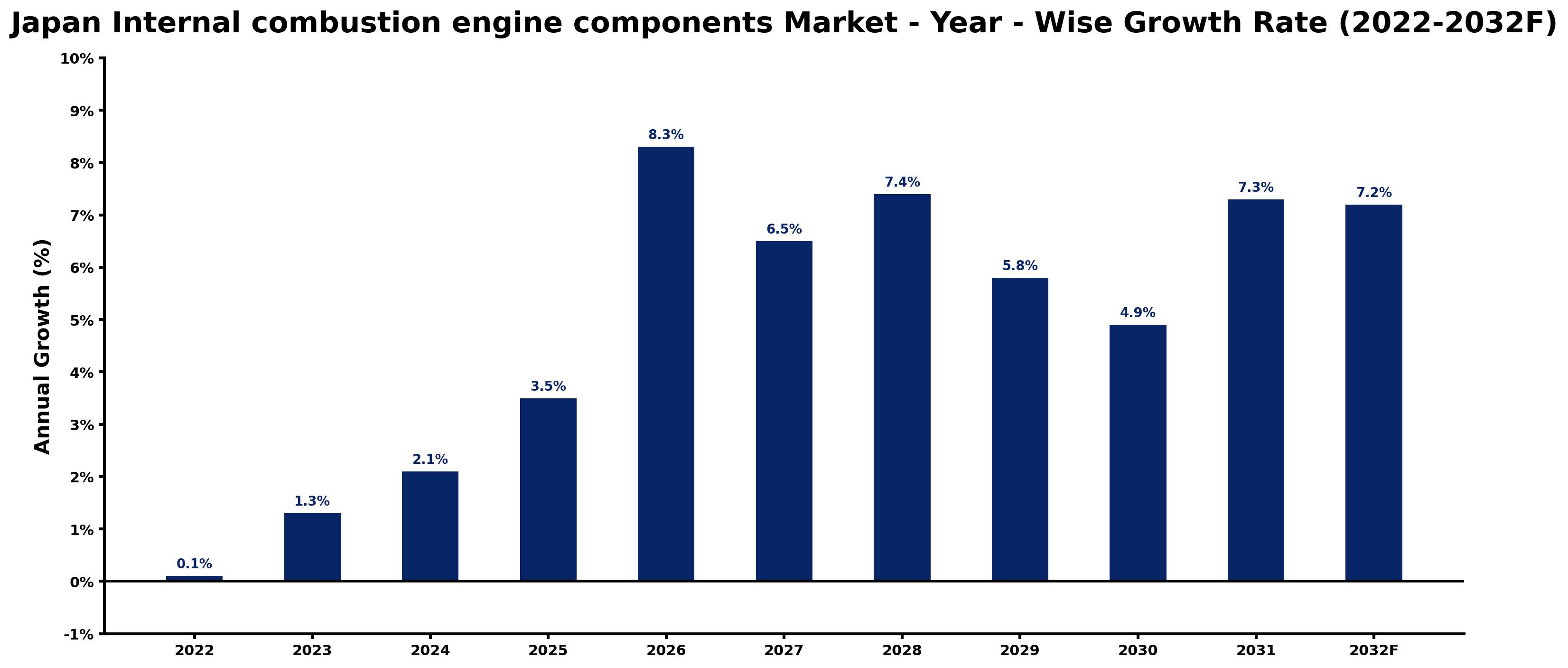
The yearly estimates that follow link every growth rate to its principal driver, so readers can see why the pace changed in each period.
| Year | Estimated Annual Growth (%) | Market Rationale |
| 2022 | 0.1 | The market showed minimal activity with a slight increase in demand. |
| 2023 | 1.3 | Demand rose as automotive production began to recover. |
| 2024 | 2.1 | Growth continued as manufacturers increased output to meet rising consumer needs. |
| 2025 | 3.5 | The automotive sector expanded, driving demand for engine components. |
| 2026 | 8.3 | Demand surged due to heightened vehicle production and technological advancements. |
| 2027 | 6.5 | Growth slowed as production stabilised after the previous year's peak. |
| 2028 | 7.4 | Demand increased again as manufacturers adopted new technologies and standards. |
| 2029 | 5.8 | Growth decelerated as market saturation began to impact new purchases. |
| 2030 | 4.9 | Demand continued to moderate as the market adjusted to previous highs. |
| 2031 | 7.3 | Growth picked up again as innovations in engine technology spurred interest. |
| 2032 | 7.2 | Demand stabilised as the market matured, reflecting consistent buyer needs. |
Note: Market size estimations and growth projections presented in this report are based on 6Wresearch's proprietary forecasting methodology, utilizing the latest available industry data, government publications, and primary research inputs.
Japan Internal combustion engine components Market Synopsis
Internal combustion engine components are mechanical parts that convert fuel into motion, manufactured through casting, machining, and assembly processes. Increased vehicle production, technological advancements, and a focus on eco-friendly engines are boosting demand from domestic users and specialised imports.
Market Dynamics Impact Analysis (2026–2032)
| Factor | Type | Impact | Primary Segment Affected |
| Increased vehicle production and technological advancements in automotive engines | Driver | High | Automotive |
| Growing demand for eco-friendly engine components | Driver | High | Automotive |
| Expansion of marine engine applications due to rising shipping needs | Opportunity | Medium | Marine |
| Investment in low-carbon technologies for engine components | Opportunity | Medium | Automotive |
| High production costs affecting component pricing | Restraint | High | Cylinder |
| Supply chain disruptions impacting component availability | Restraint | High | Piston |
| Competition from alternative fuel technologies limiting market growth | Challenge | Medium | Automotive |
| Aging vehicle fleet leading to slower replacement rates | Challenge | Medium | Automotive |
Evaluation of Drivers in Japan Internal combustion engine components Market (2026–2032)
The main growth drivers and the segments they affect most are set out below.
| Drivers | Primary Segment Affected | Why It Matters (Evidence) |
| Rising vehicle production in Japan | Automotive | Japan produced 4.5 million vehicles in 2022, increasing demand for engine components. |
| Technological advancements in engine efficiency | Automotive | The adoption of ISO 9001 standards improves manufacturing quality, driving component purchases. |
| Growing marine industry requiring reliable engine components | Marine | The Japan Marine Industry Association supports development, boosting demand for marine engines. |
| Shift towards eco-friendly engine technologies | Automotive | The government launched a program in 2023 promoting eco-friendly engines, increasing component demand. |
| Increased investment in infrastructure for vehicle manufacturing | Automotive | Tokyo is a major hub for automotive manufacturing, driving demand for components. |
The strongest pull on demand comes from the automotive sector, which produced 4.5 million vehicles in 2022, leading to increased purchases of internal combustion engine components. The adoption of ISO 9001 standards has improved manufacturing quality, encouraging more buyers to invest in reliable parts. The marine industry is expanding, with support from industry associations, which has heightened demand for marine engine components. Infrastructure investments in Tokyo are facilitating greater production capacity and component purchases.
Evaluation of Restraints in Japan Internal combustion engine components Market
These restraints slow adoption and weigh on supplier margins.
| Market Restraint | Primary Segment Affected | Why It Matters (Evidence) |
| High production costs for engine components | Cylinder | Manufacturers face rising material costs, impacting pricing and demand for cylinders. |
| Supply chain disruptions affecting component availability | Piston | Global supply chain issues have led to delays in piston deliveries, constraining production. |
| Competition from alternative fuel technologies limiting market growth | Automotive | The rise of electric vehicles diverts investment from traditional engine components. |
| Aging vehicle fleet leading to slower replacement rates | Automotive | The average age of vehicles in Japan is 10.5 years, reducing the frequency of component purchases. |
| Regulatory compliance costs for manufacturers | Crankshaft | Compliance with safety regulations increases production costs for crankshaft manufacturers. |
Japan Internal combustion engine components Market Challenges
Sourcing raw materials poses a significant challenge, as disruptions can delay production timelines by up to three months for component manufacturers. Compliance with safety standards set by the Ministry of Land, Infrastructure, Transport and Tourism incurs substantial costs, impacting suppliers' profit margins. Slow technology adoption restricts innovation, forcing producers to rely on outdated processes while competitors invest in advanced manufacturing. Increased competition from foreign manufacturers pressures local producers to lower prices, potentially shrinking profit margins by about 15%, threatening their financial stability.
Trends in the Japan Internal combustion engine components Market
Four trends stand out in the Japan Internal combustion engine components Market.
- Shift towards Eco-friendly Engine Technologies: In 2023, a government program was launched to promote eco-friendly engines, influencing manufacturers to adopt greener technologies. This initiative aims to reduce emissions, with a projected increase in eco-friendly component sales.
- Transition from Traditional to Advanced Engine Components: The automotive industry is increasingly adopting advanced engine components, driven by the need for higher efficiency. Innovations showcased at the Tokyo Motor Show reflect a shift towards more sophisticated designs.
- Emergence of Marine Engine Applications: The marine sector is experiencing growth, with increased demand for reliable engine components. Reports indicate a rise in marine engine production, contributing to component demand.
- Growing Interest in Natural Gas Vehicles: Natural gas vehicles accounted for 1.5% of total vehicle sales in 2022, indicating a shift in fuel preference. This trend is prompting manufacturers to develop compatible engine components.
Investment Opportunities in the Japan Internal combustion engine components Market
The following areas offer the clearest openings for investors and suppliers in the Japan Internal combustion engine components Market.
- Tokyo as a Hub for Automotive Manufacturing: Tokyo's automotive manufacturing facilities are expanding, creating opportunities for suppliers of engine components. With a projected growth of 20% in component demand, partnerships with local manufacturers can facilitate market entry.
- Joint Ventures in Marine Engine Development: Investing in joint ventures with marine manufacturers can tap into the growing demand for engine components. The Japan Marine Industry Association supports such collaborations, encouraging innovation and market growth.
- Focus on Eco-friendly Engine Components: The increasing emphasis on eco-friendly technologies presents opportunities for suppliers of sustainable engine components. Collaborating with automotive manufacturers can facilitate entry into this expanding market.
- Expansion of Natural Gas Infrastructure: The development of natural gas infrastructure is creating demand for compatible engine components. Suppliers can engage with local governments to establish partnerships and meet this growing need.
Government Initiatives in the Japan Internal combustion engine components Market
The Hydrogen Society Promotion Act, enacted in 2024, supports low-carbon hydrogen supply chains, encouraging the production of eco-friendly engine components. This law builds on earlier regulations by providing price-gap support, prompting manufacturers to invest in cleaner technologies.
The Fire Service Act regulates the handling of hazardous materials, ensuring safety standards in the production of internal combustion engine components. Manufacturers must comply with these regulations to ensure safe operations and maintain market access.
Future Insight of the Japan Internal combustion engine components Market
Component buyers will experience changes as the government's initiative to promote eco-friendly engines reshapes production practices. By 2032, the emphasis on ISO 9001 quality standards will lead to more reliable components, enhancing durability for buyers. The Tokyo Motor Show will continue to showcase advancements in engine technology, influencing consumer preferences. With the automotive sector employing over 5 million people, the transition towards electric and hybrid engines will create new opportunities for suppliers to innovate and respond to evolving market demands.
Market Segmentation Analysis
Japan Internal combustion engine components Market report covers a detailed analysis of the following market segments:
By Type – Low-speed Engine Leads, Medium-speed Engine Expected to Grow Fastest
According to Ravi Bhandari, Research Head at 6Wresearch, with 44% of type revenue in 2025, Low-speed Engine was the largest category. The low-speed engine segment holds the largest share due to its widespread application in large vessels and power generation facilities, which are vital for Japan's maritime and energy sectors. For example, Tokyo serves as a significant manufacturing hub for these engines, ensuring a strong installed base. Over 2026–2032, Medium-speed Engine is expected to post the fastest growth, at a CAGR of 9.0%. Medium-speed engines are experiencing rapid growth as they find increasing adoption in marine and industrial applications, indicating a shift towards more efficient engine technologies. The government's recent programme to promote eco-friendly engines further stimulates this demand. Suppliers should prioritise their offerings in medium-speed engines to capitalise on the expanding market.
By End-Users – Automotive Leads, Marine Expected to Grow Fastest
Automotive accounted for 49% of the market by end-users in 2025. The automotive sector leads the market as it is the primary user of engine components, representing 20% of Japan's manufacturing output. The production of 4.5 million vehicles in 2022 underscores the substantial demand from automotive manufacturers. The quickest growth will come from Marine, forecast to expand at a CAGR of 8.3% between 2026 and 2032. The marine segment is growing swiftly due to its significant use in shipping and fishing industries, reflecting Japan's geographical reliance on maritime activities. This growth is further bolstered by initiatives from the Japan Marine Industry Association to advance marine engine development. Buyers in the marine sector should explore diversifying their suppliers to secure access to the latest engine technologies.
By Fuel – Petroleum Leads, Natural Gas Expected to Grow Fastest
In 2025, Petroleum led the fuel split with a 57% share. Petroleum dominates the fuel segment as it is the main fuel type for internal combustion engines, reflecting the traditional reliance on fossil fuels in Japan's automotive industry. The established infrastructure for petroleum fuels further solidifies its leading position. Natural Gas are projected to grow fastest, at a CAGR of 8.9% during 2026–2032. Natural gas is gaining traction as it is increasingly used in alternative fuel engines, driven by a global push towards cleaner energy sources. The government's initiatives to promote eco-friendly engines are also contributing to this growth. Suppliers should invest in natural gas technologies to meet the rising demand for cleaner fuel options.
By Component Types – Cylinder Leads, Piston Expected to Grow Fastest
The largest component types category in 2025 was Cylinder, at 39% of revenue. The cylinder segment dominates the market as it is a critical component for combustion in internal combustion engines, essential for their operation across various applications. This significance is highlighted by the scale of the automotive industry in Japan. Piston is set to record the highest CAGR in this split, 9.1% over 2026–2032. Pistons are experiencing rapid growth as they play a vital role in converting pressure into motion, showcasing advancements in engine design and efficiency. Continuous technological improvements in engine components are expected to sustain this growth trajectory. Manufacturers must concentrate on innovation in piston design to maintain competitiveness in the market.
Key Attractiveness of the Report
- 10 Years of Market Numbers
- Historical Data Starting from 2022 to 2025
- Base Year 2025
- Forecast Data until 2032
- Key Performance Indicators Impacting the Market
- Major Upcoming Developments and Projects
Key Highlights of the Report:
- Japan Internal combustion engine components Market Outlook
- Market Size of Japan Internal combustion engine components Market, 2025
- Forecast of Japan Internal combustion engine components Market, 2032
- Historical Data and Forecast of Japan Internal combustion engine components Revenues & Volume for the Period 2022-2032
- Japan Internal combustion engine components Market Trend Evolution
- Japan Internal combustion engine components Market Drivers and Challenges
- Japan Internal combustion engine components Price Trends
- Japan Internal combustion engine components Porter's Five Forces
- Japan Internal combustion engine components Industry Life Cycle
- Historical Data and Forecast of Japan Internal combustion engine components Market Revenues & Volume By Type for the Period 2022-2032
- Historical Data and Forecast of Japan Internal combustion engine components Market Revenues & Volume By Low-speed Engine for the Period 2022-2032
- Historical Data and Forecast of Japan Internal combustion engine components Market Revenues & Volume By Medium-speed Engine for the Period 2022-2032
- Historical Data and Forecast of Japan Internal combustion engine components Market Revenues & Volume By High-speed Engine for the Period 2022-2032
- Historical Data and Forecast of Japan Internal combustion engine components Market Revenues & Volume By End-Users for the Period 2022-2032
- Historical Data and Forecast of Japan Internal combustion engine components Market Revenues & Volume By Automotive for the Period 2022-2032
- Historical Data and Forecast of Japan Internal combustion engine components Market Revenues & Volume By Marine for the Period 2022-2032
- Historical Data and Forecast of Japan Internal combustion engine components Market Revenues & Volume By Aircraft for the Period 2022-2032
- Historical Data and Forecast of Japan Internal combustion engine components Market Revenues & Volume By Fuel for the Period 2022-2032
- Historical Data and Forecast of Japan Internal combustion engine components Market Revenues & Volume By Petroleum for the Period 2022-2032
- Historical Data and Forecast of Japan Internal combustion engine components Market Revenues & Volume By Natural Gas for the Period 2022-2032
- Historical Data and Forecast of Japan Internal combustion engine components Market Revenues & Volume By Component Types for the Period 2022-2032
- Historical Data and Forecast of Japan Internal combustion engine components Market Revenues & Volume By Cylinder for the Period 2022-2032
- Historical Data and Forecast of Japan Internal combustion engine components Market Revenues & Volume By Piston for the Period 2022-2032
- Historical Data and Forecast of Japan Internal combustion engine components Market Revenues & Volume By Crankshaft for the Period 2022-2032
- Historical Data and Forecast of Japan Internal combustion engine components Market Revenues & Volume By Others for the Period 2022-2032
- Japan Internal combustion engine components Import Export Trade Statistics
- Market Opportunity Assessment By Type
- Market Opportunity Assessment By End-Users
- Market Opportunity Assessment By Fuel
- Market Opportunity Assessment By Component Types
- Japan Internal combustion engine components Top Companies Market Share
- Japan Internal combustion engine components Competitive Benchmarking By Technical and Operational Parameters
- Japan Internal combustion engine components Company Profiles
- Japan Internal combustion engine components Key Strategic Recommendations
Market Covered
The report covers the following segments.
By Type
- Low-speed Engine
- Medium-speed Engine
- High-speed Engine
By End-Users
- Automotive
- Marine
- Aircraft
By Fuel
- Petroleum
- Natural Gas
By Component Types
- Cylinder
- Piston
- Crankshaft
- Others































