Japan Inverter Duty Motor Market Size & Growth Rate
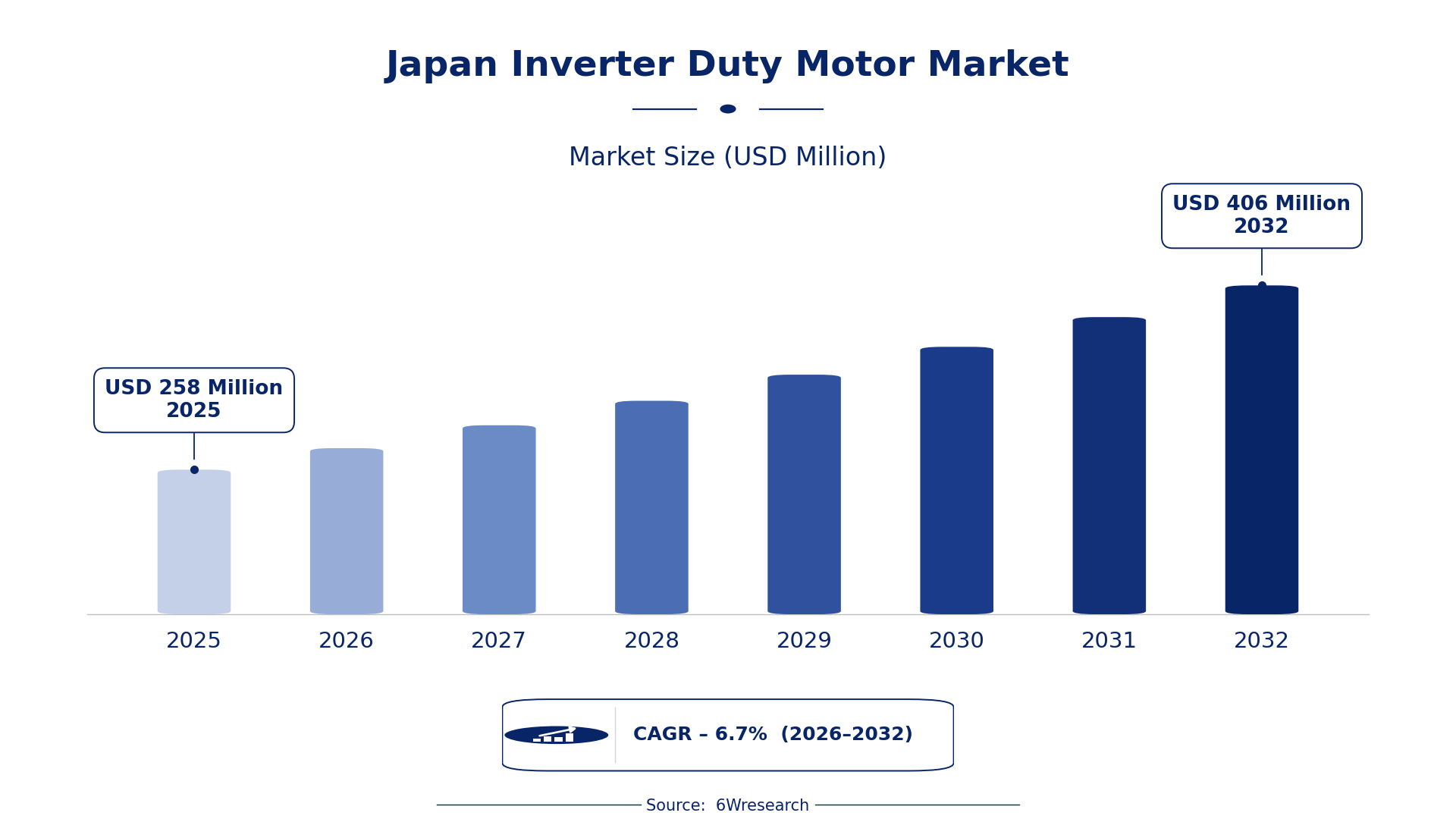
According to 6Wresearch internal database and industry insights, the Japan Inverter Duty Motor Market was valued at USD 258 Million in 2025 and is projected to reach USD 406 Million by 2032, growing at a CAGR of approximately 6.7% during 2026–2032.
Japan Inverter Duty Motor Market Highlights
| Report Metric | Details |
| Report Name | Japan Inverter Duty Motor Market (2026-2032) |
| Market Size 2025 | USD 258 Million |
| Market Size 2032 | USD 406 Million |
| Absolute Growth 2025–2032 | USD 148 Million |
| CAGR 2026–2032 | 6.7% |
| Peak Annual Growth | 8.1% in 2026 |
| Forecast Period | 2026–2032 |
| Historical Data | 2022–2025 |
| Base Year | 2025 |
| Leading Application, 2025 | Pumps (42% share) |
| Leading End-User, 2025 | Food & Beverage (49% share) |
| Leading Construction Material, 2025 | Laminated Steel (46% share) |
| Fastest-Growing End-User | Chemicals (8.8% CAGR) |
| Fastest-Growing Construction Material | Cast Iron (8.9% CAGR) |
| Growing Sector | Food & Beverage |
| Key End Users | Manufacturers, Chemical processors, Food processors, Energy sector |
Japan Inverter Duty Motor Market Year-wise Growth Rate and Key Drivers (2022–2032)
This graph illustrates the annual growth rates of the market from 2022 to 2032, highlighting a steady upward trajectory and projected market expansion over the forecast period.
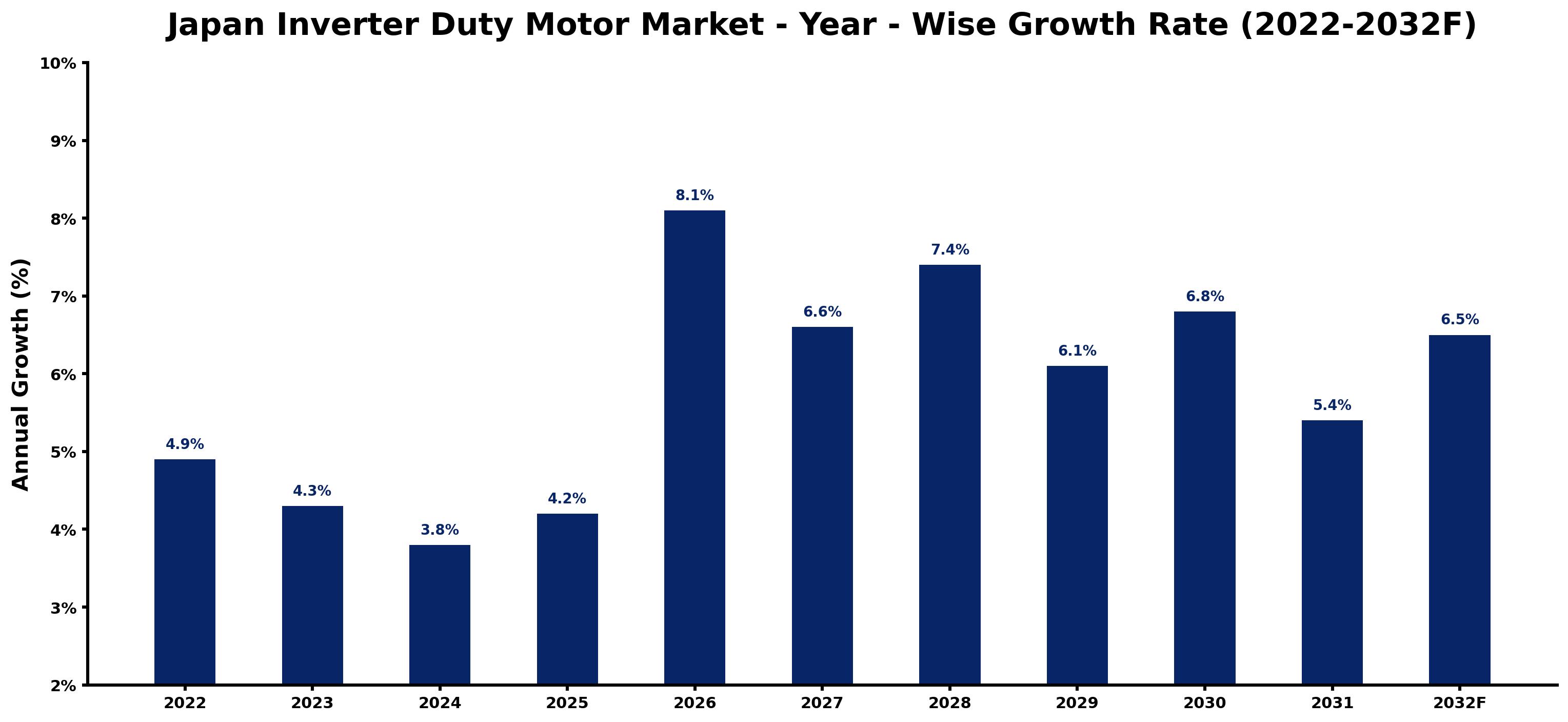
Each row of the following table gives one year's estimated growth and the event or demand shift that explains it.
| Year | Estimated Annual Growth (%) | Market Rationale |
| 2022 | 4.9 | Demand was strong as industries recovered from previous impacts, particularly in manufacturing. |
| 2023 | 4.3 | Growth slowed due to market saturation and increased competition in the industrial motor sector. |
| 2024 | 3.8 | A further slowdown occurred as manufacturers adjusted to changing demand patterns and supply chain issues. |
| 2025 | 4.2 | Growth accelerated as investment in energy-efficient technologies gained traction across sectors. |
| 2026 | 8.1 | Demand surged as the government launched initiatives to improve energy efficiency in industrial motors. |
| 2027 | 6.6 | Growth moderated as the market stabilised after the peak demand period in 2026. |
| 2028 | 7.4 | A rebound in growth was observed as industries resumed expansion plans and increased production. |
| 2029 | 6.1 | Growth slowed again as market maturity set in and competition intensified among manufacturers. |
| 2030 | 6.8 | Demand picked up as technological advancements in motor efficiency attracted new investments. |
| 2031 | 5.4 | Growth decelerated slightly as the market adjusted to previous years' rapid expansion. |
| 2032 | 6.5 | Demand is expected to rise as new projects in energy efficiency come online. |
Note: Market size estimations and growth projections presented in this report are based on 6Wresearch's proprietary forecasting methodology, utilizing the latest available industry data, government publications, and primary research inputs.
Japan Inverter Duty Motor Market Synopsis
Inverter duty motors are electric motors designed for variable speed applications, primarily utilising inverter drives for speed control. These motors are essential in industrial applications such as conveyors, pumps, and fans. The Japan Inverter Duty Motor Market is expanding due to rising demand from the manufacturing sector, which accounted for over 60% of usage in 2022, and the Food & Beverage industry, representing 25% of demand. Government initiatives to promote energy-efficient technologies further stimulate market growth, improving product availability and reliability.
Market Dynamics Impact Analysis (2026–2032)
| Factor | Type | Impact | Primary Segment Affected |
| Rising energy efficiency regulations are pushing manufacturers to adopt inverter duty motors for compliance. | Driver | High | Pumps |
| Increased automation in manufacturing processes is creating demand for advanced motor technologies. | Driver | High | Conveyors |
| The Food & Beverage industry is expanding, increasing the need for efficient motors in processing and packaging. | Opportunity | High | Food & Beverage |
| The chemical processing sector is modernising, requiring upgraded motor solutions for enhanced efficiency. | Opportunity | High | Chemicals |
| Market saturation is limiting growth potential as many industries have already adopted advanced motor technologies. | Restraint | Medium | Fans |
| Intense competition among manufacturers is leading to price wars, affecting profit margins. | Restraint | Medium | Others |
| High initial investment costs for energy-efficient motors can deter smaller manufacturers from upgrading. | Challenge | High | Pumps |
| Supply chain disruptions are causing delays in production and delivery of inverter duty motors. | Challenge | Medium | Conveyors |
Evaluation of Drivers in Japan Inverter Duty Motor Market (2026–2032)
Below are the drivers that matter most for revenue growth, with supporting evidence.
| Drivers | Primary Segment Affected | Why It Matters (Evidence) |
| Increased focus on energy efficiency in manufacturing processes. | Pumps | Over 60% of inverter duty motors are used in manufacturing, driving demand for energy-efficient solutions. |
| Automation in industrial applications is necessitating advanced motor technologies. | Conveyors | The Tokyo metropolitan area is a major hub for automation, boosting demand for inverter duty motors. |
| Expansion in the Food & Beverage sector is driving demand for processing and packaging operations. | Food & Beverage | This industry accounted for 25% of inverter duty motor demand in 2022, increasing purchases. |
| The chemical processing industry is modernising its equipment to improve operational efficiency. | Chemicals | With over 1,000 registered facilities, the sector is adopting new technologies to enhance processes. |
| Investments in infrastructure projects are increasing the need for reliable motor solutions. | Fans | Infrastructure development in Japan is driving demand for efficient ventilation systems. |
Spending rises because the focus on energy efficiency in manufacturing processes is increasing. In 2022, over 60% of inverter duty motors were used in this sector, leading to higher purchases. The chemical processing industry is modernising equipment to improve productivity, further increasing demand. The Food & Beverage sector accounted for 25% of inverter duty motor demand in 2022, reflecting its growth. Investments in infrastructure projects are driving the need for reliable motor solutions, particularly in ventilation systems.
Evaluation of Restraints in Japan Inverter Duty Motor Market
The main factors holding the market back are set out below.
| Market Restraint | Primary Segment Affected | Why It Matters (Evidence) |
| Market saturation is limiting growth potential as many industries have adopted advanced motor technologies. | Fans | This saturation has resulted in a slowdown in new purchases, affecting overall market growth. |
| Intense competition among manufacturers is causing price wars that affect profit margins. | Others | As companies compete aggressively, this can reduce profitability and restrict investment in innovation. |
| High initial investment costs for energy-efficient motors deter smaller manufacturers from upgrading. | Pumps | Smaller firms may struggle to afford the transition to more efficient technologies, limiting market expansion. |
| Supply chain disruptions are causing delays in production and delivery of inverter duty motors. | Conveyors | These disruptions can lead to project delays and increased costs for manufacturers. |
| Regulatory compliance costs can burden manufacturers, impacting their operational budgets. | Food & Beverage | Compliance with energy efficiency regulations requires investment, which can strain financial resources. |
Japan Inverter Duty Motor Market Challenges
Manufacturers in Japan face rising supply chain costs due to limited domestic production of inverter duty motors, inflating prices by up to 15% and straining budgets. Local producers encounter intense competition from imported alternatives, resulting in price wars that can cut profit margins by 10%. Slow adoption of energy-efficient technologies leads to outdated motors that waste 20% more energy, increasing operational costs for users. Buyers must contend with the average lifespan of 15 years, as outdated equipment can incur higher maintenance expenses and cause operational downtime for facilities.
Trends in the Japan Inverter Duty Motor Market
The trends below show where the Japan Inverter Duty Motor Market is heading.
- Government Programme for Energy Efficiency: In 2023, the government launched a programme to improve energy efficiency in industrial motors, targeting a 20% reduction in energy consumption by 2030. This initiative is prompting manufacturers to invest in inverter duty motors.
- Rise in Automation in Manufacturing: In 2022, over 60% of inverter duty motors were used in manufacturing, reflecting a shift towards automation. This trend is driving demand for advanced motor solutions that support automated processes.
- Growing Adoption of ISO 9001 Standards: The adoption of ISO 9001 standards in motor manufacturing is increasing, with approximately 70% of manufacturers compliant. This shift ensures higher quality and reliability in inverter duty motors.
- Expansion of the Food & Beverage Sector: The Food & Beverage industry accounted for 25% of inverter duty motor demand in 2022, reflecting its growth. This sector's expansion is leading to increased investments in processing and packaging technologies.
Investment Opportunities in the Japan Inverter Duty Motor Market
Several openings in the Japan Inverter Duty Motor Market merit attention from investors.
- Timing for Energy-Efficient Upgrades: With the government programme launched in 2023, manufacturers are encouraged to invest in energy-efficient motors. This shift presents an opportunity for suppliers in the Food & Beverage sector, which accounted for 25% of demand.
- Market Gap for Advanced Motor Technologies: The demand for high-efficiency motors is increasing, with a projected rise in market needs. Suppliers can target the chemical processing industry, which is modernising its facilities to improve efficiency.
- Need for Reliable Ventilation Solutions: The growing focus on air quality in industrial settings creates opportunities for suppliers of inverter duty motors. The fan segment requires efficient solutions, especially in the Tokyo metropolitan area.
- Entry through Local Partnerships: Now is an ideal time to enter the market by forming joint ventures with local manufacturers. This approach can facilitate access to the Food & Beverage sector, which is rapidly expanding.
Government Initiatives in the Japan Inverter Duty Motor Market
The Economic Security Promotion Act, enacted in 2022, supports supply-chain resilience for critical products, including inverter duty motors. This law encourages manufacturers to adopt energy-efficient technologies and improve production processes, ultimately benefiting buyers through better product availability and reliability. The PRTR Law requires businesses to report chemical substance releases, ensuring environmental compliance in motor manufacturing.
The Japan Electrical Manufacturers' Association oversees the implementation of various initiatives, including funding for energy efficiency projects. This agency approves programmes aimed at improving the efficiency of industrial motors, providing financial support to manufacturers that adopt new technologies.
Future Insight of the Japan Inverter Duty Motor Market
The introduction of new energy efficiency programmes will encourage buyers to upgrade to advanced inverter duty motors that meet ISO 9001 standards. Smart manufacturing facilities will emerge, driving demand for more sophisticated motor technologies that enhance performance and reliability. Government initiatives will promote energy-efficient motors, potentially reducing energy consumption by 25% across various sectors. Investment in automation within the Tokyo metropolitan area will create a robust market for advanced motor solutions.
Market Segmentation Analysis
Japan Inverter Duty Motor Market report covers a detailed analysis of the following market segments:
By Application – Pumps Lead and Record the Fastest Growth
According to Dhaval Chaurasia, Assistant Manager at 6Wresearch, the largest application category in 2025 was Pumps, at 42% of revenue. Pumps hold the largest market share as they are critical for fluid transport across various industries, including manufacturing and energy. Their essential function in operations within the Tokyo metropolitan area underscores their significance in industrial applications. Pumps are also forecast to expand faster than any other category, at a CAGR of 8.6% over 2026–2032. The pumps segment is experiencing rapid growth due to increased demand for energy-efficient solutions, particularly from a government programme aimed at enhancing industrial motor efficiency. This focus on energy efficiency will likely strengthen pumps' leading position in the market. Suppliers should focus on developing energy-efficient pump technologies to meet the growing market demand.
By End-User – Food & Beverage Leads, Chemicals Expected to Grow Fastest
In 2025, Food & Beverage led the end-user split with a 49% share. The Food & Beverage sector commands the largest share because it is essential for processing and packaging operations, contributing to 25% of inverter duty motor demand in 2022. This strong demand reflects Japan's robust food production capabilities and consumer preferences. Chemicals are projected to grow fastest, at a CAGR of 8.8% during 2026–2032. The Chemicals sector is expanding quickly as inverter duty motors are widely used in mixing and processing equipment, which is vital for operational efficiency. The presence of over 1,000 registered facilities in this sector supports its rapid growth. Buyers in the Chemicals sector should consider investing in advanced motor technologies to enhance their operational efficiency.
By Construction Material – Laminated Steel Leads, Cast Iron Expected to Grow Fastest
Laminated Steel took 46% of construction material revenue in 2025, more than any other category. Laminated Steel leads the market as it is the most prevalent material for motor cores, essential for the efficiency and longevity of inverter duty motors. Its extensive use in motor construction highlights the industry's focus on reliability and performance. Over 2026–2032, Cast Iron is expected to post the fastest growth, at a CAGR of 8.9%. Cast Iron is the fastest-growing material due to its increasing application in housing, which is crucial for enhancing motor durability and heat management. This trend indicates a shift towards more robust materials in motor design. Suppliers need to diversify their material offerings to align with the evolving preferences in motor construction.
Key Attractiveness of the Report
- 10 Years of Market Numbers
- Historical Data Starting from 2022 to 2025
- Base Year 2025
- Forecast Data until 2032
- Key Performance Indicators Impacting the Market
- Major Upcoming Developments and Projects
Key Highlights of the Report:
- Japan Inverter Duty Motor Market Outlook
- Market Size of Japan Inverter Duty Motor Market, 2025
- Forecast of Japan Inverter Duty Motor Market, 2032
- Historical Data and Forecast of Japan Inverter Duty Motor Revenues & Volume for the Period 2022-2032
- Japan Inverter Duty Motor Market Trend Evolution
- Japan Inverter Duty Motor Market Drivers and Challenges
- Japan Inverter Duty Motor Price Trends
- Japan Inverter Duty Motor Porter's Five Forces
- Japan Inverter Duty Motor Industry Life Cycle
- Historical Data and Forecast of Japan Inverter Duty Motor Market Revenues & Volume By Application for the Period 2022-2032
- Historical Data and Forecast of Japan Inverter Duty Motor Market Revenues & Volume By Conveyors for the Period 2022-2032
- Historical Data and Forecast of Japan Inverter Duty Motor Market Revenues & Volume By Pumps for the Period 2022-2032
- Historical Data and Forecast of Japan Inverter Duty Motor Market Revenues & Volume By Fans for the Period 2022-2032
- Historical Data and Forecast of Japan Inverter Duty Motor Market Revenues & Volume By Others for the Period 2022-2032
- Historical Data and Forecast of Japan Inverter Duty Motor Market Revenues & Volume By End-User for the Period 2022-2032
- Historical Data and Forecast of Japan Inverter Duty Motor Market Revenues & Volume By Oil & Gas for the Period 2022-2032
- Historical Data and Forecast of Japan Inverter Duty Motor Market Revenues & Volume By Chemicals for the Period 2022-2032
- Historical Data and Forecast of Japan Inverter Duty Motor Market Revenues & Volume By Metal & Mining for the Period 2022-2032
- Historical Data and Forecast of Japan Inverter Duty Motor Market Revenues & Volume By Food & Beverage for the Period 2022-2032
- Historical Data and Forecast of Japan Inverter Duty Motor Market Revenues & Volume By Others for the Period 2022-2032
- Historical Data and Forecast of Japan Inverter Duty Motor Market Revenues & Volume By Construction Material for the Period 2022-2032
- Historical Data and Forecast of Japan Inverter Duty Motor Market Revenues & Volume By Laminated Steel for the Period 2022-2032
- Historical Data and Forecast of Japan Inverter Duty Motor Market Revenues & Volume By Cast Iron for the Period 2022-2032
- Historical Data and Forecast of Japan Inverter Duty Motor Market Revenues & Volume By Aluminium for the Period 2022-2032
- Japan Inverter Duty Motor Import Export Trade Statistics
- Market Opportunity Assessment By Application
- Market Opportunity Assessment By End-User
- Market Opportunity Assessment By Construction Material
- Japan Inverter Duty Motor Top Companies Market Share
- Japan Inverter Duty Motor Competitive Benchmarking By Technical and Operational Parameters
- Japan Inverter Duty Motor Company Profiles
- Japan Inverter Duty Motor Key Strategic Recommendations
Market Covered
The following segment groups are covered in the report.
By Application
- Conveyors
- Pumps
- Fans
- Others
By End-User
- Oil & Gas
- Chemicals
- Metal & Mining
- Food & Beverage
- Others
By Construction Material
- Laminated Steel
- Cast Iron
- Aluminium































