Japan IoT in Manufacturing Market Size & Growth Rate (2026-2032)
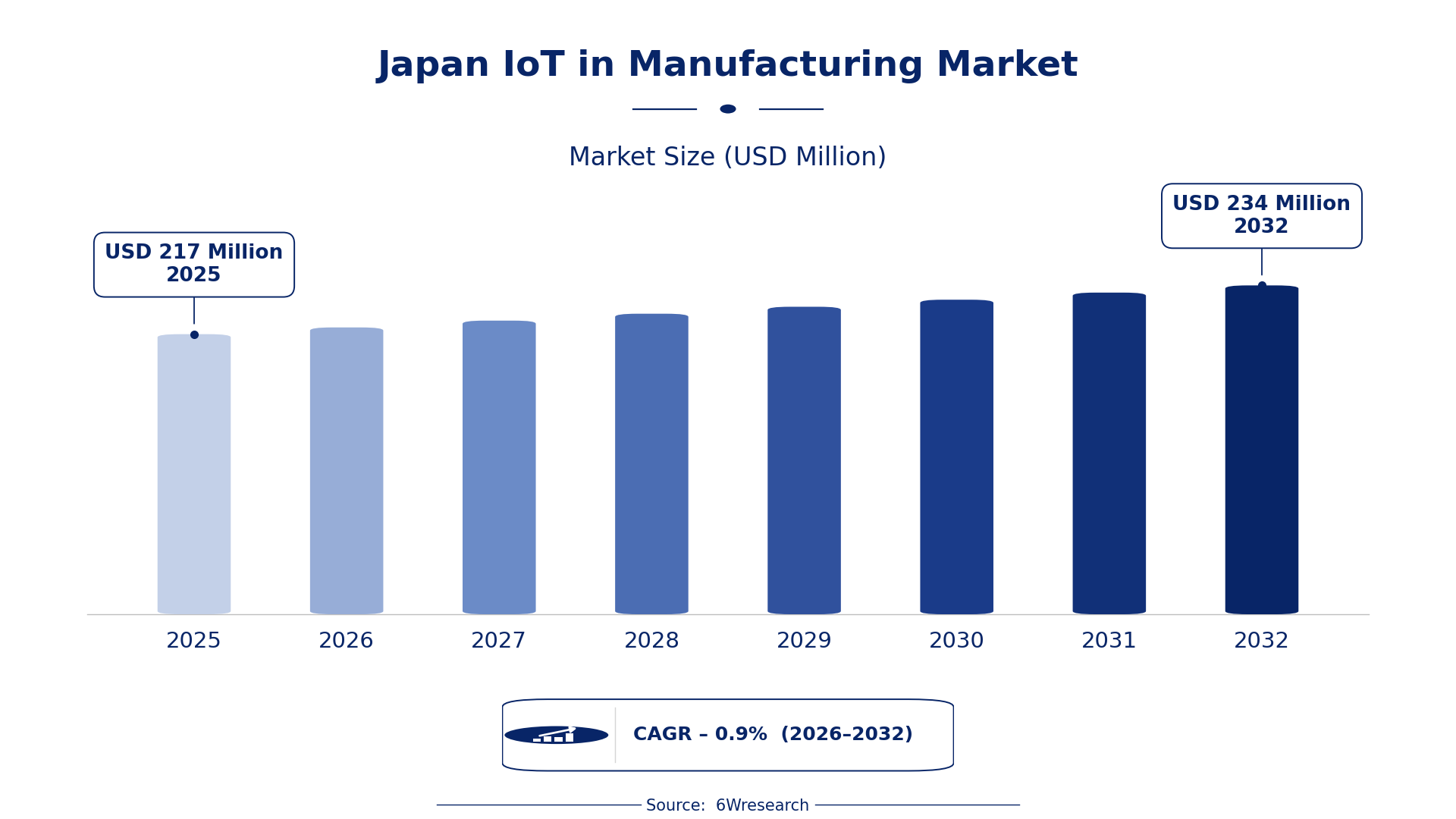
The Japan IoT in Manufacturing Market was estimated at USD 217 Million in 2025 and is projected to reach USD 234 Million by 2032, growing at a CAGR of 0.9% from 2026 to 2032.
Japan IoT in Manufacturing Market Synopsis
The Japan IoT in Manufacturing market is currently undergoing a transformative phase, fueled by the increasing integration of connected technologies across production lines. This momentum, marked by a shift towards automation and real-time data analytics, is reshaping traditional manufacturing practices.
Looking ahead, the market is set to evolve further as manufacturers seek to enhance productivity and operational efficiency. With a strong focus on Industry 4.0, the adoption of IoT solutions is expected to deepen, addressing challenges while unlocking new avenues for growth.
Japan IoT in Manufacturing Market Year-wise Growth Rate and Key Drivers
This graph illustrates the annual growth rates of the Japan IoT in Manufacturing Market from 2021 to 2032, highlighting a steady upward trajectory and projected expansion over the forecast period.
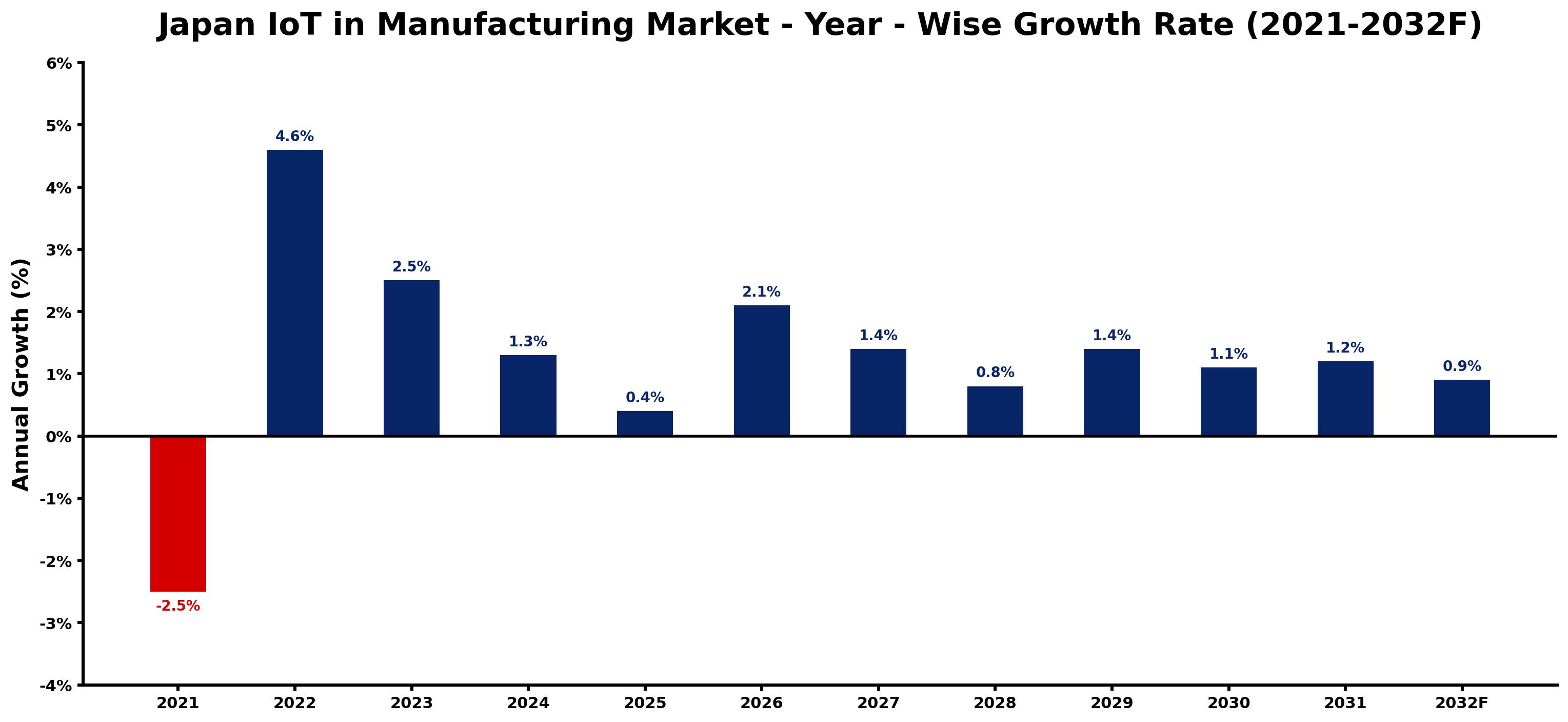
The table below presents the year‑wise growth rates along with the key drivers influencing the market
| Year | Growth Rate | Major Drivers |
| 2021 | -2.5% | Supply chain delays due to global semiconductor shortage. |
| 2022 | 4.6% | Government's 'Manufacturing Renaissance' initiative boosting IoT adoption. |
| 2023 | 2.5% | Increased semiconductor production driving IoT device integration. |
| 2024 | 1.3% | Growing labor shortages prompting automated IoT solutions demand. |
| 2025 | 0.4% | Launch of new 5G networks enhancing IoT connectivity. |
| 2026 | 2.1% | Corporate investments in smart factory technologies rising significantly. |
| 2027 | 1.4% | Focus on improving supply chain visibility through IoT systems. |
| 2028 | 0.8% | Collaboration between manufacturers and startups for IoT innovation. |
| 2029 | 1.4% | Support from METI for Industry 4.0 initiatives in Japan. |
| 2030 | 1.1% | Upgrading legacy systems to IoT-enabled technologies increases. |
| 2031 | 1.2% | Rise in environmental regulations pushing for sustainable IoT practices. |
| 2032 | 0.9% | Increased focus on data analytics capabilities in manufacturing IoT. |
Note: Market size estimations and growth projections presented in this report are based on 6Wresearch's proprietary forecasting methodology, utilizing the latest available industry data, government publications, and primary research inputs.
Japan IoT in Manufacturing Market Key Takeaways
Below are some of the specific key takeaways from the market, including:
- The integration of IoT technologies is crucial for improving operational efficiency in Japanese manufacturing.
- Predictive maintenance and real-time monitoring are key applications driving IoT adoption.
- Government initiatives play a significant role in promoting smart manufacturing practices.
- Cybersecurity measures are increasingly prioritized to safeguard sensitive manufacturing data.
- Investment opportunities abound in IoT platforms and smart factory solutions.
Evaluation of Restraints in Japan IoT in Manufacturing Market
Several factors are limiting the growth of the Japan IoT in Manufacturing market. Interoperability challenges between different IoT devices create significant hurdles for seamless integration. on top of that, concerns surrounding data security are particularly pressing, as manufacturers deal with sensitive information that is critical to operational integrity. The initial capital required for implementing IoT solutions can be daunting, especially for traditional manufacturers who may resist change. Additionally, a shortage of skilled workers proficient in IoT and data analytics further complicates the adoption process.
Japan IoT in Manufacturing Market Trends
The current trend within the Japan IoT in Manufacturing market is the rising emphasis on automation and data-driven decision-making. Companies are increasingly adopting IIoT technologies to streamline operations and enhance productivity. The merging of IoT with advanced technologies like AI and machine learning is noteworthy, enabling manufacturers to optimize quality control and resource allocation.
Additionally, the market is seeing a heightened focus on cybersecurity frameworks as businesses recognize the importance of protecting their IoT infrastructures from potential threats. Such trends indicate a shift towards a more connected and intelligent manufacturing environment.
Japan IoT in Manufacturing Market Opportunities
Investment opportunities in the Japan IoT in Manufacturing market are robust, driven by the push for smart manufacturing and improved operational efficiencies. Key areas for investment include IoT-enabled predictive maintenance systems, smart factory solutions, and supply chain optimization tools. With the government backing initiatives for digital transformation, there is ample potential for investors to engage with technology providers and startups focused on innovative IoT applications tailored for the manufacturing sector.
Government Initiatives in the Japan IoT in Manufacturing Market
The Japanese government is actively supporting the integration of IoT technologies in manufacturing through targeted policies and initiatives. This proactive stance aims to enhance competitiveness and operational efficiency across the sector. By providing regulatory support and financial incentives, the government fosters innovation and collaboration between industry and academic entities.
- The "Connected Industries" initiative, recently launched, seeks to facilitate the adoption of IoT in manufacturing processes.
- A current program under the "Robot Revolution Initiative" focuses on boosting automation technologies linked to IoT applications.
- A planned public-private partnership expected to launch in 2026 aims to enhance connectivity and data sharing across manufacturing firms.
- Subsidies and tax incentives are currently available for businesses investing in IoT solutions, encouraging broader implementation.
Future Insights of the Japan IoT in Manufacturing Market
From 2026 to 2032, the Japan IoT in Manufacturing market is anticipated to witness substantial growth. Manufacturers will continue to leverage IoT technologies to enhance efficiency and productivity while meeting evolving consumer demands. The emphasis on smart factories and predictive maintenance solutions will drive innovation, positioning Japan as a leader in intelligent manufacturing practices. This trajectory, supported by government initiatives and technological advancements, indicates a promising future for the industry.
Japan IoT in Manufacturing Market Latest Developments
In the past year, the Japan IoT in Manufacturing market has seen notable advancements as companies embrace digital transformation. The focus has shifted towards implementing cutting-edge IoT solutions that enhance operational efficiencies and drive productivity gains.
- A leading technology provider launched an IoT-enabled platform in Q3 2025, designed to streamline manufacturing processes and reduce operational costs.
- An ongoing initiative initiated in early 2025 aims to integrate AI and IoT for predictive maintenance across several manufacturing facilities.
- A major collaboration between industry stakeholders is underway, focusing on developing cybersecurity protocols for IoT applications in manufacturing.
- A rollout planned for late 2026 intends to introduce smart factory technologies across various sectors, enhancing connectivity and automation.
Japan IoT in Manufacturing Market - Key Attractiveness of the Report
- 10 Years of Market Numbers
- Historical Data Starting from 2022 to 2025
- Base Year: 2025
- Forecast Data until 2032
- Key Performance Indicators Impacting the Market
- Major Upcoming Developments and Projects
Key Highlights of the Report:
- Japan IoT in Manufacturing Market Outlook
- Market Size of Japan IoT in Manufacturing Market, 2025
- Forecast of Japan IoT in Manufacturing Market, 2032
- Historical Data and Forecast of Japan IoT in Manufacturing Revenues & Volume for the Period 2022-2032F
- Japan IoT in Manufacturing Market Trend Evolution
- Japan IoT in Manufacturing Market Drivers and Challenges
- Japan IoT in Manufacturing Price Trends
- Japan IoT in Manufacturing Porter's Five Forces
- Japan IoT in Manufacturing Industry Life Cycle
- Historical Data and Forecast of Japan IoT in Manufacturing Market Revenues & Volume By Component for the Period 2022-2032F
- Historical Data and Forecast of Japan IoT in Manufacturing Market Revenues & Volume By Solutions Network Management for the Period 2022-2032F
- Historical Data and Forecast of Japan IoT in Manufacturing Market Revenues & Volume By Data Management for the Period 2022-2032F
- Historical Data and Forecast of Japan IoT in Manufacturing Market Revenues & Volume By Vertical for the Period 2022-2032F
- Historical Data and Forecast of Japan IoT in Manufacturing Market Revenues & Volume By Process for the Period 2022-2032F
- Historical Data and Forecast of Japan IoT in Manufacturing Market Revenues & Volume By Discrete for the Period 2022-2032F
- Historical Data and Forecast of Japan IoT in Manufacturing Market Revenues & Volume By Services for the Period 2022-2032F
- Historical Data and Forecast of Japan IoT in Manufacturing Market Revenues & Volume By Professional for the Period 2022-2032F
- Historical Data and Forecast of Japan IoT in Manufacturing Market Revenues & Volume By Managed for the Period 2022-2032F
- Historical Data and Forecast of Japan IoT in Manufacturing Market Revenues & Volume By Application for the Period 2022-2032F
- Historical Data and Forecast of Japan IoT in Manufacturing Market Revenues & Volume By Predictive maintenance for the Period 2022-2032F
- Historical Data and Forecast of Japan IoT in Manufacturing Market Revenues & Volume By Business process optimization for the Period 2022-2032F
- Historical Data and Forecast of Japan IoT in Manufacturing Market Revenues & Volume By Asset tracking and management for the Period 2022-2032F
- Historical Data and Forecast of Japan IoT in Manufacturing Market Revenues & Volume By Logistics and supply chain management for the Period 2022-2032F
- Historical Data and Forecast of Japan IoT in Manufacturing Market Revenues & Volume By Real-time workforce tracking and management for the Period 2022-2032F
- Historical Data and Forecast of Japan IoT in Manufacturing Market Revenues & Volume By Automation control and management for the Period 2022-2032F
- Historical Data and Forecast of Japan IoT in Manufacturing Market Revenues & Volume By Emergency and incident management and business communication for the Period 2022-2032F
- Historical Data and Forecast of Japan IoT in Manufacturing Market Revenues & Volume By Deployment Mode for the Period 2022-2032F
- Historical Data and Forecast of Japan IoT in Manufacturing Market Revenues & Volume By On-premises for the Period 2022-2032F
- Historical Data and Forecast of Japan IoT in Manufacturing Market Revenues & Volume By Cloud for the Period 2022-2032F
- Historical Data and Forecast of Japan IoT in Manufacturing Market Revenues & Volume By Organization Size for the Period 2022-2032F
- Historical Data and Forecast of Japan IoT in Manufacturing Market Revenues & Volume By Small and Medium Enterprises for the Period 2022-2032F
- Historical Data and Forecast of Japan IoT in Manufacturing Market Revenues & Volume By Large Enterprises for the Period 2022-2032F
- Japan IoT in Manufacturing Import Export Trade Statistics
- Market Opportunity Assessment By Component
- Market Opportunity Assessment By Vertical
- Market Opportunity Assessment By Services
- Market Opportunity Assessment By Application
- Market Opportunity Assessment By Deployment Mode
- Market Opportunity Assessment By Organization Size
- Japan IoT in Manufacturing Top Companies Market Share
- Japan IoT in Manufacturing Competitive Benchmarking By Technical and Operational Parameters
- Japan IoT in Manufacturing Company Profiles
- Japan IoT in Manufacturing Key Strategic Recommendations






































