Japan Jellyfish Tank Market Size & Growth Rate
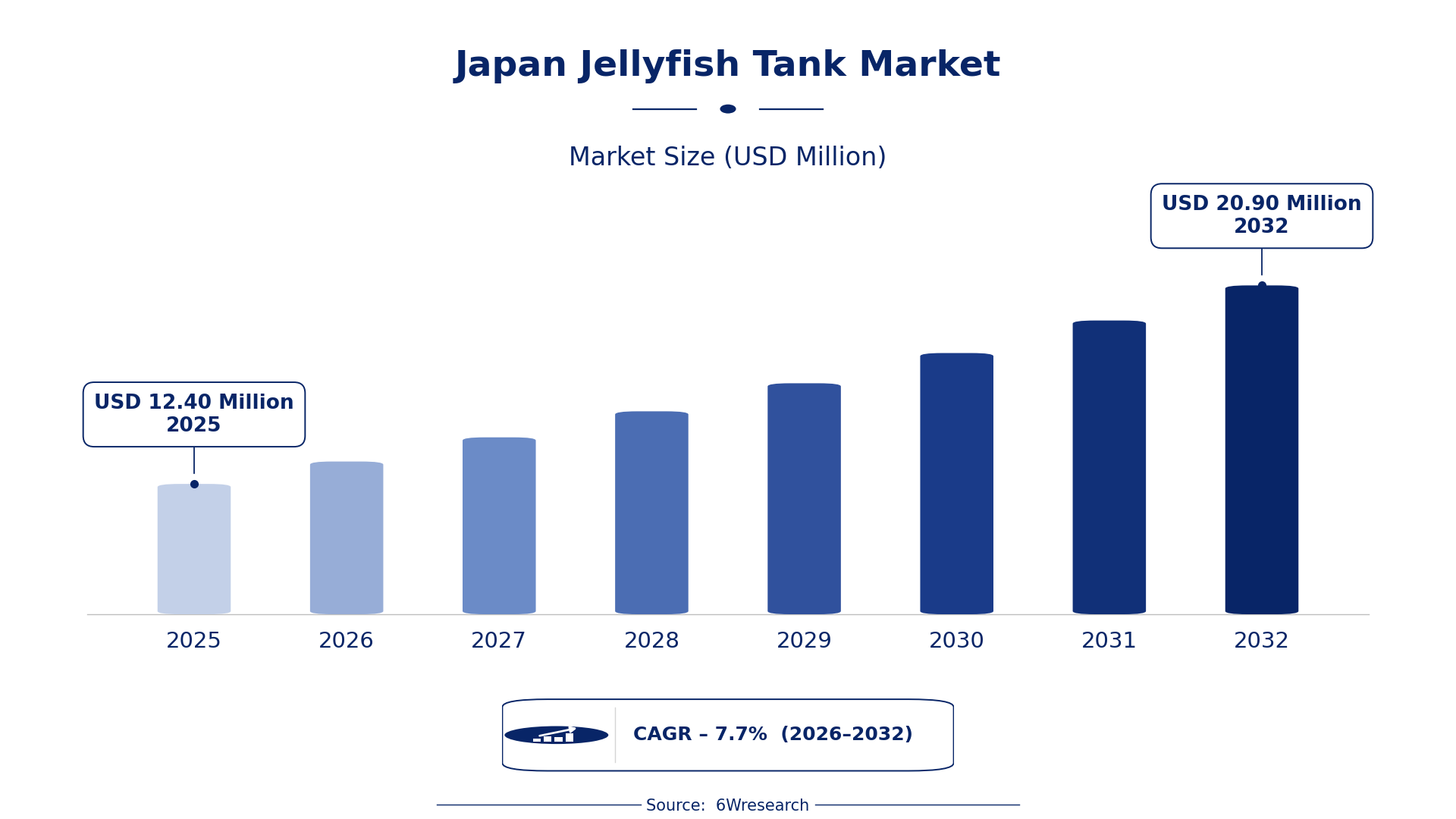
According to 6Wresearch internal database and industry insights, the Japan Jellyfish Tank Market was valued at USD 12.40 Million in 2025 and is projected to reach USD 20.90 Million by 2032, growing at a CAGR of approximately 7.7% during 2026–2032.
Japan Jellyfish Tank Market Highlights
| Report Metric | Details |
| Report Name | Japan Jellyfish Tank Market (2026-2032) |
| Market Size 2025 | USD 12.40 Million |
| Market Size 2032 | USD 20.90 Million |
| Absolute Growth 2025–2032 | USD 8.50 Million |
| CAGR 2026–2032 | 7.7% |
| Peak Annual Growth | 9.6% in 2026 |
| Forecast Period | 2026–2032 |
| Historical Data | 2022–2025 |
| Base Year | 2025 |
| Leading Product Type, 2025 | With LED Light (55% share) |
| Leading Application, 2025 | Household & Office (49% share) |
| Fastest-Growing Product Type | Without LED Light (10.0% CAGR) |
| Fastest-Growing Application | Commercial (9.8% CAGR) |
| Growing Sector | Commercial |
| Key End Users | Household & Office, Commercial |
Japan Jellyfish Tank Market Year-wise Growth Rate and Key Drivers (2022–2032)
This graph illustrates the annual growth rates of the market from 2022 to 2032, highlighting a steady upward trajectory and projected market expansion over the forecast period.
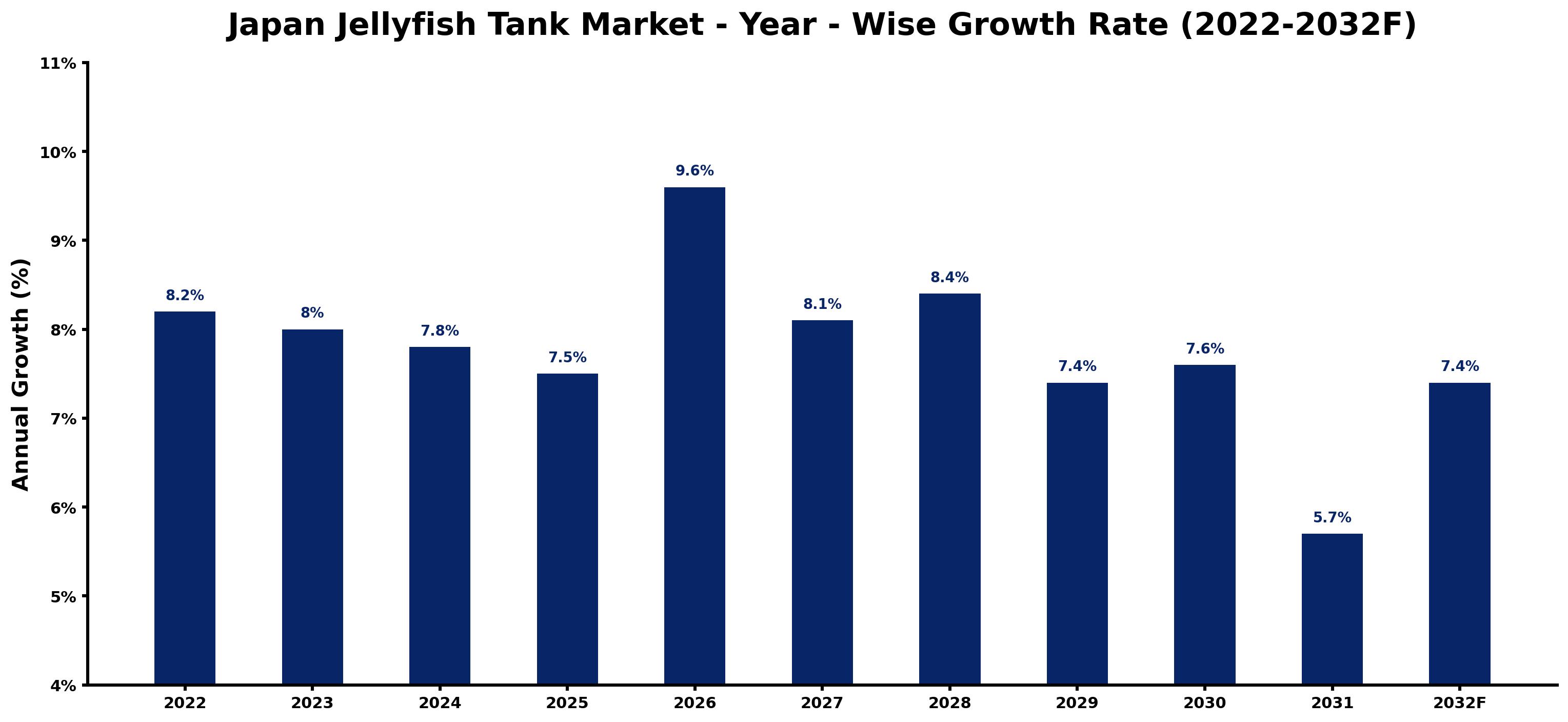
Year by year, the estimates below pair each growth rate with the development that shaped it.
| Year | Estimated Annual Growth (%) | Market Rationale |
| 2022 | 8.2 | The market experienced strong consumer interest in jellyfish tanks for decorative purposes. |
| 2023 | 8.0 | Growth slowed slightly as consumers became more selective with their purchases. |
| 2024 | 7.8 | Interest in jellyfish tanks remained steady, but competition increased among suppliers. |
| 2025 | 7.5 | The market continued to grow, albeit at a slower pace due to market saturation. |
| 2026 | 9.6 | Demand is expected to surge as new aesthetic designs and features attract more buyers. |
| 2027 | 8.1 | Growth is projected to slow as the market begins to stabilise after the peak in 2026. |
| 2028 | 8.4 | Interest is expected to pick up again with appealing designs attracting urban buyers. |
| 2029 | 7.4 | Market growth will slow as economic factors influence consumer spending habits. |
| 2030 | 7.6 | Demand is projected to increase as more households adopt jellyfish tanks for decoration. |
| 2031 | 5.7 | Growth is expected to slow as the market reaches maturity and competition intensifies. |
| 2032 | 7.4 | The market is expected to see renewed interest driven by new educational initiatives. |
Note: Market size estimations and growth projections presented in this report are based on 6Wresearch's proprietary forecasting methodology, utilizing the latest available industry data, government publications, and primary research inputs.
Japan Jellyfish Tank Market Synopsis
Jellyfish tanks are specialised aquariums designed to house jellyfish, utilising unique water flow systems to keep them suspended. Made from acrylic or glass, they often feature LED lighting for aesthetic appeal. The Japan Jellyfish Tank Market is expanding due to rising consumer interest in decorative aquariums, particularly in urban areas like Tokyo and Osaka. The average household adoption rate stands at 2.5%, while commercial settings increasingly prefer LED-equipped tanks, favoured in 60% of cases. This trend is supported by educational programmes promoting marine life awareness, driving consumer engagement and purchases.
Market Dynamics Impact Analysis (2026–2032)
| Factor | Type | Impact | Primary Segment Affected |
| Growing aesthetic appeal of jellyfish tanks | Driver | High | With LED Light |
| Increase in marine education programs | Driver | High | Commercial |
| Rising urban population | Opportunity | High | Household & Office |
| Expansion of public aquariums | Opportunity | Medium | Commercial |
| High initial investment costs | Restraint | High | Without LED Light |
| Limited awareness among potential buyers | Restraint | Medium | Household & Office |
| Competition from alternative decorative aquariums | Challenge | High | With LED Light |
| Economic fluctuations affecting discretionary spending | Challenge | Medium | Commercial |
Evaluation of Drivers in Japan Jellyfish Tank Market (2026–2032)
Key forces behind demand, with the segment each one moves most, are listed below.
| Drivers | Primary Segment Affected | Why It Matters (Evidence) |
| Increased consumer spending on home decor | Household & Office | The average household in Japan has a 2.5% adoption rate of jellyfish tanks, driving demand for aesthetic home features. |
| Popularity of jellyfish in public aquariums | Commercial | Japan has over 100 public aquariums, many featuring jellyfish exhibits, boosting commercial demand. |
| Rising interest in marine education | Commercial | Marine education programs have attracted over 50,000 visitors to exhibitions, increasing demand for tanks. |
| Technological advancements in aquarium design | With LED Light | LED light-equipped tanks are preferred for aesthetic reasons in 60% of commercial settings. |
| Urbanisation leading to smaller living spaces | Household & Office | Jellyfish tanks are popular in urban areas like Tokyo and Osaka, catering to space constraints. |
Spending rises because consumers are increasingly investing in home decor, with the average household adoption rate of jellyfish tanks at 2.5%. Urbanisation drives demand, particularly in cities like Tokyo, where jellyfish tanks are popular. LED light-equipped tanks are preferred in 60% of commercial settings, appealing to buyers seeking aesthetic improvements. Advancements in aquarium design further attract urban consumers looking for unique decorative features.
Evaluation of Restraints in Japan Jellyfish Tank Market
These restraints slow adoption and weigh on supplier margins.
| Market Restraint | Primary Segment Affected | Why It Matters (Evidence) |
| High initial costs of jellyfish tanks | Without LED Light | The average price of a jellyfish tank ranges from 20,000 to 100,000 JPY, limiting accessibility. |
| Limited consumer awareness about jellyfish care | Household & Office | Many potential buyers lack knowledge about maintaining jellyfish, hindering market growth. |
| Regulatory compliance costs for aquarium standards | Commercial | Compliance with standards set by the Japan Aquatic Society can increase operational costs. |
| Competition from alternative aquarium options | With LED Light | Consumers may choose other decorative aquariums, impacting jellyfish tank sales. |
| Economic fluctuations impacting discretionary spending | Commercial | Economic downturns can lead to reduced spending on luxury items like jellyfish tanks. |
Japan Jellyfish Tank Market Challenges
In Japan, sourcing components for jellyfish tanks can be difficult due to a limited number of suppliers, which raises prices between 20,000 and 100,000 JPY, deterring potential buyers in urban areas like Tokyo and Osaka. Competition from cheaper aquarium alternatives leads consumers to choose less specialised options, reducing the market for jellyfish tanks. Buyers also face challenges acquiring jellyfish species like Moon Jellyfish and Pacific Sea Nettle, as strict regulations on marine life can delay their purchases. High maintenance costs associated with jellyfish tanks discourage ownership, resulting in an adoption rate of only 2.5% among households.
Trends in the Japan Jellyfish Tank Market
Below are the shifts with the largest effect on the Japan Jellyfish Tank Market.
- Shift towards LED-equipped tanks: Commercial buyers are increasingly opting for LED light-equipped jellyfish tanks, which improve visibility and aesthetic appeal. In 2023, 60% of commercial settings preferred these tanks, indicating a clear trend towards modernisation.
- Growing interest in marine education: Since 2023, educational institutions have begun incorporating jellyfish tanks in their curricula, fostering marine awareness. Marine education programs have attracted over 50,000 visitors to exhibitions, highlighting their popularity.
- Expansion of public aquariums featuring jellyfish: Public aquariums have expanded their jellyfish exhibits, with over 100 facilities across Japan showcasing these species. This trend has led to increased consumer interest and awareness about jellyfish.
- Rising popularity of jellyfish as decorative elements: Jellyfish tanks are becoming popular decorative elements in urban homes, particularly in Tokyo. The average household adoption rate is now 2.5%, reflecting changing consumer preferences.
Investment Opportunities in the Japan Jellyfish Tank Market
The following areas offer the clearest openings for investors and suppliers in the Japan Jellyfish Tank Market.
- Jellyfish tanks for educational institutions: Investment in jellyfish tanks for educational purposes is increasing, particularly in marine biology programs. With over 100 public aquariums in Japan, institutions can partner with local suppliers to meet this demand.
- LED-equipped jellyfish tanks for commercial settings: The trend towards LED-equipped tanks is growing, with 60% of commercial buyers preferring these models. Suppliers can enter this market by forming joint ventures with local distributors.
- Decorative jellyfish tanks for urban homes: Urbanisation has created a demand for decorative jellyfish tanks, particularly in metropolitan areas. Suppliers should focus on marketing to households in cities like Tokyo, where adoption rates are rising.
- Custom jellyfish tank designs: The increasing popularity of jellyfish tanks opens opportunities for custom designs. Suppliers can invest in unique tank features to attract buyers, especially in urban areas with high demand.
Government Initiatives in the Japan Jellyfish Tank Market
The Industrial Standardization Act, amended in 2019, governs product and test standards for jellyfish tanks, ensuring safety and quality. Compliance with these standards is essential for producers to maintain market access and consumer trust. The Act against Unjustifiable Premiums and Misleading Representations prohibits misleading advertising, protecting consumers and ensuring a fair marketplace for jellyfish tanks.
In 2023, the Government of Japan adopted the GX Basic Policy, aiming for about JPY 150 trillion in public-private decarbonisation investment over 10 years. The Ministry of the Environment oversees programs that promote marine education, benefiting jellyfish tank producers by increasing awareness and demand.
Future Insight of the Japan Jellyfish Tank Market
Investment in marine education programmes will create demand for jellyfish tanks, particularly in public aquariums, which currently exceed 100 in Japan. Standards set by the Japan Aquatic Society will improve tank designs, making them more appealing to buyers. Technological advancements in water flow systems will simplify maintenance, encouraging more consumers to enter the market. The Tokyo Aquarium's recent jellyfish exhibition attracted over 50,000 visitors, indicating a growing interest in jellyfish displays.
Market Segmentation Analysis
Japan Jellyfish Tank Market report covers a detailed analysis of the following market segments:
By Product Type – With LED Light Leads, Without LED Light Expected to Grow Fastest
According to Ravi Bhandari, Research Head at 6Wresearch, with LED Light accounted for 55% of the market by product type in 2025. The sub-segment with LED light-equipped tanks commands the largest share as they are highly sought after in urban areas, where aesthetic appeal is essential. For example, their preference in 60% of commercial settings underscores their popularity for decorative purposes. The quickest growth will come from Without LED Light, forecast to expand at a CAGR of 10.0% between 2026 and 2032. The Without LED Light sub-segment is experiencing rapid growth as it meets the needs of users focused on practical applications, especially in educational environments. Marine education programs promoted by the Ministry of the Environment have increased interest in these functional tanks. Suppliers should diversify their product lines to include both LED and non-LED tanks to cater to varying customer preferences.
By Application – Household & Office Leads, Commercial Expected to Grow Fastest
The largest application category in 2025 was Household & Office, at 49% of revenue. The Household & Office segment leads the market as jellyfish tanks are commonly used for decoration in urban homes and offices. The 2.5% adoption rate among households indicates a steady interest in these aesthetically pleasing aquariums. Commercial is projected to grow fastest, at a CAGR of 9.8% during 2026–2032. The Commercial segment experiences the fastest growth, particularly in restaurants and public aquariums that display jellyfish for visual appeal. The popularity of the recent jellyfish exhibition at the Tokyo Aquarium, which attracted over 50,000 visitors, underscores the rising demand in this area. Suppliers should focus on enhancing the aesthetic features of jellyfish tanks to cater to the growing commercial demand.
Key Attractiveness of the Report
- 10 Years of Market Numbers
- Historical Data Starting from 2022 to 2025
- Base Year 2025
- Forecast Data until 2032
- Key Performance Indicators Impacting the Market
- Major Upcoming Developments and Projects
Key Highlights of the Report:
- Japan Jellyfish Tank Market Outlook
- Market Size of Japan Jellyfish Tank Market, 2025
- Forecast of Japan Jellyfish Tank Market, 2032
- Historical Data and Forecast of Japan Jellyfish Tank Revenues & Volume for the Period 2022-2032
- Japan Jellyfish Tank Market Trend Evolution
- Japan Jellyfish Tank Market Drivers and Challenges
- Japan Jellyfish Tank Price Trends
- Japan Jellyfish Tank Porter's Five Forces
- Japan Jellyfish Tank Industry Life Cycle
- Historical Data and Forecast of Japan Jellyfish Tank Market Revenues & Volume By Product Type for the Period 2022-2032
- Historical Data and Forecast of Japan Jellyfish Tank Market Revenues & Volume By With LED Light for the Period 2022-2032
- Historical Data and Forecast of Japan Jellyfish Tank Market Revenues & Volume By Without LED Light for the Period 2022-2032
- Historical Data and Forecast of Japan Jellyfish Tank Market Revenues & Volume By Application for the Period 2022-2032
- Historical Data and Forecast of Japan Jellyfish Tank Market Revenues & Volume By Household & Office for the Period 2022-2032
- Historical Data and Forecast of Japan Jellyfish Tank Market Revenues & Volume By Commercial for the Period 2022-2032
- Historical Data and Forecast of Japan Jellyfish Tank Market Revenues & Volume By Others for the Period 2022-2032
- Japan Jellyfish Tank Import Export Trade Statistics
- Market Opportunity Assessment By Product Type
- Market Opportunity Assessment By Application
- Japan Jellyfish Tank Top Companies Market Share
- Japan Jellyfish Tank Competitive Benchmarking By Technical and Operational Parameters
- Japan Jellyfish Tank Company Profiles
- Japan Jellyfish Tank Key Strategic Recommendations
Market Covered
The study includes the following segmentation.
By Product Type
- With LED Light
- Without LED Light
By Application
- Household & Office
- Commercial
- Others































