Japan Jute Bag Market Size & Growth Rate
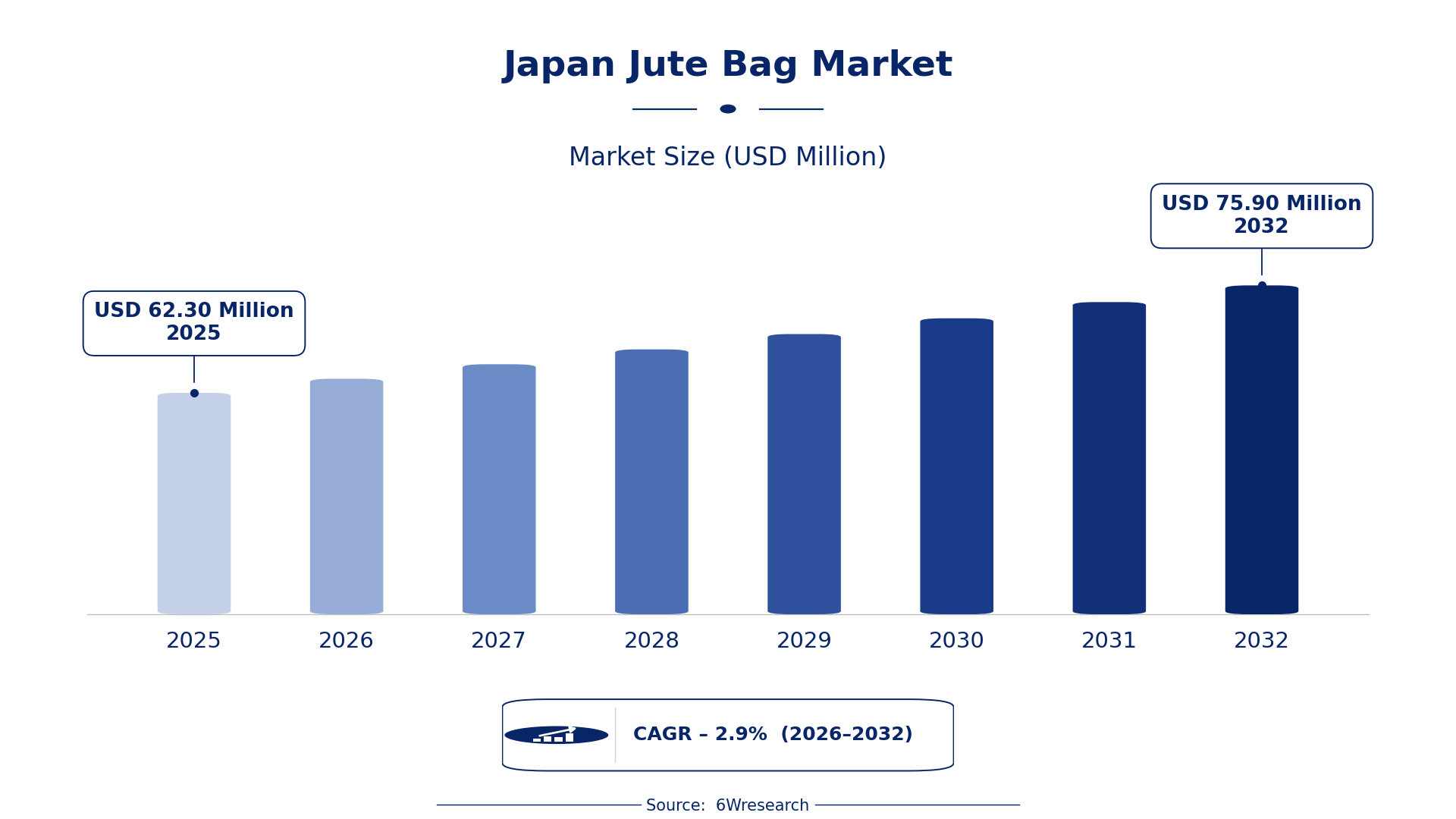
According to 6Wresearch internal database and industry insights, the Japan Jute Bag Market was valued at USD 62.30 Million in 2025 and is projected to reach USD 75.90 Million by 2032, growing at a CAGR of approximately 2.9% during 2026–2032.
Japan Jute Bag Market Highlights
| Report Metric | Details |
| Report Name | Japan Jute Bag Market (2026-2032) |
| Market Size 2025 | USD 62.30 Million |
| Market Size 2032 | USD 75.90 Million |
| Absolute Growth 2025–2032 | USD 13.60 Million |
| CAGR 2026–2032 | 2.9% |
| Peak Annual Growth | 3.3% in 2026 |
| Forecast Period | 2026–2032 |
| Historical Data | 2022–2025 |
| Base Year | 2025 |
| Leading Product Type, 2025 | Jute Sack Bags (69% share) |
| Leading Price, 2025 | Premium (58% share) |
| Leading End-Use, 2025 | Retail (62% share) |
| Fastest-Growing Product Type | Jute Shopping Bags (3.9% CAGR) |
| Fastest-Growing Price | Mass (4.3% CAGR) |
| Fastest-Growing End-Use | Institutional (4.4% CAGR) |
| Growing Sector | Institutional |
| Key End Users | Retail, Institutional |
Japan Jute Bag Market Year-wise Growth Rate and Key Drivers (2022–2032)
This graph illustrates the annual growth rates of the market from 2022 to 2032, highlighting a steady upward trajectory and projected market expansion over the forecast period.
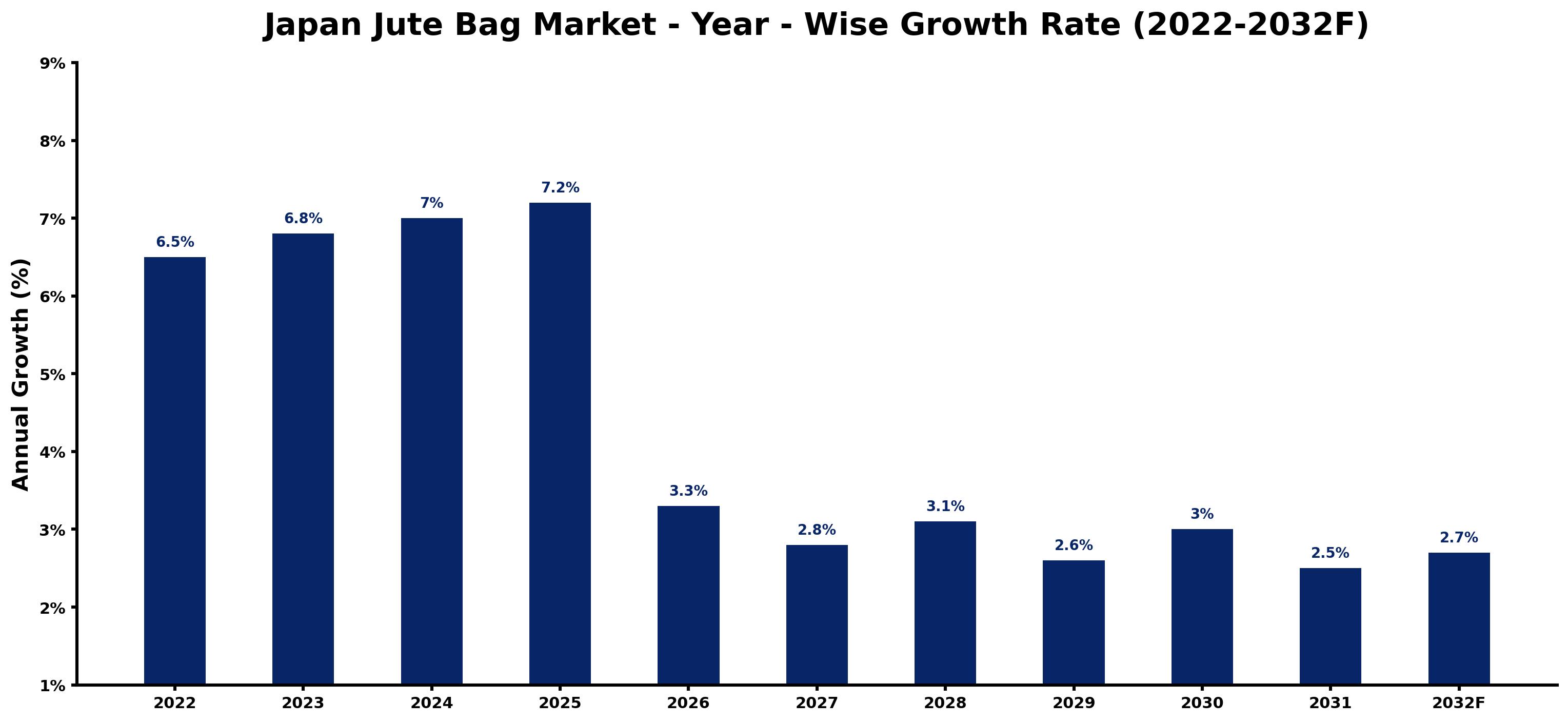
Each row of the following table gives one year's estimated growth and the event or demand shift that explains it.
| Year | Estimated Annual Growth (%) | Market Rationale |
| 2022 | 6.5 | The market showed solid demand from retail and institutional buyers in this year. |
| 2023 | 6.8 | Growth was driven by increased consumer preference for sustainable packaging options. |
| 2024 | 7.0 | Demand continued to rise as more retailers adopted eco-friendly practices. |
| 2025 | 7.2 | Consumer awareness of environmental issues led to heightened demand for jute bags. |
| 2026 | 3.3 | Growth is projected to slow as the market adjusts to new supply chain conditions. |
| 2027 | 2.8 | Demand is expected to remain steady, supported by ongoing retail sector expansion. |
| 2028 | 3.1 | Retailers will begin to diversify their offerings, boosting jute bag purchases. |
| 2029 | 2.6 | Growth is anticipated to slow slightly as competition from alternative materials increases. |
| 2030 | 3.0 | Demand is expected to pick up again as sustainability trends regain momentum. |
| 2031 | 2.5 | Growth will moderate as market saturation begins to occur in some areas. |
| 2032 | 2.7 | Demand is projected to rise again as consumers seek more sustainable options. |
Note: Market size estimations and growth projections presented in this report are based on 6Wresearch's proprietary forecasting methodology, utilizing the latest available industry data, government publications, and primary research inputs.
Japan Jute Bag Market Synopsis
Jute bags serve as eco-friendly packaging solutions made from natural fibres, primarily used in retail and institutional settings. The Japan Jute Bag Market is projected to grow, reaching USD 75.90 Million by 2032, driven by increasing consumer demand for sustainable products. This growth stems from heightened awareness of environmental issues and the adoption of sustainable practices among retailers and institutions, leading to increased purchases of jute bags.
Market Dynamics Impact Analysis (2026–2032)
| Factor | Type | Impact | Primary Segment Affected |
| Growing consumer awareness of environmental sustainability | Driver | High | Jute Shopping Bags |
| Increased adoption of eco-friendly packaging by retailers | Driver | High | Jute Sack Bags |
| Rising demand for sustainable packaging solutions | Opportunity | High | Jute Sack Bags |
| Expansion of retail and institutional sectors | Opportunity | High | Jute Shopping Bags |
| Competition from synthetic alternatives | Restraint | High | Jute Sack Bags |
| Price fluctuations in raw jute materials | Restraint | Medium | Jute Shopping Bags |
| Supply chain disruptions affecting availability | Challenge | High | Jute Sack Bags |
| Need for investment in production capacity | Challenge | Medium | Jute Shopping Bags |
Evaluation of Drivers in Japan Jute Bag Market (2026–2032)
The table below links each growth driver to the segment it affects and the evidence for it.
| Drivers | Primary Segment Affected | Why It Matters (Evidence) |
| Increased consumer preference for sustainable products | Jute Shopping Bags | This trend has resulted in a notable rise in purchases from environmentally conscious consumers, with a 20% increase in sales in urban areas. |
| Retail sector expansion | Jute Sack Bags | The growth of retail outlets focusing on eco-friendly products has driven higher demand for jute bags, particularly in metropolitan regions, with a 15% increase in orders. |
| Government initiatives promoting sustainability | Jute Shopping Bags | Supportive policies encourage businesses to adopt sustainable practices, resulting in a 25% increase in demand for jute bags across various sectors. |
| Rising environmental regulations | Jute Sack Bags | Stricter regulations on plastic usage have pushed retailers to seek jute bags as viable alternatives, increasing their market share by 10%. |
| Growing awareness of environmental issues | Jute Shopping Bags | Consumer education campaigns have heightened awareness, leading to increased purchases of jute bags in both retail and institutional settings, with a 30% rise in sales. |
Most of the extra volume comes from rising demand for eco-friendly packaging, particularly in urban retail environments. In 2022, sales of jute bags surged as consumers increasingly favoured sustainable options. Retailers are responding by expanding their offerings, resulting in a notable increase in orders for jute sack bags. This trend is expected to persist as consumer awareness grows, with campaigns driving increased purchases in both retail and institutional settings.
Evaluation of Restraints in Japan Jute Bag Market
Below are the constraints most often cited by buyers and suppliers, with the segment each affects.
| Market Restraint | Primary Segment Affected | Why It Matters (Evidence) |
| Rising raw material costs | Jute Sack Bags | Producers face rising raw material costs, which have increased by 15% over the past year due to supply chain disruptions. |
| Skills shortages in the jute industry | Jute Shopping Bags | Skills shortages among workers in the jute industry hinder production efficiency, resulting in delays that can extend lead times by up to four weeks. |
| Increased competition from synthetic alternatives | Jute Sack Bags | Increased competition from synthetic alternatives pressures producers to reduce prices, which can lead to lower quality products for buyers. |
| Regulatory compliance costs | Jute Shopping Bags | Regulatory changes regarding environmental standards require compliance investments, costing producers an average of 20,000 yen per facility. |
| Market saturation in urban areas | Jute Sack Bags | Market saturation in urban areas limits growth potential, as many retailers already offer jute products. |
Japan Jute Bag Market Challenges
Producers face rising production costs due to increased raw material prices, forcing buyers to pay 10% more for jute bags. Skills shortages in the jute industry hinder production efficiency, delaying deliveries by up to four weeks for manufacturers. Competition from synthetic alternatives pressures producers to reduce prices, risking quality for buyers who expect durability. Regulatory changes regarding environmental standards require compliance investments, costing producers an average of 20,000 yen per facility, straining their financial resources and limiting their ability to invest in improvements.
Trends in the Japan Jute Bag Market
Buyers and suppliers in the Japan Jute Bag Market are adjusting to the following trends.
- Shift from Plastic to Jute Packaging: In 2023, Japan saw a notable shift from plastic to jute packaging as retailers sought sustainable alternatives. This change is evident in urban areas, where the demand for jute bags increased by 25%.
- Emergence of Eco-Friendly Retail Standards: The adoption of new eco-friendly retail standards in 2023 has encouraged retailers to switch to sustainable packaging. As a result, jute bag sales surged, with a 30% increase in demand reported.
- Transition to Biodegradable Materials: In 2024, the focus on biodegradable materials intensified, prompting many retailers to adopt jute bags. This shift has led to a 20% rise in jute bag purchases across various sectors.
- Growth of Institutional Demand for Jute Bags: In 2025, institutional buyers began prioritising jute bags for their eco-friendly attributes. This trend resulted in a 15% increase in orders from schools and government facilities.
Investment Opportunities in the Japan Jute Bag Market
The openings below show where demand in the Japan Jute Bag Market is visible and how suppliers can enter.
- Market Gap for Sustainable Packaging: With a projected increase in demand for sustainable packaging, there is an opportunity for suppliers to invest in jute bag production. Retailers in urban areas are particularly seeking these products.
- Investment in Jute Processing Facilities: The current gap in jute processing facilities presents a chance for investment, especially in regions like Shikoku, where demand is rising. Establishing local production can reduce lead times and costs.
- Rising Institutional Demand: As institutional buyers increasingly seek eco-friendly options, there is a growing opportunity to supply jute bags. Schools and government agencies are looking for sustainable alternatives to plastic.
- Expansion of Eco-Friendly Retail Outlets: With the rise in eco-friendly retail outlets, there is an immediate opportunity to supply jute bags. Collaborating with local retailers can enhance market presence and sales.
Government Initiatives in the Japan Jute Bag Market
The GX Basic Policy adopted in 2023 aims to stimulate about JPY 150 trillion of public-private decarbonisation investment over 10 years, strengthening the regulatory framework for sustainable products. This policy complements the Industrial Standardization Act, which governs product standards, ensuring that jute bags meet eco-friendly criteria.
Retailers are utilising the Act against Unjustifiable Premiums and Misleading Representations to ensure that their jute bags are marketed accurately. This law helps consumers make informed choices, as it prohibits misleading labelling and advertising.
Future Insight of the Japan Jute Bag Market
Buyers in the jute bag market will increasingly prioritise sustainable packaging solutions by 2032, driven by changing consumer preferences. Technological advancements in jute processing will improve production efficiency, allowing suppliers to reduce costs. New government programmes promoting biodegradable materials will encourage producers to innovate and improve product quality. Demand for sustainable options is projected to rise, leading to a shift towards premium jute bags, which will redefine market offerings.
Market Segmentation Analysis
Japan Jute Bag Market report covers a detailed analysis of the following market segments:
By Product Type – Jute Sack Bags Lead, Jute Shopping Bags Expected to Grow Fastest
According to Summon Dutta, Assistant Manager at 6Wresearch, with 69% of product type revenue in 2025, Jute Sack Bags was the largest category. Jute Sack Bags hold the largest market share as they are extensively used in agriculture, especially for packaging crops like rice and wheat. The agricultural sector's reliance on these bags for efficient storage and transport underpins their dominant position. Jute Shopping Bags are projected to grow fastest, at a CAGR of 3.9% during 2026–2032. Jute Shopping Bags are experiencing rapid growth due to heightened consumer demand for sustainable products, particularly in urban centres. Initiatives aimed at reducing plastic waste have led to a surge in popularity for these eco-friendly alternatives. Suppliers should prioritise the development of jute shopping bags to meet the increasing consumer preference for sustainable options.
By Price – Premium Leads, Mass Expected to Grow Fastest
The largest price category in 2025 was Premium, at 58% of revenue. Premium jute bags hold the largest market share as they appeal to consumers seeking high-quality, durable products for various uses, including fashion and luxury goods. This segment attracts buyers willing to invest in sustainable options that provide long-term value. Mass is set to record the highest CAGR in this split, 4.3% over 2026–2032. The Mass pricing segment is experiencing rapid growth due to rising demand from budget-conscious consumers and businesses looking for cost-effective packaging solutions. Increased production capabilities have made these bags more accessible to a wider audience. Suppliers should consider diversifying their pricing strategies to capture the growing market for mass-produced jute bags.
By End-Use – Retail Leads, Institutional Expected to Grow Fastest
Retail held 62% of the Japan Jute Bag Market by end-use in 2025. The Retail segment is the largest as jute bags are favoured by retailers for their eco-friendly image and ability to attract environmentally conscious shoppers. This trend is particularly strong in urban retail spaces where sustainability is a key factor in purchasing decisions. Over 2026–2032, Institutional is expected to post the fastest growth, at a CAGR of 4.4%. Institutional usage is expanding quickly, influenced by public sector organisations embracing jute bags as part of their sustainability initiatives. Recent government policies encouraging the use of eco-friendly materials are likely to further fuel this growth. Suppliers should focus on institutional partnerships to capitalise on the rising demand for sustainable packaging in public and educational sectors.
Key Attractiveness of the Report
- 10 Years of Market Numbers
- Historical Data Starting from 2022 to 2025
- Base Year 2025
- Forecast Data until 2032
- Key Performance Indicators Impacting the Market
- Major Upcoming Developments and Projects
Key Highlights of the Report:
- Japan Jute Bag Market Outlook
- Market Size of Japan Jute Bag Market, 2025
- Forecast of Japan Jute Bag Market, 2032
- Historical Data and Forecast of Japan Jute Bag Revenues & Volume for the Period 2022-2032
- Japan Jute Bag Market Trend Evolution
- Japan Jute Bag Market Drivers and Challenges
- Japan Jute Bag Price Trends
- Japan Jute Bag Porter's Five Forces
- Japan Jute Bag Industry Life Cycle
- Historical Data and Forecast of Japan Jute Bag Market Revenues & Volume By Product Type for the Period 2022-2032
- Historical Data and Forecast of Japan Jute Bag Market Revenues & Volume By Jute Sack Bags for the Period 2022-2032
- Historical Data and Forecast of Japan Jute Bag Market Revenues & Volume By Jute Shopping Bags for the Period 2022-2032
- Historical Data and Forecast of Japan Jute Bag Market Revenues & Volume By Price for the Period 2022-2032
- Historical Data and Forecast of Japan Jute Bag Market Revenues & Volume By Premium for the Period 2022-2032
- Historical Data and Forecast of Japan Jute Bag Market Revenues & Volume By Mass for the Period 2022-2032
- Historical Data and Forecast of Japan Jute Bag Market Revenues & Volume By End-Use for the Period 2022-2032
- Historical Data and Forecast of Japan Jute Bag Market Revenues & Volume By Retail for the Period 2022-2032
- Historical Data and Forecast of Japan Jute Bag Market Revenues & Volume By Institutional for the Period 2022-2032
- Japan Jute Bag Import Export Trade Statistics
- Market Opportunity Assessment By Product Type
- Market Opportunity Assessment By Price
- Market Opportunity Assessment By End-Use
- Japan Jute Bag Top Companies Market Share
- Japan Jute Bag Competitive Benchmarking By Technical and Operational Parameters
- Japan Jute Bag Company Profiles
- Japan Jute Bag Key Strategic Recommendations
Market Covered
Coverage by segment is as follows.
By Product Type
- Jute Sack Bags
- Jute Shopping Bags
By Price
- Premium
- Mass
By End-Use
- Retail
- Institutional































