Japan K-12 Online Tutoring Market Size & Growth Rate
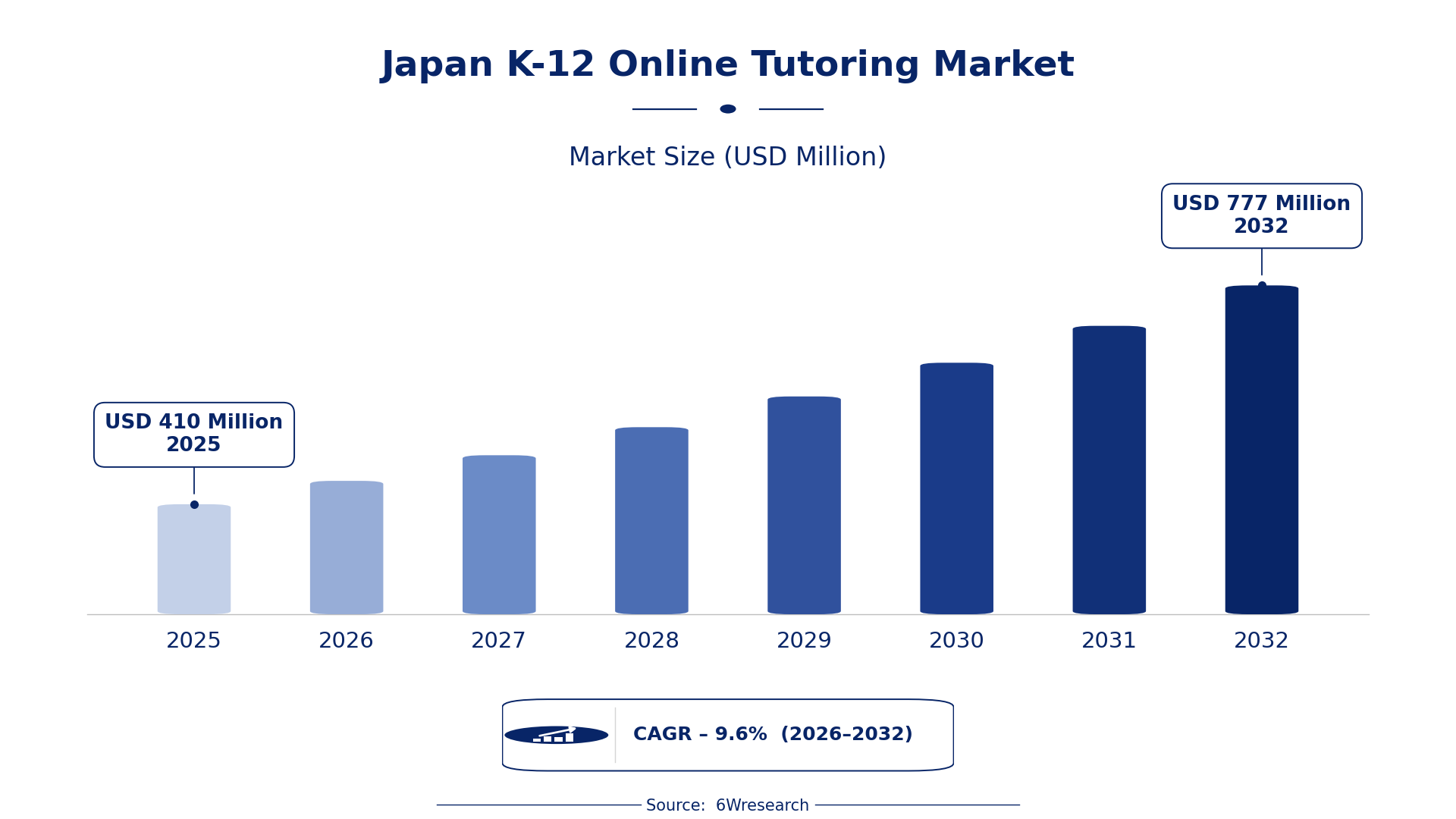
According to 6Wresearch internal database and industry insights, the Japan K-12 Online Tutoring Market was valued at USD 410 Million in 2025 and is projected to reach USD 777 Million by 2032, growing at a CAGR of approximately 9.6% during 2026–2032.
Japan K-12 Online Tutoring Market Highlights
| Report Metric | Details |
| Report Name | Japan K-12 Online Tutoring Market (2026-2032) |
| Market Size 2025 | USD 410 Million |
| Market Size 2032 | USD 777 Million |
| Absolute Growth 2025–2032 | USD 367 Million |
| CAGR 2026–2032 | 9.6% |
| Peak Annual Growth | 10.0% in 2032 |
| Forecast Period | 2026–2032 |
| Historical Data | 2022–2025 |
| Base Year | 2025 |
| Leading Type, 2025 | Primary School (40% share) |
| Leading Application, 2025 | English Courses (36% share) |
| Fastest-Growing Type | Pre-Kindergarten (13.7% CAGR) |
| Fastest-Growing Application | STEM Courses (12.7% CAGR) |
| Growing Sector | K-12 Online Education |
| Key End Users | Parents, Students, Educational Institutions, Tutors |
Japan K-12 Online Tutoring Market Year-wise Growth Rate and Key Drivers (2022–2032)
This graph illustrates the annual growth rates of the market from 2022 to 2032, highlighting a steady upward trajectory and projected market expansion over the forecast period.
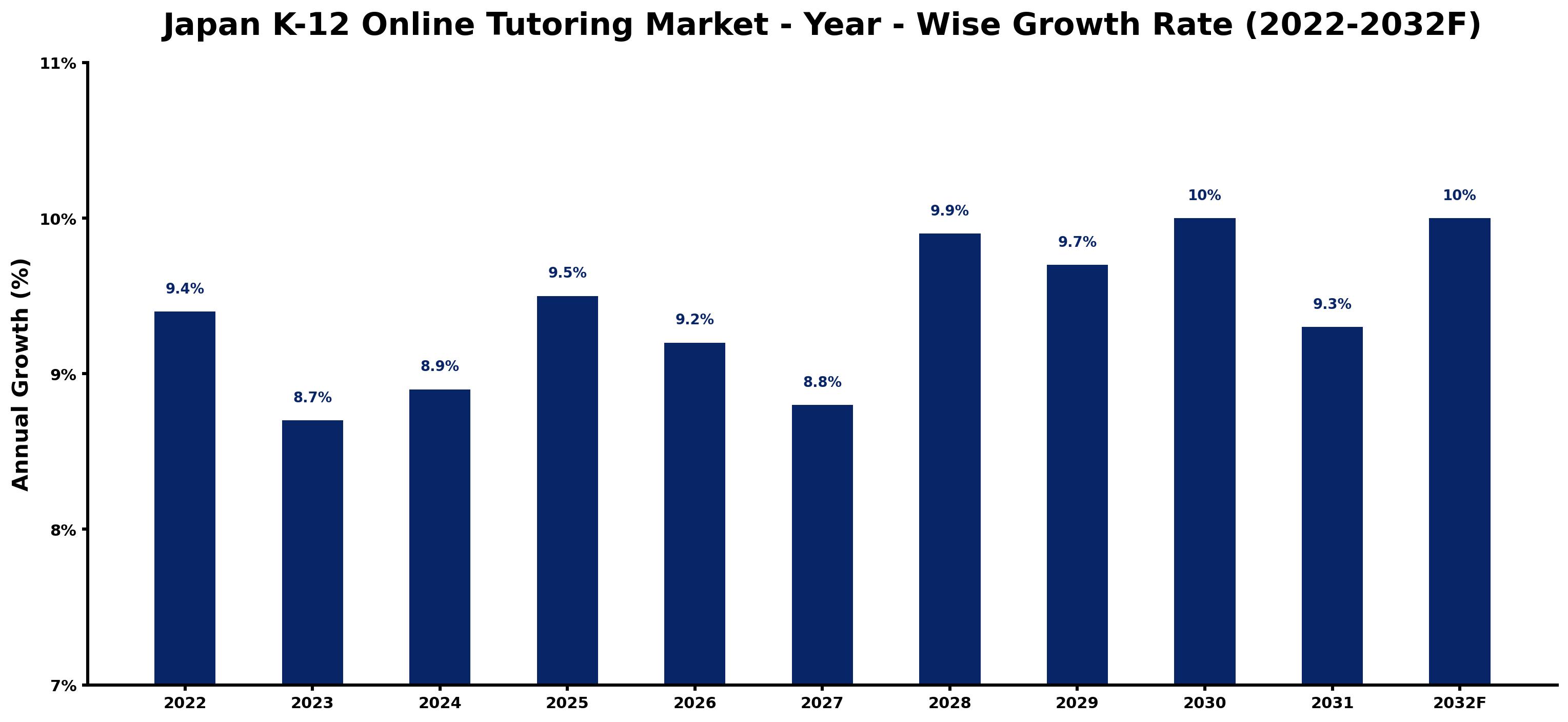
The yearly estimates that follow link every growth rate to its principal driver, so readers can see why the pace changed in each period.
| Year | Estimated Annual Growth (%) | Market Rationale |
| 2022 | 9.4 | The market experienced solid growth due to increasing interest in online education. |
| 2023 | 8.7 | Growth slowed as the market adjusted to evolving educational needs. |
| 2024 | 8.9 | Demand picked up again as more families recognised the benefits of online tutoring. |
| 2025 | 9.5 | The market saw growth driven by rising enrolments in online platforms. |
| 2026 | 9.2 | Growth is expected to slow as market saturation begins to affect new enrolments. |
| 2027 | 8.8 | Demand will continue to slow as competition intensifies among tutoring providers. |
| 2028 | 9.9 | The market is projected to rebound with renewed interest in online learning methodologies. |
| 2029 | 9.7 | Growth is expected to slow slightly as the market matures and choices expand. |
| 2030 | 10.0 | The market will peak as technology integration in education reaches new heights. |
| 2031 | 9.3 | Growth is projected to slow again as the market stabilises after rapid expansion. |
| 2032 | 10.0 | The market is expected to grow rapidly as digital education becomes mainstream. |
Note: Market size estimations and growth projections presented in this report are based on 6Wresearch's proprietary forecasting methodology, utilizing the latest available industry data, government publications, and primary research inputs.
Japan K-12 Online Tutoring Market Synopsis
K-12 Online Tutoring provides digital educational services for students from kindergarten to high school, utilising software development and content creation. The Japan K-12 Online Tutoring Market is expanding, driven by 8 million school-aged children and a 30% increase in online platforms since 2020. The shift towards flexible learning options, supported by government initiatives and rising parental demand, is propelling growth. In 2023, 60% of high school students participated in online tutoring, indicating the increasing acceptance of digital education and its benefits.
Market Dynamics Impact Analysis (2026–2032)
| Factor | Type | Impact | Primary Segment Affected |
| Growing adoption of online learning platforms among parents and students | Driver | High | Primary School |
| Increased emphasis on STEM education in the national curriculum | Driver | High | STEM Courses |
| Expansion of online tutoring services in urban areas | Opportunity | High | High School |
| Rising demand for English language proficiency among students | Opportunity | High | English Courses |
| Intense competition among online tutoring providers | Restraint | Medium | Junior High School |
| Challenges in maintaining quality across numerous platforms | Restraint | High | Pre-Kindergarten |
| High operational costs for maintaining online platforms | Challenge | High | Kindergarten |
| Difficulty in attracting qualified tutors for online platforms | Challenge | Medium | High School |
Evaluation of Drivers in Japan K-12 Online Tutoring Market (2026–2032)
Demand rests on the following drivers, each shown with the segment it touches most.
| Drivers | Primary Segment Affected | Why It Matters (Evidence) |
| Increased digital literacy among parents and students | Primary School | In 2023, 70% of parents reported using online tutoring, leading to higher enrolments. |
| Government initiatives promoting digital education | STEM Courses | The Ministry of Education's push for digital content has increased STEM course offerings. |
| Growing number of registered online tutors | English Courses | The availability of English courses has expanded with over 50,000 registered tutors in 2023. |
| Rising awareness of the benefits of supplementary education | High School | 80% of students reported improved grades through online tutoring, increasing demand. |
| Expansion of online platforms in metropolitan areas | Junior High School | Tokyo leads in K-12 online tutoring services, driving demand in urban centres. |
Behind the steady rise in orders sits a marked increase in digital literacy among both parents and students, with 70% of parents using online tutoring in 2023. The number of registered online tutors exceeded 50,000 in 2023, creating a wider selection for learners. Furthermore, 80% of students reported improved grades through online tutoring, motivating more families to seek these services. The expansion of platforms in metropolitan areas, particularly in urban centres, is driving demand for K-12 educational services.
Evaluation of Restraints in Japan K-12 Online Tutoring Market
Below are the constraints most often cited by buyers and suppliers, with the segment each affects.
| Market Restraint | Primary Segment Affected | Why It Matters (Evidence) |
| High operational costs associated with maintaining online tutoring platforms | Kindergarten | The average cost of online tutoring ranges from ¥3,000 to ¥5,000 per hour, affecting affordability. |
| Difficulty in ensuring consistent quality across various platforms | Pre-Kindergarten | Quality assurance remains a challenge as numerous platforms emerge in the market. |
| Intense competition leading to price wars among providers | Junior High School | Increased competition has driven prices down, impacting profitability for tutors. |
| Limited awareness of online tutoring benefits in rural areas | High School | Rural students often have fewer options due to urban dominance in the market. |
| Challenges in recruiting qualified tutors for online platforms | English Courses | The demand for skilled tutors is high, yet supply remains limited. |
Japan K-12 Online Tutoring Market Challenges
In Tokyo, parents face intense competition among online tutoring platforms, which drives prices down and compromises service quality for students. Suppliers struggle to find qualified tutors, as the number of registered online tutors exceeded 50,000 in 2023, yet many lack essential teaching skills. Buyers encounter frustration due to inconsistent educational outcomes, with 70% of parents using online tutoring but many reporting unmet expectations. Technology integration poses a challenge, as the government aims for 90% of classrooms to adopt digital tools by 2025, leaving suppliers unable to meet the evolving demands of educational institutions.
Trends in the Japan K-12 Online Tutoring Market
The trends below show where the Japan K-12 Online Tutoring Market is heading.
- Shift towards Digital Literacy Programs: The Tokyo Metropolitan Government has launched a program to improve digital literacy in schools, reflecting a growing emphasis on technology in education. In 2023, this initiative aims to reach over 1 million students, ensuring they are equipped for online learning.
- Transition from Traditional to Online Learning: The number of online tutoring platforms has increased by 30% since 2020, indicating a shift from traditional learning methods. This change is motivated by the need for flexible education solutions, appealing to modern families.
- Emergence of Interactive Learning Tools: In 2023, online English courses saw a 40% increase in enrolment, highlighting the demand for interactive learning tools. This trend suggests that students prefer engaging educational experiences that improve their language skills.
- Prioritisation of STEM Education: STEM education has become a focal point in the national curriculum, influencing course offerings. The emphasis on these subjects is clear as more students enrol in related tutoring, reflecting a societal shift towards technology and science.
Investment Opportunities in the Japan K-12 Online Tutoring Market
The following opportunities in the Japan K-12 Online Tutoring Market pair current demand with a clear way in.
- K-12 Online Tutoring Services: The growing number of registered online tutors presents an opportunity to expand tutoring services. In 2023, over 50,000 tutors are available, creating a gap for new platforms to enter the market.
- English Language Courses: The rising demand for English proficiency among students provides an opportunity for course providers. With 36% of the market share in 2025, English courses represent a strong area for investment.
- STEM Course Development: The increasing emphasis on STEM education offers a chance to develop specialised online courses. The government aims to integrate technology in 90% of classrooms by 2025, creating a supportive environment for these offerings.
- Expansion in Urban Areas: The concentration of school-aged children in urban areas like Tokyo creates a prime opportunity for tutoring services. With approximately 8 million school-aged children in Japan, providers can target metropolitan regions for growth.
Government Initiatives in the Japan K-12 Online Tutoring Market
The Industrial Standardization Act, established in 1949 and amended in 2019, governs product and test standards in Japan, ensuring that educational services meet national quality requirements. This law impacts K-12 online tutoring by mandating compliance with educational standards, which builds consumer trust and service quality.
The Digital Agency, established in September 2021, leads the government’s digital transformation efforts. It approves funding for educational technology advancements, allocating ¥5 billion in 2023 to support digital learning initiatives, which directly benefits K-12 online tutoring providers.
Future Insight of the Japan K-12 Online Tutoring Market
By 2032, personalised learning experiences will dominate K-12 online tutoring, driven by advancements in digital platforms. The government’s initiative to increase digital content in schools by 50% by 2025 will push suppliers to enhance their course offerings. Improved accessibility through user-friendly platforms will facilitate greater family engagement with tutoring services. The integration of virtual reality tools will create immersive learning environments, attracting diverse student populations and reshaping traditional educational approaches.
Market Segmentation Analysis
Japan K-12 Online Tutoring Market report covers a detailed analysis of the following market segments:
By Type – Primary School Leads, Pre-Kindergarten Expected to Grow Fastest
According to Vasudha, AM at 6Wresearch, Primary School held 40% of the Japan K-12 Online Tutoring Market by type in 2025. The primary school segment holds the largest share due to the high demand for essential educational support among young learners, especially in regions like Tokyo. With approximately 8 million school-aged children in Japan, this segment effectively caters to families seeking quality educational resources. Pre-Kindergarten is set to record the highest CAGR in this split, 13.7% over 2026–2032. The pre-kindergarten segment is witnessing rapid growth as parents increasingly recognise the importance of foundational skills in early childhood education, leading to a notable rise in enrolments. This trend is further encouraged by government initiatives promoting digital learning for younger children. Suppliers should focus on developing tailored educational solutions for early learners to capitalise on this expanding market.
By Application – English Courses Lead, STEM Courses Expected to Grow Fastest
English Courses took 36% of application revenue in 2025, more than any other category. English courses dominate the market as they are crucial for language acquisition in a globalised environment, with over 70% of parents opting for these services for their children. This trend highlights a strong commitment to enhancing language skills among students, particularly in urban centres. The quickest growth will come from STEM Courses, forecast to expand at a CAGR of 12.7% between 2026 and 2032. STEM courses are growing rapidly, driven by the national curriculum's emphasis on science and technology, resulting in a 40% increase in enrolments since 2021. This focus on STEM education is likely to continue as educational standards evolve. Providers must prioritise the development of STEM-related content to align with educational trends and meet the increasing demand.
Key Attractiveness of the Report
- 10 Years of Market Numbers
- Historical Data Starting from 2022 to 2025
- Base Year 2025
- Forecast Data until 2032
- Key Performance Indicators Impacting the Market
- Major Upcoming Developments and Projects
Key Highlights of the Report:
- Japan K-12 Online Tutoring Market Outlook
- Market Size of Japan K-12 Online Tutoring Market, 2025
- Forecast of Japan K-12 Online Tutoring Market, 2032
- Historical Data and Forecast of Japan K-12 Online Tutoring Revenues & Volume for the Period 2022-2032
- Japan K-12 Online Tutoring Market Trend Evolution
- Japan K-12 Online Tutoring Market Drivers and Challenges
- Japan K-12 Online Tutoring Price Trends
- Japan K-12 Online Tutoring Porter's Five Forces
- Japan K-12 Online Tutoring Industry Life Cycle
- Historical Data and Forecast of Japan K-12 Online Tutoring Market Revenues & Volume By Type for the Period 2022-2032
- Historical Data and Forecast of Japan K-12 Online Tutoring Market Revenues & Volume By Primary School for the Period 2022-2032
- Historical Data and Forecast of Japan K-12 Online Tutoring Market Revenues & Volume By Pre-Kindergarten for the Period 2022-2032
- Historical Data and Forecast of Japan K-12 Online Tutoring Market Revenues & Volume By Junior High School for the Period 2022-2032
- Historical Data and Forecast of Japan K-12 Online Tutoring Market Revenues & Volume By Kindergarten for the Period 2022-2032
- Historical Data and Forecast of Japan K-12 Online Tutoring Market Revenues & Volume By High School for the Period 2022-2032
- Historical Data and Forecast of Japan K-12 Online Tutoring Market Revenues & Volume By Application for the Period 2022-2032
- Historical Data and Forecast of Japan K-12 Online Tutoring Market Revenues & Volume By English Courses for the Period 2022-2032
- Historical Data and Forecast of Japan K-12 Online Tutoring Market Revenues & Volume By STEM Courses for the Period 2022-2032
- Historical Data and Forecast of Japan K-12 Online Tutoring Market Revenues & Volume By Language Courses for the Period 2022-2032
- Historical Data and Forecast of Japan K-12 Online Tutoring Market Revenues & Volume By Others for the Period 2022-2032
- Japan K-12 Online Tutoring Import Export Trade Statistics
- Market Opportunity Assessment By Type
- Market Opportunity Assessment By Application
- Japan K-12 Online Tutoring Top Companies Market Share
- Japan K-12 Online Tutoring Competitive Benchmarking By Technical and Operational Parameters
- Japan K-12 Online Tutoring Company Profiles
- Japan K-12 Online Tutoring Key Strategic Recommendations
Market Covered
The report covers the following segments.
By Type
- Primary School
- Pre-Kindergarten
- Junior High School
- Kindergarten
- High School
By Application
- English Courses
- STEM Courses
- Language Courses
- Others






































