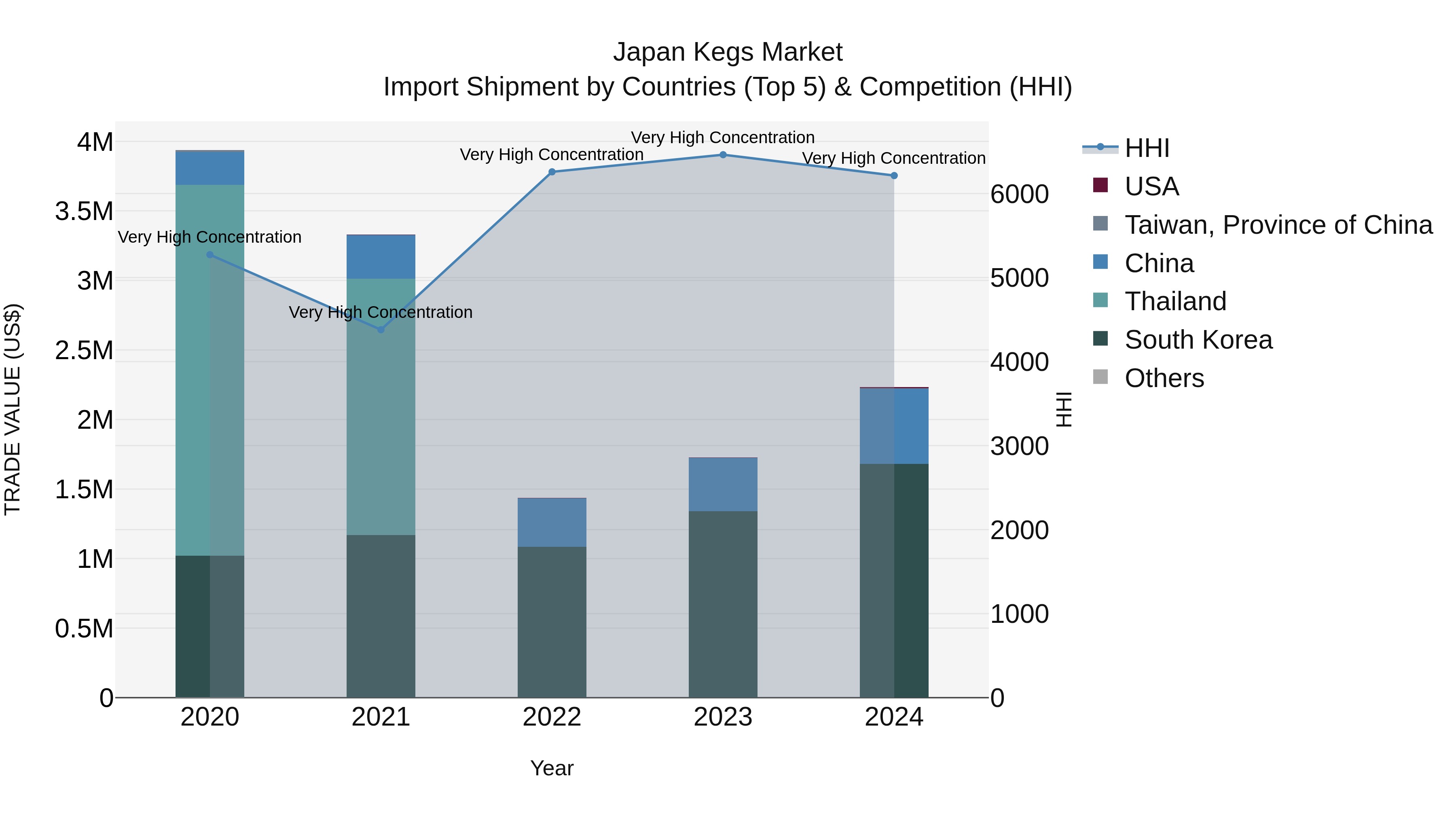
Japan Kegs Market Import Shipment by Countries (Top 5) & Competition (HHI)
In 2024, Japan saw a significant influx of kegs import shipments, with top exporters being South Korea, China, USA, Taiwan, and Germany. The high Herfindahl-Hirschman Index (HHI) indicates a concentrated market. Despite a negative compound annual growth rate (CAGR) from 2020 to 2024, there was a notable growth spurt in 2024 with a rate of 29.33%. This suggests a dynamic market landscape and potential opportunities for further expansion and diversification in the kegs import market in Japan.
Japan Kegs Market Overview
The Japan kegs market is characterized by a growing demand for kegs across various industries, including breweries, bars, restaurants, and catering services. The market is driven by factors such as rising popularity of craft beer, increasing consumer preference for draft beer, and the convenience and cost-effectiveness of using kegs for storage and transportation of beverages. Key players in the Japan kegs market offer a wide range of kegs in different sizes and materials to cater to the diverse needs of customers. With a strong emphasis on quality and innovation, manufacturers are focusing on producing kegs that are durable, easy to clean, and environmentally friendly. The market is expected to witness steady growth in the coming years as the beverage industry continues to expand and evolve.
Japan Kegs Market Trends
In the Japan kegs market, there is a growing trend towards environmentally friendly and sustainable keg options. Many breweries and beverage companies in Japan are shifting towards reusable and recyclable kegs to reduce waste and carbon footprint. Another notable trend is the increasing popularity of smaller kegs, catering to the rising demand for craft beers and limited edition brews. Additionally, there is a focus on innovation in keg technology, with advancements in materials and designs to improve keg performance and quality. Collaborations between breweries and keg manufacturers are also on the rise, leading to customized keg solutions tailored to specific needs and preferences of the market. Overall, the Japan kegs market is witnessing a shift towards sustainability, versatility, and innovation to meet the evolving consumer demands.
Japan Kegs Market Challenges
In the Japan kegs market, some challenges faced include a growing trend towards alternative packaging options such as cans and bottles, which may impact the demand for kegs. Additionally, strict regulations and quality standards imposed by authorities in Japan can pose challenges for keg manufacturers in terms of compliance and certification requirements. Furthermore, the high cost of kegs and the need for significant initial investment in kegging equipment can be a barrier for smaller breweries or businesses looking to enter the market. Competition from other beverage packaging options and the need for innovative marketing strategies to promote kegged products amidst changing consumer preferences also present ongoing challenges for companies operating in the Japan kegs market.
Japan Kegs Market Investment Opportunities
The Japan kegs market presents several investment opportunities for growth and innovation. With the increasing popularity of craft beer and the growing demand for premium beverages, there is a rising need for high-quality kegs to store and transport these products. Investing in keg manufacturing companies that focus on sustainability, durability, and technological advancements can lead to significant returns. Additionally, exploring the potential of the rental keg market in Japan, as breweries and beverage companies look to reduce costs and improve supply chain efficiency, could be a lucrative opportunity. Collaborating with local breweries and beverage distributors to provide customized keg solutions tailored to their specific needs could also be a strategic investment move in the dynamic and evolving Japan kegs market.
Japan Kegs Market Government Policy
In Japan, the kegs market is regulated by the Liquor Tax Law, which governs the production, distribution, and consumption of alcoholic beverages. Kegs used for serving draft beer are subject to specific regulations, including licensing requirements for manufacturers and distributors. The law also imposes taxes on kegs based on their volume and alcohol content. Additionally, the government has implemented measures to promote responsible drinking and reduce alcohol-related harm, such as restricting the sale of alcohol to minors and enforcing strict drunk driving laws. Overall, government policies in Japan aim to ensure the quality, safety, and responsible consumption of alcoholic beverages, including those served in kegs.
Japan Kegs Market Future Outlook
The Japan Kegs Market is expected to experience steady growth in the coming years, driven by factors such as the rising popularity of craft beer, increasing consumer preference for draft beer, and the growing number of breweries and beer festivals in the country. The market is witnessing a shift towards environmentally friendly and reusable kegs, with a focus on sustainability and reducing waste. Additionally, the demand for kegs in the hospitality industry is expected to rise as bars, restaurants, and cafes look to enhance their beverage offerings and provide unique experiences to customers. Overall, the Japan Kegs Market is poised for expansion, with opportunities for innovation and collaboration within the industry to meet the evolving needs of consumers and businesses alike.
Key Highlights of the Report:
- Japan Kegs Market Outlook
- Market Size of Japan Kegs Market, 2024
- Forecast of Japan Kegs Market, 2031
- Historical Data and Forecast of Japan Kegs Revenues & Volume for the Period 2018 - 2031
- Japan Kegs Market Trend Evolution
- Japan Kegs Market Drivers and Challenges
- Japan Kegs Price Trends
- Japan Kegs Porter's Five Forces
- Japan Kegs Industry Life Cycle
- Historical Data and Forecast of Japan Kegs Market Revenues & Volume By Material for the Period 2018 - 2031
- Historical Data and Forecast of Japan Kegs Market Revenues & Volume By Plastic for the Period 2018 - 2031
- Historical Data and Forecast of Japan Kegs Market Revenues & Volume By Tin for the Period 2018 - 2031
- Historical Data and Forecast of Japan Kegs Market Revenues & Volume By Stainless Steel for the Period 2018 - 2031
- Historical Data and Forecast of Japan Kegs Market Revenues & Volume By Capacity for the Period 2018 - 2031
- Historical Data and Forecast of Japan Kegs Market Revenues & Volume By Up to 20 Liter for the Period 2018 - 2031
- Historical Data and Forecast of Japan Kegs Market Revenues & Volume By 20 Liter to 40 Liter for the Period 2018 - 2031
- Historical Data and Forecast of Japan Kegs Market Revenues & Volume By 40 Liter to 60 Liter for the Period 2018 - 2031
- Historical Data and Forecast of Japan Kegs Market Revenues & Volume By Above 60 Liter for the Period 2018 - 2031
- Historical Data and Forecast of Japan Kegs Market Revenues & Volume By End Use for the Period 2018 - 2031
- Historical Data and Forecast of Japan Kegs Market Revenues & Volume By Alcoholic Beverages for the Period 2018 - 2031
- Historical Data and Forecast of Japan Kegs Market Revenues & Volume By Non-Alcoholic Beverages for the Period 2018 - 2031
- Historical Data and Forecast of Japan Kegs Market Revenues & Volume By Cooking Oil for the Period 2018 - 2031
- Historical Data and Forecast of Japan Kegs Market Revenues & Volume By Chemicals for the Period 2018 - 2031
- Historical Data and Forecast of Japan Kegs Market Revenues & Volume By Others for the Period 2018 - 2031
- Historical Data and Forecast of Japan Kegs Market Revenues & Volume By Distribution Channel for the Period 2018 - 2031
- Historical Data and Forecast of Japan Kegs Market Revenues & Volume By Supermarket/Hypermarket for the Period 2018 - 2031
- Historical Data and Forecast of Japan Kegs Market Revenues & Volume By Commercial Liquor Store for the Period 2018 - 2031
- Historical Data and Forecast of Japan Kegs Market Revenues & Volume By Others for the Period 2018 - 2031
- Japan Kegs Import Export Trade Statistics
- Market Opportunity Assessment By Material
- Market Opportunity Assessment By Capacity
- Market Opportunity Assessment By End Use
- Market Opportunity Assessment By Distribution Channel
- Japan Kegs Top Companies Market Share
- Japan Kegs Competitive Benchmarking By Technical and Operational Parameters
- Japan Kegs Company Profiles
- Japan Kegs Key Strategic Recommendations






































