Japan Licensed Football Merchandise Market Size & Growth Rate
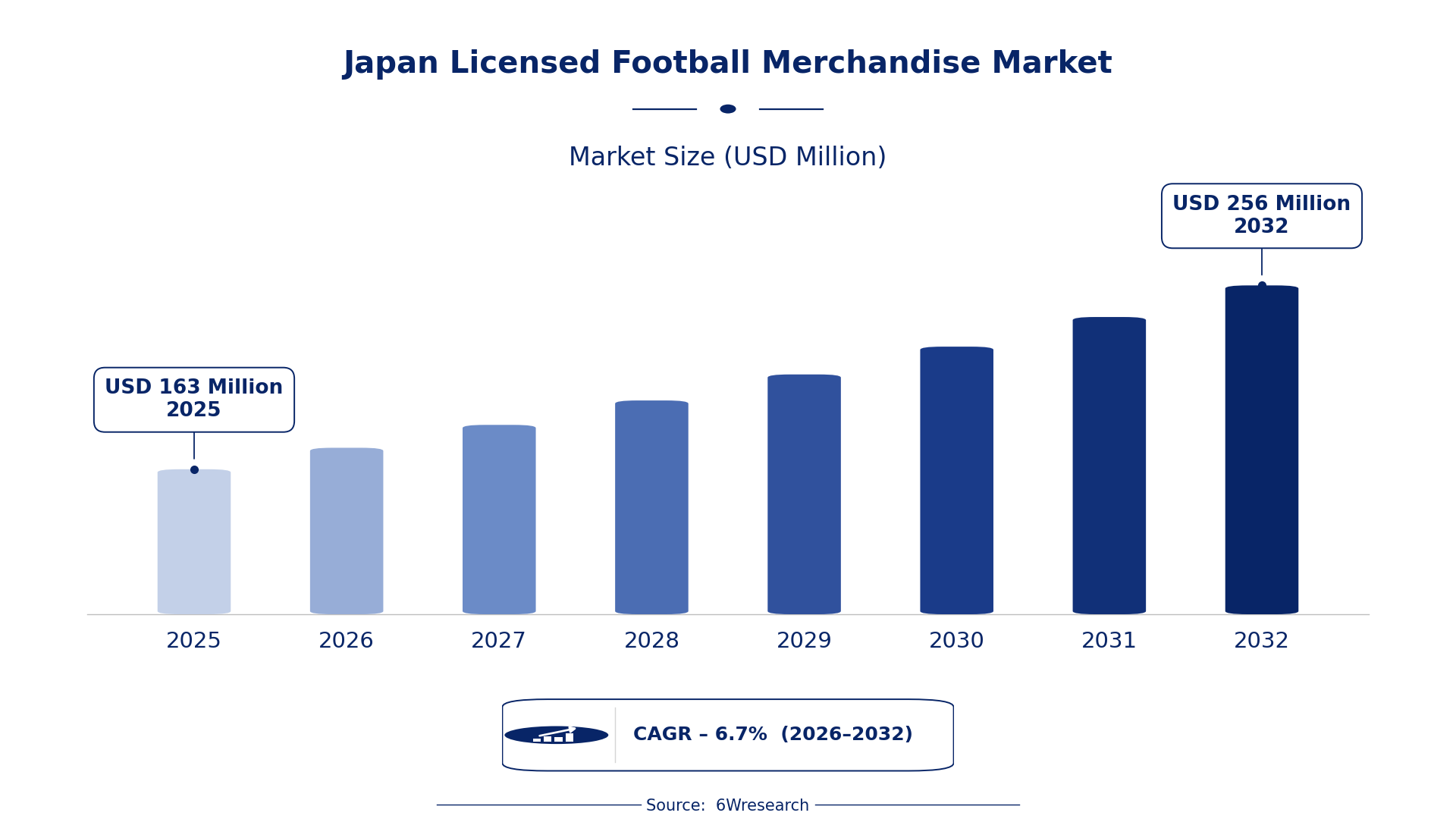
According to 6Wresearch internal database and industry insights, the Japan Licensed Football Merchandise Market was valued at USD 163 Million in 2025 and is projected to reach USD 256 Million by 2032, growing at a CAGR of approximately 6.7% during 2026–2032.
Japan Licensed Football Merchandise Market Highlights
| Report Metric | Details |
| Report Name | Japan Licensed Football Merchandise Market (2026-2032) |
| Market Size 2025 | USD 163 Million |
| Market Size 2032 | USD 256 Million |
| Absolute Growth 2025–2032 | USD 93 Million |
| CAGR 2026–2032 | 6.7% |
| Peak Annual Growth | 7.6% in 2032 |
| Forecast Period | 2026–2032 |
| Historical Data | 2022–2025 |
| Base Year | 2025 |
| Leading Product Type, 2025 | Apparels (52% share) |
| Leading Distribution Channel, 2025 | E-Commerce (39% share) |
| Leading End-User, 2025 | Men (42% share) |
| Fastest-Growing Product Type | Accessories (9.4% CAGR) |
| Fastest-Growing End-User | Women (8.6% CAGR) |
| Growing Sector | Women |
| Key End Users | Men, Women, Children |
Japan Licensed Football Merchandise Market Year-wise Growth Rate and Key Drivers (2022–2032)
This graph illustrates the annual growth rates of the market from 2022 to 2032, highlighting a steady upward trajectory and projected market expansion over the forecast period.
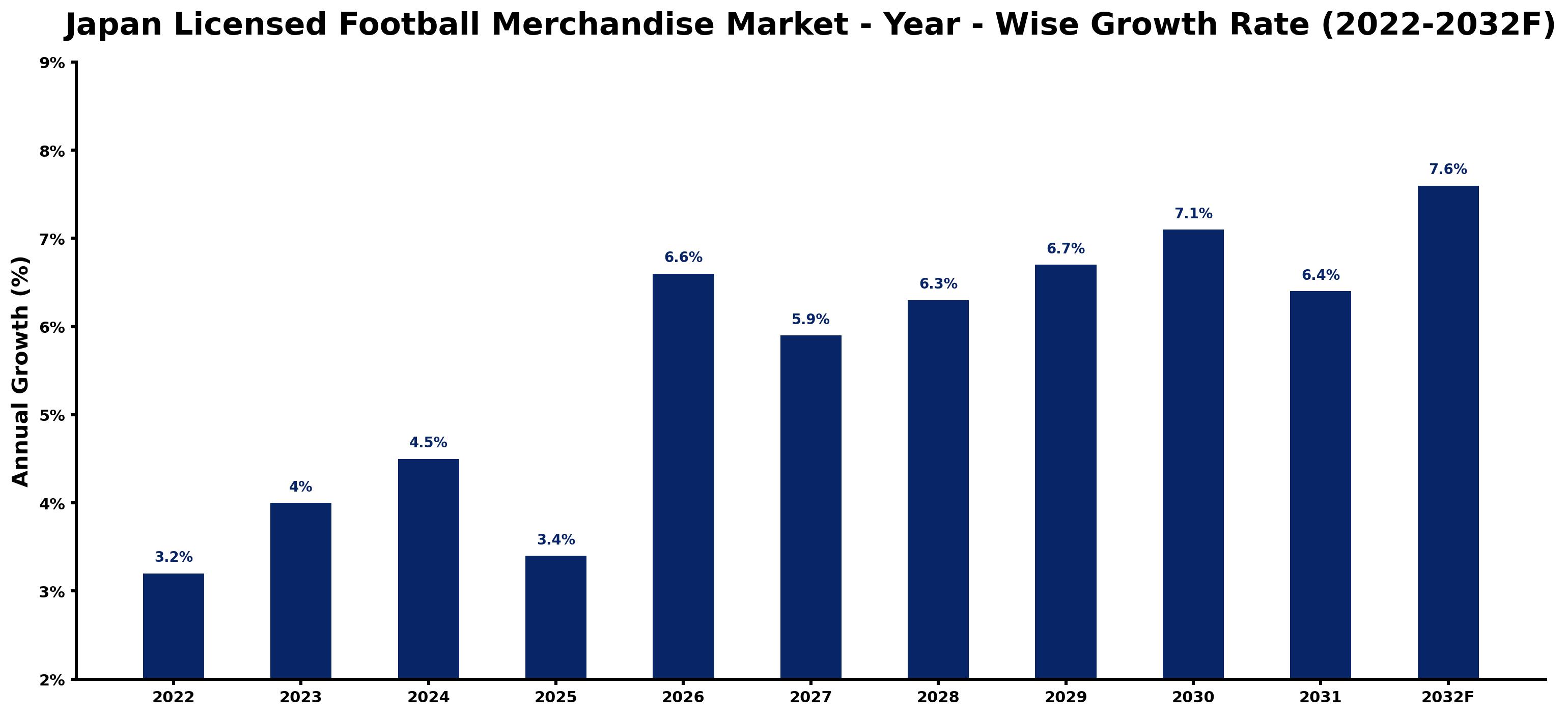
Below, each year's estimated growth is shown next to the factor that most influenced it.
| Year | Estimated Annual Growth (%) | Market Rationale |
| 2022 | 3.2 | The market showed steady growth, reflecting a strong fan base and interest in football merchandise. |
| 2023 | 4.0 | Growth accelerated due to increased consumer spending and the popularity of football events. |
| 2024 | 4.5 | The market continued to expand as merchandise sales benefited from major football tournaments. |
| 2025 | 3.4 | Growth slowed slightly as consumer spending stabilised after the previous year's surge. |
| 2026 | 6.6 | Demand is expected to surge again, driven by new merchandise initiatives and rising fan engagement. |
| 2027 | 5.9 | Growth is projected to moderate as the market adjusts to previous high levels of demand. |
| 2028 | 6.3 | The market is expected to rebound with renewed interest in football merchandise following promotional events. |
| 2029 | 6.7 | Growth is anticipated to continue as fan engagement remains high and new product lines are introduced. |
| 2030 | 7.1 | The upward trend is projected to persist, supported by successful marketing campaigns and merchandise variety. |
| 2031 | 6.4 | Growth is expected to slow as market saturation begins to impact sales. |
| 2032 | 7.6 | The market is projected to peak with a significant rise in merchandise sales during major football events. |
Note: Market size estimations and growth projections presented in this report are based on 6Wresearch's proprietary forecasting methodology, utilizing the latest available industry data, government publications, and primary research inputs.
Japan Licensed Football Merchandise Market Synopsis
Licensed football merchandise includes apparel, footwear, and accessories featuring club branding, produced through licensing agreements to ensure authenticity. The Japan Licensed Football Merchandise Market is expanding, driven by a dedicated fan base and a shift towards online shopping, with over 70% of sales occurring through e-commerce channels. Initiatives like the J-League's new merchandise programme in 2023 are stimulating demand, while the Tokyo 2020 Olympics increased interest by 15%.
Market Dynamics Impact Analysis (2026–2032)
| Factor | Type | Impact | Primary Segment Affected |
| Growing e-commerce sales channels are driving demand for licensed football merchandise. | Driver | High | E-Commerce |
| The increasing number of registered football fans in Japan boosts merchandise purchases. | Driver | High | Apparels |
| The rise in youth interest in football creates opportunities for new product lines. | Opportunity | High | Children |
| The recent government initiative to support sports merchandising opens new funding avenues. | Opportunity | High | Men |
| Market saturation may limit growth potential as competition increases. | Restraint | Medium | Footwear |
| Consumer preferences may shift towards alternative leisure activities, affecting sales. | Restraint | Medium | Accessories |
| Rising production costs could impact pricing strategies for suppliers. | Challenge | High | Apparels |
| Supply chain disruptions may delay product availability for retailers. | Challenge | High | E-Commerce |
Evaluation of Drivers in Japan Licensed Football Merchandise Market (2026–2032)
The main growth drivers and the segments they affect most are set out below.
| Drivers | Primary Segment Affected | Why It Matters (Evidence) |
| Increasing online shopping trends expand the reach of licensed football merchandise. | E-Commerce | Over 70% of football merchandise sales occur through e-commerce channels, allowing greater consumer access. |
| Growing interest among younger demographics boosts demand for football apparel. | Apparels | The average age of consumers is 25-35 years, driving purchases among younger fans. |
| The popularity of football events generates spikes in merchandise sales. | Footwear | Major tournaments increase consumer interest and sales. |
| Collaborations with popular athletes increase brand visibility and attract buyers. | Accessories | The number of licensed products has increased by 30% since 2020, reflecting market expansion. |
| The rise of social media marketing effectively engages football fans. | Men | Engagement through platforms results in higher merchandise visibility and sales. |
The strongest pull on demand comes from the increasing popularity of e-commerce, with over 70% of licensed football merchandise sold online. A youthful consumer base, primarily aged 25-35 years, drives purchases, particularly in apparel. Major football events generate spikes in merchandise sales, while collaborations with popular athletes increase brand visibility. Social media marketing effectively engages fans, leading to higher visibility and sales across various product types. The market is expanding, reflecting strong interest in football culture.
Evaluation of Restraints in Japan Licensed Football Merchandise Market
These are the pressures that could keep growth below its potential.
| Market Restraint | Primary Segment Affected | Why It Matters (Evidence) |
| Market saturation may limit growth potential as competition increases. | Footwear | The number of licensed football products has increased by 30% since 2020, resulting in fierce competition. |
| Consumer preferences may shift towards alternative leisure activities, affecting sales. | Accessories | Interest in other sports or activities could divert attention from football merchandise. |
| Rising production costs could impact pricing strategies for suppliers. | Apparels | ISO 9001 standards increase manufacturing costs, affecting retail pricing. |
| Supply chain disruptions may delay product availability for retailers. | E-Commerce | Global supply chain issues have caused inconsistent product availability for online sales. |
| Economic fluctuations could lead to reduced discretionary spending on merchandise. | Apparels | Changes in consumer spending habits can directly impact football merchandise sales. |
Japan Licensed Football Merchandise Market Challenges
Retailers in Tokyo face high costs due to limited local production capabilities, forcing them to rely on imports that can inflate prices by up to 20% for consumers. Licensing agreements encounter regulatory hurdles, causing delays that can push product availability back by three months, frustrating fans eager to buy merchandise. Smaller retailers struggle with slow technology adoption, which hampers their online competitiveness and results in a loss of up to 30% in potential sales. Marketing and digital commerce skills shortages restrict suppliers' reach in the growing e-commerce market, costing them around 140 billion yen as over 70% of merchandise is sold online.
Trends in the Japan Licensed Football Merchandise Market
The trends below show where the Japan Licensed Football Merchandise Market is heading.
- Growing Interest in Women’s Football Merchandise: Women’s football merchandise is gaining popularity, with an expected CAGR of 8.6% as more women engage with the sport. Initiatives like the J-League's recent campaigns are helping to promote this segment.
- Emergence of Sustainable Merchandise: Sustainability is becoming a priority for consumers, leading to an increase in eco-friendly licensed football products. The government's GX Basic Policy aims for substantial decarbonisation investments, influencing production practices in the sector.
- Increased Engagement Through Social Media Campaigns: Social media campaigns are driving fan engagement and merchandise sales, particularly among younger demographics. The Football Merchandise Expo in Japan attracts thousands, showcasing the impact of digital marketing.
- Shift in Consumer Preferences Towards Online Shopping: Consumers are increasingly preferring online shopping for licensed football merchandise, with e-commerce sales accounting for over 70% of total sales. This shift is clear in major cities like Tokyo and Osaka, where online platforms dominate the market.
Investment Opportunities in the Japan Licensed Football Merchandise Market
The following opportunities in the Japan Licensed Football Merchandise Market pair current demand with a clear way in.
- Timing for New Product Launches: With a growing fan base and increasing interest in football, now is an ideal time to launch new merchandise lines targeting youth. The registered football fan base reached 5 million in 2022, indicating a strong market potential.
- Investment in E-Commerce Platforms: The e-commerce segment is expanding rapidly, with a 39% market share in 2025. Investing in strong online platforms can capture the growing consumer base effectively.
- Expansion of Women's Football Merchandise: With women's football gaining traction, there is an opportunity to develop dedicated merchandise lines. The increasing interest in women's sports presents a notable market gap.
- Collaboration with Local Sports Clubs: Partnering with local clubs can increase brand visibility and consumer trust. Collaborations can lead to exclusive merchandise offerings, appealing to dedicated fan bases.
Government Initiatives in the Japan Licensed Football Merchandise Market
The GX Basic Policy, adopted in 2023, aims for JPY 150 trillion in public-private decarbonisation investment over the next decade, impacting the production of licensed football merchandise. This policy encourages sustainable practices among producers, ensuring compliance with modern standards and improving market appeal.
The Consumer Affairs Agency oversees regulations that prohibit misleading labelling and advertising. This regulation protects consumers and ensures that licensed football merchandise maintains authenticity and quality, building trust in the market.
Future Insight of the Japan Licensed Football Merchandise Market
Consumers aged 25-35 will increasingly influence the licensed football merchandise market as their online shopping habits evolve. By 2032, advanced digital marketing strategies will improve brand visibility and attract a wider fan base. The government's 1 billion yen initiative will support merchandising programmes, potentially increasing sales by 15%. As the number of registered football fans surpasses 5 million, suppliers must tailor their products to meet the diverse preferences of this expanding audience.
Market Segmentation Analysis
Japan Licensed Football Merchandise Market report covers a detailed analysis of the following market segments:
By Product Type – Apparels Lead, Accessories Expected to Grow Fastest
According to Dhaval Chaurasia, Assistant Manager at 6Wresearch, Apparels held 52% of the Japan Licensed Football Merchandise Market by product type in 2025. Apparels hold the largest share due to their direct use by fans during matches and events, making them a staple in the merchandise market. With the number of licensed football products increasing by 30% since 2020, this segment has solidified its position. Accessories are set to record the highest CAGR in this split, 9.4% over 2026–2032. Accessories are experiencing rapid growth as they complement main merchandise, appealing to fans looking for additional ways to showcase their support. The recent J-League merchandise initiative is expected to further stimulate this segment's expansion. Suppliers should focus on diversifying their apparel offerings while also investing in accessory lines to capture the growing interest.
By Distribution Channel – E-Commerce Leads and Records the Fastest Growth
E-Commerce accounted for 39% of the market by distribution channel in 2025. E-Commerce captures the largest share of the distribution channel for licensed football merchandise, accounting for over 70% of sales. This is largely due to the convenience it provides, particularly in key markets such as Tokyo and Osaka. E-Commerce is also forecast to expand faster than any other category, at a CAGR of 9.0% over 2026–2032. E-Commerce is also witnessing the fastest growth, spurred by a notable increase in online shopping after the Tokyo 2020 Olympics, which boosted interest in football merchandise by 15%. This trend indicates that E-Commerce's lead will continue to widen as consumer preferences shift towards online purchasing. Suppliers should prioritise the optimisation of their e-commerce platforms to effectively engage the expanding online consumer base.
By End-User – Men Leads, Women Expected to Grow Fastest
The largest end-user category in 2025 was Men, at 42% of revenue. Men represent the largest segment of football merchandise consumers, reflecting their deep-rooted enthusiasm for the sport. This demographic, primarily aged 25-35 years, shows a strong inclination towards purchasing licensed merchandise. The quickest growth will come from Women, forecast to expand at a CAGR of 8.6% between 2026 and 2032. Women are emerging as the fastest-growing segment, with a rising interest in football merchandise, although their share remains smaller compared to men. This growth suggests a significant opportunity for suppliers to tap into this demographic as marketing strategies evolve to attract female fans. Suppliers should implement targeted marketing initiatives to engage the female demographic and capitalise on this growing market potential.
Key Attractiveness of the Report
- 10 Years of Market Numbers
- Historical Data Starting from 2022 to 2025
- Base Year 2025
- Forecast Data until 2032
- Key Performance Indicators Impacting the Market
- Major Upcoming Developments and Projects
Key Highlights of the Report:
- Japan Licensed Football Merchandise Market Outlook
- Market Size of Japan Licensed Football Merchandise Market, 2025
- Forecast of Japan Licensed Football Merchandise Market, 2032
- Historical Data and Forecast of Japan Licensed Football Merchandise Revenues & Volume for the Period 2022-2032
- Japan Licensed Football Merchandise Market Trend Evolution
- Japan Licensed Football Merchandise Market Drivers and Challenges
- Japan Licensed Football Merchandise Price Trends
- Japan Licensed Football Merchandise Porter's Five Forces
- Japan Licensed Football Merchandise Industry Life Cycle
- Historical Data and Forecast of Japan Licensed Football Merchandise Market Revenues & Volume By Product Type for the Period 2022-2032
- Historical Data and Forecast of Japan Licensed Football Merchandise Market Revenues & Volume By Footwear for the Period 2022-2032
- Historical Data and Forecast of Japan Licensed Football Merchandise Market Revenues & Volume By Apparels for the Period 2022-2032
- Historical Data and Forecast of Japan Licensed Football Merchandise Market Revenues & Volume By Accessories for the Period 2022-2032
- Historical Data and Forecast of Japan Licensed Football Merchandise Market Revenues & Volume By Others for the Period 2022-2032
- Historical Data and Forecast of Japan Licensed Football Merchandise Market Revenues & Volume By Distribution Channel for the Period 2022-2032
- Historical Data and Forecast of Japan Licensed Football Merchandise Market Revenues & Volume By E-Commerce for the Period 2022-2032
- Historical Data and Forecast of Japan Licensed Football Merchandise Market Revenues & Volume By Department Stores for the Period 2022-2032
- Historical Data and Forecast of Japan Licensed Football Merchandise Market Revenues & Volume By Specialty Stores for the Period 2022-2032
- Historical Data and Forecast of Japan Licensed Football Merchandise Market Revenues & Volume By Supermarket & Hypermarket for the Period 2022-2032
- Historical Data and Forecast of Japan Licensed Football Merchandise Market Revenues & Volume By Others for the Period 2022-2032
- Historical Data and Forecast of Japan Licensed Football Merchandise Market Revenues & Volume By End-User for the Period 2022-2032
- Historical Data and Forecast of Japan Licensed Football Merchandise Market Revenues & Volume By Children for the Period 2022-2032
- Historical Data and Forecast of Japan Licensed Football Merchandise Market Revenues & Volume By Men for the Period 2022-2032
- Historical Data and Forecast of Japan Licensed Football Merchandise Market Revenues & Volume By Women for the Period 2022-2032
- Japan Licensed Football Merchandise Import Export Trade Statistics
- Market Opportunity Assessment By Product Type
- Market Opportunity Assessment By Distribution Channel
- Market Opportunity Assessment By End-User
- Japan Licensed Football Merchandise Top Companies Market Share
- Japan Licensed Football Merchandise Competitive Benchmarking By Technical and Operational Parameters
- Japan Licensed Football Merchandise Company Profiles
- Japan Licensed Football Merchandise Key Strategic Recommendations
Market Covered
Segments analysed in this report are listed below.
By Product Type
- Footwear
- Apparels
- Accessories
- Others
By Distribution Channel
- E-Commerce
- Department Stores
- Specialty Stores
- Supermarket & Hypermarket
- Others
By End-User
- Children
- Men
- Women































