Japan Luxury Appliances Market Size & Growth Rate
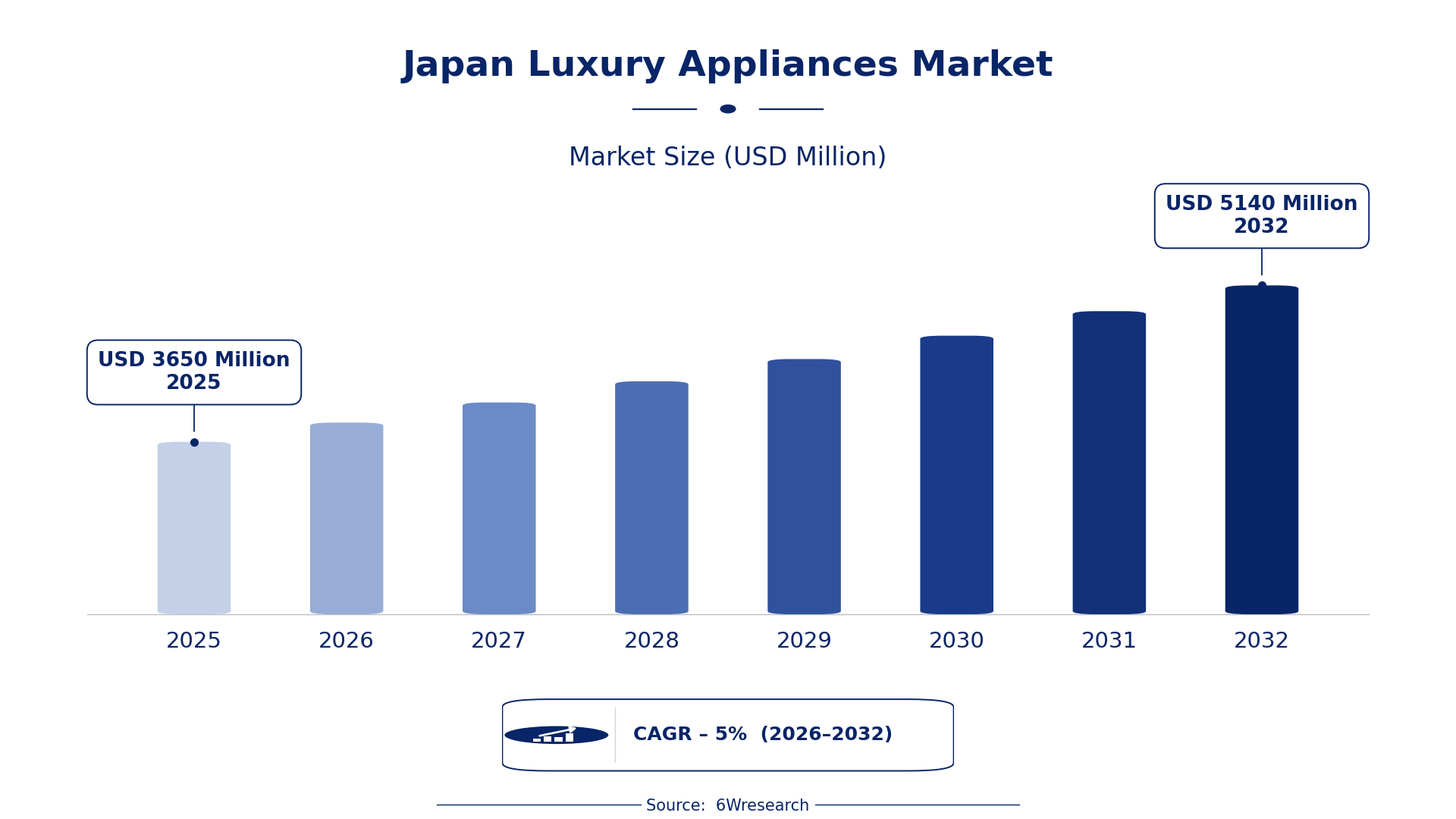
According to 6Wresearch internal database and industry insights, the Japan Luxury Appliances Market was valued at USD 3,650 Million in 2025 and is projected to reach USD 5,140 Million by 2032, growing at a CAGR of approximately 5% during 2026–2032.
Japan Luxury Appliances Market Highlights
| Report Metric | Details |
| Report Name | Japan Luxury Appliances Market (2026-2032) |
| Market Size 2025 | USD 3,650 Million |
| Market Size 2032 | USD 5,140 Million |
| Absolute Growth 2025–2032 | USD 1,490 Million |
| CAGR 2026–2032 | 5% |
| Peak Annual Growth | 6.5% in 2028 |
| Forecast Period | 2026–2032 |
| Historical Data | 2022–2025 |
| Base Year | 2025 |
| Leading Type, 2025 | Cooking and Baking Appliance (40% share) |
| Leading Distribution Channel, 2025 | E-Commerce (45% share) |
| Leading End Users, 2025 | Residential (68% share) |
| Fastest-Growing Type | Cooling Appliance (6.9% CAGR) |
| Fastest-Growing Distribution Channel | Multi-Brand Stores (6.3% CAGR) |
| Fastest-Growing End Users | Commercial (6.1% CAGR) |
| Growing Sector | Residential |
| Key End Users | Affluent households, urban consumers, home builders, interior designers |
Japan Luxury Appliances Market Year-wise Growth Rate and Key Drivers (2022–2032)
This graph illustrates the annual growth rates of the market from 2022 to 2032, highlighting a steady upward trajectory and projected market expansion over the forecast period.
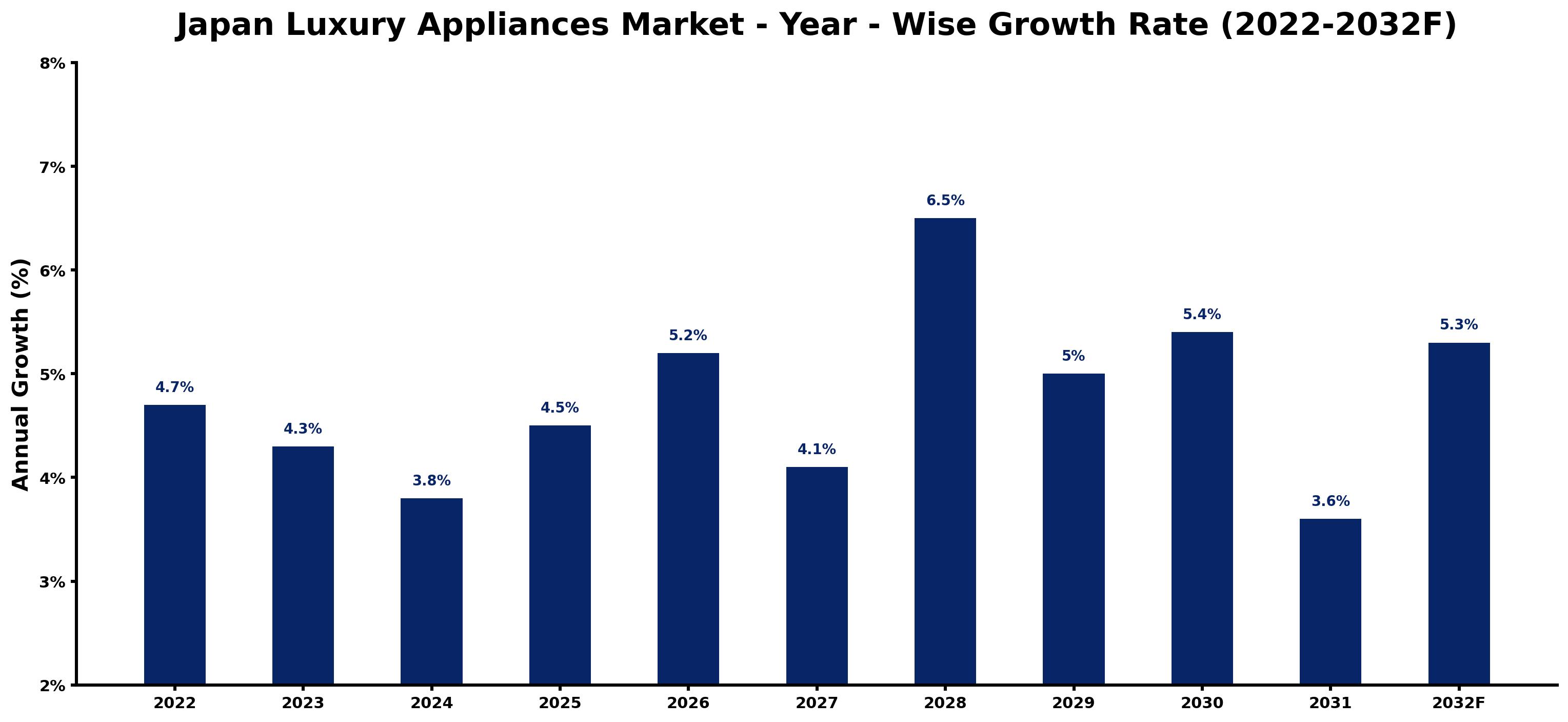
The yearly estimates that follow link every growth rate to its principal driver, so readers can see why the pace changed in each period.
| Year | Estimated Annual Growth (%) | Market Rationale |
| 2022 | 4.7 | Consumer spending on luxury appliances was strong, reflecting high demand from affluent households. |
| 2023 | 4.3 | Growth slowed as inflation affected discretionary spending among some consumers. |
| 2024 | 3.8 | Continued economic uncertainty led to cautious spending on luxury items in urban areas. |
| 2025 | 4.5 | An increase in household income spurred faster growth in luxury appliance purchases. |
| 2026 | 5.2 | The trend towards smart home technology drove demand for advanced luxury appliances. |
| 2027 | 4.1 | Market growth slowed slightly as consumers became more selective in their purchases. |
| 2028 | 6.5 | Innovations in energy-efficient appliances boosted consumer interest and sales. |
| 2029 | 5.0 | Demand stabilised as consumers adapted to new technologies in luxury appliances. |
| 2030 | 5.4 | Rising urbanisation increased the need for high-end kitchen and cleaning solutions. |
| 2031 | 3.6 | Consumer preferences shifted towards sustainability, impacting purchasing decisions. |
| 2032 | 5.3 | A growing interest in home automation will further enhance luxury appliance sales. |
Note: Market size estimations and growth projections presented in this report are based on 6Wresearch's proprietary forecasting methodology, utilizing the latest available industry data, government publications, and primary research inputs.
Japan Luxury Appliances Market Synopsis
Luxury appliances in Japan encompass high-end cooking, cooling, and cleaning devices that blend functionality with aesthetics. The market is valued at approximately 1 trillion JPY, with Tokyo as the largest consumer base. Affluent households are driving demand by investing in smart technologies and energy-efficient appliances. Urban households typically spend around 300,000 JPY on luxury kitchen appliances, demonstrating strong consumer interest and growth potential in this sector.
Market Dynamics Impact Analysis (2026–2032)
| Factor | Type | Impact | Primary Segment Affected |
| Growing interest in smart home technology | Driver | High | Cooking and Baking Appliance |
| Increased consumer spending on luxury goods | Driver | High | Cooling Appliance |
| Expansion of e-commerce channels for luxury appliances | Opportunity | High | E-Commerce |
| Rising demand for energy-efficient appliances | Opportunity | High | Cleaning Appliance |
| Economic fluctuations affecting consumer spending | Restraint | Medium | Cooling Appliance |
| High competition among luxury appliance brands | Restraint | Medium | Cooking and Baking Appliance |
| Supply chain disruptions affecting availability | Challenge | High | Cleaning Appliance |
| Rising production costs impacting pricing strategies | Challenge | Medium | Cooling Appliance |
Evaluation of Drivers in Japan Luxury Appliances Market (2026–2032)
The main growth drivers and the segments they affect most are set out below.
| Drivers | Primary Segment Affected | Why It Matters (Evidence) |
| Increased household income | Cooking and Baking Appliance | Higher income levels in urban areas lead to more purchases of luxury cooking appliances, with urban households spending an average of 300,000 JPY on kitchen appliances. |
| Growing trend of home automation | Cooling Appliance | The rise in smart home technologies drives demand for high-end cooling solutions, with ownership of luxury cooling appliances increasing by 15% since 2020. |
| Expansion of online shopping platforms | E-Commerce | Luxury appliance sales through e-commerce channels have surged by 20% in the last year, reflecting changing consumer shopping habits. |
| Increased focus on energy efficiency | Cleaning Appliance | The adoption of energy management standards promotes energy-efficient cleaning appliances, appealing to environmentally conscious consumers. |
| Rising popularity of luxury kitchen designs | Cooking and Baking Appliance | The trend towards high-end kitchen renovations boosts demand for luxury cooking appliances, improving the overall cooking experience. |
The strongest pull on demand comes from increased household income, particularly in urban areas where spending on luxury cooking appliances averages around 300,000 JPY. Five years ago, the market was less focused on smart technologies, but today, the trend towards home automation has influenced purchasing decisions. The expansion of e-commerce platforms has led to a 20% increase in luxury appliance sales online, making these products more accessible. The growing emphasis on energy efficiency, supported by energy management standards, is prompting affluent consumers to invest in high-quality cleaning appliances, further boosting market growth.
Evaluation of Restraints in Japan Luxury Appliances Market
These are the pressures that could keep growth below its potential.
| Market Restraint | Primary Segment Affected | Why It Matters (Evidence) |
| Increased costs for materials and manufacturing | Cooling Appliance | Higher costs can lead to increased retail prices, which may deter some buyers. |
| Consumer preference for sustainable products | Cooking and Baking Appliance | A shift towards sustainability may lead consumers to choose brands that prioritise eco-friendly practices. |
| Limited availability of luxury appliances | Cleaning Appliance | High demand often outpaces supply, making it difficult for buyers to find desired products. |
| Competition among luxury brands | Cooking and Baking Appliance | Intense competition can drive prices up, limiting options for cost-sensitive consumers. |
| Slow adoption of new technologies | Cooling Appliance | Some consumers may hesitate to invest in advanced cooling solutions due to unfamiliarity with new features. |
Japan Luxury Appliances Market Challenges
Affluent consumers in Tokyo encounter fierce competition for luxury appliances, which raises prices and limits availability. Increasing raw material costs burden suppliers, leading to production delays that can extend shipments to retailers by up to three weeks. A shortage of skilled technicians for luxury appliance installation affects service quality, resulting in buyer wait times that often exceed two weeks. Rapid technological advancements necessitate continuous innovation from manufacturers, causing some suppliers to lag behind and restrict choices for consumers, ultimately impacting satisfaction levels.
Trends in the Japan Luxury Appliances Market
The shifts below are changing how Japan Luxury Appliances Market products are bought and supplied.
- Shift to Smart Home Appliances in Tokyo: Tokyo has seen a marked shift towards smart home appliances, with a 20% increase in sales of energy-efficient models since 2022. This trend indicates a growing consumer preference for technology that enhances convenience and sustainability.
- Transition from Traditional to Online Retail: Since 2022, luxury appliance sales through e-commerce channels have risen by 20%. This shift reflects a growing consumer inclination towards the convenience of online shopping, prompting suppliers to strengthen their digital presence.
- Emergence of Energy-Efficient Luxury Appliances: The rise of energy-efficient luxury appliances is reshaping consumer preferences, with many choosing products that adhere to energy management standards. This shift aligns with a broader trend towards sustainability in home design.
- Growing Demand for Robotic Cleaning Devices: Robotic cleaning appliances have gained traction among affluent consumers, with sales rising significantly in urban areas. This trend highlights a desire for convenience and efficiency in maintaining luxury homes.
Investment Opportunities in the Japan Luxury Appliances Market
Investors looking at the Japan Luxury Appliances Market should consider the following areas.
- E-Commerce Expansion in Urban Areas: With luxury appliance sales through e-commerce channels increasing by 20%, there is a chance to invest in online platforms. Urban households are increasingly opting for online shopping for convenience and variety.
- Supply of Energy-Efficient Appliances: The Food Recycling Law promotes energy-efficient appliances, creating demand for suppliers of these products. Manufacturers can collaborate with local retailers to address this growing need.
- Investment in Smart Kitchen Technologies: Urban households typically spend around 300,000 JPY on luxury kitchen appliances, indicating a gap in smart kitchen technology offerings. Suppliers can enter this market by partnering with local distributors.
- Focus on High-End Cleaning Solutions: The rising popularity of robotic cleaning devices presents an opportunity for manufacturers to provide advanced cleaning solutions. Engaging with affluent consumer segments can improve market penetration.
Government Initiatives in the Japan Luxury Appliances Market
The Electrical Appliance and Material Safety Act ensures that luxury appliances sold in Japan meet stringent safety standards. Compliance with this law is essential for manufacturers to gain consumer trust and market access, with over 80% of consumers prioritising safety in their purchasing decisions. Additionally, the Industrial Standardization Act governs product and test standards, promoting quality assurance in the luxury appliance sector.
The Consumer Affairs Agency enforces regulations against misleading labelling and advertising, which helps buyers make informed choices and supports a fair marketplace. This oversight ensures that luxury appliances meet high-quality standards, benefiting both consumers and reputable manufacturers. The agency also oversees product recalls and safety assessments, ensuring that luxury appliances meet high-quality standards.
Future Insight of the Japan Luxury Appliances Market
By 2032, urban households will increasingly embrace smart technologies, driven by the government's Smart Home Initiative that promotes energy-efficient appliances. The average household in urban areas is projected to spend around 400,000 JPY on luxury kitchen products, reflecting a trend towards premium features. Suppliers will need to refine manufacturing processes to meet rising consumer expectations for quality and efficiency. Enhanced online shopping experiences will facilitate easier access to luxury appliances, allowing buyers to explore a broader range of high-end options.
Market Segmentation Analysis
Japan Luxury Appliances Market report covers a detailed analysis of the following market segments:
By Type – Cooking and Baking Appliance Leads, Cooling Appliance Expected to Grow Fastest
According to Bhawna Singh, Assistant Manager at 6Wresearch, with 40% of type revenue in 2025, Cooking and Baking Appliance was the largest category. Cooking and baking appliances hold the largest share as they are crucial for food preparation in luxury homes. In urban areas like Tokyo, high consumer spending on these appliances reinforces their dominance in the market. Over 2026–2032, Cooling Appliance is expected to post the fastest growth, at a CAGR of 6.9%. Cooling appliances are experiencing rapid growth due to a 15% increase in households adopting luxury cooling solutions since 2020. This trend indicates a growing demand for advanced food preservation technologies, which will further widen the leader's market share. Suppliers should focus on enhancing their offerings in cooling appliances to leverage this growth opportunity.
By Distribution Channel – E-Commerce Leads, Multi-Brand Stores Expected to Grow Fastest
In 2025, E-Commerce led the distribution channel split with a 45% share. E-commerce leads the distribution channel segment as it has become increasingly popular for purchasing luxury items online, catering to the convenience sought by affluent consumers. The growth of online shopping aligns with changing consumer behaviours in urban areas. Multi-Brand Stores are set to record the highest CAGR in this split, 6.3% over 2026–2032. Multi-brand stores are the fastest-growing channel, providing a diverse range of luxury brands under one roof, which appeals to consumers seeking variety. This trend reflects a shift towards experiential shopping in the luxury segment. Suppliers must strengthen partnerships with multi-brand stores to maximise reach and visibility in the luxury market.
By End Users – Residential Leads, Commercial Expected to Grow Fastest
Residential took 68% of end users revenue in 2025, more than any other category. The residential segment is the largest end-user category as luxury appliances are primarily acquired for home use by affluent consumers. This is highlighted by the substantial average household expenditure on luxury kitchen appliances in urban areas. Commercial is projected to grow fastest, at a CAGR of 6.1% during 2026–2032. Commercial end users are expanding quickly, particularly in upscale restaurants and hotels, as they increasingly recognise the advantages of luxury appliances for improving service quality. This trend points to a growing appreciation for high-end appliances in professional settings. Suppliers need to create tailored marketing approaches to address the specific needs of commercial buyers.
Key Attractiveness of the Report
- 10 Years of Market Numbers
- Historical Data Starting from 2022 to 2025
- Base Year 2025
- Forecast Data until 2032
- Key Performance Indicators Impacting the Market
- Major Upcoming Developments and Projects
Key Highlights of the Report:
- Japan Luxury Appliances Market Outlook
- Market Size of Japan Luxury Appliances Market, 2025
- Forecast of Japan Luxury Appliances Market, 2032
- Historical Data and Forecast of Japan Luxury Appliances Revenues & Volume for the Period 2022-2032
- Japan Luxury Appliances Market Trend Evolution
- Japan Luxury Appliances Market Drivers and Challenges
- Japan Luxury Appliances Price Trends
- Japan Luxury Appliances Porter's Five Forces
- Japan Luxury Appliances Industry Life Cycle
- Historical Data and Forecast of Japan Luxury Appliances Market Revenues & Volume By Type for the Period 2022-2032
- Historical Data and Forecast of Japan Luxury Appliances Market Revenues & Volume By Cooking and Baking Appliance for the Period 2022-2032
- Historical Data and Forecast of Japan Luxury Appliances Market Revenues & Volume By Cooling Appliance for the Period 2022-2032
- Historical Data and Forecast of Japan Luxury Appliances Market Revenues & Volume By Cleaning Appliance for the Period 2022-2032
- Historical Data and Forecast of Japan Luxury Appliances Market Revenues & Volume By Other kitchen appliances for the Period 2022-2032
- Historical Data and Forecast of Japan Luxury Appliances Market Revenues & Volume By Distribution Channel for the Period 2022-2032
- Historical Data and Forecast of Japan Luxury Appliances Market Revenues & Volume By E-Commerce for the Period 2022-2032
- Historical Data and Forecast of Japan Luxury Appliances Market Revenues & Volume By Multi-Brand Stores for the Period 2022-2032
- Historical Data and Forecast of Japan Luxury Appliances Market Revenues & Volume By Exclusive Stores for the Period 2022-2032
- Historical Data and Forecast of Japan Luxury Appliances Market Revenues & Volume By Other Distribution Channel for the Period 2022-2032
- Historical Data and Forecast of Japan Luxury Appliances Market Revenues & Volume By End Users for the Period 2022-2032
- Historical Data and Forecast of Japan Luxury Appliances Market Revenues & Volume By Residential for the Period 2022-2032
- Historical Data and Forecast of Japan Luxury Appliances Market Revenues & Volume By Commercial for the Period 2022-2032
- Japan Luxury Appliances Import Export Trade Statistics
- Market Opportunity Assessment By Type
- Market Opportunity Assessment By Distribution Channel
- Market Opportunity Assessment By End Users
- Japan Luxury Appliances Top Companies Market Share
- Japan Luxury Appliances Competitive Benchmarking By Technical and Operational Parameters
- Japan Luxury Appliances Company Profiles
- Japan Luxury Appliances Key Strategic Recommendations
Market Covered
This report examines the market across the segments below.
By Type
- Cooking and Baking Appliance
- Cooling Appliance
- Cleaning Appliance
- Other kitchen appliances
By Distribution Channel
- E-Commerce
- Multi-Brand Stores
- Exclusive Stores
- Other Distribution Channel
By End Users
- Residential
- Commercial






































