Japan Marine Wind Turbine Market Size & Growth Rate
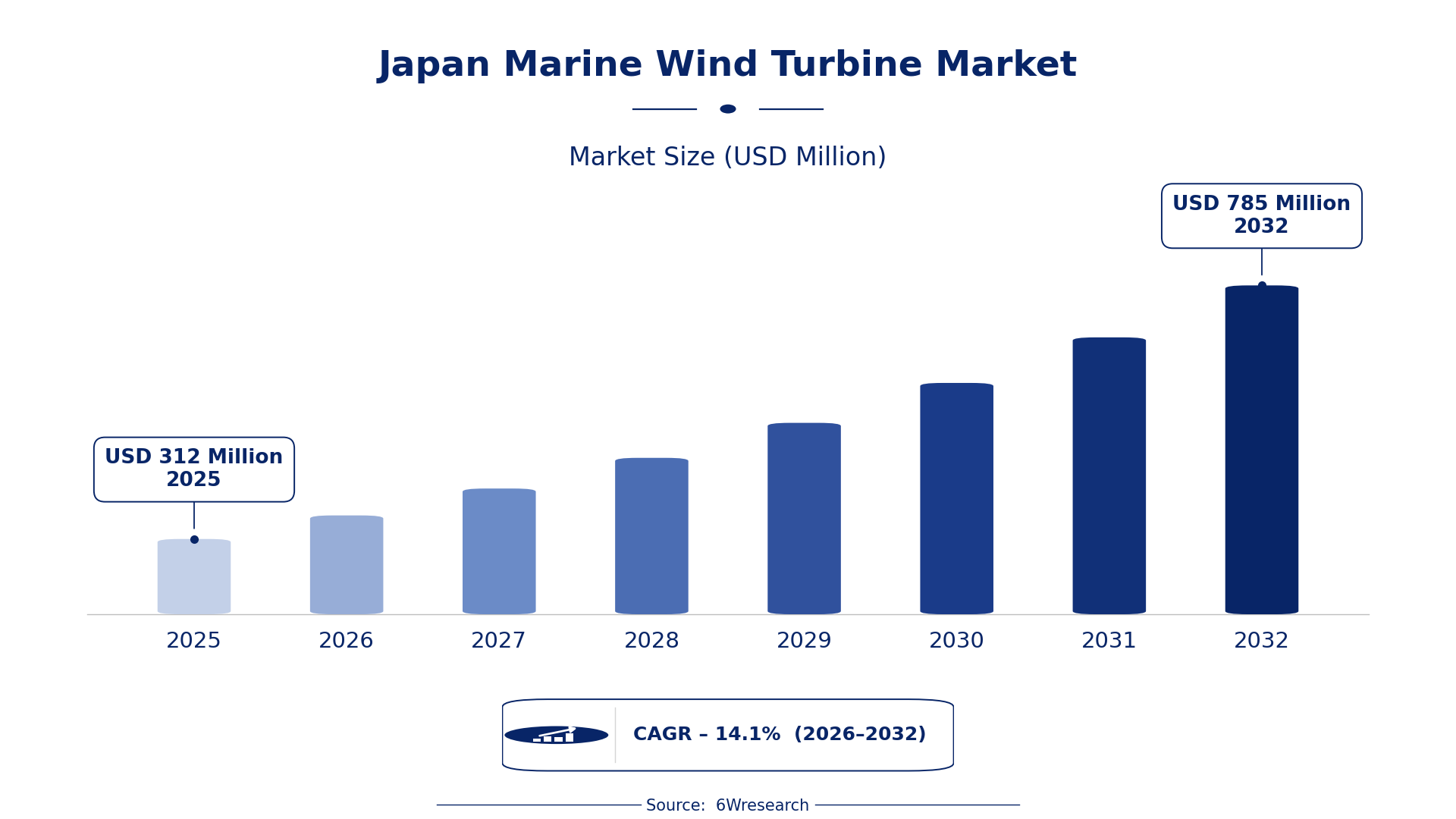
According to 6Wresearch internal database and industry insights, the Japan Marine Wind Turbine Market was valued at USD 312 Million in 2025 and is projected to reach USD 785 Million by 2032, growing at a CAGR of approximately 14.1% during 2026–2032.
Japan Marine Wind Turbine Market Highlights
| Report Metric | Details |
| Report Name | Japan Marine Wind Turbine Market (2026-2032) |
| Market Size 2025 | USD 312 Million |
| Market Size 2032 | USD 785 Million |
| Absolute Growth 2025–2032 | USD 473 Million |
| CAGR 2026–2032 | 14.1% |
| Peak Annual Growth | 15.0% in 2032 |
| Forecast Period | 2026–2032 |
| Historical Data | 2022–2025 |
| Base Year | 2025 |
| Leading Product, 2025 | Single systems (64% share) |
| Leading Axis, 2025 | Vertical axis wind turbine (64% share) |
| Leading Base, 2025 | Monopole base (60% share) |
| Fastest-Growing Product | Hybrid systems (16.1% CAGR) |
| Fastest-Growing Axis | Horizontal axis wind turbine (17.6% CAGR) |
| Fastest-Growing Base | Tripod base (18.0% CAGR) |
| Growing Sector | Renewable energy |
| Key End Users | Energy producers, government agencies, environmental organisations, coastal communities |
Japan Marine Wind Turbine Market Year-wise Growth Rate and Key Drivers (2022–2032)
This graph illustrates the annual growth rates of the market from 2022 to 2032, highlighting a steady upward trajectory and projected market expansion over the forecast period.
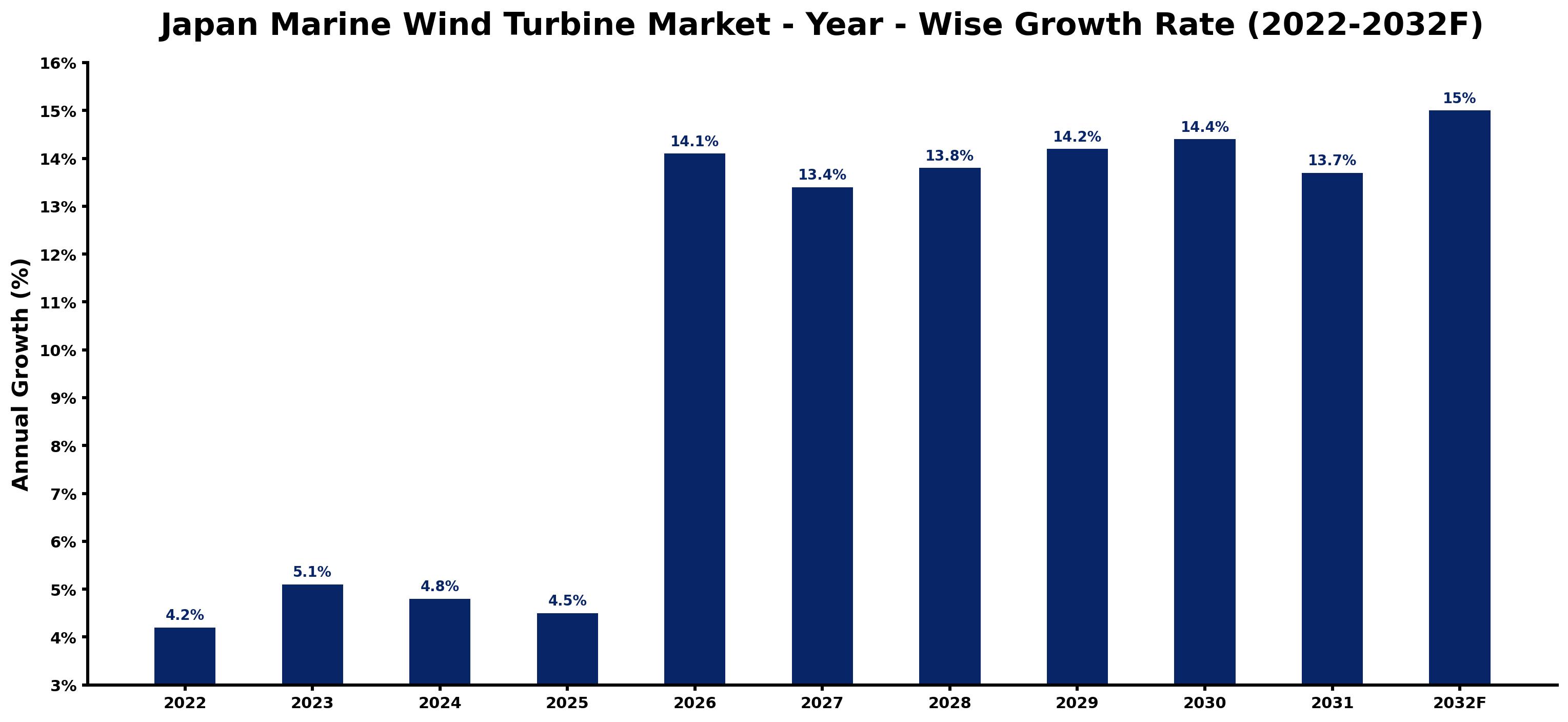
Year by year, the estimates below pair each growth rate with the development that shaped it.
| Year | Estimated Annual Growth (%) | Market Rationale |
| 2022 | 4.2 | The installed capacity reached 1.2 GW, reflecting ongoing investments in offshore wind. |
| 2023 | 5.1 | Growth accelerated due to increased governmental support for renewable energy initiatives. |
| 2024 | 4.8 | A slight slowdown occurred as project completions were delayed by supply chain issues. |
| 2025 | 4.5 | Investment continued but at a slower pace as market adjustments took place. |
| 2026 | 14.1 | A surge in demand is anticipated as new projects begin to materialise. |
| 2027 | 13.4 | Growth will decelerate slightly as the market stabilises post-initial expansion. |
| 2028 | 13.8 | Demand is projected to rise again as technology adoption increases. |
| 2029 | 14.2 | Continued investment in offshore projects is set to drive further growth in this period. |
| 2030 | 14.4 | The government plans to auction 1.5 GW of capacity, boosting market activity. |
| 2031 | 13.7 | Growth will slow as the market matures and competition intensifies. |
| 2032 | 15.0 | A peak in growth is anticipated as the market reaches its capacity targets. |
Note: Market size estimations and growth projections presented in this report are based on 6Wresearch's proprietary forecasting methodology, utilizing the latest available industry data, government publications, and primary research inputs.
Japan Marine Wind Turbine Market Synopsis
Marine wind turbines convert wind energy into electricity and are specifically designed for offshore environments. The Japan Marine Wind Turbine Market is growing due to the government's target of 10 GW of offshore wind capacity by 2030, with substantial investments in the Chiba Prefecture and Tokyo Bay area. The introduction of a new subsidy program for offshore wind development and the establishment of national standards are driving demand. These factors are expected to create thousands of jobs and improve energy security across the country.
Market Dynamics Impact Analysis (2026–2032)
| Factor | Type | Impact | Primary Segment Affected |
| Growing investments in offshore wind projects | Driver | High | Horizontal axis wind turbine |
| Government initiatives promoting renewable energy | Driver | High | Hybrid systems |
| Rising energy demand from Japan's population | Opportunity | High | Single systems |
| Expansion of coastal wind farms in key regions | Opportunity | High | Monopole base |
| Regulatory challenges in project approvals | Restraint | Medium | Hybrid systems |
| High initial capital costs for offshore installations | Restraint | High | Horizontal axis wind turbine |
| Limited supply chain capacity affecting project timelines | Challenge | High | Single systems |
| Technological barriers in deep-water installations | Challenge | Medium | Tripod base |
Evaluation of Drivers in Japan Marine Wind Turbine Market (2026–2032)
Key forces behind demand, with the segment each one moves most, are listed below.
| Drivers | Primary Segment Affected | Why It Matters (Evidence) |
| Increased offshore wind capacity targets | Horizontal axis wind turbine | Japan aims for 10 GW of offshore wind capacity by 2030, driving demand for installations. |
| Government incentives for renewable energy projects | Hybrid systems | The 2023 subsidy program incentivises investments in offshore wind, encouraging hybrid system adoption. |
| Growing energy consumption in coastal regions | Single systems | With a population of approximately 126 million, energy demand is rising, boosting single system installations. |
| Development of national standards for offshore installations | Monopole base | The JIS B 8400 standard builds confidence in offshore projects, promoting monopole base usage. |
| Job creation in offshore wind sectors | Tripod base | Thousands of jobs are expected from offshore projects, increasing demand for tripod base installations. |
Several shifts outside the market lift sales. The Chiba Prefecture is becoming a hub for offshore wind projects, with the installed capacity reaching 1.2 GW in 2022. As Japan's population approaches 126 million, energy demand is rising, leading to increased installations of single systems. The establishment of national standards builds project confidence, further boosting demand for monopole bases.
Evaluation of Restraints in Japan Marine Wind Turbine Market
These are the pressures that could keep growth below its potential.
| Market Restraint | Primary Segment Affected | Why It Matters (Evidence) |
| Regulatory hurdles in securing project approvals | Hybrid systems | Complex approval processes can delay project timelines, impacting hybrid system deployment. |
| High initial capital investment requirements | Horizontal axis wind turbine | The substantial upfront costs deter some investors from entering the offshore wind market. |
| Supply chain limitations affecting material availability | Single systems | Material shortages can cause delays, hindering the growth of single system installations. |
| Technological challenges in deep-water wind farms | Tripod base | The complexities of deep-water installations restrict the adoption of tripod bases in offshore projects. |
| Market competition leading to price pressures | Monopole base | Increased competition can drive down prices, affecting profitability for monopole base producers. |
Japan Marine Wind Turbine Market Challenges
Producers incur high material costs due to the need for advanced components that can endure harsh marine conditions, raising project budgets by over 20% for offshore installations. Limited domestic manufacturing capabilities create supply chain bottlenecks, delaying project timelines and leading to revenue losses for developers, potentially amounting to millions. Workforce skills shortages impede project execution, with estimates suggesting thousands of jobs will remain unfilled, hampering the growth of the offshore wind sector. Outdated technology adoption leads to inefficiencies, costing producers up to 15% in operational performance, ultimately diminishing their market competitiveness.
Trends in the Japan Marine Wind Turbine Market
Several trends are reshaping the Japan Marine Wind Turbine Market; the most important are set out below.
- Shift towards Hybrid Systems: The trend is moving towards hybrid systems that combine multiple renewable sources for efficiency. The 2023 subsidy program is set to encourage this shift, with installations projected to rise by 16.1%.
- Transition from Monopole to Tripod Bases: The market is seeing a transition from monopole bases to tripod bases for deeper waters. This shift began in 2026, with tripod bases projected to grow at 18.0%.
- Emergence of Vertical Axis Wind Turbines: Vertical axis wind turbines are gaining attention for specific applications despite being less common. This trend is expected to grow as projects diversify their technology use.
- Increased Focus on Offshore Job Creation: The emphasis on job creation in coastal regions is reshaping project planning. Offshore projects are expected to create thousands of jobs, boosting local economies.
Investment Opportunities in the Japan Marine Wind Turbine Market
The openings below show where demand in the Japan Marine Wind Turbine Market is visible and how suppliers can enter.
- Partnering with Local Firms for Project Development: A gap exists in local expertise for offshore projects, creating opportunities for joint ventures. The Chiba Prefecture is a prime area for such partnerships.
- Investing in Supply Chain Solutions: With the market projected to grow rapidly, investing in supply chain solutions can meet the rising demand. The offshore wind sector is expanding, requiring efficient supply chains.
- Supplying Advanced Materials for Turbines: There is a growing need for advanced materials that withstand marine conditions. Suppliers focusing on new materials can tap into the expanding offshore wind market.
- Entering the Market through Certification: Certification for offshore installations is essential for market entry. Engaging with the Japan Wind Power Association can facilitate this process.
Government Initiatives in the Japan Marine Wind Turbine Market
The GX Basic Policy, adopted in 2023, aims for JPY 150 trillion in public-private decarbonisation investment over ten years. This initiative provides a clear financial framework for renewable energy projects, including offshore wind, benefiting developers and investors.
In 2023, the government allocated JPY 50 billion to support offshore wind projects, ensuring that developers have access to necessary funding. The Consumer Affairs Agency oversees initiatives that promote renewable energy development.
Future Insight of the Japan Marine Wind Turbine Market
Advancements in turbine technology will reshape demand for efficient offshore wind solutions by 2032, enabling projects to achieve higher energy output. The national standard for offshore wind turbine installations will streamline regulatory processes, benefiting buyers and suppliers. A new subsidy program will stimulate investments, encouraging increased participation in the market and boosting competition. By 2030, Japan aims to achieve 10 GW of offshore wind capacity, significantly advancing the country's renewable energy objectives.
Market Segmentation Analysis
Japan Marine Wind Turbine Market report covers a detailed analysis of the following market segments:
By Product – Single systems Lead, Hybrid systems Expected to Grow Fastest
According to Ravi Bhandari, Research Head at 6Wresearch, Single systems took 64% of product revenue in 2025, more than any other category. Single systems dominate the market because they are specifically designed for standalone energy generation in offshore locations. Their essential role is highlighted by Japan's installed capacity of 1.2 GW in 2022, which reflects their importance in fulfilling energy requirements. The quickest growth will come from Hybrid systems, forecast to expand at a CAGR of 16.1% between 2026 and 2032. The growth of hybrid systems is propelled by the increasing need for enhanced efficiency through integration with other renewable sources. The introduction of a new subsidy programme in 2023 is expected to accelerate the development of this segment. This means suppliers should focus on developing hybrid solutions to meet the evolving market demands.
By Axis – Vertical axis wind turbine Leads, Horizontal axis wind turbine Expected to Grow Fastest
In 2025, Vertical axis wind turbine led the axis split with a 64% share. Vertical axis wind turbines hold a smaller share as they are less common in marine applications compared to their horizontal counterparts. Their limited use in offshore wind farms reflects the preference for designs that maximise energy capture. Over 2026–2032, Horizontal axis wind turbine is expected to post the fastest growth, at a CAGR of 17.6%. Horizontal axis wind turbines are experiencing rapid growth due to their dominance in offshore wind farm designs, which are being prioritised in new projects. The government's auction plans for 1.5 GW of capacity by 2025 will likely favour this design. Suppliers should prioritise horizontal axis designs to align with market trends and government initiatives.
By Base – Monopole base Leads, Tripod base Expected to Grow Fastest
The largest base category in 2025 was Monopole base, at 60% of revenue. Monopole bases are widely used due to their stability in shallow waters, making them vital for numerous offshore installations. Their prevalence is particularly notable in the Chiba Prefecture, where major offshore projects are underway. Tripod base is projected to grow fastest, at a CAGR of 18.0% during 2026–2032. Tripod bases are gaining traction as they are better suited for deeper waters, which are becoming a target for new offshore developments. The government's plan to auction 1.5 GW of capacity by 2025 highlights the growing potential for this base type. This indicates that suppliers should consider expanding their offerings to include tripod bases for deeper water applications.
Key Attractiveness of the Report
- 10 Years of Market Numbers
- Historical Data Starting from 2022 to 2025
- Base Year 2025
- Forecast Data until 2032
- Key Performance Indicators Impacting the Market
- Major Upcoming Developments and Projects
Key Highlights of the Report:
- Japan Marine Wind Turbine Market Outlook
- Market Size of Japan Marine Wind Turbine Market, 2025
- Forecast of Japan Marine Wind Turbine Market, 2032
- Historical Data and Forecast of Japan Marine Wind Turbine Revenues & Volume for the Period 2022-2032
- Japan Marine Wind Turbine Market Trend Evolution
- Japan Marine Wind Turbine Market Drivers and Challenges
- Japan Marine Wind Turbine Price Trends
- Japan Marine Wind Turbine Porter's Five Forces
- Japan Marine Wind Turbine Industry Life Cycle
- Historical Data and Forecast of Japan Marine Wind Turbine Market Revenues & Volume By Product for the Period 2022-2032
- Historical Data and Forecast of Japan Marine Wind Turbine Market Revenues & Volume By Single systems for the Period 2022-2032
- Historical Data and Forecast of Japan Marine Wind Turbine Market Revenues & Volume By Hybrid systems for the Period 2022-2032
- Historical Data and Forecast of Japan Marine Wind Turbine Market Revenues & Volume By Axis for the Period 2022-2032
- Historical Data and Forecast of Japan Marine Wind Turbine Market Revenues & Volume By Vertical axis wind turbine for the Period 2022-2032
- Historical Data and Forecast of Japan Marine Wind Turbine Market Revenues & Volume By Horizontal axis wind turbine for the Period 2022-2032
- Historical Data and Forecast of Japan Marine Wind Turbine Market Revenues & Volume By Base for the Period 2022-2032
- Historical Data and Forecast of Japan Marine Wind Turbine Market Revenues & Volume By Monopole base for the Period 2022-2032
- Historical Data and Forecast of Japan Marine Wind Turbine Market Revenues & Volume By Tripod base for the Period 2022-2032
- Japan Marine Wind Turbine Import Export Trade Statistics
- Market Opportunity Assessment By Product
- Market Opportunity Assessment By Axis
- Market Opportunity Assessment By Base
- Japan Marine Wind Turbine Top Companies Market Share
- Japan Marine Wind Turbine Competitive Benchmarking By Technical and Operational Parameters
- Japan Marine Wind Turbine Company Profiles
- Japan Marine Wind Turbine Key Strategic Recommendations
Market Covered
This report examines the market across the segments below.
By Product
- Single systems
- Hybrid systems
By Axis
- Vertical axis wind turbine
- Horizontal axis wind turbine
By Base
- Monopole base
- Tripod base































