Japan Medical Cannula Market Size & Growth Rate
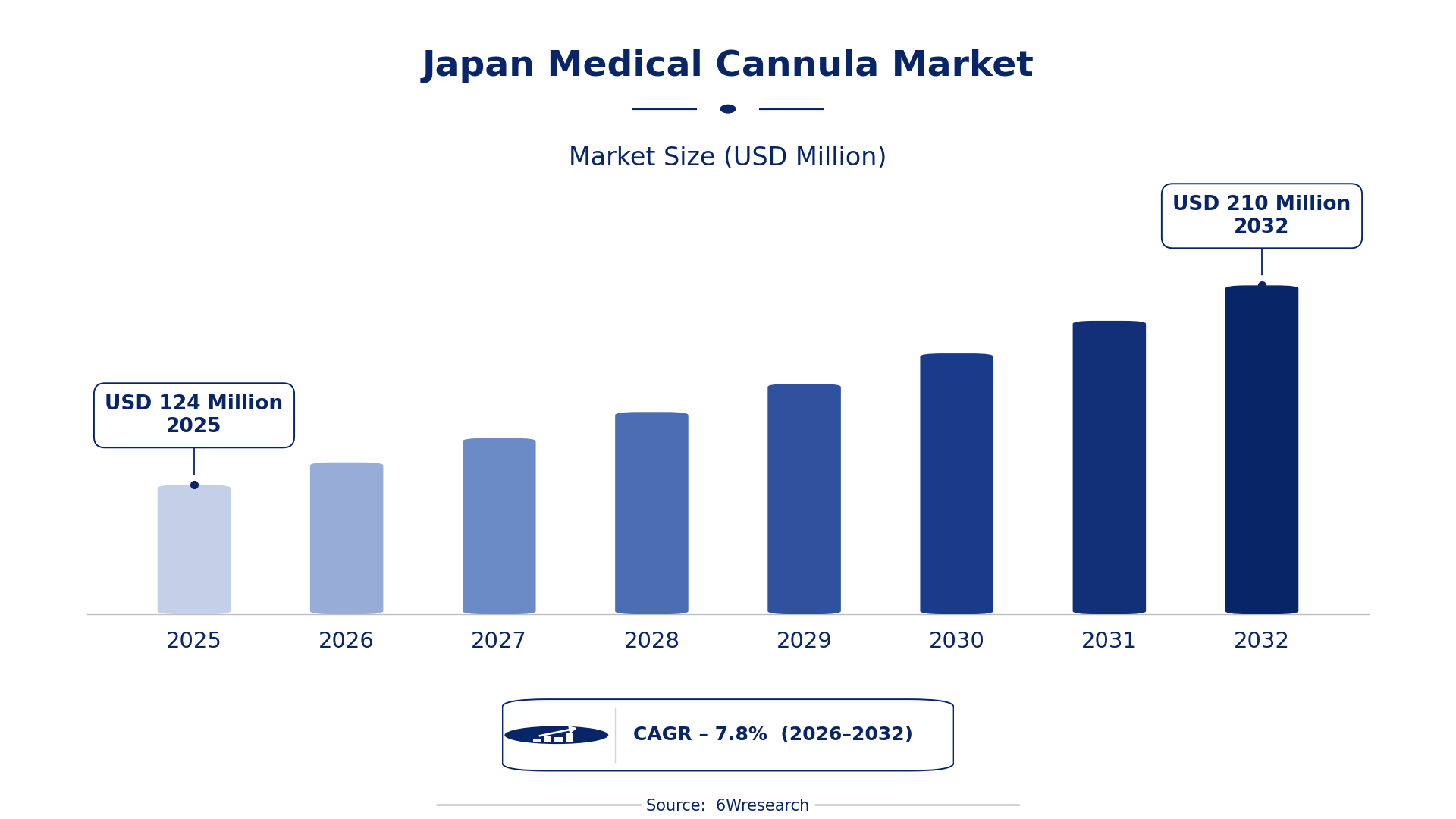
According to 6Wresearch internal database and industry insights, the Japan Medical Cannula Market was valued at USD 124 Million in 2025 and is projected to reach USD 210 Million by 2032, growing at a CAGR of approximately 7.8% during 2026–2032.
Japan Medical Cannula Market Highlights
| Report Metric | Details |
| Report Name | Japan Medical Cannula Market (2026-2032) |
| Market Size 2025 | USD 124 Million |
| Market Size 2032 | USD 210 Million |
| Absolute Growth 2025–2032 | USD 86 Million |
| CAGR 2026–2032 | 7.8% |
| Peak Annual Growth | 8.6% in 2032 |
| Forecast Period | 2026–2032 |
| Historical Data | 2022–2025 |
| Base Year | 2025 |
| Leading Product Type, 2025 | Cardiac Cannula (38% share) |
| Leading Type, 2025 | Neonatal (35% share) |
| Leading Medical Procedure, 2025 | Vascular Access (42% share) |
| Leading Size, 2025 | 14G (39% share) |
| Leading Material, 2025 | Latex (45% share) |
| Fastest-Growing Product Type | Vascular Cannula (11.1% CAGR) |
| Fastest-Growing Type | Straight (11.4% CAGR) |
| Fastest-Growing Medical Procedure | Surgery (10.4% CAGR) |
| Fastest-Growing Size | 16G (10.5% CAGR) |
| Fastest-Growing Material | Latex-Free (10.8% CAGR) |
| Growing Sector | Surgical Procedures |
| Key End Users | Hospitals, Clinics, Neonatal Intensive Care Units, Surgical Centres |
Japan Medical Cannula Market Year-wise Growth Rate and Key Drivers (2022–2032)
This graph illustrates the annual growth rates of the market from 2022 to 2032, highlighting a steady upward trajectory and projected market expansion over the forecast period.
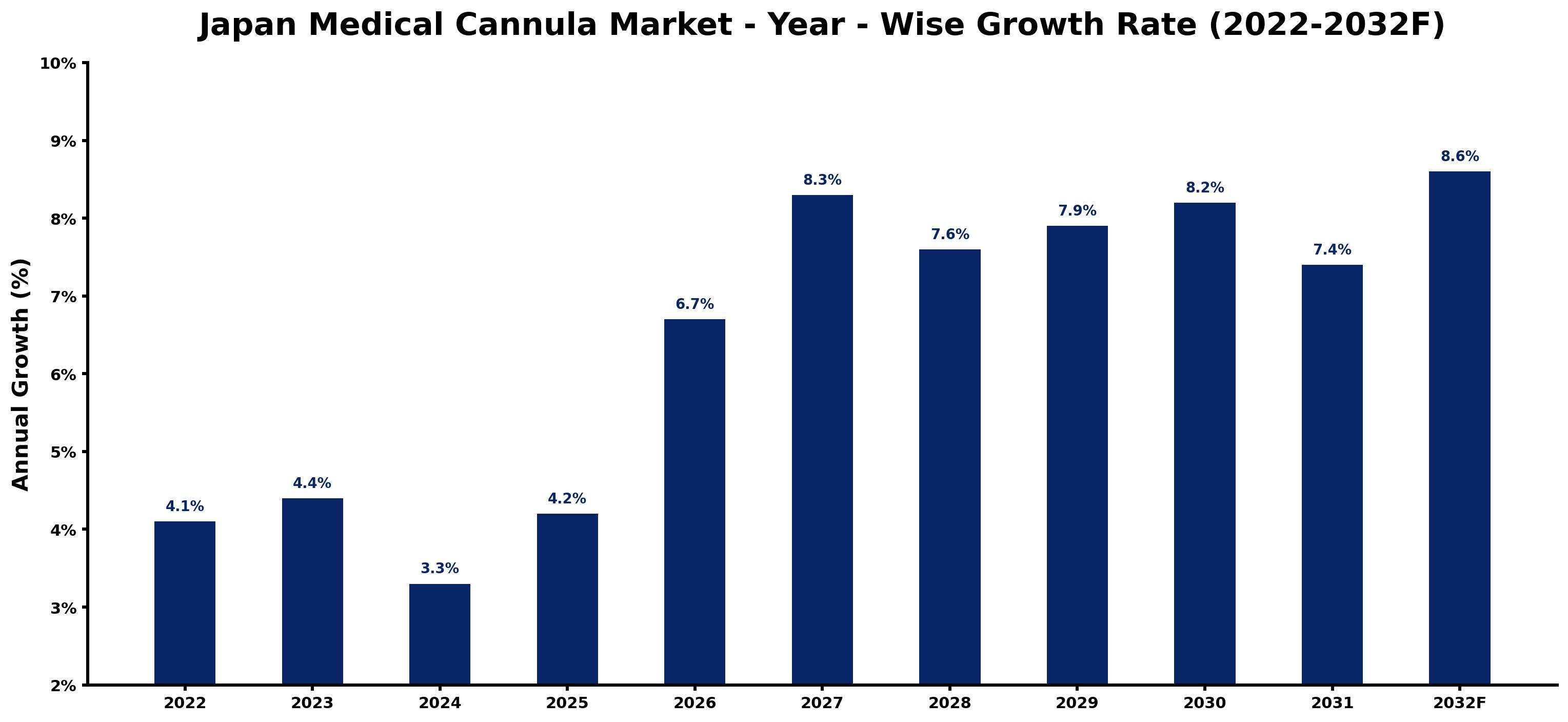
The table below sets out the estimated growth rate for each year and the main factor behind it.
| Year | Estimated Annual Growth (%) | Market Rationale |
| 2022 | 4.1 | Market conditions showed steady demand from hospitals and clinics, reflecting ongoing healthcare needs. |
| 2023 | 4.4 | Growth was driven by increased surgical procedures and a rising elderly population requiring medical interventions. |
| 2024 | 3.3 | A slowdown occurred as the market adjusted to previous growth rates and changing healthcare dynamics. |
| 2025 | 4.2 | Demand accelerated again due to advancements in medical technology and increased vascular access procedures. |
| 2026 | 6.7 | Growth surged as hospitals expanded their capabilities to meet rising patient needs and chronic disease management. |
| 2027 | 8.3 | An increase in procedures and investments in healthcare infrastructure contributed to significant growth. |
| 2028 | 7.6 | The market experienced a slowdown as growth stabilised following rapid expansions in previous years. |
| 2029 | 7.9 | Demand picked up again, driven by an ageing population and the need for more vascular access. |
| 2030 | 8.2 | Continued advancements in medical devices and procedures supported a rise in market activity. |
| 2031 | 7.4 | A slight slowdown occurred as the market adjusted to saturation in certain segments. |
| 2032 | 8.6 | Growth peaked as innovations in medical technology and rising healthcare expenditure drove demand. |
Note: Market size estimations and growth projections presented in this report are based on 6Wresearch's proprietary forecasting methodology, utilizing the latest available industry data, government publications, and primary research inputs.
Japan Medical Cannula Market Synopsis
Medical cannulas are hollow tubes crucial for delivering or withdrawing fluids in various medical procedures. In Japan, the demand for these devices is driven by a large elderly population, with 29.3% aged 65 or older as of September 2024, and over 1,000 hospitals employing them. The market is expanding due to a rise in surgical procedures, expected to surpass 10 million annually, alongside an increase in vascular access needs spurred by chronic diseases. Investment in healthcare infrastructure and adherence to quality standards like ISO 13485 further improve market prospects.
Market Dynamics Impact Analysis (2026–2032)
| Factor | Type | Impact | Primary Segment Affected |
| Rising elderly population requiring medical procedures | Driver | High | Vascular Access |
| Technological advancements in medical devices | Driver | High | Surgery |
| Increasing number of surgical procedures performed annually | Opportunity | High | Surgery |
| Growing demand for neonatal care | Opportunity | Medium | Neonatal |
| Regulatory compliance costs for manufacturers | Restraint | High | Vascular Access |
| Competition from alternative medical devices | Restraint | Medium | Surgery |
| High costs associated with advanced medical technologies | Challenge | High | Vascular Access |
| Shortage of skilled healthcare professionals | Challenge | Medium | Surgery |
Evaluation of Drivers in Japan Medical Cannula Market (2026–2032)
The table below links each growth driver to the segment it affects and the evidence for it.
| Drivers | Primary Segment Affected | Why It Matters (Evidence) |
| Increased surgical procedures due to an ageing population | Surgery | Surgical procedures in Japan reached over 10 million annually, driving demand for cannulas in hospitals. |
| Technological advancements in medical devices | Vascular Access | The adoption of ISO 13485 in 2023 ensures quality management, encouraging hospitals to purchase more cannulas. |
| Growing prevalence of chronic diseases | Vascular Access | An increase in chronic disease cases leads to a projected 5% annual rise in vascular access procedures. |
| Expansion of neonatal intensive care units | Neonatal | Neonatal cannulas are essential in over 50% of neonatal intensive care units, driving demand. |
| Rising healthcare expenditure | Surgery | Japan's national medical care expenditure was about JPY 46.7 trillion in fiscal 2022, supporting medical device purchases. |
Buyers are adding capacity as the number of surgical procedures continues to rise, with over 10 million performed annually in Japan. The increasing prevalence of chronic diseases, particularly among the elderly, drives demand for vascular access, projected to grow by 5% annually. Technological advancements ensure quality management systems, prompting hospitals to invest more in medical cannulas. The expansion of neonatal intensive care units, where cannulas are essential, further boosts market demand. Overall, healthcare expenditure of approximately JPY 46.7 trillion supports these trends.
Evaluation of Restraints in Japan Medical Cannula Market
These are the pressures that could keep growth below its potential.
| Market Restraint | Primary Segment Affected | Why It Matters (Evidence) |
| High costs associated with regulatory compliance | Vascular Access | Manufacturers incur substantial expenses to meet standards set by the PMDA, impacting pricing strategies. |
| Competition from alternative medical devices | Surgery | The presence of various alternatives in the market may limit cannula sales in surgical applications. |
| Limited availability of skilled healthcare professionals | Surgery | A shortage of trained personnel can delay procedures, reducing the demand for cannulas. |
| Increasing material costs for production | Vascular Access | Rising costs of latex and latex-free materials can affect profit margins for manufacturers. |
| Market saturation in certain sub-segments | Neonatal | An oversupply of specific cannula types may lead to price competition and reduced profitability. |
Japan Medical Cannula Market Challenges
Hospitals are encountering rising costs for medical cannulas as surgical procedures exceed 10 million annually, placing pressure on their budgets. Compliance with regulations from the Ministry of Health, Labour and Welfare complicates product approvals, causing delays for suppliers of up to six months. Intense competition from imports forces local producers to lower prices, which can significantly impact profit margins. Training gaps within the healthcare workforce result in inadequate preparation for new medical devices, increasing the risk of complications for patients and potential liabilities for clinics.
Trends in the Japan Medical Cannula Market
These developments are changing demand patterns in the Japan Medical Cannula Market.
- Shift from Latex to Latex-Free Materials: The movement towards latex-free medical cannulas began in 2023, spurred by safety concerns. Approximately 55% of hospitals have transitioned to latex-free options, reflecting a growing commitment to patient safety.
- Transition to Advanced Surgical Techniques: Since 2024, there has been a marked shift towards minimally invasive surgical techniques. This change is evident in the increased use of arthroscopy cannulas, which are essential for these procedures, demonstrating a 10% rise in demand.
- Emergence of Neonatal Cannulas in Intensive Care: Neonatal cannulas have gained importance in intensive care units since 2023, with over 50% of such units utilising them. This trend highlights a growing emphasis on specialised care for infants, driving demand in this segment.
- Growing Adoption of ISO Standards: The adoption of ISO 13485 in 2023 has had a notable impact on the medical cannula market. Hospitals are prioritising compliance with this standard, resulting in increased demand for certified products.
Investment Opportunities in the Japan Medical Cannula Market
Where to invest in the Japan Medical Cannula Market: the main openings are set out below.
- Gap in Neonatal Cannula Supply: With over 50% of neonatal intensive care units requiring specialised cannulas, a supply gap exists. Manufacturers can enter this market by collaborating with local healthcare providers to address this demand.
- Investment in Surgical Infrastructure: Japan's healthcare expenditure of JPY 46.7 trillion offers an opportunity for suppliers of surgical cannulas. Partnering with hospitals to improve surgical facilities can lead to increased sales.
- Demand for Latex-Free Options: As the preference for latex-free materials rises, manufacturers can invest in producing these alternatives. Hospitals focused on patient safety are increasingly seeking latex-free cannulas, creating a promising market.
- Expansion of Vascular Access Procedures: With a projected 5% annual increase in vascular access procedures, there is a strong opportunity for suppliers. Engaging with healthcare facilities to provide advanced vascular access solutions can yield substantial returns.
Government Initiatives in the Japan Medical Cannula Market
The Next-Generation Medical Infrastructure Act, enacted in 2017, complements earlier regulations by permitting anonymisation of medical data for research. This measure supports the development of new medical devices, including cannulas, by facilitating data-driven insights into patient care and device efficacy. The act aims to improve the quality of medical services and promotes the use of advanced technologies in healthcare.
Healthcare providers, including hospitals and clinics, utilise the PMDA's approval scheme to ensure compliance with medical device standards. This process guarantees that medical cannulas meet safety and efficacy requirements, allowing buyers to trust the products they procure. The PMDA reviews over 1,000 medical devices annually, ensuring they adhere to stringent safety standards.
Future Insight of the Japan Medical Cannula Market
By 2032, new healthcare facilities will be established, improving access to medical services and driving demand for cannulas. A government initiative from 2023 will support the development of advanced medical devices, encouraging innovation in the sector. The adoption of JIS T 0601 will elevate safety standards, providing buyers with more reliable products. Vascular access procedures are projected to increase by 5% annually, compelling suppliers to enhance production processes to accommodate this growth.
Market Segmentation Analysis
Japan Medical Cannula Market report covers a detailed analysis of the following market segments:
By Product Type – Cardiac Cannula Leads, Vascular Cannula Expected to Grow Fastest
According to Dhaval Chaurasia, Assistant Manager at 6Wresearch, with 38% of product type revenue in 2025, Cardiac Cannula was the largest category. Cardiac cannulas are vital in cardiac surgeries, which are prevalent in Japan's healthcare system. Their critical role in these high-stakes procedures, particularly in major hospitals, ensures a strong and consistent demand. Vascular Cannula is set to record the highest CAGR in this split, 11.1% over 2026–2032. Vascular cannulas are rapidly growing as vascular access procedures are set to rise by 5% annually, driven by the increasing number of patients requiring treatment. Their essential function in patient care makes them indispensable in healthcare facilities, further boosting their adoption. Suppliers should prioritise the development of vascular cannulas to capitalise on the increasing demand in the healthcare sector.
By Type – Neonatal Leads, Straight Expected to Grow Fastest
Neonatal accounted for 35% of the market by type in 2025. Neonatal cannulas lead the market as they are essential in over 50% of neonatal intensive care units, catering to the specific needs of vulnerable infants. Their widespread use in specialised care environments reinforces their dominant position. Straight is projected to grow fastest, at a CAGR of 11.4% during 2026–2032. Straight cannulas are witnessing rapid growth due to their versatile design, suitable for a variety of medical applications. This adaptability enhances their popularity among healthcare providers, contributing to their swift market expansion. Buyers may find value in a broader selection of straight cannula options to improve procedural efficiency.
By Medical Procedure – Vascular Access Leads, Surgery Expected to Grow Fastest
Vascular Access held 42% of the Japan Medical Cannula Market by medical procedure in 2025. Vascular access procedures dominate the market, being critical for patient treatment, especially for those needing regular medical interventions. The high frequency of these procedures in hospitals highlights their importance within the medical framework. Over 2026–2032, Surgery is expected to post the fastest growth, at a CAGR of 10.4%. Surgical procedures are the fastest-growing segment, with over 10 million surgeries performed annually, significantly increasing the demand for various types of cannulas. Their crucial role in surgical environments guarantees continued growth in this area. Suppliers should align their product development strategies with the rising surgical demand to seize market opportunities.
By Size – 14G Leads, 16G Expected to Grow Fastest
In 2025, 14G led the size split with a 39% share. 14G cannulas are widely used for blood transfusions, making them the preferred choice in many medical settings. Their commonality in procedures contributes to their leading market share and reflects their reliability in critical applications. The quickest growth will come from 16G, forecast to expand at a CAGR of 10.5% between 2026 and 2032. 16G cannulas are seeing the fastest growth due to their standard size applicability in various procedures, making them a versatile option for healthcare providers. This adaptability is likely to drive further adoption across different medical settings. Buyers should consider the benefits of 16G cannulas for their procedural flexibility.
By Material – Latex Leads, Latex-Free Expected to Grow Fastest
The largest material category in 2025 was Latex, at 45% of revenue. Latex cannulas maintain the largest share as they are the traditional material used in medical applications, ensuring reliability in various procedures. Their established presence in the market supports their leading position. Latex-Free is set to record the highest CAGR in this split, 10.8% over 2026–2032. Latex-free cannulas are rapidly gaining traction as a growing preference for safety drives demand among healthcare providers. The shift towards latex-free options is likely to continue as awareness of allergies increases. Suppliers should prioritise latex-free options to cater to the changing preferences of healthcare facilities.
Key Attractiveness of the Report
- 10 Years of Market Numbers
- Historical Data Starting from 2022 to 2025
- Base Year 2025
- Forecast Data until 2032
- Key Performance Indicators Impacting the Market
- Major Upcoming Developments and Projects
Key Highlights of the Report:
- Japan Medical Cannula Market Outlook
- Market Size of Japan Medical Cannula Market, 2025
- Forecast of Japan Medical Cannula Market, 2032
- Historical Data and Forecast of Japan Medical Cannula Revenues & Volume for the Period 2022-2032
- Japan Medical Cannula Market Trend Evolution
- Japan Medical Cannula Market Drivers and Challenges
- Japan Medical Cannula Price Trends
- Japan Medical Cannula Porter's Five Forces
- Japan Medical Cannula Industry Life Cycle
- Historical Data and Forecast of Japan Medical Cannula Market Revenues & Volume By Product Type for the Period 2022-2032
- Historical Data and Forecast of Japan Medical Cannula Market Revenues & Volume By Cardiac Cannula for the Period 2022-2032
- Historical Data and Forecast of Japan Medical Cannula Market Revenues & Volume By Vascular Cannula for the Period 2022-2032
- Historical Data and Forecast of Japan Medical Cannula Market Revenues & Volume By Arthroscopy Cannula for the Period 2022-2032
- Historical Data and Forecast of Japan Medical Cannula Market Revenues & Volume By Dermatology Cannula for the Period 2022-2032
- Historical Data and Forecast of Japan Medical Cannula Market Revenues & Volume By Nasal Cannula for the Period 2022-2032
- Historical Data and Forecast of Japan Medical Cannula Market Revenues & Volume By Type for the Period 2022-2032
- Historical Data and Forecast of Japan Medical Cannula Market Revenues & Volume By Neonatal for the Period 2022-2032
- Historical Data and Forecast of Japan Medical Cannula Market Revenues & Volume By Straight for the Period 2022-2032
- Historical Data and Forecast of Japan Medical Cannula Market Revenues & Volume By Winged for the Period 2022-2032
- Historical Data and Forecast of Japan Medical Cannula Market Revenues & Volume By Wing with Port for the Period 2022-2032
- Historical Data and Forecast of Japan Medical Cannula Market Revenues & Volume By Winged with Stop Cork for the Period 2022-2032
- Historical Data and Forecast of Japan Medical Cannula Market Revenues & Volume By Medical Procedure for the Period 2022-2032
- Historical Data and Forecast of Japan Medical Cannula Market Revenues & Volume By Vascular Access for the Period 2022-2032
- Historical Data and Forecast of Japan Medical Cannula Market Revenues & Volume By Surgery for the Period 2022-2032
- Historical Data and Forecast of Japan Medical Cannula Market Revenues & Volume By Intubation for the Period 2022-2032
- Historical Data and Forecast of Japan Medical Cannula Market Revenues & Volume By Lipofilling for the Period 2022-2032
- Historical Data and Forecast of Japan Medical Cannula Market Revenues & Volume By Suction for the Period 2022-2032
- Historical Data and Forecast of Japan Medical Cannula Market Revenues & Volume By Size for the Period 2022-2032
- Historical Data and Forecast of Japan Medical Cannula Market Revenues & Volume By 14G for the Period 2022-2032
- Historical Data and Forecast of Japan Medical Cannula Market Revenues & Volume By 16G for the Period 2022-2032
- Historical Data and Forecast of Japan Medical Cannula Market Revenues & Volume By 18G for the Period 2022-2032
- Historical Data and Forecast of Japan Medical Cannula Market Revenues & Volume By 20G for the Period 2022-2032
- Historical Data and Forecast of Japan Medical Cannula Market Revenues & Volume By 22G for the Period 2022-2032
- Historical Data and Forecast of Japan Medical Cannula Market Revenues & Volume By Material for the Period 2022-2032
- Historical Data and Forecast of Japan Medical Cannula Market Revenues & Volume By Latex for the Period 2022-2032
- Historical Data and Forecast of Japan Medical Cannula Market Revenues & Volume By Latex-Free for the Period 2022-2032
- Historical Data and Forecast of Japan Medical Cannula Market Revenues & Volume By Neoprene for the Period 2022-2032
- Historical Data and Forecast of Japan Medical Cannula Market Revenues & Volume By End Users for the Period 2022-2032
- Historical Data and Forecast of Japan Medical Cannula Market Revenues & Volume By Hospitals for the Period 2022-2032
- Historical Data and Forecast of Japan Medical Cannula Market Revenues & Volume By Ambulatory Surgical Center for the Period 2022-2032
- Historical Data and Forecast of Japan Medical Cannula Market Revenues & Volume By Clinics for the Period 2022-2032
- Japan Medical Cannula Import Export Trade Statistics
- Market Opportunity Assessment By Product Type
- Market Opportunity Assessment By Type
- Market Opportunity Assessment By Medical Procedure
- Market Opportunity Assessment By Size
- Market Opportunity Assessment By Material
- Market Opportunity Assessment By End Users
- Japan Medical Cannula Top Companies Market Share
- Japan Medical Cannula Competitive Benchmarking By Technical and Operational Parameters
- Japan Medical Cannula Company Profiles
- Japan Medical Cannula Key Strategic Recommendations
Market Covered
Coverage by segment is as follows.
By Product Type
- Cardiac Cannula
- Vascular Cannula
- Arthroscopy Cannula
- Dermatology Cannula
- Nasal Cannula
By Type
- Neonatal
- Straight
- Winged
- Wing with Port
- Winged with Stop Cork
By Medical Procedure
- Vascular Access
- Surgery
- Intubation
- Lipofilling
- Suction
By Size
- 14G
- 16G
- 18G
- 20G
- 22G
By Material
- Latex
- Latex-Free
- Neoprene































