Japan Medical Telepresence Robots Market Size & Growth Rate
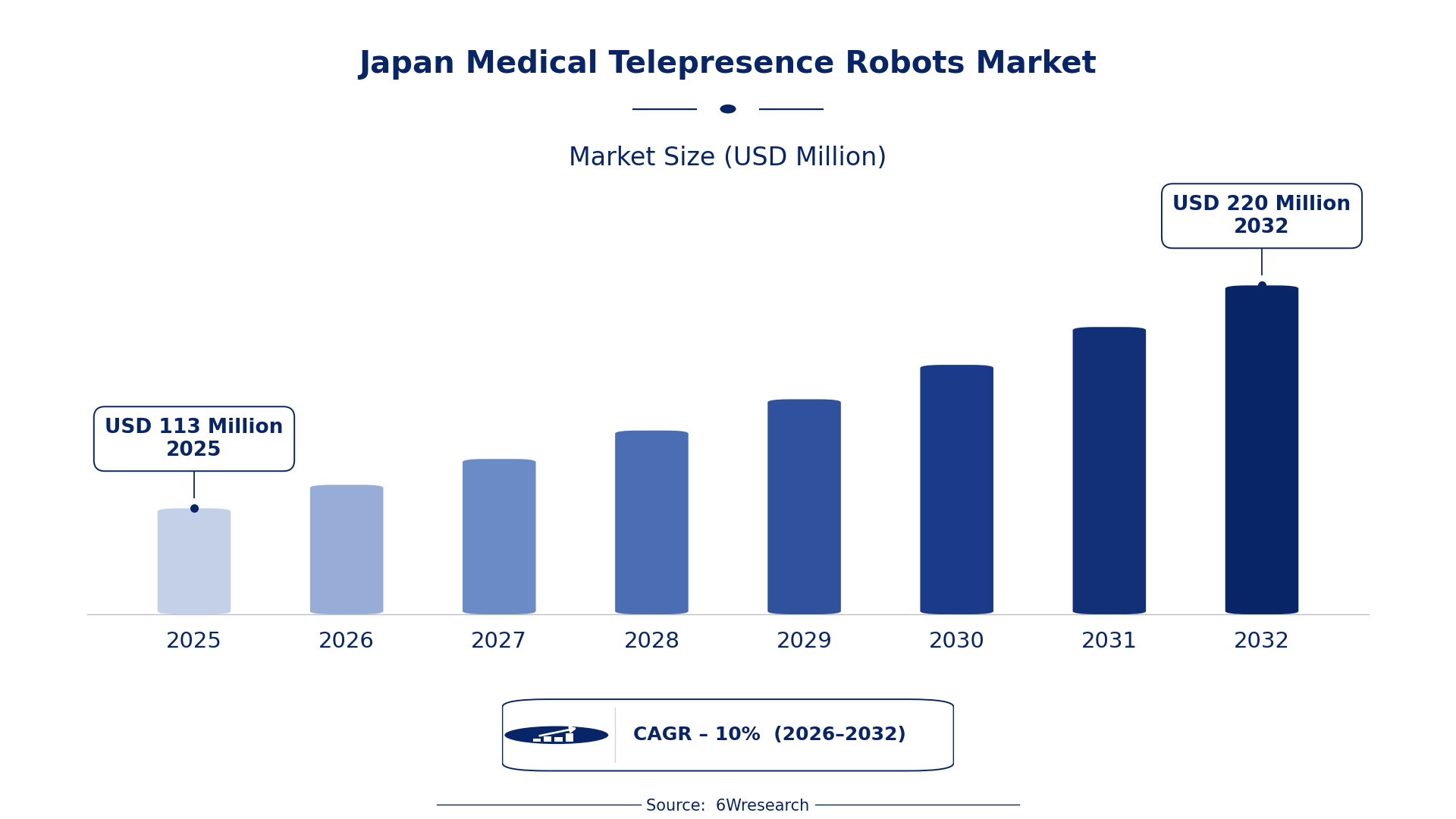
According to 6Wresearch internal database and industry insights, the Japan Medical Telepresence Robots Market was valued at USD 113 Million in 2025 and is projected to reach USD 220 Million by 2032, growing at a CAGR of approximately 10% during 2026–2032.
Japan Medical Telepresence Robots Market Highlights
| Report Metric | Details |
| Report Name | Japan Medical Telepresence Robots Market (2026-2032) |
| Market Size 2025 | USD 113 Million |
| Market Size 2032 | USD 220 Million |
| Absolute Growth 2025–2032 | USD 107 Million |
| CAGR 2026–2032 | 10% |
| Peak Annual Growth | 11.4% in 2032 |
| Forecast Period | 2026–2032 |
| Historical Data | 2022–2025 |
| Base Year | 2025 |
| Leading Type, 2025 | Mobile (67% share) |
| Leading Component, 2025 | Camera (33% share) |
| Leading End-use, 2025 | Hospitals & Assisted Living Facilities (58% share) |
| Fastest-Growing Component | Display (15.2% CAGR) |
| Fastest-Growing End-use | Home Use (12.7% CAGR) |
| Growing Sector | Hospitals & Assisted Living Facilities |
| Key End Users | Hospitals, assisted living facilities, home care providers, telehealth services |
Japan Medical Telepresence Robots Market Year-wise Growth Rate and Key Drivers (2022–2032)
This graph illustrates the annual growth rates of the market from 2022 to 2032, highlighting a steady upward trajectory and projected market expansion over the forecast period.
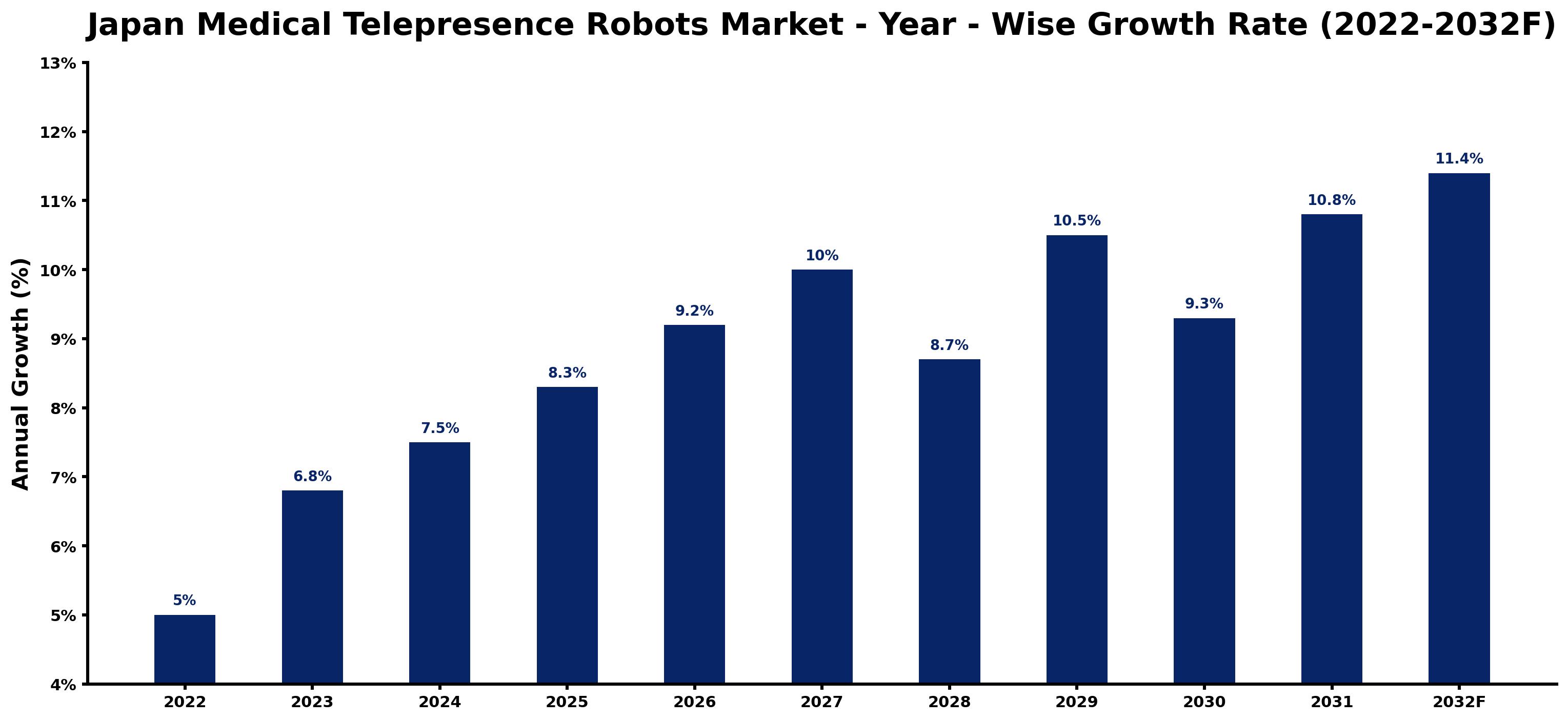
The yearly estimates that follow link every growth rate to its principal driver, so readers can see why the pace changed in each period.
| Year | Estimated Annual Growth (%) | Market Rationale |
| 2022 | 5.0 | The market showed steady growth as healthcare facilities began integrating telepresence solutions into their operations. |
| 2023 | 6.8 | Demand increased as hospitals adopted telemedicine practices to improve patient care and accessibility. |
| 2024 | 7.5 | The rise in remote consultations drove further adoption of telepresence robots in various healthcare settings. |
| 2025 | 8.3 | Healthcare investments peaked, leading to the highest growth rate in the market's history due to increased funding. |
| 2026 | 9.2 | The expansion of telehealth initiatives is expected to boost demand for telepresence solutions across the country. |
| 2027 | 10.0 | Healthcare providers increasingly seek technology to enhance patient engagement and monitoring capabilities. |
| 2028 | 8.7 | Growth is projected to slow slightly as market saturation begins to take effect in urban areas. |
| 2029 | 10.5 | Demand is expected to surge again as rural healthcare facilities expand their telehealth capabilities. |
| 2030 | 9.3 | Market growth is projected to decelerate as competition intensifies among technology providers. |
| 2031 | 10.8 | Continued investments in healthcare technology will drive a resurgence in demand for telepresence robots. |
| 2032 | 11.4 | The market is expected to peak as advancements in robotics technology unlock new applications. |
Note: Market size estimations and growth projections presented in this report are based on 6Wresearch's proprietary forecasting methodology, utilizing the latest available industry data, government publications, and primary research inputs.
Japan Medical Telepresence Robots Market Synopsis
Medical telepresence robots are advanced systems facilitating remote healthcare delivery through real-time interaction. They are primarily used in hospitals and assisted living facilities for remote consultations and patient monitoring. The Japan Medical Telepresence Robots Market is growing due to an aging population, with 29.3% aged 65 or older, and increased healthcare expenditure, which reached JPY 46.7 trillion in 2022. The Ministry of Health, Labour and Welfare has promoted telemedicine initiatives since 2020, further driving demand for these solutions.
Market Dynamics Impact Analysis (2026–2032)
| Factor | Type | Impact | Primary Segment Affected |
| Aging population driving demand for remote healthcare solutions | Driver | High | Mobile |
| Increased healthcare expenditure facilitating technology investments | Driver | High | Camera |
| Growing adoption of telehealth in rural areas | Opportunity | High | Hospitals & Assisted Living Facilities |
| Rising number of elderly individuals requiring home care services | Opportunity | High | Home Use |
| High initial investment costs for telepresence systems | Restraint | Medium | Mobile |
| Limited awareness among smaller healthcare facilities | Restraint | Medium | Camera |
| Competition from alternative telehealth solutions | Challenge | Medium | Hospitals & Assisted Living Facilities |
| Technological integration challenges in existing healthcare systems | Challenge | Medium | Home Use |
Evaluation of Drivers in Japan Medical Telepresence Robots Market (2026–2032)
Key forces behind demand, with the segment each one moves most, are listed below.
| Drivers | Primary Segment Affected | Why It Matters (Evidence) |
| Aging population increasing demand for healthcare services | Mobile | 29.3% of Japan's population was aged 65 or older in September 2024, leading to a need for remote healthcare solutions. |
| Rising healthcare expenditure supporting technology adoption | Camera | Japan's national medical care expenditure was about JPY 46.7 trillion in fiscal 2022, encouraging healthcare facilities to invest in telepresence robots. |
| Expansion of telemedicine initiatives enhancing service accessibility | Display | The Ministry of Health, Labour and Welfare has promoted telemedicine since 2020, increasing the need for telepresence robots. |
| Growing number of telehealth consultations driving demand | Microphone | In 2022, approximately 2 million telehealth consultations were conducted in Japan, boosting the need for effective communication tools. |
| Increased funding for healthcare technology fostering innovation | Speaker | Government funding for healthcare technology reached ¥50 billion in 2023, supporting advancements in telepresence solutions. |
Buyers are adding capacity as the aging population drives demand for remote healthcare solutions. With approximately 29.3% of Japan's population aged 65 or older, investments in telepresence robots are rising. Increased healthcare expenditure, reaching JPY 46.7 trillion in fiscal 2022, supports technology adoption across hospitals. Funding for healthcare technology reached ¥50 billion in 2023, supporting advancements in telepresence solutions.
Evaluation of Restraints in Japan Medical Telepresence Robots Market
The main factors holding the market back are set out below.
| Market Restraint | Primary Segment Affected | Why It Matters (Evidence) |
| High initial investment costs for telepresence systems | Mobile | The cost of implementing telepresence robots can be prohibitive for smaller healthcare facilities, limiting their adoption and resulting in a slower market growth rate. |
| Limited awareness among smaller healthcare facilities | Camera | Many smaller facilities remain unaware of the benefits of telepresence technology, hindering market growth and leading to missed opportunities for suppliers. |
| Competition from alternative telehealth solutions | Hospitals & Assisted Living Facilities | The presence of various telehealth options can divert attention from telepresence robots, affecting sales and limiting market penetration. |
| Technological integration challenges in existing healthcare systems | Home Use | Integrating telepresence robots with current healthcare IT systems can be complex, delaying adoption and increasing operational costs for healthcare providers. |
| Regulatory hurdles for new medical devices | Mobile | Navigating the approval process for telepresence robots can slow market entry for new products and increase time to market. |
Japan Medical Telepresence Robots Market Challenges
In rural areas, hospitals face challenges in adopting telepresence robots due to poor internet connectivity, which delays remote consultations and raises operational costs for healthcare providers. A shortage of skilled technicians complicates robot deployment, forcing buyers to invest more in training, which can extend up to six months. Many producers struggle to meet ISO 13485 standards, leading to increased compliance costs that can reach JPY 10 million per product. Intense competition among suppliers creates price wars, squeezing profit margins and making it difficult for buyers to secure high-quality devices.
Trends in the Japan Medical Telepresence Robots Market
Below are the shifts with the largest effect on the Japan Medical Telepresence Robots Market.
- Growing Adoption of Telemedicine: Healthcare providers are increasingly embracing telemedicine solutions, particularly in rural areas. Telehealth consultations reached approximately 2 million in 2022, indicating a growing trend towards remote healthcare delivery.
- Focus on Patient Monitoring Technologies: Hospitals are prioritising technologies that enhance patient monitoring capabilities. The Tokyo region is leading in healthcare technology development, driving innovations in telepresence robots.
- Shift to Remote Consultations: Healthcare facilities are transitioning from traditional in-person consultations to remote interactions. This shift is supported by telemedicine initiatives that began in 2020, improving patient access.
- Rising Demand for Integrated Communication Systems: The need for effective communication tools is increasing, with telepresence robots becoming indispensable. In 2023, government funding for healthcare technology reached ¥50 billion, promoting advancements in communication.
Investment Opportunities in the Japan Medical Telepresence Robots Market
The following areas offer the clearest openings for investors and suppliers in the Japan Medical Telepresence Robots Market.
- Demand from Rural Healthcare Facilities: Rural healthcare facilities are seeking telepresence robots to improve service delivery. With over 3 million elderly individuals receiving home care services, there is a clear opportunity for suppliers to meet this demand and improve patient care.
- Investment in Telehealth Solutions: Now is the time to invest in telepresence technology as healthcare expenditure continues to rise. The Japan Robot Association supports initiatives to expand telepresence robot use in healthcare, creating a favourable environment for investment.
- Partnerships with Local Healthcare Providers: Establishing joint ventures with local healthcare providers can facilitate market entry. The Tokyo region is a key hub for healthcare technology, offering opportunities for collaboration and innovation.
- Funding Available for Healthcare Technology: With government funding for healthcare technology reaching ¥50 billion in 2023, there is a clear opportunity for investment in telepresence robots, enabling better healthcare delivery.
Government Initiatives in the Japan Medical Telepresence Robots Market
The Medical Care Act of 1948 establishes essential standards for hospitals and clinics, including staffing and facilities for telepresence robots. This legislation ensures that healthcare providers meet necessary requirements, facilitating the integration of telepresence technology into their operations. Compliance with these standards is important for buyers looking to adopt telepresence robots in their facilities and ensures quality care for patients.
In 2023, government funding for healthcare technology reached ¥50 billion, overseen by the Pharmaceuticals and Medical Devices Agency (PMDA). This funding supports the development and approval of medical devices, including telepresence robots, helping to improve healthcare delivery in Japan and ensuring that healthcare providers can access advanced technologies.
Future Insight of the Japan Medical Telepresence Robots Market
The rollout of advanced telemedicine programmes will improve remote consultation capabilities in rural healthcare settings, significantly increasing patient access. Government funding for healthcare technology is expected to reach ¥50 billion, driving innovation in telepresence robots and improving patient monitoring. New compliance standards will streamline processes, reducing costs for producers. With over 3 million elderly individuals receiving home care services, the demand for telehealth consultations is set to rise, prompting further advancements in remote healthcare delivery.
Market Segmentation Analysis
Japan Medical Telepresence Robots Market report covers a detailed analysis of the following market segments:
By Type – Mobile Leads and Records the Fastest Growth
According to Dhaval Chaurasia, Assistant Manager at 6Wresearch, Mobile accounted for 67% of the market by type in 2025. Mobile telepresence robots dominate Japan's market due to their versatility in various healthcare settings, facilitating effective remote consultations and patient monitoring. Their widespread application in hospitals and assisted living facilities highlights their importance in enhancing healthcare delivery. The same category is also set to grow fastest, at a CAGR of 11.3% during 2026–2032. The mobile segment is expected to grow rapidly as healthcare providers increasingly demand adaptable solutions, especially in rural areas where access to care is limited. This trend is reinforced by government funding initiatives that aim to improve telemedicine capabilities. Suppliers should focus on developing mobile solutions to meet the rising demand from healthcare facilities.
By Component – Camera Leads, Display Expected to Grow Fastest
Camera held 33% of the Japan Medical Telepresence Robots Market by component in 2025. Cameras are the leading component in the medical telepresence robots market, as they are vital for enabling real-time video communication during remote consultations. Their essential role is highlighted by the necessity for clear visual interaction between healthcare professionals and patients. The quickest growth will come from Display, forecast to expand at a CAGR of 15.2% between 2026 and 2032. Displays are experiencing the fastest growth, driven by the increasing need for enhanced visual interaction in telehealth services. This demand is influenced by the emphasis on providing a better user experience during remote consultations. Manufacturers should prioritise advancements in display technology to take advantage of the growing market for telepresence robots.
By End-use – Hospitals & Assisted Living Facilities Lead, Home Use Expected to Grow Fastest
With 58% of end-use revenue in 2025, Hospitals & Assisted Living Facilities was the largest category. Hospitals and assisted living facilities represent the largest end-use segment, as they are the primary users of telepresence robots for patient care and monitoring. The high volume of patients in these settings necessitates efficient remote healthcare solutions. Home Use is projected to grow fastest, at a CAGR of 12.7% during 2026–2032. Home use is the fastest-growing segment, propelled by the rising number of elderly individuals receiving home care services and the increasing acceptance of telehealth practices. This shift indicates a growing preference for remote consultations in residential settings. Providers must adapt their offerings to cater to the expanding home use market for telepresence robots.
Key Attractiveness of the Report
- 10 Years of Market Numbers
- Historical Data Starting from 2022 to 2025
- Base Year 2025
- Forecast Data until 2032
- Key Performance Indicators Impacting the Market
- Major Upcoming Developments and Projects
Key Highlights of the Report:
- Japan Medical Telepresence Robots Market Outlook
- Market Size of Japan Medical Telepresence Robots Market, 2025
- Forecast of Japan Medical Telepresence Robots Market, 2032
- Historical Data and Forecast of Japan Medical Telepresence Robots Revenues & Volume for the Period 2022-2032
- Japan Medical Telepresence Robots Market Trend Evolution
- Japan Medical Telepresence Robots Market Drivers and Challenges
- Japan Medical Telepresence Robots Price Trends
- Japan Medical Telepresence Robots Porter's Five Forces
- Japan Medical Telepresence Robots Industry Life Cycle
- Historical Data and Forecast of Japan Medical Telepresence Robots Market Revenues & Volume By Type for the Period 2022-2032
- Historical Data and Forecast of Japan Medical Telepresence Robots Market Revenues & Volume By Stationary for the Period 2022-2032
- Historical Data and Forecast of Japan Medical Telepresence Robots Market Revenues & Volume By Mobile for the Period 2022-2032
- Historical Data and Forecast of Japan Medical Telepresence Robots Market Revenues & Volume By Component for the Period 2022-2032
- Historical Data and Forecast of Japan Medical Telepresence Robots Market Revenues & Volume By Camera for the Period 2022-2032
- Historical Data and Forecast of Japan Medical Telepresence Robots Market Revenues & Volume By Display for the Period 2022-2032
- Historical Data and Forecast of Japan Medical Telepresence Robots Market Revenues & Volume By Speaker for the Period 2022-2032
- Historical Data and Forecast of Japan Medical Telepresence Robots Market Revenues & Volume By Microphone for the Period 2022-2032
- Historical Data and Forecast of Japan Medical Telepresence Robots Market Revenues & Volume By Power Source for the Period 2022-2032
- Historical Data and Forecast of Japan Medical Telepresence Robots Market Revenues & Volume By Sensors & Control System for the Period 2022-2032
- Historical Data and Forecast of Japan Medical Telepresence Robots Market Revenues & Volume By End-use for the Period 2022-2032
- Historical Data and Forecast of Japan Medical Telepresence Robots Market Revenues & Volume By Hospitals & Assisted Living Facilities for the Period 2022-2032
- Historical Data and Forecast of Japan Medical Telepresence Robots Market Revenues & Volume By Home Use for the Period 2022-2032
- Japan Medical Telepresence Robots Import Export Trade Statistics
- Market Opportunity Assessment By Type
- Market Opportunity Assessment By Component
- Market Opportunity Assessment By End-use
- Japan Medical Telepresence Robots Top Companies Market Share
- Japan Medical Telepresence Robots Competitive Benchmarking By Technical and Operational Parameters
- Japan Medical Telepresence Robots Company Profiles
- Japan Medical Telepresence Robots Key Strategic Recommendations
Market Covered
This report examines the market across the segments below.
By Type
- Stationary
- Mobile
By Component
- Camera
- Display
- Speaker
- Microphone
- Power Source
- Sensors & Control System
By End-use
- Hospitals & Assisted Living Facilities
- Home Use































