Japan Micro Irrigation Market Size & Growth Rate
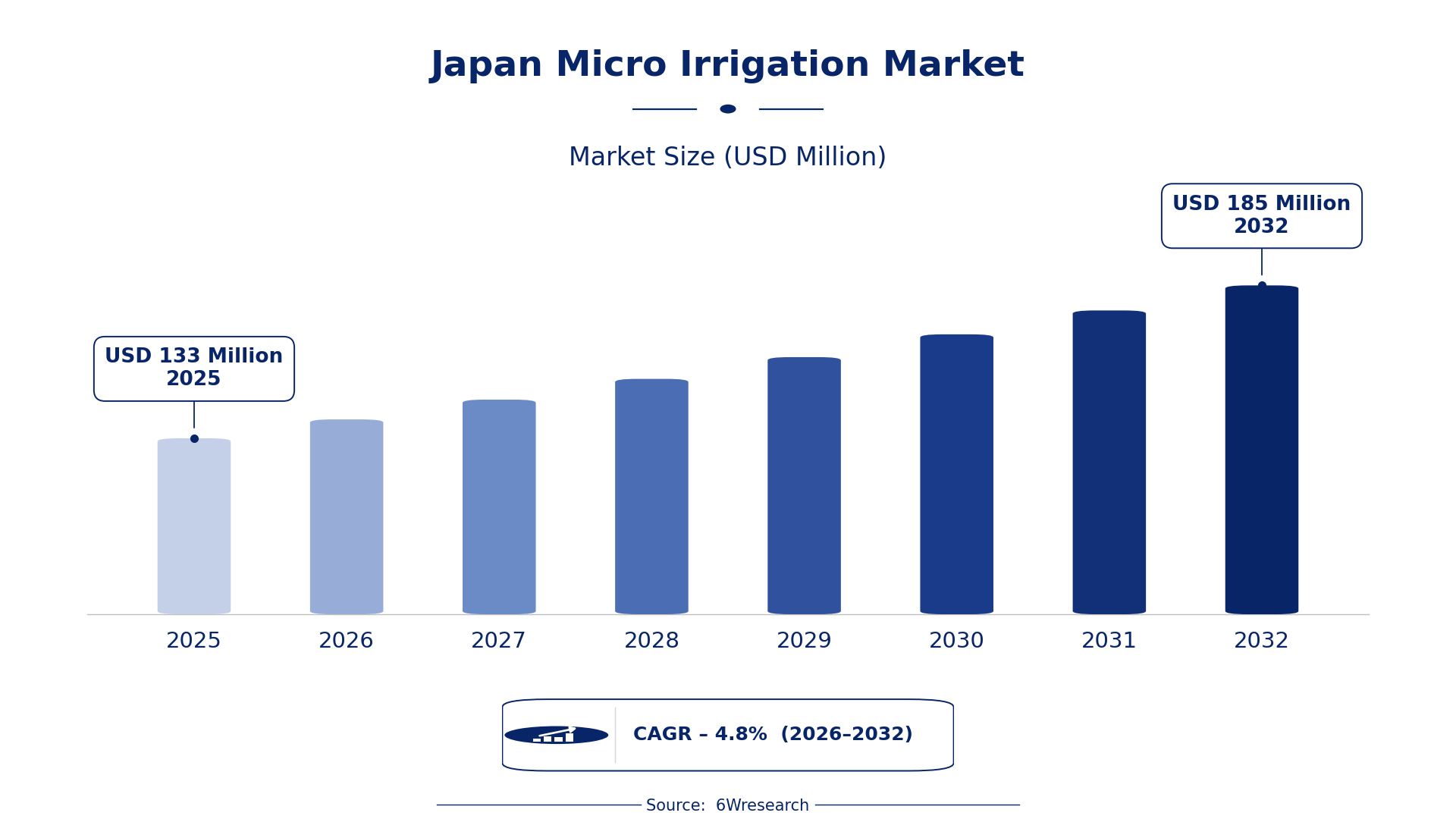
According to 6Wresearch internal database and industry insights, the Japan Micro Irrigation Market was valued at USD 133 Million in 2025 and is projected to reach USD 185 Million by 2032, growing at a CAGR of approximately 4.8% during 2026–2032.
Japan Micro Irrigation Market Highlights
| Report Metric | Details |
| Report Name | Japan Micro Irrigation Market (2026-2032) |
| Market Size 2025 | USD 133 Million |
| Market Size 2032 | USD 185 Million |
| Absolute Growth 2025–2032 | USD 52 Million |
| CAGR 2026–2032 | 4.8% |
| Peak Annual Growth | 5.7% in 2032 |
| Forecast Period | 2026–2032 |
| Historical Data | 2022–2025 |
| Base Year | 2025 |
| Leading Irrigation Type, 2025 | Drip Irrigation (45% share) |
| Leading Component Type, 2025 | Emitters & Tubing (40% share) |
| Leading Crop Type, 2025 | Orchards/Vegetables (44% share) |
| Leading Distribution Channel, 2025 | Direct Sales (51% share) |
| Leading End User, 2025 | Commercial Farms (44% share) |
| Fastest-Growing Irrigation Type | Smart Controllers (7.1% CAGR) |
| Fastest-Growing Component Type | Automated Valves (7.2% CAGR) |
| Fastest-Growing Crop Type | High-Value Crops (7.5% CAGR) |
| Fastest-Growing Distribution Channel | Online Platforms (6.4% CAGR) |
| Fastest-Growing End User | Precision Farming Firms (6.7% CAGR) |
| Growing Sector | Agriculture |
| Key End Users | Commercial Farms, Greenhouse Growers, Vineyard & Orchard Managers, Precision Farming Firms |
Japan Micro Irrigation Market Year-wise Growth Rate and Key Drivers (2022–2032)
This graph illustrates the annual growth rates of the market from 2022 to 2032, highlighting a steady upward trajectory and projected market expansion over the forecast period.
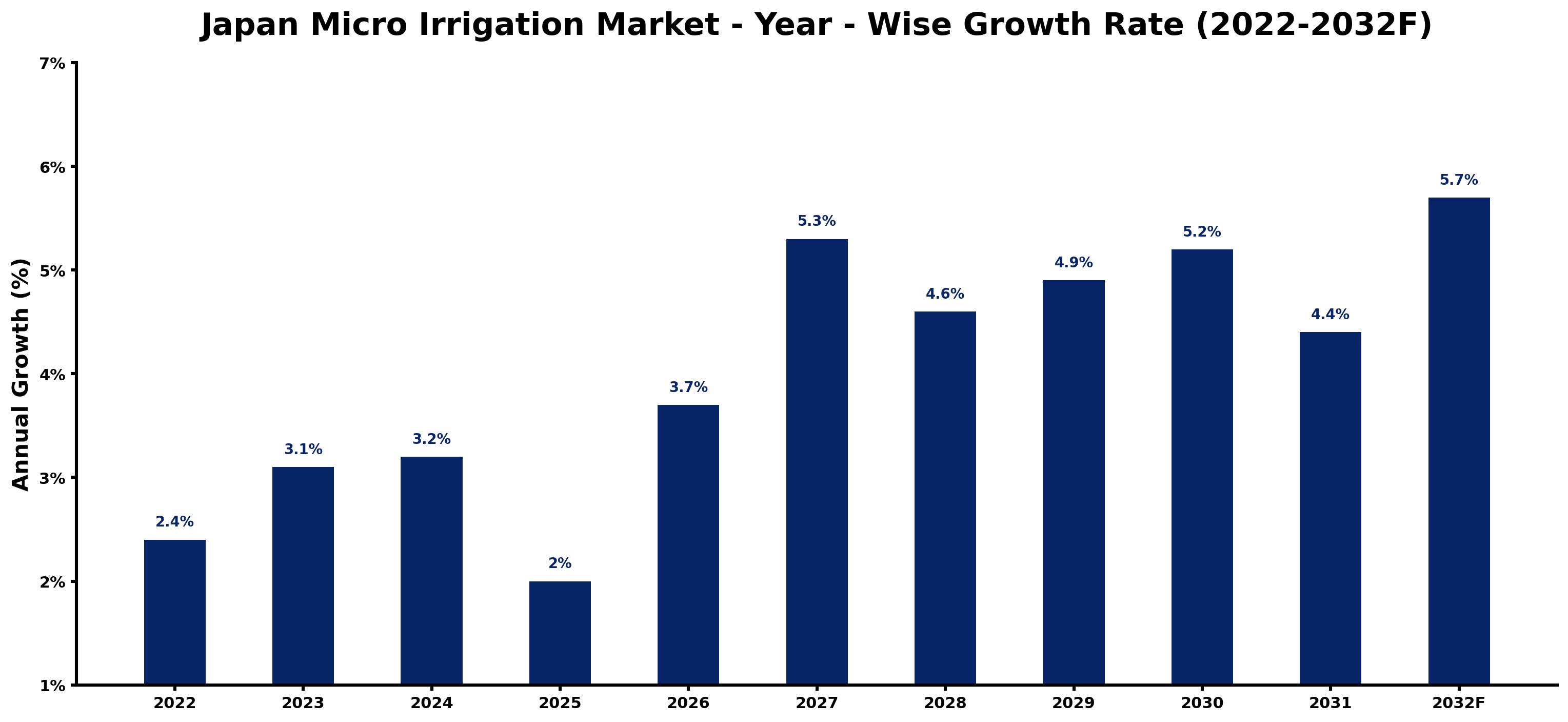
Each row of the following table gives one year's estimated growth and the event or demand shift that explains it.
| Year | Estimated Annual Growth (%) | Market Rationale |
| 2022 | 2.4 | The agricultural sector showed steady performance with ongoing investments in irrigation technology. |
| 2023 | 3.1 | Increased awareness of water conservation techniques led to faster growth in micro irrigation adoption. |
| 2024 | 3.2 | The introduction of advanced irrigation technologies contributed to sustained growth rates. |
| 2025 | 2.0 | Growth slowed as market saturation began to affect new installations and upgrades. |
| 2026 | 3.7 | Renewed investments in precision farming technologies will spur growth in micro irrigation systems. |
| 2027 | 5.3 | The rising need for efficient water management will drive demand higher for micro irrigation solutions. |
| 2028 | 4.6 | Growth will slow as market maturity sets in, but demand will remain strong for upgrades. |
| 2029 | 4.9 | Technological advancements in irrigation systems will lead to increased adoption among farmers. |
| 2030 | 5.2 | The shift towards sustainable farming practices will continue to boost demand for micro irrigation. |
| 2031 | 4.4 | Growth will slow as the market stabilises, but demand for efficiency will remain strong. |
| 2032 | 5.7 | Increased investment in agricultural modernization initiatives will propel growth to its peak. |
Note: Market size estimations and growth projections presented in this report are based on 6Wresearch's proprietary forecasting methodology, utilizing the latest available industry data, government publications, and primary research inputs.
Japan Micro Irrigation Market Synopsis
Micro irrigation technology delivers water directly to plant roots through a network of pipes, valves, and emitters, improving water efficiency in agriculture. The Japan Micro Irrigation Market is growing due to a focus on water-saving technologies, supported by the Ministry of Agriculture, Forestry and Fisheries. Commercial farms and greenhouse growers are increasingly adopting these systems, benefiting from rising investments in precision farming and modernization initiatives. The market is poised for continued expansion, reflecting a shift towards sustainable agricultural practices.
Market Dynamics Impact Analysis (2026–2032)
| Factor | Type | Impact | Primary Segment Affected |
| Growing demand for efficient water management in agriculture | Driver | High | Drip Irrigation |
| Increased adoption of precision farming technologies | Driver | High | Smart Controllers |
| Investment in agricultural modernization initiatives | Opportunity | High | Commercial Farms |
| Expansion of greenhouse crop production | Opportunity | Medium | Greenhouse Crops |
| High initial setup costs for micro irrigation systems | Restraint | High | Emitters & Tubing |
| Limited awareness among smaller farms about micro irrigation benefits | Restraint | Medium | Micro-Sprinklers |
| Compliance with JIS B 9950 standard can be challenging for producers | Challenge | High | Subsurface Drip |
| Capacity constraints in manufacturing advanced irrigation components | Challenge | Medium | Automated Valves |
Evaluation of Drivers in Japan Micro Irrigation Market (2026–2032)
The following drivers explain most of the expected growth.
| Drivers | Primary Segment Affected | Why It Matters (Evidence) |
| Increased water scarcity | Drip Irrigation | Drip irrigation systems can reduce water usage by up to 50%, prompting farmers to adopt them for better efficiency. |
| Government initiatives promoting water-saving technologies | Smart Controllers | Investment in these technologies leads to higher adoption rates among farmers. |
| Rising greenhouse crop production | Greenhouse Crops | Valued at ¥600 billion in 2022, greenhouse crops drive demand for efficient irrigation solutions. |
| Growing agricultural investments | Commercial Farms | The agricultural population of around 1.3 million is increasingly investing in modern irrigation systems. |
| Technological advancements in irrigation systems | Automated Valves | Innovations in automated systems improve efficiency, encouraging farmers to upgrade their existing setups. |
Volumes increase due to heightened water scarcity, with drip irrigation systems cutting water usage by up to 50%. Support for water-saving technologies drives higher adoption rates among commercial farms. The agricultural sector, comprising approximately 1.3 million people, is increasingly investing in modern irrigation systems. Developments in automated valves improve efficiency, prompting farmers to upgrade their existing setups. Rising greenhouse crop production, valued at ¥600 billion in 2022, further stimulates demand for efficient irrigation solutions.
Evaluation of Restraints in Japan Micro Irrigation Market
These restraints slow adoption and weigh on supplier margins.
| Market Restraint | Primary Segment Affected | Why It Matters (Evidence) |
| High initial setup costs for micro irrigation systems | Emitters & Tubing | The investment required can deter smaller farms from adopting these systems. |
| Limited awareness among smaller farms about micro irrigation benefits | Micro-Sprinklers | Many smaller farms remain unaware of the efficiency gains possible with micro irrigation. |
| Strict compliance requirements with the JIS B 9950 standard | Subsurface Drip | Producers face difficulties in meeting the stringent requirements of this standard. |
| Manufacturing capacity constraints for advanced irrigation components | Automated Valves | Manufacturers struggle to scale production to meet growing demand for advanced components. |
| Market saturation affecting new installations | Drip Irrigation | As the market matures, new installations are slowing due to existing systems in place. |
Japan Micro Irrigation Market Challenges
Micro irrigation adoption contends with strong competition from traditional methods, as many farmers in Japan favour familiar techniques, delaying efficiency improvements for producers. Regulatory hurdles associated with the JIS B 9950 standard complicate compliance for suppliers, resulting in increased costs and longer product launch timelines. Training centres face skills shortages in the agricultural workforce, which hampers effective implementation for clinics. Cost barriers exist, as initial investments for micro irrigation systems can reach ¥1 million, deterring small-scale farmers from adopting this efficient technology.
Trends in the Japan Micro Irrigation Market
The trends below show where the Japan Micro Irrigation Market is heading.
- Shift towards Precision Farming: Commercial farms are increasingly adopting precision farming techniques, improving irrigation efficiency. In 2023, Japan aims to increase precision farming adoption by 30%, reflecting a trend towards more efficient agricultural practices.
- Growth in Greenhouse Crop Production: Tokyo and Hokkaido are leading regions for micro irrigation adoption, particularly in greenhouse crops. In 2022, the value of greenhouse crop production reached ¥600 billion, indicating strong demand for efficient irrigation solutions.
- Increased Investment in Agricultural Modernization: The government allocated ¥1 billion in 2023 for agricultural modernization initiatives, signalling a shift towards advanced irrigation technologies. This funding is expected to boost micro irrigation adoption across the sector.
- Expansion of Online Sales Channels: Online platforms are emerging as a growing channel for purchasing irrigation equipment. This shift reflects changing buyer behaviour in Japan, as more consumers turn to digital solutions for their agricultural needs.
Investment Opportunities in the Japan Micro Irrigation Market
Below are the investment opportunities with the strongest case in the Japan Micro Irrigation Market.
- Investment in Smart Controllers: Tokyo is experiencing a rise in demand for smart controllers, which improve irrigation efficiency. This technology is timely for suppliers as it is projected to grow at a rate of 7.1%.
- Expansion of Greenhouse Facilities: The increasing value of greenhouse crops in Hokkaido presents an opportunity to supply advanced irrigation systems. This region's focus on efficiency makes it an ideal market for investment.
- Collaboration with Agricultural Cooperatives: The Japan Agricultural Cooperatives (JA) supports micro irrigation initiatives, providing a pathway for partnerships. Collaborating with JA can facilitate market entry for new suppliers.
- Focus on High-Value Crops: High-value crops are projected to grow, creating demand for precise irrigation systems. Targeting this segment offers substantial opportunities for investment.
Government Initiatives in the Japan Micro Irrigation Market
The JIS B 9950 standard governs micro irrigation systems in Japan, ensuring quality and efficiency. Compliance with this standard is crucial for producers and buyers, as it dictates the necessary testing and certification processes for irrigation products. This regulation supports the adoption of reliable micro irrigation technologies, benefiting the agricultural sector.
In 2023, the government allocated ¥1 billion for agricultural modernization initiatives, administered by the Ministry of Agriculture, Forestry and Fisheries. This funding aims to improve irrigation practices and support the adoption of advanced technologies, boosting overall agricultural productivity.
Future Insight of the Japan Micro Irrigation Market
The investment pipeline for agricultural modernization will expand, driven by government initiatives that create demand for advanced micro irrigation systems. By 2032, precision farming adoption is expected to rise by 30%, improving water management practices across the sector. The Ministry of Agriculture, Forestry and Fisheries will actively promote water-saving technologies, encouraging buyers to transition to more efficient systems. As greenhouse crop production was valued at ¥600 billion in 2022, suppliers will need to align their offerings with the growing requirements of this market.
Market Segmentation Analysis
Japan Micro Irrigation Market report covers a detailed analysis of the following market segments:
By Irrigation Type – Drip Irrigation Leads, Smart Controllers Expected to Grow Fastest
According to Saurav Kr Singh, Senior Research Analyst at 6Wresearch, with 45% of irrigation type revenue in 2025, Drip Irrigation was the largest category. Drip irrigation dominates the market due to its ability to deliver water directly to crops, which is essential for Japan's limited water resources. The widespread adoption of this method is supported by the JIS B 9950 standard, ensuring reliability and quality for farmers. Smart Controllers are set to record the highest CAGR in this split, 7.1% over 2026–2032. Smart controllers are experiencing rapid growth as they automate irrigation schedules, thereby improving water management efficiency. With Japan's target to increase precision farming adoption by 30% by 2025, the demand for these advanced technologies is set to expand further. Suppliers must focus on integrating smart technologies into their offerings to meet the rising demand for efficient irrigation solutions.
By Component Type – Emitters & Tubing Leads, Automated Valves Expected to Grow Fastest
Emitters & Tubing held 40% of the Japan Micro Irrigation Market by component type in 2025. Emitters and tubing are vital components of micro irrigation systems, providing effective water delivery that is crucial for crop health. Their extensive application in Japan's agricultural sector underscores their importance in achieving efficient irrigation practices. Automated Valves are projected to grow fastest, at a CAGR of 7.2% during 2026–2032. Automated valves are rapidly gaining traction as they enhance control over water flow, aligning with Japan's agricultural modernisation initiatives. The government's investment of ¥1 billion in agricultural advancements further propels this trend. Buyers should consider investing in automated components to improve system efficiency and adhere to contemporary agricultural standards.
By Crop Type – Orchards/Vegetables Lead, High-Value Crops Expected to Grow Fastest
In 2025, Orchards/Vegetables led the crop type split with a 44% share. Orchards and vegetables are the main crops benefiting from micro irrigation, as they require consistent water supply for optimal growth. The substantial value of greenhouse crop production underscores the importance of effective irrigation in these sectors. The quickest growth will come from High-Value Crops, forecast to expand at a CAGR of 7.5% between 2026 and 2032. High-value crops are experiencing the fastest growth due to their need for precise irrigation to maximise yield and quality. This aligns with Japan's focus on boosting agricultural productivity through advanced techniques. Suppliers must tailor their products to meet the specific irrigation requirements of high-value crops to seize this growing market segment.
By Distribution Channel – Direct Sales Leads, Online Platforms Expected to Grow Fastest
Direct Sales accounted for 51% of the market by distribution channel in 2025. Direct sales are the primary distribution channel for micro irrigation products, facilitating personalised interactions and support for customers. This approach effectively reaches the agricultural community, ensuring proper implementation of irrigation systems. Over 2026–2032, Online Platforms are expected to post the fastest growth, at a CAGR of 6.4%. Online platforms are becoming increasingly popular as farmers seek convenience in purchasing irrigation equipment. The ongoing digital transformation within the agricultural sector is driving this trend, making it essential for suppliers to adapt. Suppliers should enhance their online presence to accommodate the growing trend of digital purchasing among farmers.
By End User – Commercial Farms Lead, Precision Farming Firms Expected to Grow Fastest
Commercial Farms took 44% of end user revenue in 2025, more than any other category. Commercial farms represent the largest end users of micro irrigation systems, utilising them to optimise water usage and improve crop yields. Their substantial role in Japan's agricultural landscape significantly drives the demand for efficient irrigation solutions. Precision Farming Firms are set to record the highest CAGR in this split, 6.7% over 2026–2032. Precision farming firms are rapidly adopting micro irrigation as they incorporate advanced technologies into their operations. This shift is part of a broader trend towards modernised and efficient agricultural practices in Japan. Suppliers should concentrate on developing tailored solutions for precision farming firms to leverage this growth opportunity.
Key Attractiveness of the Report
- 10 Years of Market Numbers
- Historical Data Starting from 2022 to 2025
- Base Year 2025
- Forecast Data until 2032
- Key Performance Indicators Impacting the Market
- Major Upcoming Developments and Projects
Key Highlights of the Report:
- Japan Micro Irrigation Market Outlook
- Market Size of Japan Micro Irrigation Market, 2025
- Forecast of Japan Micro Irrigation Market, 2032
- Historical Data and Forecast of Japan Micro Irrigation Revenues & Volume for the Period 2022-2032F
- Japan Micro Irrigation Market Trend Evolution
- Japan Micro Irrigation Market Drivers and Challenges
- Japan Micro Irrigation Price Trends
- Japan Micro Irrigation Porter's Five Forces
- Japan Micro Irrigation Industry Life Cycle
- Historical Data and Forecast of Japan Micro Irrigation Market Revenues & Volume By Irrigation Type for the Period 2022-2032F
- Historical Data and Forecast of Japan Micro Irrigation Market Revenues & Volume By Drip Irrigation for the Period 2022-2032F
- Historical Data and Forecast of Japan Micro Irrigation Market Revenues & Volume By Micro-Sprinklers for the Period 2022-2032F
- Historical Data and Forecast of Japan Micro Irrigation Market Revenues & Volume By Subsurface Drip for the Period 2022-2032F
- Historical Data and Forecast of Japan Micro Irrigation Market Revenues & Volume By Smart Controllers for the Period 2022-2032F
- Historical Data and Forecast of Japan Micro Irrigation Market Revenues & Volume By Component Type for the Period 2022-2032F
- Historical Data and Forecast of Japan Micro Irrigation Market Revenues & Volume By Emitters & Tubing for the Period 2022-2032F
- Historical Data and Forecast of Japan Micro Irrigation Market Revenues & Volume By Spray Nozzles for the Period 2022-2032F
- Historical Data and Forecast of Japan Micro Irrigation Market Revenues & Volume By Buried Tubing for the Period 2022-2032F
- Historical Data and Forecast of Japan Micro Irrigation Market Revenues & Volume By Automated Valves for the Period 2022-2032F
- Historical Data and Forecast of Japan Micro Irrigation Market Revenues & Volume By Crop Type for the Period 2022-2032F
- Historical Data and Forecast of Japan Micro Irrigation Market Revenues & Volume By Orchards/Vegetables for the Period 2022-2032F
- Historical Data and Forecast of Japan Micro Irrigation Market Revenues & Volume By Greenhouse Crops for the Period 2022-2032F
- Historical Data and Forecast of Japan Micro Irrigation Market Revenues & Volume By High-Value Crops for the Period 2022-2032F
- Historical Data and Forecast of Japan Micro Irrigation Market Revenues & Volume By Mixed Cropping for the Period 2022-2032F
- Historical Data and Forecast of Japan Micro Irrigation Market Revenues & Volume By Distribution Channel for the Period 2022-2032F
- Historical Data and Forecast of Japan Micro Irrigation Market Revenues & Volume By Direct Sales for the Period 2022-2032F
- Historical Data and Forecast of Japan Micro Irrigation Market Revenues & Volume By Online Platforms for the Period 2022-2032F
- Historical Data and Forecast of Japan Micro Irrigation Market Revenues & Volume By Specialty Distributors for the Period 2022-2032F
- Historical Data and Forecast of Japan Micro Irrigation Market Revenues & Volume By Industrial Suppliers for the Period 2022-2032F
- Historical Data and Forecast of Japan Micro Irrigation Market Revenues & Volume By End User for the Period 2022-2032F
- Historical Data and Forecast of Japan Micro Irrigation Market Revenues & Volume By Commercial Farms for the Period 2022-2032F
- Historical Data and Forecast of Japan Micro Irrigation Market Revenues & Volume By Glasshouse Growers for the Period 2022-2032F
- Historical Data and Forecast of Japan Micro Irrigation Market Revenues & Volume By Vineyard & Orchard Managers for the Period 2022-2032F
- Historical Data and Forecast of Japan Micro Irrigation Market Revenues & Volume By Precision Farming Firms for the Period 2022-2032F
- Japan Micro Irrigation Import Export Trade Statistics
- Market Opportunity Assessment By Irrigation Type
- Market Opportunity Assessment By Component Type
- Market Opportunity Assessment By Crop Type
- Market Opportunity Assessment By Distribution Channel
- Market Opportunity Assessment By End User
- Japan Micro Irrigation Top Companies Market Share
- Japan Micro Irrigation Competitive Benchmarking By Technical and Operational Parameters
- Japan Micro Irrigation Company Profiles
- Japan Micro Irrigation Key Strategic Recommendations
Market Covered
The following segment groups are covered in the report.
By Irrigation Type
- Drip Irrigation
- Micro-Sprinklers
- Subsurface Drip
- Smart Controllers
By Component Type
- Emitters & Tubing
- Spray Nozzles
- Buried Tubing
- Automated Valves
By Crop Type
- Orchards/Vegetables
- Greenhouse Crops
- High-Value Crops
- Mixed Cropping
By Distribution Channel
- Direct Sales
- Online Platforms
- Specialty Distributors
- Industrial Suppliers
By End User
- Commercial Farms
- Glasshouse Growers
- Vineyard & Orchard Managers
- Precision Farming Firms































