Japan Military Loop Antenna Market Size & Growth Rate
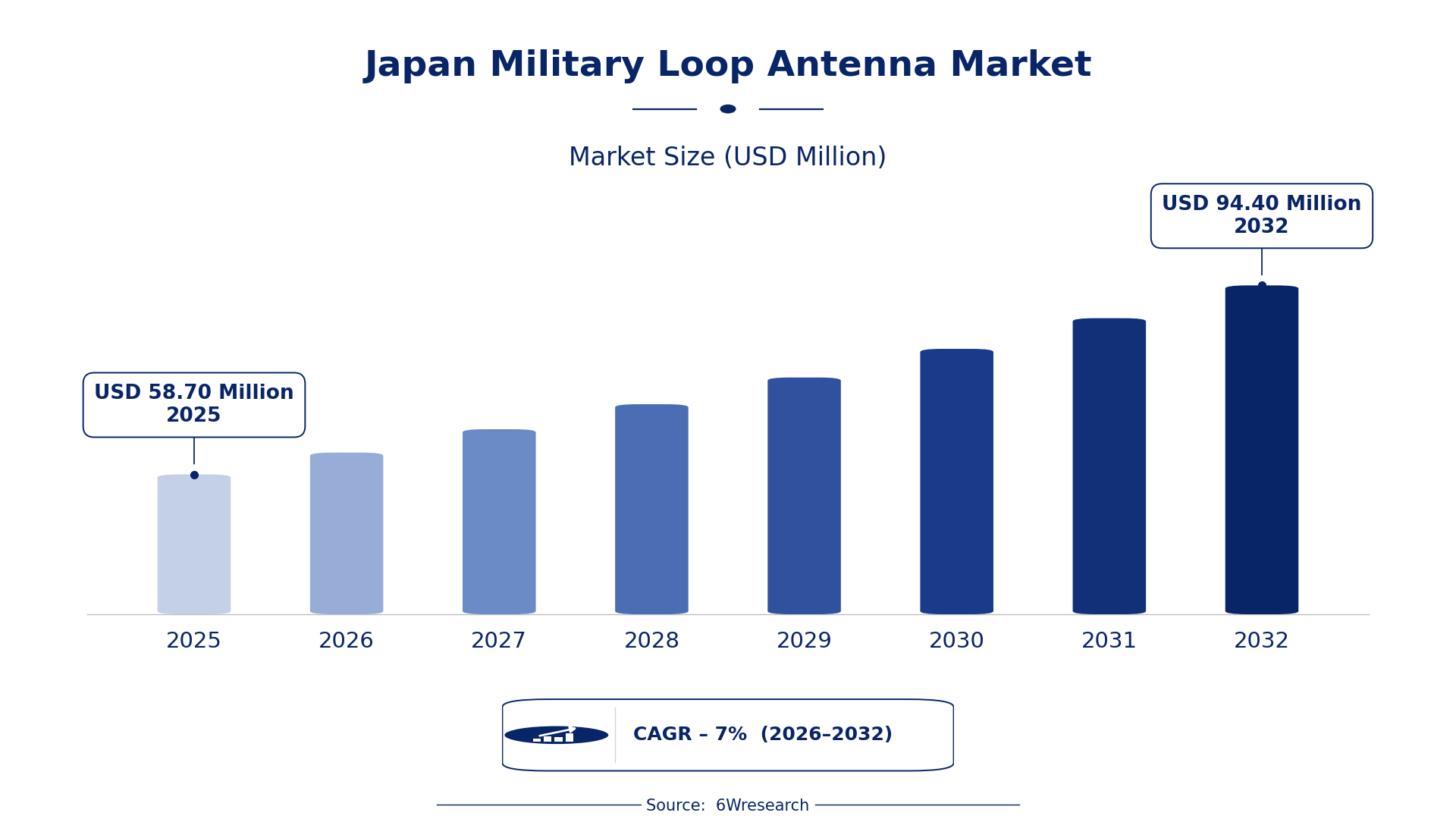
According to 6Wresearch internal database and industry insights, the Japan Military Loop Antenna Market was valued at USD 58.70 Million in 2025 and is projected to reach USD 94.40 Million by 2032, growing at a CAGR of approximately 7% during 2026–2032.
Japan Military Loop Antenna Market Highlights
| Report Metric | Details |
| Report Name | Japan Military Loop Antenna Market (2026-2032) |
| Market Size 2025 | USD 58.70 Million |
| Market Size 2032 | USD 94.40 Million |
| Absolute Growth 2025–2032 | USD 35.70 Million |
| CAGR 2026–2032 | 7% |
| Peak Annual Growth | 8.1% in 2028 |
| Forecast Period | 2026–2032 |
| Historical Data | 2022–2025 |
| Base Year | 2025 |
| Leading Type, 2025 | Active Loop (41% share) |
| Leading Frequency Range, 2025 | Ultra High Frequency (40% share) |
| Leading Material, 2025 | Copper (47% share) |
| Leading End User, 2025 | Army (42% share) |
| Leading Application, 2025 | Communications (40% share) |
| Fastest-Growing Frequency Range | High Frequency (9.4% CAGR) |
| Fastest-Growing Material | Aluminum (10.1% CAGR) |
| Fastest-Growing End User | Air Force (8.8% CAGR) |
| Fastest-Growing Application | Signal Intelligence (9.2% CAGR) |
| Growing Sector | Military communication systems |
| Key End Users | Army, Navy, Air Force, Special Forces |
Japan Military Loop Antenna Market Year-wise Growth Rate and Key Drivers (2022–2032)
This graph illustrates the annual growth rates of the market from 2022 to 2032, highlighting a steady upward trajectory and projected market expansion over the forecast period.
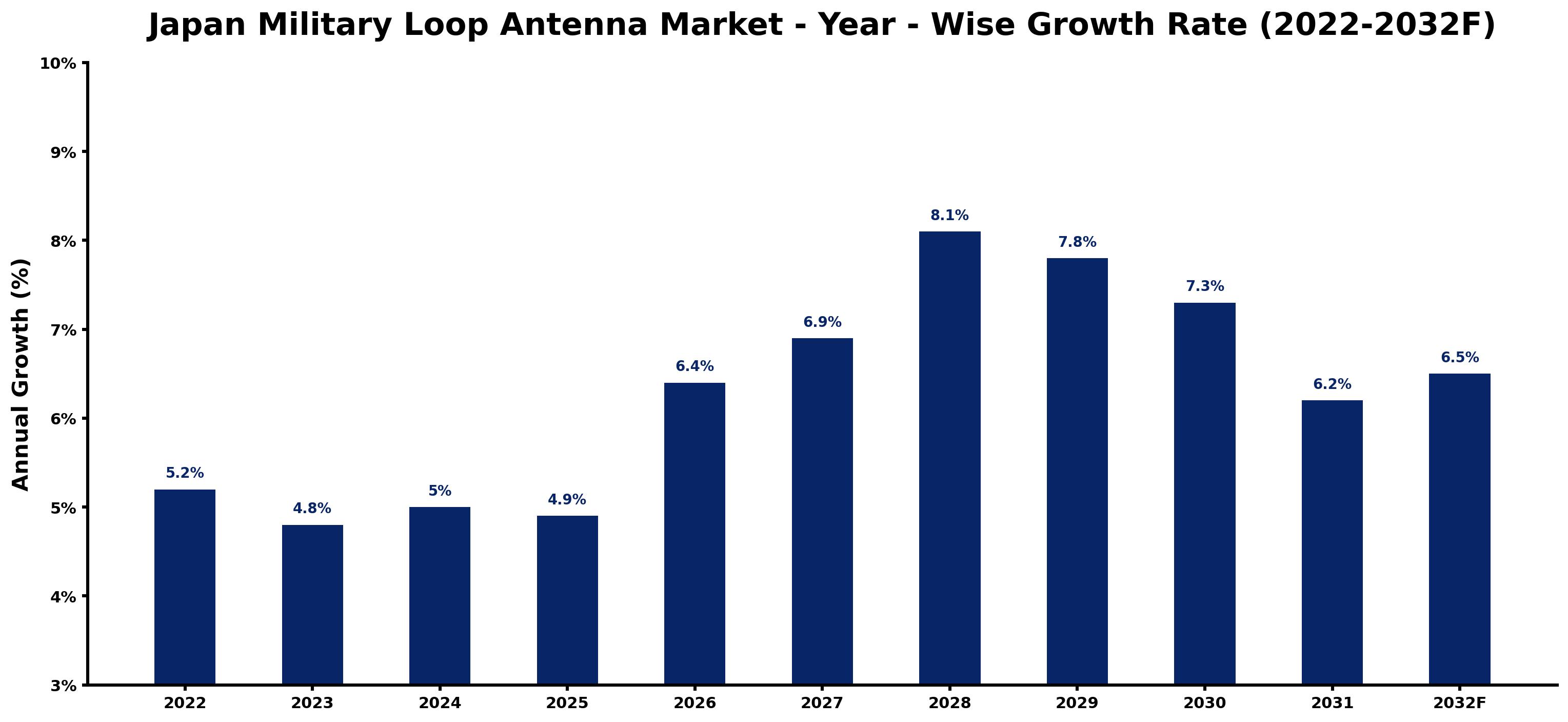
Below, each year's estimated growth is shown next to the factor that most influenced it.
| Year | Estimated Annual Growth (%) | Market Rationale |
| 2022 | 5.2 | Demand from Japan's Self-Defense Forces remained strong, supporting market growth. |
| 2023 | 4.8 | The Ministry of Defense's budget allocation for advanced systems slowed growth slightly. |
| 2024 | 5.0 | Increased investments in military communications boosted growth rates this year. |
| 2025 | 4.9 | Ongoing modernization efforts by the Air Self-Defense Force constrained growth somewhat. |
| 2026 | 6.4 | Rising demand for active loop antennas is expected to drive a faster growth rate in the market. |
| 2027 | 6.9 | Investment in radar technology development will contribute to continued growth. |
| 2028 | 8.1 | The peak growth rate is projected as military contracts surge. |
| 2029 | 7.8 | Demand stabilised as growth slowed, influenced by procurement cycles. |
| 2030 | 7.3 | Investment in signal intelligence systems will continue to support market expansion. |
| 2031 | 6.2 | Growth is expected to slow as the market adjusts to previous high investment levels. |
| 2032 | 6.5 | Increased focus on communication capabilities is projected to drive growth again. |
Note: Market size estimations and growth projections presented in this report are based on 6Wresearch's proprietary forecasting methodology, utilizing the latest available industry data, government publications, and primary research inputs.
Japan Military Loop Antenna Market Synopsis
Military loop antennas are crucial for communication and intelligence in military applications, constructed from materials such as aluminum and copper. The Japan Military Loop Antenna Market is growing due to increased demand from the Self-Defense Forces and investments in advanced communication systems. A budget of ¥500 million for 2023 and a 20% rise in signal intelligence operations over the past five years are driving this expansion. With an emphasis on improving communication capabilities, the market is poised for ongoing growth.
Market Dynamics Impact Analysis (2026–2032)
| Factor | Type | Impact | Primary Segment Affected |
| Rising investments in advanced communication systems | Driver | High | Active Loop |
| Increased signal intelligence operations | Driver | High | Signal Intelligence |
| Growing demand for military communications technology | Opportunity | High | Communications |
| Investment in radar technology development | Opportunity | Medium | Radar Systems |
| Regulatory compliance with ISO 9001 standards | Restraint | Medium | Active Loop |
| Limited domestic manufacturing capabilities | Restraint | High | Active Loop |
| High costs associated with advanced materials | Challenge | High | Copper |
| Capacity constraints in production facilities | Challenge | Medium | Active Loop |
Evaluation of Drivers in Japan Military Loop Antenna Market (2026–2032)
The factors lifting demand, and the evidence behind each, are summarised below.
| Drivers | Primary Segment Affected | Why It Matters (Evidence) |
| Increased military spending on communication systems | Active Loop | The allocation of ¥500 million in 2023 is driving demand for advanced antennas. |
| Rising signal intelligence operations | Signal Intelligence | Operations have increased by 20% over the last five years, boosting demand for antennas. |
| Focus on modernising communication capabilities | Communications | Investment in new systems is increasing orders for loop antennas. |
| Technological advancements in radar systems | Radar Systems | Collaborations on radar technology are increasing antenna demand among military forces. |
| Growing emphasis on lightweight materials | Aluminum | The preference for aluminum's lightweight properties is leading to higher purchases for military applications. |
Behind the steady rise in orders sits increased military spending, particularly from the allocation of ¥500 million for advanced communication systems in 2023. The Air Self-Defense Force is modernising its communication capabilities, resulting in greater demand for military loop antennas. Signal intelligence operations have surged, driving orders for antennas used in these applications. The preference for lightweight materials like aluminum drives purchasing patterns among military forces.
Evaluation of Restraints in Japan Military Loop Antenna Market
Several factors work against faster growth; the main ones are summarised below.
| Market Restraint | Primary Segment Affected | Why It Matters (Evidence) |
| Compliance with ISO 9001 standards | Active Loop | Manufacturers must adhere to strict quality standards, which increase production costs. |
| Limited domestic manufacturing capabilities | Active Loop | Japan relies on imports for certain components, affecting supply chain stability. |
| High costs associated with advanced materials | Copper | Price volatility of copper can deter procurement decisions by military buyers. |
| Production capacity constraints in local facilities | Active Loop | Limited capacity can delay delivery times for military contracts. |
| Regulatory hurdles for new product approvals | Active Loop | Strict regulations can slow the introduction of new antenna designs. |
Japan Military Loop Antenna Market Challenges
Producers of military loop antennas are facing rising costs as the Ministry of Defense's ¥500 million allocation for advanced communication systems drives up material prices. Buyers are experiencing supply delays since demand for lightweight aluminum has surged, affecting delivery timelines for military contracts. Competition is intensifying as a 20% increase in signal intelligence operations over the last five years pressures manufacturers to innovate quickly or risk losing contracts. Skills shortages are emerging as the Defence Technology Association reports a lack of specialised expertise in military communications, limiting the available workforce for antenna development.
Trends in the Japan Military Loop Antenna Market
The following changes are redrawing the Japan Military Loop Antenna Market.
- Shift towards Active Loop Antennas: The Japan Self-Defense Forces are increasingly adopting active loop antennas for improved signal capabilities. In 2023, active loop antennas accounted for 41% of the market, reflecting a shift in preference.
- Increased Focus on Signal Intelligence: Since 2022, there has been a notable rise in signal intelligence operations, with a 20% increase in demand. This trend is clear in military procurement strategies across Japan.
- Adoption of Lightweight Materials: The use of aluminum in military loop antennas has gained traction due to its lightweight properties. In 2023, aluminum's share in military applications is projected to rise to 47%.
- Expansion of Radar Technology Development: Collaborations on radar technology are reshaping military communication systems. This partnership is expected to improve capabilities by 2025.
Investment Opportunities in the Japan Military Loop Antenna Market
The opportunities below stand out in the Japan Military Loop Antenna Market for new entrants and existing suppliers.
- Joint Ventures for Local Manufacturing: Now is an ideal time for joint ventures in military antenna production, as local manufacturing is encouraged. The Japan Defense Industry Association supports initiatives to boost domestic capabilities.
- Supply of Advanced Communication Systems: With the allocation of ¥500 million, supplying advanced communication systems presents a strong opportunity. Engaging with local defense contractors can facilitate market entry.
- Investment in Military Technology Hubs: Tokyo and Kanagawa are key regions for military technology development. Investing in facilities in these areas can yield substantial returns due to growing demand.
- Focus on Signal Intelligence Solutions: The rise in signal intelligence operations creates opportunities for suppliers of specialised antennas. Engaging with military buyers can strengthen market presence.
Government Initiatives in the Japan Military Loop Antenna Market
The Economic Security Promotion Act of 2022 supports supply-chain resilience for critical military products, including antennas. This law encourages local production and reduces reliance on imports, benefiting domestic manufacturers and ensuring a stable supply of military equipment. The Ministry of Defense has set targets for local production, aiming for a 30% increase by 2025.
The Japan Defense Agency oversees procurement and standards for military equipment, ensuring compliance with regulations. This agency facilitates approvals for new technologies, enabling buyers to access advanced communication systems more efficiently. The agency aims to streamline the approval process, targeting a 15% reduction in time by 2024.
Future Insight of the Japan Military Loop Antenna Market
By 2032, a shift in policy will emphasise advanced communication capabilities, prompting suppliers to adopt new manufacturing technologies. The Tokyo Metropolitan Government's subsidies will encourage innovation in defence technology, leading to improved production efficiency. Collaboration with the Japan Aerospace Exploration Agency will advance radar technology, improving the effectiveness of military loop antennas. Increased focus on communication capabilities will create new opportunities for buyers and suppliers in the defence sector.
Market Segmentation Analysis
Japan Military Loop Antenna Market report covers a detailed analysis of the following market segments:
By Type – Active Loop Leads and Records the Fastest Growth
According to Vasudha, AM at 6Wresearch, with 41% of type revenue in 2025, Active Loop was the largest category. Active loop antennas hold the largest market share due to their enhanced signal reception, which is vital for secure military communications. The Japanese Self-Defense Forces heavily rely on these antennas for various operational needs, solidifying their dominant position. The same category is also set to grow fastest, at a CAGR of 9.5% during 2026–2032. The active loop segment's growth is fuelled by the Ministry of Defense's ¥500 million investment in advanced communication systems for 2023. This ongoing funding suggests that the demand for active loop antennas will continue to rise as military requirements expand. Suppliers must prioritise the development of active loop antenna technologies to meet the increasing demands of military applications.
By Frequency Range – Ultra High Frequency Leads, High Frequency Expected to Grow Fastest
Ultra High Frequency took 40% of frequency range revenue in 2025, more than any other category. Ultra high frequency antennas are critical for modern communication systems, providing the necessary bandwidth for secure military operations. Their extensive use by the Japanese Army and Navy underscores their importance in the defence sector. Over 2026–2032, High Frequency is expected to post the fastest growth, at a CAGR of 9.4%. High frequency antennas are experiencing growth due to their application in specific military operations, despite being used less frequently. This segment's expansion reflects a strategic shift towards diverse communication needs within the military. Buyers may benefit from exploring high frequency solutions to complement their existing ultra high frequency systems.
By Material – Copper Leads, Aluminum Expected to Grow Fastest
Copper held 47% of the Japan Military Loop Antenna Market by material in 2025. Copper is the leading material for military loop antennas due to its excellent conductivity, which ensures effective signal transmission in critical operations. Its widespread use in military applications highlights its importance in maintaining communication efficiency. Aluminum is projected to grow fastest, at a CAGR of 10.1% during 2026–2032. Aluminum is gaining traction as a preferred material because of its lightweight and corrosion-resistant properties, making it ideal for various military environments. This shift towards aluminium indicates a growing focus on operational efficiency and durability. Suppliers should consider expanding their offerings to include aluminium options to cater to evolving military requirements.
By End User – Army Leads, Air Force Expected to Grow Fastest
Army accounted for 42% of the market by end user in 2025. The Army is the primary user of military loop antennas, employing them extensively for secure communications across a range of operational scenarios. Their significant investments in communication technologies reinforce their leading position in the market. The quickest growth will come from Air Force, forecast to expand at a CAGR of 8.8% between 2026 and 2032. The Air Force is rapidly adopting military loop antennas for aerial operations, indicating a strategic focus on enhancing airborne communication capabilities. This shift suggests that the Air Force's demand for these antennas will continue to grow as they modernise their systems. Suppliers should target the Air Force segment to capitalise on the increasing demand for advanced aerial communication solutions.
By Application – Communications Lead, Signal Intelligence Expected to Grow Fastest
In 2025, Communications led the application split with a 40% share. Communications is the leading application for military loop antennas, as they are essential for ensuring secure and reliable military operations. The commitment of the Japanese military to improve communication capabilities underscores the importance of this application. Signal Intelligence is set to record the highest CAGR in this split, 9.2% over 2026–2032. Signal intelligence is witnessing notable growth, driven by the military's heightened focus on intelligence gathering for strategic advantages. This trend indicates a rising emphasis on advanced signal intelligence capabilities within military operations. Buyers should focus on investing in signal intelligence technologies to maintain a competitive advantage in military operations.
Key Attractiveness of the Report
- 10 Years of Market Numbers
- Historical Data Starting from 2022 to 2025
- Base Year 2025
- Forecast Data until 2032
- Key Performance Indicators Impacting the Market
- Major Upcoming Developments and Projects
Key Highlights of the Report:
- Japan Military Loop Antenna Market Outlook
- Market Size of Japan Military Loop Antenna Market,2025
- Forecast of Japan Military Loop Antenna Market, 2032
- Historical Data and Forecast of Japan Military Loop Antenna Revenues & Volume for the Period 2022-2032
- Japan Military Loop Antenna Market Trend Evolution
- Japan Military Loop Antenna Market Drivers and Challenges
- Japan Military Loop Antenna Price Trends
- Japan Military Loop Antenna Porter's Five Forces
- Japan Military Loop Antenna Industry Life Cycle
- Historical Data and Forecast of Japan Military Loop Antenna Market Revenues & Volume By Type for the Period 2022-2032
- Historical Data and Forecast of Japan Military Loop Antenna Market Revenues & Volume By Passive Loop for the Period 2022-2032
- Historical Data and Forecast of Japan Military Loop Antenna Market Revenues & Volume By Active Loop for the Period 2022-2032
- Historical Data and Forecast of Japan Military Loop Antenna Market Revenues & Volume By Directional Loop for the Period 2022-2032
- Historical Data and Forecast of Japan Military Loop Antenna Market Revenues & Volume By Others for the Period 2022-2032
- Historical Data and Forecast of Japan Military Loop Antenna Market Revenues & Volume By Frequency Range for the Period 2022-2032
- Historical Data and Forecast of Japan Military Loop Antenna Market Revenues & Volume By Low Frequency for the Period 2022-2032
- Historical Data and Forecast of Japan Military Loop Antenna Market Revenues & Volume By Mid Frequency for the Period 2022-2032
- Historical Data and Forecast of Japan Military Loop Antenna Market Revenues & Volume By High Frequency for the Period 2022-2032
- Historical Data and Forecast of Japan Military Loop Antenna Market Revenues & Volume By Ultra High Frequency for the Period 2022-2032
- Historical Data and Forecast of Japan Military Loop Antenna Market Revenues & Volume By Material for the Period 2022-2032
- Historical Data and Forecast of Japan Military Loop Antenna Market Revenues & Volume By Aluminum for the Period 2022-2032
- Historical Data and Forecast of Japan Military Loop Antenna Market Revenues & Volume By Copper for the Period 2022-2032
- Historical Data and Forecast of Japan Military Loop Antenna Market Revenues & Volume By Composite for the Period 2022-2032
- Historical Data and Forecast of Japan Military Loop Antenna Market Revenues & Volume By Hybrid for the Period 2022-2032
- Historical Data and Forecast of Japan Military Loop Antenna Market Revenues & Volume By End User for the Period 2022-2032
- Historical Data and Forecast of Japan Military Loop Antenna Market Revenues & Volume By Army for the Period 2022-2032
- Historical Data and Forecast of Japan Military Loop Antenna Market Revenues & Volume By Navy for the Period 2022-2032
- Historical Data and Forecast of Japan Military Loop Antenna Market Revenues & Volume By Air Force for the Period 2022-2032
- Historical Data and Forecast of Japan Military Loop Antenna Market Revenues & Volume By Special Forces for the Period 2022-2032
- Historical Data and Forecast of Japan Military Loop Antenna Market Revenues & Volume By Application for the Period 2022-2032
- Historical Data and Forecast of Japan Military Loop Antenna Market Revenues & Volume By Communications for the Period 2022-2032
- Historical Data and Forecast of Japan Military Loop Antenna Market Revenues & Volume By Signal Intelligence for the Period 2022-2032
- Historical Data and Forecast of Japan Military Loop Antenna Market Revenues & Volume By Radar Systems for the Period 2022-2032
- Historical Data and Forecast of Japan Military Loop Antenna Market Revenues & Volume By Electronic Warfare for the Period 2022-2032
- Japan Military Loop Antenna Import Export Trade Statistics
- Market Opportunity Assessment By Type
- Market Opportunity Assessment By Frequency Range
- Market Opportunity Assessment By Material
- Market Opportunity Assessment By End User
- Market Opportunity Assessment By Application
- Japan Military Loop Antenna Top Companies Market Share
- Japan Military Loop Antenna Competitive Benchmarking By Technical and Operational Parameters
- Japan Military Loop Antenna Company Profiles
- Japan Military Loop Antenna Key Strategic Recommendations
Market Covered
The study includes the following segmentation.
By Type
- Passive Loop
- Active Loop
- Directional Loop
- Others
By Frequency Range
- Low Frequency
- Mid Frequency
- High Frequency
- Ultra High Frequency
By Material
- Aluminum
- Copper
- Composite
- Hybrid
By End User
- Army
- Navy
- Air Force
- Special Forces
By Application
- Communications
- Signal Intelligence
- Radar Systems
- Electronic Warfare






































