Japan Military Truck Market Size & Growth Rate
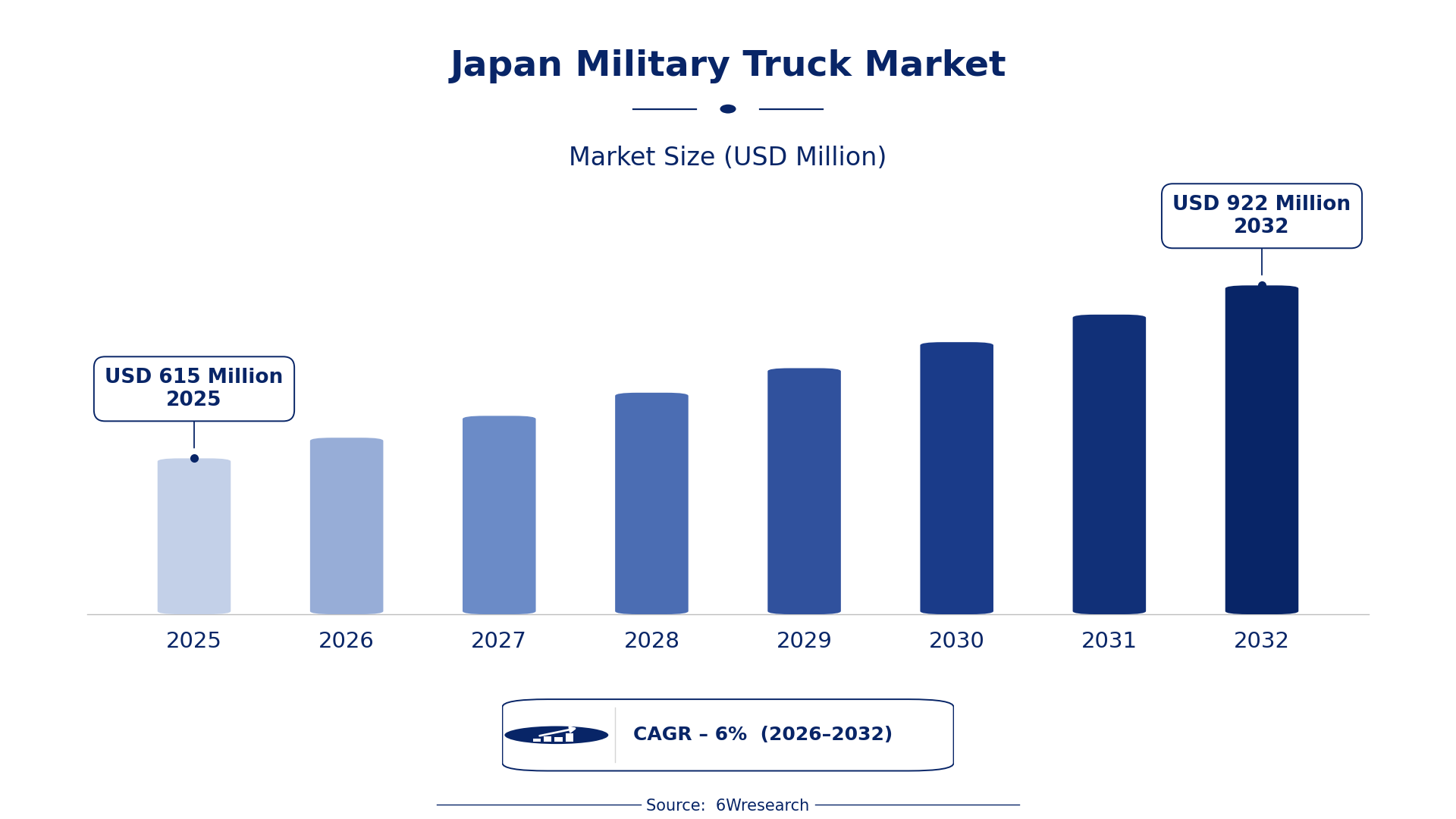
According to 6Wresearch internal database and industry insights, the Japan Military Truck Market was valued at USD 615 Million in 2025 and is projected to reach USD 922 Million by 2032, growing at a CAGR of approximately 6% during 2026–2032.
Japan Military Truck Market Highlights
| Report Metric | Details |
| Report Name | Japan Military Truck Market (2026-2032) |
| Market Size 2025 | USD 615 Million |
| Market Size 2032 | USD 922 Million |
| Absolute Growth 2025–2032 | USD 307 Million |
| CAGR 2026–2032 | 6% |
| Peak Annual Growth | 6.8% in 2030 |
| Forecast Period | 2026–2032 |
| Historical Data | 2022–2025 |
| Base Year | 2025 |
| Leading Application, 2025 | Troop (44% share) |
| Leading Axle, 2025 | 6x6 (43% share) |
| Leading Propulsion Type, 2025 | Diesel (57% share) |
| Fastest-Growing Application | Cargo/logistics (8.0% CAGR) |
| Fastest-Growing Propulsion Type | Gasoline (8.5% CAGR) |
| Growing Sector | Military logistics |
| Key End Users | Japan Self-Defense Forces, governmental agencies, defense contractors |
Japan Military Truck Market Year-wise Growth Rate and Key Drivers (2022–2032)
This graph illustrates the annual growth rates of the market from 2022 to 2032, highlighting a steady upward trajectory and projected market expansion over the forecast period.
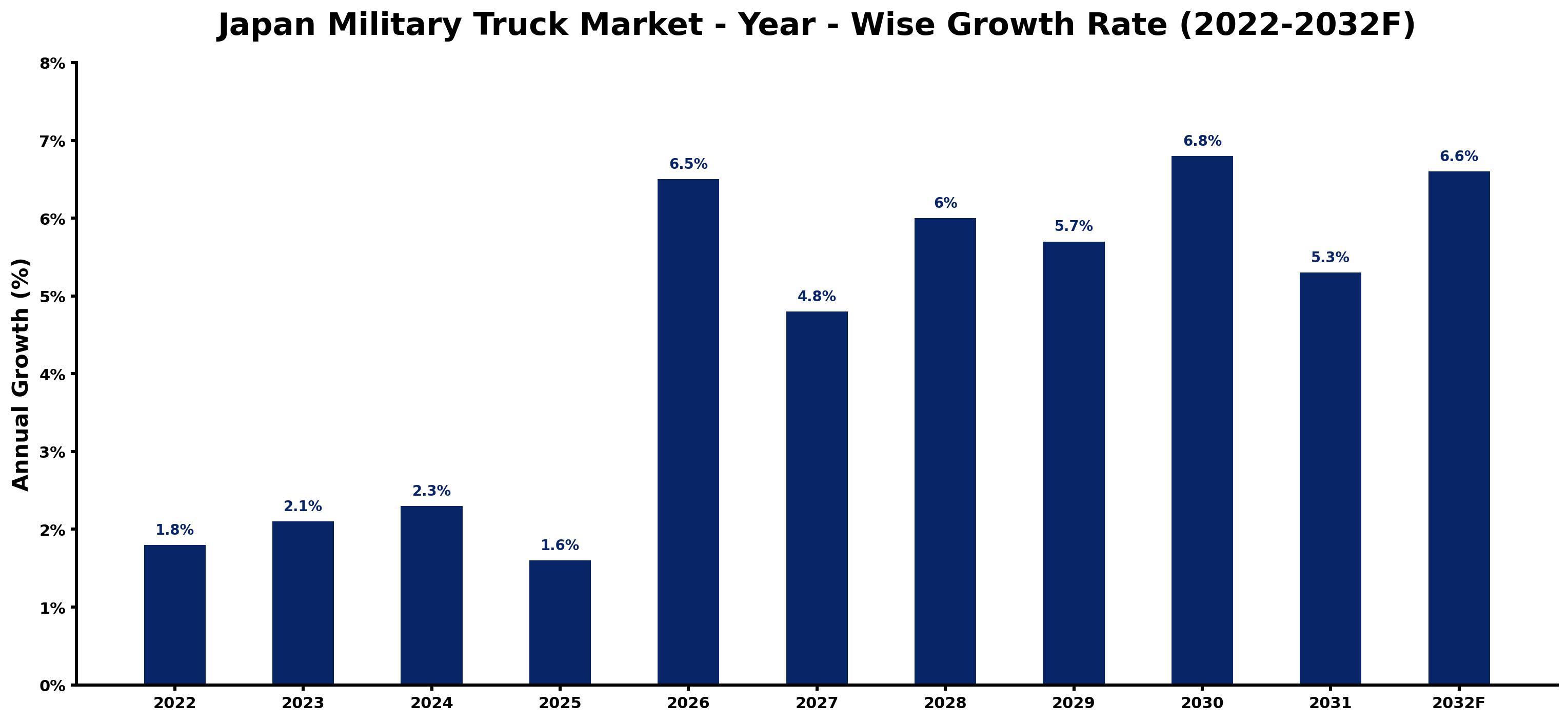
The following figures match every annual growth estimate with the main market development of that year, giving the reasoning behind each rise or slowdown.
| Year | Estimated Annual Growth (%) | Market Rationale |
| 2022 | 1.8 | The market showed steady activity with ongoing defense commitments and procurement needs. |
| 2023 | 2.1 | Growth was driven by increased defense spending and modernization efforts in military logistics. |
| 2024 | 2.3 | Continued investment in military capabilities supported a rise in demand for military trucks. |
| 2025 | 1.6 | Growth slowed as procurement strategies adjusted to align with budgetary constraints. |
| 2026 | 6.5 | A surge in demand for logistics capabilities will drive significant growth in military truck purchases. |
| 2027 | 4.8 | Demand will remain strong, but growth will slow as supply chain challenges emerge. |
| 2028 | 6.0 | Increased investment in military infrastructure will lead to a rebound in purchasing activity. |
| 2029 | 5.7 | Growth will continue, albeit at a slower pace, as operational needs evolve. |
| 2030 | 6.8 | A peak in demand will occur due to heightened focus on logistics modernization and fleet upgrades. |
| 2031 | 5.3 | Growth will decelerate as procurement cycles adjust to previous years' expansions. |
| 2032 | 6.6 | The market is projected to grow as modernization efforts continue to gain momentum. |
Note: Market size estimations and growth projections presented in this report are based on 6Wresearch's proprietary forecasting methodology, utilizing the latest available industry data, government publications, and primary research inputs.
Japan Military Truck Market Synopsis
Military trucks are specialized vehicles designed for transporting troops and equipment in military operations. The Japan Self-Defense Forces operate various models, including the Type 73 and Type 96. Growth in the Japan Military Truck Market is driven by increased defense spending, with ¥6 trillion allocated in 2023, and a commitment to enhancing logistics capabilities by 2025. The Tokyo region is pivotal in military vehicle manufacturing, stimulating demand for efficient military trucks.
Market Dynamics Impact Analysis (2026–2032)
| Factor | Type | Impact | Primary Segment Affected |
| Increased defense spending is driving demand for military trucks. | Driver | High | Cargo/logistics |
| The need for modernized logistics capabilities is boosting military truck procurement. | Driver | High | Troop |
| Rising operational demands create opportunities for advanced military truck models. | Opportunity | High | 6x6 |
| The push for sustainable military solutions opens avenues for electric military trucks. | Opportunity | Medium | Electric |
| Supply chain disruptions are affecting the availability of military trucks. | Restraint | High | Utility |
| Compliance with stringent safety standards may increase production costs. | Restraint | Medium | Cargo/logistics |
| Competition from international manufacturers may limit local market share. | Challenge | High | Troop |
| Technological advancements require continuous investment, straining budgets. | Challenge | Medium | 6x6 |
Evaluation of Drivers in Japan Military Truck Market (2026–2032)
Below are the drivers that matter most for revenue growth, with supporting evidence.
| Drivers | Primary Segment Affected | Why It Matters (Evidence) |
| Increased defense spending supports procurement of military trucks. | Cargo/logistics | Japan allocated ¥6 trillion for defense in 2023, boosting military logistics capabilities. |
| Modernization of logistics capabilities drives demand for troop transport vehicles. | Troop | The target to upgrade logistics systems by 2025 will increase troop transport needs. |
| Operational demands for versatile military trucks boost the 6x6 segment. | 6x6 | The Self-Defense Forces require 6x6 trucks for varied missions, leading to increased investments. |
| The focus on sustainability is encouraging the development of electric military trucks. | Electric | The Hydrogen Society Promotion Act supports low-carbon solutions, prompting interest in electric vehicles. |
| Technological advancements necessitate upgrades in military vehicle fleets. | Utility | A program to modernize existing fleets by 2026 will increase demand for utility trucks. |
Purchasing is picking up as the Japan Self-Defense Forces modernize logistics capabilities, with a ¥6 trillion defense budget allocated in 2023. The target to upgrade logistics by 2025 is driving demand for troop transport vehicles. Operational demands for versatile military trucks are increasing, particularly in the 6x6 segment, which is expected to see significant investments. The focus on sustainability is encouraging interest in electric military trucks.
Evaluation of Restraints in Japan Military Truck Market
Below are the constraints most often cited by buyers and suppliers, with the segment each affects.
| Market Restraint | Primary Segment Affected | Why It Matters (Evidence) |
| Supply chain disruptions are limiting the availability of military trucks. | Utility | Increased global demand has strained supply chains, affecting timely delivery of vehicles. |
| Compliance with stringent safety standards raises production costs. | Cargo/logistics | Adherence to JIS standards requires additional investments, impacting overall profitability. |
| Limited local production capacity may hinder market growth. | Troop | The reliance on a few manufacturers restricts the ability to meet rising demand. |
| Technological advancements require continuous investment in fleet upgrades. | 6x6 | Ongoing innovation necessitates funding that may divert resources from other areas. |
| Competition from international manufacturers may pressure local firms. | Electric | Foreign entrants with advanced technologies could capture market share from local producers. |
Japan Military Truck Market Challenges
High competition among military truck manufacturers leads to lower prices, which compresses profit margins for producers. Strict adherence to JIS standards elevates production costs, compelling manufacturers to invest in quality assurance and potentially delaying deliveries to the Japan Self-Defense Forces by up to three months. Buyers encounter procurement challenges due to the Ministry of Defense's stringent guidelines, resulting in approval processes that can extend timelines by as much as six months. Rapid technological advancements require ongoing investment, straining budgets for suppliers and delaying fleet upgrades for end users, affecting operational readiness.
Trends in the Japan Military Truck Market
The trends below show where the Japan Military Truck Market is heading.
- Shift Towards Advanced Military Vehicles: The Tokyo region is witnessing a shift towards advanced military vehicles, with the Ministry of Defense emphasizing modernization. In 2023, Japan allocated ¥6 trillion for defense spending, indicating a trend towards more sophisticated military logistics.
- Transition from Diesel to Electric Military Trucks: The Hydrogen Society Promotion Act, adopted in 2024, is promoting the transition to electric military trucks. This shift is supported by the growing demand for low-carbon solutions, with investments expected to rise significantly.
- Emergence of Enhanced Logistics Capabilities: The Ministry of Defense's 2023 strategy focuses on improving logistics capabilities, leading to increased demand for military trucks. By 2025, Japan aims to enhance its logistics infrastructure, reflecting a shift in operational priorities.
- Growing Investment in 6x6 Military Trucks: The 6x6 military truck segment is gaining traction, with a projected CAGR of 7.7% from 2026 to 2032. This growth is driven by operational demands for versatile vehicles that can handle various military tasks.
Investment Opportunities in the Japan Military Truck Market
Where to invest in the Japan Military Truck Market: the main openings are set out below.
- Tokyo Region as a Manufacturing Hub: The Tokyo region is emerging as a hub for military vehicle manufacturing, with significant investments anticipated. Establishing local partnerships can enhance supply chain efficiency and improve production capabilities.
- Increased Demand from the Self-Defense Forces: The Japan Self-Defense Forces are actively pursuing advanced military trucks, particularly in the 6x6 segment. With a growing budget, suppliers can take advantage of this demand by forming local collaborations.
- Market Gap for Electric Military Trucks: With the emphasis on sustainability, there is an increasing gap in the market for electric military trucks. Suppliers can enter this sector by aligning with the Hydrogen Society Promotion Act and targeting government contracts.
- Timing for Fleet Upgrades: The initiative to upgrade military fleets by 2026 presents a timely opportunity for suppliers. By aligning with the Ministry of Defense's objectives, companies can secure contracts for new vehicle models.
Government Initiatives in the Japan Military Truck Market
The Electrical Appliance and Material Safety Act, enacted in 1961, governs the safety of military vehicles, ensuring compliance with safety standards. This law mandates rigorous testing and certification processes for military truck manufacturers, affecting production timelines and costs. Additionally, the GX Basic Policy adopted in 2023 aims for substantial public-private decarbonisation investment, steering military vehicle development towards more sustainable options.
In 2023, ¥6 trillion was allocated for defense spending, overseen by the Defense Agency. This agency ensures compliance with procurement standards and facilitates funding for military vehicle upgrades, supporting fleet modernization and improving operational capabilities.
Future Insight of the Japan Military Truck Market
The Japan Self-Defense Forces will modernise logistics capabilities by 2032 through a government initiative to upgrade vehicle fleets by 2026. Increased funding of ¥6 trillion for defense spending will enable suppliers to deliver more advanced military trucks. Improved collaboration between the Defense Agency and manufacturers will streamline procurement, benefiting buyers. A focus on technological advancements will lead to more efficient military operations and better resource management for both buyers and suppliers.
Market Segmentation Analysis
Japan Military Truck Market report covers a detailed analysis of the following market segments:
By Application – Troop Leads, Cargo/logistics Expected to Grow Fastest
According to Shubham Padhi, Research Analyst at 6Wresearch, Troop accounted for 44% of the market by application in 2025. Troop transport holds the largest share as it is vital for moving personnel to and from operational areas, supported by the Japan Self-Defense Forces operating around 1,500 military trucks. The focus on enhancing logistics capabilities by 2025 further solidifies this segment's prominence. Cargo/logistics is set to record the highest CAGR in this split, 8.0% over 2026–2032. Cargo/logistics is experiencing rapid growth due to the Ministry of Defense's emphasis on modernising logistics and transport capabilities, which are essential for effective military operations. The increasing operational demands for efficient supply transport will likely widen the gap between this segment and others. This suggests that suppliers should concentrate on developing solutions tailored for cargo/logistics to align with government priorities.
By Axle – 6x6 Leads and Records the Fastest Growth
In 2025, 6x6 led the axle split with a 43% share. The 6x6 segment leads the market due to its optimal balance of mobility and payload capacity, essential for various military operations. This configuration is preferred by the Japan Self-Defense Forces, ensuring its dominance in military truck applications. The same category is also set to grow fastest, at a CAGR of 7.7% during 2026–2032. The 6x6 segment is also the fastest-growing, as its versatility meets the increasing operational demands of the Japan Self-Defense Forces. As military needs evolve, the 6x6 configuration's advantages will likely expand its market share further. Manufacturers should prioritise investment in 6x6 configurations to capitalise on both current and future demand.
By Propulsion Type – Diesel Leads, Gasoline Expected to Grow Fastest
Diesel took 57% of propulsion type revenue in 2025, more than any other category. Diesel propulsion leads the market because it is preferred for its power and fuel efficiency, making it suitable for the rigorous demands of military operations. The Japan Self-Defense Forces favour diesel engines for their reliability in various operational environments. The quickest growth will come from Gasoline, forecast to expand at a CAGR of 8.5% between 2026 and 2032. Gasoline is the fastest-growing segment, albeit from a smaller base, as advancements in technology may improve its efficiency and applicability in specific military scenarios. The growing interest in alternative fuel options could further boost this segment's growth. Suppliers may need to explore innovations in gasoline technology to meet emerging military requirements.
Key Attractiveness of the Report
- 10 Years of Market Numbers
- Historical Data Starting from 2022 to 2025
- Base Year 2025
- Forecast Data until 2032
- Key Performance Indicators Impacting the Market
- Major Upcoming Developments and Projects
Key Highlights of the Report:
- Japan Military Truck Market Outlook
- Market Size of Japan Military Truck Market, 2025
- Forecast of Japan Military Truck Market, 2032
- Historical Data and Forecast of Japan Military Truck Revenues & Volume for the Period 2022-2032
- Japan Military Truck Market Trend Evolution
- Japan Military Truck Market Drivers and Challenges
- Japan Military Truck Price Trends
- Japan Military Truck Porter's Five Forces
- Japan Military Truck Industry Life Cycle
- Historical Data and Forecast of Japan Military Truck Market Revenues & Volume By Application for the Period 2022-2032
- Historical Data and Forecast of Japan Military Truck Market Revenues & Volume By Cargo/logistics for the Period 2022-2032
- Historical Data and Forecast of Japan Military Truck Market Revenues & Volume By Troop for the Period 2022-2032
- Historical Data and Forecast of Japan Military Truck Market Revenues & Volume By Utility for the Period 2022-2032
- Historical Data and Forecast of Japan Military Truck Market Revenues & Volume By Axle for the Period 2022-2032
- Historical Data and Forecast of Japan Military Truck Market Revenues & Volume By 4x4 for the Period 2022-2032
- Historical Data and Forecast of Japan Military Truck Market Revenues & Volume By 6x6 for the Period 2022-2032
- Historical Data and Forecast of Japan Military Truck Market Revenues & Volume By 8x8 for the Period 2022-2032
- Historical Data and Forecast of Japan Military Truck Market Revenues & Volume By Others for the Period 2022-2032
- Historical Data and Forecast of Japan Military Truck Market Revenues & Volume By Propulsion Type for the Period 2022-2032
- Historical Data and Forecast of Japan Military Truck Market Revenues & Volume By Electric for the Period 2022-2032
- Historical Data and Forecast of Japan Military Truck Market Revenues & Volume By Gasoline for the Period 2022-2032
- Historical Data and Forecast of Japan Military Truck Market Revenues & Volume By Diesel for the Period 2022-2032
- Japan Military Truck Import Export Trade Statistics
- Market Opportunity Assessment By Application
- Market Opportunity Assessment By Axle
- Market Opportunity Assessment By Propulsion Type
- Japan Military Truck Top Companies Market Share
- Japan Military Truck Competitive Benchmarking By Technical and Operational Parameters
- Japan Military Truck Company Profiles
- Japan Military Truck Key Strategic Recommendations
Market Covered
Coverage by segment is as follows.
By Application
- Cargo/logistics
- Troop
- Utility
By Axle
- 4x4
- 6x6
- 8x8
- Others
By Propulsion Type
- Electric
- Gasoline
- Diesel































