Japan Mobile Telepresence Robots Market Size & Growth Rate
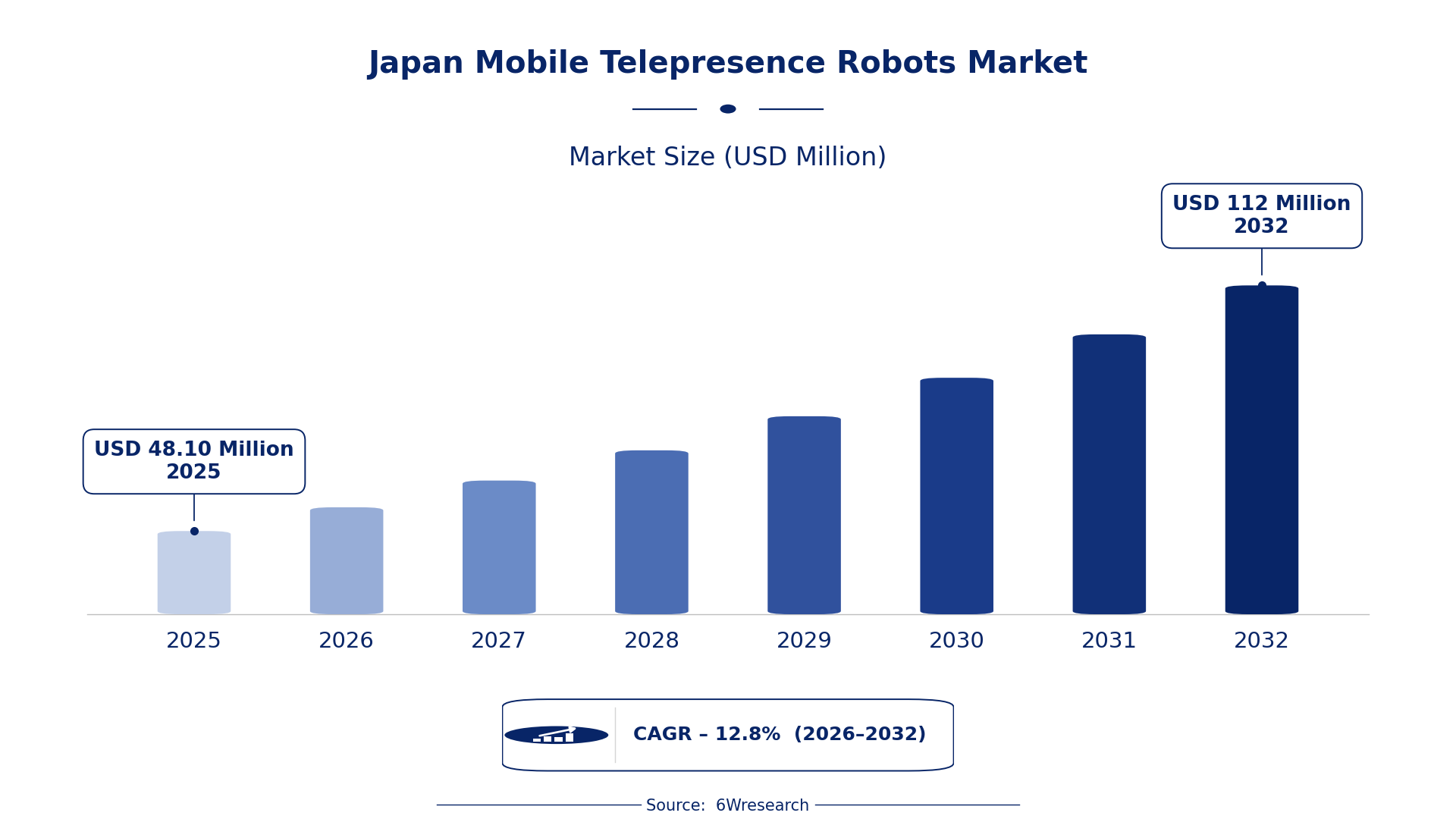
According to 6Wresearch internal database and industry insights, the Japan Mobile Telepresence Robots Market was valued at USD 48.10 Million in 2025 and is projected to reach USD 112 Million by 2032, growing at a CAGR of approximately 12.8% during 2026–2032.
Japan Mobile Telepresence Robots Market Highlights
| Report Metric | Details |
| Report Name | Japan Mobile Telepresence Robots Market (2026-2032) |
| Market Size 2025 | USD 48.10 Million |
| Market Size 2032 | USD 112 Million |
| Absolute Growth 2025–2032 | USD 63.90 Million |
| CAGR 2026–2032 | 12.8% |
| Peak Annual Growth | 14.7% in 2028 |
| Forecast Period | 2026–2032 |
| Historical Data | 2022–2025 |
| Base Year | 2025 |
| Leading Component, 2025 | Head (59% share) |
| Leading Interface, 2025 | Hardware (64% share) |
| Leading Type, 2025 | Stationary (57% share) |
| Leading Application, 2025 | Education (52% share) |
| Fastest-Growing Component | Body (17.4% CAGR) |
| Fastest-Growing Interface | Software (17.0% CAGR) |
| Fastest-Growing Type | Mobile (14.8% CAGR) |
| Fastest-Growing Application | Healthcare (17.3% CAGR) |
| Growing Sector | Healthcare |
| Key End Users | Healthcare providers, educational institutions, telehealth service providers, universities |
Japan Mobile Telepresence Robots Market Year-wise Growth Rate and Key Drivers (2022–2032)
This graph illustrates the annual growth rates of the market from 2022 to 2032, highlighting a steady upward trajectory and projected market expansion over the forecast period.
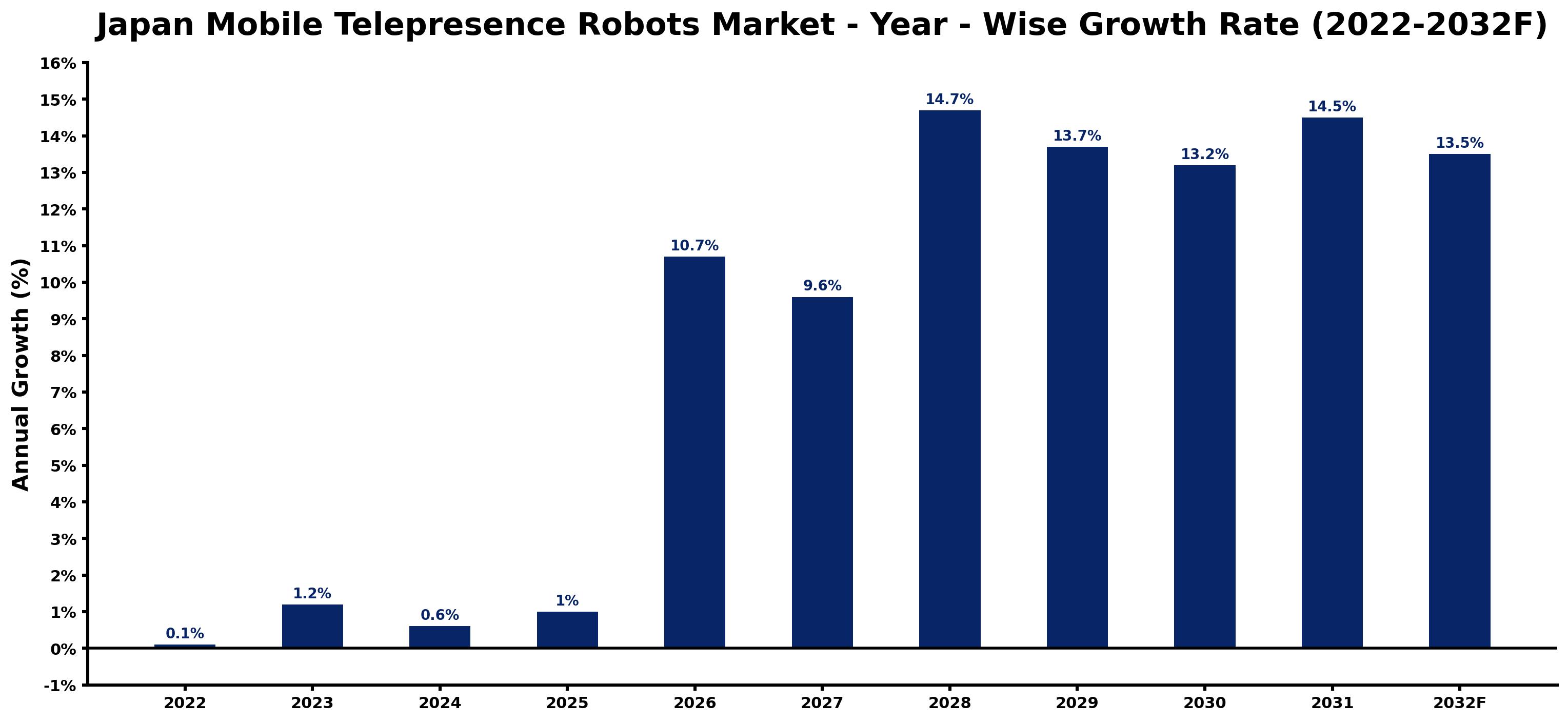
For each year, the table pairs the estimated growth rate with the leading influence on demand, showing how the drivers changed across the period.
| Year | Estimated Annual Growth (%) | Market Rationale |
| 2022 | 0.1 | The market showed minimal growth as initial adoption of telepresence robots was limited. |
| 2023 | 1.2 | Growth accelerated due to increased awareness of remote communication solutions in healthcare and education. |
| 2024 | 0.6 | Growth slowed as market saturation began to affect new unit sales, although demand remained positive. |
| 2025 | 1.0 | Demand improved as educational institutions expanded their use of telepresence robots for remote learning. |
| 2026 | 10.7 | Growth is expected to surge as healthcare facilities adopt telepresence robots at a higher rate for patient consultations. |
| 2027 | 9.6 | Growth is projected to slow slightly as the market adjusts to the influx of new technologies and products. |
| 2028 | 14.7 | Demand is anticipated to peak as investments are made in telehealth services, boosting robot applications. |
| 2029 | 13.7 | Growth is expected to moderate as the market begins to stabilise following rapid expansion in previous years. |
| 2030 | 13.2 | Growth will continue to slow as competition increases among providers of telepresence solutions. |
| 2031 | 14.5 | Demand is projected to rise again as new educational programmes integrate telepresence robots into their curricula. |
| 2032 | 13.5 | Growth is expected to decelerate slightly, but the market will remain strong with ongoing healthcare applications. |
Note: Market size estimations and growth projections presented in this report are based on 6Wresearch's proprietary forecasting methodology, utilizing the latest available industry data, government publications, and primary research inputs.
Japan Mobile Telepresence Robots Market Synopsis
Mobile telepresence robots are advanced systems that facilitate remote communication through video and audio capabilities, finding applications in healthcare and education. Government support for telemedicine initiatives and a rising adoption rate in educational institutions are propelling market growth.
Market Dynamics Impact Analysis (2026–2032)
| Factor | Type | Impact | Primary Segment Affected |
| Growing demand for remote healthcare solutions due to an aging population | Driver | High | Healthcare |
| Increased adoption of telepresence robots in educational institutions | Driver | High | Education |
| Expansion of telehealth services in rural areas | Opportunity | High | Healthcare |
| Rising interest in integrating telepresence robots in public health services | Opportunity | Medium | Healthcare |
| High initial investment costs for telepresence robot systems | Restraint | High | Mobile |
| Limited awareness among smaller healthcare facilities about telepresence benefits | Restraint | Medium | Healthcare |
| Competition from alternative remote communication technologies | Challenge | High | Mobile |
| Challenges in maintaining and updating robot technology | Challenge | Medium | Mobile |
Evaluation of Drivers in Japan Mobile Telepresence Robots Market (2026–2032)
The factors lifting demand, and the evidence behind each, are summarised below.
| Drivers | Primary Segment Affected | Why It Matters (Evidence) |
| Aging population increasing demand for remote consultations | Healthcare | Japan's average age is rising, leading to a greater need for telepresence robots in hospitals for patient care. |
| Educational institutions expanding remote learning capabilities | Education | With a focus on digital learning, universities are adopting telepresence robots to improve student engagement, with over 1,000 units deployed in 2022. |
| Government support for telemedicine initiatives | Healthcare | The Ministry of Health, Labour and Welfare's initiatives encourage hospitals to integrate telepresence robots for better healthcare access, with ¥500 million allocated in 2023. |
| Growing technological advancements in robotics and AI | Mobile | Innovations in robotics are making telepresence robots more functional and affordable, attracting more buyers in healthcare and education sectors. |
| Increased investment in telehealth services | Healthcare | The government allocated ¥500 million in 2023 to improve telehealth services, driving demand for telepresence robots. |
Buyers are adding capacity as Japan's aging population increases the need for remote healthcare solutions, with a projected annual growth rate of 15% in telepresence robot adoption through 2025. Over 1,000 telepresence robots were used in hospitals in 2022, reflecting the growing demand for effective patient care. Increased funding for telehealth services is driving demand across both healthcare and education sectors.
Evaluation of Restraints in Japan Mobile Telepresence Robots Market
The following restraints limit how fast demand can grow.
| Market Restraint | Primary Segment Affected | Why It Matters (Evidence) |
| High initial investment costs for telepresence robots | Healthcare | The cost of acquiring telepresence robots can deter smaller healthcare facilities from adopting the technology. |
| Limited awareness among smaller healthcare facilities | Healthcare | Many smaller healthcare providers are unaware of the benefits telepresence robots can offer, hindering market growth. |
| Competition from alternative remote communication technologies | Mobile | The presence of cheaper alternatives may divert potential buyers from investing in telepresence robots. |
| Challenges in maintaining and updating technology | Software | Ongoing maintenance and software updates can be resource-intensive, discouraging some buyers from investing. |
| Regulatory hurdles in healthcare technology adoption | Healthcare | Strict regulations can delay the integration of telepresence robots in healthcare settings, impacting market growth. |
Japan Mobile Telepresence Robots Market Challenges
Buyers in the healthcare sector encounter fierce competition from global manufacturers, which drives prices down and affects their ability to acquire advanced technologies. Delays in obtaining telepresence robots due to lengthy import processes hinder hospitals from implementing timely telehealth services, impacting patient care. Rising production costs, influenced by Japan's minimum wage increase to JPY 1,055 per hour, compel suppliers to raise prices, making these technologies less accessible for clinics. Shortages of skilled workers in robotics and software development restrict producers' capacity to innovate, resulting in slower responses to market demands for new functionalities.
Trends in the Japan Mobile Telepresence Robots Market
These developments are changing demand patterns in the Japan Mobile Telepresence Robots Market.
- Integration of Telepresence Robots in Public Health Services: The Tokyo Metropolitan Government has initiated a program to integrate telepresence robots into public health services, improving healthcare delivery. This initiative is part of a broader strategy to improve access to healthcare, with ¥500 million allocated in 2023.
- Shift from Traditional to Remote Learning: Educational institutions are increasingly adopting telepresence robots for remote learning, facilitating student engagement. In 2022, over 1,000 units were deployed in schools, reflecting a shift towards digital education.
- Growing Use of Telepresence Robots in Healthcare: Telepresence robots are becoming critical in healthcare for remote patient consultations, with adoption rates projected to rise by 15% annually through 2025. This trend highlights the increasing reliance on technology in patient care.
- Standardisation of Telepresence Robot Technologies: ISO 13482:2014 is being adopted as a standard for service robots, including telepresence robots. This standardisation ensures safety and effectiveness, encouraging more healthcare providers to invest in these technologies.
Investment Opportunities in the Japan Mobile Telepresence Robots Market
The following areas offer the clearest openings for investors and suppliers in the Japan Mobile Telepresence Robots Market.
- Healthcare Providers Seeking Telepresence Solutions: Healthcare providers are increasingly pursuing telepresence solutions to enhance patient care. The market is set to grow as Japan's population ages, with over 126 million residents requiring remote services.
- Gap in Remote Learning Technologies: With a rising demand for remote learning solutions, educational institutions are investing in telepresence robots. The Tokyo region, characterised by a high concentration of educational applications, presents a strong opportunity for suppliers.
- Partnerships with Educational Institutions: Establishing partnerships with universities can facilitate the integration of telepresence robots into curricula. This approach is particularly relevant in urban areas like Tokyo, where the demand for advanced educational tools is pronounced.
- Expansion of Telehealth Services in Rural Areas: Rural healthcare facilities are seeking to enhance their service offerings with telepresence robots. Government initiatives aimed at improving telehealth access provide a clear entry point for suppliers.
Government Initiatives in the Japan Mobile Telepresence Robots Market
The New Robot Strategy, adopted in 2015, seeks to broaden the use of robots across various sectors, including healthcare and education. This policy encourages investment in telepresence robots, ensuring that producers align with national goals for technological advancement and service improvement. The AI Promotion Act, set to come into effect in 2025, will further develop the framework for AI research and integration, supporting the incorporation of AI in telepresence technology.
The Consumer Affairs Agency supervises the implementation of regulations that guarantee proper labelling and advertising of telepresence robots. This includes monitoring compliance with regulations that protect buyers from misleading information.
Future Insight of the Japan Mobile Telepresence Robots Market
Advancements in telecommunication technology will reshape demand for mobile telepresence robots, especially in healthcare and education. The government's investment of ¥500 million for telehealth services will improve the integration of these robots into public health initiatives. ISO 13482:2014 will establish safety and performance standards, boosting buyer confidence. The healthcare sector is anticipated to adopt over 1,500 telepresence robots in hospitals by 2032, enhancing patient care and enabling more effective remote consultations.
Market Segmentation Analysis
Japan Mobile Telepresence Robots Market report covers a detailed analysis of the following market segments:
By Component – Head Leads, Body Expected to Grow Fastest
According to Dhaval Chaurasia, Assistant Manager at 6Wresearch, Head took 59% of component revenue in 2025, more than any other category. The head segment leads the market as it is a direct and essential component for telepresence functionality. This is evidenced by the over 1,000 telepresence robots currently operational in hospitals across Japan, highlighting the critical role of the head in effective communication and interaction. The quickest growth will come from Body, forecast to expand at a CAGR of 17.4% between 2026 and 2032. The body segment is experiencing rapid growth due to its provision of mobility and structure for the robots. This segment's expansion is reflected in the increasing adoption of telepresence robots in educational institutions and healthcare facilities, driving demand for enhanced mobility features. Suppliers should focus on improving the body segment to meet the rising demand for advanced mobile telepresence robots.
By Interface – Hardware Leads, Software Expected to Grow Fastest
The largest interface category in 2025 was Hardware, at 64% of revenue. The hardware segment leads the market because it is necessary for the physical operation of telepresence robots. Its importance is underscored by the widespread adoption of these robots in educational institutions and healthcare facilities. Software is projected to grow fastest, at a CAGR of 17.0% during 2026–2032. Software is the fastest-growing segment as it enables communication and control of the robots, which is essential for effective remote interactions. The increasing integration of telepresence solutions in various sectors is driving this growth. Buyers will benefit from investing in advanced software solutions to optimise the functionality of telepresence robots.
By Type – Stationary Leads, Mobile Expected to Grow Fastest
With 57% of type revenue in 2025, Stationary was the largest category. The stationary type holds the largest share as it is used in specific applications, although mobility is generally preferred. Its prevalence in certain settings, such as fixed educational environments, contributes to its market position. Mobile is set to record the highest CAGR in this split, 14.8% over 2026–2032. Mobile telepresence robots are growing rapidly as they are the primary type for effective telepresence, allowing for greater flexibility in remote communication. The increasing demand for mobility in healthcare and education is a key factor in this growth. Suppliers should prioritise mobile solutions to align with market trends and user preferences.
By Application – Education Leads, Healthcare Expected to Grow Fastest
In 2025, Education led the application split with a 52% share. Education leads as the primary application for telepresence robots, being widely utilised for remote learning and interaction in various educational settings. The concentration of applications in the Tokyo region further solidifies its position in the market. Over 2026–2032, Healthcare is expected to post the fastest growth, at a CAGR of 17.3%. Healthcare is the fastest-growing application, as telepresence robots are essential for remote patient consultations amidst an ageing population. Government initiatives to support telehealth services are accelerating growth in this segment. Focusing on healthcare applications will be vital for suppliers aiming to seize emerging market opportunities.
Key Attractiveness of the Report
- 10 Years of Market Numbers
- Historical Data Starting from 2022 to 2025
- Base Year 2025
- Forecast Data until 2032
- Key Performance Indicators Impacting the Market
- Major Upcoming Developments and Projects
Key Highlights of the Report:
- Japan Mobile Telepresence Robots Market Outlook
- Market Size of Japan Mobile Telepresence Robots Market, 2025
- Forecast of Japan Mobile Telepresence Robots Market, 2032
- Historical Data and Forecast of Japan Mobile Telepresence Robots Revenues & Volume for the Period 2022-2032
- Japan Mobile Telepresence Robots Market Trend Evolution
- Japan Mobile Telepresence Robots Market Drivers and Challenges
- Japan Mobile Telepresence Robots Price Trends
- Japan Mobile Telepresence Robots Porter's Five Forces
- Japan Mobile Telepresence Robots Industry Life Cycle
- Historical Data and Forecast of Japan Mobile Telepresence Robots Market Revenues & Volume By Component for the Period 2022-2032
- Historical Data and Forecast of Japan Mobile Telepresence Robots Market Revenues & Volume By Head for the Period 2022-2032
- Historical Data and Forecast of Japan Mobile Telepresence Robots Market Revenues & Volume By Body for the Period 2022-2032
- Historical Data and Forecast of Japan Mobile Telepresence Robots Market Revenues & Volume By Interface for the Period 2022-2032
- Historical Data and Forecast of Japan Mobile Telepresence Robots Market Revenues & Volume By Hardware for the Period 2022-2032
- Historical Data and Forecast of Japan Mobile Telepresence Robots Market Revenues & Volume By Software for the Period 2022-2032
- Historical Data and Forecast of Japan Mobile Telepresence Robots Market Revenues & Volume By Type for the Period 2022-2032
- Historical Data and Forecast of Japan Mobile Telepresence Robots Market Revenues & Volume By Stationary for the Period 2022-2032
- Historical Data and Forecast of Japan Mobile Telepresence Robots Market Revenues & Volume By Mobile for the Period 2022-2032
- Historical Data and Forecast of Japan Mobile Telepresence Robots Market Revenues & Volume By Application for the Period 2022-2032
- Historical Data and Forecast of Japan Mobile Telepresence Robots Market Revenues & Volume By Education for the Period 2022-2032
- Historical Data and Forecast of Japan Mobile Telepresence Robots Market Revenues & Volume By Healthcare for the Period 2022-2032
- Historical Data and Forecast of Japan Mobile Telepresence Robots Market Revenues & Volume By Enteprise for the Period 2022-2032
- Historical Data and Forecast of Japan Mobile Telepresence Robots Market Revenues & Volume By Homecare for the Period 2022-2032
- Historical Data and Forecast of Japan Mobile Telepresence Robots Market Revenues & Volume By Others for the Period 2022-2032
- Japan Mobile Telepresence Robots Import Export Trade Statistics
- Market Opportunity Assessment By Component
- Market Opportunity Assessment By Interface
- Market Opportunity Assessment By Type
- Market Opportunity Assessment By Application
- Japan Mobile Telepresence Robots Top Companies Market Share
- Japan Mobile Telepresence Robots Competitive Benchmarking By Technical and Operational Parameters
- Japan Mobile Telepresence Robots Company Profiles
- Japan Mobile Telepresence Robots Key Strategic Recommendations
Market Covered
Coverage by segment is as follows.
By Component
- Head
- Body
By Interface
- Hardware
- Software
By Type
- Stationary
- Mobile
By Application
- Education
- Healthcare
- Enteprise
- Homecare
- Others































