Japan Modular Gas Processing Plant Market Size & Growth Rate
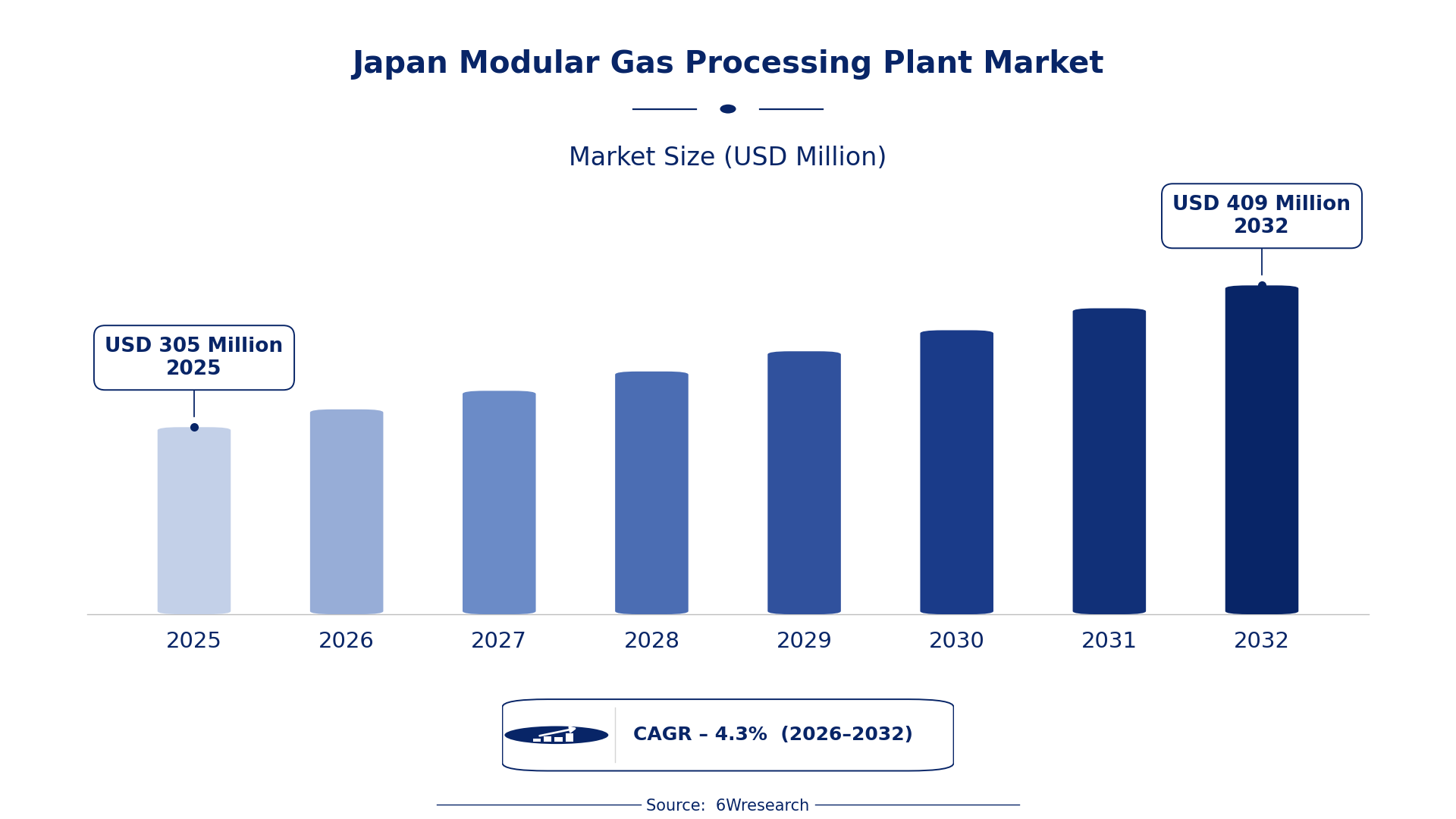
According to 6Wresearch internal database and industry insights, the Japan Modular Gas Processing Plant Market was valued at USD 305 Million in 2025 and is projected to reach USD 409 Million by 2032, growing at a CAGR of approximately 4.3% during 2026–2032.
Japan Modular Gas Processing Plant Market Highlights
| Report Metric | Details |
| Report Name | Japan Modular Gas Processing Plant Market (2026-2032) |
| Market Size 2025 | USD 305 Million |
| Market Size 2032 | USD 409 Million |
| Absolute Growth 2025–2032 | USD 104 Million |
| CAGR 2026–2032 | 4.3% |
| Peak Annual Growth | 5.1% in 2032 |
| Forecast Period | 2026–2032 |
| Historical Data | 2022–2025 |
| Base Year | 2025 |
| Leading Gas Type, 2025 | LNG (41% share) |
| Leading Application, 2025 | Onshore (62% share) |
| Leading Type, 2025 | Portable (62% share) |
| Fastest-Growing Gas Type | LPG (6.0% CAGR) |
| Fastest-Growing Application | Offshore (5.6% CAGR) |
| Fastest-Growing Type | Stationary (6.1% CAGR) |
| Growing Sector | Energy production and distribution |
| Key End Users | Energy producers, industrial manufacturers, government agencies |
Japan Modular Gas Processing Plant Market Year-wise Growth Rate and Key Drivers (2022–2032)
This graph illustrates the annual growth rates of the market from 2022 to 2032, highlighting a steady upward trajectory and projected market expansion over the forecast period.
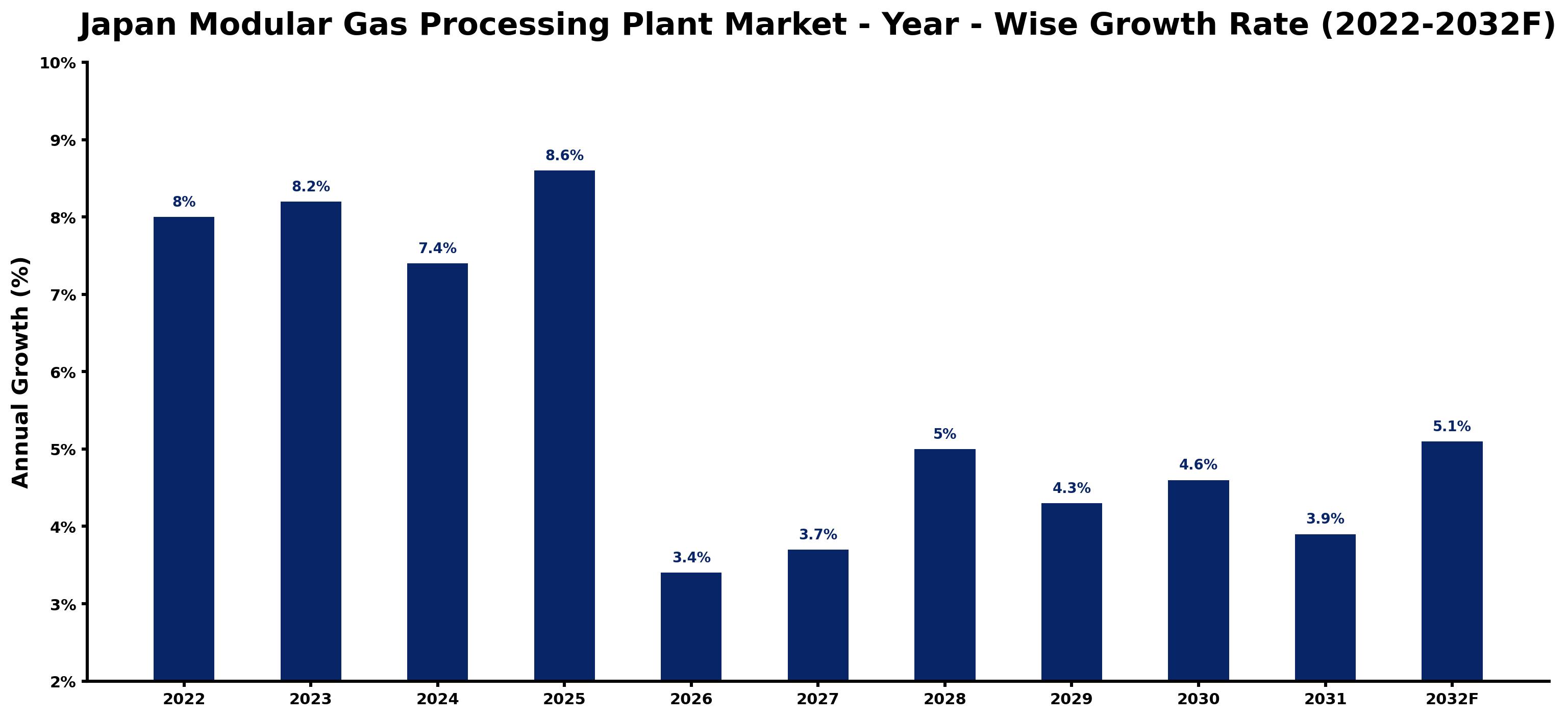
Year by year, the estimates below pair each growth rate with the development that shaped it.
| Year | Estimated Annual Growth (%) | Market Rationale |
| 2022 | 8.0 | Demand for modular gas processing plants was strong, driven by energy production needs. |
| 2023 | 8.2 | Growth continued as the LNG market remained strong, supporting further investments. |
| 2024 | 7.4 | Growth slowed due to market saturation in certain regions, yet demand persisted. |
| 2025 | 8.6 | The market peaked as Japan imported over 70 million tons of LNG for power generation. |
| 2026 | 3.4 | A slowdown occurred as the focus shifted towards renewable energy sources. |
| 2027 | 3.7 | Growth resumed as investments in gas processing infrastructure increased. |
| 2028 | 5.0 | Demand rose due to heightened energy efficiency standards in processing facilities. |
| 2029 | 4.3 | A slowdown was noted as competition from alternative energy sources intensified. |
| 2030 | 4.6 | Growth accelerated as the government promoted cleaner gas technologies. |
| 2031 | 3.9 | The market experienced a slowdown as buyers adjusted to new energy policies. |
| 2032 | 5.1 | Demand surged again as investments in decarbonisation technologies expanded. |
Note: Market size estimations and growth projections presented in this report are based on 6Wresearch's proprietary forecasting methodology, utilizing the latest available industry data, government publications, and primary research inputs.
Japan Modular Gas Processing Plant Market Synopsis
Modular Gas Processing Plants are facilities that process natural gas into LNG, LPG, and CNG using modular construction techniques for rapid deployment. The Japan Modular Gas Processing Plant Market is growing as LNG imports surpassed 70 million tons in 2022, primarily for power generation. This expansion is driven by the government's commitment to reducing greenhouse gas emissions and the increasing demand for cleaner energy solutions, which is prompting investments in gas processing infrastructure.
Market Dynamics Impact Analysis (2026–2032)
| Factor | Type | Impact | Primary Segment Affected |
| Rising LNG imports for power generation | Driver | High | LNG |
| Increasing energy efficiency standards | Driver | High | Onshore |
| Investment in cleaner gas technologies | Opportunity | High | LPG |
| Growing demand for portable energy solutions | Opportunity | Medium | Portable |
| Competition from renewable energy sources | Restraint | High | CNG |
| High costs of modular plant construction | Restraint | Medium | Stationary |
| Fluctuating natural gas prices | Challenge | High | LNG |
| Regulatory compliance costs | Challenge | Medium | Onshore |
Evaluation of Drivers in Japan Modular Gas Processing Plant Market (2026–2032)
The factors lifting demand, and the evidence behind each, are summarised below.
| Drivers | Primary Segment Affected | Why It Matters (Evidence) |
| High LNG imports for energy production | LNG | Japan imported over 70 million tons of LNG in 2022, driving demand for processing facilities. |
| Government energy efficiency initiatives | Onshore | The Ministry of the Environment promotes energy efficiency standards, increasing demand for compliant facilities. |
| Investment in cleaner technologies | LPG | The government aims for a 46% cut in greenhouse-gas emissions by 2030, boosting demand for cleaner processing. |
| Demand for portable energy solutions | Portable | Portable units are increasingly used in remote areas, expanding the market for modular gas processing. |
| Growing industrial base in Chubu region | Stationary | The Chubu region's industrial base drives demand for permanent gas processing installations. |
Volumes increase due to Japan's LNG imports, which exceeded 70 million tons in 2022, fuelling the demand for processing facilities. The push for energy efficiency standards encourages investments in compliant gas processing plants, especially in the Onshore segment. The commitment to reduce greenhouse gas emissions by 46% by 2030 stimulates demand for cleaner LPG technologies. The industrial base in regions like Chubu supports the growth of stationary installations, while portable units are increasingly used in remote areas, improving energy access.
Evaluation of Restraints in Japan Modular Gas Processing Plant Market
The table below lists the restraints and the evidence behind each.
| Market Restraint | Primary Segment Affected | Why It Matters (Evidence) |
| High construction costs for modular plants | Stationary | The cost of modular construction can deter investments, impacting the growth of stationary facilities. |
| Competition from renewable energy sources | CNG | As renewable energy gains traction, demand for traditional gas processing may face challenges. |
| Volatile natural gas prices | LNG | Fluctuations in natural gas prices can affect project viability and investment decisions. |
| Regulatory compliance costs | Onshore | Strict regulations can increase operational costs for gas processing plants. |
| Limited offshore applications | Offshore | Offshore gas processing remains less common, restricting market growth in that segment. |
Japan Modular Gas Processing Plant Market Challenges
In 2023, rising material costs for modular gas processing plants inflate project budgets by up to 15%, delaying timelines for energy producers. Technological limitations in existing facilities hinder efficiency improvements, causing operators to miss potential energy savings of around 20%. Increased competition from renewable energy sources pressures buyers, compelling them to reassess investments in gas processing infrastructure. Buyers in the Tokyo metropolitan area face fluctuating demand, complicating long-term planning and potentially resulting in underutilised facilities.
Trends in the Japan Modular Gas Processing Plant Market
Four trends stand out in the Japan Modular Gas Processing Plant Market.
- Shift towards Cleaner Gas Technologies: Japan is adopting cleaner gas processing technologies, driven by government initiatives. In 2023, the government allocated funds for renewable energy projects, including gas processing, supporting this transition.
- Growing Use of Portable Gas Processing Units: Portable gas processing units are becoming more common in remote areas, providing essential energy solutions. In 2022, demand surged as these units addressed energy needs for isolated communities.
- Expansion of Energy Efficiency Standards: The Ministry of the Environment's promotion of energy efficiency standards is reshaping the gas processing sector. In 2023, new standards were introduced, encouraging investment in modern facilities.
- Increased Investment in Gas Processing Infrastructure: Investment in gas processing infrastructure is rising, particularly in the Chubu region. The government aims for substantial funding to support this growth, targeting JPY 150 trillion by 2033.
Investment Opportunities in the Japan Modular Gas Processing Plant Market
The following areas offer the clearest openings for investors and suppliers in the Japan Modular Gas Processing Plant Market.
- Timing of Energy Transition: Now is an ideal moment for investment in cleaner gas technologies, as Japan aims for a 46% reduction in emissions by 2030. The LPG sector is especially poised for growth.
- Gap in Portable Energy Solutions: With rising demand for portable processing units, a notable market gap exists. Remote areas, such as Hokkaido, offer opportunities for suppliers to address this need.
- Investment in Onshore Facilities: Onshore facilities are in high demand due to the expanding industrial base in regions like Chubu. Suppliers can enter this market by forming partnerships with local manufacturers.
- Focus on Renewable Energy Projects: The government has allocated funds for renewable energy projects, creating opportunities for gas processing suppliers. The target of JPY 150 trillion by 2033 encourages investment in cleaner technologies.
Government Initiatives in the Japan Modular Gas Processing Plant Market
The Industrial Standardization Act of 1949, amended in 2019, governs product and test standards for gas processing facilities. This law ensures that manufacturers comply with quality standards, impacting production processes and compliance requirements. The Hydrogen Society Promotion Act, adopted in 2024, supports low-carbon hydrogen supply chains, promoting investment in cleaner gas technologies.
In 2023, the government allocated JPY 150 trillion for public-private decarbonisation investment over ten years. The Ministry of Economy, Trade and Industry (METI) oversees this funding, which supports the development of cleaner gas processing technologies and infrastructure.
Future Insight of the Japan Modular Gas Processing Plant Market
By 2032, a policy-driven shift will compel suppliers to adopt cleaner gas technologies, aligning with Japan's greenhouse gas reduction targets. The government's funding for renewable energy projects will drive the development of advanced modular gas processing facilities, improving operational efficiency. Energy consumers will benefit from enhanced standards promoted by the Japan Gas Association, ensuring a more reliable gas supply. With government initiatives supporting over 70 million tons of LNG imports, the market will experience growing demand for efficient processing solutions that meet environmental objectives.
Market Segmentation Analysis
Japan Modular Gas Processing Plant Market report covers a detailed analysis of the following market segments:
By Gas Type – LNG Leads, LPG Expected to Grow Fastest
According to Ravi Bhandari, Research Head at 6Wresearch, LNG held 41% of the Japan Modular Gas Processing Plant Market by gas type in 2025. LNG holds the largest share due to its extensive use in power generation, with Japan importing over 70 million tons in 2022. This high demand stems from the country's reliance on LNG to ensure energy security for its population of approximately 125 million. Over 2026–2032, LPG is expected to post the fastest growth, at a CAGR of 6.0%. LPG is experiencing rapid growth as it is increasingly utilised for heating and cooking applications, particularly in urban areas like the Tokyo metropolitan region. The government's push for cleaner gas technologies is accelerating the adoption of LPG in residential and commercial sectors. Suppliers should prioritise their LPG strategies to align with the increasing consumer preference for cleaner energy solutions.
By Application – Onshore Leads, Offshore Expected to Grow Fastest
In 2025, Onshore led the application split with a 62% share. Onshore applications lead the market as they are essential for land-based gas processing, which is crucial for meeting Japan's energy demands. The Tokyo metropolitan area, with its high concentration of gas consumers, illustrates the robust need for onshore facilities. Offshore is projected to grow fastest, at a CAGR of 5.6% during 2026–2032. Offshore applications are experiencing rapid growth due to heightened exploration and production activities in marine environments. This segment's expansion is further propelled by the government's push for cleaner gas technologies and energy diversification. Suppliers should consider enhancing their offerings for offshore solutions to meet the evolving energy landscape.
By Type – Portable Leads, Stationary Expected to Grow Fastest
Portable accounted for 62% of the market by type in 2025. Portable units, while a minor segment, are gaining traction for temporary setups in remote areas, providing essential energy access. Their adaptability makes them suitable for various applications, particularly in less accessible regions. The quickest growth will come from Stationary, forecast to expand at a CAGR of 6.1% between 2026 and 2032. Stationary units are expected to grow rapidly as they are widely used for permanent installations, catering to the substantial demand from the gas processing industry. Their reliability and efficiency make them a preferred choice for long-term operations. Suppliers should prioritise stationary solutions to meet the increasing demand for permanent gas processing facilities.
Key Attractiveness of the Report
- 10 Years of Market Numbers
- Historical Data Starting from 2022 to 2025
- Base Year 2025
- Forecast Data until 2032
- Key Performance Indicators Impacting the Market
- Major Upcoming Developments and Projects
Key Highlights of the Report:
- Japan Modular Gas Processing Plant Market Outlook
- Market Size of Japan Modular Gas Processing Plant Market, 2025
- Forecast of Japan Modular Gas Processing Plant Market, 2032
- Historical Data and Forecast of Japan Modular Gas Processing Plant Revenues & Volume for the Period 2022-2032
- Japan Modular Gas Processing Plant Market Trend Evolution
- Japan Modular Gas Processing Plant Market Drivers and Challenges
- Japan Modular Gas Processing Plant Price Trends
- Japan Modular Gas Processing Plant Porter's Five Forces
- Japan Modular Gas Processing Plant Industry Life Cycle
- Historical Data and Forecast of Japan Modular Gas Processing Plant Market Revenues & Volume By Gas Type for the Period 2022-2032
- Historical Data and Forecast of Japan Modular Gas Processing Plant Market Revenues & Volume By LNG for the Period 2022-2032
- Historical Data and Forecast of Japan Modular Gas Processing Plant Market Revenues & Volume By LPG for the Period 2022-2032
- Historical Data and Forecast of Japan Modular Gas Processing Plant Market Revenues & Volume By CNG for the Period 2022-2032
- Historical Data and Forecast of Japan Modular Gas Processing Plant Market Revenues & Volume By Others for the Period 2022-2032
- Historical Data and Forecast of Japan Modular Gas Processing Plant Market Revenues & Volume By Application for the Period 2022-2032
- Historical Data and Forecast of Japan Modular Gas Processing Plant Market Revenues & Volume By Onshore for the Period 2022-2032
- Historical Data and Forecast of Japan Modular Gas Processing Plant Market Revenues & Volume By Offshore for the Period 2022-2032
- Historical Data and Forecast of Japan Modular Gas Processing Plant Market Revenues & Volume By Type for the Period 2022-2032
- Historical Data and Forecast of Japan Modular Gas Processing Plant Market Revenues & Volume By Portable for the Period 2022-2032
- Historical Data and Forecast of Japan Modular Gas Processing Plant Market Revenues & Volume By Stationary for the Period 2022-2032
- Japan Modular Gas Processing Plant Import Export Trade Statistics
- Market Opportunity Assessment By Gas Type
- Market Opportunity Assessment By Application
- Market Opportunity Assessment By Type
- Japan Modular Gas Processing Plant Top Companies Market Share
- Japan Modular Gas Processing Plant Competitive Benchmarking By Technical and Operational Parameters
- Japan Modular Gas Processing Plant Company Profiles
- Japan Modular Gas Processing Plant Key Strategic Recommendations
Market Covered
The following segment groups are covered in the report.
By Gas Type
- LNG
- LPG
- CNG
- Others
By Application
- Onshore
- Offshore
By Type
- Portable
- Stationary































