Japan Music Production Software Market Size & Growth Rate
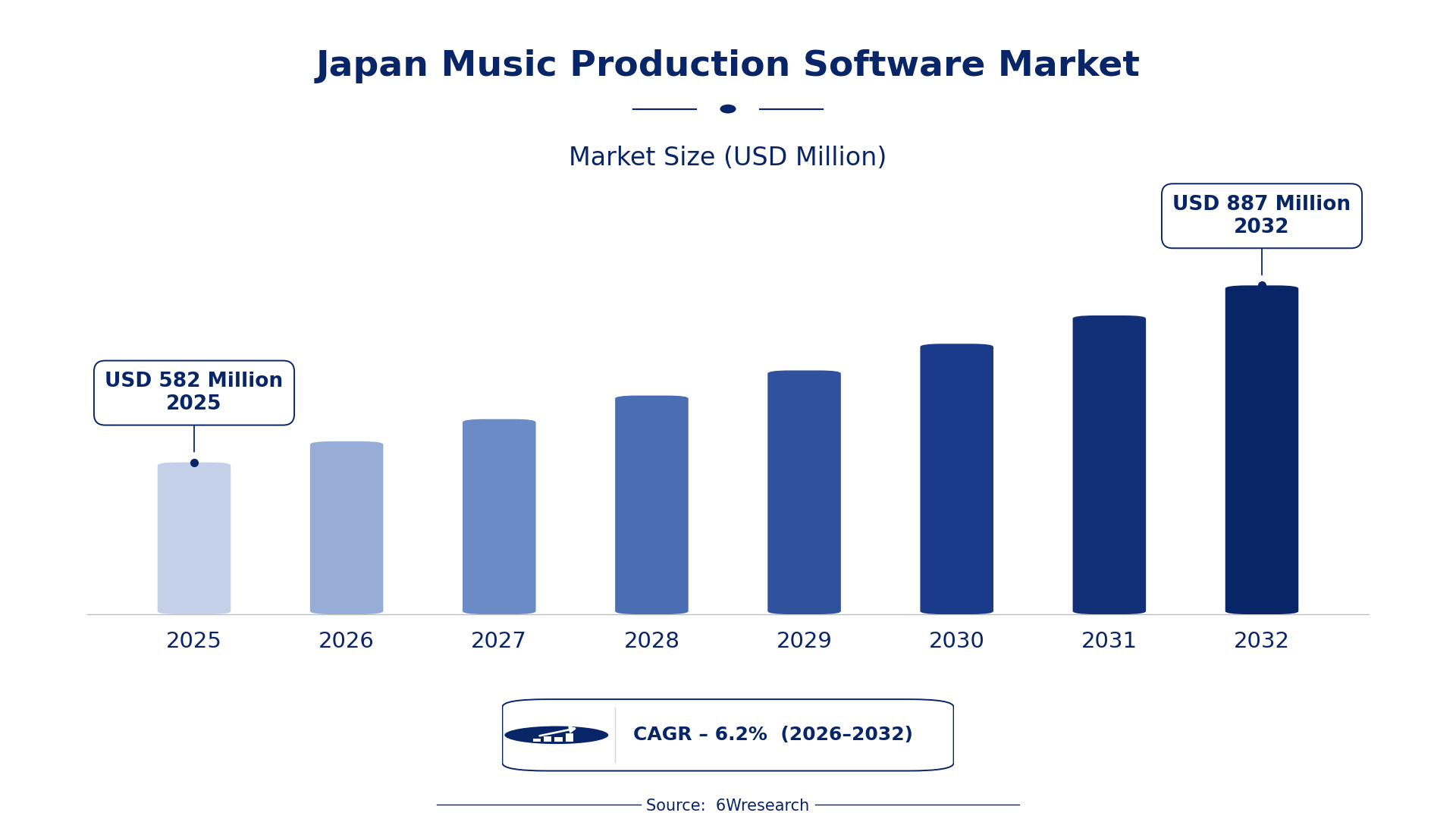
According to 6Wresearch internal database and industry insights, the Japan Music Production Software Market was valued at USD 582 Million in 2025 and is projected to reach USD 887 Million by 2032, growing at a CAGR of approximately 6.2% during 2026–2032.
Japan Music Production Software Market Highlights
| Report Metric | Details |
| Report Name | Japan Music Production Software Market (2026-2032) |
| Market Size 2025 | USD 582 Million |
| Market Size 2032 | USD 887 Million |
| Absolute Growth 2025–2032 | USD 305 Million |
| CAGR 2026–2032 | 6.2% |
| Peak Annual Growth | 7.0% in 2026 |
| Forecast Period | 2026–2032 |
| Historical Data | 2022–2025 |
| Base Year | 2025 |
| Leading Software Type, 2025 | DAW (Digital Audio Workstation) (38% share) |
| Leading Platform, 2025 | Desktop (53% share) |
| Leading Features, 2025 | Multi-Track Recording (47% share) |
| Leading User Type, 2025 | Professionals (36% share) |
| Leading Distribution Model, 2025 | Subscription (33% share) |
| Fastest-Growing Software Type | Audio Editing Software (9.0% CAGR) |
| Fastest-Growing Platform | Mobile (9.1% CAGR) |
| Fastest-Growing Features | Audio Effects (8.4% CAGR) |
| Fastest-Growing User Type | Beginners (8.6% CAGR) |
| Fastest-Growing Distribution Model | One-Time Purchase (7.8% CAGR) |
| Growing Sector | entertainment and media |
| Key End Users | music producers, educators, independent artists, studios |
Japan Music Production Software Market Year-wise Growth Rate and Key Drivers (2022–2032)
This graph illustrates the annual growth rates of the market from 2022 to 2032, highlighting a steady upward trajectory and projected market expansion over the forecast period.
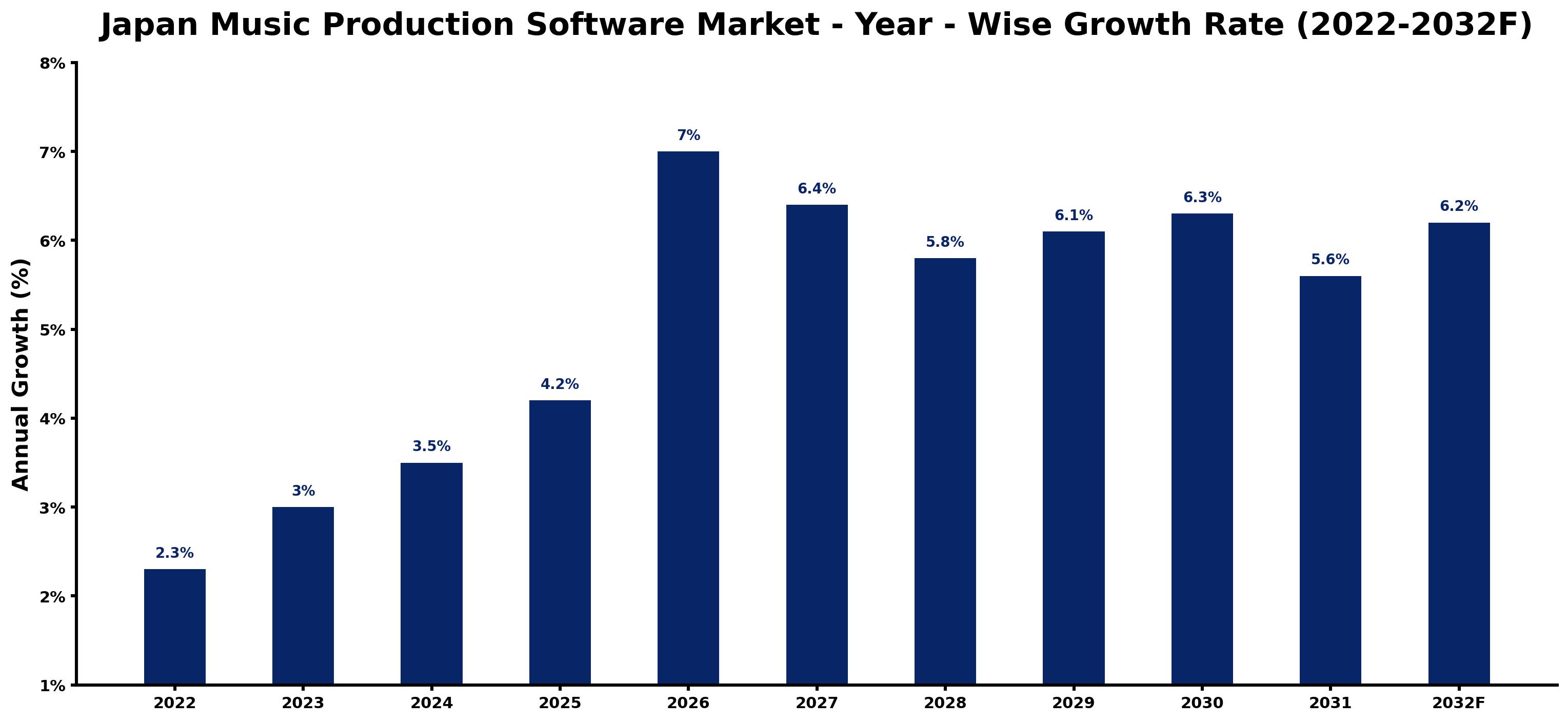
The table below sets out the estimated growth rate for each year and the main factor behind it.
| Year | Estimated Annual Growth (%) | Market Rationale |
| 2022 | 2.3 | The market experienced steady growth due to established demand from music producers. |
| 2023 | 3.0 | Growth accelerated as more users adopted digital tools for music creation. |
| 2024 | 3.5 | The rise in professional musicians contributed to a faster growth rate. |
| 2025 | 4.2 | Increased interest in audio production led to higher software sales. |
| 2026 | 7.0 | The introduction of new features is expected to spur market expansion. |
| 2027 | 6.4 | Growth will slow as the market reaches a more mature phase. |
| 2028 | 5.8 | A slowdown in growth is projected as competition intensifies. |
| 2029 | 6.1 | New technology adoption will revitalise interest in music production software. |
| 2030 | 6.3 | Continued investment in creative industries will support market growth. |
| 2031 | 5.6 | A slowdown is anticipated as the market stabilises after rapid expansion. |
| 2032 | 6.2 | Growth is expected to resume as new user segments emerge, driving demand. |
Note: Market size estimations and growth projections presented in this report are based on 6Wresearch's proprietary forecasting methodology, utilizing the latest available industry data, government publications, and primary research inputs.
Japan Music Production Software Market Synopsis
Music production software includes applications for creating, editing, and producing audio files, essential for music composition and sound design. Tokyo serves as a major hub for this market, with a thriving entertainment sector and approximately 300,000 professional musicians driving demand. The market is further supported by technological advancements and increased investment in digital content industries, valued at around $3 billion in 2022.
Market Dynamics Impact Analysis (2026–2032)
| Factor | Type | Impact | Primary Segment Affected |
| Growing number of professional musicians drives demand for music production software. | Driver | High | DAW (Digital Audio Workstation) |
| Technological advancements in audio editing tools enhance user experience. | Driver | High | Audio Editing Software |
| Increasing interest in music education creates demand for educational software. | Opportunity | High | Virtual Instruments |
| The rise of independent artists boosts the need for affordable production tools. | Opportunity | Medium | Beat-Making Software |
| High competition among software providers may limit market growth. | Restraint | Medium | Mixing & Mastering Tools |
| Rapid technological changes may lead to short product life cycles. | Restraint | High | Audio Effects |
| Limited awareness of advanced features can hinder user adoption. | Challenge | Medium | Multi-Track Recording |
| High initial costs for advanced software may deter new users. | Challenge | High | Subscription |
Evaluation of Drivers in Japan Music Production Software Market (2026–2032)
Demand rests on the following drivers, each shown with the segment it touches most.
| Drivers | Primary Segment Affected | Why It Matters (Evidence) |
| Increased adoption of DAWs among music producers boosts production capabilities. | DAW (Digital Audio Workstation) | Over 50% of music producers in Japan use DAWs regularly, resulting in higher software sales. |
| The growing popularity of audio editing tools improves sound quality in productions. | Audio Editing Software | The number of music studios in Japan exceeds 5,000, increasing demand for editing software. |
| Rising interest in music education boosts the need for virtual instruments. | Virtual Instruments | The demand for educational music software is increasing in schools, with more institutions incorporating these tools. |
| Technological advancements in music production tools attract independent artists. | Beat-Making Software | AI mastering tools are becoming popular among independent artists, increasing software demand. |
| The increasing number of music festivals creates opportunities for sound design software. | Mixing & Mastering Tools | The number of music festivals in Japan reached over 1,000 in 2023, enhancing software use. |
Spending rises because the number of professional musicians in Japan, estimated at 300,000, drives demand for production software. Music studios, exceeding 5,000, require advanced tools for audio editing and mixing. The growing interest in music education leads to increased purchases of virtual instruments, particularly in schools. The rise of independent artists utilising AI mastering tools increases demand for new software solutions. As the number of music festivals surpasses 1,000, the need for high-quality production tools continues to expand.
Evaluation of Restraints in Japan Music Production Software Market
Below are the constraints most often cited by buyers and suppliers, with the segment each affects.
| Market Restraint | Primary Segment Affected | Why It Matters (Evidence) |
| Intense competition among software providers may limit market share. | Mixing & Mastering Tools | With numerous options available, producers may hesitate to invest in premium software. |
| Rapid technological changes can lead to short product life cycles. | Audio Effects | Producers may delay purchases, waiting for the next version or update. |
| Limited awareness of advanced features can hinder user adoption. | Multi-Track Recording | Many users remain unaware of the benefits of complex recording capabilities. |
| High initial costs for advanced software may deter new users. | Subscription | Budget constraints prevent casual users from investing in professional-grade tools. |
| The need for continuous updates can strain budgets for smaller studios. | Virtual Instruments | Smaller studios may struggle to keep up with ongoing software costs. |
Japan Music Production Software Market Challenges
Rapid technological changes create challenges for producers, resulting in software that may not meet buyer expectations. This disconnect has led to a 20% decline in sales for those unable to adapt. Buyers struggle to find software compatible with their existing systems, causing production delays averaging six weeks. Increased competition from international markets compels local producers to reduce prices, shrinking profit margins by 15%. Rising development costs, with the national minimum wage at JPY 1,055 per hour, limit producers' capacity to invest in necessary technology upgrades.
Trends in the Japan Music Production Software Market
The trends below show where the Japan Music Production Software Market is heading.
- Shift to Cloud-Based Collaboration Tools: Tokyo is experiencing a shift towards cloud-based music production tools that facilitate collaboration among artists. By 2025, these tools are expected to gain popularity, enabling users to work together remotely.
- Emergence of AI Mastering Tools: Since 2023, AI mastering tools have gained popularity among independent artists in Japan, simplifying the mastering process. This trend is likely to expand as more artists pursue efficient production methods.
- Growth of Educational Music Software: The demand for educational music software has surged since 2022, spurred by initiatives in schools. Over 50% of music educators are now integrating software into their curricula.
- Expansion of Mobile Music Production: The rise of mobile music production tools began in 2023, appealing to casual users. The mobile segment is projected to grow considerably in the coming years.
Investment Opportunities in the Japan Music Production Software Market
The following opportunities in the Japan Music Production Software Market pair current demand with a clear way in.
- Growing Demand for Educational Software: With the increasing number of music programs in schools, there is an opportunity to provide educational music software. The market for such tools is expected to expand, particularly among music educators.
- Investment in AI Mastering Tools: As AI mastering tools gain traction, there is an opportunity to invest in the development of these technologies. Independent artists are increasingly searching for affordable solutions for high-quality production.
- Expansion of Subscription Models: The shift towards subscription models offers an opportunity for software providers to capture a larger market share. Many studios are seeking flexible payment options to access advanced tools.
- Focus on Mobile Platforms: With mobile music production tools becoming more popular, there is an opportunity to create applications tailored for casual users. The mobile segment is expected to expand significantly in the coming years.
Government Initiatives in the Japan Music Production Software Market
The Act against Unjustifiable Premiums and Misleading Representations, established in 1962, prohibits misleading advertising of music production software, ensuring transparency for buyers. Compliance with the Industrial Standardization Act, amended in 2019, requires adherence to JIS product standards, which improves the quality and reliability of software products. These regulations protect consumers and promote fair competition among producers, creating a trustworthy market environment.
The Digital Agency, established in September 2021, oversees the implementation of digital transformation initiatives and approves funding for projects that enhance the digital content industry. With a focus on promoting innovation, the agency supports initiatives that improve software development processes, benefiting both producers and users. The agency's efforts aim to streamline the approval of new technologies, facilitating quicker access to advanced music production tools.
Future Insight of the Japan Music Production Software Market
By 2032, the demand for music production software will shift towards collaborative tools as remote work becomes standard among creators. New standards from the Japan Audio Society will improve audio quality, benefiting both buyers and suppliers. Educational institutions will increasingly adopt music production software, broadening the user base and encouraging creativity. Support from the Tokyo Metropolitan Government for creative industries will stimulate innovation, leading to the emergence of new facilities dedicated to music production.
Market Segmentation Analysis
Japan Music Production Software Market report covers a detailed analysis of the following market segments:
By Software Type – DAW (Digital Audio Workstation) Leads, Audio Editing Software Expected to Grow Fastest
According to Shubham Padhi, Research Analyst at 6Wresearch, in 2025, DAW (Digital Audio Workstation) led the software type split with a 38% share. DAWs are essential for music production, serving as the primary tool for creating and editing audio files. With over 50% of music producers in Japan regularly using DAWs, their importance is underscored by their widespread adoption in the industry. Over 2026–2032, Audio Editing Software is expected to post the fastest growth, at a CAGR of 9.0%. The rise of independent artists in Japan is driving the demand for audio editing software, which is crucial for refining tracks. As more creators seek to improve their audio quality, this segment is expected to see rapid growth. Suppliers should focus on developing features that cater to the needs of independent artists.
By Platform – Desktop Leads, Mobile Expected to Grow Fastest
The largest platform category in 2025 was Desktop, at 53% of revenue. Desktop remains the predominant platform for professionals, offering the necessary power and functionality for intricate music production tasks. This established user base ensures that desktop software continues to command a substantial share in the market. Mobile is projected to grow fastest, at a CAGR of 9.1% during 2026–2032. The growing use of mobile devices among casual users is propelling the expansion of mobile music production applications. As more individuals seek convenience, this segment is likely to witness swift growth. Suppliers must consider mobile compatibility to capture the expanding casual user market.
By Features – Multi-Track Recording Leads, Audio Effects Expected to Grow Fastest
Multi-Track Recording held 47% of the Japan Music Production Software Market by features in 2025. Multi-track recording is fundamental for complex compositions, enabling producers to layer multiple audio tracks effectively. This capability is vital for professional music production, reinforcing its leading position in the market. Audio Effects are set to record the highest CAGR in this split, 8.4% over 2026–2032. The increasing demand for audio effects is driven by producers aiming to enhance sound quality and creativity in their projects. This trend indicates a broader shift towards more sophisticated audio manipulation tools. Suppliers should prioritise the development of advanced audio effects to meet rising consumer expectations.
By User Type – Professionals Lead, Beginners Expected to Grow Fastest
Professionals accounted for 36% of the market by user type in 2025. Professionals are the primary users in the industry, employing advanced software for high-quality music production. Their established presence ensures that this segment maintains a leading share in the market. The quickest growth will come from Beginners, forecast to expand at a CAGR of 8.6% between 2026 and 2032. Beginners are increasingly adopting accessible software, which is driving rapid growth in this segment. As more individuals enter the music production space, the demand for beginner-friendly tools is likely to surge. Suppliers should create user-friendly options to attract and retain beginner users.
By Distribution Model – Subscription Leads, One-Time Purchase Expected to Grow Fastest
With 33% of distribution model revenue in 2025, Subscription was the largest category. Subscription models are prevalent for software access, providing users with continuous updates and support. This approach aligns with the preferences of many professionals who seek reliable, ongoing service for their production needs. Over 2026–2032, One-Time Purchase is expected to post the fastest growth, at a CAGR of 7.8%. The one-time purchase model is gaining traction as some users prefer outright ownership of software. This shift reflects a desire for flexibility in payment options among certain consumer segments. Suppliers should consider offering diverse pricing models to cater to varying consumer preferences.
Key Attractiveness of the Report
- 10 Years of Market Numbers
- Historical Data Starting from 2022 to 2025
- Base Year 2025
- Forecast Data until 2032
- Key Performance Indicators Impacting the Market
- Major Upcoming Developments and Projects
Key Highlights of the Report:
- Japan Music Production Software Market Outlook
- Market Size of Japan Music Production Software Market,2025
- Forecast of Japan Music Production Software Market, 2032
- Historical Data and Forecast of Japan Music Production Software Revenues & Volume for the Period 2022-2032
- Japan Music Production Software Market Trend Evolution
- Japan Music Production Software Market Drivers and Challenges
- Japan Music Production Software Price Trends
- Japan Music Production Software Porter's Five Forces
- Japan Music Production Software Industry Life Cycle
- Historical Data and Forecast of Japan Music Production Software Market Revenues & Volume By Software Type for the Period 2022-2032
- Historical Data and Forecast of Japan Music Production Software Market Revenues & Volume By DAW (Digital Audio Workstation) for the Period 2022-2032
- Historical Data and Forecast of Japan Music Production Software Market Revenues & Volume By Audio Editing Software for the Period 2022-2032
- Historical Data and Forecast of Japan Music Production Software Market Revenues & Volume By Beat-Making Software for the Period 2022-2032
- Historical Data and Forecast of Japan Music Production Software Market Revenues & Volume By Mixing & Mastering Tools for the Period 2022-2032
- Historical Data and Forecast of Japan Music Production Software Market Revenues & Volume By Virtual Instruments for the Period 2022-2032
- Historical Data and Forecast of Japan Music Production Software Market Revenues & Volume By Platform for the Period 2022-2032
- Historical Data and Forecast of Japan Music Production Software Market Revenues & Volume By Desktop for the Period 2022-2032
- Historical Data and Forecast of Japan Music Production Software Market Revenues & Volume By Mobile for the Period 2022-2032
- Historical Data and Forecast of Japan Music Production Software Market Revenues & Volume By Cloud-Based for the Period 2022-2032
- Historical Data and Forecast of Japan Music Production Software Market Revenues & Volume By Desktop for the Period 2022-2032
- Historical Data and Forecast of Japan Music Production Software Market Revenues & Volume By Mobile for the Period 2022-2032
- Historical Data and Forecast of Japan Music Production Software Market Revenues & Volume By Features for the Period 2022-2032
- Historical Data and Forecast of Japan Music Production Software Market Revenues & Volume By Multi-Track Recording for the Period 2022-2032
- Historical Data and Forecast of Japan Music Production Software Market Revenues & Volume By Audio Effects for the Period 2022-2032
- Historical Data and Forecast of Japan Music Production Software Market Revenues & Volume By Loop Libraries for the Period 2022-2032
- Historical Data and Forecast of Japan Music Production Software Market Revenues & Volume By AI Mastering for the Period 2022-2032
- Historical Data and Forecast of Japan Music Production Software Market Revenues & Volume By Sample Packs for the Period 2022-2032
- Historical Data and Forecast of Japan Music Production Software Market Revenues & Volume By User Type for the Period 2022-2032
- Historical Data and Forecast of Japan Music Production Software Market Revenues & Volume By Professionals for the Period 2022-2032
- Historical Data and Forecast of Japan Music Production Software Market Revenues & Volume By Beginners for the Period 2022-2032
- Historical Data and Forecast of Japan Music Production Software Market Revenues & Volume By Hobbyists for the Period 2022-2032
- Historical Data and Forecast of Japan Music Production Software Market Revenues & Volume By Studios for the Period 2022-2032
- Historical Data and Forecast of Japan Music Production Software Market Revenues & Volume By Musicians for the Period 2022-2032
- Historical Data and Forecast of Japan Music Production Software Market Revenues & Volume By Distribution Model for the Period 2022-2032
- Historical Data and Forecast of Japan Music Production Software Market Revenues & Volume By Subscription for the Period 2022-2032
- Historical Data and Forecast of Japan Music Production Software Market Revenues & Volume By One-Time Purchase for the Period 2022-2032
- Historical Data and Forecast of Japan Music Production Software Market Revenues & Volume By Freeware for the Period 2022-2032
- Historical Data and Forecast of Japan Music Production Software Market Revenues & Volume By Freemium for the Period 2022-2032
- Historical Data and Forecast of Japan Music Production Software Market Revenues & Volume By Trial Version for the Period 2022-2032
- Japan Music Production Software Import Export Trade Statistics
- Market Opportunity Assessment By Software Type
- Market Opportunity Assessment By Platform
- Market Opportunity Assessment By Features
- Market Opportunity Assessment By User Type
- Market Opportunity Assessment By Distribution Model
- Japan Music Production Software Top Companies Market Share
- Japan Music Production Software Competitive Benchmarking By Technical and Operational Parameters
- Japan Music Production Software Company Profiles
- Japan Music Production Software Key Strategic Recommendations
Market Covered
The following segment groups are covered in the report.
By Software Type
- DAW (Digital Audio Workstation)
- Audio Editing Software
- Beat-Making Software
- Mixing & Mastering Tools
- Virtual Instruments
By Platform
- Desktop
- Mobile
- Cloud-Based
By Features
- Multi-Track Recording
- Audio Effects
- Loop Libraries
- AI Mastering
- Sample Packs
By User Type
- Professionals
- Beginners
- Hobbyists
- Studios
- Musicians
By Distribution Model
- Subscription
- One-Time Purchase
- Freeware
- Freemium
- Trial Version































