Japan MV Camera Market Size & Growth Rate
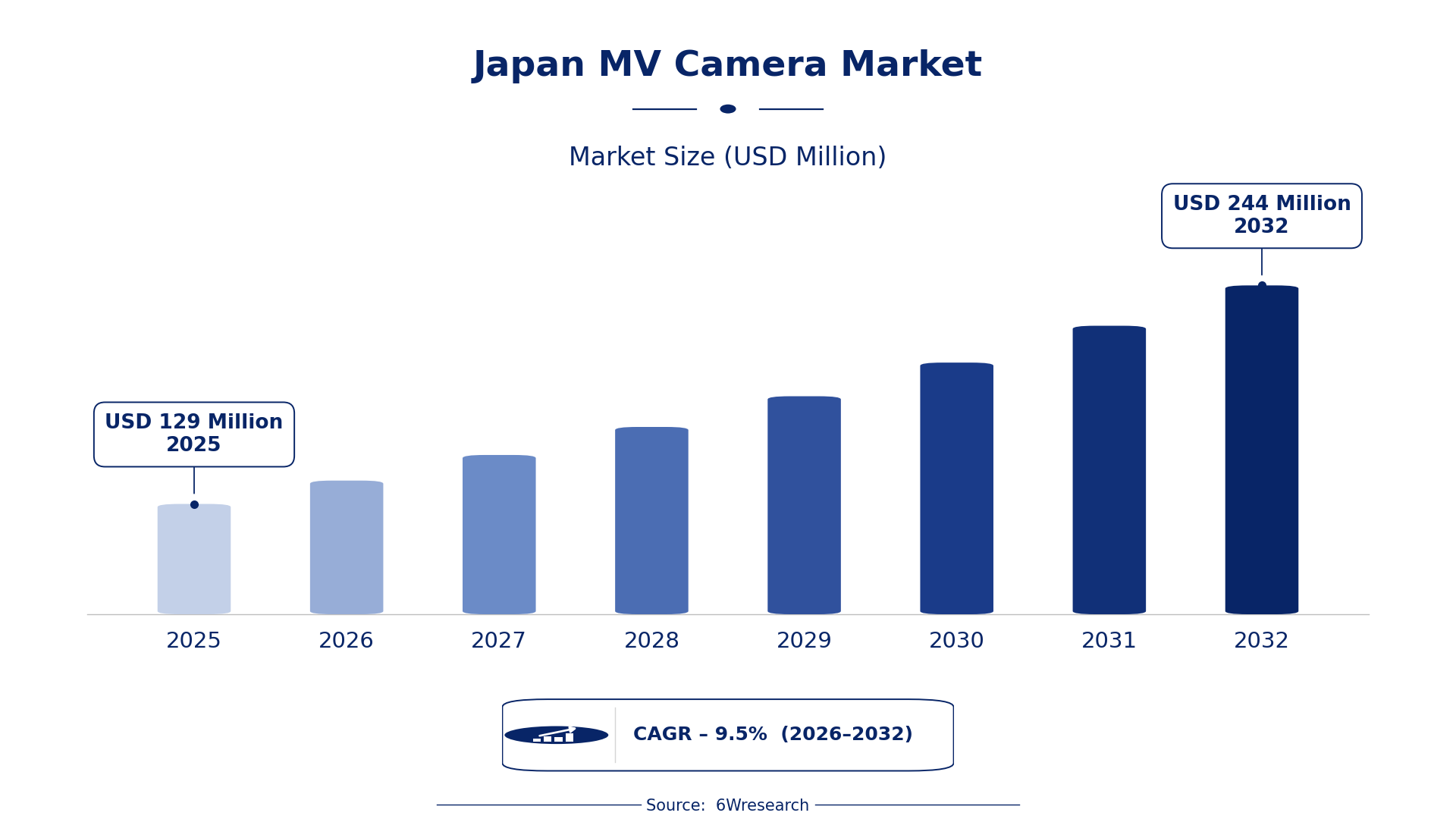
According to 6Wresearch internal database and industry insights, the Japan MV Camera Market was valued at USD 129 Million in 2025 and is projected to reach USD 244 Million by 2032, growing at a CAGR of approximately 9.5% during 2026–2032.
Japan MV Camera Market Highlights
| Report Metric | Details |
| Report Name | Japan MV Camera Market (2026-2032) |
| Market Size 2025 | USD 129 Million |
| Market Size 2032 | USD 244 Million |
| Absolute Growth 2025–2032 | USD 115 Million |
| CAGR 2026–2032 | 9.5% |
| Peak Annual Growth | 10.6% in 2032 |
| Forecast Period | 2026–2032 |
| Historical Data | 2022–2025 |
| Base Year | 2025 |
| Leading Camera Type, 2025 | Industrial Cameras (43% share) |
| Leading Sensor Type, 2025 | CMOS (40% share) |
| Leading Application, 2025 | Manufacturing Inspection (39% share) |
| Leading Resolution, 2025 | Ultra HD (41% share) |
| Leading Connectivity, 2025 | Wired (43% share) |
| Fastest-Growing Camera Type | Smart Cameras (14.2% CAGR) |
| Fastest-Growing Application | Robotics (13.9% CAGR) |
| Fastest-Growing Resolution | 4K (13.3% CAGR) |
| Fastest-Growing Connectivity | Wireless (13.7% CAGR) |
| Growing Sector | Robotics |
| Key End Users | Manufacturing Inspection, Medical Imaging, Security & Surveillance, Automotive |
Japan MV Camera Market Year-wise Growth Rate and Key Drivers (2022–2032)
This graph illustrates the annual growth rates of the market from 2022 to 2032, highlighting a steady upward trajectory and projected market expansion over the forecast period.
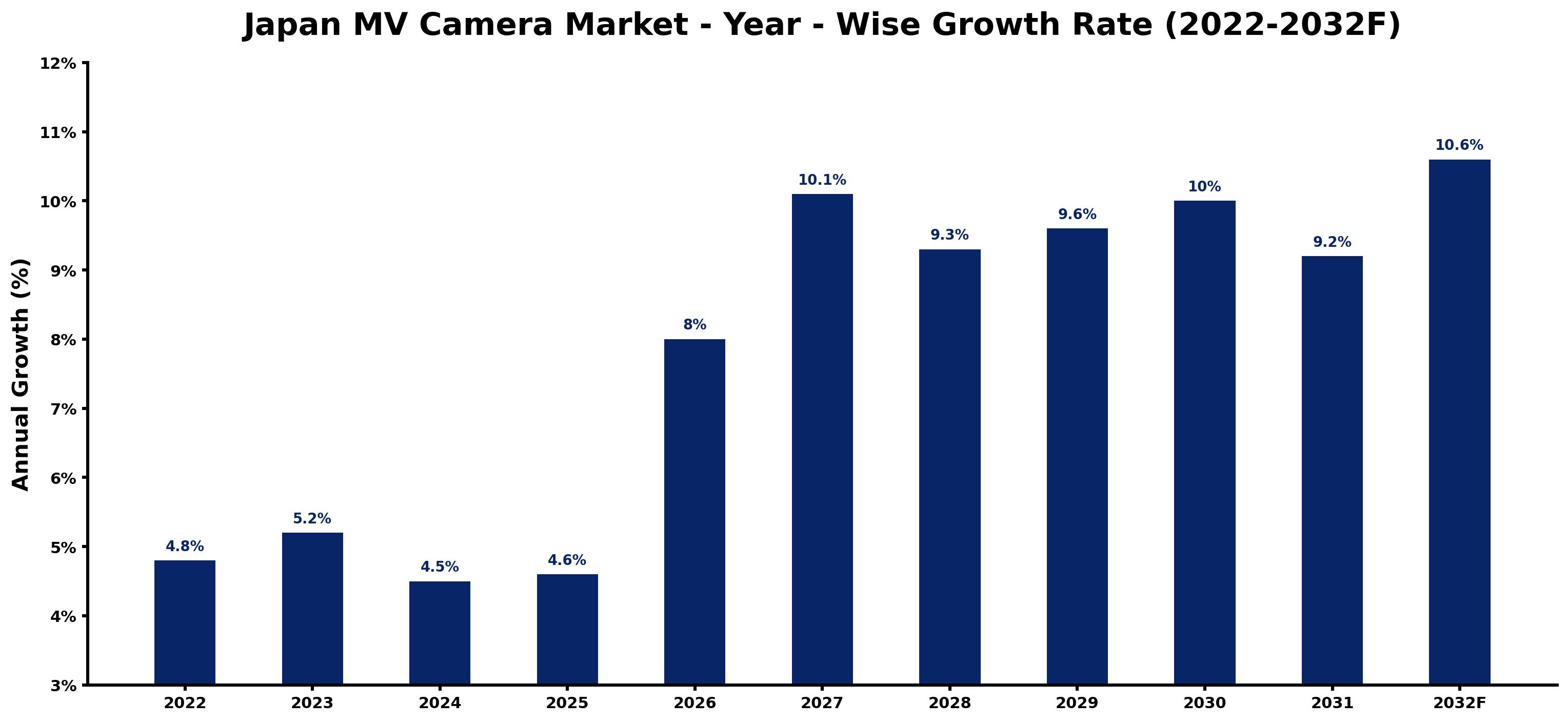
Annual growth estimates for each year appear below with the principal reason behind them, explaining the shifts that set the pace of the market.
| Year | Estimated Annual Growth (%) | Market Rationale |
| 2022 | 4.8 | The market experienced steady growth due to increasing automation in industries. |
| 2023 | 5.2 | Demand rose as manufacturers adopted advanced imaging technologies for quality control. |
| 2024 | 4.5 | Growth slowed as some sectors adjusted to previous investments in automation. |
| 2025 | 4.6 | A slight increase in growth was noted as new applications emerged in robotics. |
| 2026 | 8.0 | The market is expected to accelerate with rising investments in AI technologies. |
| 2027 | 10.1 | Growth is projected to increase further as demand for smart cameras expands. |
| 2028 | 9.3 | A slight slowdown is anticipated as the market matures and stabilises. |
| 2029 | 9.6 | Growth is expected to rise again as new sectors adopt machine vision solutions. |
| 2030 | 10.0 | The market is projected to grow as advanced imaging systems gain traction. |
| 2031 | 9.2 | A slowdown is anticipated as the market reaches a more stable phase. |
| 2032 | 10.6 | Growth is expected to peak as technological advancements drive demand. |
Note: Market size estimations and growth projections presented in this report are based on 6Wresearch's proprietary forecasting methodology, utilizing the latest available industry data, government publications, and primary research inputs.
Japan MV Camera Market Synopsis
MV Cameras, or Machine Vision Cameras, are advanced imaging devices crucial for industrial automation and quality control. They utilise sophisticated sensor technologies like CMOS and CCD to capture high-resolution images for applications such as manufacturing inspection and medical imaging. The Japan MV Camera Market is expanding due to rising demand for automation in industries, particularly in the Kanto region, which hosts major manufacturing hubs. In 2023, a government initiative was launched to promote advanced manufacturing technologies, further advancing market opportunities.
Market Dynamics Impact Analysis (2026–2032)
| Factor | Type | Impact | Primary Segment Affected |
| Rising automation in manufacturing processes | Driver | High | Industrial Cameras |
| Growing adoption of AI technologies in imaging | Driver | High | Smart Cameras |
| Increased investment in manufacturing automation | Opportunity | High | Manufacturing Inspection |
| Expansion of smart city initiatives | Opportunity | Medium | Robotics |
| High initial investment costs for advanced systems | Restraint | High | 3D Cameras |
| Limited awareness of machine vision benefits in some sectors | Restraint | Medium | Hyperspectral Cameras |
| Competition from alternative imaging technologies | Challenge | High | Line-Scan Cameras |
| Supply chain disruptions affecting component availability | Challenge | Medium | Infrared |
Evaluation of Drivers in Japan MV Camera Market (2026–2032)
The factors lifting demand, and the evidence behind each, are summarised below.
| Drivers | Primary Segment Affected | Why It Matters (Evidence) |
| Increased demand for quality control in manufacturing | Industrial Cameras | The automotive sector, a major user, requires precision in quality checks, driving demand for over 1 million installed cameras. |
| Integration of AI for image processing | Smart Cameras | The adoption of AI technologies in urban surveillance applications is rising, particularly in metropolitan areas, enhancing operational efficiency. |
| Growing focus on automation in production lines | Manufacturing Inspection | With an average investment of ¥1 trillion annually in automation, manufacturers are increasingly investing in inspection technologies to improve quality assurance. |
| Rising safety and security concerns in public spaces | Thermal | The demand for thermal cameras has surged, particularly in urban environments, due to heightened safety measures and public awareness. |
| Technological advancements in imaging resolution | Ultra HD | The average resolution of cameras used in manufacturing inspection has increased to 4K, significantly improving image clarity. |
Most of the extra volume comes from the increasing focus on automation in manufacturing processes, with an average investment of ¥1 trillion annually driving demand for industrial cameras. The automotive sector requires precision in quality control, leading to over 1 million installed cameras. The integration of AI technologies in urban surveillance applications is rising, particularly in metropolitan areas. Demand for thermal cameras has surged due to heightened safety measures in public spaces. Recent advancements have led to an average resolution increase to 4K, improving clarity in manufacturing inspection.
Evaluation of Restraints in Japan MV Camera Market
The main factors holding the market back are set out below.
| Market Restraint | Primary Segment Affected | Why It Matters (Evidence) |
| High initial investment costs for advanced systems | 3D Cameras | The cost of implementing advanced imaging systems can deter smaller manufacturers from upgrading their technology. |
| Limited awareness of machine vision benefits in some sectors | Hyperspectral Cameras | Many industries remain unaware of the advantages machine vision can provide, hindering adoption rates. |
| Competition from alternative imaging technologies | Line-Scan Cameras | Emerging technologies may offer lower-cost solutions, impacting the market share of traditional machine vision systems. |
| Supply chain disruptions affecting component availability | Infrared | Global supply chain issues can delay the availability of critical components, impacting production timelines. |
| Regulatory compliance costs for advanced imaging systems | Smart Cameras | Meeting compliance standards can increase operational costs, affecting the adoption of smart camera technologies. |
Japan MV Camera Market Challenges
Outdated imaging technology in factories hampers the integration of modern machine vision systems, delaying production for buyers. High upgrade costs can reach ¥500 million for larger manufacturers, making it challenging for them to adopt new solutions. Buyers face difficulties as local producers struggle to compete with international suppliers, leading to potential market share losses. Regulatory standards, such as ISO 9001, impose strict compliance requirements, often extending project timelines by up to six months for buyers navigating these processes.
Trends in the Japan MV Camera Market
The shifts below are changing how Japan MV Camera Market products are bought and supplied.
- Shift to Smart Cameras: The adoption of smart cameras has increased since 2023, particularly in urban surveillance applications. The average resolution of smart cameras has improved, with a notable rise in demand for AI features, reflecting a shift in buyer preferences.
- Transition to Ultra HD Imaging: Since 2023, there has been a marked shift towards Ultra HD imaging in manufacturing inspection. This change is driven by the need for higher resolution in quality control processes, with the average resolution now reaching 4K.
- Emergence of AI-Enhanced Imaging Solutions: The integration of AI technologies into imaging solutions has gained traction since 2023, particularly in robotic applications. The Robotics Society of Japan promotes this trend, highlighting the growing demand for automation in various sectors.
- Increased Focus on Thermal Imaging for Safety: The demand for thermal cameras has risen sharply since 2023, especially in public safety applications. This trend is driven by heightened security measures in urban areas, reflecting a growing awareness of safety needs.
Investment Opportunities in the Japan MV Camera Market
The openings below show where demand in the Japan MV Camera Market is visible and how suppliers can enter.
- Investment in Advanced Manufacturing Facilities: The Kanto region is experiencing significant investments in advanced manufacturing technologies, with approximately ¥10 billion allocated in 2023. This presents opportunities for suppliers to provide imaging solutions tailored to industry needs.
- Collaboration with Robotics Developers: Partnerships with robotics developers are becoming increasingly important, particularly as the demand for AI-enhanced imaging solutions grows. Suppliers can enter this space through joint ventures or collaborations.
- Expansion of Medical Imaging Technologies: With around 8,000 hospitals in Japan, the demand for advanced medical imaging technologies is on the rise. Suppliers can tap into this market by offering innovative imaging solutions tailored to healthcare needs.
- Growth in Urban Surveillance Projects: The increasing focus on urban safety and security creates opportunities for suppliers of smart cameras. Collaborating with local governments on smart city initiatives can facilitate market entry.
Government Initiatives in the Japan MV Camera Market
The Economic Security Promotion Act, enacted in 2022, supports supply-chain resilience for critical products, including machine vision technologies. This law requires manufacturers to ensure compliance with safety and quality standards, fostering a more secure production environment. In 2023, the government allocated ¥10 billion to promote advanced manufacturing technologies, benefiting producers and buyers in the machine vision sector.
The Ministry of Economy, Trade and Industry oversees the approval of funding for advanced manufacturing projects. In 2023, the ministry allocated ¥10 billion to support the development of AI technologies, benefiting producers and buyers in the machine vision sector.
Future Insight of the Japan MV Camera Market
Investment in advanced manufacturing technologies will exceed ¥10 billion by 2032, generating substantial demand for modern imaging solutions. The rise of smart city initiatives will create new opportunities for machine vision applications in urban environments. Improvements in camera capabilities will drive adoption across healthcare and security sectors. As the installed base of industrial cameras surpasses 1 million units, suppliers must adapt to evolving buyer expectations and technological advancements.
Market Segmentation Analysis
Japan MV Camera Market report covers a detailed analysis of the following market segments:
By Camera Type – Industrial Cameras Lead, Smart Cameras Expected to Grow Fastest
According to Anjali Gupta, Research Analyst at 6Wresearch, Industrial Cameras accounted for 43% of the market by camera type in 2025. Industrial Cameras command the largest share as they are essential for quality control in manufacturing processes, especially in the Kanto region, which houses key manufacturing hubs. The installed base exceeding 1 million units indicates their critical role across various industries. The quickest growth will come from Smart Cameras, forecast to expand at a CAGR of 14.2% between 2026 and 2032. Smart Cameras are experiencing rapid growth due to their integration with advanced technologies that enhance image processing, meeting the rising demand for automation in diverse sectors. This trend is further supported by government initiatives promoting advanced manufacturing technologies. Suppliers should focus on improving camera functionalities to cater to the increasing demand for smart solutions in automation.
By Sensor Type – CMOS Leads and Records the Fastest Growth
The largest sensor type category in 2025 was CMOS, at 40% of revenue. CMOS sensors dominate the market as they are favoured for low-light imaging applications, crucial in many industrial settings. Their widespread adoption is a result of the growing need for high-resolution imaging capabilities in automation processes. CMOS is also forecast to expand faster than any other category, at a CAGR of 11.4% over 2026–2032. CMOS sensors not only lead the market but also exhibit the fastest growth rate, owing to ongoing technological advancements that enhance their performance. This dual position solidifies their market dominance and share. Buyers can expect continuous improvements in sensor technology, which will enhance imaging capabilities across various applications.
By Application – Manufacturing Inspection Leads, Robotics Expected to Grow Fastest
Manufacturing Inspection took 39% of application revenue in 2025, more than any other category. Manufacturing Inspection is the leading application due to its importance in ensuring product quality within Japan's extensive manufacturing sector. The average annual investment in automation technologies, around ¥1 trillion, underscores the critical nature of this application. Over 2026–2032, Robotics are expected to post the fastest growth, at a CAGR of 13.9%. Robotics is the fastest-growing application, largely because of its vital role in machine vision for automation, with backing from organisations that promote its use. As manufacturing processes become more automated, this segment is set for considerable growth. Suppliers should concentrate on developing solutions that enhance robotic applications to capitalise on this growth opportunity.
By Resolution – Ultra HD Leads, 4K Expected to Grow Fastest
Ultra HD held 41% of the Japan MV Camera Market by resolution in 2025. Ultra HD resolution is the market leader as it is widely used in advanced imaging systems, providing the clarity required for detailed inspections in various applications. Its adoption is driven by the need for high-definition imaging in quality control processes. 4K is set to record the highest CAGR in this split, 13.3% over 2026–2032. The 4K resolution segment is growing rapidly, gaining popularity for high-definition needs in manufacturing and inspection applications. As technology advances, the demand for 4K imaging will likely increase, supporting its growth. Buyers should consider upgrading to 4K systems to meet the increasing demands for high-definition imaging.
By Connectivity – Wired Leads, Wireless Expected to Grow Fastest
With 43% of connectivity revenue in 2025, Wired was the largest category. Wired connectivity leads the market due to its reliability and stability in industrial applications, ensuring consistent data transmission in critical environments. This preference is particularly pronounced in manufacturing settings where performance is paramount. The quickest growth will come from Wireless, forecast to expand at a CAGR of 13.7% between 2026 and 2032. Wireless connectivity is the fastest-growing segment, propelled by the increasing demand for flexible camera installations across various applications. As industries pursue adaptable solutions, the shift towards wireless technology is expected to accelerate significantly. Suppliers should prioritise the development of robust wireless solutions to meet the evolving demands of the market.
Key Attractiveness of the Report
- 10 Years of Market Numbers
- Historical Data Starting from 2022 to 2025
- Base Year 2025
- Forecast Data until 2032
- Key Performance Indicators Impacting the Market
- Major Upcoming Developments and Projects
Key Highlights of the Report:
- Japan MV Camera Market Outlook
- Market Size of Japan MV Camera Market,2025
- Forecast of Japan MV Camera Market, 2032
- Historical Data and Forecast of Japan MV Camera Revenues & Volume for the Period 2022-2032
- Japan MV Camera Market Trend Evolution
- Japan MV Camera Market Drivers and Challenges
- Japan MV Camera Price Trends
- Japan MV Camera Porter's Five Forces
- Japan MV Camera Industry Life Cycle
- Historical Data and Forecast of Japan MV Camera Market Revenues & Volume By Camera Type for the Period 2022-2032
- Historical Data and Forecast of Japan MV Camera Market Revenues & Volume By Industrial Cameras for the Period 2022-2032
- Historical Data and Forecast of Japan MV Camera Market Revenues & Volume By Smart Cameras for the Period 2022-2032
- Historical Data and Forecast of Japan MV Camera Market Revenues & Volume By Line-Scan Cameras for the Period 2022-2032
- Historical Data and Forecast of Japan MV Camera Market Revenues & Volume By 3D Cameras for the Period 2022-2032
- Historical Data and Forecast of Japan MV Camera Market Revenues & Volume By Hyperspectral Cameras for the Period 2022-2032
- Historical Data and Forecast of Japan MV Camera Market Revenues & Volume By Sensor Type for the Period 2022-2032
- Historical Data and Forecast of Japan MV Camera Market Revenues & Volume By CMOS for the Period 2022-2032
- Historical Data and Forecast of Japan MV Camera Market Revenues & Volume By CCD for the Period 2022-2032
- Historical Data and Forecast of Japan MV Camera Market Revenues & Volume By Infrared for the Period 2022-2032
- Historical Data and Forecast of Japan MV Camera Market Revenues & Volume By Thermal for the Period 2022-2032
- Historical Data and Forecast of Japan MV Camera Market Revenues & Volume By UV for the Period 2022-2032
- Historical Data and Forecast of Japan MV Camera Market Revenues & Volume By Application for the Period 2022-2032
- Historical Data and Forecast of Japan MV Camera Market Revenues & Volume By Manufacturing Inspection for the Period 2022-2032
- Historical Data and Forecast of Japan MV Camera Market Revenues & Volume By Medical Imaging for the Period 2022-2032
- Historical Data and Forecast of Japan MV Camera Market Revenues & Volume By Security & Surveillance for the Period 2022-2032
- Historical Data and Forecast of Japan MV Camera Market Revenues & Volume By Automotive for the Period 2022-2032
- Historical Data and Forecast of Japan MV Camera Market Revenues & Volume By Robotics for the Period 2022-2032
- Historical Data and Forecast of Japan MV Camera Market Revenues & Volume By Resolution for the Period 2022-2032
- Historical Data and Forecast of Japan MV Camera Market Revenues & Volume By HD for the Period 2022-2032
- Historical Data and Forecast of Japan MV Camera Market Revenues & Volume By 4K for the Period 2022-2032
- Historical Data and Forecast of Japan MV Camera Market Revenues & Volume By Ultra HD for the Period 2022-2032
- Historical Data and Forecast of Japan MV Camera Market Revenues & Volume By 3D for the Period 2022-2032
- Historical Data and Forecast of Japan MV Camera Market Revenues & Volume By AI-Enhanced for the Period 2022-2032
- Historical Data and Forecast of Japan MV Camera Market Revenues & Volume By Connectivity for the Period 2022-2032
- Historical Data and Forecast of Japan MV Camera Market Revenues & Volume By Wired for the Period 2022-2032
- Historical Data and Forecast of Japan MV Camera Market Revenues & Volume By Wireless for the Period 2022-2032
- Historical Data and Forecast of Japan MV Camera Market Revenues & Volume By Ethernet for the Period 2022-2032
- Historical Data and Forecast of Japan MV Camera Market Revenues & Volume By USB for the Period 2022-2032
- Historical Data and Forecast of Japan MV Camera Market Revenues & Volume By IoT for the Period 2022-2032
- Japan MV Camera Import Export Trade Statistics
- Market Opportunity Assessment By Camera Type
- Market Opportunity Assessment By Sensor Type
- Market Opportunity Assessment By Application
- Market Opportunity Assessment By Resolution
- Market Opportunity Assessment By Connectivity
- Japan MV Camera Top Companies Market Share
- Japan MV Camera Competitive Benchmarking By Technical and Operational Parameters
- Japan MV Camera Company Profiles
- Japan MV Camera Key Strategic Recommendations
Market Covered
The following segment groups are covered in the report.
By Camera Type
- Industrial Cameras
- Smart Cameras
- Line-Scan Cameras
- 3D Cameras
- Hyperspectral Cameras
By Sensor Type
- CMOS
- CCD
- Infrared
- Thermal
- UV
By Application
- Manufacturing Inspection
- Medical Imaging
- Security & Surveillance
- Automotive
- Robotics
By Resolution
- HD
- 4K
- Ultra HD
- 3D
- AI-Enhanced
By Connectivity
- Wired
- Wireless
- Ethernet
- USB
- IoT































