Japan Nonlinear Editing System Market Size & Growth Rate
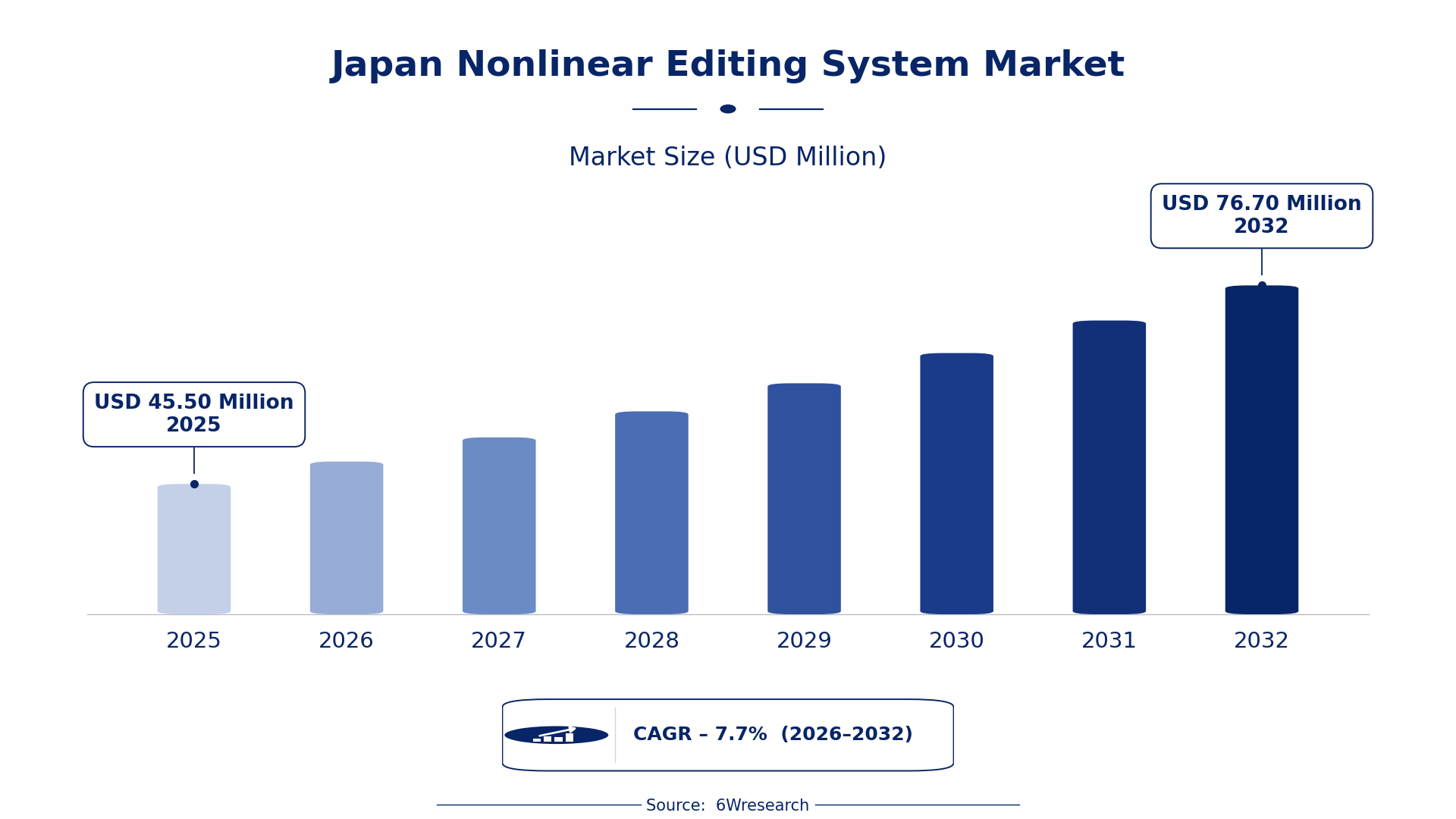
According to 6Wresearch internal database and industry insights, the Japan Nonlinear Editing System Market was valued at USD 45.50 Million in 2025 and is projected to reach USD 76.70 Million by 2032, growing at a CAGR of approximately 7.7% during 2026–2032.
Japan Nonlinear Editing System Market Highlights
| Report Metric | Details |
| Report Name | Japan Nonlinear Editing System Market (2026-2032) |
| Market Size 2025 | USD 45.50 Million |
| Market Size 2032 | USD 76.70 Million |
| Absolute Growth 2025–2032 | USD 31.20 Million |
| CAGR 2026–2032 | 7.7% |
| Peak Annual Growth | 8.5% in 2027 |
| Forecast Period | 2026–2032 |
| Historical Data | 2022–2025 |
| Base Year | 2025 |
| Leading Technology Type, 2025 | Nonlinear Video Editing (52% share) |
| Leading Application Area, 2025 | Commercial (45% share) |
| Leading End User, 2025 | Professional Editors (46% share) |
| Leading Product Type, 2025 | Software (64% share) |
| Fastest-Growing Technology Type | Nonlinear Audio Editing (11.0% CAGR) |
| Fastest-Growing Application Area | Personal (8.8% CAGR) |
| Fastest-Growing End User | Amateur Editors (9.6% CAGR) |
| Fastest-Growing Product Type | Services (10.7% CAGR) |
| Growing Sector | film and media production |
| Key End Users | professional editors, amateur creators, corporate training departments |
Japan Nonlinear Editing System Market Year-wise Growth Rate and Key Drivers (2022–2032)
This graph illustrates the annual growth rates of the market from 2022 to 2032, highlighting a steady upward trajectory and projected market expansion over the forecast period.
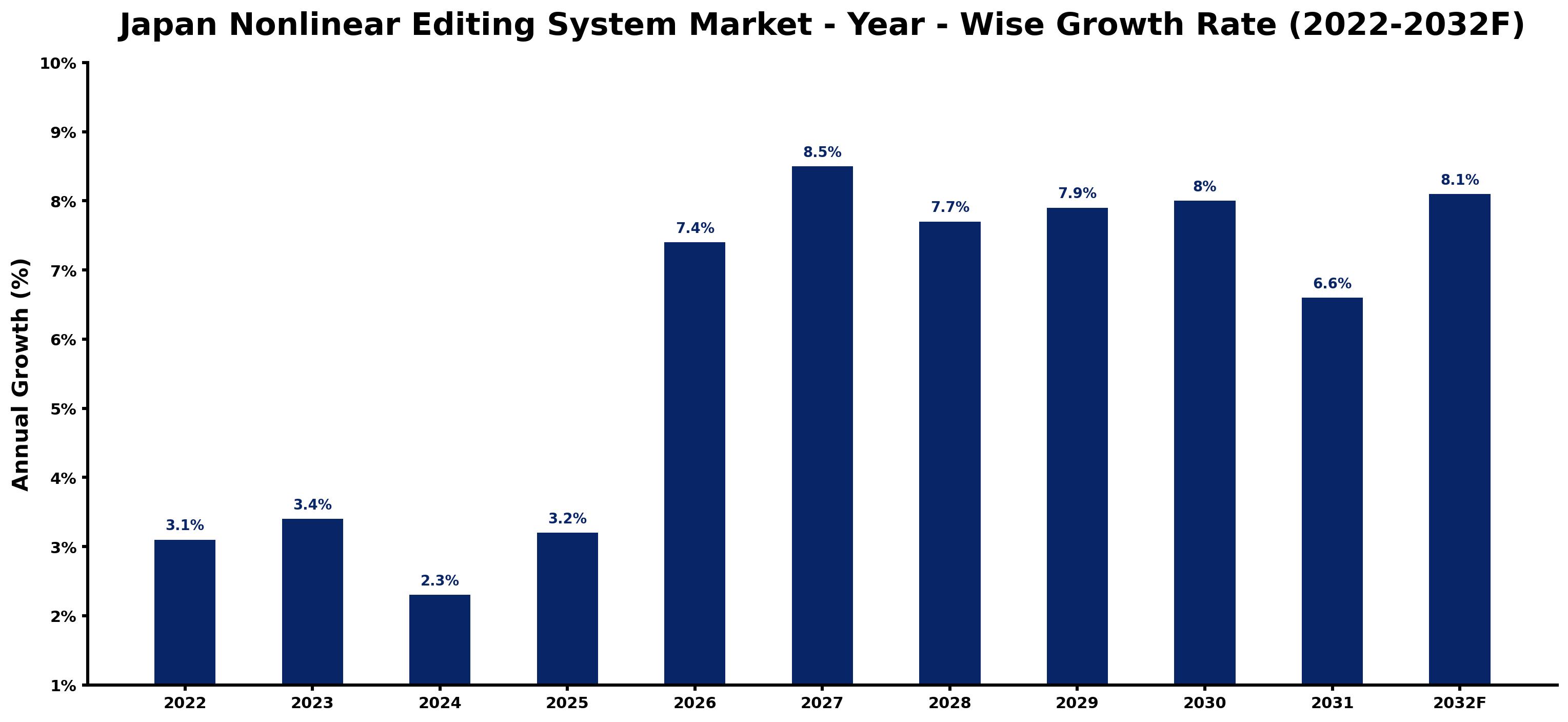
For each year, the table pairs the estimated growth rate with the leading influence on demand, showing how the drivers changed across the period.
| Year | Estimated Annual Growth (%) | Market Rationale |
| 2022 | 3.1 | The market exhibited steady demand from professional editors and content creators. |
| 2023 | 3.4 | Growth accelerated as the film industry produced a significant number of feature films. |
| 2024 | 2.3 | Demand slowed slightly due to market saturation in certain segments. |
| 2025 | 3.2 | A resurgence in commercial projects boosted demand for editing software. |
| 2026 | 7.4 | Increased investment in digital content creation is expected to spur higher orders. |
| 2027 | 8.5 | The peak growth will be driven by the rise of streaming services. |
| 2028 | 7.7 | Demand growth will moderate as the market stabilises after rapid expansion. |
| 2029 | 7.9 | Continued interest in video content creation will lead to a rebound in orders. |
| 2030 | 8.0 | The market will experience renewed growth from emerging editing technologies. |
| 2031 | 6.6 | Growth will slow as competition intensifies among software providers. |
| 2032 | 8.1 | The market will see a resurgence driven by new digital initiatives. |
Note: Market size estimations and growth projections presented in this report are based on 6Wresearch's proprietary forecasting methodology, utilizing the latest available industry data, government publications, and primary research inputs.
Japan Nonlinear Editing System Market Synopsis
Nonlinear Editing Systems are sophisticated software tools for video, audio, and image editing, enabling access to any frame in a digital clip. The Japan Nonlinear Editing System Market is growing as the film and media industry thrives, with the Tokyo region accounting for 40% of production activities. The rise of streaming services and an increasing number of professional video editing users are driving demand, with an estimated 200,000 users in Japan. The government's digital content initiative supports this growth, allocating ¥1 billion to enhance media production capabilities.
Market Dynamics Impact Analysis (2026–2032)
| Factor | Type | Impact | Primary Segment Affected |
| Growing demand for video content creation | Driver | High | Nonlinear Video Editing |
| Increased investment in digital media production | Driver | High | Commercial |
| Expansion of streaming platforms | Opportunity | High | Nonlinear Audio Editing |
| Rising number of amateur video creators | Opportunity | Medium | Personal |
| Market saturation in certain segments | Restraint | Medium | Nonlinear Image Editing |
| High competition among software providers | Restraint | High | Software |
| Technological advancements requiring constant updates | Challenge | Medium | Services |
| Need for compliance with industry standards | Challenge | High | Nonlinear Video Editing |
Evaluation of Drivers in Japan Nonlinear Editing System Market (2026–2032)
Demand rests on the following drivers, each shown with the segment it touches most.
| Drivers | Primary Segment Affected | Why It Matters (Evidence) |
| Increased production of feature films | Nonlinear Video Editing | Japan's film industry produced over 500 feature films in 2022, driving demand for editing software. |
| Growth of streaming services | Nonlinear Audio Editing | The rise of streaming platforms has led to a 15% increase in demand for audio editing tools. |
| Investment in digital content initiatives | Commercial | The Ministry of Internal Affairs and Communications allocated ¥1 billion in 2023 to support media production. |
| Surge in amateur video creators | Personal | The number of amateur video creators in Japan has increased by 30% since 2020, boosting software demand. |
| Technological advancements in editing software | Software | ISO 27001 standard improves software security, prompting upgrades and new purchases. |
Behind the steady rise in orders sits a notable increase in feature film production, with over 500 films produced in 2022. This growth in the film sector has led to heightened demand for nonlinear video editing tools among professional editors. The surge in streaming services has further amplified the need for audio editing software, as content creators seek high-quality production. The number of amateur video creators has risen by 30% since 2020, creating a new market segment for editing software.
Evaluation of Restraints in Japan Nonlinear Editing System Market
The key brakes on demand, and where they bite hardest, are shown below.
| Market Restraint | Primary Segment Affected | Why It Matters (Evidence) |
| Market saturation in certain segments | Nonlinear Image Editing | As the market matures, growth in nonlinear image editing has slowed due to saturation. |
| Intense competition among software providers | Software | High competition leads to price pressure, affecting profitability for software developers. |
| Constant need for software updates | Services | Technological advancements require ongoing updates, increasing costs for service providers. |
| Compliance with industry standards | Nonlinear Video Editing | Adhering to standards necessitates additional investments in software security. |
| Limited adoption of advanced features by users | Nonlinear Audio Editing | Many users do not fully utilise advanced features, limiting market growth. |
Japan Nonlinear Editing System Market Challenges
Japan's film industry produced over 500 feature films in 2022, resulting in fierce competition among editing studios. This competition drives down prices, forcing producers to accept lower margins, which can hinder investment in advanced software tools. Rapid technological advancements require continuous updates to editing systems, yet many producers struggle to keep pace, delaying project timelines for buyers. The rise of streaming services increases demand for video editing software, but many buyers face escalating costs as they upgrade their systems, impacting their budgets and limiting project scopes.
Trends in the Japan Nonlinear Editing System Market
Several trends are reshaping the Japan Nonlinear Editing System Market; the most important are set out below.
- Shift towards Professional Editing: Professional editors are increasingly adopting advanced nonlinear editing systems to improve production quality, as seen in the Tokyo International Film Festival, which showcases innovative editing techniques.
- Emergence of Amateur Content Creation: The rise of amateur video creators has led to increased demand for user-friendly editing software, with a 30% increase in creators since 2020, reflecting a growing market.
- Transition to Cloud-Based Solutions: Cloud-based editing solutions are gaining popularity, allowing for remote collaboration among editing teams, particularly in urban areas like Tokyo, which hosts 40% of media production.
- Increased Focus on Accessibility Standards: Editing software is prioritising accessibility features, driven by the JIS X 8341-3 standard, ensuring inclusivity for all users in Japan.
Investment Opportunities in the Japan Nonlinear Editing System Market
Investors looking at the Japan Nonlinear Editing System Market should consider the following areas.
- Partnerships with Local Studios: Forming joint ventures with local film studios can tap into the growing demand for editing software, as evidenced by the 500 films produced in 2022.
- Investing in User-Friendly Software: With a 30% rise in amateur video creators, developing user-friendly editing software can effectively capture this expanding market segment.
- Expanding Services for Corporate Training: Corporate users are increasingly seeking advanced editing services for training videos, presenting opportunities for service providers to cater to this demand.
- Certification for Compliance with Standards: Investing in certification for software security can improve marketability, especially with the ISO 27001 standard gaining importance among users.
Government Initiatives in the Japan Nonlinear Editing System Market
The Act against Unjustifiable Premiums and Misleading Representations, established in 1962, prohibits misleading advertising in the editing industry, ensuring that buyers receive accurate information about software capabilities. This law protects consumers and promotes fair competition among software providers.
In 2023, the government allocated ¥1 billion to support media production through the Digital Agency, which leads efforts in digital transformation and common system standards, helping producers improve their offerings and reach wider audiences.
Future Insight of the Japan Nonlinear Editing System Market
A digital content initiative launched in 2023 will reshape media production, leading to increased investment in editing technologies. By 2032, enhanced software security will ensure safer environments for users, as compliance with standards like JIS X 8341-3 becomes standard practice. The number of professional video editing software users is projected to reach 300,000, creating a more competitive market. Improved accessibility features will also drive inclusivity in video editing, benefiting both buyers and suppliers.
Market Segmentation Analysis
Japan Nonlinear Editing System Market report covers a detailed analysis of the following market segments:
By Technology Type – Nonlinear Video Editing Leads, Nonlinear Audio Editing Expected to Grow Fastest
According to Sachin Kumar Rai, Senior Research Analyst at 6Wresearch, the largest technology type category in 2025 was Nonlinear Video Editing, at 52% of revenue. Nonlinear Video Editing holds the largest share due to its critical role in film and media production, particularly in the Tokyo region, which accounts for 40% of Japan's media activities. The extensive installed base of professional video editing software users, estimated at 200,000, reinforces this segment's prominence. Nonlinear Audio Editing is set to record the highest CAGR in this split, 11.0% over 2026–2032. The growth of Nonlinear Audio Editing is stimulated by the increasing demand for high-quality audio in post-production, especially as Japan's film industry produced over 500 feature films in 2022. This trend suggests a rising focus on audio alongside visual content, which will likely widen the lead of video editing. Suppliers should prioritise features that cater to both video and audio editing to capture the expanding market.
By Application Area – Commercial Leads, Personal Expected to Grow Fastest
Commercial accounted for 45% of the market by application area in 2025. The Commercial application area holds the largest share due to its extensive use in marketing and advertising, which is crucial for businesses in Japan. The Tokyo region, accounting for 40% of media production activities, significantly contributes to this demand. The quickest growth will come from Personal, forecast to expand at a CAGR of 8.8% between 2026 and 2032. The Personal application area is growing quickly, driven by a 30% increase in amateur video creators since 2020, indicating a rising interest in individual content creation. This trend suggests that the gap between personal and commercial usage may continue to narrow. Suppliers should focus on creating accessible tools for personal users to tap into this expanding market.
By End User – Professional Editors Lead, Amateur Editors Expected to Grow Fastest
Professional Editors took 46% of end user revenue in 2025, more than any other category. Professional Editors represent the core user group for nonlinear editing systems, as they require high-quality output for their projects in the competitive film industry. Their expertise and demand for advanced features ensure this segment maintains a strong market presence. Amateur Editors are projected to grow fastest, at a CAGR of 9.6% during 2026–2032. Amateur Editors are experiencing the fastest growth, driven by the increasing number of hobbyists entering the video creation space. This trend reflects a broader interest in content creation among the general public, which could lead to higher software adoption rates. Vendors should explore educational resources and tools to engage amateur editors and facilitate their entry into the market.
By Product Type – Software Leads, Services Expected to Grow Fastest
In 2025, Software led the product type split with a 64% share. Software leads the product type segment as it is the primary offering in nonlinear editing systems, catering to both professional and amateur editors. The strong demand for software is supported by the thriving film industry, which produced over 500 feature films in 2022. Over 2026–2032, Services are expected to post the fastest growth, at a CAGR of 10.7%. Services are the fastest-growing product type, as users increasingly seek training and support to maximise their software use. This trend indicates a need for companies to offer comprehensive service packages alongside software solutions. Vendors should integrate service offerings with software to enhance user experience and loyalty.
Key Attractiveness of the Report
- 10 Years of Market Numbers
- Historical Data Starting from 2022 to 2025
- Base Year 2025
- Forecast Data until 2032
- Key Performance Indicators Impacting the Market
- Major Upcoming Developments and Projects
Key Highlights of the Report:
- Japan Nonlinear Editing System Market Outlook
- Market Size of Japan Nonlinear Editing System Market,2025
- Forecast of Japan Nonlinear Editing System Market, 2032
- Historical Data and Forecast of Japan Nonlinear Editing System Revenues & Volume for the Period 2022-2032
- Japan Nonlinear Editing System Market Trend Evolution
- Japan Nonlinear Editing System Market Drivers and Challenges
- Japan Nonlinear Editing System Price Trends
- Japan Nonlinear Editing System Porter's Five Forces
- Japan Nonlinear Editing System Industry Life Cycle
- Historical Data and Forecast of Japan Nonlinear Editing System Market Revenues & Volume By Technology Type for the Period 2022-2032
- Historical Data and Forecast of Japan Nonlinear Editing System Market Revenues & Volume By Nonlinear Video Editing for the Period 2022-2032
- Historical Data and Forecast of Japan Nonlinear Editing System Market Revenues & Volume By Nonlinear Audio Editing for the Period 2022-2032
- Historical Data and Forecast of Japan Nonlinear Editing System Market Revenues & Volume By Nonlinear Image Editing for the Period 2022-2032
- Historical Data and Forecast of Japan Nonlinear Editing System Market Revenues & Volume By Application Area for the Period 2022-2032
- Historical Data and Forecast of Japan Nonlinear Editing System Market Revenues & Volume By Commercial for the Period 2022-2032
- Historical Data and Forecast of Japan Nonlinear Editing System Market Revenues & Volume By Personal for the Period 2022-2032
- Historical Data and Forecast of Japan Nonlinear Editing System Market Revenues & Volume By Others for the Period 2022-2032
- Historical Data and Forecast of Japan Nonlinear Editing System Market Revenues & Volume By End User for the Period 2022-2032
- Historical Data and Forecast of Japan Nonlinear Editing System Market Revenues & Volume By Professional Editors for the Period 2022-2032
- Historical Data and Forecast of Japan Nonlinear Editing System Market Revenues & Volume By Amateur Editors for the Period 2022-2032
- Historical Data and Forecast of Japan Nonlinear Editing System Market Revenues & Volume By Enterprise Users for the Period 2022-2032
- Historical Data and Forecast of Japan Nonlinear Editing System Market Revenues & Volume By Product Type for the Period 2022-2032
- Historical Data and Forecast of Japan Nonlinear Editing System Market Revenues & Volume By Software for the Period 2022-2032
- Historical Data and Forecast of Japan Nonlinear Editing System Market Revenues & Volume By Services for the Period 2022-2032
- Japan Nonlinear Editing System Import Export Trade Statistics
- Market Opportunity Assessment By Technology Type
- Market Opportunity Assessment By Application Area
- Market Opportunity Assessment By End User
- Market Opportunity Assessment By Product Type
- Japan Nonlinear Editing System Top Companies Market Share
- Japan Nonlinear Editing System Competitive Benchmarking By Technical and Operational Parameters
- Japan Nonlinear Editing System Company Profiles
- Japan Nonlinear Editing System Key Strategic Recommendations
Market Covered
Segments analysed in this report are listed below.
By Technology Type
- Nonlinear Video Editing
- Nonlinear Audio Editing
- Nonlinear Image Editing
By Application Area
- Commercial
- Personal
- Others
By End User
- Professional Editors
- Amateur Editors
- Enterprise Users
By Product Type
- Software
- Services































