Japan Optical Imaging Equipment Market Size & Growth Rate
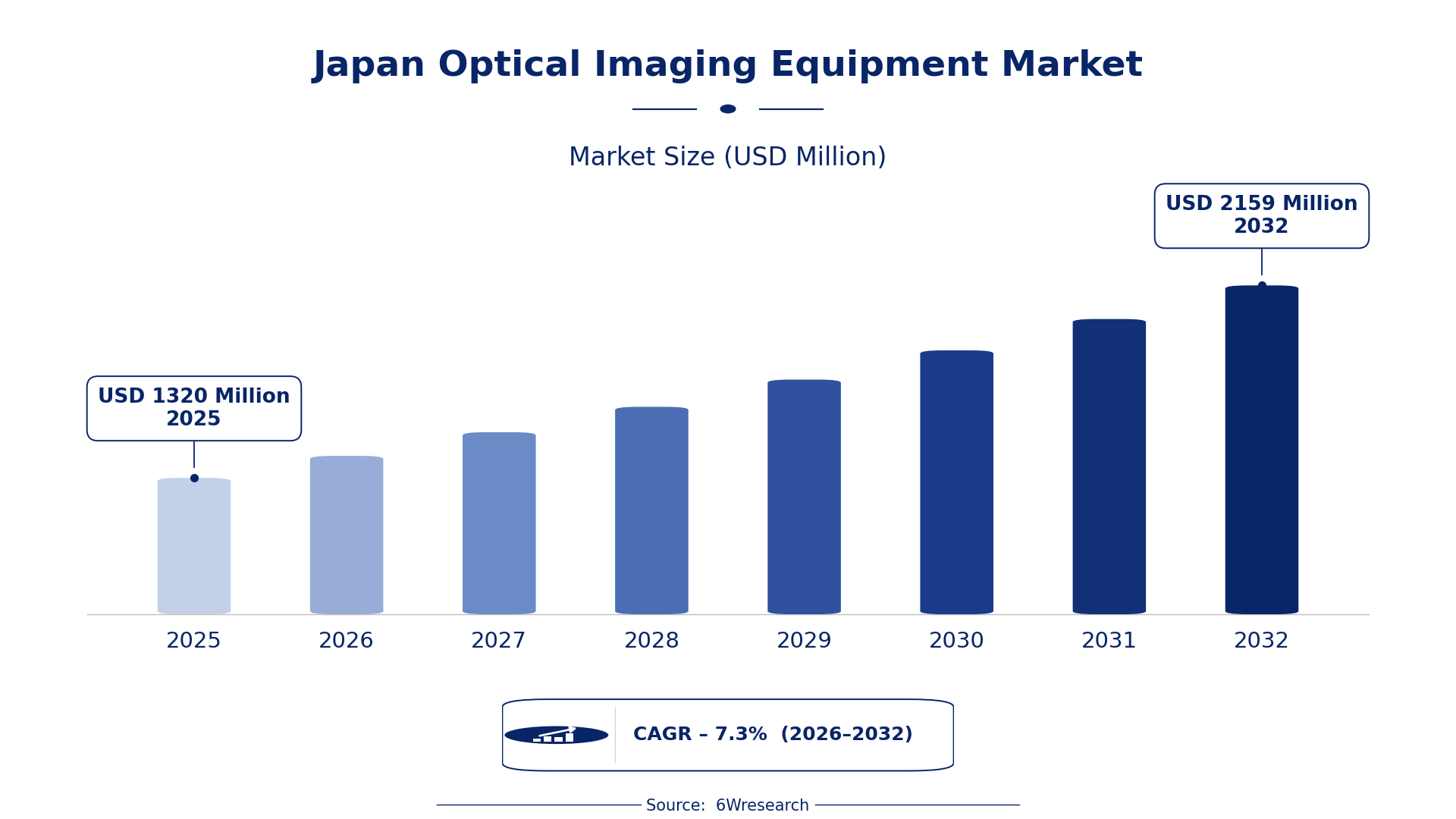
According to 6Wresearch internal database and industry insights, the Japan Optical Imaging Equipment Market was valued at USD 1,320 Million in 2025 and is projected to reach USD 2,159 Million by 2032, growing at a CAGR of approximately 7.3% during 2026–2032.
Japan Optical Imaging Equipment Market Highlights
| Report Metric | Details |
| Report Name | Japan Optical Imaging Equipment Market (2026-2032) |
| Market Size 2025 | USD 1,320 Million |
| Market Size 2032 | USD 2,159 Million |
| Absolute Growth 2025–2032 | USD 839 Million |
| CAGR 2026–2032 | 7.3% |
| Peak Annual Growth | 8.2% in 2028 |
| Forecast Period | 2026–2032 |
| Historical Data | 2022–2025 |
| Base Year | 2025 |
| Leading Type, 2025 | Optical Coherence Tomography (41% share) |
| Leading Technology, 2025 | Near-Infrared (34% share) |
| Leading Application, 2025 | Oncology (44% share) |
| Leading End Use, 2025 | Hospitals (41% share) |
| Fastest-Growing Type | Photoacoustic Imaging (9.8% CAGR) |
| Fastest-Growing Technology | Fluorescence (10.0% CAGR) |
| Fastest-Growing Application | Ophthalmology (9.3% CAGR) |
| Fastest-Growing End Use | Diagnostic Centers (9.6% CAGR) |
| Growing Sector | Hospitals |
| Key End Users | Hospitals, Diagnostic Centers, Research Labs, Specialty Clinics |
Japan Optical Imaging Equipment Market Year-wise Growth Rate and Key Drivers (2022–2032)
This graph illustrates the annual growth rates of the market from 2022 to 2032, highlighting a steady upward trajectory and projected market expansion over the forecast period.
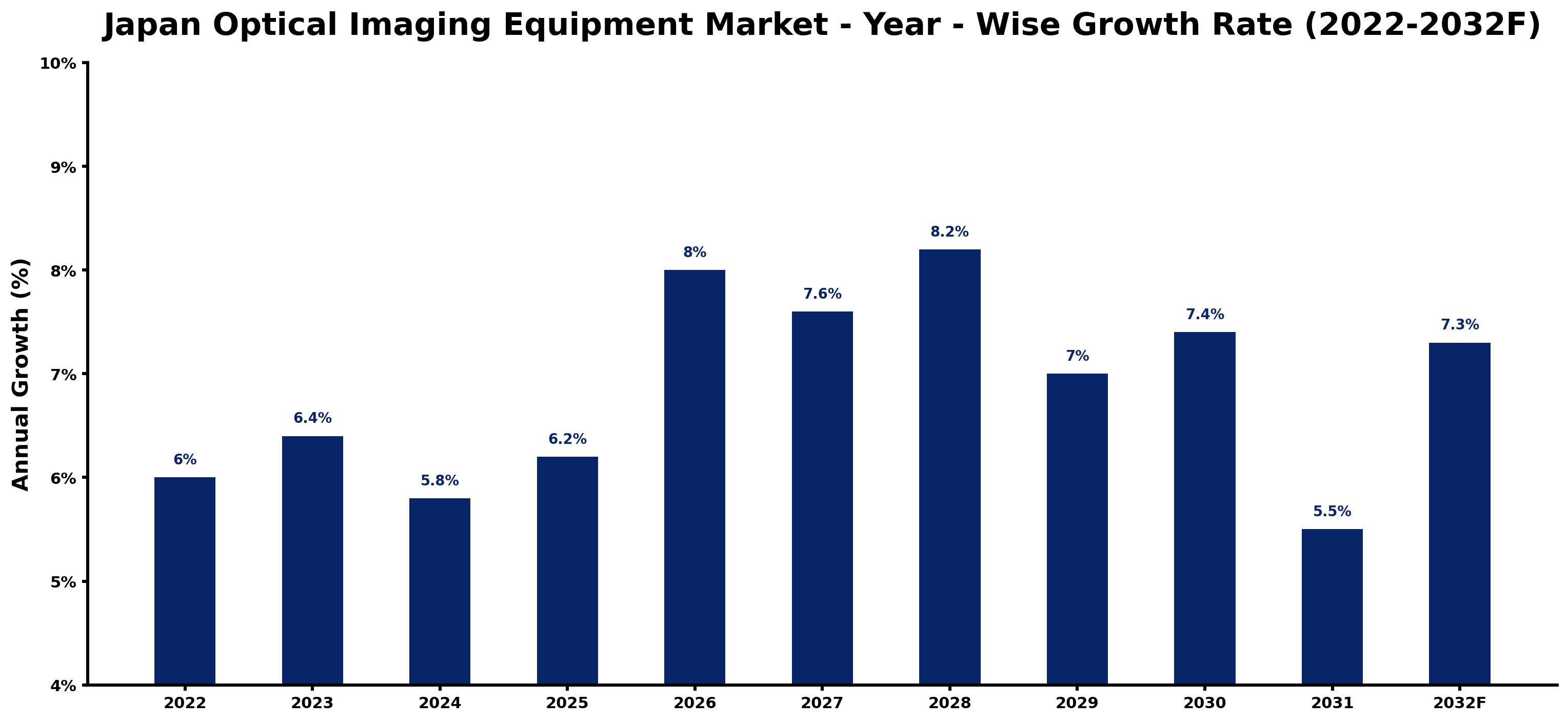
For each year, the table pairs the estimated growth rate with the leading influence on demand, showing how the drivers changed across the period.
| Year | Estimated Annual Growth (%) | Market Rationale |
| 2022 | 6.0 | The market showed steady growth, reflecting consistent demand from hospitals and diagnostic centers. |
| 2023 | 6.4 | Growth accelerated due to increased investments in advanced imaging technologies across healthcare facilities. |
| 2024 | 5.8 | A slight slowdown occurred as hospitals adjusted budgets amid rising operational costs. |
| 2025 | 6.2 | Demand rebounded as hospitals expanded their imaging capabilities to improve patient care. |
| 2026 | 8.0 | Growth surged as new imaging technologies gained traction in oncology and ophthalmology. |
| 2027 | 7.6 | A slowdown in growth was noted as the market stabilised after rapid advancements. |
| 2028 | 8.2 | The market peaked with heightened investments in imaging systems for cancer detection. |
| 2029 | 7.0 | Growth decelerated slightly as market saturation began to affect new purchases. |
| 2030 | 7.4 | Demand increased again as hospitals adopted new imaging technologies to improve diagnostics. |
| 2031 | 5.5 | A slowdown was observed as the market approached maturity and competition intensified. |
| 2032 | 7.3 | The market is expected to grow as investments in imaging technologies continue to rise. |
Note: Market size estimations and growth projections presented in this report are based on 6Wresearch's proprietary forecasting methodology, utilizing the latest available industry data, government publications, and primary research inputs.
Japan Optical Imaging Equipment Market Synopsis
Optical imaging equipment uses light to visualize internal biological structures, primarily made through advanced optics. It plays a critical role in diagnostics for oncology, ophthalmology, and neurology. The Japan Optical Imaging Equipment Market is expanding due to strong demand from over 8,000 hospitals and 1,200 diagnostic centers. The launch of programs to improve imaging capabilities in rural hospitals and the increasing adoption of technologies like optical coherence tomography are driving growth.
Market Dynamics Impact Analysis (2026–2032)
| Factor | Type | Impact | Primary Segment Affected |
| Strong demand from hospitals for advanced imaging technologies | Driver | High | Optical Coherence Tomography |
| Increased investment in healthcare infrastructure | Driver | High | Photoacoustic Imaging |
| Growing adoption of imaging technologies in rural healthcare facilities | Opportunity | High | Diagnostic Centers |
| Expansion of research labs focusing on advanced imaging techniques | Opportunity | Medium | Research Labs |
| High costs associated with advanced imaging equipment | Restraint | High | Hospitals |
| Limited local production of certain advanced imaging technologies | Restraint | Medium | Diagnostic Centers |
| Shortage of skilled technicians for operating advanced imaging systems | Challenge | High | Hospitals |
| Competition from alternative imaging technologies | Challenge | Medium | Research Labs |
Evaluation of Drivers in Japan Optical Imaging Equipment Market (2026–2032)
The following drivers explain most of the expected growth.
| Drivers | Primary Segment Affected | Why It Matters (Evidence) |
| Growing number of hospitals adopting optical coherence tomography | Optical Coherence Tomography | Over 500 clinics in Japan utilize this technology, driving demand for new installations. |
| Increased focus on cancer detection and treatment | Photoacoustic Imaging | With over 100 devices in use, this technology is becoming essential in oncology. |
| Rising patient population in diagnostic centers | Diagnostic Centers | Each center serves around 20,000 patients annually, increasing the need for imaging technologies. |
| Expansion of advanced imaging capabilities in rural hospitals | Hospitals | The 2023 program aims to enhance imaging services, leading to more equipment purchases. |
| Growing research activities in imaging technologies | Research Labs | Fluorescence imaging is key in over 300 labs, boosting demand for advanced systems. |
Orders keep climbing as the Tokyo region sees a growing number of hospitals adopting optical coherence tomography, with over 500 clinics using this technology. The rising focus on cancer detection drives demand for photoacoustic imaging, with more than 100 devices currently in operation. Diagnostic centers, serving a considerable patient population annually, are expanding their imaging capabilities. Research labs are increasingly adopting advanced imaging technologies, supporting the growth of these systems.
Evaluation of Restraints in Japan Optical Imaging Equipment Market
These are the pressures that could keep growth below its potential.
| Market Restraint | Primary Segment Affected | Why It Matters (Evidence) |
| High costs of advanced imaging equipment limit accessibility | Hospitals | Many hospitals face budget constraints that hinder the acquisition of new technologies. |
| Limited local production of advanced imaging systems affects supply | Diagnostic Centers | Dependence on imports can lead to delays and higher costs for diagnostic centers. |
| Shortage of skilled technicians impacts operational efficiency | Hospitals | The lack of trained personnel can slow down the adoption of new imaging technologies. |
| Competition from alternative imaging methods reduces market share | Research Labs | Emerging technologies may divert funding and attention away from traditional imaging systems. |
| Regulatory hurdles can delay the introduction of new technologies | Diagnostic Centers | Stringent approval processes may slow down the entry of new imaging solutions. |
Japan Optical Imaging Equipment Market Challenges
Japan's rising minimum wage, now at JPY 1,055 per hour, increases production costs for optical imaging equipment. This rise compels producers to elevate prices, directly affecting hospitals that depend on these technologies for diagnostics, leading to higher operational expenses. A shortage of skilled technicians in the imaging sector is delaying equipment installation and maintenance across over 8,000 hospitals, potentially causing service interruptions. Stringent regulations from the Japanese Society of Medical Imaging impose extra compliance costs, limiting suppliers' ability to compete effectively in the market.
Trends in the Japan Optical Imaging Equipment Market
Several trends are reshaping the Japan Optical Imaging Equipment Market; the most important are set out below.
- Shift from Traditional to Advanced Imaging Techniques: A growing number of hospitals are adopting advanced imaging technologies, with investments made since 2023. This shift improves diagnostic accuracy and patient outcomes, reflecting the evolution of the healthcare sector.
- Emergence of Telemedicine in Imaging Services: The rise of telemedicine since 2023 has transformed the delivery of imaging services, with remote consultations becoming standard. This trend is driven by the need for accessibility in rural areas, enhancing patient care.
- Increased Focus on Cancer Diagnostics: In 2023, oncology emerged as a key application area for optical imaging, capturing a 44% market share. This trend highlights the growing emphasis on early cancer detection and treatment efficacy.
- Expansion of Imaging Capabilities in Rural Areas: The 2023 programme to improve imaging capabilities in rural hospitals has resulted in increased investments. With ¥5 billion allocated, this initiative aims to enhance access to advanced imaging technologies.
Investment Opportunities in the Japan Optical Imaging Equipment Market
Below are the investment opportunities with the strongest case in the Japan Optical Imaging Equipment Market.
- Partner with Rural Healthcare Facilities: Now is the time to invest in partnerships with rural hospitals that require advanced imaging technologies. The 2023 initiative allocates ¥5 billion to improve imaging capabilities, creating a market opportunity.
- Invest in Diagnostic Centers: Diagnostic centres are expanding their imaging capabilities, serving a patient population of around 20,000 annually. Engaging with these centres can lead to fruitful collaborations and equipment supply contracts.
- Focus on Research Labs: Research labs are increasingly adopting advanced imaging technologies, particularly fluorescence imaging. With over 300 labs using this technology, suppliers can explore partnerships to meet growing demand.
- Utilise Government Funding Initiatives: The Japanese government has allocated substantial funding for advancements in medical imaging technology. Engaging with government agencies can facilitate market entry and support growth.
Government Initiatives in the Japan Optical Imaging Equipment Market
The Long-Term Care Insurance Act, enacted in 1997 and in force since 2000, provides funding for nursing care and support services for older individuals. This law indirectly benefits optical imaging equipment producers by increasing the demand for diagnostic services in elder care facilities. Additionally, the Industrial Safety and Health Act of 1972 mandates employer responsibilities regarding hazardous substances, ensuring safety in the use of imaging equipment.
The Ministry of Health, Labour and Welfare oversees the implementation of the Long-Term Care Insurance Act, funding various healthcare initiatives. In 2023, the ministry launched a programme to improve imaging capabilities in rural hospitals, allocating ¥5 billion to support this initiative. This funding allows hospitals to upgrade their imaging technologies, directly benefiting buyers seeking advanced diagnostic solutions.
Future Insight of the Japan Optical Imaging Equipment Market
Photoacoustic imaging will reshape demand by 2032, driven by its broader application in oncology. The Japanese government's ¥5 billion investment in medical imaging technology will improve capabilities in rural hospitals, enhancing patient access to advanced diagnostics. Integration of advanced imaging technologies into clinical protocols will align with the Japanese Society of Medical Imaging's evolving standards. By 2032, the average installed base of optical imaging devices in hospitals is expected to rise significantly, reflecting a transition towards more sophisticated solutions.
Market Segmentation Analysis
Japan Optical Imaging Equipment Market report covers a detailed analysis of the following market segments:
By Type – Optical Coherence Tomography Leads, Photoacoustic Imaging Expected to Grow Fastest
According to Bhawna Singh, Assistant Manager at 6Wresearch, Optical Coherence Tomography accounted for 41% of the market by type in 2025. Optical Coherence Tomography holds the largest share as it is extensively utilised in over 500 ophthalmology clinics across Japan, providing essential imaging for detailed assessments of the retina and other tissues. This technology is vital for accurate diagnostics, making it a preferred choice among healthcare providers. Over 2026–2032, Photoacoustic Imaging is expected to post the fastest growth, at a CAGR of 9.8%. Photoacoustic Imaging is rapidly gaining traction due to its adoption for cancer detection and monitoring, with over 100 devices currently operational. This increasing demand reflects the urgent need for advanced imaging solutions in oncology, ensuring that the lead in Optical Coherence Tomography will continue to widen as it remains crucial for diagnostics. Suppliers should focus on enhancing the availability of optical coherence tomography and photoacoustic imaging technologies to meet the growing needs of healthcare facilities.
By Technology – Near-Infrared Leads, Fluorescence Expected to Grow Fastest
Near-Infrared held 34% of the Japan Optical Imaging Equipment Market by technology in 2025. Near-Infrared technology leads the market as it is commonly used in various imaging applications, ensuring a broad installed base across hospitals and diagnostic centers. Its versatility makes it a reliable choice for medical professionals. The quickest growth will come from Fluorescence, forecast to expand at a CAGR of 10.0% between 2026 and 2032. Fluorescence technology is growing quickly, widely utilised in diagnostics and research, which is evidenced by its adoption in numerous laboratories. This trend indicates a shift towards more advanced imaging techniques in clinical settings. Buyers will benefit from investing in fluorescence imaging technologies to stay competitive in diagnostics and research capabilities.
By Application – Oncology Leads, Ophthalmology Expected to Grow Fastest
The largest application category in 2025 was Oncology, at 44% of revenue. Oncology is the leading application area for optical imaging equipment, critical for cancer diagnosis and treatment, which is a top priority in Japan's healthcare system. The emphasis on oncology highlights the urgent need for effective imaging solutions to combat cancer effectively. Ophthalmology is set to record the highest CAGR in this split, 9.3% over 2026–2032. Ophthalmology is the fastest-growing application, essential for eye-related diagnostics, with a notable number of clinics adopting advanced imaging technologies. This growth is driven by the increasing prevalence of eye disorders among the population, suggesting a sustained demand for these solutions. Suppliers should prioritise the development of imaging solutions tailored for ophthalmology to capture the expanding market opportunities.
By End Use – Hospitals Lead, Diagnostic Centers Expected to Grow Fastest
In 2025, Hospitals led the end use split with a 41% share. Hospitals are the primary users of imaging equipment, with over 8,000 facilities in Japan relying on these technologies for patient care. Their substantial installed base and ongoing demand underscore their dominant position in the market, solidifying their role as key stakeholders. Diagnostic Centers are projected to grow fastest, at a CAGR of 9.6% during 2026–2032. Diagnostic Centers are witnessing the fastest growth, driven by the significant demand for imaging technologies, with around 1,200 facilities currently operational. This trend indicates an increasing reliance on specialised diagnostic services, which will likely continue to expand. Suppliers must ensure that diagnostic centers have access to the latest imaging technologies to meet their growing operational demands.
Key Attractiveness of the Report
- 10 Years of Market Numbers
- Historical Data Starting from 2022 to 2025
- Base Year 2025
- Forecast Data until 2032
- Key Performance Indicators Impacting the Market
- Major Upcoming Developments and Projects
Key Highlights of the Report:
- Japan Optical Imaging Equipment Market Outlook
- Market Size of Japan Optical Imaging Equipment Market,2025
- Forecast of Japan Optical Imaging Equipment Market, 2032
- Historical Data and Forecast of Japan Optical Imaging Equipment Revenues & Volume for the Period 2022-2032
- Japan Optical Imaging Equipment Market Trend Evolution
- Japan Optical Imaging Equipment Market Drivers and Challenges
- Japan Optical Imaging Equipment Price Trends
- Japan Optical Imaging Equipment Porter's Five Forces
- Japan Optical Imaging Equipment Industry Life Cycle
- Historical Data and Forecast of Japan Optical Imaging Equipment Market Revenues & Volume By Type for the Period 2022-2032
- Historical Data and Forecast of Japan Optical Imaging Equipment Market Revenues & Volume By Optical Coherence Tomography for the Period 2022-2032
- Historical Data and Forecast of Japan Optical Imaging Equipment Market Revenues & Volume By Photoacoustic Imaging for the Period 2022-2032
- Historical Data and Forecast of Japan Optical Imaging Equipment Market Revenues & Volume By Hyperspectral Imaging for the Period 2022-2032
- Historical Data and Forecast of Japan Optical Imaging Equipment Market Revenues & Volume By Others for the Period 2022-2032
- Historical Data and Forecast of Japan Optical Imaging Equipment Market Revenues & Volume By Technology for the Period 2022-2032
- Historical Data and Forecast of Japan Optical Imaging Equipment Market Revenues & Volume By Near-Infrared for the Period 2022-2032
- Historical Data and Forecast of Japan Optical Imaging Equipment Market Revenues & Volume By Fluorescence for the Period 2022-2032
- Historical Data and Forecast of Japan Optical Imaging Equipment Market Revenues & Volume By Confocal for the Period 2022-2032
- Historical Data and Forecast of Japan Optical Imaging Equipment Market Revenues & Volume By Others for the Period 2022-2032
- Historical Data and Forecast of Japan Optical Imaging Equipment Market Revenues & Volume By Application for the Period 2022-2032
- Historical Data and Forecast of Japan Optical Imaging Equipment Market Revenues & Volume By Oncology for the Period 2022-2032
- Historical Data and Forecast of Japan Optical Imaging Equipment Market Revenues & Volume By Ophthalmology for the Period 2022-2032
- Historical Data and Forecast of Japan Optical Imaging Equipment Market Revenues & Volume By Neurology for the Period 2022-2032
- Historical Data and Forecast of Japan Optical Imaging Equipment Market Revenues & Volume By Others for the Period 2022-2032
- Historical Data and Forecast of Japan Optical Imaging Equipment Market Revenues & Volume By End Use for the Period 2022-2032
- Historical Data and Forecast of Japan Optical Imaging Equipment Market Revenues & Volume By Hospitals for the Period 2022-2032
- Historical Data and Forecast of Japan Optical Imaging Equipment Market Revenues & Volume By Diagnostic Centers for the Period 2022-2032
- Historical Data and Forecast of Japan Optical Imaging Equipment Market Revenues & Volume By Research Labs for the Period 2022-2032
- Historical Data and Forecast of Japan Optical Imaging Equipment Market Revenues & Volume By Specialty Clinics for the Period 2022-2032
- Japan Optical Imaging Equipment Import Export Trade Statistics
- Market Opportunity Assessment By Type
- Market Opportunity Assessment By Technology
- Market Opportunity Assessment By Application
- Market Opportunity Assessment By End Use
- Japan Optical Imaging Equipment Top Companies Market Share
- Japan Optical Imaging Equipment Competitive Benchmarking By Technical and Operational Parameters
- Japan Optical Imaging Equipment Company Profiles
- Japan Optical Imaging Equipment Key Strategic Recommendations
Market Covered
The report covers the following segments.
By Type
- Optical Coherence Tomography
- Photoacoustic Imaging
- Hyperspectral Imaging
- Others
By Technology
- Near-Infrared
- Fluorescence
- Confocal
- Others
By Application
- Oncology
- Ophthalmology
- Neurology
- Others
By End Use
- Hospitals
- Diagnostic Centers
- Research Labs
- Specialty Clinics































