Japan Optical Imaging System Market Size & Growth Rate
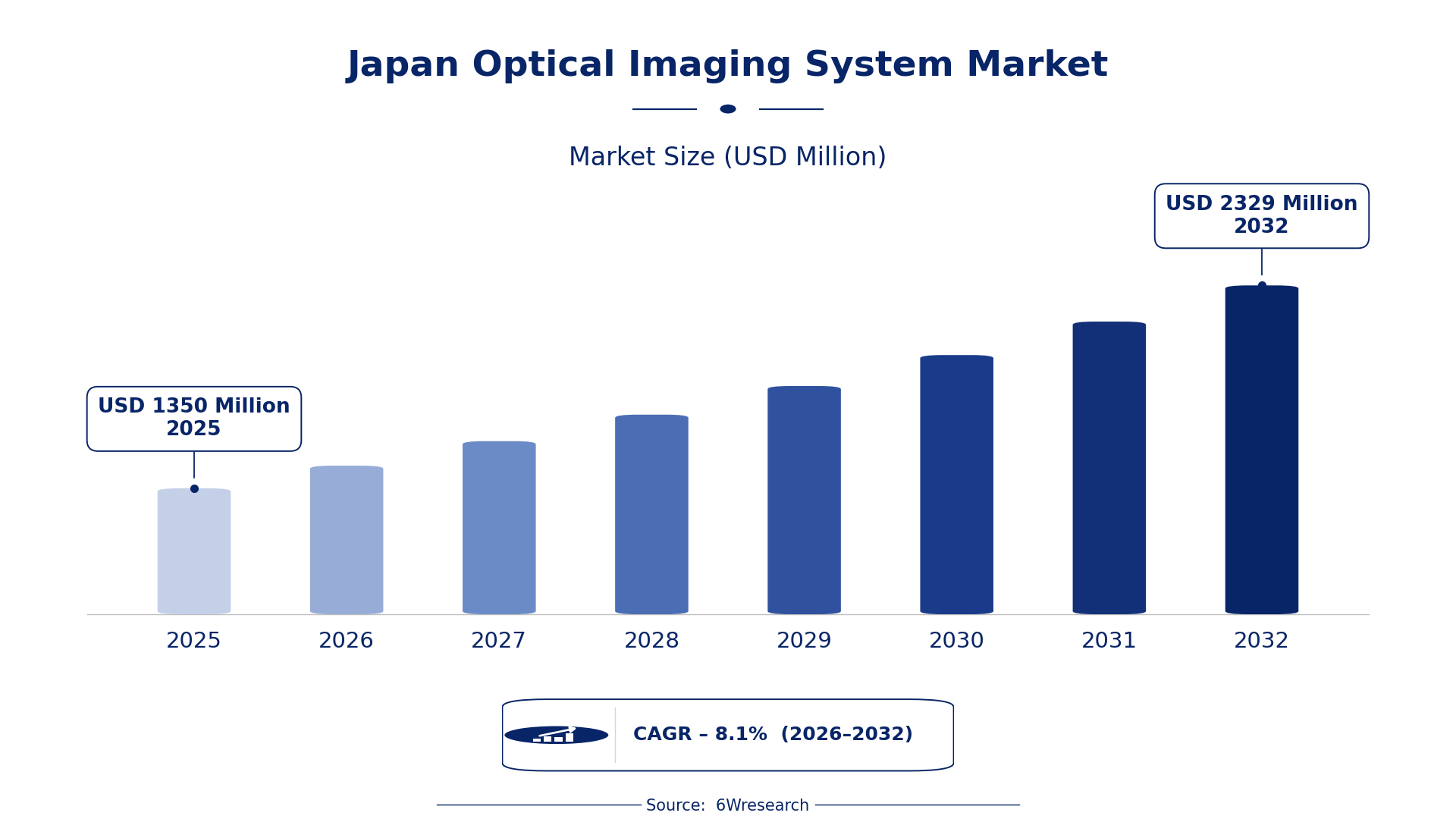
According to 6Wresearch internal database and industry insights, the Japan Optical Imaging System Market was valued at USD 1,350 Million in 2025 and is projected to reach USD 2,329 Million by 2032, growing at a CAGR of approximately 8.1% during 2026–2032.
Japan Optical Imaging System Market Highlights
| Report Metric | Details |
| Report Name | Japan Optical Imaging System Market (2026-2032) |
| Market Size 2025 | USD 1,350 Million |
| Market Size 2032 | USD 2,329 Million |
| Absolute Growth 2025–2032 | USD 979 Million |
| CAGR 2026–2032 | 8.1% |
| Peak Annual Growth | 8.4% in 2032 |
| Forecast Period | 2026–2032 |
| Historical Data | 2022–2025 |
| Base Year | 2025 |
| Leading Type, 2025 | Microscopy System (37% share) |
| Leading Component, 2025 | Cameras (42% share) |
| Leading Application, 2025 | Cancer Diagnostics (48% share) |
| Leading End Use, 2025 | Hospitals (54% share) |
| Fastest-Growing Type | Endoscopy System (11.0% CAGR) |
| Fastest-Growing Component | Software (11.6% CAGR) |
| Fastest-Growing Application | Dermatology (10.5% CAGR) |
| Fastest-Growing End Use | Clinics (10.3% CAGR) |
| Growing Sector | Hospitals |
| Key End Users | Hospitals, Clinics, Research Centers, Diagnostic Labs |
Japan Optical Imaging System Market Year-wise Growth Rate and Key Drivers (2022–2032)
This graph illustrates the annual growth rates of the market from 2022 to 2032, highlighting a steady upward trajectory and projected market expansion over the forecast period.
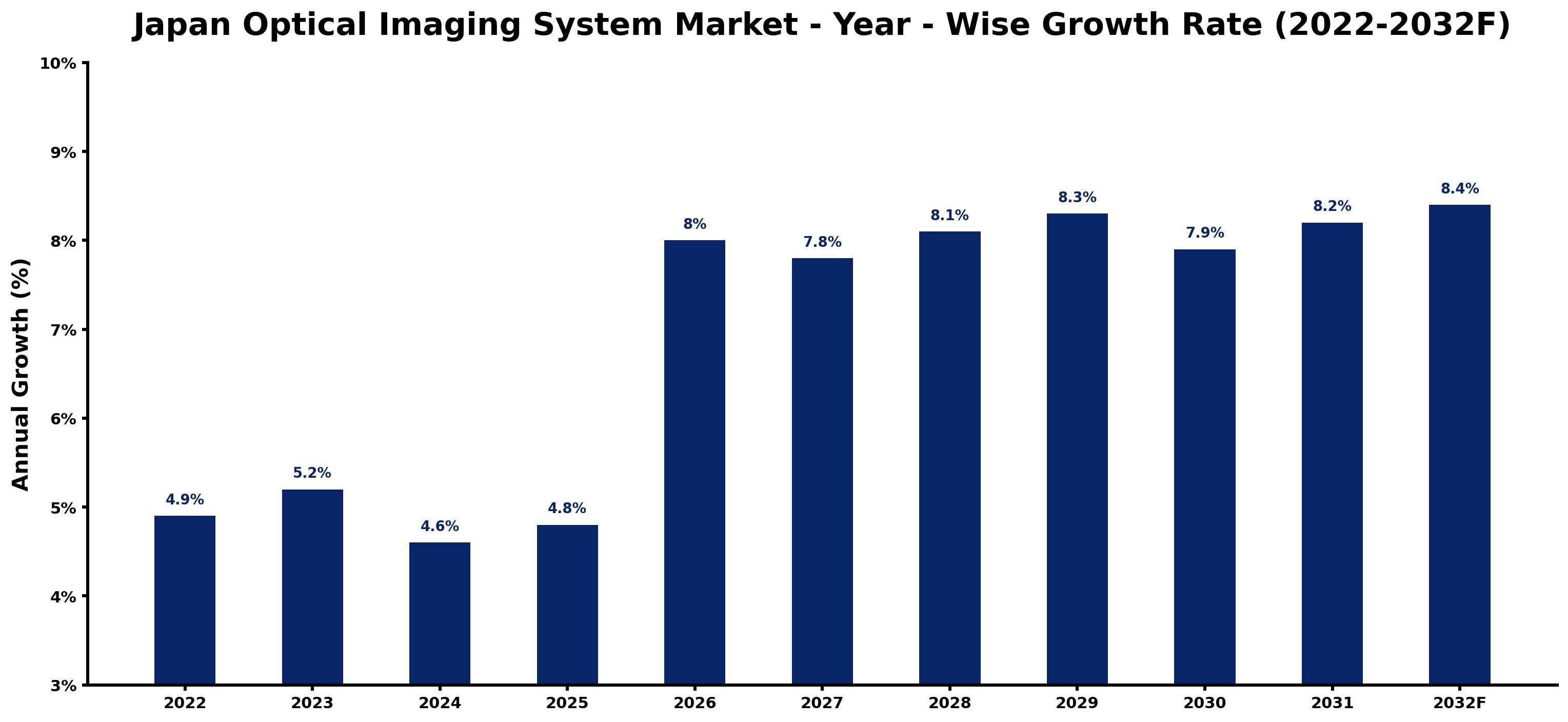
The following figures match every annual growth estimate with the main market development of that year, giving the reasoning behind each rise or slowdown.
| Year | Estimated Annual Growth (%) | Market Rationale |
| 2022 | 4.9 | The market showed steady demand from hospitals and clinics for advanced imaging technology. |
| 2023 | 5.2 | Growth accelerated due to increased funding for medical imaging technology upgrades. |
| 2024 | 4.6 | Growth slowed as hospitals adjusted to new imaging technologies and budget constraints. |
| 2025 | 4.8 | Demand rose again as hospitals expanded their imaging capabilities to improve diagnostics. |
| 2026 | 8.0 | A surge in investment for optical imaging systems is expected to drive growth. |
| 2027 | 7.8 | Growth is projected to slow slightly as the market stabilises after rapid expansion. |
| 2028 | 8.1 | Increased adoption of imaging systems in clinics is expected to boost market growth. |
| 2029 | 8.3 | Demand is projected to rise as dermatology applications gain traction due to rising skin cancer rates. |
| 2030 | 7.9 | Growth is anticipated to slow as market saturation begins to take effect. |
| 2031 | 8.2 | Investment in research centres is expected to drive renewed demand for imaging systems. |
| 2032 | 8.4 | The peak growth year is driven by advancements in imaging technology and increased healthcare spending. |
Note: Market size estimations and growth projections presented in this report are based on 6Wresearch's proprietary forecasting methodology, utilizing the latest available industry data, government publications, and primary research inputs.
Japan Optical Imaging System Market Synopsis
Optical imaging systems are advanced technologies used to visualise and analyse biological tissues, primarily in medical diagnostics. The Japan Optical Imaging System Market is growing due to rising demand from hospitals and research institutions, alongside substantial investment in medical imaging technology upgrades. In 2023, the Ministry of Health allocated ¥2 billion for these upgrades, while the Tokyo region accounts for 30% of the market. Increased focus on early diagnosis and telemedicine integration is further driving demand for these systems, with 90% of cancer diagnostics relying on optical imaging technology.
Market Dynamics Impact Analysis (2026–2032)
| Factor | Type | Impact | Primary Segment Affected |
| Rising investment in healthcare technology | Driver | High | Optical Coherence Tomography |
| Growing prevalence of skin cancer | Driver | High | Dermatology |
| Emerging demand for advanced imaging solutions | Opportunity | High | Endoscopy System |
| Increased funding for research and development | Opportunity | High | Microscopy System |
| Stringent regulatory requirements for medical devices | Restraint | High | Cameras |
| High costs associated with advanced imaging systems | Restraint | Medium | Optical Coherence Tomography |
| Limited availability of skilled technicians | Challenge | High | Endoscopy System |
| Competition from alternative imaging technologies | Challenge | Medium | Microscopy System |
Evaluation of Drivers in Japan Optical Imaging System Market (2026–2032)
Below are the drivers that matter most for revenue growth, with supporting evidence.
| Drivers | Primary Segment Affected | Why It Matters (Evidence) |
| Increased healthcare spending | Optical Coherence Tomography | Japan's healthcare expenditure reached ¥42 trillion in 2023, boosting demand for advanced imaging systems. |
| Rising incidence of skin-related diseases | Dermatology | The growing skin cancer rates in urban areas have led to a 15% increase in dermatology imaging procedures. |
| Government funding for medical imaging upgrades | Endoscopy System | The Ministry of Health allocated ¥2 billion in 2023 for enhancing imaging technology in healthcare facilities. |
| Technological advancements in imaging systems | Microscopy System | Research funding for optical imaging technology reached ¥1.5 billion in 2023, promoting innovation. |
| Growing demand from research institutions | Cameras | Over 70% of research centres reported using optical imaging systems, increasing their purchasing needs. |
Buyers are adding capacity as healthcare spending in Japan reached ¥42 trillion in 2023, driving demand for advanced imaging systems. Rising skin cancer rates in urban areas have led to a 15% increase in dermatology imaging procedures, prompting hospitals to invest in optical imaging technology. The allocation of ¥2 billion for medical imaging upgrades in 2023 has further stimulated demand. Research funding for optical imaging technology reached ¥1.5 billion, promoting innovation in the sector. More than 70% of research centres reported using these systems, which boosts purchasing from suppliers.
Evaluation of Restraints in Japan Optical Imaging System Market
Below are the constraints most often cited by buyers and suppliers, with the segment each affects.
| Market Restraint | Primary Segment Affected | Why It Matters (Evidence) |
| Regulatory compliance costs for medical devices | Cameras | ISO 13485 certification is mandatory for manufacturers, increasing production costs by 20%. |
| High initial investment for advanced systems | Optical Coherence Tomography | The average cost of these systems can exceed ¥10 million, limiting access for smaller clinics. |
| Shortage of trained imaging technicians | Endoscopy System | The average age of imaging technicians is rising, with 30% nearing retirement in the next five years. |
| Market saturation in urban areas | Microscopy System | Over 80% of major university hospitals already utilise optical imaging systems, limiting new sales opportunities. |
| Competition from alternative imaging technologies | Dermatology | Emerging technologies like AI-based diagnostics are gaining traction, diverting investment from traditional imaging. |
Japan Optical Imaging System Market Challenges
Inefficient technology hinders the optical imaging system market, as many hospitals rely on outdated equipment that delays diagnostics for patients. Upgrade costs strain hospital budgets, with ¥2 billion allocated in 2023, restricting funds for other critical services. Intense price competition among suppliers often compromises quality, which affects hospitals' ability to provide accurate diagnostics. Buyers face challenges in sourcing systems that meet JIS standards, resulting in longer procurement times and potential delays in patient care.
Trends in the Japan Optical Imaging System Market
Four trends stand out in the Japan Optical Imaging System Market.
- Shift towards Telemedicine Integration: In 2023, the Ministry of Health's strategy emphasised telemedicine and imaging integration, leading to a 25% increase in remote diagnostics.
- Emergence of AI in Imaging: AI-based imaging solutions are becoming prevalent, with over 40% of hospitals exploring these technologies to improve diagnostic accuracy.
- Growth in Dermatology Applications: Dermatology applications are expanding rapidly, with a reported 15% increase in imaging procedures due to rising skin cancer rates.
- Focus on Early Diagnosis: The optical imaging market is supported by government health initiatives focusing on early diagnosis, with 90% of cancer diagnostics relying on these systems.
Investment Opportunities in the Japan Optical Imaging System Market
The openings below show where demand in the Japan Optical Imaging System Market is visible and how suppliers can enter.
- Supply advanced Optical Coherence Tomography systems: With over 500 ophthalmology clinics using these systems, the market gap is estimated at ¥5 billion for 2023.
- Invest in Endoscopy System technology: The demand for minimally invasive procedures is rising, with a 20% market growth expected in surgical clinics by 2025.
- Provide Software solutions for imaging systems: As the fastest-growing component, software is projected to grow at 11.6%, driven by increased data analysis needs.
- Partner with research institutions: With 70% of research centres using optical imaging systems, establishing joint ventures can facilitate market entry and expansion.
Government Initiatives in the Japan Optical Imaging System Market
The Long-Term Care Insurance Act (1997, in force 2000) provides funding for nursing care and support services, benefiting buyers of optical imaging systems by ensuring access to necessary medical technologies. Furthermore, the Semiconductor and Digital Industry Strategy (METI, June 2021) promotes domestic semiconductor manufacturing, which is vital for the production of imaging systems.
The Ministry of Health, Labour and Welfare (MHLW) oversees the approval of medical devices, ensuring compliance with JIS standards. In 2023, the agency funded ¥2 billion for medical imaging technology upgrades, improving the capabilities of healthcare providers and promoting the adoption of advanced imaging systems.
Future Insight of the Japan Optical Imaging System Market
The introduction of advanced telemedicine facilities will improve diagnostic capabilities by 2032, broadening access to imaging services. Government health initiatives will prioritise early diagnosis, driving demand for cutting-edge optical systems. Research funding for optical imaging technology is projected to reach ¥3 billion by 2032, encouraging innovations that improve diagnostic accuracy. As the population ages, suppliers will need to create imaging systems that cater to the specific needs of older patients.
Market Segmentation Analysis
Japan Optical Imaging System Market report covers a detailed analysis of the following market segments:
By Type – Microscopy System Leads, Endoscopy System Expected to Grow Fastest
According to Bhawna Singh, Assistant Manager at 6Wresearch, Microscopy System accounted for 37% of the market by type in 2025. The Microscopy System holds the largest share as it is indispensable in hospitals for detailed cellular imaging, with over 8,000 hospitals employing these systems. This widespread use is crucial for accurate diagnostics in oncology and dermatology, making it a fundamental component of medical imaging. The quickest growth will come from Endoscopy System, forecast to expand at a CAGR of 11.0% between 2026 and 2032. The Endoscopy System is experiencing rapid growth due to its importance in minimally invasive procedures, which are increasingly preferred in surgical clinics. With over 1,200 surgical clinics in Japan utilising endoscopy, this trend indicates a shift towards less invasive diagnostics and treatments. Suppliers should prioritise advancements in endoscopy technologies to align with the growing demand in surgical environments.
By Component – Cameras Lead, Software Expected to Grow Fastest
With 42% of component revenue in 2025, Cameras was the largest category. Cameras lead the market as they are essential for supporting imaging systems, enabling high-quality visualisation across various medical applications. Their integration into optical imaging systems is vital for effective diagnostics in hospitals, where precision is critical. Over 2026–2032, Software is expected to post the fastest growth, at a CAGR of 11.6%. Software is the fastest-growing component because it is integral for data analysis and processing, necessary for optimising the functionality of imaging systems. The increasing complexity of medical imaging data drives the demand for advanced software solutions. Buyers should focus on software capabilities when selecting imaging systems to maximise the utility of diagnostic data.
By Application – Cancer Diagnostics Lead, Dermatology Expected to Grow Fastest
Cancer Diagnostics took 48% of application revenue in 2025, more than any other category. Cancer Diagnostics leads the market as it is the primary use for detecting tumors, with optical imaging systems integral to 90% of cancer diagnostic procedures in hospitals. This critical application drives demand for advanced imaging technologies in the healthcare sector. Dermatology is projected to grow fastest, at a CAGR of 10.5% during 2026–2032. Dermatology is the fastest-growing application due to rising skin cancer rates in urban areas, prompting increased use of imaging systems for skin condition assessments. The focus on early diagnosis in dermatology is fuelling this growth. Suppliers must adapt their strategies to cater to the increasing demand for dermatological imaging solutions.
By End Use – Hospitals Lead, Clinics Expected to Grow Fastest
In 2025, Hospitals led the end use split with a 54% share. Hospitals represent the largest end-use segment as they are the primary users of imaging systems, with an average installed base of approximately 1,500 units per facility. Their comprehensive medical care services significantly fuel the demand for optical imaging technologies. Clinics are set to record the highest CAGR in this split, 10.3% over 2026–2032. Clinics are the fastest-growing end-use segment as they are increasingly utilised for outpatient diagnostics, reflecting a shift towards more accessible healthcare services. This trend aligns with the Ministry of Health's strategy promoting telemedicine and imaging integration. Suppliers should develop targeted solutions for clinics to address the rising demand for outpatient imaging services.
Key Attractiveness of the Report
- 10 Years of Market Numbers
- Historical Data Starting from 2022 to 2025
- Base Year 2025
- Forecast Data until 2032
- Key Performance Indicators Impacting the Market
- Major Upcoming Developments and Projects
Key Highlights of the Report:
- Japan Optical Imaging System Market Outlook
- Market Size of Japan Optical Imaging System Market,2025
- Forecast of Japan Optical Imaging System Market, 2032
- Historical Data and Forecast of Japan Optical Imaging System Revenues & Volume for the Period 2022-2032
- Japan Optical Imaging System Market Trend Evolution
- Japan Optical Imaging System Market Drivers and Challenges
- Japan Optical Imaging System Price Trends
- Japan Optical Imaging System Porter's Five Forces
- Japan Optical Imaging System Industry Life Cycle
- Historical Data and Forecast of Japan Optical Imaging System Market Revenues & Volume By Type for the Period 2022-2032
- Historical Data and Forecast of Japan Optical Imaging System Market Revenues & Volume By Microscopy System for the Period 2022-2032
- Historical Data and Forecast of Japan Optical Imaging System Market Revenues & Volume By Endoscopy System for the Period 2022-2032
- Historical Data and Forecast of Japan Optical Imaging System Market Revenues & Volume By Optical Coherence Tomography for the Period 2022-2032
- Historical Data and Forecast of Japan Optical Imaging System Market Revenues & Volume By Others for the Period 2022-2032
- Historical Data and Forecast of Japan Optical Imaging System Market Revenues & Volume By Component for the Period 2022-2032
- Historical Data and Forecast of Japan Optical Imaging System Market Revenues & Volume By Cameras for the Period 2022-2032
- Historical Data and Forecast of Japan Optical Imaging System Market Revenues & Volume By Software for the Period 2022-2032
- Historical Data and Forecast of Japan Optical Imaging System Market Revenues & Volume By Sensors for the Period 2022-2032
- Historical Data and Forecast of Japan Optical Imaging System Market Revenues & Volume By Light Source for the Period 2022-2032
- Historical Data and Forecast of Japan Optical Imaging System Market Revenues & Volume By Application for the Period 2022-2032
- Historical Data and Forecast of Japan Optical Imaging System Market Revenues & Volume By Cancer Diagnostics for the Period 2022-2032
- Historical Data and Forecast of Japan Optical Imaging System Market Revenues & Volume By Dermatology for the Period 2022-2032
- Historical Data and Forecast of Japan Optical Imaging System Market Revenues & Volume By Neurology for the Period 2022-2032
- Historical Data and Forecast of Japan Optical Imaging System Market Revenues & Volume By Others for the Period 2022-2032
- Historical Data and Forecast of Japan Optical Imaging System Market Revenues & Volume By End Use for the Period 2022-2032
- Historical Data and Forecast of Japan Optical Imaging System Market Revenues & Volume By Hospitals for the Period 2022-2032
- Historical Data and Forecast of Japan Optical Imaging System Market Revenues & Volume By Clinics for the Period 2022-2032
- Historical Data and Forecast of Japan Optical Imaging System Market Revenues & Volume By Research Centers for the Period 2022-2032
- Historical Data and Forecast of Japan Optical Imaging System Market Revenues & Volume By Diagnostic Labs for the Period 2022-2032
- Japan Optical Imaging System Import Export Trade Statistics
- Market Opportunity Assessment By Type
- Market Opportunity Assessment By Component
- Market Opportunity Assessment By Application
- Market Opportunity Assessment By End Use
- Japan Optical Imaging System Top Companies Market Share
- Japan Optical Imaging System Competitive Benchmarking By Technical and Operational Parameters
- Japan Optical Imaging System Company Profiles
- Japan Optical Imaging System Key Strategic Recommendations
Market Covered
Segments analysed in this report are listed below.
By Type
- Microscopy System
- Endoscopy System
- Optical Coherence Tomography
- Others
By Component
- Cameras
- Software
- Sensors
- Light Source
By Application
- Cancer Diagnostics
- Dermatology
- Neurology
- Others
By End Use
- Hospitals
- Clinics
- Research Centers
- Diagnostic Labs































