Japan Optical Stores Market Size & Growth Rate
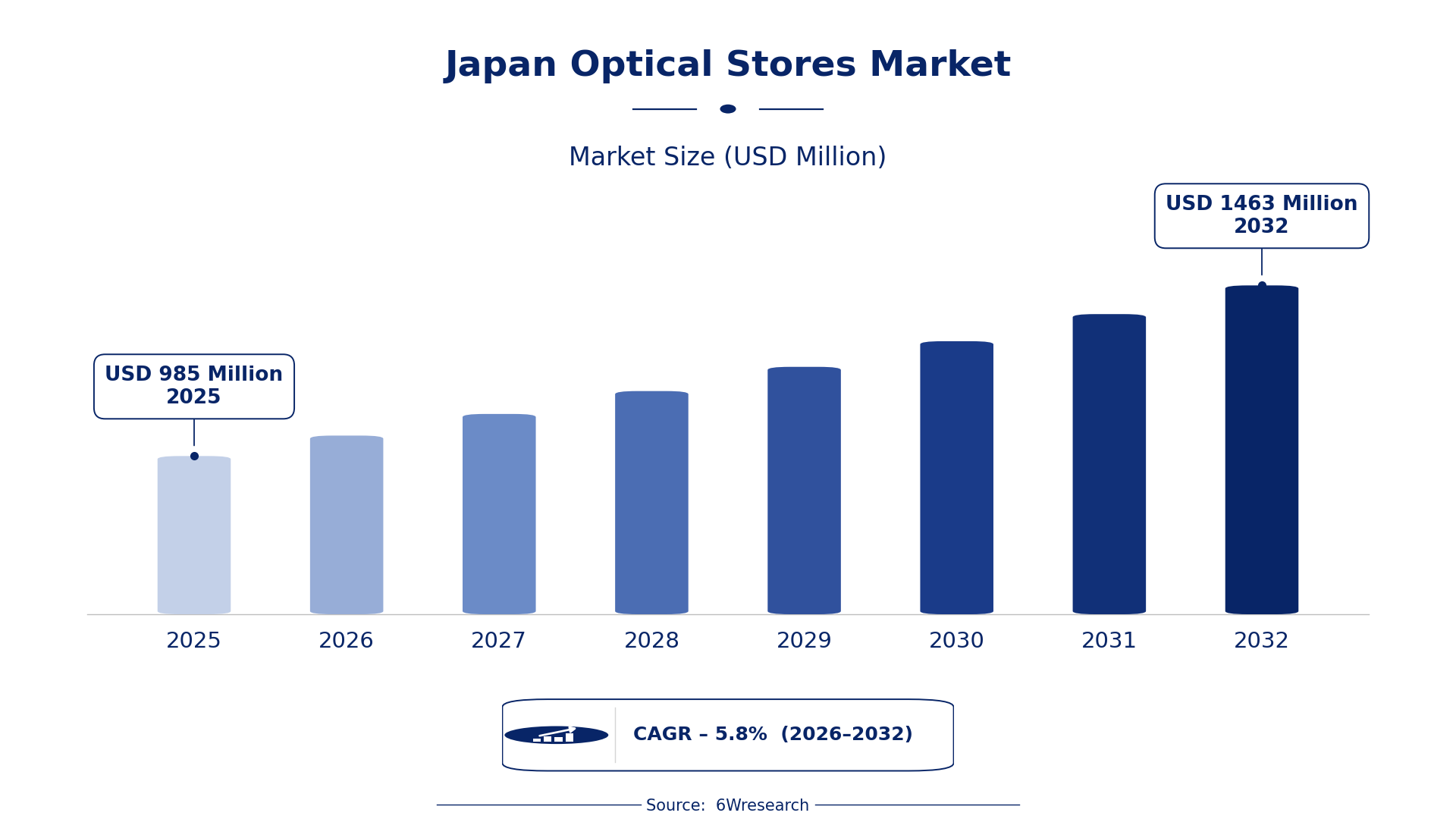
According to 6Wresearch internal database and industry insights, the Japan Optical Stores Market was valued at USD 985 Million in 2025 and is projected to reach USD 1,463 Million by 2032, growing at a CAGR of approximately 5.8% during 2026–2032.
Japan Optical Stores Market Highlights
| Report Metric | Details |
| Report Name | Japan Optical Stores Market (2026-2032) |
| Market Size 2025 | USD 985 Million |
| Market Size 2032 | USD 1,463 Million |
| Absolute Growth 2025–2032 | USD 478 Million |
| CAGR 2026–2032 | 5.8% |
| Peak Annual Growth | 6.6% in 2032 |
| Forecast Period | 2026–2032 |
| Historical Data | 2022–2025 |
| Base Year | 2025 |
| Leading Type, 2025 | Contact Lenses (51% share) |
| Leading Application, 2025 | E-Commerce (61% share) |
| Fastest-Growing Type | Spectacles (8.1% CAGR) |
| Fastest-Growing Application | Brick & Mortar (7.9% CAGR) |
| Growing Sector | Optical Retail |
| Key End Users | Consumers, E-commerce platforms, Retailers, Health professionals |
Japan Optical Stores Market Year-wise Growth Rate and Key Drivers (2022–2032)
This graph illustrates the annual growth rates of the market from 2022 to 2032, highlighting a steady upward trajectory and projected market expansion over the forecast period.
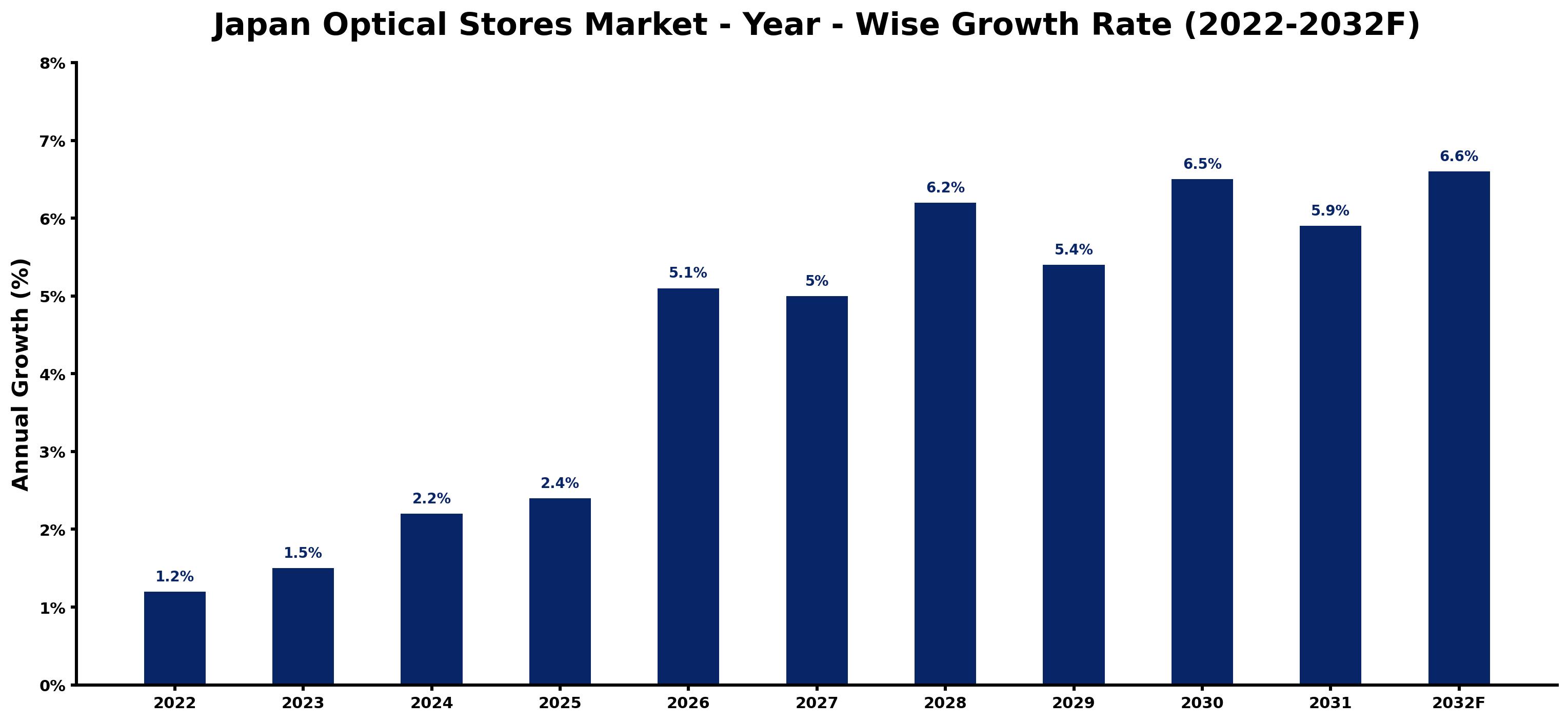
For each year, the table pairs the estimated growth rate with the leading influence on demand, showing how the drivers changed across the period.
| Year | Estimated Annual Growth (%) | Market Rationale |
| 2022 | 1.2 | The market experienced stable demand as consumers sought vision correction solutions. |
| 2023 | 1.5 | Growth accelerated due to increased awareness of vision health among consumers. |
| 2024 | 2.2 | Rising disposable income led to higher spending on optical products. |
| 2025 | 2.4 | The introduction of new eyewear styles attracted more customers to stores. |
| 2026 | 5.1 | Consumer preference shifted towards online shopping, boosting e-commerce sales. |
| 2027 | 5.0 | Growth slowed slightly as the market adjusted to increased competition. |
| 2028 | 6.2 | A surge in summer sunglasses sales contributed to market expansion. |
| 2029 | 5.4 | The market continued to grow, though at a slower pace than previous years. |
| 2030 | 6.5 | Technological advancements in lens production spurred demand for new products. |
| 2031 | 5.9 | Consumer interest in fashionable eyewear maintained steady growth. |
| 2032 | 6.6 | The market is expected to peak with a strong demand for both spectacles and contact lenses. |
Note: Market size estimations and growth projections presented in this report are based on 6Wresearch's proprietary forecasting methodology, utilizing the latest available industry data, government publications, and primary research inputs.
Japan Optical Stores Market Synopsis
Optical stores in Japan provide vision correction products such as spectacles and contact lenses, along with sunglasses for UV protection and fashion. The Japan Optical Stores Market is growing due to rising consumer awareness of vision health and an expanding e-commerce segment, with online sales increasing by 15% in 2023. High demand from a population of approximately 126 million people and ongoing advancements in optical technology are driving this growth.
Market Dynamics Impact Analysis (2026–2032)
| Factor | Type | Impact | Primary Segment Affected |
| Increasing consumer awareness of vision health | Driver | High | Contact Lenses |
| Growth in online shopping for optical products | Driver | High | E-Commerce |
| Expansion of retail outlets in urban areas | Opportunity | High | Brick & Mortar |
| Rising demand for fashionable eyewear among younger consumers | Opportunity | High | Spectacles |
| High competition among optical retailers | Restraint | Medium | Contact Lenses |
| Fluctuating raw material costs for eyewear production | Restraint | Medium | Spectacles |
| Limited supply chain capacity for optical products | Challenge | High | E-Commerce |
| Regulatory compliance costs for optical retailers | Challenge | Medium | Brick & Mortar |
Evaluation of Drivers in Japan Optical Stores Market (2026–2032)
The main growth drivers and the segments they affect most are set out below.
| Drivers | Primary Segment Affected | Why It Matters (Evidence) |
| Rising disposable income | Spectacles | Consumers are willing to spend more on premium eyewear, with the average price of spectacles around 20,000 JPY. |
| Technological advancements in lens production | Contact Lenses | Innovations in materials and manufacturing processes improve product quality, attracting more buyers and increasing sales. |
| Increased marketing efforts targeting younger demographics | Sunglasses | Fashion trends drive demand, particularly during peak sales months like June and July, boosting overall sales. |
| Expansion of e-commerce platforms | E-Commerce | Online sales of optical products grew by 15% in 2023, appealing to tech-savvy consumers seeking convenience. |
| High population density in urban areas | Brick & Mortar | Tokyo, with its high concentration of retail outlets, supports strong foot traffic and sales for optical products. |
Much of the new demand traces back to rising disposable income, which has led consumers to invest more in quality eyewear. In 2023, e-commerce sales of optical products grew by 15%, reflecting a shift towards online shopping. Urban areas, particularly Tokyo, continue to see high foot traffic, driving sales in brick-and-mortar stores. Technological advancements in lens production have improved product offerings, attracting a broader customer base. Marketing efforts targeting younger consumers have increased interest in fashionable eyewear, further boosting demand for spectacles and sunglasses.
Evaluation of Restraints in Japan Optical Stores Market
These restraints slow adoption and weigh on supplier margins.
| Market Restraint | Primary Segment Affected | Why It Matters (Evidence) |
| High competition among optical retailers | Contact Lenses | This competition can lead to price wars, reducing profit margins for retailers by up to 15%. |
| Fluctuating raw material costs for eyewear production | Spectacles | Rising costs can affect pricing strategies and profitability for manufacturers, leading to increased prices. |
| Supply chain disruptions for optical products | E-Commerce | Delays in the supply chain can impact product availability, resulting in lost sales opportunities. |
| Regulatory compliance costs for optical retailers | Brick & Mortar | Meeting industry standards can increase operational costs, affecting pricing and profitability for stores. |
| Consumer price sensitivity due to economic conditions | Sunglasses | Economic fluctuations may lead consumers to prioritise essential purchases over luxury items, impacting sales. |
Japan Optical Stores Market Challenges
Buyers face rising expenses as over 10,000 optical retail stores compete intensely, leading to price wars that can reduce profit margins by up to 15%. Suppliers encounter supply chain disruptions due to dependence on specific materials, causing delays in product availability that can extend lead times by several weeks for retailers. Increasing costs of advanced optical technology burden producers, with spectacles averaging around 20,000 JPY, making it challenging for some buyers to afford quality options. Many retailers struggle to implement new technologies, resulting in lost sales opportunities during peak seasons, especially in summer when demand for sunglasses peaks.
Trends in the Japan Optical Stores Market
Buyers and suppliers in the Japan Optical Stores Market are adjusting to the following trends.
- Shift from Traditional to Online Shopping: Consumers are increasingly choosing online platforms to purchase optical products, particularly contact lenses. This trend gained momentum in 2023, with e-commerce sales growing by 15%, indicating a preference for convenience.
- Rise in Fashion-Forward Eyewear: Younger consumers are prioritising stylish eyewear, leading to increased sales of spectacles. This trend began in 2022, especially in urban areas like Tokyo, where fashion influences purchasing decisions.
- Emphasis on Vision Health Awareness: The government launched a vision health awareness program in 2023 targeting school-aged children, promoting regular eye check-ups and proper eyewear usage. This initiative is expected to boost long-term demand for optical products, benefiting retailers.
- Growth of Sustainable Eyewear: There is a notable shift towards sustainable eyewear options, with consumers seeking eco-friendly materials. This trend is particularly relevant in urban markets, where awareness of environmental issues is high, influencing purchasing decisions.
Investment Opportunities in the Japan Optical Stores Market
Below are the investment opportunities with the strongest case in the Japan Optical Stores Market.
- E-Commerce Expansion in Optical Products: Investing in e-commerce platforms is essential now, as online sales grew by 15% in 2023. Retailers should collaborate with tech firms to improve their online presence and attract more customers.
- Fashionable Sunglasses for Summer: With sunglasses sales peaking in June and July, there is an opportunity to supply trendy designs. Retailers in urban areas should focus on seasonal marketing strategies to maximise sales.
- Urban Retail Expansion: The high concentration of optical stores in Tokyo presents an opportunity for new entrants. Establishing partnerships with local distributors can facilitate market entry and enhance visibility.
- Advancements in Lens Technologies: Investing in advanced lens technologies is timely, as consumers seek better quality products. Collaborating with research institutions can drive innovation in this sector and meet evolving consumer demands.
Government Initiatives in the Japan Optical Stores Market
The Industrial Standardization Act, amended in 2019, governs the standards for optical products, ensuring quality and safety for consumers. Compliance with these standards is essential for retailers to maintain market access and consumer trust, impacting their operational strategies.
The Consumer Affairs Agency oversees regulations that protect buyers from misleading advertising. Retailers must ensure their marketing practices align with these regulations to avoid penalties, which can affect their reputation and sales.
Future Insight of the Japan Optical Stores Market
The development of advanced optical manufacturing facilities will streamline production processes, allowing suppliers to respond more effectively to growing buyer demand by 2032. E-commerce sales will continue to expand, driven by a 15% growth in 2023, providing consumers with greater access to optical products. The government's vision health awareness program will enhance consumer education, driving demand for quality eyewear. Compliance with ISO 13485 standards will improve product safety and reliability, benefiting both buyers and suppliers in the optical market.
Market Segmentation Analysis
Japan Optical Stores Market report covers a detailed analysis of the following market segments:
By Type – Contact Lenses Lead, Spectacles Expected to Grow Fastest
According to Ravi Bhandari, Research Head at 6Wresearch, Contact Lenses accounted for 51% of the market by type in 2025. Contact lenses hold the largest share in Japan's optical market as they are crucial for vision correction among various demographics. Their accessibility across more than 10,000 optical retail stores allows a significant portion of the population to obtain these products easily. Over 2026–2032, Spectacles are expected to post the fastest growth, at a CAGR of 8.1%. Spectacles are witnessing rapid growth as consumers increasingly seek fashionable options that also fulfil vision correction requirements. With the eyewear market projected to reach 1 trillion JPY by 2025, this trend highlights a strong potential for spectacles. Suppliers should focus on diversifying their spectacles offerings to cater to the growing consumer demand for stylish eyewear.
By Application – E-Commerce Leads, Brick & Mortar Expected to Grow Fastest
With 61% of application revenue in 2025, E-Commerce was the largest category. E-commerce has become the predominant channel for purchasing optical products, largely due to its convenience and accessibility for consumers. The 15% growth in e-commerce sales of optical products in 2023 reflects a notable shift in buying behaviour towards online platforms. Brick & Mortar is projected to grow fastest, at a CAGR of 7.9% during 2026–2032. Brick and mortar stores are experiencing the fastest growth as they adapt their services to provide personalised shopping experiences. This indicates that physical retail outlets are enhancing their customer engagement strategies to attract more shoppers. Buyers can anticipate improved service quality and product variety as brick-and-mortar stores respond to changing consumer preferences.
Key Attractiveness of the Report
- 10 Years of Market Numbers
- Historical Data Starting from 2022 to 2025
- Base Year 2025
- Forecast Data until 2032
- Key Performance Indicators Impacting the Market
- Major Upcoming Developments and Projects
Key Highlights of the Report:
- Japan Optical Stores Market Outlook
- Market Size of Japan Optical Stores Market, 2025
- Forecast of Japan Optical Stores Market, 2032
- Historical Data and Forecast of Japan Optical Stores Revenues & Volume for the Period 2022-2032
- Japan Optical Stores Market Trend Evolution
- Japan Optical Stores Market Drivers and Challenges
- Japan Optical Stores Price Trends
- Japan Optical Stores Porter's Five Forces
- Japan Optical Stores Industry Life Cycle
- Historical Data and Forecast of Japan Optical Stores Market Revenues & Volume By Type for the Period 2022-2032
- Historical Data and Forecast of Japan Optical Stores Market Revenues & Volume By Contact Lenses for the Period 2022-2032
- Historical Data and Forecast of Japan Optical Stores Market Revenues & Volume By Spectacles for the Period 2022-2032
- Historical Data and Forecast of Japan Optical Stores Market Revenues & Volume By Sunglasses for the Period 2022-2032
- Historical Data and Forecast of Japan Optical Stores Market Revenues & Volume By Application for the Period 2022-2032
- Historical Data and Forecast of Japan Optical Stores Market Revenues & Volume By E-Commerce for the Period 2022-2032
- Historical Data and Forecast of Japan Optical Stores Market Revenues & Volume By Brick & Mortar for the Period 2022-2032
- Japan Optical Stores Import Export Trade Statistics
- Market Opportunity Assessment By Type
- Market Opportunity Assessment By Application
- Japan Optical Stores Top Companies Market Share
- Japan Optical Stores Competitive Benchmarking By Technical and Operational Parameters
- Japan Optical Stores Company Profiles
- Japan Optical Stores Key Strategic Recommendations
Market Covered
Coverage by segment is as follows.
By Type
- Contact Lenses
- Spectacles
- Sunglasses
By Application
- E-Commerce
- Brick & Mortar































