Japan Pay Television Market Size & Growth Rate
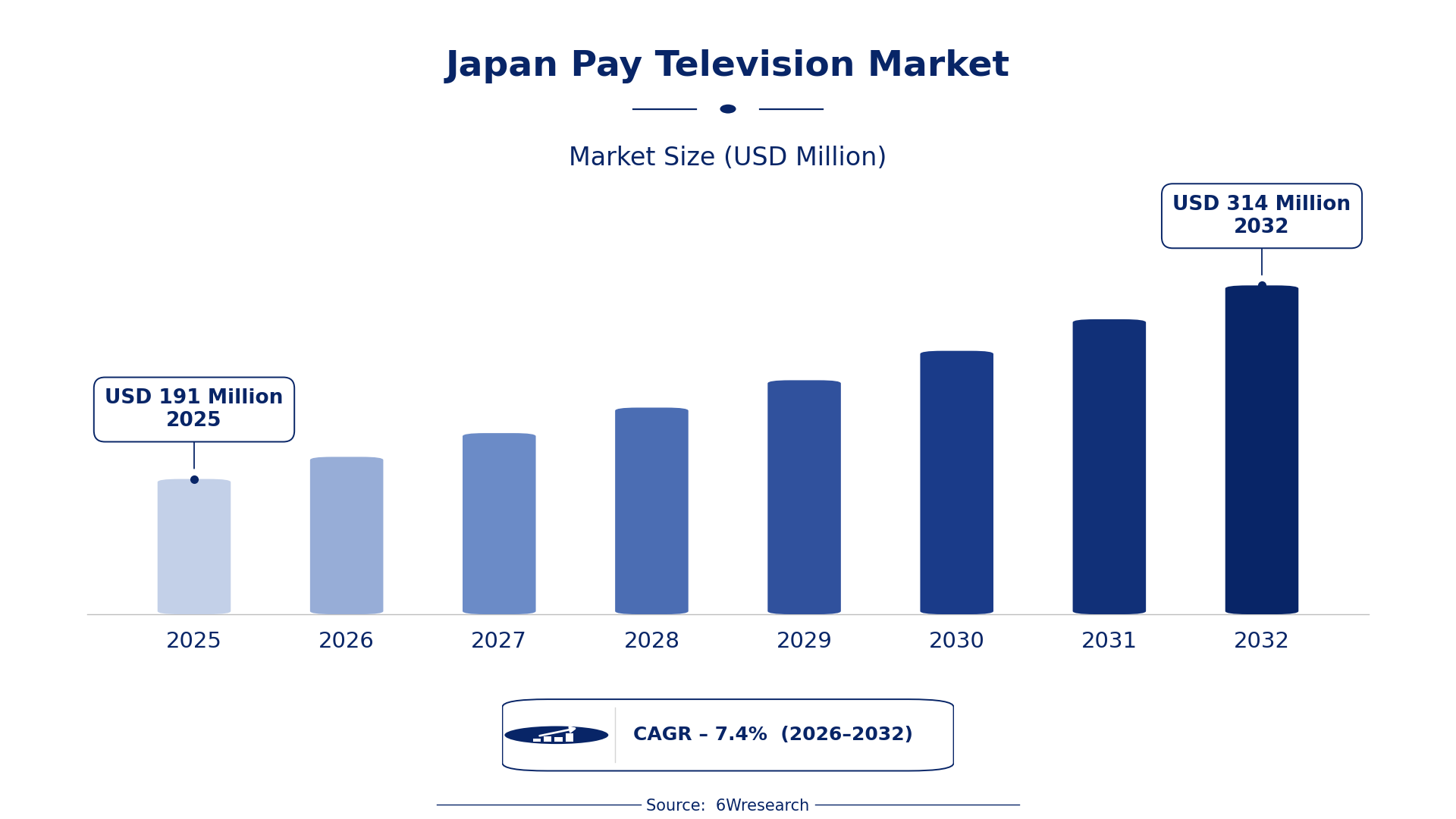
According to 6Wresearch internal database and industry insights, the Japan Pay Television Market was valued at USD 191 Million in 2025 and is projected to reach USD 314 Million by 2032, growing at a CAGR of approximately 7.4% during 2026–2032.
Japan Pay Television Market Highlights
| Report Metric | Details |
| Report Name | Japan Pay Television Market (2026-2032) |
| Market Size 2025 | USD 191 Million |
| Market Size 2032 | USD 314 Million |
| Absolute Growth 2025–2032 | USD 123 Million |
| CAGR 2026–2032 | 7.4% |
| Peak Annual Growth | 8.1% in 2028 |
| Forecast Period | 2026–2032 |
| Historical Data | 2022–2025 |
| Base Year | 2025 |
| Leading Type, 2025 | IPTV (37% share) |
| Leading Subscription Model, 2025 | Monthly (40% share) |
| Leading Content Type, 2025 | Sports (41% share) |
| Leading Distribution Channel, 2025 | Streaming Apps (40% share) |
| Leading Resolution Type, 2025 | HD (41% share) |
| Fastest-Growing Type | OTT (11.0% CAGR) |
| Fastest-Growing Subscription Model | On-Demand (9.8% CAGR) |
| Fastest-Growing Content Type | Documentaries (10.5% CAGR) |
| Fastest-Growing Resolution Type | 4K (10.6% CAGR) |
| Growing Sector | Subscription-based content services |
| Key End Users | Households, Educational institutions, Sports organizations |
Japan Pay Television Market Year-wise Growth Rate and Key Drivers (2022–2032)
This graph illustrates the annual growth rates of the market from 2022 to 2032, highlighting a steady upward trajectory and projected market expansion over the forecast period.
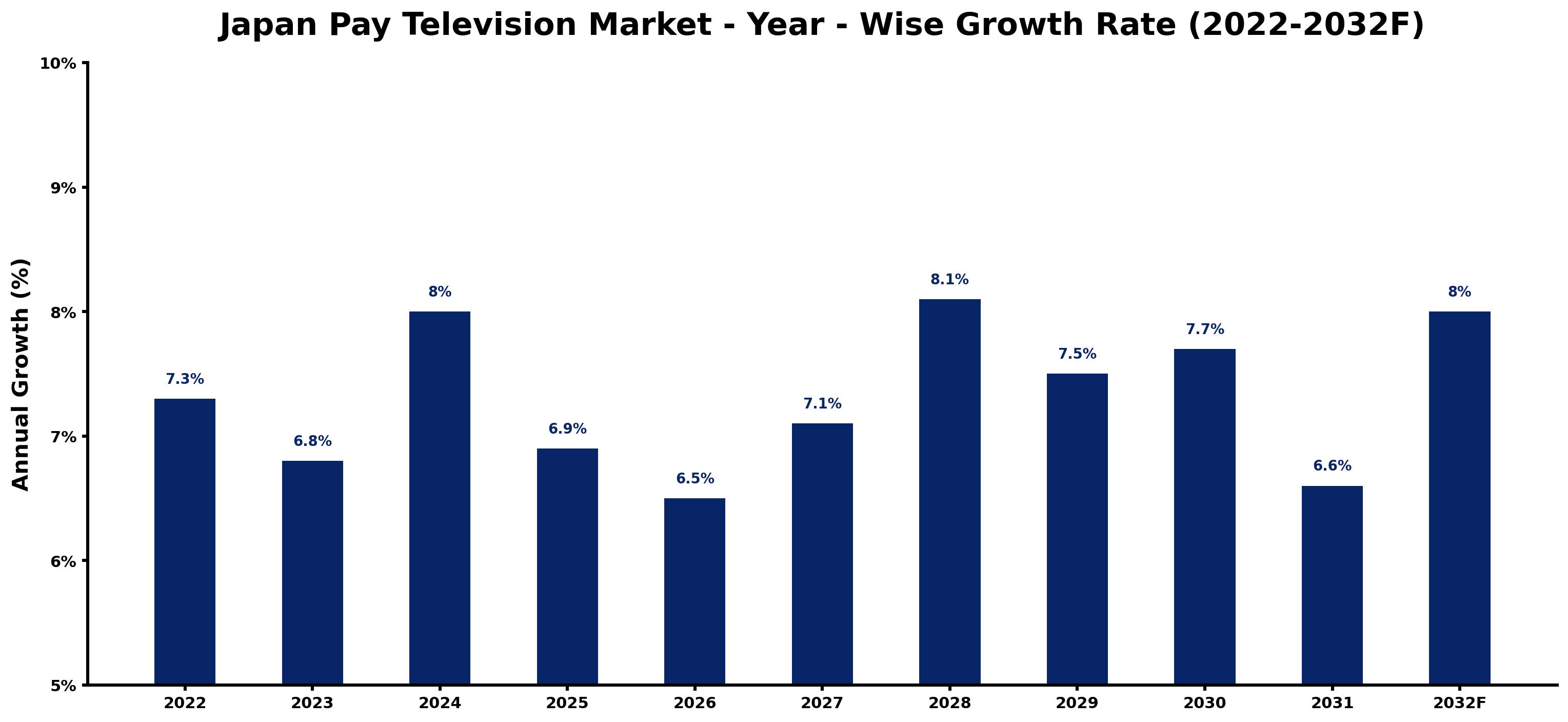
Below, each year's estimated growth is shown next to the factor that most influenced it.
| Year | Estimated Annual Growth (%) | Market Rationale |
| 2022 | 7.3 | The market experienced steady growth due to strong content demand from various platforms. |
| 2023 | 6.8 | Growth slowed slightly as competition intensified among pay television providers. |
| 2024 | 8.0 | A surge in sports programming drove faster growth compared to the previous year. |
| 2025 | 6.9 | The market continued to grow, albeit at a slower pace due to market saturation. |
| 2026 | 6.5 | Growth is projected to slow again as consumer preferences shift towards on-demand content. |
| 2027 | 7.1 | An increase in subscriptions will contribute to a resurgence in growth rates. |
| 2028 | 8.1 | The peak growth year will see a rise in OTT subscriptions and content availability. |
| 2029 | 7.5 | Growth is expected to slow as the market begins to stabilise after peak demand. |
| 2030 | 7.7 | A renewed interest in 4K content will spur growth as technology adoption increases. |
| 2031 | 6.6 | Growth will slow again as the market adjusts to evolving consumer habits. |
| 2032 | 8.0 | The market is projected to grow faster due to advancements in broadband infrastructure. |
Note: Market size estimations and growth projections presented in this report are based on 6Wresearch's proprietary forecasting methodology, utilizing the latest available industry data, government publications, and primary research inputs.
Japan Pay Television Market Synopsis
Pay television in Japan encompasses various subscription-based services providing content through cable, satellite, IPTV, and streaming platforms. The Japan Pay Television Market is expanding due to rising demand for diverse content, particularly in sports and on-demand programming. With over 40 million subscribers and an average viewing time of around 2.5 hours per day, the industry is well-positioned for further growth. The ongoing improvement of broadband infrastructure for IPTV services is likely to attract more viewers and increase subscription rates.
Market Dynamics Impact Analysis (2026–2032)
| Factor | Type | Impact | Primary Segment Affected |
| Rising demand for sports content | Driver | High | Sports |
| Increased adoption of streaming services | Driver | High | IPTV |
| Growing interest in on-demand content | Opportunity | High | On-Demand |
| Expansion of broadband infrastructure for IPTV | Opportunity | High | IPTV |
| Intense competition among service providers | Restraint | High | Cable TV |
| Market saturation limiting new subscriber growth | Restraint | Medium | OTT |
| High operational costs for content acquisition | Challenge | High | Satellite TV |
| Regulatory compliance affecting service flexibility | Challenge | Medium | IPTV |
Evaluation of Drivers in Japan Pay Television Market (2026–2032)
Demand rests on the following drivers, each shown with the segment it touches most.
| Drivers | Primary Segment Affected | Why It Matters (Evidence) |
| Increased sports broadcasting rights | Sports | The demand for live sports events drives subscriptions, with a 15% rise in sports channels since 2020. |
| Growth of OTT platforms | OTT | The total number of OTT subscribers reached 20 million, improving content accessibility and viewer engagement. |
| Rising average viewing time | Cable TV | Consumers are more likely to subscribe to pay TV services with an average viewing time of around 2.5 hours daily. |
| Improved broadband infrastructure | IPTV | The ongoing initiative to upgrade broadband for IPTV services will attract more subscribers. |
| Increasing demand for 4K content | UHD | The growing adoption of the 4K UHD standard is pushing viewers to seek higher-quality subscription options. |
What keeps demand rising is the growing availability of live sports broadcasting rights, resulting in a 15% increase in sports channels since 2020. The total number of OTT subscribers has reached 20 million, improving content accessibility and driving subscriptions. More viewers are willing to invest in pay television services, supported by an average viewing time of approximately 2.5 hours daily. The ongoing upgrade of broadband infrastructure for IPTV services will attract a larger audience. The increasing adoption of the 4K UHD standard is driving viewers to seek higher-quality content options, further stimulating demand.
Evaluation of Restraints in Japan Pay Television Market
The table below lists the restraints and the evidence behind each.
| Market Restraint | Primary Segment Affected | Why It Matters (Evidence) |
| High operational costs for content acquisition | Satellite TV | Service providers incur substantial expenses in securing broadcasting rights, which affects profitability. |
| Market saturation limiting new subscriber growth | OTT | As the market matures, attracting new subscribers becomes increasingly challenging for existing platforms. |
| Intense competition among service providers | Cable TV | The presence of multiple providers results in price wars, impacting revenue and margins. |
| Regulatory compliance affecting service flexibility | IPTV | Adhering to broadcasting regulations can restrict the types of content offered. |
| Limited availability of high-quality content | IPTV | Demand for premium content exceeds supply, leading to potential subscriber dissatisfaction. |
Japan Pay Television Market Challenges
High subscription fees burden buyers, with an average monthly cost of 4,000 JPY, limiting access for low-income households. Producers face challenges with technology adoption, as the slow integration of new broadcasting standards hampers their competitiveness against emerging platforms. Distributors contend with fierce competition from the OTT market, which reached 20 million subscribers in 2023, reducing traditional pay TV revenues. Regulatory challenges from the Ministry of Internal Affairs and Communications can delay service launches, raising operational costs for providers and affecting their responsiveness to market demands.
Trends in the Japan Pay Television Market
The following changes are redrawing the Japan Pay Television Market.
- Shift Towards On-Demand Content: In 2023, on-demand subscriptions grew by 9.8%, reflecting changing viewer preferences for flexible viewing. This trend indicates a shift from traditional scheduling to consumer-driven content consumption.
- Increase in 4K Content Availability: The growing demand for high-resolution viewing is clear as 4K content adoption rises. In 2023, 4K UHD standard adoption increased, appealing to tech-savvy viewers.
- Expansion of Streaming Apps: Streaming Apps have become the dominant distribution channel, capturing 40% of the market share in 2025. This shift highlights the growing preference for digital content consumption over traditional cable.
- Rise in Sports Programming: Sports content remains a leading driver, with 41% market share in 2025. The enactment of the Sports Broadcasting Law has further protected broadcasting rights, enhancing viewer engagement.
Investment Opportunities in the Japan Pay Television Market
The openings below show where demand in the Japan Pay Television Market is visible and how suppliers can enter.
- Partnerships with Local Content Creators: Given the demand for localized content, partnerships with regional creators can improve offerings. The average monthly subscription fee is around 4,000 JPY, indicating a promising market for tailored content.
- Investment in Streaming Technology: With OTT subscriptions reaching 20 million, investing in streaming technology can yield high returns. Collaborating with tech firms to improve user experience can attract more subscribers.
- Focus on 4K Content Production: The increasing adoption of 4K UHD content presents a significant investment opportunity. Targeting tech-savvy consumers in urban areas can drive subscription growth.
- Improving IPTV Services: The ongoing initiative to upgrade broadband infrastructure for IPTV creates a demand for advanced services. Collaborating with local telecom providers can facilitate market entry.
Government Initiatives in the Japan Pay Television Market
The AI Promotion Act, enacted in 2025, introduces a national framework for AI research and development, enhancing the capabilities of pay television providers. This complements the Electrical Appliance and Material Safety Act, which regulates safety standards for equipment used in broadcasting, ensuring compliance across the industry.
The Digital Agency oversees the implementation of digital transformation initiatives and approves funding for projects aimed at improving broadcasting capabilities. With an annual budget of approximately 10 billion JPY for broadcasting development, the agency supports advancements that benefit pay television providers.
Future Insight of the Japan Pay Television Market
Investment in broadband infrastructure will stimulate demand for enhanced pay television services, creating opportunities for buyers and suppliers alike. By 2032, the average viewing time for pay television is expected to increase, driven by a wider variety of content offerings. The total number of channels available through pay TV platforms is projected to exceed 300, catering to diverse viewer preferences. Advances in technology will facilitate better content delivery, ensuring a more competitive landscape for all market participants.
Market Segmentation Analysis
Japan Pay Television Market report covers a detailed analysis of the following market segments:
By Type – IPTV Leads, OTT Expected to Grow Fastest
According to Vasudha, AM at 6Wresearch, with 37% of type revenue in 2025, IPTV was the largest category. IPTV captures the largest share as it meets the needs of users who prefer internet-based delivery and on-demand services. This segment is particularly strong in urban areas like Tokyo, where high-speed internet infrastructure is readily available. OTT is projected to grow fastest, at a CAGR of 11.0% during 2026–2032. OTT is experiencing rapid growth, fuelled by a notable rise in viewers choosing streaming services that provide original content. The total number of OTT subscribers reached 20 million in 2023, reflecting a significant shift in consumer preferences. Suppliers must enhance their OTT offerings to capitalise on the growing audience.
By Subscription Model – Monthly Leads, On-Demand Expected to Grow Fastest
The largest subscription model category in 2025 was Monthly, at 40% of revenue. The monthly subscription model is the most prevalent as it offers flexibility for consumers to manage their viewing preferences. This model aligns well with the average monthly subscription fee of approximately 4,000 JPY, making it accessible to a wide audience. The quickest growth will come from On-Demand, forecast to expand at a CAGR of 9.8% between 2026 and 2032. On-demand subscriptions are gaining traction as they provide viewers with the convenience of watching content at their own pace. This model caters to the increasing demand for personalised viewing experiences. Providers need to consider expanding on-demand options to meet changing consumer expectations.
By Content Type – Sports Lead, Documentaries Expected to Grow Fastest
Sports accounted for 41% of the market by content type in 2025. Sports content dominates the market due to the high demand for live sports events, which are a crucial aspect of Japan's sports culture. The increase of 15% in available sports channels since 2020 highlights the growing interest in this area. Over 2026–2032, Documentaries are expected to post the fastest growth, at a CAGR of 10.5%. Documentaries are witnessing the fastest growth as they attract niche audiences who value in-depth storytelling. The rising viewership for documentary programming indicates this segment's increasing importance in the market. Content creators should focus on producing high-quality documentaries to engage this growing audience.
By Distribution Channel – Streaming Apps Lead and Record the Fastest Growth
In 2025, Streaming Apps led the distribution channel split with a 40% share. Streaming apps are the leading distribution channel, allowing users easy access to a wide variety of content. This trend is particularly evident in urban regions where mobile and broadband services are extensively available. Its lead should widen, with a projected CAGR of 9.5% during 2026–2032, the highest in this split. Streaming apps are also the fastest-growing channel, reflecting a clear trend towards digital content consumption. Their user-friendly interfaces and convenience are driving increased viewer engagement. Content providers must optimise their platforms for streaming to improve user experience and retention.
By Resolution Type – HD Leads, 4K Expected to Grow Fastest
HD held 41% of the Japan Pay Television Market by resolution type in 2025. HD is the predominant resolution type, serving as the standard for most content delivery and ensuring compatibility with a broad range of consumer devices. This widespread adoption is supported by established broadcasting standards and consumer expectations. 4K is projected to grow fastest, at a CAGR of 10.6% during 2026–2032. 4K is rapidly gaining traction as consumers increasingly seek high-resolution content for an enhanced viewing experience. The growing availability of 4K UHD content is further driving this demand. Suppliers should prioritise the development of 4K content to meet the expectations of discerning consumers.
Key Attractiveness of the Report
- 10 Years of Market Numbers
- Historical Data Starting from 2022 to 2025
- Base Year 2025
- Forecast Data until 2032
- Key Performance Indicators Impacting the Market
- Major Upcoming Developments and Projects
Key Highlights of the Report:
- Japan Pay Television Market Outlook
- Market Size of Japan Pay Television Market,2025
- Forecast of Japan Pay Television Market, 2032
- Historical Data and Forecast of Japan Pay Television Revenues & Volume for the Period 2022-2032
- Japan Pay Television Market Trend Evolution
- Japan Pay Television Market Drivers and Challenges
- Japan Pay Television Price Trends
- Japan Pay Television Porter's Five Forces
- Japan Pay Television Industry Life Cycle
- Historical Data and Forecast of Japan Pay Television Market Revenues & Volume By Type for the Period 2022-2032
- Historical Data and Forecast of Japan Pay Television Market Revenues & Volume By Cable TV for the Period 2022-2032
- Historical Data and Forecast of Japan Pay Television Market Revenues & Volume By Satellite TV for the Period 2022-2032
- Historical Data and Forecast of Japan Pay Television Market Revenues & Volume By IPTV for the Period 2022-2032
- Historical Data and Forecast of Japan Pay Television Market Revenues & Volume By OTT for the Period 2022-2032
- Historical Data and Forecast of Japan Pay Television Market Revenues & Volume By Digital Terrestrial for the Period 2022-2032
- Historical Data and Forecast of Japan Pay Television Market Revenues & Volume By Subscription Model for the Period 2022-2032
- Historical Data and Forecast of Japan Pay Television Market Revenues & Volume By Monthly for the Period 2022-2032
- Historical Data and Forecast of Japan Pay Television Market Revenues & Volume By Annual for the Period 2022-2032
- Historical Data and Forecast of Japan Pay Television Market Revenues & Volume By On-Demand for the Period 2022-2032
- Historical Data and Forecast of Japan Pay Television Market Revenues & Volume By Pay-Per-View for the Period 2022-2032
- Historical Data and Forecast of Japan Pay Television Market Revenues & Volume By Freemium for the Period 2022-2032
- Historical Data and Forecast of Japan Pay Television Market Revenues & Volume By Content Type for the Period 2022-2032
- Historical Data and Forecast of Japan Pay Television Market Revenues & Volume By Sports for the Period 2022-2032
- Historical Data and Forecast of Japan Pay Television Market Revenues & Volume By Movies for the Period 2022-2032
- Historical Data and Forecast of Japan Pay Television Market Revenues & Volume By News for the Period 2022-2032
- Historical Data and Forecast of Japan Pay Television Market Revenues & Volume By Documentaries for the Period 2022-2032
- Historical Data and Forecast of Japan Pay Television Market Revenues & Volume By Kids Content for the Period 2022-2032
- Historical Data and Forecast of Japan Pay Television Market Revenues & Volume By Distribution Channel for the Period 2022-2032
- Historical Data and Forecast of Japan Pay Television Market Revenues & Volume By Satellite for the Period 2022-2032
- Historical Data and Forecast of Japan Pay Television Market Revenues & Volume By Cable for the Period 2022-2032
- Historical Data and Forecast of Japan Pay Television Market Revenues & Volume By IPTV for the Period 2022-2032
- Historical Data and Forecast of Japan Pay Television Market Revenues & Volume By Streaming Apps for the Period 2022-2032
- Historical Data and Forecast of Japan Pay Television Market Revenues & Volume By Retail for the Period 2022-2032
- Historical Data and Forecast of Japan Pay Television Market Revenues & Volume By Resolution Type for the Period 2022-2032
- Historical Data and Forecast of Japan Pay Television Market Revenues & Volume By SD for the Period 2022-2032
- Historical Data and Forecast of Japan Pay Television Market Revenues & Volume By HD for the Period 2022-2032
- Historical Data and Forecast of Japan Pay Television Market Revenues & Volume By 4K for the Period 2022-2032
- Historical Data and Forecast of Japan Pay Television Market Revenues & Volume By UHD for the Period 2022-2032
- Historical Data and Forecast of Japan Pay Television Market Revenues & Volume By 8K for the Period 2022-2032
- Japan Pay Television Import Export Trade Statistics
- Market Opportunity Assessment By Type
- Market Opportunity Assessment By Subscription Model
- Market Opportunity Assessment By Content Type
- Market Opportunity Assessment By Distribution Channel
- Market Opportunity Assessment By Resolution Type
- Japan Pay Television Top Companies Market Share
- Japan Pay Television Competitive Benchmarking By Technical and Operational Parameters
- Japan Pay Television Company Profiles
- Japan Pay Television Key Strategic Recommendations
Market Covered
The study includes the following segmentation.
By Type
- Cable TV
- Satellite TV
- IPTV
- OTT
- Digital Terrestrial
By Subscription Model
- Monthly
- Annual
- On-Demand
- Pay-Per-View
- Freemium
By Content Type
- Sports
- Movies
- News
- Documentaries
- Kids Content
By Distribution Channel
- Satellite
- Cable
- IPTV
- Streaming Apps
- Retail
By Resolution Type
- SD
- HD
- 4K
- UHD
- 8K































