Japan PC Semiconductors Market Size & Growth Rate
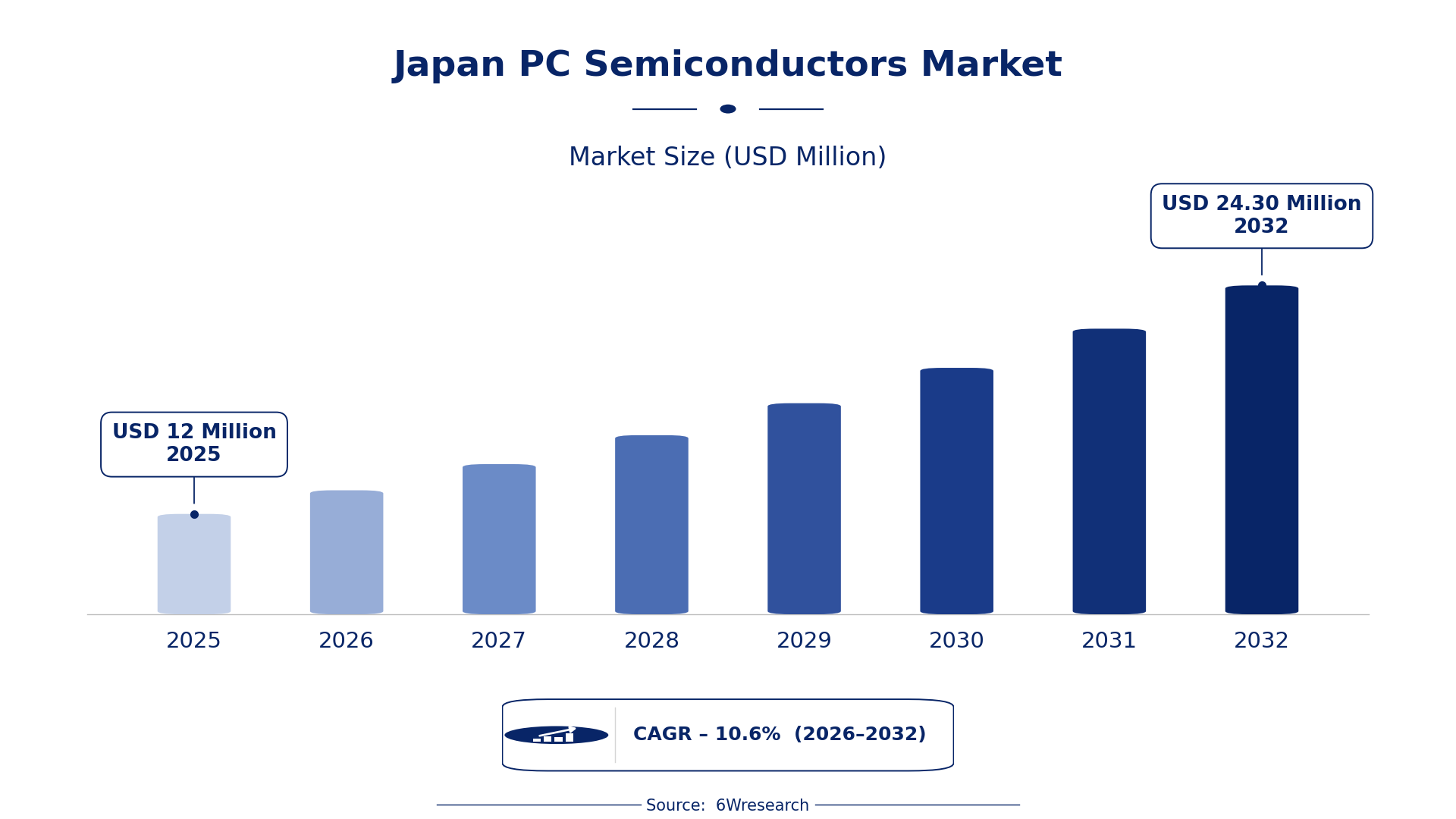
According to 6Wresearch internal database and industry insights, the Japan PC Semiconductors Market was valued at USD 12 Million in 2025 and is projected to reach USD 24.30 Million by 2032, growing at a CAGR of approximately 10.6% during 2026–2032.
Japan PC Semiconductors Market Highlights
| Report Metric | Details |
| Report Name | Japan PC Semiconductors Market (2026-2032) |
| Market Size 2025 | USD 12 Million |
| Market Size 2032 | USD 24.30 Million |
| Absolute Growth 2025–2032 | USD 12.30 Million |
| CAGR 2026–2032 | 10.6% |
| Peak Annual Growth | 12.2% in 2032 |
| Forecast Period | 2026–2032 |
| Historical Data | 2022–2025 |
| Base Year | 2025 |
| Leading PC Semiconductors, 2025 | Microprocessors (47% share) |
| Leading Product Type, 2025 | x86 Architecture (44% share) |
| Leading Technology Node, 2025 | 5nm (37% share) |
| Leading Distribution Channel, 2025 | Direct Sales (44% share) |
| Leading End User, 2025 | Personal Computers (52% share) |
| Fastest-Growing PC Semiconductors | Graphic Processing Units (13.8% CAGR) |
| Fastest-Growing Product Type | DDR5 (14.8% CAGR) |
| Fastest-Growing Distribution Channel | OEM Partnerships (14.1% CAGR) |
| Fastest-Growing End User | AI Workstations (14.4% CAGR) |
| Growing Sector | Personal Computers |
| Key End Users | Technology firms, gaming system manufacturers, data center operators, AI developers |
Japan PC Semiconductors Market Year-wise Growth Rate and Key Drivers (2022–2032)
This graph illustrates the annual growth rates of the market from 2022 to 2032, highlighting a steady upward trajectory and projected market expansion over the forecast period.
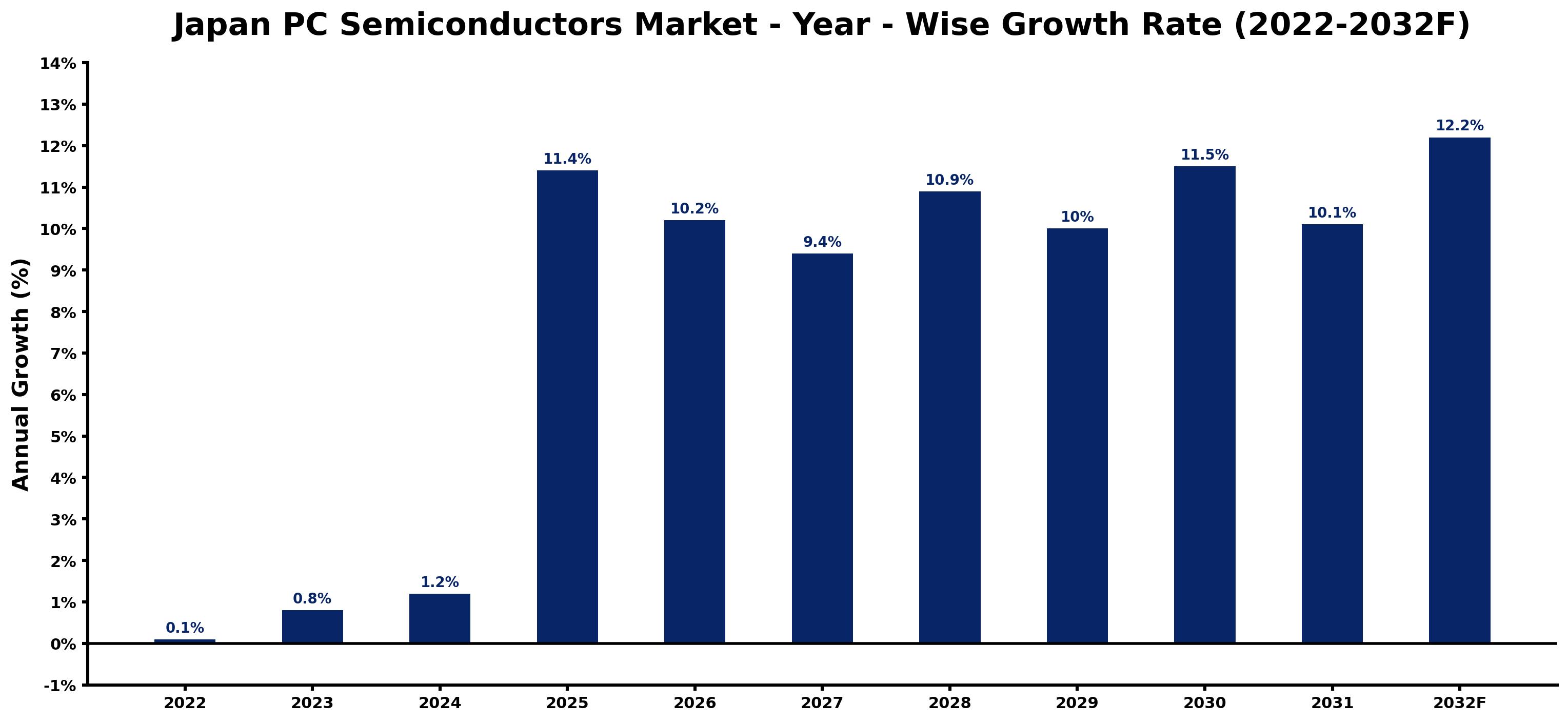
Below, each year's estimated growth is shown next to the factor that most influenced it.
| Year | Estimated Annual Growth (%) | Market Rationale |
| 2022 | 0.1 | The market showed minimal growth as demand began to stabilise following previous fluctuations. |
| 2023 | 0.8 | Growth accelerated due to increased production of microprocessors and memory chips, reflecting rising consumer interest. |
| 2024 | 1.2 | Demand continued to rise, driven by the adoption of DDR5 memory in high-end PCs, enhancing performance. |
| 2025 | 11.4 | The market peaked as personal computer sales surged alongside gaming system upgrades, leading to higher semiconductor needs. |
| 2026 | 10.2 | Growth is expected to slow slightly as the market adjusts to previous high levels of demand, reflecting stabilisation. |
| 2027 | 9.4 | Demand is projected to remain strong, but growth rates will normalise from the peak, indicating maturity. |
| 2028 | 10.9 | A resurgence in AI applications is expected to drive renewed interest in advanced semiconductors, boosting demand. |
| 2029 | 10.0 | Growth is anticipated to slow again as supply chain adjustments take effect across the industry, impacting production. |
| 2030 | 11.5 | Increased investments in semiconductor technology will lead to a rebound in growth rates, reflecting renewed confidence. |
| 2031 | 10.1 | Demand is projected to stabilise, reflecting a more mature market with consistent purchasing patterns and needs. |
| 2032 | 12.2 | The market is expected to peak again, driven by advancements in AI and IoT technologies, enhancing opportunities. |
Note: Market size estimations and growth projections presented in this report are based on 6Wresearch's proprietary forecasting methodology, utilizing the latest available industry data, government publications, and primary research inputs.
Japan PC Semiconductors Market Synopsis
PC semiconductors are critical components in computing devices, produced through intricate fabrication processes involving photolithography and doping. The Japan PC Semiconductors Market is experiencing growth driven by rising demand from personal computers, gaming systems, and data centers. In 2023, semiconductor exports reached $10 billion, highlighting strong domestic production capabilities. The adoption of advanced technologies, such as the 5nm node, alongside increasing applications in AI and IoT, is propelling market expansion.
Market Dynamics Impact Analysis (2026–2032)
| Factor | Type | Impact | Primary Segment Affected |
| Rising demand for high-performance computing and gaming systems drives the need for advanced microprocessors. | Driver | High | Microprocessors |
| The growing installed base of personal computers fuels the demand for memory chips. | Driver | High | Memory Chips |
| The shift towards AI applications creates opportunities for high-performance graphic processing units. | Opportunity | High | Graphic Processing Units |
| The increasing adoption of DDR5 memory in high-end PCs presents a significant market opportunity. | Opportunity | High | DDR5 |
| Supply chain disruptions can affect the timely delivery of critical semiconductor components. | Restraint | Medium | Integrated Circuits ICs |
| Competition from international semiconductor manufacturers may limit market share for local producers. | Restraint | Medium | Microprocessors |
| High production costs can hinder the profitability of local semiconductor manufacturers. | Challenge | High | Memory Chips |
| Technological advancements require continuous investment, which can strain smaller firms. | Challenge | Medium | Graphic Processing Units |
Evaluation of Drivers in Japan PC Semiconductors Market (2026–2032)
These are the developments adding the most demand over the forecast period.
| Drivers | Primary Segment Affected | Why It Matters (Evidence) |
| Increased production of microprocessors to meet growing consumer demand. | Microprocessors | Japan produced 1.2 million units of microprocessors in 2022, leading to higher sales. |
| Growing installed base of personal computers drives demand for memory chips. | Memory Chips | The total installed base of personal computers in Japan is approximately 40 million, increasing memory needs. |
| Adoption of advanced technology nodes improves performance in graphic processing units. | Graphic Processing Units | The 5nm technology node is being adopted by major manufacturers, boosting efficiency. |
| Rising interest in gaming systems leads to demand for high-performance semiconductors. | Graphic Processing Units | Gaming PCs are driving demand for advanced graphic processing units, especially in urban areas. |
| The push for AI applications increases the need for high-performance computing. | AI Workstations | AI Workstations are becoming increasingly important, further driving semiconductor demand. |
Much of the new demand traces back to the growing installed base of personal computers, which is approximately 40 million in Japan. This surge in PC ownership has led to increased production of microprocessors, with 1.2 million units manufactured in 2022. The adoption of advanced technology nodes, such as the 5nm node, improves the performance of graphic processing units, which are vital for gaming systems. The rising interest in AI applications fuels demand for high-performance computing, particularly in urban areas where AI workstations are becoming essential. Consequently, local manufacturers are ramping up production to meet these evolving needs.
Evaluation of Restraints in Japan PC Semiconductors Market
The key brakes on demand, and where they bite hardest, are shown below.
| Market Restraint | Primary Segment Affected | Why It Matters (Evidence) |
| Supply chain disruptions can delay the delivery of critical semiconductor components. | Integrated Circuits ICs | Disruptions in logistics have affected the timely availability of essential parts, impacting production schedules. |
| High production costs can limit the competitiveness of local semiconductor manufacturers. | Memory Chips | Rising costs of raw materials and labour have squeezed profit margins for domestic producers. |
| Intense competition from international semiconductor firms may pressure local market players. | Microprocessors | Foreign manufacturers benefit from economies of scale, making it challenging for local firms to compete. |
| Technological advancements require continuous investment, which can strain smaller firms. | Graphic Processing Units | Smaller manufacturers may struggle to keep pace with rapid technological changes and required investments. |
| Market volatility can lead to unpredictable demand patterns for semiconductors. | Integrated Circuits ICs | Fluctuating consumer preferences and economic conditions can create uncertainty in purchasing decisions. |
Japan PC Semiconductors Market Challenges
Local semiconductor producers face fierce competition from international firms, which compresses profit margins and limits investments in innovation. Consequently, local manufacturers experience delays in sourcing essential components, extending project timelines by as much as 20%. A shortage of skilled workers in advanced fabrication processes disrupts production efficiency, leading to longer lead times and escalating costs for producers. Additionally, rising material costs due to global supply chain disruptions inflate expenses for manufacturers, resulting in price increases of up to 15% that affect local producers' competitiveness.
Trends in the Japan PC Semiconductors Market
The trends below show where the Japan PC Semiconductors Market is heading.
- Shift from Traditional to Advanced Memory Technologies: Japan is experiencing a shift towards advanced memory technologies, particularly DDR5, which is gaining traction in high-end PCs. In 2023, DDR5 memory adoption increased, reflecting the need for improved performance.
- Transition from 10nm to 5nm Technology Nodes: The adoption of 5nm technology nodes is becoming more prevalent among manufacturers in Japan. By 2023, 37% of microprocessors produced were based on this advanced node, indicating a push for efficiency.
- Emergence of AI Workstations as a Key Segment: AI workstations are increasingly important in Japan's semiconductor market, driven by the growing demand for AI applications. This segment is projected to grow at a CAGR of 14.4% through 2032, highlighting its significance.
- Focus on Sustainable Semiconductor Production: There is a growing emphasis on sustainable practices in semiconductor production in Japan. The Green Growth Strategy aims for carbon neutrality by 2050, influencing manufacturers to adopt greener technologies.
Investment Opportunities in the Japan PC Semiconductors Market
Below are the investment opportunities with the strongest case in the Japan PC Semiconductors Market.
- Tokyo Region as a Semiconductor Manufacturing Hub: The Tokyo region serves as a central hub for semiconductor manufacturing, with substantial investments in technology. In 2023, the government allocated $10 billion to support local manufacturers, creating opportunities for new entrants.
- Timing for Investment in AI Applications: With the growth of AI applications, now presents an ideal opportunity to invest in high-performance semiconductors. The rising demand from AI workstations offers a promising avenue for suppliers.
- Gap in Supply for Advanced Memory Technologies: The demand for DDR5 memory is surpassing supply, creating a market gap. Manufacturers can take advantage of this by increasing production capacity to satisfy the needs of high-end PC users.
- Growing Demand from Gaming PC Segment: The gaming PC segment is rapidly expanding, driven by consumer interest in high-performance systems. Suppliers can penetrate this market by forming partnerships with local gaming hardware manufacturers.
Government Initiatives in the Japan PC Semiconductors Market
The Semiconductor and Digital Industry Strategy, established by the Ministry of Economy, Trade and Industry in June 2021, aims to secure domestic semiconductor manufacturing capabilities. This initiative includes measures to improve production efficiency and support local firms in adopting advanced technologies. The Economic Security Promotion Act of 2022 further supports supply-chain resilience for critical products, ensuring that Japan's semiconductor industry remains competitive in the global market.
In 2023, the government allocated $15 billion to support semiconductor technology development through various programmes. The Ministry of Economy, Trade and Industry oversees these initiatives, which aim to strengthen domestic production and encourage innovation within the semiconductor sector. Additionally, the Japan Electronics and Information Technology Industries Association advocates for industry standards that facilitate growth and collaboration among manufacturers.
Future Insight of the Japan PC Semiconductors Market
The investment pipeline for Japan's semiconductor sector is set to expand significantly, generating strong demand for new designs and technologies. Initiatives from the Tokyo Metropolitan Government will stimulate local innovation and enhance production capabilities. The adoption of industry standards such as ISO/IEC 27001 will improve information security management, fostering trust within the supply chain. With semiconductor exports projected to reach $10 billion, local manufacturers and technology firms will gain from a more competitive market environment.
Market Segmentation Analysis
Japan PC Semiconductors Market report covers a detailed analysis of the following market segments:
By PC Semiconductors – Microprocessors Lead, Graphic Processing Units Expected to Grow Fastest
According to Navya, Research Analyst at 6Wresearch, Microprocessors took 47% of pc semiconductors revenue in 2025, more than any other category. Microprocessors are fundamental components for executing tasks in personal computers and gaming systems, ensuring their widespread use. The substantial installed base of approximately 40 million personal computers in Japan reinforces their dominant market position. The quickest growth will come from Graphic Processing Units, forecast to expand at a CAGR of 13.8% between 2026 and 2032. Graphic Processing Units are experiencing rapid growth due to the rising demand for high-quality graphics in gaming and professional applications. The increasing popularity of immersive gaming experiences is a crucial factor contributing to this segment's expansion. Suppliers must prioritise advancements in graphic processing technologies to address the growing market demand.
By Product Type – x86 Architecture Leads, DDR5 Expected to Grow Fastest
x86 Architecture accounted for 44% of the market by product type in 2025. x86 Architecture leads the market as it serves as the standard for most personal computers, ensuring compatibility and performance across various systems. This extensive adoption among PC manufacturers solidifies its dominant market share. DDR5 is set to record the highest CAGR in this split, 14.8% over 2026–2032. DDR5 memory is rapidly gaining traction as the latest technology for high-performance computing, particularly in gaming and professional environments. The need for improved data transfer rates significantly drives its swift adoption. Buyers should consider upgrading to DDR5 to enhance their systems' performance and longevity.
By Technology Node – 5nm Leads and Records the Fastest Growth
With 37% of technology node revenue in 2025, 5nm was the largest category. The 5nm technology node leads the market as it represents the state-of-the-art in semiconductor fabrication, allowing for more powerful and efficient chips. Major manufacturers in Japan are increasingly adopting this technology to stay competitive. The same category is also set to grow fastest, at a CAGR of 12.6% during 2026–2032. As the 5nm node is both the leader and fastest-growing, its continued adoption will likely widen the gap over other nodes. This trend indicates a strong commitment to advancing semiconductor capabilities in Japan. Suppliers must invest in 5nm technology to remain relevant in a highly competitive market.
By Distribution Channel – Direct Sales Leads, OEM Partnerships Expected to Grow Fastest
The largest distribution channel category in 2025 was Direct Sales, at 44% of revenue. Direct Sales is the primary channel for manufacturers, allowing them to establish strong relationships with customers and tailor solutions to specific needs. This approach is particularly effective in the semiconductor sector, where precise technical specifications are crucial. OEM Partnerships are projected to grow fastest, at a CAGR of 14.1% during 2026–2032. OEM Partnerships are expanding rapidly as they are essential for integrating semiconductors into complete systems, especially in the technology sector. The growing collaboration between manufacturers and tech firms is a key factor in this segment's growth. Suppliers should strengthen their OEM partnerships to enhance market access and customer engagement.
By End User – Personal Computers Lead, AI Workstations Expected to Grow Fastest
In 2025, Personal Computers led the end user split with a 52% share. Personal Computers are the primary application for semiconductors, driving consistent demand across the market. The large installed base of PCs in Japan ensures a steady requirement for microprocessors and other components. The quickest growth will come from AI Workstations, forecast to expand at a CAGR of 14.4% between 2026 and 2032. AI Workstations are emerging as a fast-growing segment due to the rising importance of artificial intelligence applications in various industries. This trend highlights the shift towards more specialised computing needs. Suppliers should adapt their product lines to cater to the specific requirements of AI Workstations to capture this expanding market.
Key Attractiveness of the Report
- 10 Years of Market Numbers
- Historical Data Starting from 2022 to 2025
- Base Year 2025
- Forecast Data until 2032
- Key Performance Indicators Impacting the Market
- Major Upcoming Developments and Projects
Key Highlights of the Report:
- Japan PC Semiconductors Market Outlook
- Market Size of Japan PC Semiconductors Market, 2025
- Forecast of Japan PC Semiconductors Market, 2032
- Historical Data and Forecast of Japan PC Semiconductors Revenues & Volume for the Period 2022-2032F
- Japan PC Semiconductors Market Trend Evolution
- Japan PC Semiconductors Market Drivers and Challenges
- Japan PC Semiconductors Price Trends
- Japan PC Semiconductors Porter's Five Forces
- Japan PC Semiconductors Industry Life Cycle
- Historical Data and Forecast of Japan PC Semiconductors Market Revenues & Volume By PC Semiconductors for the Period 2022-2032F
- Historical Data and Forecast of Japan PC Semiconductors Market Revenues & Volume By Microprocessors for the Period 2022-2032F
- Historical Data and Forecast of Japan PC Semiconductors Market Revenues & Volume By Memory Chips for the Period 2022-2032F
- Historical Data and Forecast of Japan PC Semiconductors Market Revenues & Volume By Integrated Circuits ICs for the Period 2022-2032F
- Historical Data and Forecast of Japan PC Semiconductors Market Revenues & Volume By Graphic Processing Units for the Period 2022-2032F
- Historical Data and Forecast of Japan PC Semiconductors Market Revenues & Volume By Product Type for the Period 2022-2032F
- Historical Data and Forecast of Japan PC Semiconductors Market Revenues & Volume By x86 Architecture for the Period 2022-2032F
- Historical Data and Forecast of Japan PC Semiconductors Market Revenues & Volume By DDR5 for the Period 2022-2032F
- Historical Data and Forecast of Japan PC Semiconductors Market Revenues & Volume By Logic ICs for the Period 2022-2032F
- Historical Data and Forecast of Japan PC Semiconductors Market Revenues & Volume By GPU for the Period 2022-2032F
- Historical Data and Forecast of Japan PC Semiconductors Market Revenues & Volume By Technology Node for the Period 2022-2032F
- Historical Data and Forecast of Japan PC Semiconductors Market Revenues & Volume By 7nm for the Period 2022-2032F
- Historical Data and Forecast of Japan PC Semiconductors Market Revenues & Volume By 10nm for the Period 2022-2032F
- Historical Data and Forecast of Japan PC Semiconductors Market Revenues & Volume By 5nm for the Period 2022-2032F
- Historical Data and Forecast of Japan PC Semiconductors Market Revenues & Volume By Advanced Node for the Period 2022-2032F
- Historical Data and Forecast of Japan PC Semiconductors Market Revenues & Volume By Distribution Channel for the Period 2022-2032F
- Historical Data and Forecast of Japan PC Semiconductors Market Revenues & Volume By Direct Sales for the Period 2022-2032F
- Historical Data and Forecast of Japan PC Semiconductors Market Revenues & Volume By OEM Partnerships for the Period 2022-2032F
- Historical Data and Forecast of Japan PC Semiconductors Market Revenues & Volume By Distributors for the Period 2022-2032F
- Historical Data and Forecast of Japan PC Semiconductors Market Revenues & Volume By Online Platforms for the Period 2022-2032F
- Historical Data and Forecast of Japan PC Semiconductors Market Revenues & Volume By End User for the Period 2022-2032F
- Historical Data and Forecast of Japan PC Semiconductors Market Revenues & Volume By Personal Computers for the Period 2022-2032F
- Historical Data and Forecast of Japan PC Semiconductors Market Revenues & Volume By Gaming PCs for the Period 2022-2032F
- Historical Data and Forecast of Japan PC Semiconductors Market Revenues & Volume By Data Centers for the Period 2022-2032F
- Historical Data and Forecast of Japan PC Semiconductors Market Revenues & Volume By AI Workstations for the Period 2022-2032F
- Japan PC Semiconductors Import Export Trade Statistics
- Market Opportunity Assessment By PC Semiconductors
- Market Opportunity Assessment By Product Type
- Market Opportunity Assessment By Technology Node
- Market Opportunity Assessment By Distribution Channel
- Market Opportunity Assessment By End User
- Japan PC Semiconductors Top Companies Market Share
- Japan PC Semiconductors Competitive Benchmarking By Technical and Operational Parameters
- Japan PC Semiconductors Company Profiles
- Japan PC Semiconductors Key Strategic Recommendations
Market Covered
The study includes the following segmentation.
By PC Semiconductors
- Microprocessors
- Memory Chips
- Integrated Circuits ICs
- Graphic Processing Units
By Product Type
- x86 Architecture
- DDR5
- Logic ICs
- GPU
By Technology Node
- 7nm
- 10nm
- 5nm
- Advanced Node
By Distribution Channel
- Direct Sales
- OEM Partnerships
- Distributors
- Online Platforms
By End User
- Personal Computers
- Gaming PCs
- Data Centers
- AI Workstations































