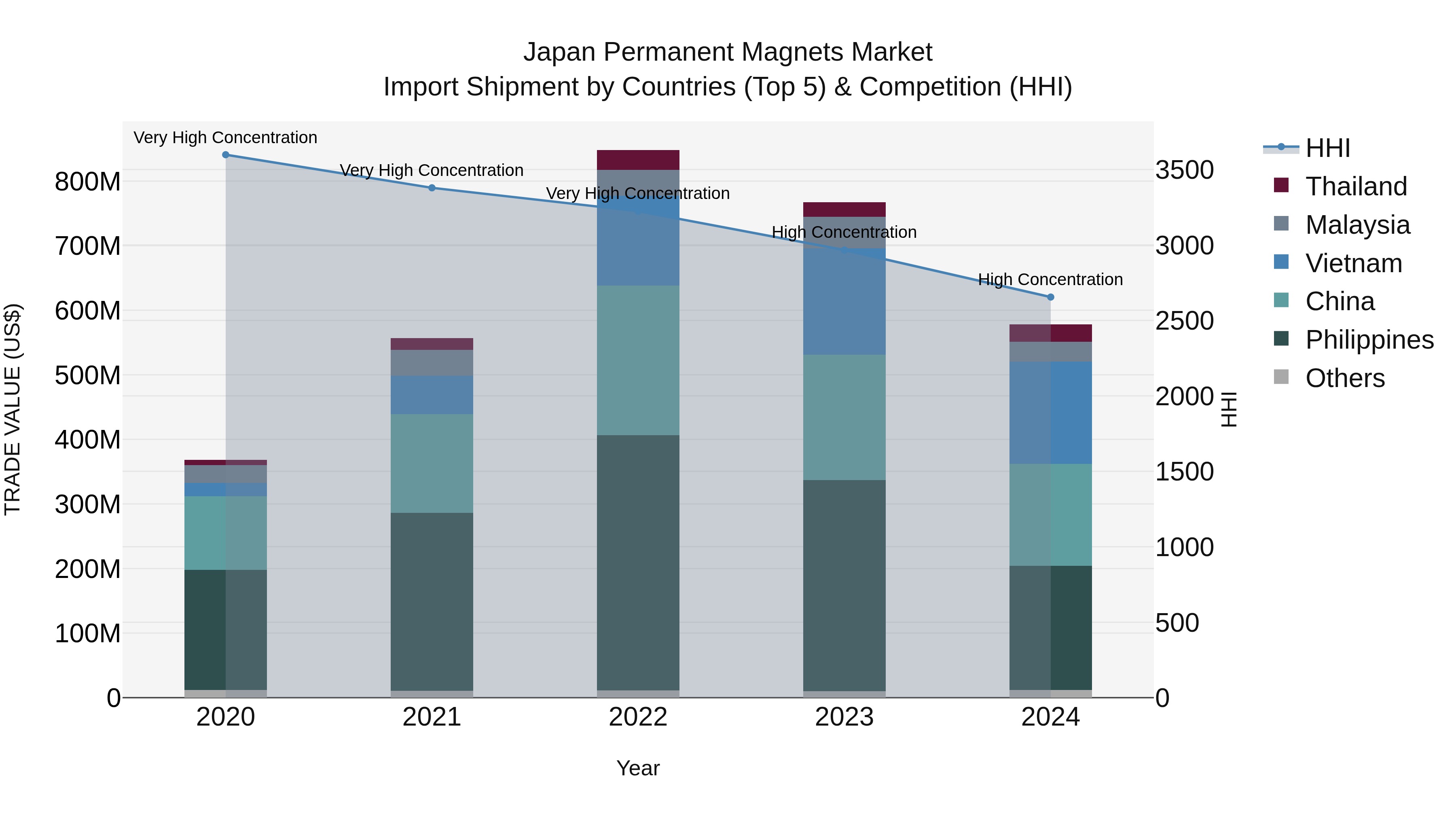
Japan Permanent Magnets Market Import Shipment by Countries (Top 5) & Competition (HHI)
Japan's permanent magnets import market saw significant growth with a CAGR of 11.91% from 2020 to 2024, despite experiencing a decline in growth rate of -24.69% from 2023 to 2024. The top countries exporting to Japan in 2024 were Philippines, Vietnam, China, Malaysia, and Thailand, indicating a diverse mix of sources. However, the market continues to exhibit high concentration, as reflected by the high HHI index, suggesting that the industry is dominated by a few key players.
Japan Permanent Magnets Market Overview
The Japan Permanent Magnets Market is characterized by a high demand for rare earth magnets, especially neodymium magnets, due to their widespread application in industries such as electronics, automotive, and renewable energy. The market is driven by the country`s strong manufacturing base and technological advancements, leading to the development of high-performance magnets. However, the market is also facing challenges related to the supply chain disruption caused by fluctuations in rare earth metal prices and geopolitical tensions affecting trade relations. To counter these challenges, industry players are focusing on research and development initiatives to innovate new magnet materials and improve production efficiency. Overall, the Japan Permanent Magnets Market is poised for steady growth, driven by increasing demand for energy-efficient technologies and the continuous evolution of industrial applications.
Japan Permanent Magnets Market Trends
The Japan Permanent Magnets Market is experiencing several key trends. One major trend is the increasing demand for rare earth magnets, particularly neodymium magnets, driven by their strong magnetic properties and wide applications in industries such as automotive, electronics, and renewable energy. Another trend is the focus on sustainability and environmental concerns, leading to a shift towards developing eco-friendly magnet materials and recycling initiatives. Additionally, there is a growing emphasis on research and development efforts to improve magnet performance and explore new applications in emerging technologies like electric vehicles and wind turbines. Overall, the Japan Permanent Magnets Market is witnessing a combination of technological advancements, sustainability efforts, and diversification of applications driving its growth and innovation.
Japan Permanent Magnets Market Challenges
In the Japan Permanent Magnets Market, one major challenge is the increasing competition from other countries, particularly China, which is a significant producer of permanent magnets at lower costs. This poses a threat to Japanese manufacturers who may struggle to compete on pricing. Additionally, there is a growing concern over the availability of rare earth materials, which are essential for producing high-performance magnets. The reliance on these materials, which are predominantly sourced from China, creates supply chain vulnerabilities and price fluctuations. Furthermore, the market is also facing pressure to develop more sustainable and environmentally friendly magnet production processes to align with global sustainability goals. Overall, Japanese permanent magnet manufacturers need to focus on innovation, cost-efficiency, and sustainability to maintain their competitive edge in the market.
Japan Permanent Magnets Market Investment Opportunities
The Japan Permanent Magnets Market offers significant investment opportunities due to the growing demand in various industries such as automotive, electronics, and renewable energy. With the increasing focus on electric vehicles and the shift towards sustainable energy sources, the demand for permanent magnets, especially neodymium magnets, is expected to rise. Investing in companies involved in the production and development of permanent magnets in Japan can be lucrative. Additionally, advancements in technology and research for enhancing the performance of permanent magnets further enhance the market potential. Furthermore, Japan`s strong manufacturing capabilities and expertise in the magnet industry provide a competitive advantage for investors looking to capitalize on the growing demand for permanent magnets both domestically and globally.
Japan Permanent Magnets Market Government Policy
The Japanese government has implemented various policies to support the growth of the Permanent Magnets Market. These policies include promoting research and development activities in the field of advanced materials, providing subsidies and tax incentives to companies investing in production facilities for permanent magnets, and fostering collaboration between industry players and research institutions to drive innovation. Additionally, the government has set stringent environmental regulations to ensure sustainable production practices in the market. Overall, these policies aim to enhance the competitiveness of the Japanese Permanent Magnets Market, accelerate technological advancements, and maintain a strong position in the global market.
Japan Permanent Magnets Market Future Outlook
The Japan Permanent Magnets Market is poised for steady growth in the coming years, driven by increasing demand from industries such as automotive, electronics, and renewable energy. The market is expected to benefit from technological advancements in magnet materials, leading to improved performance and efficiency in various applications. Additionally, the government`s focus on promoting clean energy sources like wind and solar power is likely to boost the demand for permanent magnets used in these sectors. With Japan being a major hub for innovation and manufacturing, the market is also anticipated to witness investments in research and development activities aimed at further enhancing the capabilities of permanent magnets. Overall, the Japan Permanent Magnets Market is projected to experience a positive growth trajectory in the foreseeable future.
Key Highlights of the Report:
- Japan Permanent Magnets Market Outlook
- Market Size of Japan Permanent Magnets Market, 2021
- Forecast of Japan Permanent Magnets Market, 2031
- Historical Data and Forecast of Japan Permanent Magnets Revenues & Volume for the Period 2021 - 2031
- Japan Permanent Magnets Market Trend Evolution
- Japan Permanent Magnets Market Drivers and Challenges
- Japan Permanent Magnets Price Trends
- Japan Permanent Magnets Porter's Five Forces
- Japan Permanent Magnets Industry Life Cycle
- Historical Data and Forecast of Japan Permanent Magnets Market Revenues & Volume By Material for the Period 2021 - 2031
- Historical Data and Forecast of Japan Permanent Magnets Market Revenues & Volume By Ferrite for the Period 2021 - 2031
- Historical Data and Forecast of Japan Permanent Magnets Market Revenues & Volume By Neodymium Iron Boron (NdFeB) for the Period 2021 - 2031
- Historical Data and Forecast of Japan Permanent Magnets Market Revenues & Volume By Aluminium Nickel Cobalt (Alnico) for the Period 2021 - 2031
- Historical Data and Forecast of Japan Permanent Magnets Market Revenues & Volume By Samarium Cobalt (SmCo) for the Period 2021 - 2031
- Historical Data and Forecast of Japan Permanent Magnets Market Revenues & Volume By Applications for the Period 2021 - 2031
- Historical Data and Forecast of Japan Permanent Magnets Market Revenues & Volume By Automotive for the Period 2021 - 2031
- Historical Data and Forecast of Japan Permanent Magnets Market Revenues & Volume By Consumer Goods & Electronics for the Period 2021 - 2031
- Historical Data and Forecast of Japan Permanent Magnets Market Revenues & Volume By Industrial for the Period 2021 - 2031
- Historical Data and Forecast of Japan Permanent Magnets Market Revenues & Volume By Aerospace & Defense for the Period 2021 - 2031
- Historical Data and Forecast of Japan Permanent Magnets Market Revenues & Volume By Energy for the Period 2021 - 2031
- Historical Data and Forecast of Japan Permanent Magnets Market Revenues & Volume By Medical for the Period 2021 - 2031
- Historical Data and Forecast of Japan Permanent Magnets Market Revenues & Volume By Others for the Period 2021 - 2031
- Japan Permanent Magnets Import Export Trade Statistics
- Market Opportunity Assessment By Material
- Market Opportunity Assessment By Applications
- Japan Permanent Magnets Top Companies Market Share
- Japan Permanent Magnets Competitive Benchmarking By Technical and Operational Parameters
- Japan Permanent Magnets Company Profiles
- Japan Permanent Magnets Key Strategic Recommendations






































