Japan Plasma Donation Market Size & Growth Rate
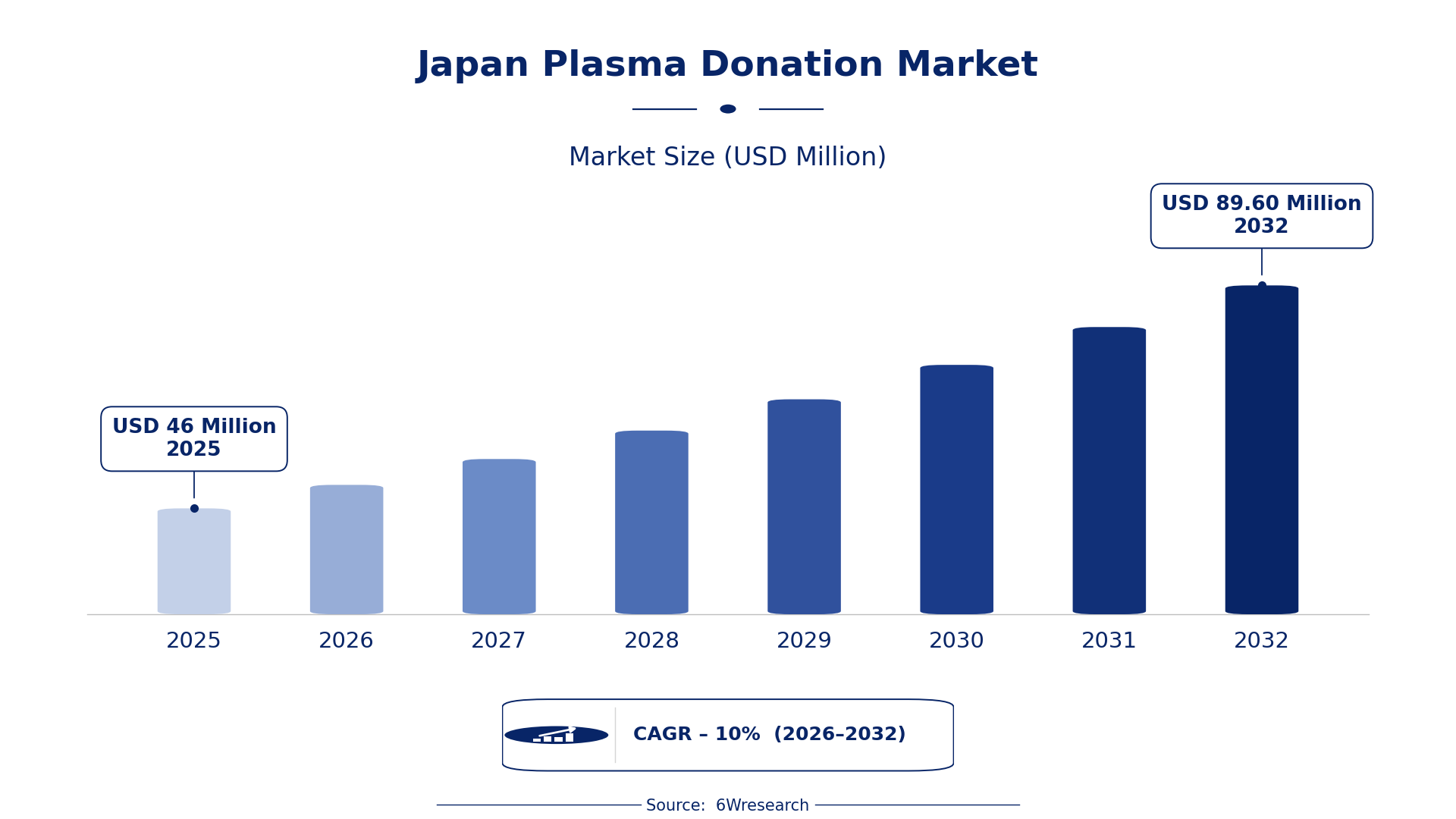
According to 6Wresearch internal database and industry insights, the Japan Plasma Donation Market was valued at USD 46 Million in 2025 and is projected to reach USD 89.60 Million by 2032, growing at a CAGR of approximately 10% during 2026–2032.
Japan Plasma Donation Market Highlights
| Report Metric | Details |
| Report Name | Japan Plasma Donation Market (2026-2032) |
| Market Size 2025 | USD 46 Million |
| Market Size 2032 | USD 89.60 Million |
| Absolute Growth 2025–2032 | USD 43.60 Million |
| CAGR 2026–2032 | 10% |
| Peak Annual Growth | 10.8% in 2026 |
| Forecast Period | 2026–2032 |
| Historical Data | 2022–2025 |
| Base Year | 2025 |
| Leading Donation Type, 2025 | Whole Blood Plasma (47% share) |
| Leading Collection Method, 2025 | Manual Collection (41% share) |
| Leading Distribution Channel, 2025 | Direct Sales (39% share) |
| Leading End User, 2025 | Blood Banks (37% share) |
| Fastest-Growing Donation Type | Apheresis Plasma (13.7% CAGR) |
| Fastest-Growing Collection Method | Automated Machine (14.1% CAGR) |
| Fastest-Growing Distribution Channel | Online Booking Portals (12.9% CAGR) |
| Fastest-Growing End User | Hospitals & Clinics (13.4% CAGR) |
| Growing Sector | Therapeutic Plasma Products |
| Key End Users | Blood Banks, Biopharma Companies, Hospitals & Clinics |
Japan Plasma Donation Market Year-wise Growth Rate and Key Drivers (2022–2032)
This graph illustrates the annual growth rates of the market from 2022 to 2032, highlighting a steady upward trajectory and projected market expansion over the forecast period.
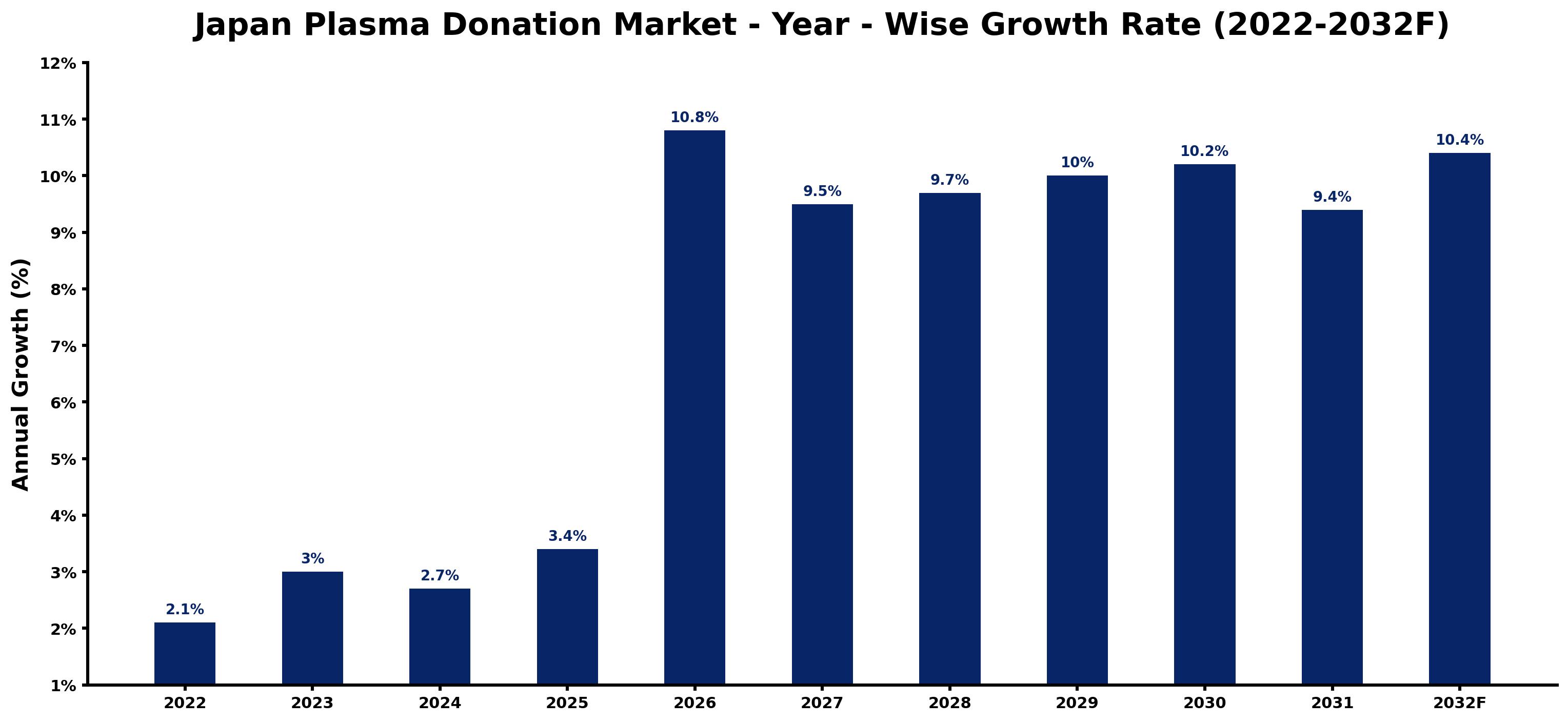
The following figures match every annual growth estimate with the main market development of that year, giving the reasoning behind each rise or slowdown.
| Year | Estimated Annual Growth (%) | Market Rationale |
| 2022 | 2.1 | The market experienced steady activity with a growing donor base. |
| 2023 | 3.0 | Increased awareness campaigns contributed to faster growth than the previous year. |
| 2024 | 2.7 | Growth slowed as the market adjusted to previous high levels of activity. |
| 2025 | 3.4 | The market saw renewed interest, leading to faster growth compared to 2024. |
| 2026 | 10.8 | Strong demand for therapies drove growth in plasma collection. |
| 2027 | 9.5 | Growth slowed slightly as the market stabilised after peak demand. |
| 2028 | 9.7 | Increased efficiency in collection methods led to faster growth again. |
| 2029 | 10.0 | Demand continued to rise, supported by ongoing healthcare needs. |
| 2030 | 10.2 | The introduction of new technologies is expected to further boost collection rates. |
| 2031 | 9.4 | Growth slowed as the market began to reach saturation levels. |
| 2032 | 10.4 | Continued technological advancements are projected to sustain growth. |
Note: Market size estimations and growth projections presented in this report are based on 6Wresearch's proprietary forecasting methodology, utilizing the latest available industry data, government publications, and primary research inputs.
Japan Plasma Donation Market Synopsis
Plasma donation involves collecting blood plasma, a component rich in proteins, primarily through apheresis. This method allows for efficient collection, returning other blood components to the donor. The Japan Plasma Donation Market is expanding due to increasing demand from biopharma companies and hospitals for therapeutic products. With approximately 1.2 million litres collected in 2022 and initiatives to boost volunteer donations, the market is projected to grow, driven by advancements in collection technology and a rising donor base.
Market Dynamics Impact Analysis (2026–2032)
| Factor | Type | Impact | Primary Segment Affected |
| Growing demand for plasma-derived therapies | Driver | High | Apheresis Plasma |
| Increasing number of blood donation centers | Driver | High | Volunteer Donation |
| Emergence of automated collection technologies | Opportunity | High | Automated Machine |
| Expanding biopharma sector requiring plasma products | Opportunity | High | Biopharma Companies |
| Ethical concerns surrounding paid donations | Restraint | Medium | Paid Plasma Donation |
| Limited awareness about plasma donation benefits | Restraint | Medium | Volunteer Donation |
| Balancing supply with rising demand for therapies | Challenge | High | Apheresis Plasma |
| Need for continuous donor engagement and retention | Challenge | Medium | Blood Banks |
Evaluation of Drivers in Japan Plasma Donation Market (2026–2032)
The table below links each growth driver to the segment it affects and the evidence for it.
| Drivers | Primary Segment Affected | Why It Matters (Evidence) |
| Increased patient population requiring therapies | Biopharma Companies | Approximately 50,000 patients with hemophilia depend on plasma-derived therapies, driving demand for collection. |
| Technological advancements in collection methods | Automated Machine | The introduction of new automated machines improved efficiency, increasing donor throughput by 20%. |
| Government initiatives promoting volunteer donations | Volunteer Donation | The 2023 campaign aims to increase volunteer plasma donations by 20%, boosting collection efforts. |
| Growing healthcare infrastructure and blood donation centers | Blood Banks | Japan has over 1,000 blood donation centers, facilitating easier access for potential donors. |
| Rising awareness of plasma donation benefits | Hospitals & Clinics | Educational programs have increased the number of registered plasma donors to 500,000. |
Buyers are adding capacity as approximately 1.2 million litres of plasma were collected in 2022, reflecting strong demand for therapies. The introduction of automated machines has improved collection efficiency, allowing blood banks to process more donations. A campaign to boost volunteer donations by 20% in 2023 has further stimulated growth. With over 1,000 blood donation centres across Japan, access for potential donors has increased.
Evaluation of Restraints in Japan Plasma Donation Market
The table below lists the restraints and the evidence behind each.
| Market Restraint | Primary Segment Affected | Why It Matters (Evidence) |
| Ethical concerns limiting paid plasma donations | Paid Plasma Donation | Ethical issues surrounding compensation have led to a preference for volunteer donations, constraining supply. |
| Lack of awareness about the importance of plasma donation | Volunteer Donation | Limited public knowledge affects donor turnout, impacting overall plasma collection rates. |
| Regulatory hurdles in expanding collection facilities | Blood Banks | Compliance with stringent regulations can delay the establishment of new donation centers. |
| Competition for donor time and attention | Hospitals & Clinics | Other medical needs compete for potential donors' time, reducing plasma donation frequency. |
| Variability in donor willingness and health status | Apheresis Plasma | Health concerns among potential donors can lead to fluctuations in available plasma supply. |
Japan Plasma Donation Market Challenges
A lack of trained personnel in plasma collection creates inefficiencies, delaying essential therapies and costing hospitals timely treatment for 50,000 patients with hemophilia. Increased competition among blood donation centres raises operational costs, making it difficult for smaller facilities to attract donors and maintain service levels. Hospitals face rising prices for plasma-derived therapies as demand continues to grow, which can lead to treatment delays for patients in need. Slow adoption of modern technology results in outdated collection methods, potentially leading to a loss of 1.2 million litres of plasma that could have been collected annually.
Trends in the Japan Plasma Donation Market
Four trends stand out in the Japan Plasma Donation Market.
- Shift from Manual to Automated Plasma Collection: Since 2023, the adoption of automated machines has increased efficiency in plasma collection, with over 70% of donations now using this method. This shift allows blood banks to process more donations and meet rising demand.
- Increase in Volunteer Donation Campaigns: In 2023, a government campaign aimed to boost volunteer plasma donations by 20%, reflecting a growing trend towards community engagement in health initiatives. This effort is expected to increase the donor base.
- Expansion of Plasma Collection Centers in Urban Areas: The Tokyo Metropolitan area has seen a rise in blood donation centres, with the highest concentration in Japan. This growth facilitates easier access for urban populations, increasing overall donation rates.
- Emergence of Online Booking for Donations: The introduction of online booking portals for plasma donations has streamlined the scheduling process, with a 12.9% CAGR projected for this segment. This trend increases convenience for donors and encourages higher participation.
Investment Opportunities in the Japan Plasma Donation Market
Several openings in the Japan Plasma Donation Market merit attention from investors.
- Partnering with Local Health Agencies: With Japan's population of approximately 126 million, there is an opportunity to partner with local health agencies to improve plasma donation outreach. This collaboration can help increase donor participation.
- Investing in Automated Collection Technology: The government allocated funding for new automated collection machines in 2023, creating a gap in supply. Suppliers can invest in this technology to meet the growing demand for efficient plasma collection.
- Expanding Specialty Plasma Collection Centers: The rise in demand for plasma-derived therapies presents an opportunity to establish specialty centres. Blood banks in urban areas can expand their services to accommodate more donors and increase collection rates.
- Enhancing Public Awareness Campaigns: With a target to increase plasma collection by 15% by 2025, there is a pressing need for improved public awareness campaigns. Engaging local communities can drive higher participation and support overall market growth.
Government Initiatives in the Japan Plasma Donation Market
The GX Promotion Act of 2023 establishes a legal framework for promoting plasma donation, enhancing previous regulations like the Blood Donation Law of 2009. This new act mandates improved safety standards and encourages voluntary donations, ensuring a more effective plasma collection system.
The Japanese Red Cross Society utilises funding from government initiatives to improve its plasma donation programs, ensuring compliance with updated regulations. This support allows for the expansion of outreach efforts, increasing the number of registered donors and improving collection efficiency.
Future Insight of the Japan Plasma Donation Market
Automated collection machines will revolutionise plasma donation by increasing efficiency and capacity, allowing facilities to collect an additional 300,000 litres by 2025. Advanced data analytics will enhance donor management and engagement, fostering a more diverse donor base. Outreach programmes will specifically target younger demographics, aiming to attract new donors and expand participation. Stricter regulatory frameworks will ensure higher safety and quality standards, boosting confidence among potential donors and suppliers.
Market Segmentation Analysis
Japan Plasma Donation Market report covers a detailed analysis of the following market segments:
By Donation Type – Whole Blood Plasma Leads, Apheresis Plasma Expected to Grow Fastest
According to Navya, Research Analyst at 6Wresearch, with 47% of donation type revenue in 2025, Whole Blood Plasma was the largest category. Whole blood plasma maintains the largest share due to its historical use in transfusions within healthcare facilities across Japan. Blood banks in major cities, such as Tokyo, predominantly rely on this method to fulfil patient care requirements. Apheresis Plasma is set to record the highest CAGR in this split, 13.7% over 2026–2032. Apheresis plasma is rapidly gaining prominence as it is essential for therapeutic plasma collection, particularly for treating conditions like hemophilia. The government's 2023 initiative to increase volunteer plasma donations by 20% will further drive this segment's growth. Suppliers should focus on enhancing apheresis capabilities to meet the rising demand for therapeutic applications.
By Collection Method – Manual Collection Leads, Automated Machine Expected to Grow Fastest
Manual Collection held 41% of the Japan Plasma Donation Market by collection method in 2025. Manual collection is the leading method as it has been the traditional standard in blood donation facilities for many years. This method remains prevalent in centres overseen by the Japanese Red Cross Society, ensuring a consistent collection process. Automated Machine is projected to grow fastest, at a CAGR of 14.1% during 2026–2032. Automated machines are experiencing the fastest growth due to their capacity to significantly improve efficiency in plasma collection. The recent government funding for new automated collection machines in 2023 highlights a commitment to modernising collection practices. Investing in automated collection technology is crucial for suppliers to remain competitive in the market.
By Distribution Channel – Direct Sales Leads, Online Booking Portals Expected to Grow Fastest
Direct Sales accounted for 39% of the market by distribution channel in 2025. Direct sales dominate the distribution channel as they allow blood donation centres to maintain control over the donation process and effectively engage with donors. This method is particularly successful in regions with a high concentration of donation centres, such as the Tokyo Metropolitan area. The quickest growth will come from Online Booking Portals, forecast to expand at a CAGR of 12.9% between 2026 and 2032. Online booking portals are swiftly gaining traction as they streamline the scheduling process for donors, improving appointment management. The increase in registered plasma donors, which reached 500,000 in 2022, emphasises the need for efficient scheduling solutions. Suppliers should consider integrating online platforms to enhance donor engagement and improve operational efficiency.
By End User – Blood Banks Lead, Hospitals & Clinics Expected to Grow Fastest
Blood Banks took 37% of end user revenue in 2025, more than any other category. Blood banks are the primary end users of collected plasma, playing a crucial role in the storage and distribution of plasma for therapeutic purposes. Their established connections with healthcare providers ensure a steady demand for plasma products. Over 2026–2032, Hospitals & Clinics are expected to post the fastest growth, at a CAGR of 13.4%. Hospitals and clinics are witnessing the fastest growth in plasma utilisation as they increasingly rely on plasma-derived therapies for patient treatments. The ongoing need for therapies addressing conditions like hemophilia further fuels this demand. Suppliers must strengthen partnerships with hospitals and clinics to capitalise on the expanding market opportunities.
Key Attractiveness of the Report
- 10 Years of Market Numbers
- Historical Data Starting from 2022 to 2025
- Base Year 2025
- Forecast Data until 2032
- Key Performance Indicators Impacting the Market
- Major Upcoming Developments and Projects
Key Highlights of the Report:
- Japan Plasma Donation Market Outlook
- Market Size of Japan Plasma Donation Market, 2025
- Forecast of Japan Plasma Donation Market, 2032
- Historical Data and Forecast of Japan Plasma Donation Revenues & Volume for the Period 2022-2032F
- Japan Plasma Donation Market Trend Evolution
- Japan Plasma Donation Market Drivers and Challenges
- Japan Plasma Donation Price Trends
- Japan Plasma Donation Porter's Five Forces
- Japan Plasma Donation Industry Life Cycle
- Historical Data and Forecast of Japan Plasma Donation Market Revenues & Volume By Donation Type for the Period 2022-2032F
- Historical Data and Forecast of Japan Plasma Donation Market Revenues & Volume By Whole Blood Plasma for the Period 2022-2032F
- Historical Data and Forecast of Japan Plasma Donation Market Revenues & Volume By Apheresis Plasma for the Period 2022-2032F
- Historical Data and Forecast of Japan Plasma Donation Market Revenues & Volume By Paid Plasma Donation for the Period 2022-2032F
- Historical Data and Forecast of Japan Plasma Donation Market Revenues & Volume By Volunteer Donation for the Period 2022-2032F
- Historical Data and Forecast of Japan Plasma Donation Market Revenues & Volume By Collection Method for the Period 2022-2032F
- Historical Data and Forecast of Japan Plasma Donation Market Revenues & Volume By Manual Collection for the Period 2022-2032F
- Historical Data and Forecast of Japan Plasma Donation Market Revenues & Volume By Automated Machine for the Period 2022-2032F
- Historical Data and Forecast of Japan Plasma Donation Market Revenues & Volume By Compensation Model for the Period 2022-2032F
- Historical Data and Forecast of Japan Plasma Donation Market Revenues & Volume By Non-profit Model for the Period 2022-2032F
- Historical Data and Forecast of Japan Plasma Donation Market Revenues & Volume By Distribution Channel for the Period 2022-2032F
- Historical Data and Forecast of Japan Plasma Donation Market Revenues & Volume By Direct Sales for the Period 2022-2032F
- Historical Data and Forecast of Japan Plasma Donation Market Revenues & Volume By Online Booking Portals for the Period 2022-2032F
- Historical Data and Forecast of Japan Plasma Donation Market Revenues & Volume By Specialty Centers for the Period 2022-2032F
- Historical Data and Forecast of Japan Plasma Donation Market Revenues & Volume By Walk-in Centers for the Period 2022-2032F
- Historical Data and Forecast of Japan Plasma Donation Market Revenues & Volume By End User for the Period 2022-2032F
- Historical Data and Forecast of Japan Plasma Donation Market Revenues & Volume By Blood Banks for the Period 2022-2032F
- Historical Data and Forecast of Japan Plasma Donation Market Revenues & Volume By Hospitals & Clinics for the Period 2022-2032F
- Historical Data and Forecast of Japan Plasma Donation Market Revenues & Volume By Biopharma Companies for the Period 2022-2032F
- Historical Data and Forecast of Japan Plasma Donation Market Revenues & Volume By Plasma Fractionators for the Period 2022-2032F
- Japan Plasma Donation Import Export Trade Statistics
- Market Opportunity Assessment By Donation Type
- Market Opportunity Assessment By Collection Method
- Market Opportunity Assessment By Distribution Channel
- Market Opportunity Assessment By End User
- Japan Plasma Donation Top Companies Market Share
- Japan Plasma Donation Competitive Benchmarking By Technical and Operational Parameters
- Japan Plasma Donation Company Profiles
- Japan Plasma Donation Key Strategic Recommendations
Market Covered
This report examines the market across the segments below.
By Donation Type
- Whole Blood Plasma
- Apheresis Plasma
- Paid Plasma Donation
- Volunteer Donation
By Collection Method
- Manual Collection
- Automated Machine
- Compensation Model
- Non-profit Model
By Distribution Channel
- Direct Sales
- Online Booking Portals
- Specialty Centers
- Walk-in Centers
By End User
- Blood Banks
- Hospitals & Clinics
- Biopharma Companies
- Plasma Fractionators































