Japan Poultry Management Systems Market Size & Growth Rate
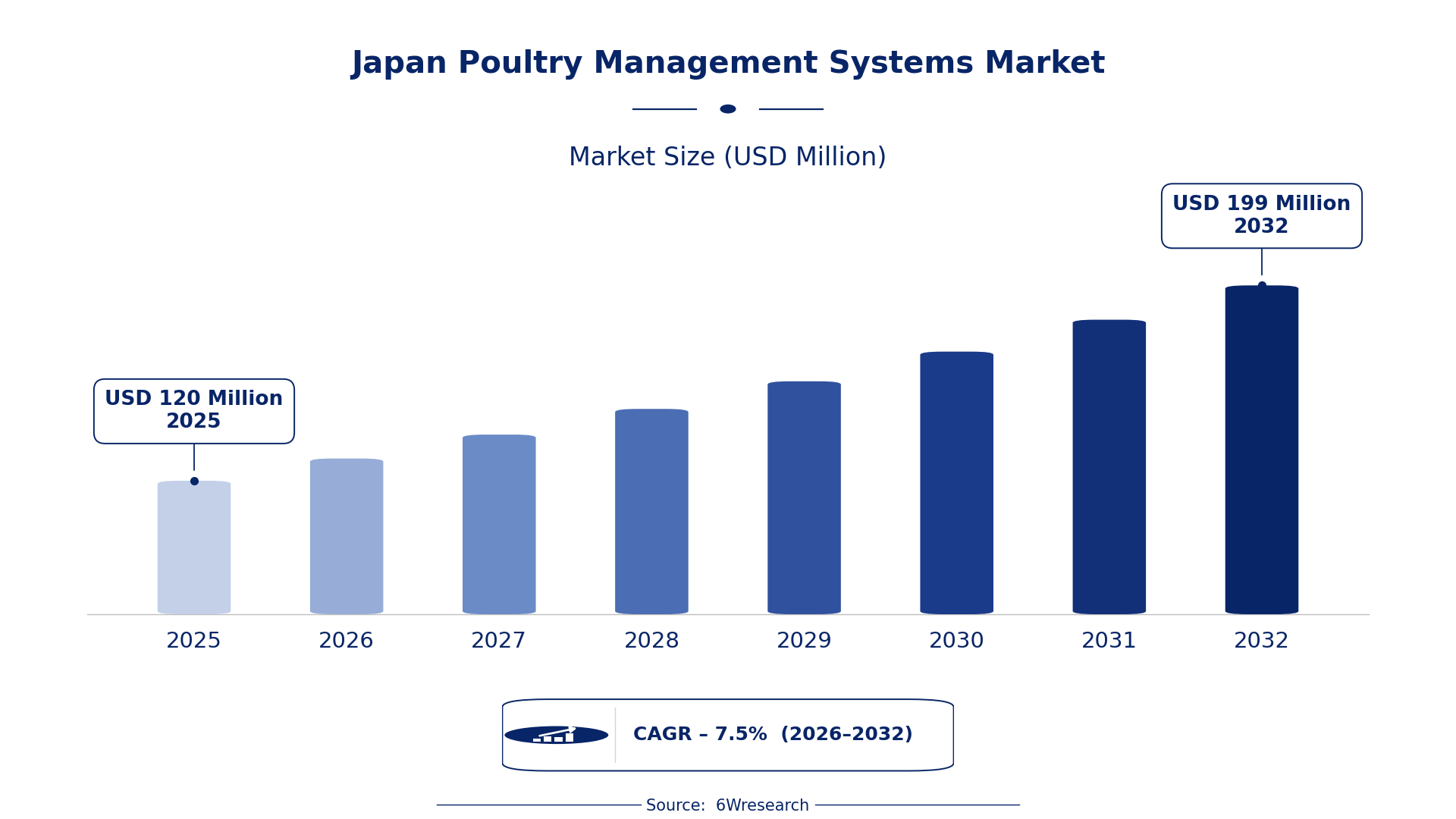
According to 6Wresearch internal database and industry insights, the Japan Poultry Management Systems Market was valued at USD 120 Million in 2025 and is projected to reach USD 199 Million by 2032, growing at a CAGR of approximately 7.5% during 2026–2032.
Japan Poultry Management Systems Market Highlights
| Report Metric | Details |
| Report Name | Japan Poultry Management Systems Market (2026-2032) |
| Market Size 2025 | USD 120 Million |
| Market Size 2032 | USD 199 Million |
| Absolute Growth 2025–2032 | USD 79 Million |
| CAGR 2026–2032 | 7.5% |
| Peak Annual Growth | 8.7% in 2030 |
| Forecast Period | 2026–2032 |
| Historical Data | 2022–2025 |
| Base Year | 2025 |
| Leading Product Type, 2025 | Cloud-Based PMS (35% share) |
| Leading Platform Type, 2025 | Mobile/Web App (45% share) |
| Leading Distribution Channel, 2025 | Online Platforms (46% share) |
| Leading End User, 2025 | Integrated Poultry Farms (41% share) |
| Fastest-Growing Product Type | Sensor-Based Monitoring (10.8% CAGR) |
| Fastest-Growing Platform Type | IoT Devices (11.0% CAGR) |
| Fastest-Growing Distribution Channel | Direct Sales (9.7% CAGR) |
| Fastest-Growing End User | Poultry Integrators (9.6% CAGR) |
| Growing Sector | Poultry Integrators |
| Key End Users | Integrated Poultry Farms, Poultry Integrators, Commercial Farm Chains, Feed & Breeder Managers |
Japan Poultry Management Systems Market Year-wise Growth Rate and Key Drivers (2022–2032)
This graph illustrates the annual growth rates of the market from 2022 to 2032, highlighting a steady upward trajectory and projected market expansion over the forecast period.
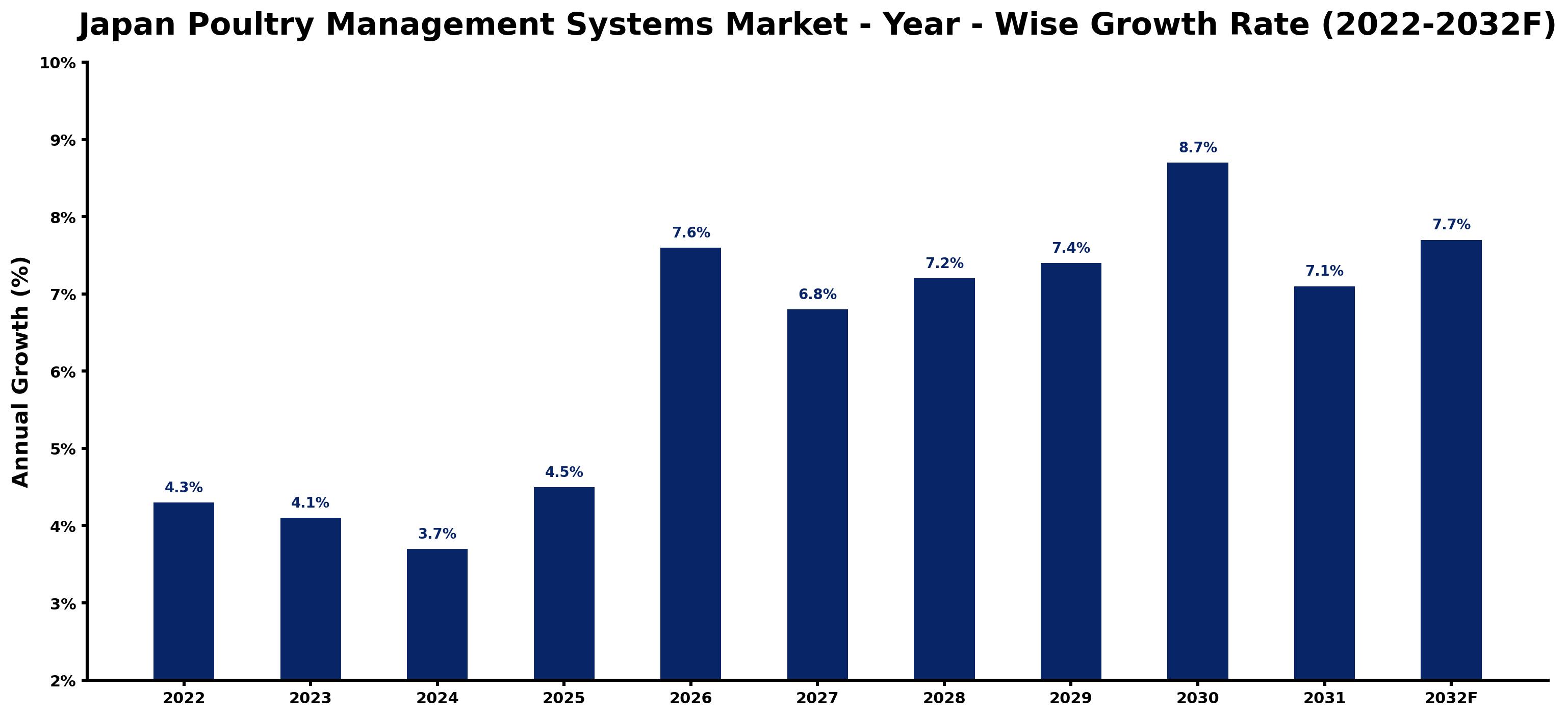
The following figures match every annual growth estimate with the main market development of that year, giving the reasoning behind each rise or slowdown.
| Year | Estimated Annual Growth (%) | Market Rationale |
| 2022 | 4.3 | The poultry sector experienced steady growth, driven by rising domestic consumption. |
| 2023 | 4.1 | Growth slowed slightly due to market saturation and increased competition among suppliers. |
| 2024 | 3.7 | The market continued to slow as producers adjusted to changing consumer preferences. |
| 2025 | 4.5 | Growth accelerated as integrated poultry farms adopted advanced management systems. |
| 2026 | 7.6 | Demand is projected to rise sharply as cloud-based PMS gains popularity among farmers. |
| 2027 | 6.8 | Growth is expected to slow as the market matures and competition intensifies among service providers. |
| 2028 | 7.2 | Increased adoption of IoT devices is anticipated to spur renewed interest in poultry management solutions. |
| 2029 | 7.4 | The market is projected to see a rise in demand as AI-based tools gain traction in the industry. |
| 2030 | 8.7 | Growth is expected to peak as poultry integrators expand their operations and upgrade systems. |
| 2031 | 7.1 | The market is projected to slow slightly as producers focus on optimising existing systems. |
| 2032 | 7.7 | Demand is expected to rise as new technologies improve farm efficiency. |
Note: Market size estimations and growth projections presented in this report are based on 6Wresearch's proprietary forecasting methodology, utilizing the latest available industry data, government publications, and primary research inputs.
Japan Poultry Management Systems Market Synopsis
Poultry Management Systems are integrated software solutions designed to optimise poultry farming operations through data collection and analysis, focusing on flock health, feed efficiency, and growth predictions. The Japan Poultry Management Systems Market is expanding, driven by poultry production of approximately 1.5 million tons in 2022 and a farming population of around 1.2 million. The increasing adoption of cloud-based solutions, projected to rise annually, along with the need for improved efficiency in poultry operations, are key factors propelling market growth.
Market Dynamics Impact Analysis (2026–2032)
| Factor | Type | Impact | Primary Segment Affected |
| Rising adoption of cloud-based PMS solutions | Driver | High | Cloud-Based PMS |
| Integration of AI-based tools for predictive analytics | Driver | High | AI-Based Prediction Tools |
| Growing need for efficient farm management solutions | Opportunity | High | Integrated Poultry Farms |
| Expansion of poultry integrators managing larger flocks | Opportunity | High | Poultry Integrators |
| High competition among software providers | Restraint | Medium | ERP Solutions |
| Market saturation limiting new entrants | Restraint | Medium | Sensor-Based Monitoring |
| Limited awareness of advanced technologies among small farms | Challenge | High | Mobile/Web App |
| High initial investment costs for advanced systems | Challenge | Medium | AI-Based Prediction Tools |
Evaluation of Drivers in Japan Poultry Management Systems Market (2026–2032)
Demand rests on the following drivers, each shown with the segment it touches most.
| Drivers | Primary Segment Affected | Why It Matters (Evidence) |
| Increased poultry production | Integrated Poultry Farms | Japan's poultry production reached approximately 1.5 million tons in 2022, driving demand for efficient management systems. |
| Growing emphasis on data-driven decision making | AI-Based Prediction Tools | AI tools are expected to improve feed conversion ratios by 10% in 2023, prompting farms to invest in these technologies. |
| Rising demand for remote management capabilities | Cloud-Based PMS | The adoption of cloud-based PMS is increasing by 15% annually, allowing farmers to manage operations more efficiently. |
| Expansion of poultry integrators | Poultry Integrators | Poultry integrators in Japan manage over 500,000 birds per facility, necessitating advanced management solutions. |
| Increased focus on food safety standards | ERP Solutions | ISO 22000 is a key standard in food safety management, prompting farms to adopt comprehensive management systems. |
Buyers are adding capacity as poultry production in Japan reached approximately 1.5 million tons in 2022, leading to greater demand for efficient management solutions. The emphasis on data-driven decision making is rising, with AI tools projected to improve feed conversion ratios significantly in 2023. Adoption of cloud-based PMS is increasing annually, enabling farmers to manage operations remotely and efficiently. The expansion of poultry integrators managing large flocks is driving the need for advanced systems. The focus on ISO 22000 food safety standards is prompting farms to implement ERP solutions for effective management.
Evaluation of Restraints in Japan Poultry Management Systems Market
The table below lists the restraints and the evidence behind each.
| Market Restraint | Primary Segment Affected | Why It Matters (Evidence) |
| High competition among software providers | ERP Solutions | The intense competition limits pricing flexibility and can lead to reduced profit margins for providers. |
| Market saturation limiting new entrants | Sensor-Based Monitoring | With many established players, new entrants struggle to gain market share and visibility. |
| Limited awareness of advanced technologies among small farms | Mobile/Web App | Many small farms lack knowledge about the benefits of advanced poultry management systems, hindering adoption. |
| High initial investment costs for advanced systems | AI-Based Prediction Tools | The substantial upfront costs deter some buyers from adopting advanced technologies, limiting market growth. |
| Slow adoption rate of IoT devices | IoT Devices | Farmers may be hesitant to invest in IoT due to perceived complexity and costs, affecting overall efficiency. |
Japan Poultry Management Systems Market Challenges
Japan's poultry production reached approximately 1.5 million tons in 2022, but compliance with ISO 22000 regulations often delays processing for producers, extending timelines by 20%. Regulatory oversight from the Ministry of Agriculture, Forestry and Fisheries complicates supply chains, increasing costs for suppliers who must frequently adapt to new standards. A lack of skilled workers in advanced poultry management technologies reduces efficiency, causing buyers to forfeit potential productivity gains of 30%. Fragmentation in the market arises as small farms increasingly adopt mobile applications, making it challenging for buyers to obtain reliable data and insights.
Trends in the Japan Poultry Management Systems Market
These developments are changing demand patterns in the Japan Poultry Management Systems Market.
- Shift from Traditional to Digital Management: In 2023, integrated poultry farms are increasingly adopting digital management solutions, with cloud-based PMS usage projected to rise significantly. This shift allows for better data analysis and operational efficiency, improving overall farm productivity.
- Emergence of AI Tools in Poultry Management: Since 2023, AI-based prediction tools have gained traction among poultry integrators, with expectations of notable improvements in feed conversion ratios. This trend marks a move towards data-driven decision-making in poultry farming.
- Growing Popularity of Mobile Applications: In 2023, small farms in Tokyo are increasingly using mobile applications for poultry management, reflecting a shift towards more accessible technology. This trend supports better flock monitoring and management on the go.
- Expansion of Remote Management Solutions: Beginning in 2023, cloud-based PMS solutions are being adopted by poultry integrators, with a significant annual increase. This trend facilitates remote management, allowing farmers to optimise operations from anywhere.
Investment Opportunities in the Japan Poultry Management Systems Market
Several openings in the Japan Poultry Management Systems Market merit attention from investors.
- Integrated Poultry Farms seeking efficiency: With Japan's poultry production reaching 1.5 million tons in 2022, there is a growing need for advanced management systems. Suppliers can target integrated poultry farms in Tokyo and Aichi, forming local partnerships to enter the market.
- AI-Based Prediction Tools for better outcomes: The poultry sector is projected to improve feed conversion ratios significantly in 2023. Suppliers should focus on providing AI tools to poultry integrators, ensuring they meet the demand for effective decision-making capabilities.
- Cloud-Based PMS for remote management: The increasing adoption of cloud-based solutions, expected to rise annually, presents an opportunity for suppliers. Targeting poultry integrators in Aichi can facilitate market entry through local collaborations.
- Mobile Applications for small farms: As small farms in Japan increasingly adopt mobile applications for poultry management, there is a gap for suppliers to fill. By offering user-friendly solutions, suppliers can enter the market effectively.
Government Initiatives in the Japan Poultry Management Systems Market
The Industrial Safety and Health Act (1972; MHLW) outlines responsibilities for employers regarding workplace safety, impacting poultry producers by ensuring safe working conditions. Compliance with this law requires producers to implement safety measures, which can lead to increased operational costs.
The Ministry of Agriculture, Forestry and Fisheries oversees poultry regulations and funds initiatives aimed at improving farm efficiency. For instance, a government program launched in 2023 aims to enhance poultry farm efficiency by 30%, providing financial support for technology adoption.
Future Insight of the Japan Poultry Management Systems Market
By 2032, a policy-driven shift will lead to improvements in poultry farm efficiency, prompting suppliers to invest in modern technologies. Adoption of AI-based tools is expected to improve feed conversion ratios by 10%, benefiting producers with higher profitability. The sector will see a rise in integrated software solutions, enabling buyers to streamline operations. Enhanced collaboration through industry associations will promote best practices, ensuring that the poultry market remains competitive and responsive to consumer demands.
Market Segmentation Analysis
Japan Poultry Management Systems Market report covers a detailed analysis of the following market segments:
By Product Type – Cloud-Based PMS Leads, Sensor-Based Monitoring Expected to Grow Fastest
According to Navya, Research Analyst at 6Wresearch, the largest product type category in 2025 was Cloud-Based PMS, at 35% of revenue. Cloud-Based PMS holds the largest share due to its capacity for remote management and data access, which is vital for poultry farms. This is especially important in regions like Tokyo and Aichi, where poultry production is concentrated. The quickest growth will come from Sensor-Based Monitoring, forecast to expand at a CAGR of 10.8% between 2026 and 2032. Sensor-Based Monitoring is witnessing rapid growth as it provides real-time health and environment tracking, crucial for effective flock management. The rising emphasis on health monitoring and operational efficiency is driving this segment's expansion. Suppliers should prioritise the development of cloud-based solutions to satisfy the increasing demand for remote management in poultry operations.
By Platform Type – Mobile/Web App Leads, IoT Devices Expected to Grow Fastest
With 45% of platform type revenue in 2025, Mobile/Web App was the largest category. Mobile/Web App leads the market as it supports user access to poultry management systems, allowing farmers to monitor operations conveniently. This is particularly beneficial for the large poultry farming population in Japan, estimated at around 1.2 million. IoT Devices are set to record the highest CAGR in this split, 11.0% over 2026–2032. IoT Devices are growing quickly because they collect data for monitoring and analysis, which is becoming indispensable for modern poultry management. The rising adoption of IoT technologies is propelling this segment's growth. Buyers will increasingly seek integrated solutions that combine mobile access with IoT capabilities for better operational efficiency.
By Distribution Channel – Online Platforms Lead, Direct Sales Expected to Grow Fastest
In 2025, Online Platforms led the distribution channel split with a 46% share. Online Platforms lead the distribution channel as they facilitate the sale of poultry management systems, making them more accessible to a broader audience. This trend aligns with the government's initiative aimed at improving poultry farm efficiency by 30%. Direct Sales is projected to grow fastest, at a CAGR of 9.7% during 2026–2032. Direct Sales is the fastest-growing channel, serving as the primary method for distributing software directly to farmers. This approach allows for tailored solutions that address specific farm needs, contributing to its rapid growth. Suppliers should enhance their direct sales strategies to capitalise on the rising interest in customised poultry management solutions.
By End User – Integrated Poultry Farms Lead, Poultry Integrators Expected to Grow Fastest
Integrated Poultry Farms accounted for 41% of the market by end user in 2025. Integrated Poultry Farms represent the largest share as they are the main users of poultry management systems designed to boost operational efficiency. These farms typically manage substantial numbers of birds, making effective management essential for their success. Over 2026–2032, Poultry Integrators are expected to post the fastest growth, at a CAGR of 9.6%. Poultry Integrators are the fastest-growing segment since they employ poultry management systems for coordination and optimisation across various facilities. Their management of over 500,000 birds per facility underscores the increasing need for effective systems. Suppliers must customise their offerings to address the specific requirements of poultry integrators for improved coordination and efficiency.
Key Attractiveness of the Report
- 10 Years of Market Numbers
- Historical Data Starting from 2022 to 2025
- Base Year 2025
- Forecast Data until 2032
- Key Performance Indicators Impacting the Market
- Major Upcoming Developments and Projects
Key Highlights of the Report:
- Japan Poultry Management Systems Market Outlook
- Market Size of Japan Poultry Management Systems Market, 2025
- Forecast of Japan Poultry Management Systems Market, 2032
- Historical Data and Forecast of Japan Poultry Management Systems Revenues & Volume for the Period 2022-2032F
- Japan Poultry Management Systems Market Trend Evolution
- Japan Poultry Management Systems Market Drivers and Challenges
- Japan Poultry Management Systems Price Trends
- Japan Poultry Management Systems Porter's Five Forces
- Japan Poultry Management Systems Industry Life Cycle
- Historical Data and Forecast of Japan Poultry Management Systems Market Revenues & Volume By Product Type for the Period 2022-2032F
- Historical Data and Forecast of Japan Poultry Management Systems Market Revenues & Volume By Cloud-Based PMS for the Period 2022-2032F
- Historical Data and Forecast of Japan Poultry Management Systems Market Revenues & Volume By Sensor-Based Monitoring for the Period 2022-2032F
- Historical Data and Forecast of Japan Poultry Management Systems Market Revenues & Volume By ERP Solutions for the Period 2022-2032F
- Historical Data and Forecast of Japan Poultry Management Systems Market Revenues & Volume By AI-Based Prediction Tools for the Period 2022-2032F
- Historical Data and Forecast of Japan Poultry Management Systems Market Revenues & Volume By Platform Type for the Period 2022-2032F
- Historical Data and Forecast of Japan Poultry Management Systems Market Revenues & Volume By Mobile/Web App for the Period 2022-2032F
- Historical Data and Forecast of Japan Poultry Management Systems Market Revenues & Volume By IoT Devices for the Period 2022-2032F
- Historical Data and Forecast of Japan Poultry Management Systems Market Revenues & Volume By Enterprise Software for the Period 2022-2032F
- Historical Data and Forecast of Japan Poultry Management Systems Market Revenues & Volume By Machine Learning Models for the Period 2022-2032F
- Historical Data and Forecast of Japan Poultry Management Systems Market Revenues & Volume By Distribution Channel for the Period 2022-2032F
- Historical Data and Forecast of Japan Poultry Management Systems Market Revenues & Volume By Online Platforms for the Period 2022-2032F
- Historical Data and Forecast of Japan Poultry Management Systems Market Revenues & Volume By Direct Sales for the Period 2022-2032F
- Historical Data and Forecast of Japan Poultry Management Systems Market Revenues & Volume By Software Providers for the Period 2022-2032F
- Historical Data and Forecast of Japan Poultry Management Systems Market Revenues & Volume By Specialty Tech Firms for the Period 2022-2032F
- Historical Data and Forecast of Japan Poultry Management Systems Market Revenues & Volume By End User for the Period 2022-2032F
- Historical Data and Forecast of Japan Poultry Management Systems Market Revenues & Volume By Integrated Poultry Farms for the Period 2022-2032F
- Historical Data and Forecast of Japan Poultry Management Systems Market Revenues & Volume By Poultry Integrators for the Period 2022-2032F
- Historical Data and Forecast of Japan Poultry Management Systems Market Revenues & Volume By Commercial Farm Chains for the Period 2022-2032F
- Historical Data and Forecast of Japan Poultry Management Systems Market Revenues & Volume By Feed & Breeder Managers for the Period 2022-2032F
- Japan Poultry Management Systems Import Export Trade Statistics
- Market Opportunity Assessment By Product Type
- Market Opportunity Assessment By Platform Type
- Market Opportunity Assessment By Distribution Channel
- Market Opportunity Assessment By End User
- Japan Poultry Management Systems Top Companies Market Share
- Japan Poultry Management Systems Competitive Benchmarking By Technical and Operational Parameters
- Japan Poultry Management Systems Company Profiles
- Japan Poultry Management Systems Key Strategic Recommendations
Market Covered
This report examines the market across the segments below.
By Product Type
- Cloud-Based PMS
- Sensor-Based Monitoring
- ERP Solutions
- AI-Based Prediction Tools
By Platform Type
- Mobile/Web App
- IoT Devices
- Enterprise Software
- Machine Learning Models
By Distribution Channel
- Online Platforms
- Direct Sales
- Software Providers
- Specialty Tech Firms
By End User
- Integrated Poultry Farms
- Poultry Integrators
- Commercial Farm Chains
- Feed & Breeder Managers































