Japan Power Transistor Market Size & Growth Rate
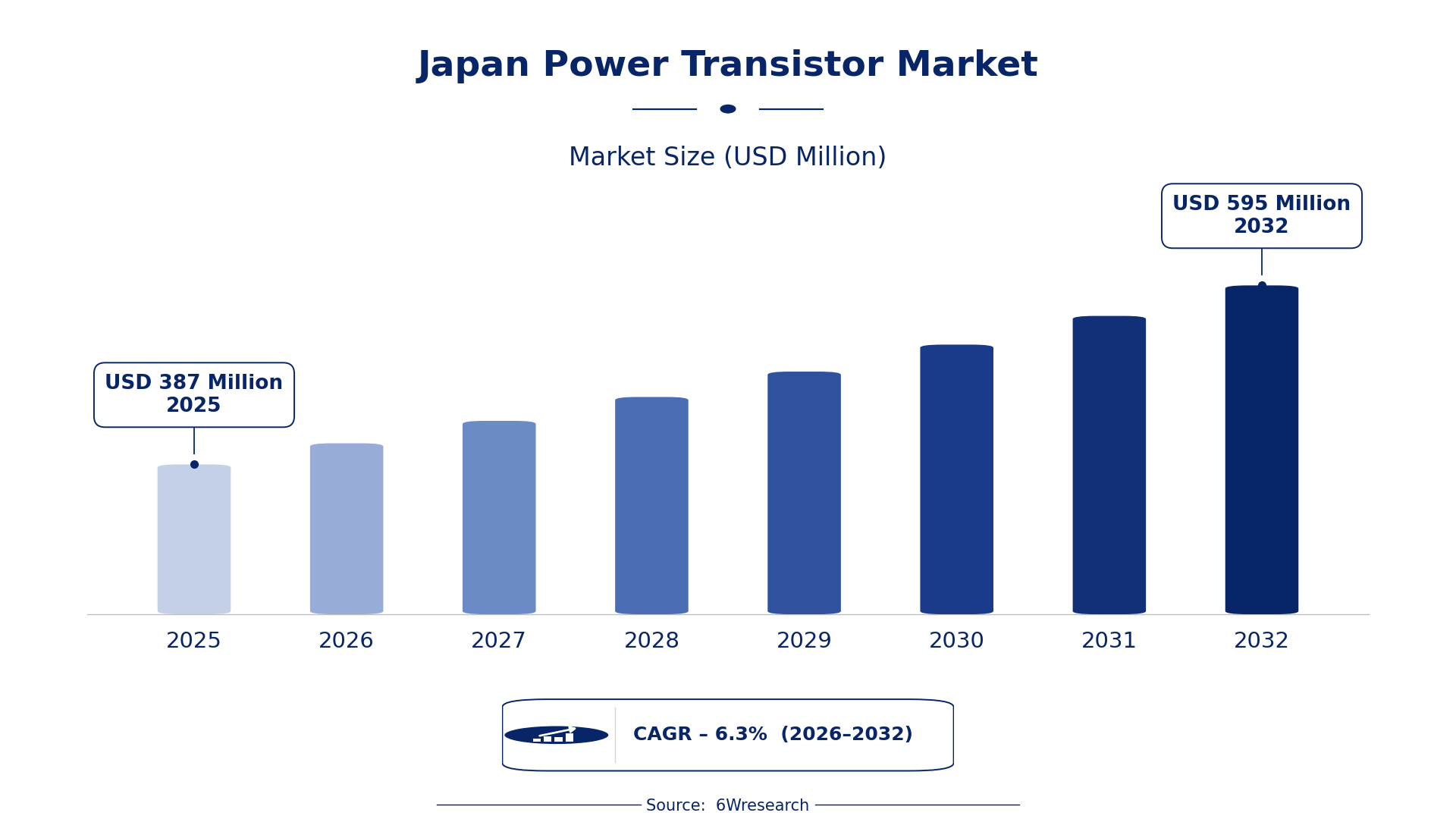
According to 6Wresearch internal database and industry insights, the Japan Power Transistor Market was valued at USD 387 Million in 2025 and is projected to reach USD 595 Million by 2032, growing at a CAGR of approximately 6.3% during 2026–2032.
Japan Power Transistor Market Highlights
| Report Metric | Details |
| Report Name | Japan Power Transistor Market (2026-2032) |
| Market Size 2025 | USD 387 Million |
| Market Size 2032 | USD 595 Million |
| Absolute Growth 2025–2032 | USD 208 Million |
| CAGR 2026–2032 | 6.3% |
| Peak Annual Growth | 7.5% in 2028 |
| Forecast Period | 2026–2032 |
| Historical Data | 2022–2025 |
| Base Year | 2025 |
| Leading Type, 2025 | Field Effect Transistor (43% share) |
| Leading Product, 2025 | IGBT Module (47% share) |
| Fastest-Growing Type | Heterojunction Bipolar Transistor (8.3% CAGR) |
| Fastest-Growing Product | RF and Microwave Power (8.6% CAGR) |
| Growing Sector | automotive electronics |
| Key End Users | automotive manufacturers, telecommunications companies, industrial automation firms, renewable energy providers |
Japan Power Transistor Market Year-wise Growth Rate and Key Drivers (2022–2032)
This graph illustrates the annual growth rates of the market from 2022 to 2032, highlighting a steady upward trajectory and projected market expansion over the forecast period.
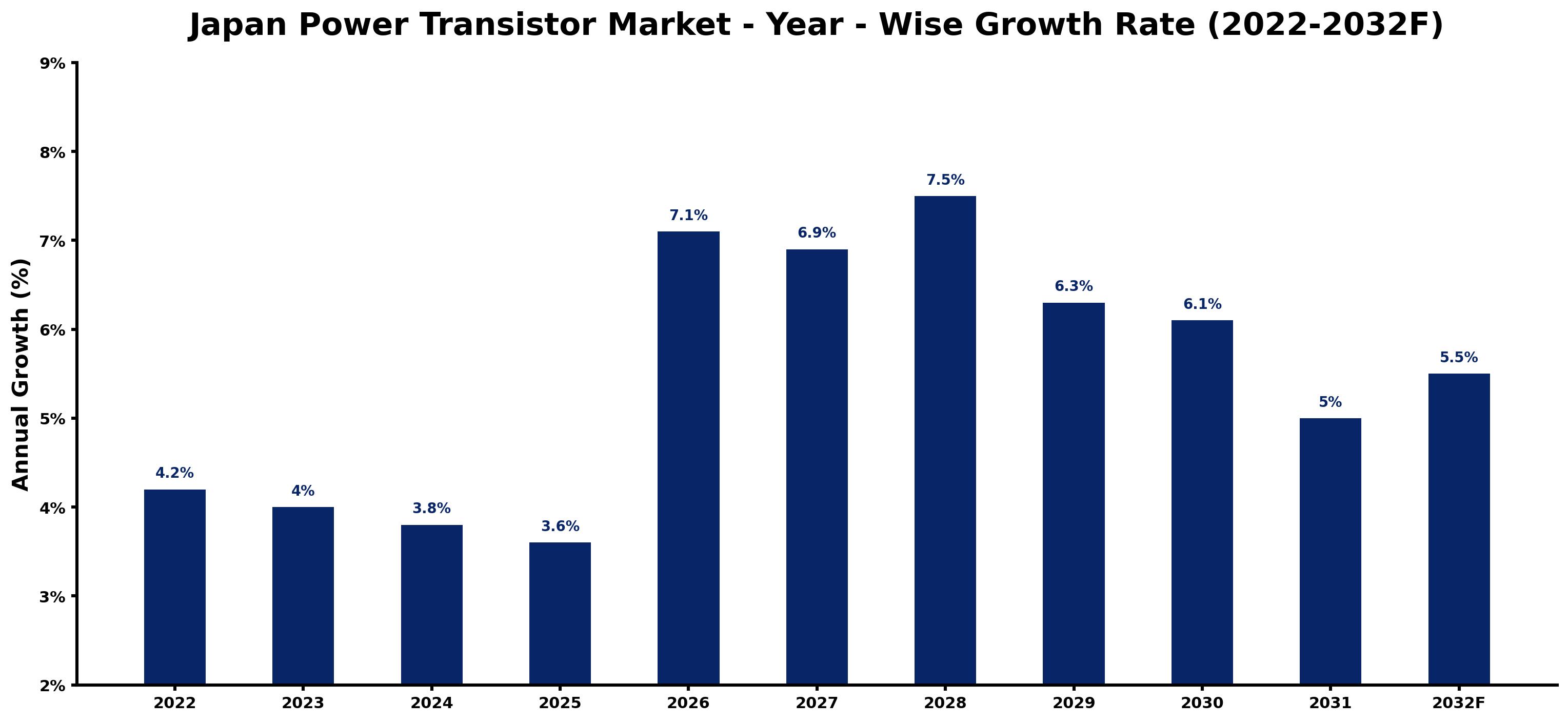
For each year, the table pairs the estimated growth rate with the leading influence on demand, showing how the drivers changed across the period.
| Year | Estimated Annual Growth (%) | Market Rationale |
| 2022 | 4.2 | The market experienced steady growth due to strong demand from the automotive sector. |
| 2023 | 4.0 | Growth slowed as supply chain issues impacted production capacity across various sectors. |
| 2024 | 3.8 | Market expansion continued but at a reduced pace, reflecting ongoing supply constraints. |
| 2025 | 3.6 | The market grew at a slower rate, influenced by shifting consumer electronics trends. |
| 2026 | 7.1 | Growth is expected to accelerate as investments in renewable energy systems increase demand for power transistors. |
| 2027 | 6.9 | The market is projected to continue expanding, driven by rising semiconductor demand in automotive applications. |
| 2028 | 7.5 | A peak in growth is anticipated, supported by advancements in telecommunications technology. |
| 2029 | 6.3 | Growth is expected to slow slightly as market saturation begins to affect new purchases. |
| 2030 | 6.1 | The market is projected to maintain growth, driven by ongoing investments in energy-efficient technologies. |
| 2031 | 5.0 | Growth is expected to slow as competition intensifies among semiconductor manufacturers. |
| 2032 | 5.5 | The market is expected to grow faster due to increased domestic semiconductor production initiatives. |
Note: Market size estimations and growth projections presented in this report are based on 6Wresearch's proprietary forecasting methodology, utilizing the latest available industry data, government publications, and primary research inputs.
Japan Power Transistor Market Synopsis
Power transistors are semiconductor devices that amplify or switch electronic signals, composed of materials like silicon or gallium nitride. They find extensive application in power regulation across industrial equipment, consumer electronics, and renewable energy systems. The Japan Power Transistor Market is growing, propelled by demand from automotive, telecommunications, and industrial automation sectors. With the semiconductor market valued at approximately 4 trillion yen in 2022 and a projected average annual growth rate of 5% through 2025, growth is expected to continue as investments in decarbonisation and technology development increase.
Market Dynamics Impact Analysis (2026–2032)
| Factor | Type | Impact | Primary Segment Affected |
| Rising demand for automotive electronics | Driver | High | Field Effect Transistor |
| Increased adoption of renewable energy systems | Driver | High | IGBT Module |
| Growing investments in semiconductor manufacturing | Opportunity | High | RF and Microwave Power |
| Expansion of 5G infrastructure | Opportunity | High | Heterojunction Bipolar Transistor |
| Supply chain disruptions affecting production | Restraint | High | Bipolar Junction Transistor |
| Intense competition among semiconductor manufacturers | Restraint | Medium | Power Module |
| High costs associated with advanced semiconductor technology | Challenge | High | Low Voltage-FETs |
| Regulatory compliance requirements for energy efficiency | Challenge | Medium | Others |
Evaluation of Drivers in Japan Power Transistor Market (2026–2032)
Demand rests on the following drivers, each shown with the segment it touches most.
| Drivers | Primary Segment Affected | Why It Matters (Evidence) |
| Investment in renewable energy | IGBT Module | Power transistors are critical in solar inverters, supporting Japan's decarbonisation targets with a projected investment of JPY 150 trillion over 10 years. |
| Government support for semiconductor development | Heterojunction Bipolar Transistor | The government allocated 500 billion yen for semiconductor R&D, boosting production capabilities and market growth. |
| Growth in consumer electronics | Power Module | The rising electronics consumption in Japan's population of 125 million drives demand for power modules. |
| Telecommunications advancements | RF and Microwave Power | The rollout of 5G technology is increasing demand for RF and microwave power transistors, reflecting the need for high-frequency applications. |
| Automotive sector expansion | Field Effect Transistor | The automotive sector accounts for 30% of semiconductor demand, driving growth in field effect transistors. |
Buyers are expanding capacity as the automotive sector increasingly depends on advanced electronics, which represent 30% of semiconductor demand. In 2022, Japan's semiconductor market was valued at around 4 trillion yen, with investments in renewable energy systems driving the need for power transistors. The rollout of 5G technology is opening new avenues for RF and microwave power transistors, while the rising electronics consumption among Japan's 125 million population supports further growth in the power module segment.
Evaluation of Restraints in Japan Power Transistor Market
Below are the constraints most often cited by buyers and suppliers, with the segment each affects.
| Market Restraint | Primary Segment Affected | Why It Matters (Evidence) |
| High production costs | Low Voltage-FETs | Advanced semiconductor technologies require substantial investment, limiting affordability for some buyers and increasing overall costs. |
| Regulatory compliance costs | Heterojunction Bipolar Transistor | Compliance with energy efficiency regulations increases operational costs for producers, affecting pricing strategies. |
| Market saturation | Field Effect Transistor | As the market matures, growth opportunities become limited, affecting new investments and innovation. |
| Supply chain disruptions | Bipolar Junction Transistor | Ongoing supply chain issues hinder timely production, leading to delays in meeting market demand. |
| Technological obsolescence | Others | Rapid advancements in technology necessitate frequent upgrades, burdening buyers with additional expenses. |
Japan Power Transistor Market Challenges
Japan's automotive sector faces a skills shortage in semiconductor manufacturing, resulting in production delays that can extend timelines by up to six months for producers. This challenge arises from an ageing workforce and inadequate training programmes, leading to increased costs for producers striving to meet demand. Rising material costs for silicon and gallium nitride are pushing input prices higher, with estimates indicating a 15% increase affecting producers' margins. Rapid advancements in power transistor technology necessitate constant upgrades, imposing additional expenses on buyers as they adapt to evolving standards and compliance requirements.
Trends in the Japan Power Transistor Market
Below are the shifts with the largest effect on the Japan Power Transistor Market.
- Shift in Automotive Electronics Demand: Automotive manufacturers are integrating advanced electronics, driving demand for power transistors. In 2022, the automotive sector accounted for 30% of semiconductor demand, prompting suppliers to increase production capabilities.
- Transition to Renewable Energy Systems: The adoption of renewable energy solutions is accelerating, with power transistors playing a critical role in solar inverters. Japan targets a 46% cut in greenhouse-gas emissions by fiscal 2030, driving investment in these technologies.
- Emergence of 5G Technology: The rollout of 5G technology is creating new opportunities for RF and microwave power transistors. This segment is projected to grow at a CAGR of 8.6% through 2032, reflecting the rising need for high-frequency applications.
- Focus on Semiconductor Supply Chain Resilience: Japan launched a program in 2023 to enhance semiconductor supply chain resilience, aiming for increased domestic production. The government targets raising domestic semiconductor production to 30% by 2030.
Investment Opportunities in the Japan Power Transistor Market
The following opportunities in the Japan Power Transistor Market pair current demand with a clear way in.
- Local Partnerships for Semiconductor Production: Establishing local partnerships is essential for entering the semiconductor market, particularly in the Nagoya region, which specializes in automotive electronics. The government allocated 500 billion yen for R&D, creating opportunities for collaboration.
- Investment in Renewable Energy Technologies: With Japan targeting a 46% reduction in greenhouse gas emissions by 2030, there is a growing need for power transistors in renewable energy systems. Companies can invest in solar inverter production to meet this demand.
- Expansion of 5G Infrastructure: Telecommunications companies are ramping up investments in 5G infrastructure, increasing demand for RF and microwave power transistors. Suppliers can enter this market by aligning with industry standards and regulations.
- Development of Energy-Efficient Solutions: The demand for energy-efficient technologies is rising, driven by the Act on the Rational Use of Energy. Suppliers can focus on developing low-voltage FETs to meet this growing need.
Government Initiatives in the Japan Power Transistor Market
The GX Promotion Act (2023) establishes a framework for decarbonisation efforts, requiring producers to invest in energy-efficient technologies. This act supports the development of power transistors that comply with new energy standards, ensuring market alignment and promoting sustainable practices. The government aims to allocate JPY 150 trillion for public and private decarbonisation investment over the next decade, enhancing the market for advanced technologies.
The Ministry of Economy, Trade and Industry (METI) oversees energy efficiency regulations, obliging large energy users to report energy consumption. This regulation encourages buyers to seek more efficient power transistors to comply with energy efficiency mandates, creating a market for advanced technologies. The government has set a target to increase domestic semiconductor production to 30% by 2030, further supporting industry growth.
Future Insight of the Japan Power Transistor Market
Japan's commitment to decarbonisation will reshape the power transistor market by 2032, driven by a JPY 150 trillion investment in green technologies. This investment will enhance production capabilities and stimulate innovation in renewable energy systems. As domestic semiconductor production increases, suppliers will benefit from improved supply chain resilience and reduced reliance on external sources. The expansion of 5G technology will also elevate the demand for advanced power transistors, creating new opportunities for buyers and suppliers in the electronics sector.
Market Segmentation Analysis
Japan Power Transistor Market report covers a detailed analysis of the following market segments:
By Type – Field Effect Transistor Leads, Heterojunction Bipolar Transistor Expected to Grow Fastest
According to Bhawna Singh, Assistant Manager at 6Wresearch, with 43% of type revenue in 2025, Field Effect Transistor was the largest category. Field Effect Transistors dominate the market due to their extensive use in switching and amplifying applications across sectors such as automotive electronics. Their integration into a vast array of devices contributes to a substantial installed base in Japan. Heterojunction Bipolar Transistor is projected to grow fastest, at a CAGR of 8.3% during 2026–2032. Heterojunction Bipolar Transistors are rapidly gaining traction as the demand for high-frequency applications rises, particularly with the ongoing rollout of 5G technology. This growth is likely to continue as the need for advanced communication capabilities expands, reinforcing their market presence. Suppliers should focus on enhancing their offerings in high-frequency technologies to meet the growing demand in this segment.
By Product – IGBT Module Leads, RF and Microwave Power Expected to Grow Fastest
IGBT Module accounted for 47% of the market by product in 2025. IGBT Modules are the leading product type as they play a critical role in controlling electric motors and inverters, particularly in industrial and renewable energy applications. Their importance in power regulation solidifies their position in Japan's semiconductor market. RF and Microwave Power is set to record the highest CAGR in this split, 8.6% over 2026–2032. RF and Microwave Power products are experiencing the fastest growth, driven by their essential applications in communication and radar systems, especially with the ongoing 5G rollout. This trend is expected to continue as the demand for efficient communication technologies increases. Buyers need to prioritise sourcing RF and Microwave Power products to stay competitive in the advancing electronics market.
Key Attractiveness of the Report
- 10 Years of Market Numbers
- Historical Data Starting from 2022 to 2025
- Base Year 2025
- Forecast Data until 2032
- Key Performance Indicators Impacting the Market
- Major Upcoming Developments and Projects
Key Highlights of the Report:
- Japan Power Transistor Market Outlook
- Market Size of Japan Power Transistor Market, 2025
- Forecast of Japan Power Transistor Market, 2032
- Historical Data and Forecast of Japan Power Transistor Revenues & Volume for the Period 2022-2032
- Japan Power Transistor Market Trend Evolution
- Japan Power Transistor Market Drivers and Challenges
- Japan Power Transistor Price Trends
- Japan Power Transistor Porter's Five Forces
- Japan Power Transistor Industry Life Cycle
- Historical Data and Forecast of Japan Power Transistor Market Revenues & Volume By Type for the Period 2022-2032
- Historical Data and Forecast of Japan Power Transistor Market Revenues & Volume By Field Effect Transistor for the Period 2022-2032
- Historical Data and Forecast of Japan Power Transistor Market Revenues & Volume By Heterojunction Bipolar Transistor for the Period 2022-2032
- Historical Data and Forecast of Japan Power Transistor Market Revenues & Volume By Bipolar Junction Transistor for the Period 2022-2032
- Historical Data and Forecast of Japan Power Transistor Market Revenues & Volume By Others for the Period 2022-2032
- Historical Data and Forecast of Japan Power Transistor Market Revenues & Volume By Product for the Period 2022-2032
- Historical Data and Forecast of Japan Power Transistor Market Revenues & Volume By IGBT Module for the Period 2022-2032
- Historical Data and Forecast of Japan Power Transistor Market Revenues & Volume By RF and Microwave Power for the Period 2022-2032
- Historical Data and Forecast of Japan Power Transistor Market Revenues & Volume By Power Module for the Period 2022-2032
- Historical Data and Forecast of Japan Power Transistor Market Revenues & Volume By Low Voltage-FETs for the Period 2022-2032
- Historical Data and Forecast of Japan Power Transistor Market Revenues & Volume By Others for the Period 2022-2032
- Japan Power Transistor Import Export Trade Statistics
- Market Opportunity Assessment By Type
- Market Opportunity Assessment By Product
- Japan Power Transistor Top Companies Market Share
- Japan Power Transistor Competitive Benchmarking By Technical and Operational Parameters
- Japan Power Transistor Company Profiles
- Japan Power Transistor Key Strategic Recommendations
Market Covered
The report covers the following segments.
By Type
- Field Effect Transistor
- Heterojunction Bipolar Transistor
- Bipolar Junction Transistor
- Others
By Product
- IGBT Module
- RF and Microwave Power
- Power Module
- Low Voltage-FETs
- Others






































