Japan Predictive Data Tiering AI Market Size & Growth Rate
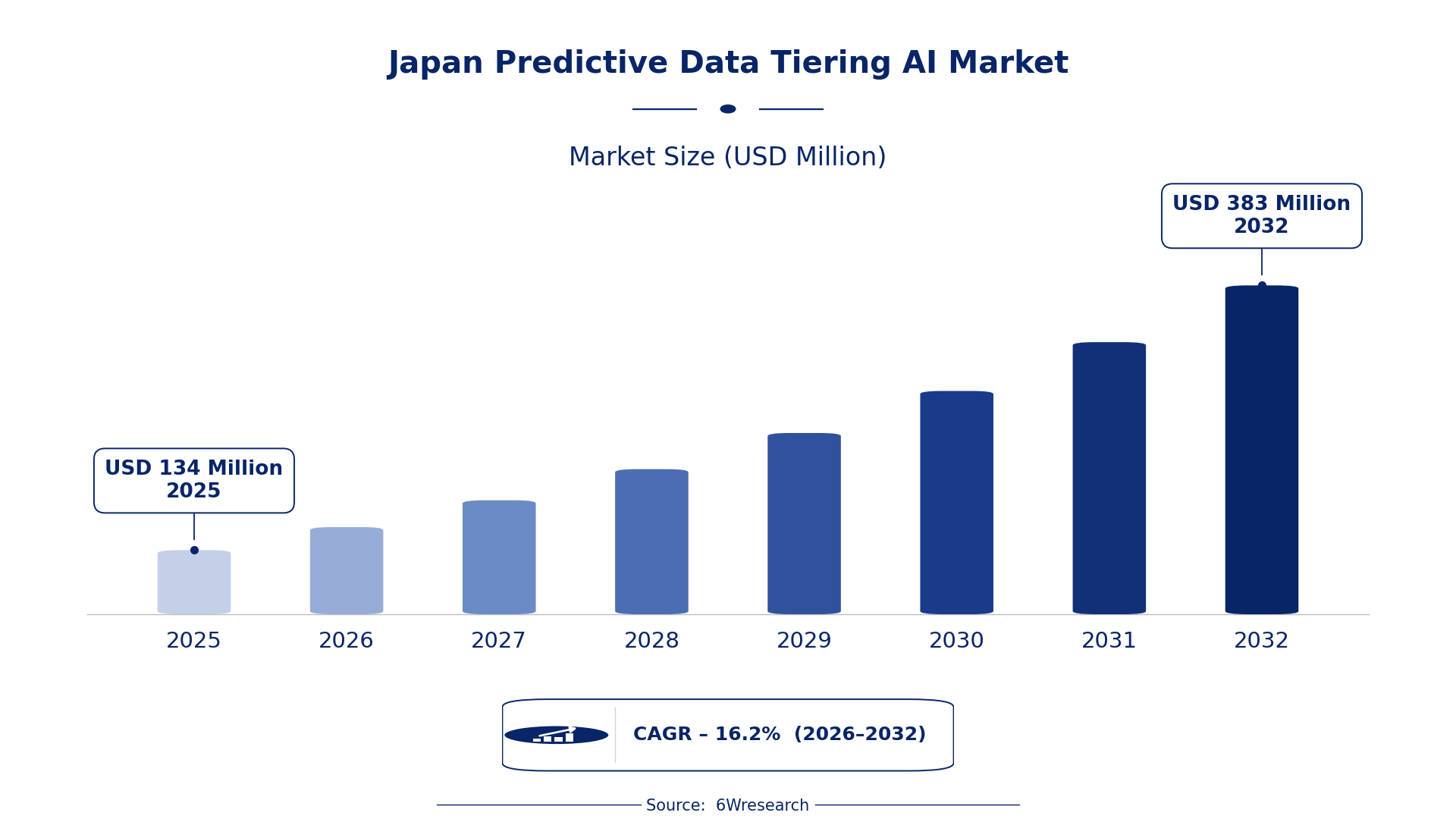
According to 6Wresearch internal database and industry insights, the Japan Predictive Data Tiering AI Market was valued at USD 134 Million in 2025 and is projected to reach USD 383 Million by 2032, growing at a CAGR of approximately 16.2% during 2026–2032.
Japan Predictive Data Tiering AI Market Highlights
| Report Metric | Details |
| Report Name | Japan Predictive Data Tiering AI Market (2026-2032) |
| Market Size 2025 | USD 134 Million |
| Market Size 2032 | USD 383 Million |
| Absolute Growth 2025–2032 | USD 249 Million |
| CAGR 2026–2032 | 16.2% |
| Peak Annual Growth | 21.1% in 2026 |
| Forecast Period | 2026–2032 |
| Historical Data | 2022–2025 |
| Base Year | 2025 |
| Leading Tiering Type, 2025 | Hot/Cold Data Models (38% share) |
| Leading AI Methodology, 2025 | Machine Learning (39% share) |
| Leading Distribution Channel, 2025 | Direct Sales (48% share) |
| Leading End User, 2025 | Data Centers (37% share) |
| Fastest-Growing Tiering Type | Hybrid Tiering (22.7% CAGR) |
| Fastest-Growing AI Methodology | Deep Learning (21.7% CAGR) |
| Fastest-Growing Distribution Channel | SaaS Subscriptions (21.2% CAGR) |
| Fastest-Growing End User | Cloud Providers (20.5% CAGR) |
| Growing Sector | data management |
| Key End Users | data centers, cloud providers, enterprise IT |
Japan Predictive Data Tiering AI Market Year-wise Growth Rate and Key Drivers (2022–2032)
This graph illustrates the annual growth rates of the market from 2022 to 2032, highlighting a steady upward trajectory and projected market expansion over the forecast period.
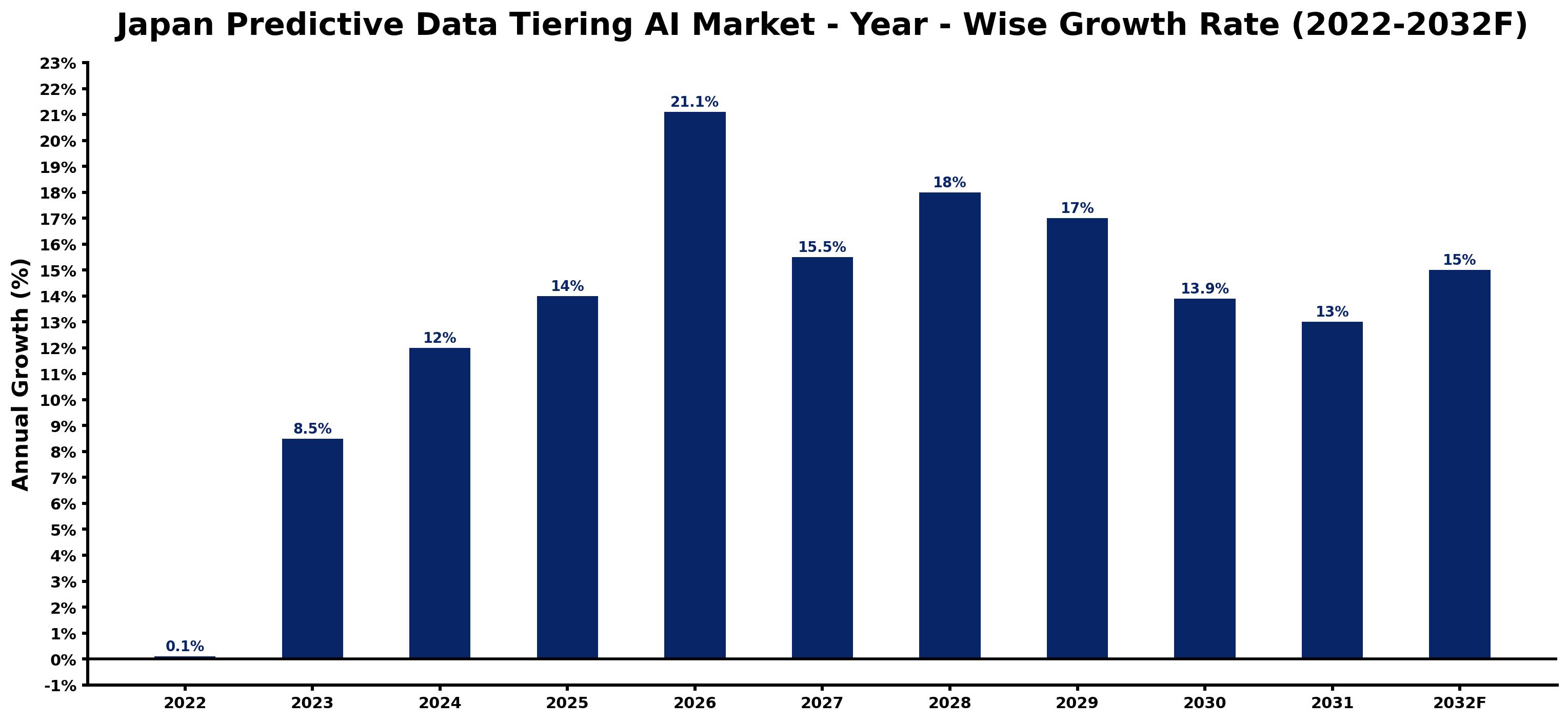
The following figures match every annual growth estimate with the main market development of that year, giving the reasoning behind each rise or slowdown.
| Year | Estimated Annual Growth (%) | Market Rationale |
| 2022 | 0.1 | The market showed minimal growth due to initial adoption phases. |
| 2023 | 8.5 | Growth accelerated as data management needs increased among users. |
| 2024 | 12.0 | Demand continued to rise with more enterprises adopting AI technologies. |
| 2025 | 14.0 | The market reached a historical peak driven by heightened data needs. |
| 2026 | 21.1 | A surge in investments propelled growth to its forecast peak. |
| 2027 | 15.5 | Growth is expected to slow as the market begins to stabilise after rapid expansion. |
| 2028 | 18.0 | Increased cloud service adoption is projected to lead to a rebound in growth rates. |
| 2029 | 17.0 | The market will experience a slight slowdown as competition intensifies. |
| 2030 | 13.9 | Growth will continue to decelerate as saturation approaches in key areas. |
| 2031 | 13.0 | The market will stabilise with consistent demand from data centers. |
| 2032 | 15.0 | Growth will pick up again due to renewed investments in AI solutions. |
Note: Market size estimations and growth projections presented in this report are based on 6Wresearch's proprietary forecasting methodology, utilizing the latest available industry data, government publications, and primary research inputs.
Japan Predictive Data Tiering AI Market Synopsis
Predictive Data Tiering AI optimises data storage by categorising data based on usage patterns, improving retrieval speeds and lowering costs. The Japan Predictive Data Tiering AI Market is expanding due to the increasing number of cloud service users, which reached 6 million in 2023. This growth is driven by initiatives from the Ministry of Internal Affairs and Communications to improve data management in public sectors, creating a favourable investment environment for predictive data tiering solutions.
Market Dynamics Impact Analysis (2026–2032)
| Factor | Type | Impact | Primary Segment Affected |
| Increasing cloud service adoption | Driver | High | Cloud Providers |
| Rising demand for efficient data management | Driver | High | Data Centers |
| Growing number of data centers | Opportunity | High | Data Centers |
| Emerging AI technologies in data management | Opportunity | High | Enterprise IT |
| Limited awareness of tiering benefits | Restraint | Medium | Data Centers |
| High initial implementation costs | Restraint | High | Cloud Providers |
| Shortage of skilled AI professionals | Challenge | High | Enterprise IT |
| Rapid technological advancements | Challenge | Medium | Data Centers |
Evaluation of Drivers in Japan Predictive Data Tiering AI Market (2026–2032)
Demand rests on the following drivers, each shown with the segment it touches most.
| Drivers | Primary Segment Affected | Why It Matters (Evidence) |
| Increased cloud service adoption | Cloud Providers | The number of cloud service users in Japan reached 6 million in 2023, driving demand for tiering solutions. |
| Rising demand for efficient data management | Data Centers | Japan's data center market is projected to reach 1,000 facilities by 2025, increasing the need for tiering solutions. |
| Investment in digital transformation projects | Enterprise IT | The government allocated ¥10 billion for digital transformation in 2023, encouraging AI adoption in data management. |
| Growing focus on data security standards | Data Centers | ISO/IEC 27001 is widely adopted, prompting data centers to seek efficient tiering solutions for compliance. |
| Adoption of AI technologies | Enterprise IT | The demand for AI-driven solutions in data management is increasing by 15% annually, boosting tiering needs. |
Buyers are adding capacity as the number of cloud service users in Japan reached 6 million in 2023, creating a surge in demand for predictive data tiering solutions. Increased investments in efficient data management are clear, especially with funding of ¥10 billion for digital transformation projects in 2023 driving AI adoption across industries. The rising focus on data security standards compels data centers to implement tiering solutions to ensure compliance. The annual growth of 15% in demand for AI-driven data management solutions highlights the need for effective tiering strategies.
Evaluation of Restraints in Japan Predictive Data Tiering AI Market
The main factors holding the market back are set out below.
| Market Restraint | Primary Segment Affected | Why It Matters (Evidence) |
| Limited awareness of tiering benefits | Data Centers | Many data centers lack understanding of predictive data tiering, hindering adoption rates. |
| High initial implementation costs | Cloud Providers | The costs associated with implementing tiering solutions can deter cloud providers from investing. |
| Shortage of skilled AI professionals | Enterprise IT | The lack of qualified personnel to implement AI solutions limits the market's growth potential. |
| Complexity of data management systems | Data Centers | The intricate nature of data management can complicate the integration of tiering solutions. |
| Regulatory compliance challenges | Cloud Providers | Navigating data protection regulations can slow down the adoption of new technologies. |
Japan Predictive Data Tiering AI Market Challenges
Inefficient technology limits data management for buyers, as many systems do not effectively categorise data based on usage patterns. This problem exists due to slow algorithm adoption, costing data centres up to 20% more in storage expenses. High operational costs burden suppliers because strict regulations like ISO/IEC 27001 require substantial compliance investments, delaying project timelines for hospitals and clinics. Fluctuating energy prices impact data centre power usage effectiveness, averaging 1.5, which raises operational costs for producers and affects their pricing strategies.
Trends in the Japan Predictive Data Tiering AI Market
Buyers and suppliers in the Japan Predictive Data Tiering AI Market are adjusting to the following trends.
- Shift from Traditional Storage to Predictive Tiering: Japan's data centers are increasingly adopting predictive data tiering to optimise storage. The Tokyo Metropolitan Government supports smart city data management initiatives, leading to improved data retrieval efficiencies.
- Emergence of AI-Driven Solutions: The AI Promotion Act is encouraging the development of AI technologies in data management. This has led to a 15% annual increase in demand for AI-driven solutions across various sectors.
- Transition from On-Premises to Cloud Solutions: The rise of cloud service users in Japan is shifting focus from traditional data management to cloud-based solutions. This trend is evident as the number of cloud service users reached 6 million in 2023.
- Growth in SaaS Subscriptions for Tiering Solutions: SaaS subscriptions are becoming a preferred model for delivering predictive data tiering solutions. The segment is expected to grow at a CAGR of 21.2% from 2026 to 2032.
Investment Opportunities in the Japan Predictive Data Tiering AI Market
The following opportunities in the Japan Predictive Data Tiering AI Market pair current demand with a clear way in.
- Data Centers seeking efficient solutions: Data Centers are increasingly looking for predictive data tiering solutions to optimise storage. With projections indicating a growing number of facilities, there is a strong opportunity for suppliers.
- Cloud Providers improving service offerings: Cloud Providers are focusing on enhancing their service efficiency through predictive data tiering. The Tokyo region, with over 40% of Japan's data center capacity, presents a prime market.
- Investment in AI technologies: Investment in AI technologies is surging, creating demand for predictive data tiering solutions. The Digital Agency is promoting digital transformation, providing a pathway for new entrants.
- Partnerships with local firms: Collaborating with local firms can facilitate entry into the predictive data tiering market. Working with data centers in the Tokyo region can enhance market penetration.
Government Initiatives in the Japan Predictive Data Tiering AI Market
The Predictive Data Tiering AI Market is influenced by several laws, including the AI Promotion Act of 2025, which establishes a national framework for AI research and development. This act encourages investment in AI technologies, crucial for improving data management solutions. The Digital Agency, established in September 2021, plays a key role in leading the government's digital transformation efforts, ensuring that data management practices align with modern standards and technologies. Together, these measures create a conducive environment for the growth of predictive data tiering solutions in Japan.
In 2023, the government allocated ¥10 billion for digital transformation projects, aimed at improving data management across various sectors. The Ministry of Internal Affairs and Communications oversees these initiatives, focusing on enhancing data management in public sectors. This funding supports the development of advanced data solutions, encouraging the adoption of predictive data tiering AI technologies among data centers and cloud providers. Such government backing is crucial for driving innovation and efficiency in data management practices.
Future Insight of the Japan Predictive Data Tiering AI Market
The investment pipeline for digital transformation projects will expand by 2032, creating robust demand for predictive data tiering solutions. The government's allocation of ¥10 billion for digital initiatives will stimulate new programmes, especially in public sectors. The number of cloud service users is expected to reach 8 million, increasing competition among suppliers. Smart city initiatives in Tokyo will promote the adoption of AI-driven data management solutions, reshaping operational practices across industries.
Market Segmentation Analysis
Japan Predictive Data Tiering AI Market report covers a detailed analysis of the following market segments:
By Tiering Type – Hot/Cold Data Models Lead, Hybrid Tiering Expected to Grow Fastest
According to Navya, Research Analyst at 6Wresearch, with 38% of tiering type revenue in 2025, Hot/Cold Data Models was the largest category. Hot/Cold Data Models are prevalent as they efficiently categorise data based on access frequency, making them vital for data centres. This approach is particularly important in the Tokyo region, which accounts for over 40% of Japan's data centre capacity. The quickest growth will come from Hybrid Tiering, forecast to expand at a CAGR of 22.7% between 2026 and 2032. Hybrid Tiering is seeing rapid growth due to its capability to merge various storage types, optimising performance across different data requirements. The increasing focus on efficient data management solutions in Japan's expanding data centre market is a key factor in this trend. Suppliers should prioritise the development of hybrid tiering solutions to align with the rising demand for efficient data management.
By AI Methodology – Machine Learning Leads, Deep Learning Expected to Grow Fastest
Machine Learning took 39% of ai methodology revenue in 2025, more than any other category. Machine Learning holds the largest share due to its critical role in analysing data access patterns and optimising storage solutions. Its widespread application in data centres, which are projected to reach 1,000 by 2025, underlines its importance in the market. Deep Learning is set to record the highest CAGR in this split, 21.7% over 2026–2032. Deep Learning is growing rapidly because it provides advanced analytical capabilities that can enhance data management strategies. This growth is fuelled by the increasing demand for sophisticated data management solutions, projected to rise by 15% annually. Suppliers should consider integrating advanced methodologies to meet the evolving needs of data management.
By Distribution Channel – Direct Sales Leads, SaaS Subscriptions Expected to Grow Fastest
Direct Sales held 48% of the Japan Predictive Data Tiering AI Market by distribution channel in 2025. Direct Sales is the leading channel as it allows for personalised engagement with clients, ensuring tailored solutions for predictive data tiering. This approach is particularly effective in the data centre sector, where specific needs must be addressed. Over 2026–2032, SaaS Subscriptions are expected to post the fastest growth, at a CAGR of 21.2%. SaaS Subscriptions are rapidly gaining traction due to their flexibility and scalability, appealing to organisations looking for cost-effective solutions. The growing trend towards cloud services in Japan supports the shift towards subscription-based models. Suppliers must adapt to the rise of SaaS models to capture a larger share of the market.
By End User – Data Centers Lead, Cloud Providers Expected to Grow Fastest
Data Centers accounted for 37% of the market by end user in 2025. Data Centres dominate the market as they are the primary users of predictive data tiering solutions, essential for managing extensive data volumes. Their significant contribution to Japan's data infrastructure reinforces their leading role in this segment. Cloud Providers are projected to grow fastest, at a CAGR of 20.5% during 2026–2032. Cloud Providers are experiencing the fastest growth as they seek to optimise storage solutions for their expanding customer base. The number of cloud service users in Japan reached 6 million in 2023, driving this demand. Suppliers should tailor their offerings to meet the specific requirements of cloud providers in this growing market.
Key Attractiveness of the Report
- 10 Years of Market Numbers
- Historical Data Starting from 2022 to 2025
- Base Year 2025
- Forecast Data until 2032
- Key Performance Indicators Impacting the Market
- Major Upcoming Developments and Projects
Key Highlights of the Report:
- Japan Predictive Data Tiering AI Market Outlook
- Market Size of Japan Predictive Data Tiering AI Market, 2025
- Forecast of Japan Predictive Data Tiering AI Market, 2032
- Historical Data and Forecast of Japan Predictive Data Tiering AI Revenues & Volume for the Period 2022-2032F
- Japan Predictive Data Tiering AI Market Trend Evolution
- Japan Predictive Data Tiering AI Market Drivers and Challenges
- Japan Predictive Data Tiering AI Price Trends
- Japan Predictive Data Tiering AI Porter's Five Forces
- Japan Predictive Data Tiering AI Industry Life Cycle
- Historical Data and Forecast of Japan Predictive Data Tiering AI Market Revenues & Volume By Tiering Type for the Period 2022-2032F
- Historical Data and Forecast of Japan Predictive Data Tiering AI Market Revenues & Volume By Hot/Cold Data Models for the Period 2022-2032F
- Historical Data and Forecast of Japan Predictive Data Tiering AI Market Revenues & Volume By Hybrid Tiering for the Period 2022-2032F
- Historical Data and Forecast of Japan Predictive Data Tiering AI Market Revenues & Volume By SSD Optimization for the Period 2022-2032F
- Historical Data and Forecast of Japan Predictive Data Tiering AI Market Revenues & Volume By Policy-Based Tiering for the Period 2022-2032F
- Historical Data and Forecast of Japan Predictive Data Tiering AI Market Revenues & Volume By AI Methodology for the Period 2022-2032F
- Historical Data and Forecast of Japan Predictive Data Tiering AI Market Revenues & Volume By Machine Learning for the Period 2022-2032F
- Historical Data and Forecast of Japan Predictive Data Tiering AI Market Revenues & Volume By Deep Learning for the Period 2022-2032F
- Historical Data and Forecast of Japan Predictive Data Tiering AI Market Revenues & Volume By Neural Networks for the Period 2022-2032F
- Historical Data and Forecast of Japan Predictive Data Tiering AI Market Revenues & Volume By Rule Engines for the Period 2022-2032F
- Historical Data and Forecast of Japan Predictive Data Tiering AI Market Revenues & Volume By Distribution Channel for the Period 2022-2032F
- Historical Data and Forecast of Japan Predictive Data Tiering AI Market Revenues & Volume By Direct Sales for the Period 2022-2032F
- Historical Data and Forecast of Japan Predictive Data Tiering AI Market Revenues & Volume By SaaS Subscriptions for the Period 2022-2032F
- Historical Data and Forecast of Japan Predictive Data Tiering AI Market Revenues & Volume By Online Platforms for the Period 2022-2032F
- Historical Data and Forecast of Japan Predictive Data Tiering AI Market Revenues & Volume By Reseller Networks for the Period 2022-2032F
- Historical Data and Forecast of Japan Predictive Data Tiering AI Market Revenues & Volume By End User for the Period 2022-2032F
- Historical Data and Forecast of Japan Predictive Data Tiering AI Market Revenues & Volume By Data Centers for the Period 2022-2032F
- Historical Data and Forecast of Japan Predictive Data Tiering AI Market Revenues & Volume By Cloud Providers for the Period 2022-2032F
- Historical Data and Forecast of Japan Predictive Data Tiering AI Market Revenues & Volume By Enterprise IT for the Period 2022-2032F
- Historical Data and Forecast of Japan Predictive Data Tiering AI Market Revenues & Volume By Telecom Companies for the Period 2022-2032F
- Japan Predictive Data Tiering AI Import Export Trade Statistics
- Market Opportunity Assessment By Tiering Type
- Market Opportunity Assessment By AI Methodology
- Market Opportunity Assessment By Distribution Channel
- Market Opportunity Assessment By End User
- Japan Predictive Data Tiering AI Top Companies Market Share
- Japan Predictive Data Tiering AI Competitive Benchmarking By Technical and Operational Parameters
- Japan Predictive Data Tiering AI Company Profiles
- Japan Predictive Data Tiering AI Key Strategic Recommendations
Market Covered
The report covers the following segments.
By Tiering Type
- Hot/Cold Data Models
- Hybrid Tiering
- SSD Optimization
- Policy-Based Tiering
By AI Methodology
- Machine Learning
- Deep Learning
- Neural Networks
- Rule Engines
By Distribution Channel
- Direct Sales
- SaaS Subscriptions
- Online Platforms
- Reseller Networks
By End User
- Data Centers
- Cloud Providers
- Enterprise IT
- Telecom Companies































