Japan Predictive Threat Analytics Market Size & Growth Rate
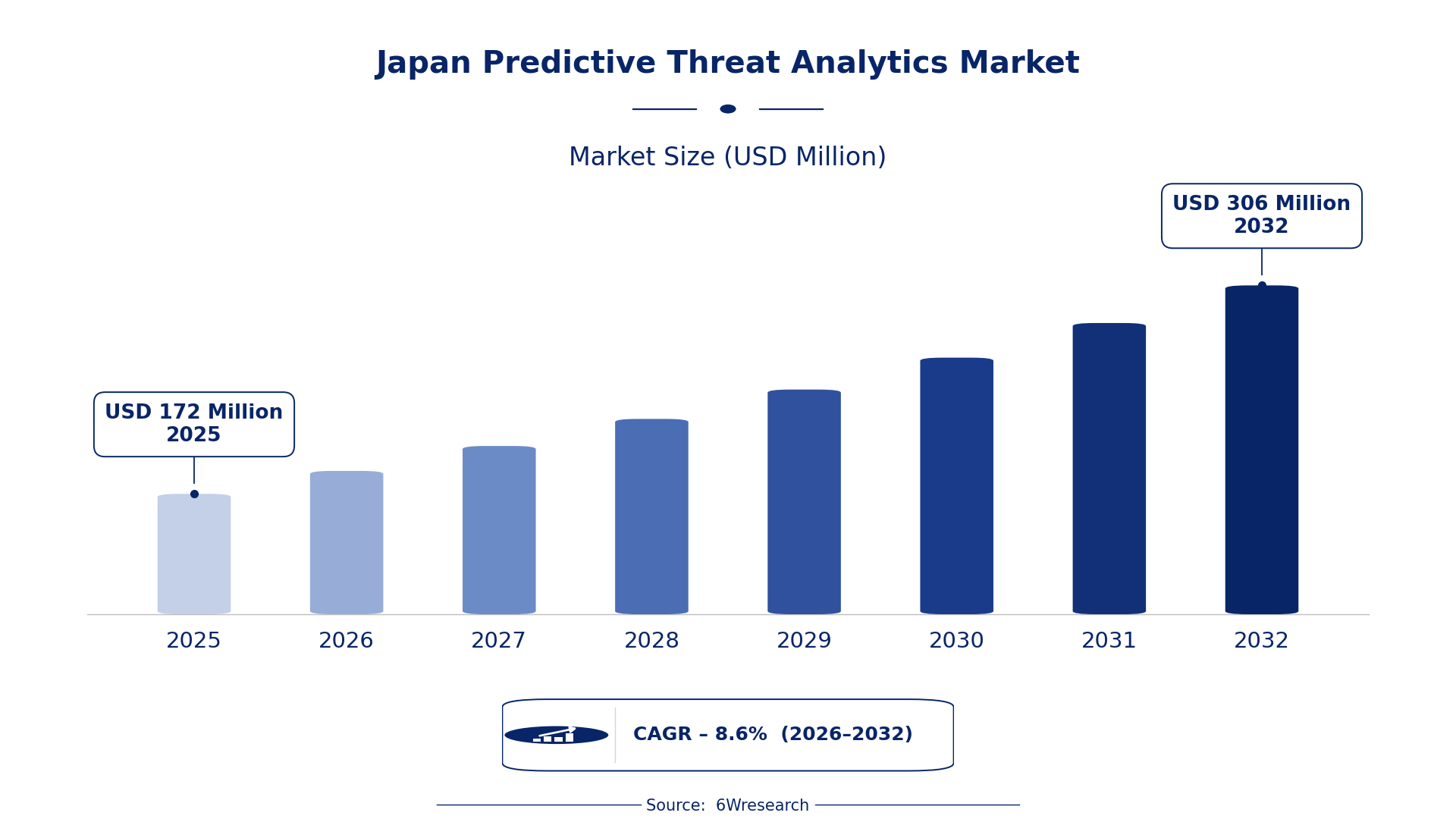
According to 6Wresearch internal database and industry insights, the Japan Predictive Threat Analytics Market was valued at USD 172 Million in 2025 and is projected to reach USD 306 Million by 2032, growing at a CAGR of approximately 8.6% during 2026–2032.
Japan Predictive Threat Analytics Market Highlights
| Report Metric | Details |
| Report Name | Japan Predictive Threat Analytics Market (2026-2032) |
| Market Size 2025 | USD 172 Million |
| Market Size 2032 | USD 306 Million |
| Absolute Growth 2025–2032 | USD 134 Million |
| CAGR 2026–2032 | 8.6% |
| Peak Annual Growth | 10.7% in 2032 |
| Forecast Period | 2026–2032 |
| Historical Data | 2022–2025 |
| Base Year | 2025 |
| Leading Threat Type, 2025 | Cybersecurity Breaches (36% share) |
| Leading Tech Used, 2025 | Behavioral AI (48% share) |
| Leading Distribution Channel, 2025 | Direct Sales (39% share) |
| Leading End User, 2025 | Enterprises (41% share) |
| Fastest-Growing Threat Type | Insider Threat Detection (12.2% CAGR) |
| Fastest-Growing Tech Used | ML Algorithms (11.9% CAGR) |
| Fastest-Growing Distribution Channel | Cybersecurity Providers (11.5% CAGR) |
| Fastest-Growing End User | Data Centers (11.6% CAGR) |
| Growing Sector | Cybersecurity |
| Key End Users | Enterprises, Financial Institutions, Data Centers, Telecom Companies |
Japan Predictive Threat Analytics Market Year-wise Growth Rate and Key Drivers (2022–2032)
This graph illustrates the annual growth rates of the market from 2022 to 2032, highlighting a steady upward trajectory and projected market expansion over the forecast period.
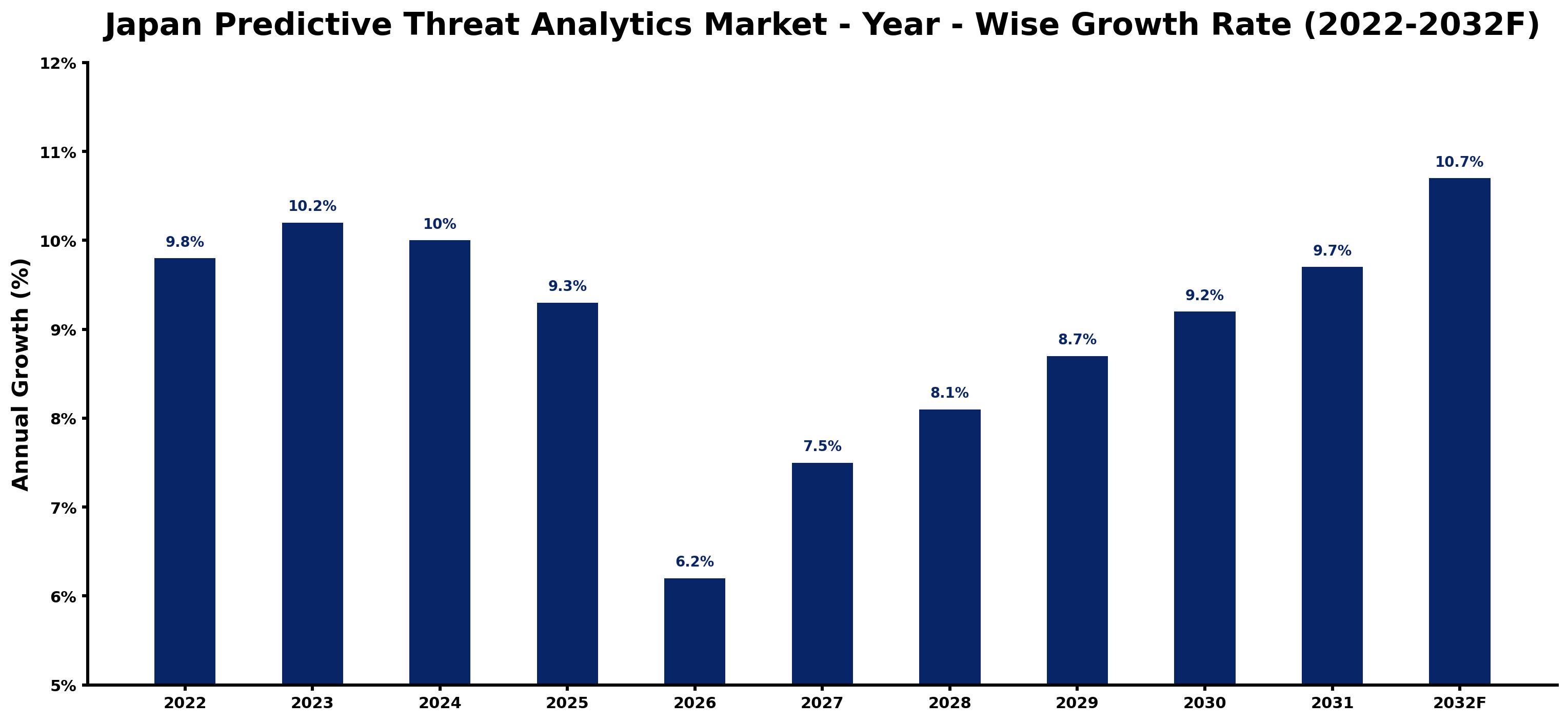
Each row of the following table gives one year's estimated growth and the event or demand shift that explains it.
| Year | Estimated Annual Growth (%) | Market Rationale |
| 2022 | 9.8 | The market showed strong demand as enterprises focused on improving cybersecurity measures. |
| 2023 | 10.2 | Growth accelerated due to increased investments in predictive analytics for threat detection. |
| 2024 | 10.0 | The growth rate slowed slightly as market saturation began to affect new investments. |
| 2025 | 9.3 | A further slowdown occurred as enterprises consolidated existing cybersecurity solutions. |
| 2026 | 6.2 | The market growth rate decreased as companies will face budget constraints amid economic pressures. |
| 2027 | 7.5 | Growth is expected to pick up as new technologies emerge, prompting increased spending on security. |
| 2028 | 8.1 | Demand will rise as more enterprises recognise the importance of advanced threat analytics. |
| 2029 | 8.7 | The growth rate is projected to continue improving with rising awareness of cybersecurity threats. |
| 2030 | 9.2 | Increased regulatory requirements will spur further investments in predictive analytics. |
| 2031 | 9.7 | The market will experience steady growth as cybersecurity becomes a top priority for firms. |
| 2032 | 10.7 | A peak growth rate is expected as enterprises fully embrace predictive threat analytics. |
Note: Market size estimations and growth projections presented in this report are based on 6Wresearch's proprietary forecasting methodology, utilizing the latest available industry data, government publications, and primary research inputs.
Japan Predictive Threat Analytics Market Synopsis
Predictive Threat Analytics is a technology that utilises advanced algorithms and machine learning to foresee and mitigate security threats in digital environments. The Japan Predictive Threat Analytics Market is expanding due to increased investments in digital security, driven primarily by domestic enterprises and financial institutions that require effective security measures. Key growth factors include heightened cybersecurity awareness, the implementation of the 2023 cybersecurity strategy, and the rising adoption of predictive analytics, with over 80% of enterprises in Japan implementing such solutions.
Market Dynamics Impact Analysis (2026–2032)
| Factor | Type | Impact | Primary Segment Affected |
| Increased investments in cybersecurity infrastructure | Driver | High | Cybersecurity Breaches |
| Rising incidents of cyber threats | Driver | High | Insider Threat Detection |
| Growing demand for advanced security solutions | Opportunity | High | Ransomware Prevention |
| Emerging technologies enhancing predictive capabilities | Opportunity | Medium | Network Intrusion Prediction |
| Budget constraints limiting technology adoption | Restraint | High | Cybersecurity Breaches |
| Market saturation affecting new investments | Restraint | Medium | Insider Threat Detection |
| High costs associated with implementing advanced systems | Challenge | High | Ransomware Prevention |
| Compliance with stringent regulations | Challenge | Medium | Network Intrusion Prediction |
Evaluation of Drivers in Japan Predictive Threat Analytics Market (2026–2032)
The table below links each growth driver to the segment it affects and the evidence for it.
| Drivers | Primary Segment Affected | Why It Matters (Evidence) |
| Increased cybersecurity spending by enterprises | Cybersecurity Breaches | In 2023, Japan's cybersecurity market was valued at approximately 1.2 trillion yen, prompting more investments. |
| Growing awareness of insider threats | Insider Threat Detection | Over 80% of enterprises in Japan have implemented predictive analytics for cybersecurity. |
| Rising ransomware attacks necessitating prevention measures | Ransomware Prevention | The average cost of a data breach in Japan is estimated at 100 million yen, driving demand. |
| Need for effective threat management solutions | Network Intrusion Prediction | The establishment of the Cybersecurity Strategy Council in 2023 highlights the focus on threat management. |
| Adoption of international security standards | Cybersecurity Breaches | ISO/IEC 27001 is widely adopted by Japanese enterprises, enhancing security frameworks. |
Spending rises because enterprises are increasingly investing in cybersecurity measures, with the market valued at approximately 1.2 trillion yen in 2023. Over 80% of enterprises have adopted predictive analytics, reflecting a strong focus on reducing insider threats. The average cost of a data breach, estimated at 100 million yen, drives demand for ransomware prevention solutions. The adoption of ISO/IEC 27001 standards strengthens security frameworks, prompting further investments in cybersecurity solutions. The establishment of the Cybersecurity Strategy Council in 2023 highlights the need for effective threat management.
Evaluation of Restraints in Japan Predictive Threat Analytics Market
Several factors work against faster growth; the main ones are summarised below.
| Market Restraint | Primary Segment Affected | Why It Matters (Evidence) |
| Limited budgets for advanced cybersecurity solutions | Cybersecurity Breaches | Many enterprises face financial constraints, hindering their ability to invest in new technologies. |
| Saturation of existing cybersecurity solutions | Insider Threat Detection | As the market matures, new investments are becoming less frequent due to existing implementations. |
| High implementation costs for predictive analytics | Ransomware Prevention | The average cost of a data breach at 100 million yen makes firms cautious about spending. |
| Compliance challenges with evolving regulations | Network Intrusion Prediction | Enterprises must navigate complex regulations, which can delay implementation of new systems. |
| Insufficient skilled workforce in cybersecurity | Cybersecurity Breaches | A shortage of trained professionals limits the ability to adopt advanced solutions effectively. |
Japan Predictive Threat Analytics Market Challenges
Predictive Threat Analytics faces a skills shortage, as many professionals lack expertise in advanced algorithms, delaying project timelines for firms by up to six months. Competition intensifies as domestic enterprises adopt predictive analytics, increasing costs for buyers who must invest more to maintain their security measures. Technology integration issues arise from slow compliance with new cybersecurity strategies, which can take over a year, hindering suppliers' ability to respond to threats. Buyers encounter rising risks, with the average cost of a data breach estimated at 100 million yen, compelling firms to allocate more resources to security.
Trends in the Japan Predictive Threat Analytics Market
The following changes are redrawing the Japan Predictive Threat Analytics Market.
- Shift from Reactive to Predictive Cybersecurity Strategies: Enterprises are increasingly adopting predictive threat analytics to mitigate risks. In 2023, over 80% of enterprises implemented such analytics, indicating a notable shift in approach.
- Emergence of AI-Driven Security Solutions: The integration of AI technologies in cybersecurity is on the rise, with Behavioral AI leading the market. In 2025, it is expected to hold a 48% share, reflecting a growing reliance on AI for threat detection.
- Increased Regulatory Focus on Cybersecurity: The establishment of the Cybersecurity Strategy Council in 2023 highlights regulatory emphasis on improving national security. This focus is likely to drive further investments in predictive analytics solutions.
- Rising Demand for Real-Time Threat Monitoring: Enterprises are prioritising real-time analytics to respond swiftly to threats. The adoption of real-time analytics in Japan is projected to grow significantly, driven by the need for immediate threat response.
Investment Opportunities in the Japan Predictive Threat Analytics Market
Investors looking at the Japan Predictive Threat Analytics Market should consider the following areas.
- Timing for Investment in Predictive Analytics: With over 80% of enterprises implementing predictive analytics in 2023, there is a strong demand for advanced solutions. Investing in this area can yield high returns as firms seek to improve security.
- Growth in Cybersecurity Startups: Tokyo is becoming a hub for cybersecurity startups, with numerous initiatives supporting innovation. This environment presents opportunities for investment in emerging technologies and solutions.
- Need for Advanced Security in Financial Institutions: Financial institutions are under pressure to comply with stringent regulations, creating opportunities for advanced security solutions. Investing in tailored services for this sector can be profitable.
- Expansion of Cybersecurity Services in Data Centers: Data centers are increasingly prioritising security, with a projected growth rate of 11.6% for this segment. Suppliers can enter this market by offering specialised cybersecurity services.
Government Initiatives in the Japan Predictive Threat Analytics Market
The AI Promotion Act established in 2025 creates a national framework for AI research and development, which directly impacts predictive threat analytics by encouraging innovation in security technologies. Additionally, the Digital Agency, established in September 2021, leads government digital transformation efforts, ensuring that cybersecurity measures are integrated into national strategies.
The Japan Computer Security Incident Response Team (JPCERT) plays an important role in incident management, providing support and guidance to enterprises facing cybersecurity threats. The National Institute of Information and Communications Technology (NICT) oversees cybersecurity research and development, approving projects that improve predictive analytics capabilities.
Future Insight of the Japan Predictive Threat Analytics Market
The launch of new cybersecurity incubators in Tokyo will stimulate innovation and offer buyers customised solutions. By 2032, predictive threat analytics will advance through developments in machine learning, improving threat detection capabilities. The enforcement of stringent cybersecurity measures mandated by regulatory bodies will elevate standards across the sector. As over 80% of enterprises implement predictive analytics, suppliers will need to adapt their offerings to meet the growing demand for advanced security solutions.
Market Segmentation Analysis
Japan Predictive Threat Analytics Market report covers a detailed analysis of the following market segments:
By Threat Type – Cybersecurity Breaches Lead, Insider Threat Detection Expected to Grow Fastest
According to Uttkarsh, Research Associate at 6Wresearch, Cybersecurity Breaches accounted for 36% of the market by threat type in 2025. Cybersecurity Breaches are the foremost concern for organisations, as they are essential for safeguarding sensitive information. The high implementation rate of predictive analytics among over 80% of enterprises in Japan highlights the critical nature of this sub-segment. Insider Threat Detection is set to record the highest CAGR in this split, 12.2% over 2026–2032. Insider Threat Detection is rapidly gaining prominence due to heightened awareness of internal vulnerabilities, with organisations increasingly recognising the importance of thorough monitoring systems. This trend is supported by the establishment of the Cybersecurity Strategy Council in 2023 to tackle such risks. Suppliers should prioritise developing solutions for insider threat detection to align with the increasing focus from enterprises.
By Tech Used – Behavioral AI Leads, ML Algorithms Expected to Grow Fastest
The largest tech used category in 2025 was Behavioral AI, at 48% of revenue. Behavioral analytics holds the largest share as it assists in threat detection through the analysis of user interactions, enabling organisations to identify anomalies effectively. Its adoption is prevalent among enterprises aiming to strengthen their security frameworks. Over 2026–2032, ML Algorithms are expected to post the fastest growth, at a CAGR of 11.9%. Machine learning algorithms are experiencing notable growth as they enhance predictive capabilities, allowing for more accurate threat forecasting. The recent cybersecurity strategy from the Ministry of Internal Affairs and Communications highlights their increasing importance in improving security measures. Buyers need to invest in machine learning algorithms to maintain a competitive edge against emerging threats and fortify their cybersecurity frameworks.
By Distribution Channel – Direct Sales Leads, Cybersecurity Providers Expected to Grow Fastest
Direct Sales held 39% of the Japan Predictive Threat Analytics Market by distribution channel in 2025. Direct sales is the primary channel for reaching customers, offering tailored solutions that address specific security needs. This method is essential in a market where personal interaction can significantly influence purchasing decisions. The quickest growth will come from Cybersecurity Providers, forecast to expand at a CAGR of 11.5% between 2026 and 2032. Cybersecurity providers are witnessing the fastest growth as they play a crucial role in delivering comprehensive security solutions to enterprises. Their importance is underscored by the rising number of industry events in Tokyo that facilitate collaboration and knowledge sharing. Suppliers should strengthen partnerships with cybersecurity providers to broaden their market reach and enhance service delivery.
By End User – Enterprises Lead, Data Centers Expected to Grow Fastest
With 41% of end user revenue in 2025, Enterprises was the largest category. Enterprises represent the largest user group in need of protection, facing substantial risks from cyber threats. Their extensive operations and data management require advanced predictive threat analytics solutions to safeguard their critical assets. Data Centers are projected to grow fastest, at a CAGR of 11.6% during 2026–2032. Data centers are rapidly becoming a focal point for security investments, driven by their essential infrastructure that demands robust protection. The average cost of a data breach, estimated at 100 million yen, underscores the urgent need for enhanced security measures in these facilities. Suppliers must tailor their offerings to meet the specific security needs of data centers, capitalising on this growing market segment.
Key Attractiveness of the Report
- 10 Years of Market Numbers
- Historical Data Starting from 2022 to 2025
- Base Year 2025
- Forecast Data until 2032
- Key Performance Indicators Impacting the Market
- Major Upcoming Developments and Projects
Key Highlights of the Report:
- Japan Predictive Threat Analytics Market Outlook
- Market Size of Japan Predictive Threat Analytics Market, 2025
- Forecast of Japan Predictive Threat Analytics Market, 2032
- Historical Data and Forecast of Japan Predictive Threat Analytics Revenues & Volume for the Period 2022-2032F
- Japan Predictive Threat Analytics Market Trend Evolution
- Japan Predictive Threat Analytics Market Drivers and Challenges
- Japan Predictive Threat Analytics Price Trends
- Japan Predictive Threat Analytics Porter's Five Forces
- Japan Predictive Threat Analytics Industry Life Cycle
- Historical Data and Forecast of Japan Predictive Threat Analytics Market Revenues & Volume By Threat Type for the Period 2022-2032F
- Historical Data and Forecast of Japan Predictive Threat Analytics Market Revenues & Volume By Cybersecurity Breaches for the Period 2022-2032F
- Historical Data and Forecast of Japan Predictive Threat Analytics Market Revenues & Volume By Insider Threat Detection for the Period 2022-2032F
- Historical Data and Forecast of Japan Predictive Threat Analytics Market Revenues & Volume By Ransomware Prevention for the Period 2022-2032F
- Historical Data and Forecast of Japan Predictive Threat Analytics Market Revenues & Volume By Network Intrusion Prediction for the Period 2022-2032F
- Historical Data and Forecast of Japan Predictive Threat Analytics Market Revenues & Volume By Tech Used for the Period 2022-2032F
- Historical Data and Forecast of Japan Predictive Threat Analytics Market Revenues & Volume By Behavioral AI for the Period 2022-2032F
- Historical Data and Forecast of Japan Predictive Threat Analytics Market Revenues & Volume By ML Algorithms for the Period 2022-2032F
- Historical Data and Forecast of Japan Predictive Threat Analytics Market Revenues & Volume By Real-Time Analytics for the Period 2022-2032F
- Historical Data and Forecast of Japan Predictive Threat Analytics Market Revenues & Volume By AI Engines for the Period 2022-2032F
- Historical Data and Forecast of Japan Predictive Threat Analytics Market Revenues & Volume By Distribution Channel for the Period 2022-2032F
- Historical Data and Forecast of Japan Predictive Threat Analytics Market Revenues & Volume By Direct Sales for the Period 2022-2032F
- Historical Data and Forecast of Japan Predictive Threat Analytics Market Revenues & Volume By Cybersecurity Providers for the Period 2022-2032F
- Historical Data and Forecast of Japan Predictive Threat Analytics Market Revenues & Volume By Online Platforms for the Period 2022-2032F
- Historical Data and Forecast of Japan Predictive Threat Analytics Market Revenues & Volume By SaaS Vendors for the Period 2022-2032F
- Historical Data and Forecast of Japan Predictive Threat Analytics Market Revenues & Volume By End User for the Period 2022-2032F
- Historical Data and Forecast of Japan Predictive Threat Analytics Market Revenues & Volume By Enterprises for the Period 2022-2032F
- Historical Data and Forecast of Japan Predictive Threat Analytics Market Revenues & Volume By Data Centers for the Period 2022-2032F
- Historical Data and Forecast of Japan Predictive Threat Analytics Market Revenues & Volume By Financial Institutions for the Period 2022-2032F
- Historical Data and Forecast of Japan Predictive Threat Analytics Market Revenues & Volume By Telecom Companies for the Period 2022-2032F
- Japan Predictive Threat Analytics Import Export Trade Statistics
- Market Opportunity Assessment By Threat Type
- Market Opportunity Assessment By Tech Used
- Market Opportunity Assessment By Distribution Channel
- Market Opportunity Assessment By End User
- Japan Predictive Threat Analytics Top Companies Market Share
- Japan Predictive Threat Analytics Competitive Benchmarking By Technical and Operational Parameters
- Japan Predictive Threat Analytics Company Profiles
- Japan Predictive Threat Analytics Key Strategic Recommendations
Market Covered
This report examines the market across the segments below.
By Threat Type
- Cybersecurity Breaches
- Insider Threat Detection
- Ransomware Prevention
- Network Intrusion Prediction
By Tech Used
- Behavioral AI
- ML Algorithms
- Real-Time Analytics
- AI Engines
By Distribution Channel
- Direct Sales
- Cybersecurity Providers
- Online Platforms
- SaaS Vendors
By End User
- Enterprises
- Data Centers
- Financial Institutions
- Telecom Companies































