Japan Process Optimization Software Market Size & Growth Rate
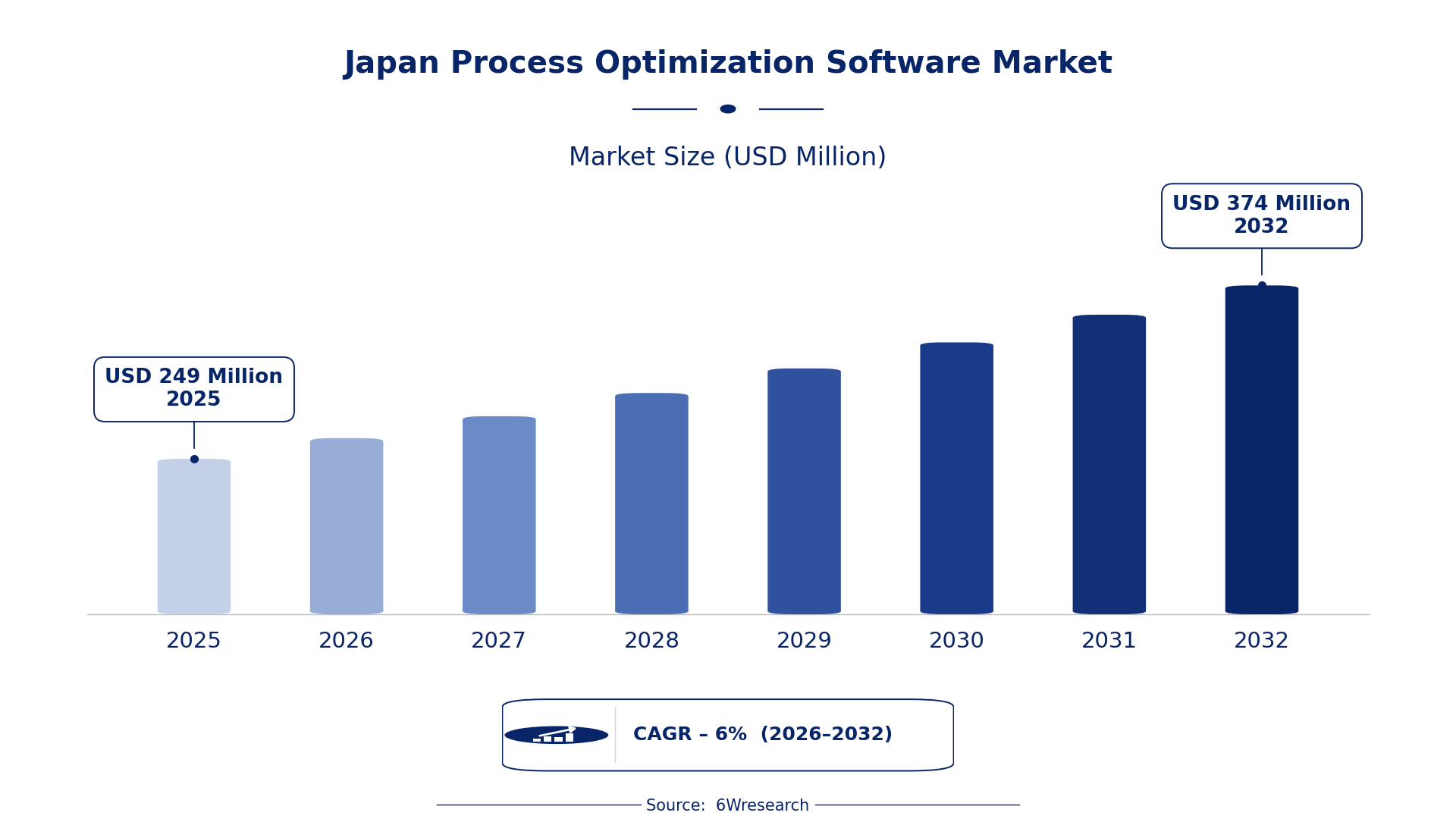
According to 6Wresearch internal database and industry insights, the Japan Process Optimization Software Market was valued at USD 249 Million in 2025 and is projected to reach USD 374 Million by 2032, growing at a CAGR of approximately 6% during 2026–2032.
Japan Process Optimization Software Market Highlights
| Report Metric | Details |
| Report Name | Japan Process Optimization Software Market (2026-2032) |
| Market Size 2025 | USD 249 Million |
| Market Size 2032 | USD 374 Million |
| Absolute Growth 2025–2032 | USD 125 Million |
| CAGR 2026–2032 | 6% |
| Peak Annual Growth | 6.6% in 2028 |
| Forecast Period | 2026–2032 |
| Historical Data | 2022–2025 |
| Base Year | 2025 |
| Leading Software Type, 2025 | Analytics Platforms (51% share) |
| Leading Feature Focus, 2025 | Real-time Analysis (47% share) |
| Leading Platform, 2025 | SaaS (42% share) |
| Leading Distribution Channel, 2025 | Direct Sales (43% share) |
| Leading End User, 2025 | IT and Data Centers (34% share) |
| Fastest-Growing Software Type | Workflow Optimization (8.1% CAGR) |
| Fastest-Growing Feature Focus | AI-Powered (8.6% CAGR) |
| Fastest-Growing Distribution Channel | Online Platforms (7.7% CAGR) |
| Fastest-Growing End User | Managed Service Providers (7.8% CAGR) |
| Growing Sector | IT and Data Centers |
| Key End Users | IT firms, manufacturing companies, telecom infrastructure providers, managed service providers |
Japan Process Optimization Software Market Year-wise Growth Rate and Key Drivers (2022–2032)
This graph illustrates the annual growth rates of the market from 2022 to 2032, highlighting a steady upward trajectory and projected market expansion over the forecast period.
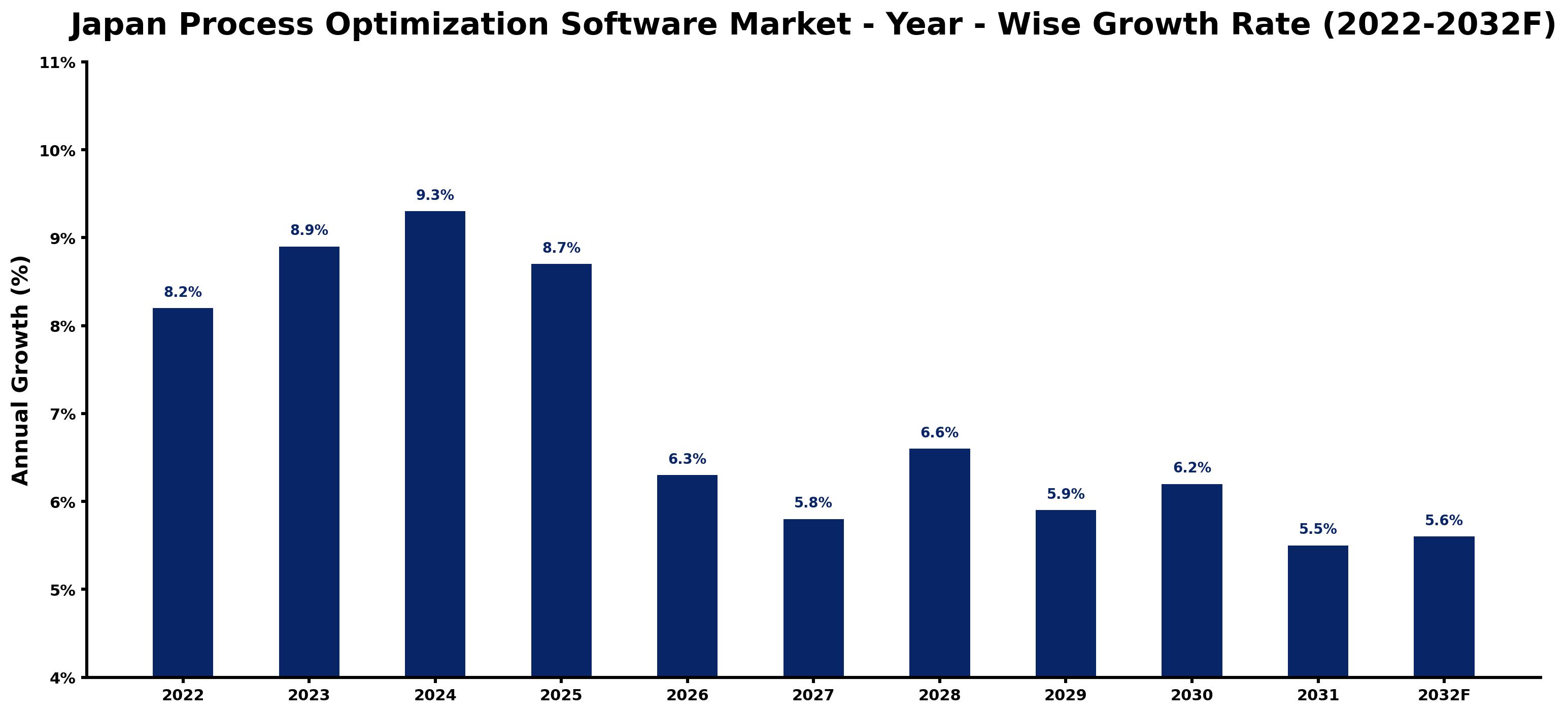
The following figures match every annual growth estimate with the main market development of that year, giving the reasoning behind each rise or slowdown.
| Year | Estimated Annual Growth (%) | Market Rationale |
| 2022 | 8.2 | The market experienced solid growth due to increased demand from IT and manufacturing sectors. |
| 2023 | 8.9 | Growth accelerated as firms adopted advanced analytics for improved decision-making. |
| 2024 | 9.3 | The peak growth rate was driven by heightened investments in digital transformation initiatives. |
| 2025 | 8.7 | Growth slowed slightly as the market began to stabilise after rapid expansion. |
| 2026 | 6.3 | A further slowdown is expected as firms adjust to new operational efficiencies. |
| 2027 | 5.8 | The market will continue to grow, albeit at a reduced rate, as companies focus on cost management. |
| 2028 | 6.6 | Growth is projected to rebound as new automation technologies gain traction across industries. |
| 2029 | 5.9 | The market growth rate will decrease again as saturation in some sectors begins to emerge. |
| 2030 | 6.2 | A slight recovery in growth is anticipated as firms seek to improve operational capabilities. |
| 2031 | 5.5 | Growth will slow as the market matures and competition intensifies among providers. |
| 2032 | 5.6 | The market is projected to maintain steady growth as demand for optimization software remains strong. |
Note: Market size estimations and growth projections presented in this report are based on 6Wresearch's proprietary forecasting methodology, utilizing the latest available industry data, government publications, and primary research inputs.
Japan Process Optimization Software Market Synopsis
Process Optimization Software improves operational efficiency through data analysis and automation. It finds primary application in the IT and manufacturing sectors, enhancing productivity and lowering costs. The Japan Process Optimization Software Market is growing due to increasing demand for data-driven decision-making and digital transformation efforts. The IT sector is expected to achieve a market size of 1.3 trillion JPY by 2025, further driving the adoption of these solutions.
Market Dynamics Impact Analysis (2026–2032)
| Factor | Type | Impact | Primary Segment Affected |
| Increased digital transformation initiatives | Driver | High | Analytics Platforms |
| Growing need for real-time data insights | Driver | High | Real-time Analysis |
| Rising demand for predictive maintenance solutions | Opportunity | High | Predictive Maintenance |
| Expansion of IT infrastructure in urban areas | Opportunity | Medium | IT and Data Centers |
| High initial investment costs for software implementation | Restraint | High | Workflow Optimization |
| Limited awareness of process optimization benefits among SMEs | Restraint | Medium | Automation & Alerts |
| Intense competition among software providers | Challenge | High | SaaS |
| Rapid technological changes requiring constant updates | Challenge | Medium | Desktop/Cloud |
Evaluation of Drivers in Japan Process Optimization Software Market (2026–2032)
The factors lifting demand, and the evidence behind each, are summarised below.
| Drivers | Primary Segment Affected | Why It Matters (Evidence) |
| Increased investments in AI technologies | Analytics Platforms | Japan's IT sector is expected to reach 1.3 trillion JPY by 2025, driving demand for advanced analytics. |
| Rising need for operational efficiency | Real-time Analysis | The average internet speed in Japan is 100 Mbps, facilitating real-time data processing. |
| Growing focus on predictive maintenance | Predictive Maintenance | The Japanese government aims for a 50% AI adoption rate in manufacturing by 2030, boosting demand. |
| Expansion of data centers | Workflow Optimization | The number of data centers in Japan increased by 15% from 2020 to 2023, enhancing operational needs. |
| Demand for cloud-based solutions | SaaS | The adoption rate of cloud computing in Japan is around 30% as of 2023, increasing software use. |
Volumes grow on the back of increased investments in AI technologies, with the IT sector projected to reach 1.3 trillion JPY by 2025. The average internet speed of 100 Mbps supports real-time data processing, prompting more firms to adopt real-time analysis solutions. As the number of data centers increased by 15% from 2020 to 2023, the demand for workflow optimization tools also rose. The target of achieving a 50% AI adoption rate in manufacturing by 2030 is stimulating interest in predictive maintenance solutions. The cloud computing adoption rate of 30% as of 2023 is driving the shift towards SaaS offerings.
Evaluation of Restraints in Japan Process Optimization Software Market
The main factors holding the market back are set out below.
| Market Restraint | Primary Segment Affected | Why It Matters (Evidence) |
| High initial investment costs for software solutions | Workflow Optimization | The average annual salary for IT professionals in Japan is approximately 6 million JPY, impacting hiring costs. |
| Limited awareness of benefits among small businesses | Automation & Alerts | Approximately 70% of SMEs lack knowledge about process optimization, hindering adoption rates. |
| Complex integration with existing systems | Predictive Maintenance | Companies face challenges in integrating new software with legacy systems, delaying implementation by up to six months. |
| Dependence on skilled workforce for implementation | Analytics Platforms | The number of managed service providers in Japan is over 1,000, indicating a competitive talent market. |
| Regulatory compliance challenges | SaaS | The JIS Q 15001 standard for information security management requires rigorous compliance, complicating software deployment. |
Japan Process Optimization Software Market Challenges
Compliance with ISO 9001 standards increases costs for manufacturers, necessitating investments in quality management systems that can postpone product launches by up to six months. Limited cloud computing adoption, currently around 30%, hampers technology integration, resulting in inefficiencies for IT firms dependent on real-time data processing. Rapid growth in data centers has raised operational costs by 15% for service providers requiring infrastructure upgrades. Skills shortages in AI and data analytics impede the workforce's capability to implement optimization software, prolonging project timelines for buyers.
Trends in the Japan Process Optimization Software Market
Four trends stand out in the Japan Process Optimization Software Market.
- Shift from On-Premise to Cloud Solutions: The uptake of cloud-based solutions is on the rise, with SaaS expected to grow at an 8.8% CAGR. This trend is reflected in the increasing number of firms choosing subscription-based software access.
- Emergence of AI-Powered Analytics: AI-powered analytics tools are becoming more popular, with an anticipated CAGR of 8.6%. This trend is fuelled by the demand for advanced data insights in sectors such as manufacturing and IT.
- Increase in Real-Time Data Processing: Real-time data processing is becoming crucial, especially in IT and data centres. The average internet speed in Japan supports this trend, enhancing operational efficiency.
- Focus on Predictive Maintenance Solutions: Predictive maintenance is gaining prominence, driven by the government's initiative for AI adoption in manufacturing. This focus is set to grow as companies aim to reduce downtime.
Investment Opportunities in the Japan Process Optimization Software Market
The following areas offer the clearest openings for investors and suppliers in the Japan Process Optimization Software Market.
- IT and Data Centers Seeking Efficiency: IT and data centers are increasingly looking for process optimization solutions, with a market size of 1.3 trillion JPY by 2025. Collaborating with local software providers can facilitate entry.
- Gap in Predictive Maintenance Solutions: The predictive maintenance market is expanding, with substantial growth potential. Managed service providers can fill this gap by offering tailored solutions to clients.
- Timing for AI Integration: With the government's target of 50% AI adoption in manufacturing by 2030, there is a pressing need for optimization software. Partnering with technology firms can improve market entry.
- Entry through Local Partnerships: Local partnerships with system integrators can help navigate the competitive environment. This approach allows for tailored solutions that meet specific client needs.
Government Initiatives in the Japan Process Optimization Software Market
The AI Promotion Act (2025) introduces a national framework for AI research and development, building upon the previous Industrial Standardization Act. This measure encourages companies to adopt AI technologies, facilitating compliance with industry standards and improving operational efficiencies for Process Optimization Software users.
In 2023, the Japanese government allocated 200 billion JPY for digital transformation initiatives, overseen by the Digital Agency. This funding supports projects aimed at improving IT infrastructure and promoting best practices in data management, benefiting buyers of Process Optimization Software.
Future Insight of the Japan Process Optimization Software Market
The Digital Agency of Japan's initiatives will propel the establishment of new data centres, improving processing capabilities by 2032. The target to increase AI adoption in manufacturing to 50% will streamline operations and enhance productivity. Investment in digital transformation will grow, with 200 billion JPY earmarked for 2023, broadening the availability of advanced optimization solutions. Improved internet speeds will enable more efficient real-time data processing, providing significant benefits for both buyers and suppliers.
Market Segmentation Analysis
Japan Process Optimization Software Market report covers a detailed analysis of the following market segments:
By Software Type – Analytics Platforms Lead, Workflow Optimization Expected to Grow Fastest
According to Uttkarsh, Research Associate at 6Wresearch, the largest software type category in 2025 was Analytics Platforms, at 51% of revenue. Analytics Platforms dominate the market due to their essential role in data-driven decision-making and performance tracking across various sectors. Their importance is underscored by the total installed base of data analytics software in Japan, estimated at 5 million licenses. Workflow Optimization is projected to grow fastest, at a CAGR of 8.1% during 2026–2032. Workflow Optimization is experiencing rapid growth as organisations seek to improve efficiency in their operational processes. The Japanese government's allocation of 200 billion JPY for digital transformation initiatives in 2023 serves as a key driver for this demand. Suppliers should focus on creating solutions that enhance workflow efficiency to capture growing market opportunities.
By Feature Focus – Real-time Analysis Leads, AI-Powered Expected to Grow Fastest
In 2025, Real-time Analysis led the feature focus split with a 47% share. Real-time Analysis holds the largest share as it is vital for providing immediate insights and facilitating timely actions in fast-paced environments. This feature is particularly in demand in sectors like IT and manufacturing, where quick access to data is crucial. AI-Powered is set to record the highest CAGR in this split, 8.6% over 2026–2032. AI-Powered features are growing swiftly as companies increasingly adopt advanced analytics for process improvements. The Japanese government's target to achieve 50% AI adoption in manufacturing by 2030 significantly propels this growth. Buyers will benefit by prioritising solutions that incorporate real-time analysis and advanced analytics functionalities.
By Platform – SaaS Lead and Record the Fastest Growth
With 42% of platform revenue in 2025, SaaS was the largest category. SaaS leads the market because it offers subscription-based access and ease of updates, making it highly attractive for businesses looking to streamline operations. The convenience of SaaS aligns well with the increasing demand for efficient software solutions. SaaS are also forecast to expand faster than any other category, at a CAGR of 8.8% over 2026–2032. SaaS is also the fastest-growing platform, as its model allows for rapid deployment and scalability. The ongoing shift towards cloud computing in Japan, with an adoption rate of around 30%, supports this trend. Suppliers should ensure their offerings are optimised for the SaaS model to capture market opportunities.
By Distribution Channel – Direct Sales Leads, Online Platforms Expected to Grow Fastest
Direct Sales took 43% of distribution channel revenue in 2025, more than any other category. Direct Sales is the leading distribution method for reaching enterprise customers, allowing for tailored solutions and direct engagement. This approach is particularly effective in the IT sector, where understanding specific client needs is essential for success. Over 2026–2032, Online Platforms are expected to post the fastest growth, at a CAGR of 7.7%. Online Platforms are rapidly gaining traction as a preferred distribution channel, reflecting a broader shift towards digital transactions. The presence of over 1,000 managed service providers in Japan is driving this trend. Suppliers must enhance their online presence to effectively engage with a broader customer base.
By End User – IT and Data Centers Lead, Managed Service Providers Expected to Grow Fastest
IT and Data Centers accounted for 34% of the market by end user in 2025. IT and Data Centers are the primary end users of process optimization software, leveraging these solutions to improve operational efficiency and maintain competitiveness. The high demand in this sector is illustrated by the significant number of companies listed on the Tokyo Stock Exchange. Managed Service Providers are projected to grow fastest, at a CAGR of 7.8% during 2026–2032. Managed Service Providers represent the fastest-growing segment as they utilise optimization software to improve service delivery and customer satisfaction. The increasing reliance on outsourced IT services highlights the importance of this growth. Suppliers should tailor their offerings to meet the specific needs of managed service providers to take advantage of this expanding market segment.
Key Attractiveness of the Report
- 10 Years of Market Numbers
- Historical Data Starting from 2022 to 2025
- Base Year 2025
- Forecast Data until 2032
- Key Performance Indicators Impacting the Market
- Major Upcoming Developments and Projects
Key Highlights of the Report:
- Japan Process Optimization Software Market Outlook
- Market Size of Japan Process Optimization Software Market, 2025
- Forecast of Japan Process Optimization Software Market, 2032
- Historical Data and Forecast of Japan Process Optimization Software Revenues & Volume for the Period 2022-2032F
- Japan Process Optimization Software Market Trend Evolution
- Japan Process Optimization Software Market Drivers and Challenges
- Japan Process Optimization Software Price Trends
- Japan Process Optimization Software Porter's Five Forces
- Japan Process Optimization Software Industry Life Cycle
- Historical Data and Forecast of Japan Process Optimization Software Market Revenues & Volume By Software Type for the Period 2022-2032F
- Historical Data and Forecast of Japan Process Optimization Software Market Revenues & Volume By Simulation Tools for the Period 2022-2032F
- Historical Data and Forecast of Japan Process Optimization Software Market Revenues & Volume By Analytics Platforms for the Period 2022-2032F
- Historical Data and Forecast of Japan Process Optimization Software Market Revenues & Volume By Workflow Optimization for the Period 2022-2032F
- Historical Data and Forecast of Japan Process Optimization Software Market Revenues & Volume By Predictive Maintenance for the Period 2022-2032F
- Historical Data and Forecast of Japan Process Optimization Software Market Revenues & Volume By Feature Focus for the Period 2022-2032F
- Historical Data and Forecast of Japan Process Optimization Software Market Revenues & Volume By Process Modeling for the Period 2022-2032F
- Historical Data and Forecast of Japan Process Optimization Software Market Revenues & Volume By Real-time Analysis for the Period 2022-2032F
- Historical Data and Forecast of Japan Process Optimization Software Market Revenues & Volume By Automation & Alerts for the Period 2022-2032F
- Historical Data and Forecast of Japan Process Optimization Software Market Revenues & Volume By AI-Powered for the Period 2022-2032F
- Historical Data and Forecast of Japan Process Optimization Software Market Revenues & Volume By Platform for the Period 2022-2032F
- Historical Data and Forecast of Japan Process Optimization Software Market Revenues & Volume By Desktop/Cloud for the Period 2022-2032F
- Historical Data and Forecast of Japan Process Optimization Software Market Revenues & Volume By SaaS for the Period 2022-2032F
- Historical Data and Forecast of Japan Process Optimization Software Market Revenues & Volume By Hybrid for the Period 2022-2032F
- Historical Data and Forecast of Japan Process Optimization Software Market Revenues & Volume By Embedded Systems for the Period 2022-2032F
- Historical Data and Forecast of Japan Process Optimization Software Market Revenues & Volume By Distribution Channel for the Period 2022-2032F
- Historical Data and Forecast of Japan Process Optimization Software Market Revenues & Volume By Direct Sales for the Period 2022-2032F
- Historical Data and Forecast of Japan Process Optimization Software Market Revenues & Volume By Online Platforms for the Period 2022-2032F
- Historical Data and Forecast of Japan Process Optimization Software Market Revenues & Volume By System Integrators for the Period 2022-2032F
- Historical Data and Forecast of Japan Process Optimization Software Market Revenues & Volume By Specialty Distributors for the Period 2022-2032F
- Historical Data and Forecast of Japan Process Optimization Software Market Revenues & Volume By End User for the Period 2022-2032F
- Historical Data and Forecast of Japan Process Optimization Software Market Revenues & Volume By IT and Data Centers for the Period 2022-2032F
- Historical Data and Forecast of Japan Process Optimization Software Market Revenues & Volume By Telecom Infrastructure Firms for the Period 2022-2032F
- Historical Data and Forecast of Japan Process Optimization Software Market Revenues & Volume By Managed Service Providers for the Period 2022-2032F
- Historical Data and Forecast of Japan Process Optimization Software Market Revenues & Volume By Industrial Tech Firms for the Period 2022-2032F
- Japan Process Optimization Software Import Export Trade Statistics
- Market Opportunity Assessment By Software Type
- Market Opportunity Assessment By Feature Focus
- Market Opportunity Assessment By Platform
- Market Opportunity Assessment By Distribution Channel
- Market Opportunity Assessment By End User
- Japan Process Optimization Software Top Companies Market Share
- Japan Process Optimization Software Competitive Benchmarking By Technical and Operational Parameters
- Japan Process Optimization Software Company Profiles
- Japan Process Optimization Software Key Strategic Recommendations
Market Covered
The study includes the following segmentation.
By Software Type
- Simulation Tools
- Analytics Platforms
- Workflow Optimization
- Predictive Maintenance
By Feature Focus
- Process Modeling
- Real-time Analysis
- Automation & Alerts
- AI-Powered
By Platform
- Desktop/Cloud
- SaaS
- Hybrid
- Embedded Systems
By Distribution Channel
- Direct Sales
- Online Platforms
- System Integrators
- Specialty Distributors
By End User
- IT and Data Centers
- Telecom Infrastructure Firms
- Managed Service Providers
- Industrial Tech Firms































