Japan Public Sector Blockchain Market Size & Growth Rate
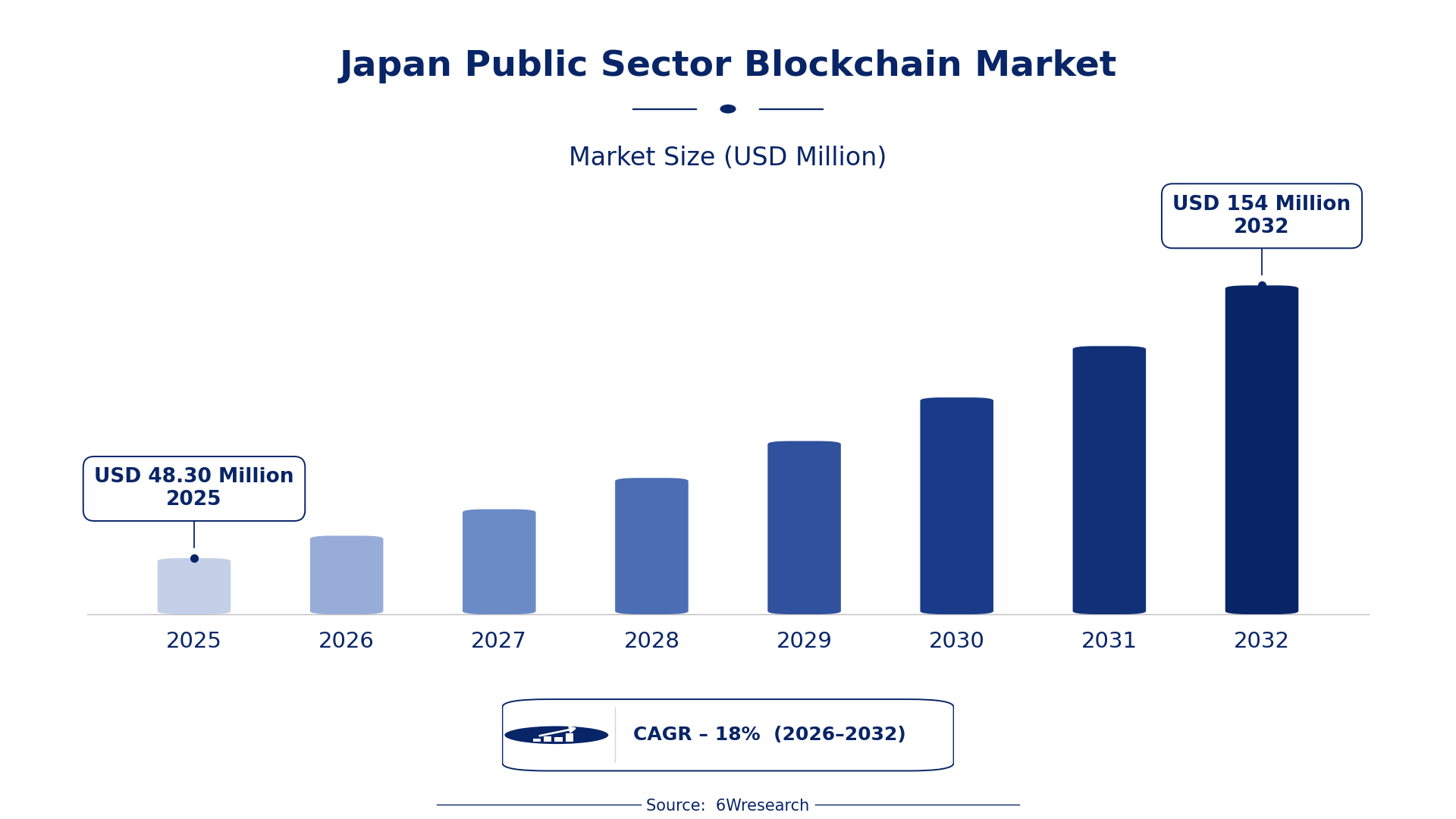
According to 6Wresearch internal database and industry insights, the Japan Public Sector Blockchain Market was valued at USD 48.30 Million in 2025 and is projected to reach USD 154 Million by 2032, growing at a CAGR of approximately 18% during 2026–2032.
Japan Public Sector Blockchain Market Highlights
| Report Metric | Details |
| Report Name | Japan Public Sector Blockchain Market (2026-2032) |
| Market Size 2025 | USD 48.30 Million |
| Market Size 2032 | USD 154 Million |
| Absolute Growth 2025–2032 | USD 105.70 Million |
| CAGR 2026–2032 | 18% |
| Peak Annual Growth | 21.8% in 2026 |
| Forecast Period | 2026–2032 |
| Historical Data | 2022–2025 |
| Base Year | 2025 |
| Leading Application Area, 2025 | Voting Systems (47% share) |
| Leading Blockchain Type, 2025 | Permissioned (53% share) |
| Leading Deployment Type, 2025 | On-Premise (51% share) |
| Leading End User, 2025 | Government Agencies (47% share) |
| Fastest-Growing Application Area | Land Registry (20.5% CAGR) |
| Fastest-Growing Blockchain Type | Consortium (24.1% CAGR) |
| Fastest-Growing End User | Election Commissions (22.1% CAGR) |
| Growing Sector | Land Registry |
| Key End Users | Voting Systems, Land Registry, Identity Management, Supply Chain Tracking |
Japan Public Sector Blockchain Market Year-wise Growth Rate and Key Drivers (2022–2032)
This graph illustrates the annual growth rates of the market from 2022 to 2032, highlighting a steady upward trajectory and projected market expansion over the forecast period.
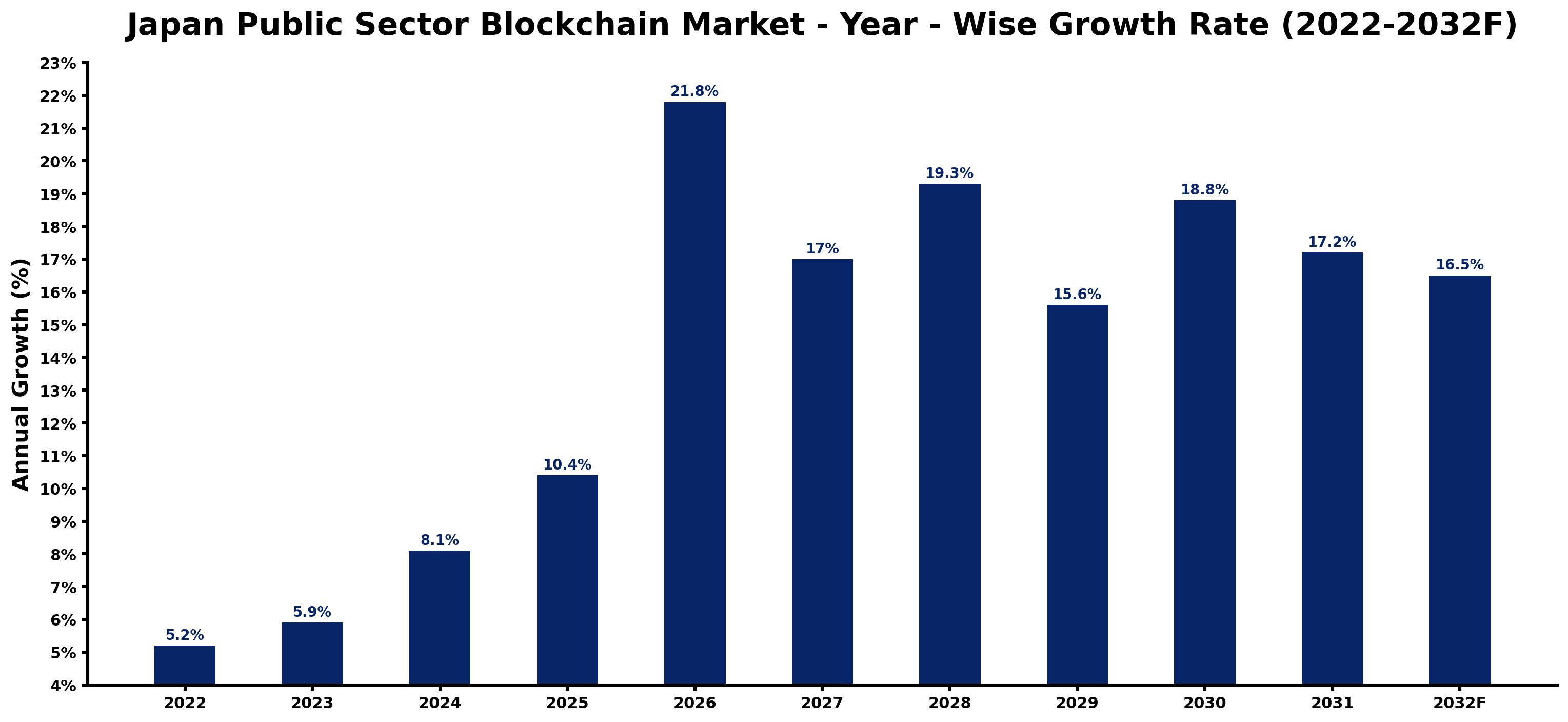
Annual growth estimates for each year appear below with the principal reason behind them, explaining the shifts that set the pace of the market.
| Year | Estimated Annual Growth (%) | Market Rationale |
| 2022 | 5.2 | The market exhibited steady growth as government agencies began exploring blockchain applications. |
| 2023 | 5.9 | Increased pilot programs and initiatives led to faster growth compared to the previous year. |
| 2024 | 8.1 | Adoption of blockchain for identity management and land registry processes accelerated demand. |
| 2025 | 10.4 | The implementation of key projects drove growth in the market. |
| 2026 | 21.8 | The forecast peak year reflects heightened investment in blockchain technologies by public authorities. |
| 2027 | 17.0 | Growth is expected to slow as initial enthusiasm stabilises, but demand will remain strong. |
| 2028 | 19.3 | A rebound in interest for blockchain solutions is anticipated to result in faster growth again. |
| 2029 | 15.6 | Growth is projected to slow slightly as the market matures and competition intensifies. |
| 2030 | 18.8 | Continued investment in digital governance will maintain a healthy growth rate. |
| 2031 | 17.2 | Growth is expected to slow as the market approaches saturation in certain applications. |
| 2032 | 16.5 | The market continues to grow, driven by ongoing initiatives and evolving needs. |
Note: Market size estimations and growth projections presented in this report are based on 6Wresearch's proprietary forecasting methodology, utilizing the latest available industry data, government publications, and primary research inputs.
Japan Public Sector Blockchain Market Synopsis
Public Sector Blockchain encompasses the use of blockchain technology in government operations, enhancing transparency, security, and efficiency in services such as land registration and voting systems. The Japan Public Sector Blockchain Market is on an upward trajectory, spurred by growing government initiatives, with over 50% of local governments investigating blockchain applications. The Tokyo metropolitan area has adopted blockchain for identity verification, while the government has set a goal to improve digital governance by 2025, further accelerating the uptake of blockchain technologies.
Market Dynamics Impact Analysis (2026–2032)
| Factor | Type | Impact | Primary Segment Affected |
| Growing interest in secure voting systems | Driver | High | Voting Systems |
| Increased exploration of blockchain applications by local governments | Driver | High | Identity Management |
| Emerging demand for secure and efficient land registration processes | Opportunity | High | Land Registry |
| Need for enhanced digital governance and transparency in public services | Opportunity | High | Voting Systems |
| Concerns over data privacy and security in public blockchain applications | Restraint | Medium | Public Blockchain |
| Limited understanding of blockchain technology among government officials | Restraint | Medium | Identity Management |
| The challenge of integrating blockchain with existing legacy systems | Challenge | High | On-Premise |
| Regulatory uncertainties surrounding blockchain implementation | Challenge | Medium | Private Blockchain |
Evaluation of Drivers in Japan Public Sector Blockchain Market (2026–2032)
Below are the drivers that matter most for revenue growth, with supporting evidence.
| Drivers | Primary Segment Affected | Why It Matters (Evidence) |
| Government initiatives promoting blockchain adoption | Voting Systems | The Cabinet Office initiated a blockchain project for secure voting systems in elections, building trust in electoral integrity. |
| Pilot programs for land registry | Land Registry | Japan's Ministry of Internal Affairs and Communications launched a blockchain pilot program in 2023 to improve property transaction transparency. |
| Increased local government exploration of blockchain | Identity Management | As of 2023, over 50% of local governments are exploring blockchain applications, leading to more secure citizen identification processes. |
| Research and development in blockchain technology | Private Blockchain | Research initiatives are encouraging investment in secure data management, promoting blockchain adoption in public administration. |
| Adoption of international standards for blockchain security | Voting Systems | ISO/IEC 27001 is being adopted for blockchain security in public sector applications, increasing confidence among agencies. |
Volumes grow on the back of initiatives promoting blockchain adoption, such as a project for secure voting systems that builds trust in electoral integrity. In 2023, over 50% of local governments explored blockchain applications, leading to improved identity management. A pilot program for land registry launched by the Ministry of Internal Affairs and Communications improves transparency in property transactions. Research initiatives support investment in secure data management, encouraging blockchain adoption. The adoption of ISO/IEC 27001 for blockchain security increases confidence among agencies, driving further demand.
Evaluation of Restraints in Japan Public Sector Blockchain Market
The following restraints limit how fast demand can grow.
| Market Restraint | Primary Segment Affected | Why It Matters (Evidence) |
| Concerns over data privacy in public blockchain applications | Public Blockchain | Privacy concerns limit the adoption of public blockchain in government applications, affecting transparency and trust. |
| Limited understanding of blockchain among officials | Identity Management | A lack of knowledge among government officials hinders effective implementation of blockchain solutions, delaying projects. |
| Integration challenges with legacy systems | On-Premise | Existing systems may not easily accommodate blockchain technology, delaying adoption and increasing costs. |
| Regulatory uncertainties surrounding blockchain | Private Blockchain | Unclear regulations can create hesitation among agencies to fully implement blockchain solutions, affecting progress. |
| Budget constraints for blockchain initiatives | Voting Systems | Limited budgets can restrict the scope of blockchain projects in the public sector, delaying advancements. |
Japan Public Sector Blockchain Market Challenges
Slow adoption of blockchain technology in public sector operations presents a major obstacle. This reluctance stems from concerns about data security and the complexity of integrating new systems, leading local governments to incur up to 20% in operational inefficiencies. Supply chain challenges arise as public procurement processes struggle to incorporate blockchain, delaying essential services by six months. Competition for blockchain expertise among local authorities drives up consultancy costs, with some paying 30% more. Skills shortages in blockchain development hinder project progress, stretching timelines by an average of 12 months for public sector initiatives.
Trends in the Japan Public Sector Blockchain Market
These developments are changing demand patterns in the Japan Public Sector Blockchain Market.
- Shift from Traditional to Blockchain-Based Voting Systems: The Tokyo metropolitan area has initiated the use of blockchain for secure voting processes since 2023, expected to boost voter confidence and participation, with over 50% of local governments exploring similar initiatives.
- Growing Adoption of Blockchain for Identity Verification: Government agencies are increasingly leveraging blockchain for identity verification, as demonstrated by the Tokyo metropolitan area's implementation. This trend is likely to streamline public services and enhance security for citizens, with over 50% of local governments involved.
- Transition to Improved Digital Governance: The Japanese government aims to elevate digital governance by 2025 through blockchain technologies. This initiative is projected to enhance service delivery and transparency across various public sectors, with substantial investments in blockchain applications.
- Emergence of Consortium Blockchains in Government: Consortium blockchains are gaining popularity among multiple government entities, promoting collaboration and data sharing. This trend is reflected in pilot projects initiated by local governments, exploring shared blockchain solutions.
Investment Opportunities in the Japan Public Sector Blockchain Market
Investors looking at the Japan Public Sector Blockchain Market should consider the following areas.
- Government Agencies Seeking Secure Solutions: Government agencies in Japan are actively searching for secure solutions, with over 50% exploring blockchain applications. Investing in customised blockchain systems for identity management can fulfil this demand and enhance public service efficiency.
- Investment in Blockchain for Land Registry: With the Ministry of Internal Affairs and Communications launching a pilot programme, there is a considerable need for blockchain solutions in land registry. Suppliers can partner with local governments to deliver tailored solutions.
- Growing Demand for Secure Voting Systems: The Cabinet Office's blockchain project for voting systems underscores the need for secure electoral processes. Suppliers can provide blockchain technologies to bolster voter trust and streamline operations.
- Public Sector Blockchain Education Initiatives: The Japan Blockchain Association is advancing blockchain education among public authorities. Investing in training programmes can address the increasing demand for skilled professionals in blockchain technology.
Government Initiatives in the Japan Public Sector Blockchain Market
The Economic Security Promotion Act (2022) supports supply-chain resilience for designated critical products and materials, which includes blockchain technology. The Digital Agency, established in September 2021, leads government digital transformation and sets common system standards for blockchain applications in public services.
Government agencies utilize the Industrial Standardization Act to ensure compliance with blockchain standards. The Act against Unjustifiable Premiums and Misleading Representations prohibits misleading labelling, impacting how blockchain solutions are marketed and adopted in public sector initiatives.
Future Insight of the Japan Public Sector Blockchain Market
A policy-driven shift will transform Japan's public sector by 2032, concentrating on blockchain integration for enhanced digital governance. Suppliers will respond by developing tailored blockchain solutions, improving efficiency and transparency in public services. Research from the National Institute of Advanced Industrial Science and Technology will stimulate innovation in public administration. Local governments are likely to implement blockchain applications, revolutionising service delivery and citizen engagement.
Market Segmentation Analysis
Japan Public Sector Blockchain Market report covers a detailed analysis of the following market segments:
By Application Area – Voting Systems Lead, Land Registry Expected to Grow Fastest
According to Saurav Kr Singh, Senior Research Analyst at 6Wresearch, in 2025, Voting Systems led the application area split with a 47% share. Voting systems hold the largest share due to their critical role in ensuring secure and tamper-proof voting processes, which are essential for maintaining public trust. The Japanese Cabinet Office's blockchain project for secure voting systems illustrates the government's dedication to this application. The quickest growth will come from Land Registry, forecast to expand at a CAGR of 20.5% between 2026 and 2032. Land registry is growing swiftly as it enhances transparency and efficiency in property transactions, with over 50% of local governments actively exploring blockchain applications. This increasing interest indicates that municipalities are recognising the benefits of implementing blockchain in land registration. Suppliers should concentrate on developing tailored solutions for land registry to capitalise on this expanding interest.
By Blockchain Type – Permissioned Leads, Consortium Expected to Grow Fastest
With 53% of blockchain type revenue in 2025, Permissioned was the largest category. The permissioned blockchain type leads the market because it is essential for controlled access in government applications, ensuring compliance with regulations and data security. This is particularly important in sectors that manage sensitive information, such as public administration. Over 2026–2032, Consortium is expected to post the fastest growth, at a CAGR of 24.1%. Consortium blockchains are experiencing rapid growth as they facilitate collaboration among multiple government entities, promoting shared initiatives and resource optimisation. The trend of agencies pursuing joint blockchain projects is likely to accelerate this segment's growth. Buyers should consider consortium solutions to enhance inter-agency collaboration and improve operational efficiency.
By Deployment Type – On-Premise Leads and Records the Fastest Growth
The largest deployment type category in 2025 was On-Premise, at 51% of revenue. On-premise deployment is the market leader as it is preferred for data security and control, especially in sensitive public sector applications. This preference arises from the need for stringent data protection measures in government operations. On-Premise is also forecast to expand faster than any other category, at a CAGR of 19.1% over 2026–2032. On-premise solutions are also the fastest-growing segment, as they meet the security and control requirements of public sector entities, particularly with the government's increasing digital governance targets. This alignment of security needs with deployment preferences will further strengthen its lead. Suppliers must focus on enhancing on-premise offerings to meet the rising demand for secure solutions.
By End User – Government Agencies Lead, Election Commissions Expected to Grow Fastest
Government Agencies held 47% of the Japan Public Sector Blockchain Market by end user in 2025. Government agencies represent the largest user group for blockchain technology in public services, as they are the primary drivers of innovation and implementation. Their extensive involvement in various public services ensures a steady demand for blockchain solutions. Election Commissions are set to record the highest CAGR in this split, 22.1% over 2026–2032. Election commissions are the fastest-growing end user as they increasingly utilise blockchain for secure voting processes, reflecting the urgent need for integrity in electoral systems. This focus on secure elections will likely lead to further investments in blockchain technology. Vendors should tailor their offerings to meet the specific needs of election commissions to capture this emerging opportunity.
Key Attractiveness of the Report
- 10 Years of Market Numbers
- Historical Data Starting from 2022 to 2025
- Base Year 2025
- Forecast Data until 2032
- Key Performance Indicators Impacting the Market
- Major Upcoming Developments and Projects
Key Highlights of the Report:
- Japan Public Sector Blockchain Market Outlook
- Market Size of Japan Public Sector Blockchain Market, 2025
- Forecast of Japan Public Sector Blockchain Market, 2032
- Historical Data and Forecast of Japan Public Sector Blockchain Revenues & Volume for the Period 2022-2032F
- Japan Public Sector Blockchain Market Trend Evolution
- Japan Public Sector Blockchain Market Drivers and Challenges
- Japan Public Sector Blockchain Price Trends
- Japan Public Sector Blockchain Porter's Five Forces
- Japan Public Sector Blockchain Industry Life Cycle
- Historical Data and Forecast of Japan Public Sector Blockchain Market Revenues & Volume By Application Area for the Period 2022-2032F
- Historical Data and Forecast of Japan Public Sector Blockchain Market Revenues & Volume By Land Registry for the Period 2022-2032F
- Historical Data and Forecast of Japan Public Sector Blockchain Market Revenues & Volume By Identity Management for the Period 2022-2032F
- Historical Data and Forecast of Japan Public Sector Blockchain Market Revenues & Volume By Supply Chain Tracking for the Period 2022-2032F
- Historical Data and Forecast of Japan Public Sector Blockchain Market Revenues & Volume By Voting Systems for the Period 2022-2032F
- Historical Data and Forecast of Japan Public Sector Blockchain Market Revenues & Volume By Blockchain Type for the Period 2022-2032F
- Historical Data and Forecast of Japan Public Sector Blockchain Market Revenues & Volume By Permissioned for the Period 2022-2032F
- Historical Data and Forecast of Japan Public Sector Blockchain Market Revenues & Volume By Public Blockchain for the Period 2022-2032F
- Historical Data and Forecast of Japan Public Sector Blockchain Market Revenues & Volume By Consortium for the Period 2022-2032F
- Historical Data and Forecast of Japan Public Sector Blockchain Market Revenues & Volume By Private Blockchain for the Period 2022-2032F
- Historical Data and Forecast of Japan Public Sector Blockchain Market Revenues & Volume By Deployment Type for the Period 2022-2032F
- Historical Data and Forecast of Japan Public Sector Blockchain Market Revenues & Volume By On-Premise for the Period 2022-2032F
- Historical Data and Forecast of Japan Public Sector Blockchain Market Revenues & Volume By Cloud-Based for the Period 2022-2032F
- Historical Data and Forecast of Japan Public Sector Blockchain Market Revenues & Volume By Hybrid for the Period 2022-2032F
- Historical Data and Forecast of Japan Public Sector Blockchain Market Revenues & Volume By Blockchain-as-a-Service for the Period 2022-2032F
- Historical Data and Forecast of Japan Public Sector Blockchain Market Revenues & Volume By End User for the Period 2022-2032F
- Historical Data and Forecast of Japan Public Sector Blockchain Market Revenues & Volume By Government Agencies for the Period 2022-2032F
- Historical Data and Forecast of Japan Public Sector Blockchain Market Revenues & Volume By Public Authorities for the Period 2022-2032F
- Historical Data and Forecast of Japan Public Sector Blockchain Market Revenues & Volume By Customs Departments for the Period 2022-2032F
- Historical Data and Forecast of Japan Public Sector Blockchain Market Revenues & Volume By Election Commissions for the Period 2022-2032F
- Japan Public Sector Blockchain Import Export Trade Statistics
- Market Opportunity Assessment By Application Area
- Market Opportunity Assessment By Blockchain Type
- Market Opportunity Assessment By Deployment Type
- Market Opportunity Assessment By End User
- Japan Public Sector Blockchain Top Companies Market Share
- Japan Public Sector Blockchain Competitive Benchmarking By Technical and Operational Parameters
- Japan Public Sector Blockchain Company Profiles
- Japan Public Sector Blockchain Key Strategic Recommendations
Market Covered
Coverage by segment is as follows.
By Application Area
- Land Registry
- Identity Management
- Supply Chain Tracking
- Voting Systems
By Blockchain Type
- Permissioned
- Public Blockchain
- Consortium
- Private Blockchain
By Deployment Type
- On-Premise
- Cloud-Based
- Hybrid
- Blockchain-as-a-Service
By End User
- Government Agencies
- Public Authorities
- Customs Departments
- Election Commissions































