Japan Quantitative Trading Market Size & Growth Rate
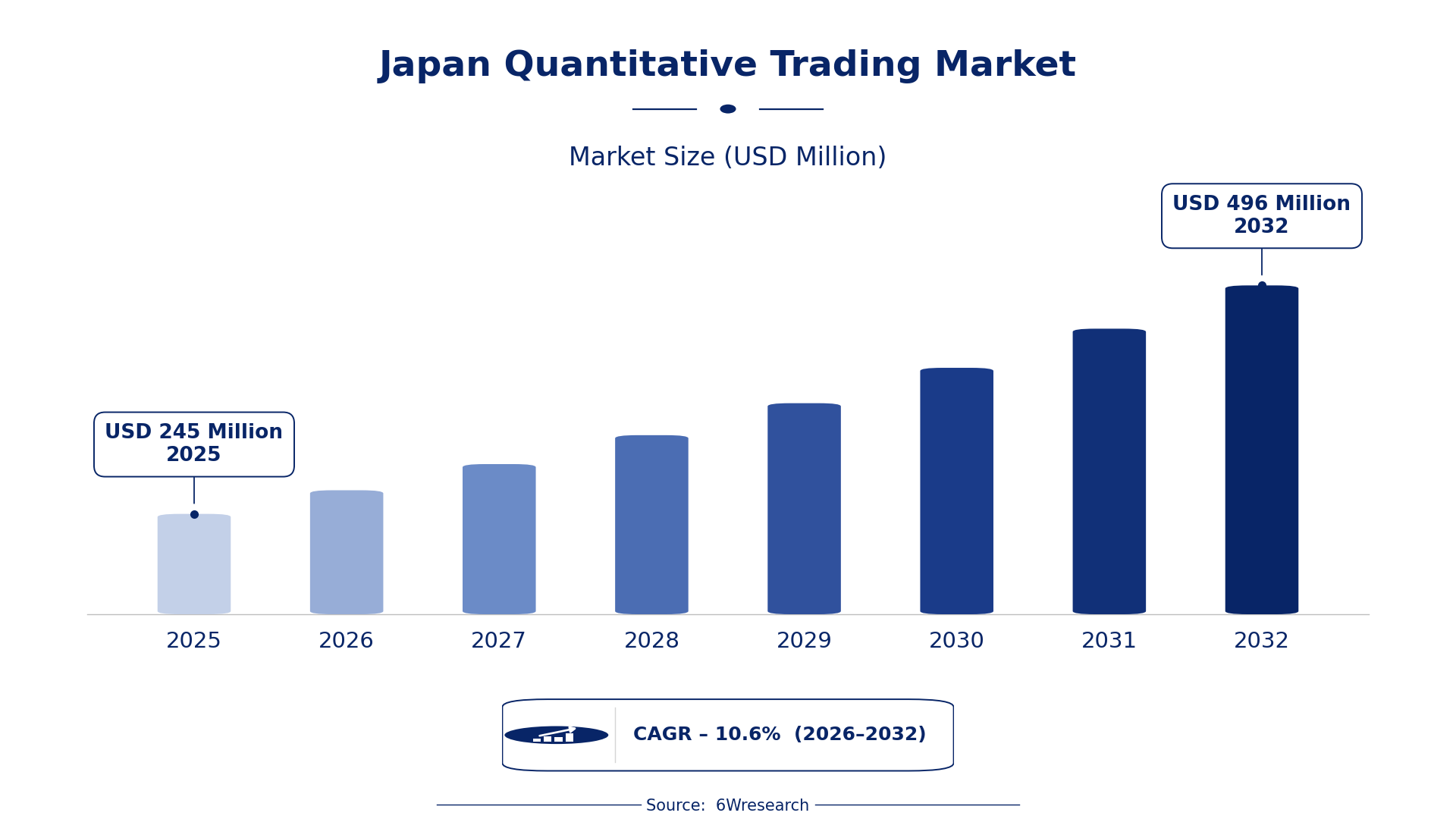
According to 6Wresearch internal database and industry insights, the Japan Quantitative Trading Market was valued at USD 245 Million in 2025 and is projected to reach USD 496 Million by 2032, growing at a CAGR of approximately 10.6% during 2026–2032.
Japan Quantitative Trading Market Highlights
| Report Metric | Details |
| Report Name | Japan Quantitative Trading Market (2026-2032) |
| Market Size 2025 | USD 245 Million |
| Market Size 2032 | USD 496 Million |
| Absolute Growth 2025–2032 | USD 251 Million |
| CAGR 2026–2032 | 10.6% |
| Peak Annual Growth | 11.3% in 2031 |
| Forecast Period | 2026–2032 |
| Historical Data | 2022–2025 |
| Base Year | 2025 |
| Leading Trading Strategy, 2025 | High-Frequency Trading (46% share) |
| Leading Instrument Type, 2025 | Stocks/Futures (42% share) |
| Leading Data Source, 2025 | Market Feeds (50% share) |
| Leading End User, 2025 | Hedge Funds (38% share) |
| Fastest-Growing Trading Strategy | Statistical Arbitrage (13.6% CAGR) |
| Fastest-Growing Instrument Type | ETFs/Currencies (15.1% CAGR) |
| Fastest-Growing End User | Quantitative Funds (13.5% CAGR) |
| Growing Sector | Quantitative Trading |
| Key End Users | Hedge Funds, Investment Firms, Quantitative Funds, Algorithmic Traders |
Japan Quantitative Trading Market Year-wise Growth Rate and Key Drivers (2022–2032)
This graph illustrates the annual growth rates of the market from 2022 to 2032, highlighting a steady upward trajectory and projected market expansion over the forecast period.
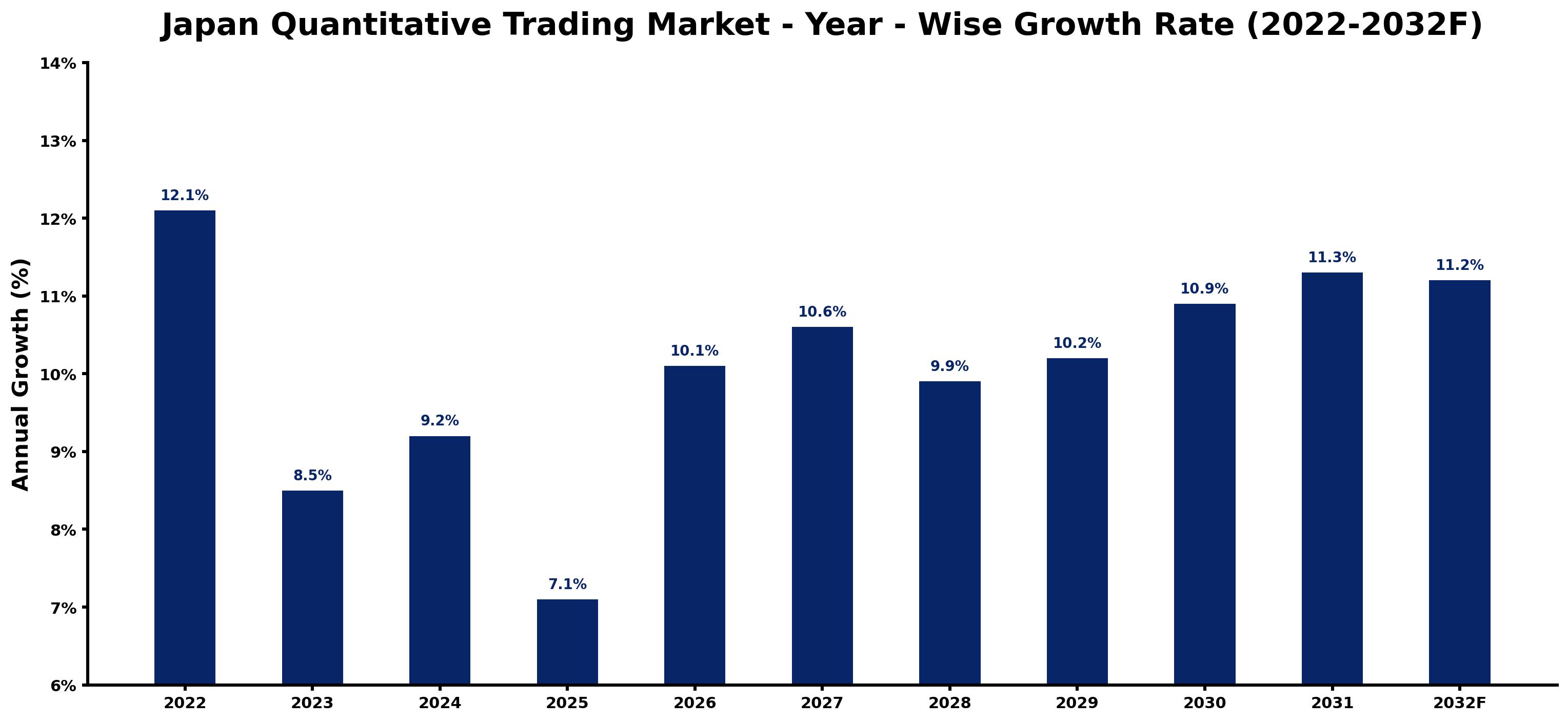
The table below sets out the estimated growth rate for each year and the main factor behind it.
| Year | Estimated Annual Growth (%) | Market Rationale |
| 2022 | 12.1 | The market showed strong activity with demand from hedge funds and investment firms. |
| 2023 | 8.5 | Growth slowed due to market adjustments and regulatory changes impacting trading strategies. |
| 2024 | 9.2 | Increased adoption of algorithmic trading models drove faster growth compared to the previous year. |
| 2025 | 7.1 | Market volatility affected trading volumes and strategies, leading to slower growth. |
| 2026 | 10.1 | A resurgence in quantitative strategies is expected to lead to faster growth as firms adapt to market conditions. |
| 2027 | 10.6 | Continued investment in technology and data analytics is projected to support further growth in the market. |
| 2028 | 9.9 | Growth is expected to slow as firms face challenges in maintaining competitive advantages in trading. |
| 2029 | 10.2 | An uptick in trading activity among investment firms will contribute to faster growth in the market. |
| 2030 | 10.9 | Technological advancements in trading algorithms will support continued market expansion. |
| 2031 | 11.3 | The market is projected to peak with high demand for quantitative trading strategies from various sectors. |
| 2032 | 11.2 | Growth is expected to slow slightly as firms consolidate strategies and adapt to market changes. |
Note: Market size estimations and growth projections presented in this report are based on 6Wresearch's proprietary forecasting methodology, utilizing the latest available industry data, government publications, and primary research inputs.
Japan Quantitative Trading Market Synopsis
Quantitative trading employs mathematical models and algorithms to execute trades rapidly, capitalising on market inefficiencies. In Japan, the Japan Quantitative Trading Market thrives in Tokyo, where over 200 hedge funds utilise quantitative strategies. Growth arises from the rising adoption of AI-driven models, with quantitative funds managing assets exceeding ¥10 trillion, alongside new regulatory guidelines that improve market stability and efficiency.
Market Dynamics Impact Analysis (2026–2032)
| Factor | Type | Impact | Primary Segment Affected |
| Growing adoption of algorithmic trading models | Driver | High | High-Frequency Trading |
| Increasing investment in quantitative strategies by hedge funds | Driver | High | Quantitative Funds |
| Expansion of trading platforms in Tokyo | Opportunity | High | Stocks/Futures |
| Rising demand for advanced data analytics tools | Opportunity | Medium | Market Feeds |
| Regulatory compliance costs impacting profitability | Restraint | High | Algorithmic Traders |
| Market volatility affecting trading strategies | Restraint | Medium | Statistical Arbitrage |
| High costs of technology implementation | Challenge | High | Hedge Funds |
| Intense competition among trading firms | Challenge | Medium | Investment Firms |
Evaluation of Drivers in Japan Quantitative Trading Market (2026–2032)
The following drivers explain most of the expected growth.
| Drivers | Primary Segment Affected | Why It Matters (Evidence) |
| Increased investment in AI-driven trading models | Quantitative Funds | As of 2023, quantitative funds manage assets exceeding ¥10 trillion, driving demand for sophisticated trading solutions. |
| High-frequency trading strategies gaining traction | High-Frequency Trading | The concentration of over 200 hedge funds in Tokyo boosts demand for high-speed trading solutions. |
| Growing need for real-time data feeds | Market Feeds | Real-time data feeds accounted for 50% of trading strategies, allowing firms to react swiftly to market changes. |
| Adoption of statistical arbitrage techniques | Statistical Arbitrage | Statistical arbitrage uses historical data, appealing to firms seeking to exploit market inefficiencies. |
| Expansion of trading options and futures | Stocks/Futures | The Tokyo Financial Exchange provides essential platforms for executing diverse trading strategies. |
Volumes grow on the back of increased investment in AI-driven trading models, with quantitative funds managing assets exceeding ¥10 trillion as of 2023. The concentration of over 200 hedge funds in Tokyo fuels demand for high-frequency trading solutions, improving execution speed. Real-time data feeds account for 50% of trading strategies, allowing firms to react swiftly to market changes. The adoption of statistical arbitrage techniques appeals to firms aiming to exploit inefficiencies, while the Tokyo Financial Exchange supports the expansion of trading options and futures essential for executing diverse strategies.
Evaluation of Restraints in Japan Quantitative Trading Market
These restraints slow adoption and weigh on supplier margins.
| Market Restraint | Primary Segment Affected | Why It Matters (Evidence) |
| Regulatory compliance costs impacting profitability | Algorithmic Traders | The Financial Services Agency's guidelines increase operational costs, affecting profit margins for algorithmic traders. |
| Market volatility affecting trading strategies | Statistical Arbitrage | Fluctuating market conditions challenge the effectiveness of statistical arbitrage strategies, leading to potential losses. |
| High costs of technology implementation | Hedge Funds | Investment in advanced trading technology can exceed ¥1 billion, straining budgets for smaller hedge funds. |
| Limited access to high-quality data sources | Quantitative Funds | Dependence on premium data feeds can restrict smaller funds' ability to compete effectively. |
| Intense competition among trading firms | Investment Firms | The proliferation of trading firms in Tokyo increases competition, making it difficult for new entrants to gain market share. |
Japan Quantitative Trading Market Challenges
High operational costs arise from the need for advanced software and data analysis, with some hedge funds facing expenses exceeding ¥500 million annually. Competition intensifies as over 200 hedge funds in Tokyo vie for market share, which compresses profit margins for smaller firms. Regulatory changes from the Financial Services Agency introduce new guidelines for algorithmic trading, causing delays of up to six months for many firms in implementing strategies. Buyers encounter limited access to varied trading strategies, as a significant number of funds focus primarily on statistical arbitrage, restricting their investment choices in a saturated market.
Trends in the Japan Quantitative Trading Market
The following changes are redrawing the Japan Quantitative Trading Market.
- Shift towards AI-driven trading models: In 2023, investment firms in Japan increasingly adopted AI-driven quantitative trading models, with over 30% of hedge funds implementing these strategies to improve decision-making.
- Transition to algorithmic trading solutions: The introduction of new algorithmic trading guidelines in 2023 prompted over 50% of investment firms to shift towards automated trading solutions, boosting efficiency.
- Growth in statistical arbitrage strategies: Statistical arbitrage has gained popularity among Japanese quantitative funds, with a 13.6% CAGR projected through 2032, as firms use historical data for trading opportunities.
- Expansion of trading platforms in Tokyo: The Tokyo Financial Exchange has seen a 20% increase in trading volumes for options and futures, reflecting the growing demand for diverse trading instruments.
Investment Opportunities in the Japan Quantitative Trading Market
The openings below show where demand in the Japan Quantitative Trading Market is visible and how suppliers can enter.
- Tokyo Financial Exchange expansion: The Tokyo Financial Exchange is enhancing its trading platforms, with a 20% increase in trading volumes expected, creating opportunities for firms to offer advanced trading solutions.
- Demand for advanced data analytics tools: With 50% of trading strategies relying on real-time data feeds, firms can invest in analytics tools to meet the increasing needs of quantitative traders.
- Interest from hedge funds: Hedge funds are increasingly seeking advanced quantitative strategies, with over 200 operating in Japan, presenting opportunities for service providers to cater to this demand.
- Partnerships with technology firms: Forming joint ventures with technology firms can help trading companies improve their algorithmic capabilities, tapping into the rising demand for AI-driven solutions.
Government Initiatives in the Japan Quantitative Trading Market
The Financial Services Agency introduced new guidelines for algorithmic trading in 2023, improving market stability and compliance requirements for quantitative trading firms. This measure builds on the existing framework established by the Japan Securities Dealers Association, which regulates trading practices and standards, ensuring a secure trading environment for all participants.
The Digital Agency oversees the implementation of digital transformation initiatives in Japan. It funds projects aimed at improving the efficiency of trading systems and promotes common standards for data sharing among trading firms, facilitating smoother operations in the quantitative trading market.
Future Insight of the Japan Quantitative Trading Market
A shift in policy will drive improvements in algorithmic trading practices, encouraging firms to implement advanced AI models for greater efficiency. The Financial Services Agency will continue to refine its guidelines, promoting compliance and transparency that will enhance investor trust. As the Tokyo Financial Exchange upgrades its infrastructure, firms will experience quicker trade execution and superior data analytics capabilities. Quantitative trading assets are expected to exceed ¥20 trillion, reflecting strong growth potential in the sector.
Market Segmentation Analysis
Japan Quantitative Trading Market report covers a detailed analysis of the following market segments:
By Trading Strategy – High-Frequency Trading Leads, Statistical Arbitrage Expected to Grow Fastest
According to Saurav Kr Singh, Senior Research Analyst at 6Wresearch, High-Frequency Trading took 46% of trading strategy revenue in 2025, more than any other category. High-Frequency Trading commands the largest share as it allows traders to execute transactions at exceptional speeds, taking advantage of minor price changes. This method is widely adopted by numerous hedge funds in Japan, which rely on it to maintain a competitive edge in the market. Statistical Arbitrage is set to record the highest CAGR in this split, 13.6% over 2026–2032. Statistical Arbitrage is experiencing rapid growth by utilising statistical models to identify lucrative trading opportunities, appealing to funds aiming to optimise their returns. The increasing sophistication of data analysis techniques among Japanese funds is likely to further enhance this segment's growth trajectory. Suppliers must focus on providing advanced technological solutions that cater to both high-frequency trading and statistical arbitrage strategies.
By Instrument Type – Stocks/Futures Lead, ETFs/Currencies Expected to Grow Fastest
Stocks/Futures accounted for 42% of the market by instrument type in 2025. Stocks/Futures hold the largest share as they are the primary instruments for quantitative trading, offering high liquidity and volatility essential for executing strategies. Their widespread use among hedge funds in Japan underscores their importance in the market. ETFs/Currencies are projected to grow fastest, at a CAGR of 15.1% during 2026–2032. ETFs/Currencies are growing quickly due to their ability to provide diversification and ease of trading, which is increasingly appealing to quantitative strategies. The shift towards these instruments reflects the evolving preferences of traders seeking flexibility in their portfolios. Buyers should consider diversifying their strategies to include ETFs and currencies to adapt to market trends.
By Data Source – Market Feeds Lead and Record the Fastest Growth
Market Feeds held 50% of the Japan Quantitative Trading Market by data source in 2025. Market Feeds are crucial as they deliver real-time data essential for executing trades effectively, which is vital in the fast-paced environment of quantitative trading. The dependence on precise and timely data feeds underscores their importance in the operations of trading firms across Japan. The same category are also set to grow fastest, at a CAGR of 12.3% during 2026–2032. Market Feeds are also the fastest-growing segment due to the rising demand for real-time data in trading, which significantly enhances decision-making processes. As firms increasingly adopt sophisticated trading models, the necessity for reliable data sources will continue to escalate. Data feed suppliers must ensure the provision of high-quality, real-time information to meet the growing demands of quantitative traders.
By End User – Hedge Funds Lead, Quantitative Funds Expected to Grow Fastest
With 38% of end user revenue in 2025, Hedge Funds was the largest category. Hedge Funds constitute the largest user group as they extensively leverage quantitative trading strategies to enhance their investment performance. The management of assets exceeding ¥10 trillion by these funds highlights their substantial impact on the market landscape. The quickest growth will come from Quantitative Funds, forecast to expand at a CAGR of 13.5% between 2026 and 2032. Quantitative Funds are the fastest-growing segment as they are specifically designed to implement quantitative trading strategies, drawing in more investors interested in data-centric approaches. The increasing complexity of trading models within these funds is propelling their rapid expansion. Suppliers should customise their offerings to align with the specific requirements of quantitative funds to effectively tap into this growing market segment.
Key Attractiveness of the Report
- 10 Years of Market Numbers
- Historical Data Starting from 2022 to 2025
- Base Year 2025
- Forecast Data until 2032
- Key Performance Indicators Impacting the Market
- Major Upcoming Developments and Projects
Key Highlights of the Report:
- Japan Quantitative Trading Market Outlook
- Market Size of Japan Quantitative Trading Market, 2025
- Forecast of Japan Quantitative Trading Market, 2032
- Historical Data and Forecast of Japan Quantitative Trading Revenues & Volume for the Period 2022-2032F
- Japan Quantitative Trading Market Trend Evolution
- Japan Quantitative Trading Market Drivers and Challenges
- Japan Quantitative Trading Price Trends
- Japan Quantitative Trading Porter's Five Forces
- Japan Quantitative Trading Industry Life Cycle
- Historical Data and Forecast of Japan Quantitative Trading Market Revenues & Volume By Trading Strategy for the Period 2022-2032F
- Historical Data and Forecast of Japan Quantitative Trading Market Revenues & Volume By High-Frequency Trading for the Period 2022-2032F
- Historical Data and Forecast of Japan Quantitative Trading Market Revenues & Volume By Arbitrage Strategies for the Period 2022-2032F
- Historical Data and Forecast of Japan Quantitative Trading Market Revenues & Volume By Momentum Trading for the Period 2022-2032F
- Historical Data and Forecast of Japan Quantitative Trading Market Revenues & Volume By Statistical Arbitrage for the Period 2022-2032F
- Historical Data and Forecast of Japan Quantitative Trading Market Revenues & Volume By Instrument Type for the Period 2022-2032F
- Historical Data and Forecast of Japan Quantitative Trading Market Revenues & Volume By Stocks/Futures for the Period 2022-2032F
- Historical Data and Forecast of Japan Quantitative Trading Market Revenues & Volume By ETFs/Currencies for the Period 2022-2032F
- Historical Data and Forecast of Japan Quantitative Trading Market Revenues & Volume By Equities for the Period 2022-2032F
- Historical Data and Forecast of Japan Quantitative Trading Market Revenues & Volume By Options for the Period 2022-2032F
- Historical Data and Forecast of Japan Quantitative Trading Market Revenues & Volume By Data Source for the Period 2022-2032F
- Historical Data and Forecast of Japan Quantitative Trading Market Revenues & Volume By Market Feeds for the Period 2022-2032F
- Historical Data and Forecast of Japan Quantitative Trading Market Revenues & Volume By Price Discrepancy for the Period 2022-2032F
- Historical Data and Forecast of Japan Quantitative Trading Market Revenues & Volume By Price Trends for the Period 2022-2032F
- Historical Data and Forecast of Japan Quantitative Trading Market Revenues & Volume By Historical Data for the Period 2022-2032F
- Historical Data and Forecast of Japan Quantitative Trading Market Revenues & Volume By End User for the Period 2022-2032F
- Historical Data and Forecast of Japan Quantitative Trading Market Revenues & Volume By Hedge Funds for the Period 2022-2032F
- Historical Data and Forecast of Japan Quantitative Trading Market Revenues & Volume By Quantitative Funds for the Period 2022-2032F
- Historical Data and Forecast of Japan Quantitative Trading Market Revenues & Volume By Investment Firms for the Period 2022-2032F
- Historical Data and Forecast of Japan Quantitative Trading Market Revenues & Volume By Algorithmic Traders for the Period 2022-2032F
- Japan Quantitative Trading Import Export Trade Statistics
- Market Opportunity Assessment By Trading Strategy
- Market Opportunity Assessment By Instrument Type
- Market Opportunity Assessment By Data Source
- Market Opportunity Assessment By End User
- Japan Quantitative Trading Top Companies Market Share
- Japan Quantitative Trading Competitive Benchmarking By Technical and Operational Parameters
- Japan Quantitative Trading Company Profiles
- Japan Quantitative Trading Key Strategic Recommendations
Market Covered
The following segment groups are covered in the report.
By Trading Strategy
- High-Frequency Trading
- Arbitrage Strategies
- Momentum Trading
- Statistical Arbitrage
By Instrument Type
- Stocks/Futures
- ETFs/Currencies
- Equities
- Options
By Data Source
- Market Feeds
- Price Discrepancy
- Price Trends
- Historical Data
By End User
- Hedge Funds
- Quantitative Funds
- Investment Firms
- Algorithmic Traders































