Japan Railway Signaling System Market Size & Growth Rate
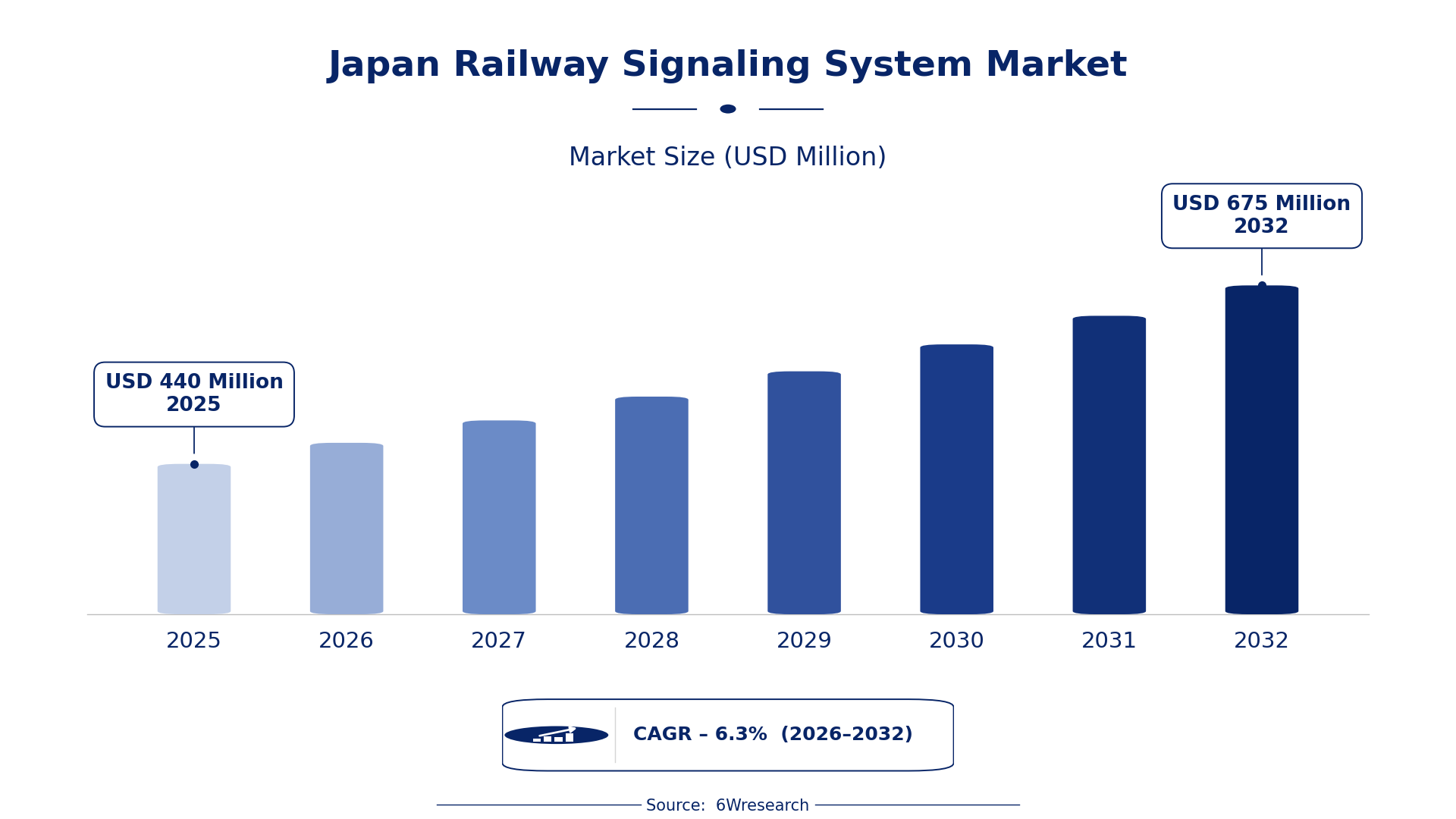
According to 6Wresearch internal database and industry insights, the Japan Railway Signaling System Market was valued at USD 440 Million in 2025 and is projected to reach USD 675 Million by 2032, growing at a CAGR of approximately 6.3% during 2026–2032.
Japan Railway Signaling System Market Highlights
| Report Metric | Details |
| Report Name | Japan Railway Signaling System Market (2026-2032) |
| Market Size 2025 | USD 440 Million |
| Market Size 2032 | USD 675 Million |
| Absolute Growth 2025–2032 | USD 235 Million |
| CAGR 2026–2032 | 6.3% |
| Peak Annual Growth | 7.1% in 2028 |
| Forecast Period | 2026–2032 |
| Historical Data | 2022–2025 |
| Base Year | 2025 |
| Leading Type, 2025 | ETCS (48% share) |
| Leading Technology, 2025 | AI-Based (32% share) |
| Leading Application, 2025 | Mainline Railways (36% share) |
| Leading End Use, 2025 | Rail Operators (36% share) |
| Fastest-Growing Type | CBTC (8.7% CAGR) |
| Fastest-Growing Technology | Cloud Computing (9.3% CAGR) |
| Fastest-Growing Application | Metro & Light Rail (8.6% CAGR) |
| Fastest-Growing End Use | Infrastructure Providers (7.9% CAGR) |
| Growing Sector | Rail Operators |
| Key End Users | Rail Operators, Infrastructure Providers, Government Bodies |
Japan Railway Signaling System Market Year-wise Growth Rate and Key Drivers (2022–2032)
This graph illustrates the annual growth rates of the market from 2022 to 2032, highlighting a steady upward trajectory and projected market expansion over the forecast period.
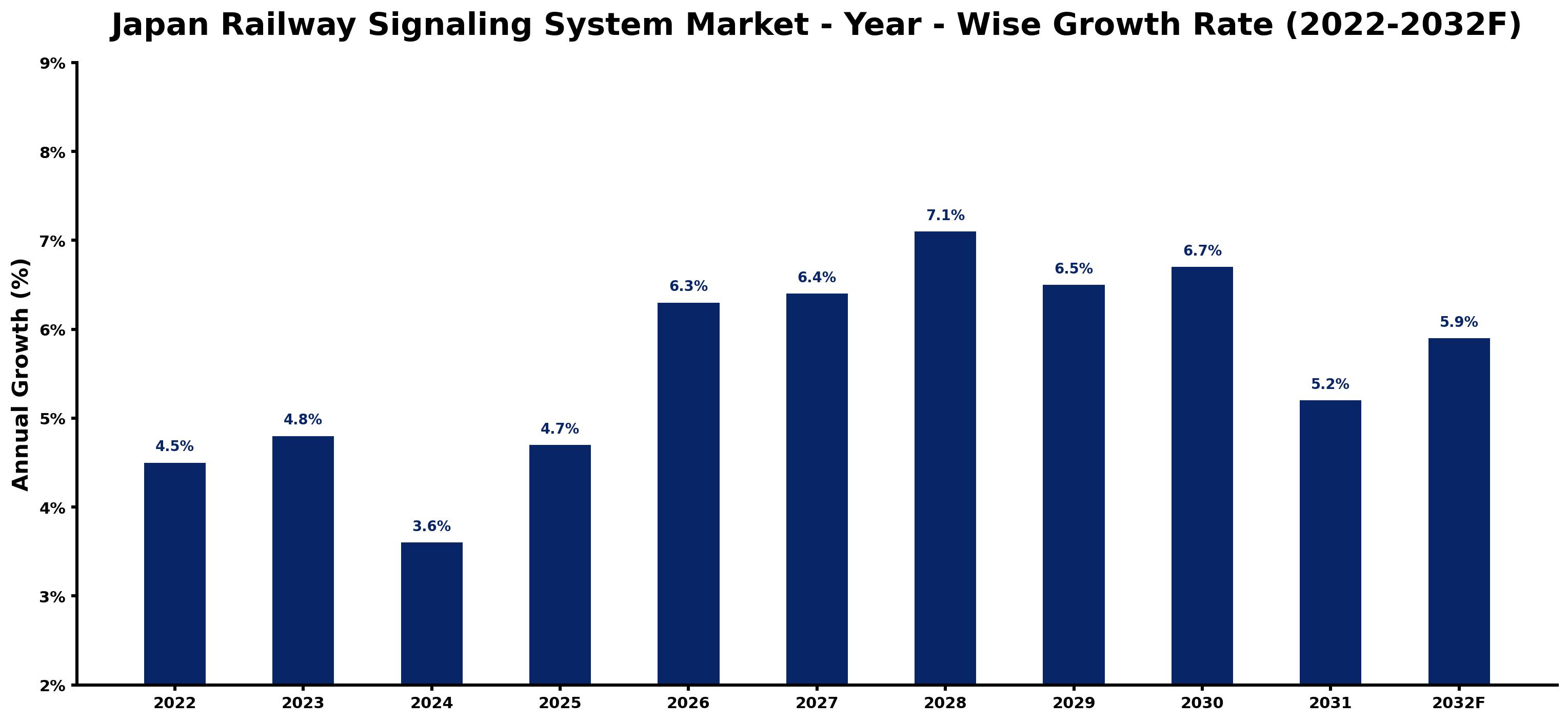
Below, each year's estimated growth is shown next to the factor that most influenced it.
| Year | Estimated Annual Growth (%) | Market Rationale |
| 2022 | 4.5 | The market experienced steady growth due to ongoing infrastructure investments. |
| 2023 | 4.8 | Growth accelerated as the government initiated upgrades to regional signaling systems. |
| 2024 | 3.6 | A slowdown occurred as projects faced delays in implementation timelines. |
| 2025 | 4.7 | Demand increased again as urban rail modernization strategies gained traction. |
| 2026 | 6.3 | Growth is expected to surge as investments in AI technologies for signaling are introduced. |
| 2027 | 6.4 | The market will continue to rise with the expansion of high-speed rail networks. |
| 2028 | 7.1 | Peak growth is projected as demand for advanced signaling systems peaks. |
| 2029 | 6.5 | A slowdown is anticipated as the market adjusts to previous growth rates. |
| 2030 | 6.7 | Growth is expected to resume as urban rail systems adopt new wireless communication technologies. |
| 2031 | 5.2 | The market will experience a slowdown as infrastructure projects face budget constraints. |
| 2032 | 5.9 | Growth is projected to pick up as the focus shifts towards cybersecurity in signaling systems. |
Note: Market size estimations and growth projections presented in this report are based on 6Wresearch's proprietary forecasting methodology, utilizing the latest available industry data, government publications, and primary research inputs.
Japan Railway Signaling System Market Synopsis
Railway Signaling Systems play a crucial role in maintaining safe and efficient train operations in Japan, utilising advanced electronics and software. The Japan Railway Signaling System Market benefits from an extensive railway network exceeding 27,000 kilometers and increasing demand from rail operators and infrastructure providers. Investments, including the ¥10 billion earmarked for railway improvements in 2023, drive market growth. The incorporation of AI technologies and the modernisation of urban rail systems are key contributors to this expansion.
Market Dynamics Impact Analysis (2026–2032)
| Factor | Type | Impact | Primary Segment Affected |
| Growing demand for high-speed rail operations | Driver | High | High-Speed Rail |
| Investment in urban rail modernization | Driver | High | Metro & Light Rail |
| Increasing need for advanced signaling technologies | Opportunity | High | AI-Based |
| Expansion of railway networks in urban areas | Opportunity | High | Mainline Railways |
| Budget constraints affecting infrastructure projects | Restraint | High | Infrastructure Providers |
| Delays in technology adoption for signaling upgrades | Restraint | Medium | Rail Operators |
| Competition from alternative transport modes | Challenge | Medium | Freight Rail |
| Shortage of skilled workforce in signaling technology | Challenge | High | Rail Operators |
Evaluation of Drivers in Japan Railway Signaling System Market (2026–2032)
Demand rests on the following drivers, each shown with the segment it touches most.
| Drivers | Primary Segment Affected | Why It Matters (Evidence) |
| Investment in high-speed rail infrastructure | High-Speed Rail | Japan's Shinkansen, operating at speeds up to 320 km/h, necessitates advanced signaling systems for safety. |
| Urban rail modernization initiatives | Metro & Light Rail | Tokyo Metro's adoption of CBTC technology improves operational efficiency, driving demand for signaling systems. |
| Integration of AI technologies | AI-Based | AI improves predictive maintenance, increasing demand among rail operators for advanced signaling solutions. |
| Expansion of the railway network | Mainline Railways | Japan's extensive railway network requires efficient signaling for safe operations. |
| Government funding for infrastructure improvements | Infrastructure Providers | The ¥10 billion allocated in 2023 for railway upgrades supports signaling system enhancements. |
Several shifts outside the market lift sales. The expansion of high-speed rail networks drives demand for advanced signaling systems essential for safety. AI technologies are increasingly integrated into signaling systems, improving predictive maintenance capabilities. The integration of IoT sensors is also expected to improve operational responsiveness for suppliers.
Evaluation of Restraints in Japan Railway Signaling System Market
These are the pressures that could keep growth below its potential.
| Market Restraint | Primary Segment Affected | Why It Matters (Evidence) |
| Budget constraints impacting project timelines | Infrastructure Providers | Budget limitations have delayed essential signaling upgrades across various railway projects. |
| Delays in technology adoption | Rail Operators | Rail operators face challenges in adopting new signaling technologies due to lengthy approval processes. |
| Regulatory hurdles in implementing new technologies | Infrastructure Providers | Complex regulations slow down the implementation of advanced signaling systems. |
| Competition from alternative transport modes | Freight Rail | Freight rail operators are increasingly competing with road transport, affecting investment in signaling systems. |
| Shortage of skilled workforce | Rail Operators | A lack of qualified personnel in signaling technology hampers operational efficiency and safety. |
Japan Railway Signaling System Market Challenges
In 2023, regional rail operators encountered delays attributed to outdated signaling systems that jeopardise safety. Limited availability of advanced components compels buyers to incur inflated costs, leading to project overruns that can surpass 15%. A shortage of skilled personnel hampers technological integration, resulting in maintenance inefficiencies that disrupt schedules for train operators. High expenses related to cybersecurity measures, estimated at ¥10 billion for infrastructure upgrades, strain budgets for local railway companies, restricting their ability to invest in further advancements.
Trends in the Japan Railway Signaling System Market
The following changes are redrawing the Japan Railway Signaling System Market.
- Transition to CBTC Technology in Urban Rail: Tokyo Metro's adoption of CBTC technology has resulted in a 20% boost in operational efficiency, highlighting a move towards modern signaling solutions in urban transit.
- Growing Focus on Cybersecurity in Signaling: The 2023 initiative by the Ministry of Land, Infrastructure, Transport and Tourism seeks to strengthen cybersecurity measures in signaling systems, reflecting an increasing priority for safety in rail operations.
- Expansion of Wireless Communication Technologies: The Kansai region is investing in wireless communication technologies for real-time data exchange in signaling, with a projected 25% increase in adoption by 2025.
- Supply of Advanced Signaling Systems: With a projected market size of USD 675 million by 2032, there is a substantial opportunity to supply advanced signaling systems to rail operators in Japan.
Investment Opportunities in the Japan Railway Signaling System Market
The opportunities below stand out in the Japan Railway Signaling System Market for new entrants and existing suppliers.
- Investment in AI-Based Solutions: The integration of AI technologies in signaling systems reveals a market gap, with an anticipated growth rate of 8.7% for AI-Based solutions by 2032.
- Development of Cybersecurity Solutions: The government's emphasis on cybersecurity measures in signaling systems opens avenues for suppliers to create solutions, especially within urban rail networks.
- Expansion of IoT Sensor Applications: As IoT sensor utilisation is projected to increase, suppliers can target rail operators in the Kansai region to improve real-time monitoring capabilities.
- Supply of Advanced Signaling Systems: The anticipated market size of USD 675 million by 2032 presents a strong opportunity for suppliers in the signaling sector.
Government Initiatives in the Japan Railway Signaling System Market
The GX Promotion Act, enacted in 2023, updates regulations by advocating advanced technologies in railway signaling systems. This law mandates adherence to revised safety standards, ensuring that producers meet stringent requirements for system reliability and performance. The act also promotes investment in modern signaling technologies to improve operational efficiency.
In 2023, the Ministry of Land, Infrastructure, Transport and Tourism allocated ¥10 billion for railway infrastructure enhancements, managed by the Japan Railway Construction, Transport and Technology Agency. This funding supports the deployment of modern signaling technologies and upgrades across regional railways, directly benefiting rail operators and infrastructure providers.
Future Insight of the Japan Railway Signaling System Market
Urban rail operators in Tokyo will benefit from the 2025 modernization strategy, improving efficiency and safety in passenger transport. By 2032, the integration of IoT sensors will facilitate real-time data exchange, improving operational responsiveness for suppliers. The government's investment in signaling upgrades will stimulate advancements in technology, strengthening the capabilities of regional railways. As satellite-based signaling technologies become standard, buyers will enjoy improved reliability and reduced delays in service.
Market Segmentation Analysis
Japan Railway Signaling System Market report covers a detailed analysis of the following market segments:
By Type – ETCS Leads, CBTC Expected to Grow Fastest
According to Bhawna Singh, Assistant Manager at 6Wresearch, in 2025, ETCS led the type split with a 48% share. The ETCS segment captures the largest share because it is vital for ensuring interoperability across Japan's extensive railway network. This standardised technology is essential for maintaining safety and operational efficiency, particularly for international rail operations. The quickest growth will come from CBTC, forecast to expand at a CAGR of 8.7% between 2026 and 2032. The CBTC segment is experiencing rapid growth as urban areas, especially Tokyo, increasingly adopt advanced systems to enhance metro capacity and safety. This trend is driven by the rising demand for efficient urban transit solutions, reflecting a broader shift in metropolitan rail development. Suppliers should prioritise the development of advanced signaling technologies to meet the growing demands of urban rail systems.
By Technology – AI-Based Leads, Cloud Computing Expected to Grow Fastest
AI-Based held 32% of the Japan Railway Signaling System Market by technology in 2025. AI-Based technologies lead the market due to their ability to significantly improve predictive maintenance and operational efficiency for railway systems. Their integration into existing frameworks allows for better management of train operations and minimises downtime, making them indispensable. Over 2026–2032, Cloud Computing is expected to post the fastest growth, at a CAGR of 9.3%. Cloud Computing is growing quickly as it becomes more widely adopted for data storage and analytics, supporting real-time decision-making in signaling operations. As rail systems evolve towards data-centric models, the demand for cloud solutions will likely continue to rise. Buyers should consider investing in advanced technologies to optimise their signaling systems and enhance overall operational performance.
By Application – Mainline Railways Lead, Metro & Light Rail Expected to Grow Fastest
The largest application category in 2025 was Mainline Railways, at 36% of revenue. Mainline Railways hold the largest share as they are essential for managing long-distance train operations across Japan's extensive network. The operational safety and efficiency provided by signaling systems in this segment are crucial for maintaining high service standards. Metro & Light Rail is set to record the highest CAGR in this split, 8.6% over 2026–2032. The Metro & Light Rail segment is rapidly expanding as cities focus on improving urban transit safety and efficiency, particularly in densely populated areas like Tokyo. This growth underscores the increasing emphasis on public transport solutions in urban planning. Suppliers must adapt their offerings to address the rising needs of urban transit systems, ensuring safety and efficiency in metro operations.
By End Use – Rail Operators Lead, Infrastructure Providers Expected to Grow Fastest
With 36% of end use revenue in 2025, Rail Operators was the largest category. Rail Operators are the primary users of signaling systems, relying on these technologies for operational safety and effective train management across extensive networks. Their significant investment in these systems highlights their critical role in the railway ecosystem. Infrastructure Providers are projected to grow fastest, at a CAGR of 7.9% during 2026–2032. Infrastructure Providers are experiencing the fastest growth as they take on the responsibility of implementing and maintaining advanced signaling systems. The heightened focus on railway infrastructure development is driving this segment's expansion. Suppliers should strengthen partnerships with infrastructure providers to align with the increasing demand for advanced signaling solutions.
Key Attractiveness of the Report
- 10 Years of Market Numbers
- Historical Data Starting from 2022 to 2025
- Base Year 2025
- Forecast Data until 2032
- Key Performance Indicators Impacting the Market
- Major Upcoming Developments and Projects
Key Highlights of the Report:
- Japan Railway Signaling System Market Outlook
- Market Size of Japan Railway Signaling System Market,2025
- Forecast of Japan Railway Signaling System Market, 2032
- Historical Data and Forecast of Japan Railway Signaling System Revenues & Volume for the Period 2022-2032
- Japan Railway Signaling System Market Trend Evolution
- Japan Railway Signaling System Market Drivers and Challenges
- Japan Railway Signaling System Price Trends
- Japan Railway Signaling System Porter's Five Forces
- Japan Railway Signaling System Industry Life Cycle
- Historical Data and Forecast of Japan Railway Signaling System Market Revenues & Volume By Type for the Period 2022-2032
- Historical Data and Forecast of Japan Railway Signaling System Market Revenues & Volume By ETCS for the Period 2022-2032
- Historical Data and Forecast of Japan Railway Signaling System Market Revenues & Volume By CBTC for the Period 2022-2032
- Historical Data and Forecast of Japan Railway Signaling System Market Revenues & Volume By PTC for the Period 2022-2032
- Historical Data and Forecast of Japan Railway Signaling System Market Revenues & Volume By ATP for the Period 2022-2032
- Historical Data and Forecast of Japan Railway Signaling System Market Revenues & Volume By Interlocking Systems for the Period 2022-2032
- Historical Data and Forecast of Japan Railway Signaling System Market Revenues & Volume By Technology for the Period 2022-2032
- Historical Data and Forecast of Japan Railway Signaling System Market Revenues & Volume By AI-Based for the Period 2022-2032
- Historical Data and Forecast of Japan Railway Signaling System Market Revenues & Volume By Cloud Computing for the Period 2022-2032
- Historical Data and Forecast of Japan Railway Signaling System Market Revenues & Volume By IoT & Sensors for the Period 2022-2032
- Historical Data and Forecast of Japan Railway Signaling System Market Revenues & Volume By Satellite-Based for the Period 2022-2032
- Historical Data and Forecast of Japan Railway Signaling System Market Revenues & Volume By Wireless Communications for the Period 2022-2032
- Historical Data and Forecast of Japan Railway Signaling System Market Revenues & Volume By Application for the Period 2022-2032
- Historical Data and Forecast of Japan Railway Signaling System Market Revenues & Volume By Mainline Railways for the Period 2022-2032
- Historical Data and Forecast of Japan Railway Signaling System Market Revenues & Volume By Metro & Light Rail for the Period 2022-2032
- Historical Data and Forecast of Japan Railway Signaling System Market Revenues & Volume By High-Speed Rail for the Period 2022-2032
- Historical Data and Forecast of Japan Railway Signaling System Market Revenues & Volume By Industrial Railways for the Period 2022-2032
- Historical Data and Forecast of Japan Railway Signaling System Market Revenues & Volume By Freight & Passenger Rail for the Period 2022-2032
- Historical Data and Forecast of Japan Railway Signaling System Market Revenues & Volume By End Use for the Period 2022-2032
- Historical Data and Forecast of Japan Railway Signaling System Market Revenues & Volume By Rail Operators for the Period 2022-2032
- Historical Data and Forecast of Japan Railway Signaling System Market Revenues & Volume By Infrastructure Providers for the Period 2022-2032
- Historical Data and Forecast of Japan Railway Signaling System Market Revenues & Volume By Freight Rail for the Period 2022-2032
- Historical Data and Forecast of Japan Railway Signaling System Market Revenues & Volume By Government Bodies for the Period 2022-2032
- Historical Data and Forecast of Japan Railway Signaling System Market Revenues & Volume By Others for the Period 2022-2032
- Japan Railway Signaling System Import Export Trade Statistics
- Market Opportunity Assessment By Type
- Market Opportunity Assessment By Technology
- Market Opportunity Assessment By Application
- Market Opportunity Assessment By End Use
- Japan Railway Signaling System Top Companies Market Share
- Japan Railway Signaling System Competitive Benchmarking By Technical and Operational Parameters
- Japan Railway Signaling System Company Profiles
- Japan Railway Signaling System Key Strategic Recommendations
Market Covered
The following segment groups are covered in the report.
By Type
- ETCS
- CBTC
- PTC
- ATP
- Interlocking Systems
By Technology
- AI-Based
- Cloud Computing
- IoT & Sensors
- Satellite-Based
- Wireless Communications
By Application
- Mainline Railways
- Metro & Light Rail
- High-Speed Rail
- Industrial Railways
- Freight & Passenger Rail
By End Use
- Rail Operators
- Infrastructure Providers
- Freight Rail
- Government Bodies
- Others






































