Japan Recreation Clubs Market Size & Growth Rate
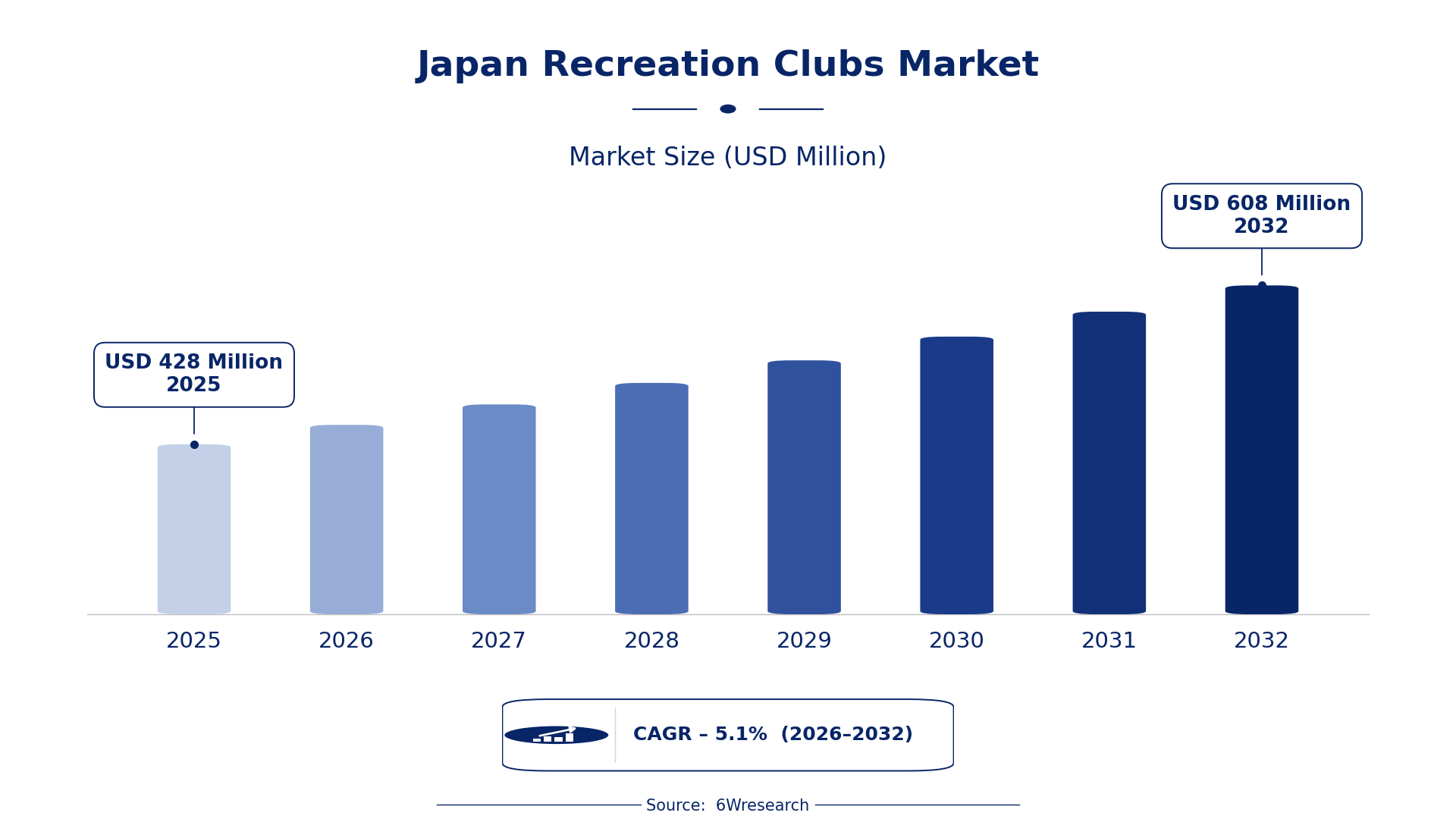
According to 6Wresearch internal database and industry insights, the Japan Recreation Clubs Market was valued at USD 428 Million in 2025 and is projected to reach USD 608 Million by 2032, growing at a CAGR of approximately 5.1% during 2026–2032.
Japan Recreation Clubs Market Highlights
| Report Metric | Details |
| Report Name | Japan Recreation Clubs Market (2026-2032) |
| Market Size 2025 | USD 428 Million |
| Market Size 2032 | USD 608 Million |
| Absolute Growth 2025–2032 | USD 180 Million |
| CAGR 2026–2032 | 5.1% |
| Peak Annual Growth | 6.1% in 2031 |
| Forecast Period | 2026–2032 |
| Historical Data | 2022–2025 |
| Base Year | 2025 |
| Leading Type, 2025 | Fitness Clubs (44% share) |
| Leading Membership Type, 2025 | Annual Membership (40% share) |
| Leading Activities Offered, 2025 | Gym (15% share) |
| Leading Target Audience, 2025 | Health & Wellness Seekers (40% share) |
| Fastest-Growing Membership Type | Monthly Membership (7.3% CAGR) |
| Fastest-Growing Activities Offered | Yoga (7.1% CAGR) |
| Fastest-Growing Target Audience | Sports Enthusiasts (6.8% CAGR) |
| Growing Sector | Health and Wellness |
| Key End Users | Health & Wellness Seekers, Sports Enthusiasts, Professionals, Hobbyists |
Japan Recreation Clubs Market Year-wise Growth Rate and Key Drivers (2022–2032)
This graph illustrates the annual growth rates of the market from 2022 to 2032, highlighting a steady upward trajectory and projected market expansion over the forecast period.
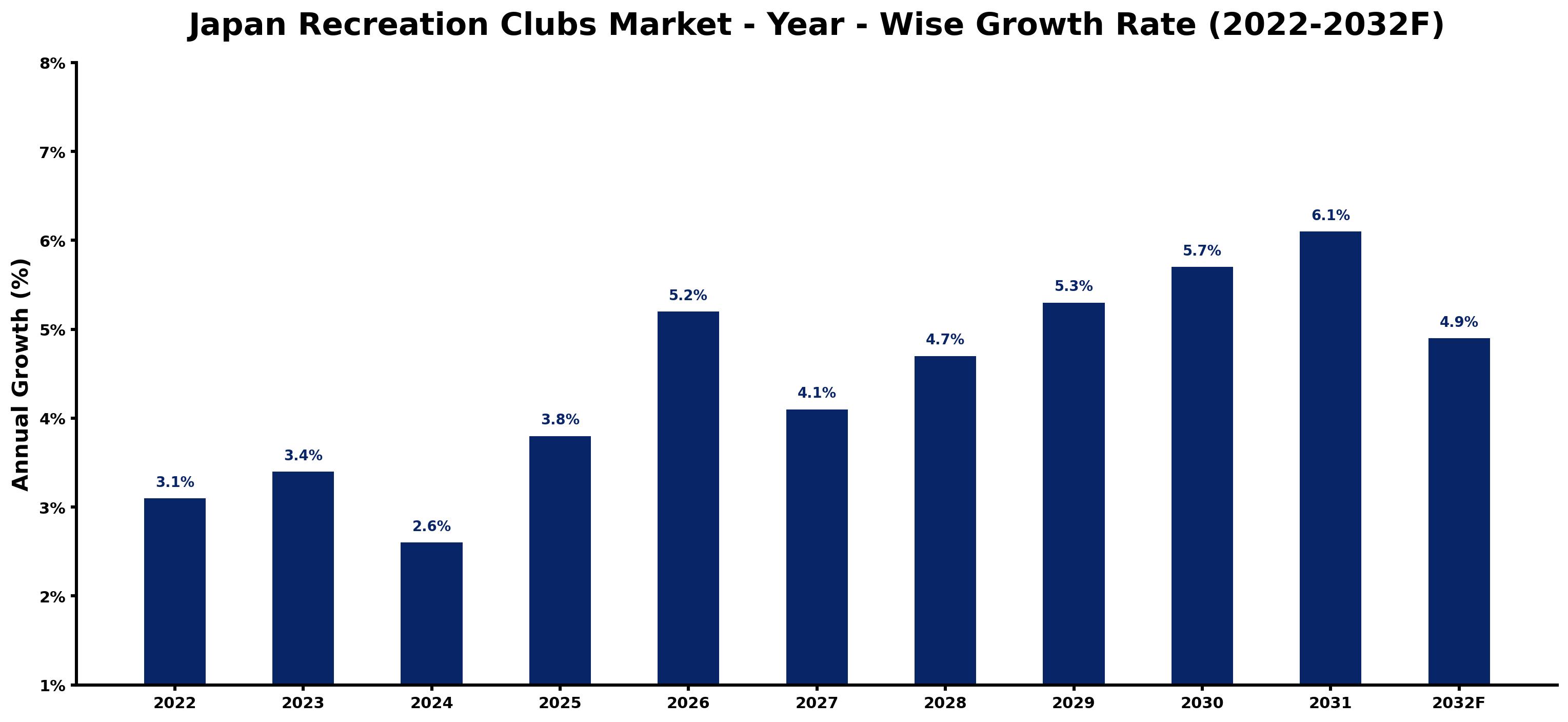
For each year, the table pairs the estimated growth rate with the leading influence on demand, showing how the drivers changed across the period.
| Year | Estimated Annual Growth (%) | Market Rationale |
| 2022 | 3.1 | The market showed steady growth as domestic users sought community engagement. |
| 2023 | 3.4 | Demand increased as more individuals pursued health and wellness opportunities. |
| 2024 | 2.6 | Growth slowed due to market saturation in urban areas like Tokyo. |
| 2025 | 3.8 | Interest surged following the Tokyo 2020 Olympics, boosting participation rates. |
| 2026 | 5.2 | The introduction of digital membership systems is expected to drive faster growth. |
| 2027 | 4.1 | Growth is expected to slow as competition intensifies among fitness facilities. |
| 2028 | 4.7 | Rising health consciousness will lead to increased memberships in clubs. |
| 2029 | 5.3 | Demand is projected to rise as urban populations continue to seek fitness solutions. |
| 2030 | 5.7 | The expansion of community sports programs will further stimulate interest. |
| 2031 | 6.1 | Peak growth will occur as clubs adapt to evolving consumer preferences. |
| 2032 | 4.9 | Growth is expected to slow as the market matures and competition stabilises. |
Note: Market size estimations and growth projections presented in this report are based on 6Wresearch's proprietary forecasting methodology, utilizing the latest available industry data, government publications, and primary research inputs.
Japan Recreation Clubs Market Synopsis
Recreation clubs in Japan provide diverse facilities for social and physical activities, promoting health and leisure. The Japan Recreation Clubs Market is expanding due to a strong focus on health and wellness, with over 3 million fitness club members reported in 2023. Initiatives from the Japan Sports Agency and the popularity of events like the Tokyo 2020 Olympics are generating new demand, ensuring continued engagement from domestic users seeking community and wellness opportunities. This trend underscores the growing importance of recreation clubs in facilitating social interaction and physical well-being among the population.
Market Dynamics Impact Analysis (2026–2032)
| Factor | Type | Impact | Primary Segment Affected |
| Growing health consciousness among the population | Driver | High | Fitness Clubs |
| Increased participation in community sports events | Driver | High | Sports Clubs |
| Expansion of digital membership systems | Opportunity | Medium | Fitness Clubs |
| Rising demand for yoga and wellness activities | Opportunity | Medium | Fitness Clubs |
| High competition among recreation clubs | Restraint | High | Fitness Clubs |
| Market saturation in urban areas | Restraint | Medium | Fitness Clubs |
| High operational costs for maintaining facilities | Challenge | High | Sports Clubs |
| Difficulty in attracting new members | Challenge | Medium | Social Clubs |
Evaluation of Drivers in Japan Recreation Clubs Market (2026–2032)
These are the developments adding the most demand over the forecast period.
| Drivers | Primary Segment Affected | Why It Matters (Evidence) |
| Increased focus on health and wellness programs | Fitness Clubs | Approximately 3 million fitness club members in Japan are driving demand for health-focused activities. |
| Community engagement through sports events | Sports Clubs | Annual sports events attract over 500,000 participants, boosting interest in organized sports. |
| Growth in yoga class participation | Fitness Clubs | Yoga classes have seen a 20% increase in urban areas, appealing to health-conscious individuals. |
| Support from government initiatives | Fitness Clubs | The Japan Sports Agency promotes sports participation through various initiatives, increasing club memberships. |
| Digital membership systems improving convenience | Fitness Clubs | Fitness clubs are adopting digital systems, which are projected to increase member retention rates by 15%. |
Spending rises because Tokyo, with its population of approximately 14 million, drives demand for recreation clubs. The focus on health and wellness is clear, with 3 million fitness club members reported in 2023. Community sports events attract substantial participation, increasing interest in organized activities. Yoga classes have seen a notable increase in participation, appealing to health-conscious individuals seeking fitness solutions. The adoption of digital membership systems is expected to improve convenience and retention rates for clubs, enhancing user experience.
Evaluation of Restraints in Japan Recreation Clubs Market
The table below lists the restraints and the evidence behind each.
| Market Restraint | Primary Segment Affected | Why It Matters (Evidence) |
| High operational costs for maintaining facilities | Sports Clubs | Operational costs can exceed ¥1 billion for community sports facilities, affecting profitability. |
| Market saturation in urban areas | Fitness Clubs | In urban centres like Tokyo, competition limits growth opportunities for new entrants. |
| Difficulty in attracting new members | Social Clubs | Social clubs face challenges in engaging younger demographics, impacting membership numbers. |
| High competition among recreation clubs | Fitness Clubs | With over 10,000 registered clubs, competition drives down prices and profit margins. |
| Changing consumer interests in fitness trends | Fitness Clubs | As fitness trends evolve, clubs must adapt quickly to retain members. |
Japan Recreation Clubs Market Challenges
Many recreation facilities struggle to obtain quality fitness equipment, as limited domestic manufacturers lead to reliance on imports that can take up to six months to arrive. Competition intensifies in urban areas like Tokyo and Osaka, where new entrants can drive membership fees down by 15%, negatively impacting existing operators' revenues. A shortage of qualified trainers limits facilities from offering diverse classes, resulting in lost membership opportunities and reduced engagement for providers. Buyers face rising annual fees, which can range from ¥10,000 to ¥50,000, restricting access for some users and diminishing overall participation.
Trends in the Japan Recreation Clubs Market
Four trends stand out in the Japan Recreation Clubs Market.
- Shift from Traditional to Digital Membership Systems: Tokyo is experiencing a shift as fitness clubs adopt digital membership systems for convenience. This change is reflected in a reported increase in membership retention rates by 15%.
- Health & Wellness Seekers Prioritised over Hobbyists: Health & Wellness Seekers are increasingly prioritised in fitness clubs, reflecting a growing trend towards fitness and wellness activities. This demographic accounted for 40% of memberships in 2025.
- Yoga Gaining Popularity in Urban Areas: Yoga classes are gaining popularity in urban areas, with a 20% increase in participation. This trend aligns with the rising health consciousness among city dwellers.
- Community Sports Events Gaining Traction: Community sports events are gaining traction, attracting significant participation nationwide. This trend is supported by initiatives from the Japan Sports Agency.
Investment Opportunities in the Japan Recreation Clubs Market
Several openings in the Japan Recreation Clubs Market merit attention from investors.
- Digital Membership Systems: Fitness clubs can invest in digital membership systems to improve user experience. With over 3 million fitness club members, this is a timely opportunity to attract tech-savvy users.
- Yoga and Wellness Programs: Health & Wellness Seekers are increasingly interested in yoga and wellness programs. Clubs can capitalise on this trend by offering specialized classes to meet growing demand.
- Community Sports Initiatives: The Tokyo Metropolitan Government's budget of ¥1 billion for community sports programs presents an opportunity for clubs to engage with local populations and increase memberships.
- Fitness Events and Competitions: Annual sports events attract significant participation, providing clubs with opportunities to host competitions and increase visibility among potential members.
Government Initiatives in the Japan Recreation Clubs Market
The Health Promotion Law established in 2002 mandates recreation clubs to promote health and wellness initiatives among their members. This law requires clubs to implement quality management systems, such as ISO 9001, ensuring high standards in service delivery. The Japan Sports Agency has been active in promoting sports participation through various initiatives, further supporting the growth of recreation clubs.
The Japan Sports Council oversees funding for community sports facilities, with a budget of ¥1 billion allocated to support local sports initiatives. The Ministry of Health, Labour and Welfare encourages wellness initiatives through recreation clubs, ensuring compliance with health standards and promoting community engagement.
Future Insight of the Japan Recreation Clubs Market
Digital membership systems will transform how buyers interact with recreation facilities by 2032, streamlining access and improving user experience. The government’s health promotion program will likely increase participation in fitness activities, encouraging more members to join. Collaboration with local schools for community projects will expand the reach of social initiatives, enhancing engagement. As urban populations grow, the demand for diverse activities will rise, prompting facilities to innovate their offerings and attract a broader audience.
Market Segmentation Analysis
Japan Recreation Clubs Market report covers a detailed analysis of the following market segments:
By Type – Fitness Clubs Lead and Record the Fastest Growth
According to Bhawna Singh, Assistant Manager at 6Wresearch, Fitness Clubs held 44% of the Japan Recreation Clubs Market by type in 2025. Fitness clubs dominate the market as they focus on physical fitness and wellness, appealing to a broad range of individuals. With 3 million fitness club members reported in 2023, they are central to health-oriented activities in Japan. Its lead should widen, with a projected CAGR of 7.2% during 2026–2032, the highest in this split. The growth of fitness clubs is propelled by increasing interest in health and wellness, especially after the Tokyo 2020 Olympics which heightened public engagement in sports. This ongoing enthusiasm will ensure that fitness clubs continue to expand their membership base. Suppliers should enhance offerings within fitness clubs to capitalise on the sustained growth opportunities.
By Membership Type – Annual Membership Leads, Monthly Membership Expected to Grow Fastest
With 40% of membership type revenue in 2025, Annual Membership was the largest category. Annual memberships are preferred as they provide continuous access to club facilities and activities, ensuring member retention. This model aligns with the long-term commitment of users towards their health and fitness goals. Over 2026–2032, Monthly Membership is expected to post the fastest growth, at a CAGR of 7.3%. Monthly memberships are gaining traction due to their flexibility, appealing to users who prefer short-term commitments. This shift reflects changing consumer preferences for adaptable fitness solutions in a fast-paced society. Buyers may benefit from exploring various membership options to find the best fit for their lifestyle.
By Activities Offered – Gym Leads, Yoga Expected to Grow Fastest
Gym accounted for 15% of the market by activities offered in 2025. The gym segment leads the market as it is foundational to fitness clubs, providing essential equipment and facilities for physical training. Its widespread presence ensures that gyms attract a diverse range of members looking for effective fitness solutions. Yoga is projected to grow fastest, at a CAGR of 7.1% during 2026–2032. Yoga is experiencing rapid growth, driven by its rising popularity among urban populations who seek holistic health benefits. The 20% increase in participation indicates a strong trend towards incorporating mindfulness and flexibility into fitness routines. Suppliers should consider including popular activities like yoga in their offerings to align with changing consumer preferences.
By Target Audience – Health & Wellness Seekers Lead, Sports Enthusiasts Expected to Grow Fastest
The largest target audience category in 2025 was Health & Wellness Seekers, at 40% of revenue. Health and wellness seekers form the largest audience segment, actively pursuing fitness solutions to improve their well-being. Their dedication to health drives strong demand for fitness club memberships and related services. Sports Enthusiasts are set to record the highest CAGR in this split, 6.8% over 2026–2032. Sports enthusiasts are boosting market growth as they seek specialised training and community involvement through clubs. Their enthusiasm for sports ensures a consistent influx of new members and active participation in club activities. Providers should tailor marketing strategies to effectively engage health and wellness seekers.
Key Attractiveness of the Report
- 10 Years of Market Numbers
- Historical Data Starting from 2022 to 2025
- Base Year 2025
- Forecast Data until 2032
- Key Performance Indicators Impacting the Market
- Major Upcoming Developments and Projects
Key Highlights of the Report:
- Japan Recreation Clubs Market Outlook
- Market Size of Japan Recreation Clubs Market,2025
- Forecast of Japan Recreation Clubs Market, 2032
- Historical Data and Forecast of Japan Recreation Clubs Revenues & Volume for the Period 2022-2032
- Japan Recreation Clubs Market Trend Evolution
- Japan Recreation Clubs Market Drivers and Challenges
- Japan Recreation Clubs Price Trends
- Japan Recreation Clubs Porter's Five Forces
- Japan Recreation Clubs Industry Life Cycle
- Historical Data and Forecast of Japan Recreation Clubs Market Revenues & Volume By Type for the Period 2022-2032
- Historical Data and Forecast of Japan Recreation Clubs Market Revenues & Volume By Sports Clubs for the Period 2022-2032
- Historical Data and Forecast of Japan Recreation Clubs Market Revenues & Volume By Social Clubs for the Period 2022-2032
- Historical Data and Forecast of Japan Recreation Clubs Market Revenues & Volume By Fitness Clubs for the Period 2022-2032
- Historical Data and Forecast of Japan Recreation Clubs Market Revenues & Volume By Hobby Clubs for the Period 2022-2032
- Historical Data and Forecast of Japan Recreation Clubs Market Revenues & Volume By Membership Type for the Period 2022-2032
- Historical Data and Forecast of Japan Recreation Clubs Market Revenues & Volume By Annual Membership for the Period 2022-2032
- Historical Data and Forecast of Japan Recreation Clubs Market Revenues & Volume By Monthly Membership for the Period 2022-2032
- Historical Data and Forecast of Japan Recreation Clubs Market Revenues & Volume By Pay-Per-Session for the Period 2022-2032
- Historical Data and Forecast of Japan Recreation Clubs Market Revenues & Volume By Lifetime Membership for the Period 2022-2032
- Historical Data and Forecast of Japan Recreation Clubs Market Revenues & Volume By Activities Offered for the Period 2022-2032
- Historical Data and Forecast of Japan Recreation Clubs Market Revenues & Volume By Tennis, Golf, Swimming for the Period 2022-2032
- Historical Data and Forecast of Japan Recreation Clubs Market Revenues & Volume By Social Events, Dining for the Period 2022-2032
- Historical Data and Forecast of Japan Recreation Clubs Market Revenues & Volume By Yoga, Gym, Aerobics for the Period 2022-2032
- Historical Data and Forecast of Japan Recreation Clubs Market Revenues & Volume By Art, Music, Book Reading for the Period 2022-2032
- Historical Data and Forecast of Japan Recreation Clubs Market Revenues & Volume By Target Audience for the Period 2022-2032
- Historical Data and Forecast of Japan Recreation Clubs Market Revenues & Volume By Sports Enthusiasts for the Period 2022-2032
- Historical Data and Forecast of Japan Recreation Clubs Market Revenues & Volume By Professionals for the Period 2022-2032
- Historical Data and Forecast of Japan Recreation Clubs Market Revenues & Volume By Health & Wellness Seekers for the Period 2022-2032
- Historical Data and Forecast of Japan Recreation Clubs Market Revenues & Volume By Hobbyists for the Period 2022-2032
- Japan Recreation Clubs Import Export Trade Statistics
- Market Opportunity Assessment By Type
- Market Opportunity Assessment By Membership Type
- Market Opportunity Assessment By Activities Offered
- Market Opportunity Assessment By Target Audience
- Japan Recreation Clubs Top Companies Market Share
- Japan Recreation Clubs Competitive Benchmarking By Technical and Operational Parameters
- Japan Recreation Clubs Company Profiles
- Japan Recreation Clubs Key Strategic Recommendations
Market Covered
Coverage by segment is as follows.
By Type
- Sports Clubs
- Social Clubs
- Fitness Clubs
- Hobby Clubs
By Membership Type
- Annual Membership
- Monthly Membership
- Pay-Per-Session
- Lifetime Membership
By Activities Offered
- Tennis
- Golf
- Swimming
- Social Events
- Dining
- Yoga
- Gym
- Aerobics
- Art
- Music
- Book Reading
By Target Audience
- Sports Enthusiasts
- Professionals
- Health & Wellness Seekers
- Hobbyists































