Japan Revenue Management System Market Size & Growth Rate
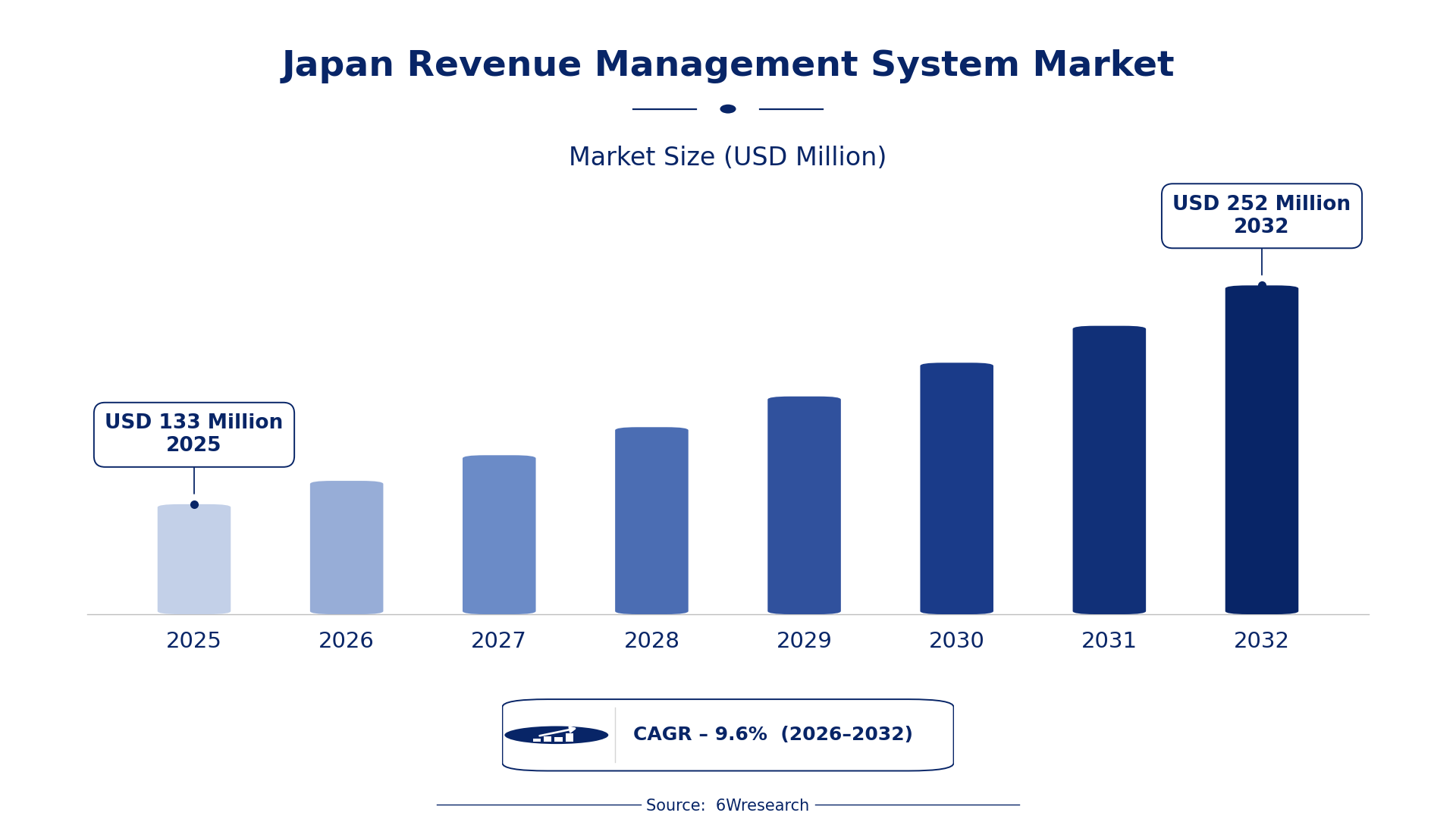
According to 6Wresearch internal database and industry insights, the Japan Revenue Management System Market was valued at USD 133 Million in 2025 and is projected to reach USD 252 Million by 2032, growing at a CAGR of approximately 9.6% during 2026–2032.
Japan Revenue Management System Market Highlights
| Report Metric | Details |
| Report Name | Japan Revenue Management System Market (2026-2032) |
| Market Size 2025 | USD 133 Million |
| Market Size 2032 | USD 252 Million |
| Absolute Growth 2025–2032 | USD 119 Million |
| CAGR 2026–2032 | 9.6% |
| Peak Annual Growth | 10.5% in 2030 |
| Forecast Period | 2026–2032 |
| Historical Data | 2022–2025 |
| Base Year | 2025 |
| Leading Component Type, 2025 | Pricing Engines (38% share) |
| Leading Industry Application, 2025 | Airlines (45% share) |
| Leading Deployment Model, 2025 | Cloud-Based (50% share) |
| Leading End User Sector, 2025 | Travel Industry (51% share) |
| Leading Key Functionality, 2025 | Dynamic Pricing (44% share) |
| Fastest-Growing Component Type | Forecasting Tools (13.2% CAGR) |
| Fastest-Growing Industry Application | Hospitality (12.4% CAGR) |
| Fastest-Growing End User Sector | Hotels (12.2% CAGR) |
| Fastest-Growing Key Functionality | Demand Forecasting (12.3% CAGR) |
| Growing Sector | Travel Industry |
| Key End Users | Airlines, Hotels, Travel Agencies, Hospitality Sector |
Japan Revenue Management System Market Year-wise Growth Rate and Key Drivers (2022–2032)
This graph illustrates the annual growth rates of the market from 2022 to 2032, highlighting a steady upward trajectory and projected market expansion over the forecast period.
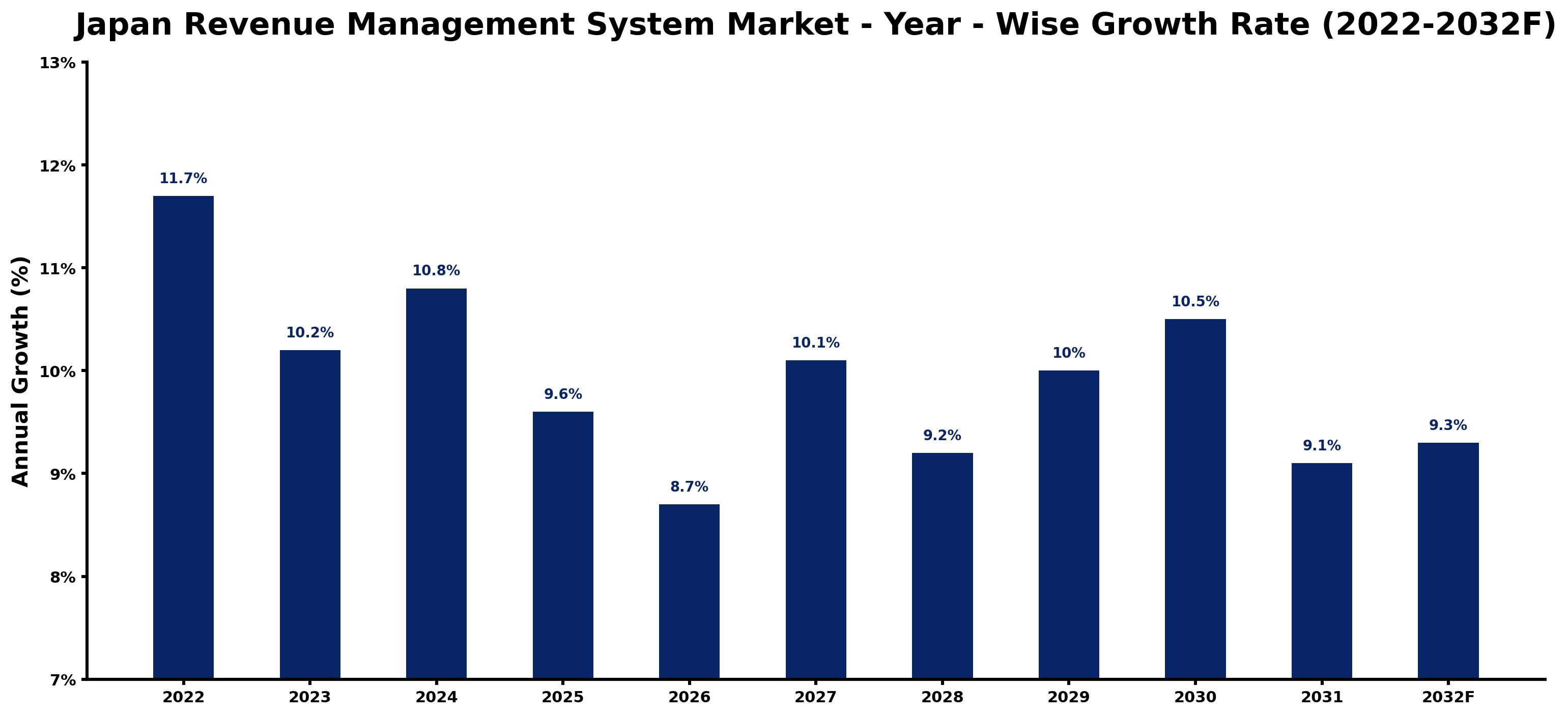
Annual growth estimates for each year appear below with the principal reason behind them, explaining the shifts that set the pace of the market.
| Year | Estimated Annual Growth (%) | Market Rationale |
| 2022 | 11.7 | The market experienced strong growth due to increased adoption of RMS technology in the airline sector. |
| 2023 | 10.2 | Demand growth slowed as competition intensified among service providers in the hospitality industry. |
| 2024 | 10.8 | The market saw a slight rebound as airlines adopted more dynamic pricing strategies. |
| 2025 | 9.6 | Growth slowed again as market saturation began to affect new technology deployments. |
| 2026 | 8.7 | Demand growth is expected to slow as the market stabilises after rapid expansion. |
| 2027 | 10.1 | A resurgence in growth is projected as travel demand increases. |
| 2028 | 9.2 | Growth is anticipated to slow again as the market adjusts to new pricing models and competition. |
| 2029 | 10.0 | The market is expected to rebound with renewed interest in advanced analytics for revenue management. |
| 2030 | 10.5 | A peak in growth will be reached as airlines fully embrace dynamic pricing strategies. |
| 2031 | 9.1 | Growth is projected to slow as the market matures and competition intensifies among providers. |
| 2032 | 9.3 | The market is expected to grow steadily as technology integration continues in the hospitality sector. |
Note: Market size estimations and growth projections presented in this report are based on 6Wresearch's proprietary forecasting methodology, utilizing the latest available industry data, government publications, and primary research inputs.
Japan Revenue Management System Market Synopsis
Revenue Management Systems (RMS) are technology solutions that optimise pricing strategies and inventory management through data analytics. The Japan Revenue Management System Market is expanding, driven by the airline industry, which serves over 100 million passengers annually, and the hospitality sector with over 60,000 hotels. Growth is fuelled by increased adoption of cloud-based solutions, dynamic pricing strategies, and digital transformation initiatives supported by the Japan Tourism Agency.
Market Dynamics Impact Analysis (2026–2032)
| Factor | Type | Impact | Primary Segment Affected |
| Increased adoption of cloud-based solutions | Driver | High | Cloud-Based |
| Growing demand for dynamic pricing strategies | Driver | High | Airlines |
| Expansion of the hospitality sector | Opportunity | High | Hospitality |
| Rising interest in data analytics for pricing | Opportunity | Medium | Travel Industry |
| Market saturation affecting new technology deployments | Restraint | High | Pricing Engines |
| Intense competition among service providers | Restraint | Medium | Pricing Engines |
| Compliance with evolving technology standards | Challenge | High | Pricing Engines |
| Cost pressures from technology integration | Challenge | Medium | Pricing Engines |
Evaluation of Drivers in Japan Revenue Management System Market (2026–2032)
Key forces behind demand, with the segment each one moves most, are listed below.
| Drivers | Primary Segment Affected | Why It Matters (Evidence) |
| Increased passenger volume in airlines | Airlines | Japan's airline industry serves over 100 million passengers annually, driving demand for RMS to optimise pricing. |
| Adoption of cloud-based RMS solutions | Cloud-Based | With a 30% adoption rate in hotels, cloud solutions provide accessibility and scalability for users. |
| Dynamic pricing strategies in travel | Travel Industry | The travel sector increasingly adopts dynamic pricing, enabling better revenue management during peak seasons. |
| Expansion of the hospitality sector | Hospitality | With over 60,000 hotels, the hospitality industry requires RMS to optimise room rates and occupancy. |
| Demand forecasting tools for peak seasons | Forecasting Tools | Forecasting tools are critical for managing peak demand, especially in the travel industry. |
Volumes grow on the back of the airline industry, which serves over 100 million passengers annually, creating a strong demand for RMS to optimise pricing strategies. The hospitality sector, comprising over 60,000 hotels, increasingly adopts cloud-based solutions, with a 30% adoption rate improving accessibility. Dynamic pricing strategies are becoming standard in the travel industry, allowing for better revenue management during peak seasons. Demand forecasting tools are essential for optimising occupancy rates, especially in the hospitality sector, where the average hotel occupancy rate is around 70%. This combination of factors drives RMS adoption in Japan.
Evaluation of Restraints in Japan Revenue Management System Market
The key brakes on demand, and where they bite hardest, are shown below.
| Market Restraint | Primary Segment Affected | Why It Matters (Evidence) |
| Market saturation affecting new technology deployments | Pricing Engines | As the market matures, new technology deployments face challenges, limiting growth opportunities. |
| Intense competition among service providers | Pricing Engines | Increased competition leads to price pressures, impacting profitability for RMS providers. |
| Compliance with evolving technology standards | Pricing Engines | Producers must ensure compliance with new standards, which can delay product launches. |
| Cost pressures from technology integration | Pricing Engines | Integrating advanced technologies can be costly, affecting investment decisions for buyers. |
| Limited awareness of RMS benefits among smaller hotels | Hospitality | Many smaller hotels lack awareness of RMS advantages, hindering market expansion. |
Japan Revenue Management System Market Challenges
Japan's stringent regulations for technology integration hinder timely revenue management system deployment for producers. This can lead to project delays of up to six months, affecting suppliers reliant on swift implementation. A shortage of skilled data analysts restricts buyers from leveraging RMS features, potentially costing the hospitality sector around ¥2 billion in lost revenue annually. Limited technology adoption, with only 30% of hotels employing cloud-based solutions, constrains buyers' ability to implement dynamic pricing strategies, weakening their competitive edge.
Trends in the Japan Revenue Management System Market
Four trends stand out in the Japan Revenue Management System Market.
- Shift from On-Premise to Cloud-Based Solutions: Cloud-based RMS solutions are becoming the preferred choice among hotels, with 50% adoption in 2025. This shift allows for greater scalability and easier updates, benefiting hotel operators.
- Growing Emphasis on Dynamic Pricing Strategies: The travel industry is increasingly adopting dynamic pricing strategies, with airlines leading the way. This trend is driven by the need to maximise revenue during peak travel seasons, improving profitability.
- Increased Use of Analytics Dashboards: Hotels are increasingly utilising analytics dashboards, with 55% of major establishments employing them for performance tracking. This trend supports better decision-making and revenue optimisation.
- Rising Demand for Demand Forecasting Tools: Demand forecasting tools are gaining traction, particularly in the hospitality sector, where accurate predictions are vital. These tools help manage peak seasons effectively, improving operational efficiency.
Investment Opportunities in the Japan Revenue Management System Market
Several openings in the Japan Revenue Management System Market merit attention from investors.
- Tokyo as a Hub for RMS Adoption: Tokyo is experiencing a surge in RMS adoption, with a 30% increase in cloud-based solutions. Hotels in this region can invest in advanced RMS to optimise pricing strategies.
- Travel Agencies Seeking Advanced RMS: Travel agencies are increasingly looking for RMS to improve pricing strategies, with a notable gap in technology adoption. Investing in tailored solutions for these agencies presents a lucrative opportunity.
- Hospitality Sector's Digital Transformation: The hospitality sector is undergoing digital transformation, with over 60,000 hotels in Japan. Suppliers can offer RMS solutions to help hotels optimise revenue management processes.
- Growing Interest in Dynamic Pricing: With dynamic pricing strategies gaining traction, there is a demand for RMS that can support these models. Hotels and airlines can invest in advanced systems to maximise revenue.
Government Initiatives in the Japan Revenue Management System Market
The Electrical Appliance and Material Safety Act of 1961 establishes safety requirements for electrical appliances and materials, impacting RMS producers by ensuring compliance with safety standards. The Medical Care Act of 1948 sets standards for facilities, influencing the integration of RMS in healthcare settings. The Digital Agency, established in 2021, oversees digital transformation initiatives, promoting the adoption of RMS in various sectors, including hospitality and travel.
The Japan Tourism Agency plays a key role in funding projects that support technology integration in the hospitality industry. This agency backs initiatives aimed at improving revenue management practices, ensuring that hotels and travel agencies can access advanced RMS solutions.
Future Insight of the Japan Revenue Management System Market
By 2032, government initiatives will drive a significant shift in the hospitality sector towards advanced technology integration. Suppliers will innovate revenue management systems to enhance analytics and real-time pricing strategies. The adoption of ISO 9001 standards will elevate the quality of system implementations. As the average room rate in Tokyo hotels reaches approximately ¥15,000 per night, buyers will increasingly seek effective pricing solutions, creating opportunities for suppliers to meet rising demand.
Market Segmentation Analysis
Japan Revenue Management System Market report covers a detailed analysis of the following market segments:
By Component Type – Pricing Engines Lead, Forecasting Tools Expected to Grow Fastest
According to Navya, Research Analyst at 6Wresearch, Pricing Engines accounted for 38% of the market by component type in 2025. Pricing engines are crucial for establishing optimal pricing strategies tailored to market demand, particularly in the airline sector where competition is fierce. With over 100 million passengers annually, effective pricing mechanisms are essential to capture and maximise revenue opportunities. Forecasting Tools are set to record the highest CAGR in this split, 13.2% over 2026–2032. The rapid growth of forecasting tools is driven by the increasing need for accurate demand predictions, especially during peak travel seasons. Given that the average hotel occupancy rate in Japan is around 70%, these tools are vital for optimising revenue during high-demand periods. Suppliers should enhance pricing engine functionalities to meet the specific demands of the airline sector.
By Industry Application – Airlines Lead, Hospitality Expected to Grow Fastest
The largest industry application category in 2025 was Airlines, at 45% of revenue. The airline sector is the core user of revenue management systems, implementing dynamic pricing strategies to maximise revenue from a large passenger base. This demand is reinforced by the high volume of air travel in Japan, which exceeds 100 million passengers annually. Hospitality is projected to grow fastest, at a CAGR of 12.4% during 2026–2032. The hospitality industry is experiencing rapid growth in RMS adoption as hotels seek to optimise room rates and occupancy levels. With over 60,000 hotels and inns in Japan, the competition for guests drives this need for advanced revenue management solutions. Suppliers should tailor their offerings to cater to the unique requirements of the hospitality sector, ensuring they remain competitive.
By Deployment Model – Cloud-Based Leads and Records the Fastest Growth
With 50% of deployment model revenue in 2025, Cloud-Based was the largest category. Cloud-based solutions are favoured for their scalability and ease of access, making them well-suited to the dynamic requirements of the market. This model allows users to leverage advanced analytics without incurring significant upfront costs, appealing to a broad spectrum of enterprises. Its lead should widen, with a projected CAGR of 11.4% during 2026–2032, the highest in this split. The cloud-based model is also the fastest-growing due to its flexibility and the increasing demand for remote access to RMS. As businesses continue to transition towards digital solutions, this trend will likely strengthen the dominance of cloud-based systems. Vendors should focus on developing advanced features for cloud-based RMS to align with market trends and user preferences.
By End User Sector – Travel Industry Leads, Hotels Expected to Grow Fastest
In 2025, Travel Industry led the end user sector split with a 51% share. The travel industry is the largest end user of revenue management systems, relying heavily on them for effective pricing and inventory management. The extensive passenger volume in the airline sector and the vast hospitality industry underscore this dependence. The quickest growth will come from Hotels, forecast to expand at a CAGR of 12.2% between 2026 and 2032. Hotels are quickly adopting RMS to optimise room pricing and improve occupancy rates, particularly in competitive urban markets like Tokyo. This sector's growth reflects the rising demand for sophisticated revenue management tools to attract guests. Suppliers must concentrate on creating tailored solutions for hotels to capture the increasing demand in this sector.
By Key Functionality – Dynamic Pricing Leads, Demand Forecasting Expected to Grow Fastest
Dynamic Pricing held 44% of the Japan Revenue Management System Market by key functionality in 2025. Dynamic pricing is vital for maximising revenue in industries like airlines and hospitality, where demand can fluctuate significantly. This functionality allows businesses to adjust prices in real-time, ensuring competitiveness in a rapidly changing market. Demand Forecasting is set to record the highest CAGR in this split, 12.3% over 2026–2032. Demand forecasting is becoming increasingly important as businesses strive to predict customer behaviour and adapt their strategies accordingly. The necessity for accurate predictions is highlighted by the variable occupancy rates seen across Japan's hospitality sector. Providers should invest in enhancing forecasting capabilities to meet the rising expectations of users across various sectors.
Key Attractiveness of the Report
- 10 Years of Market Numbers
- Historical Data Starting from 2022 to 2025
- Base Year 2025
- Forecast Data until 2032
- Key Performance Indicators Impacting the Market
- Major Upcoming Developments and Projects
Key Highlights of the Report:
- Japan Revenue Management System Market Outlook
- Market Size of Japan Revenue Management System Market, 2025
- Forecast of Japan Revenue Management System Market, 2032
- Historical Data and Forecast of Japan Revenue Management System Revenues & Volume for the Period 2022-2032F
- Japan Revenue Management System Market Trend Evolution
- Japan Revenue Management System Market Drivers and Challenges
- Japan Revenue Management System Price Trends
- Japan Revenue Management System Porter's Five Forces
- Japan Revenue Management System Industry Life Cycle
- Historical Data and Forecast of Japan Revenue Management System Market Revenues & Volume By Component Type for the Period 2022-2032F
- Historical Data and Forecast of Japan Revenue Management System Market Revenues & Volume By Pricing Engines for the Period 2022-2032F
- Historical Data and Forecast of Japan Revenue Management System Market Revenues & Volume By Forecasting Tools for the Period 2022-2032F
- Historical Data and Forecast of Japan Revenue Management System Market Revenues & Volume By Analytics Dashboard for the Period 2022-2032F
- Historical Data and Forecast of Japan Revenue Management System Market Revenues & Volume By Inventory Control for the Period 2022-2032F
- Historical Data and Forecast of Japan Revenue Management System Market Revenues & Volume By Industry Application for the Period 2022-2032F
- Historical Data and Forecast of Japan Revenue Management System Market Revenues & Volume By Airlines for the Period 2022-2032F
- Historical Data and Forecast of Japan Revenue Management System Market Revenues & Volume By Hospitality for the Period 2022-2032F
- Historical Data and Forecast of Japan Revenue Management System Market Revenues & Volume By Media & Entertainment for the Period 2022-2032F
- Historical Data and Forecast of Japan Revenue Management System Market Revenues & Volume By Telecom for the Period 2022-2032F
- Historical Data and Forecast of Japan Revenue Management System Market Revenues & Volume By Deployment Model for the Period 2022-2032F
- Historical Data and Forecast of Japan Revenue Management System Market Revenues & Volume By Cloud-Based for the Period 2022-2032F
- Historical Data and Forecast of Japan Revenue Management System Market Revenues & Volume By SaaS for the Period 2022-2032F
- Historical Data and Forecast of Japan Revenue Management System Market Revenues & Volume By On-Premise for the Period 2022-2032F
- Historical Data and Forecast of Japan Revenue Management System Market Revenues & Volume By Hybrid for the Period 2022-2032F
- Historical Data and Forecast of Japan Revenue Management System Market Revenues & Volume By End User Sector for the Period 2022-2032F
- Historical Data and Forecast of Japan Revenue Management System Market Revenues & Volume By Travel Industry for the Period 2022-2032F
- Historical Data and Forecast of Japan Revenue Management System Market Revenues & Volume By Hotels for the Period 2022-2032F
- Historical Data and Forecast of Japan Revenue Management System Market Revenues & Volume By OTT Platforms for the Period 2022-2032F
- Historical Data and Forecast of Japan Revenue Management System Market Revenues & Volume By Network Providers for the Period 2022-2032F
- Historical Data and Forecast of Japan Revenue Management System Market Revenues & Volume By Key Functionality for the Period 2022-2032F
- Historical Data and Forecast of Japan Revenue Management System Market Revenues & Volume By Dynamic Pricing for the Period 2022-2032F
- Historical Data and Forecast of Japan Revenue Management System Market Revenues & Volume By Demand Forecasting for the Period 2022-2032F
- Historical Data and Forecast of Japan Revenue Management System Market Revenues & Volume By Monetization Tracking for the Period 2022-2032F
- Historical Data and Forecast of Japan Revenue Management System Market Revenues & Volume By Usage Optimization for the Period 2022-2032F
- Japan Revenue Management System Import Export Trade Statistics
- Market Opportunity Assessment By Component Type
- Market Opportunity Assessment By Industry Application
- Market Opportunity Assessment By Deployment Model
- Market Opportunity Assessment By End User Sector
- Market Opportunity Assessment By Key Functionality
- Japan Revenue Management System Top Companies Market Share
- Japan Revenue Management System Competitive Benchmarking By Technical and Operational Parameters
- Japan Revenue Management System Company Profiles
- Japan Revenue Management System Key Strategic Recommendations
Market Covered
The following segment groups are covered in the report.
By Component Type
- Pricing Engines
- Forecasting Tools
- Analytics Dashboard
- Inventory Control
By Industry Application
- Airlines
- Hospitality
- Media & Entertainment
- Telecom
By Deployment Model
- Cloud-Based
- SaaS
- On-Premise
- Hybrid
By End User Sector
- Travel Industry
- Hotels
- OTT Platforms
- Network Providers
By Key Functionality
- Dynamic Pricing
- Demand Forecasting
- Monetization Tracking
- Usage Optimization































