Japan Robotics , Automation Actuators Market Size & Growth Rate
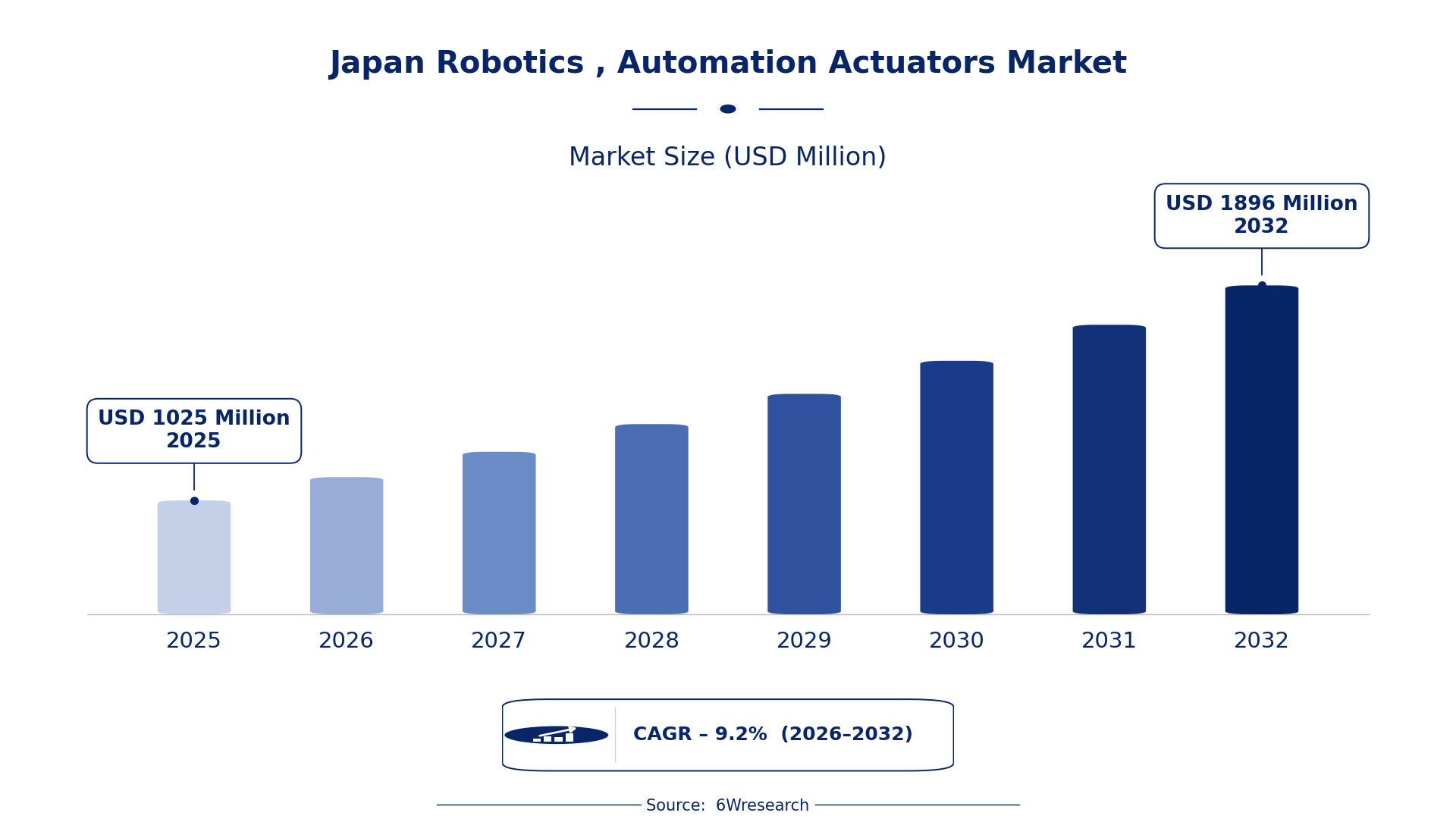
According to 6Wresearch internal database and industry insights, the Japan Robotics , Automation Actuators Market was valued at USD 1,025 Million in 2025 and is projected to reach USD 1,896 Million by 2032, growing at a CAGR of approximately 9.2% during 2026–2032.
Japan Robotics , Automation Actuators Market Highlights
| Report Metric | Details |
| Report Name | Japan Robotics , Automation Actuators Market (2026-2032) |
| Market Size 2025 | USD 1,025 Million |
| Market Size 2032 | USD 1,896 Million |
| Absolute Growth 2025–2032 | USD 871 Million |
| CAGR 2026–2032 | 9.2% |
| Peak Annual Growth | 10.0% in 2028 |
| Forecast Period | 2026–2032 |
| Historical Data | 2022–2025 |
| Base Year | 2025 |
| Leading Actuation, 2025 | Electric (45% share) |
| Leading Application, 2025 | Robotics (69% share) |
| Leading Vertical, 2025 | Automotive (35% share) |
| Leading Characteristics, 2025 | Load (57% share) |
| Leading Type, 2025 | Linear Actuators (60% share) |
| Fastest-Growing Application | Process Automation (12.6% CAGR) |
| Fastest-Growing Vertical | Pharmaceutical & Healthcare (12.8% CAGR) |
| Fastest-Growing Characteristics | Torque (11.6% CAGR) |
| Fastest-Growing Type | Rotary Actuators (12.5% CAGR) |
| Growing Sector | manufacturing |
| Key End Users | automotive industry, food and beverage sector, pharmaceutical manufacturers, aerospace and defense |
Japan Robotics , Automation Actuators Market Year-wise Growth Rate and Key Drivers (2022–2032)
This graph illustrates the annual growth rates of the market from 2022 to 2032, highlighting a steady upward trajectory and projected market expansion over the forecast period.
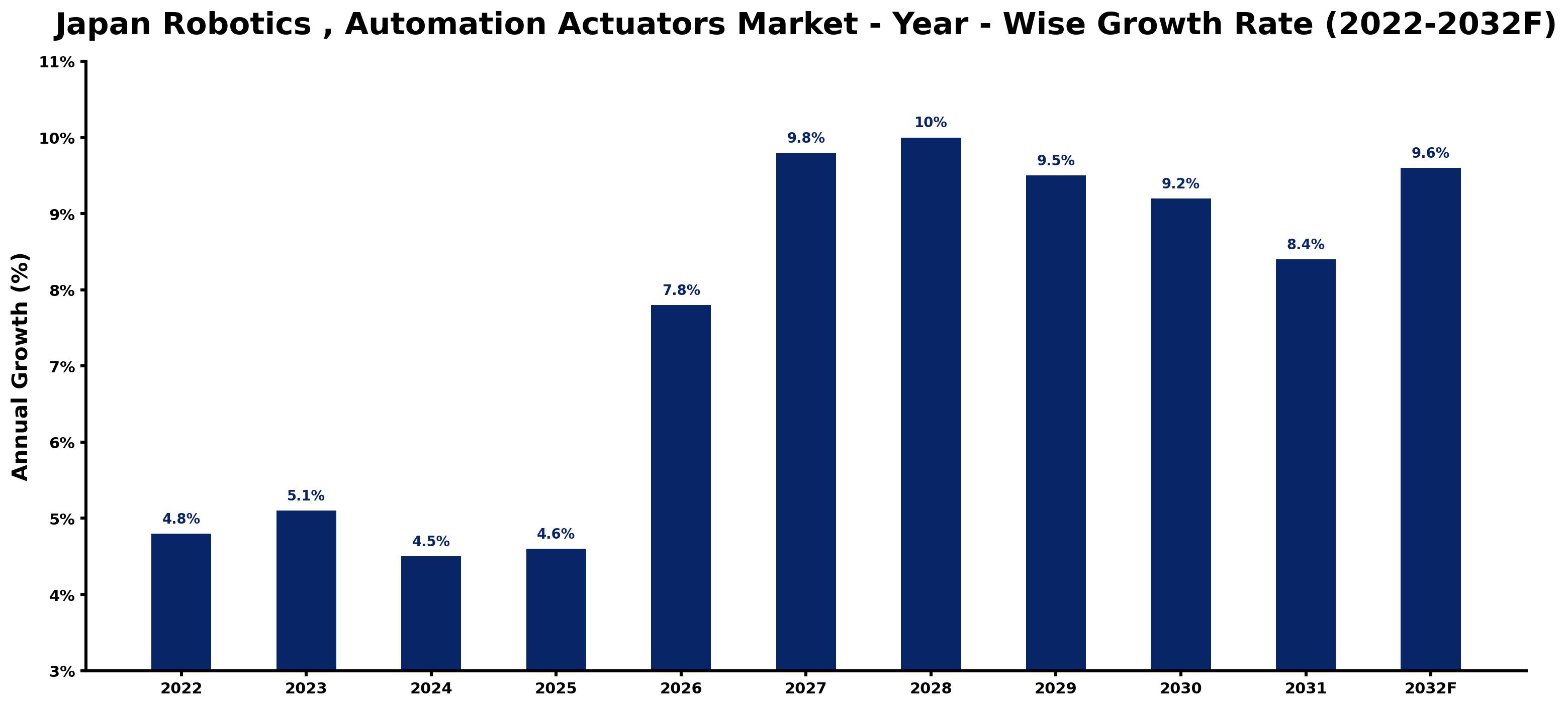
The following figures match every annual growth estimate with the main market development of that year, giving the reasoning behind each rise or slowdown.
| Year | Estimated Annual Growth (%) | Market Rationale |
| 2022 | 4.8 | The market experienced steady growth due to ongoing automation initiatives. |
| 2023 | 5.1 | Growth accelerated as companies increased investments in robotics technology. |
| 2024 | 4.5 | A slight slowdown occurred as some sectors reassessed automation strategies. |
| 2025 | 4.6 | Demand rose again as manufacturers sought efficiency through automation. |
| 2026 | 7.8 | The market is expected to expand rapidly, driven by technological advancements. |
| 2027 | 9.8 | Continued investment in automation technologies will boost market growth. |
| 2028 | 10.0 | The peak growth year will see strong demand from various industries. |
| 2029 | 9.5 | Growth will slow slightly as the market begins to stabilise. |
| 2030 | 9.2 | A further slowdown will occur as market dynamics normalise. |
| 2031 | 8.4 | The market will continue to grow, albeit at a reduced rate. |
| 2032 | 9.6 | Growth will pick up again, driven by renewed investments in automation. |
Note: Market size estimations and growth projections presented in this report are based on 6Wresearch's proprietary forecasting methodology, utilizing the latest available industry data, government publications, and primary research inputs.
Japan Robotics , Automation Actuators Market Synopsis
Robotics and automation actuators convert energy into motion and are essential in industrial applications, particularly in manufacturing and logistics. The Japan Robotics, Automation Actuators Market is projected to reach 1.5 trillion yen by 2025, driven by investments in automation technologies across various sectors. Key factors include strong demand from the automotive industry, ongoing technological advancements, and government initiatives such as the New Robot Strategy established in 2015, which promotes the expansion of robotics across multiple industries.
Market Dynamics Impact Analysis (2026–2032)
| Factor | Type | Impact | Primary Segment Affected |
| Rising demand for automation in manufacturing processes | Driver | High | Process Automation |
| Increased investments in robotics technology | Driver | High | Robotics |
| Growing automation needs in the pharmaceutical sector | Opportunity | High | Pharmaceutical & Healthcare |
| Expansion of automation in food and beverage production | Opportunity | High | Food & Beverages |
| High initial investment costs for automation systems | Restraint | Medium | Robotics |
| Limited skilled workforce for advanced automation technologies | Restraint | Medium | Process Automation |
| Competition from low-cost automation solutions | Challenge | High | Robotics |
| Technological complexity leading to integration challenges | Challenge | High | Process Automation |
Evaluation of Drivers in Japan Robotics , Automation Actuators Market (2026–2032)
The factors lifting demand, and the evidence behind each, are summarised below.
| Drivers | Primary Segment Affected | Why It Matters (Evidence) |
| Increased automation in manufacturing processes | Process Automation | The manufacturing sector is expected to invest 10 billion yen in automation technologies by 2024. |
| Growing adoption of robotics in the automotive sector | Robotics | The automotive industry is adopting robotics at a rate of 15% per year, enhancing production efficiency. |
| Rising demand for automation in food and beverage production | Food & Beverages | The food and beverage industry in Japan is valued at 20 trillion yen, heavily investing in automation. |
| Technological advancements in actuator systems | Electric | Electric actuators account for 40% of the actuator market in Japan, driving demand for precise control. |
| Increased focus on safety and efficiency in pharmaceuticals | Pharmaceutical & Healthcare | The pharmaceutical sector is expected to grow by 5% annually, increasing actuator demand. |
Much of the new demand stems from increased automation in manufacturing processes, with the sector expected to invest 10 billion yen in automation technologies by 2024. The automotive industry is adopting robotics at a rate of 15% per year, boosting production efficiency and actuator purchases. The food and beverage industry, valued at 20 trillion yen, is heavily investing in automation, further driving demand. Technological advancements in actuator systems are improving precision in various applications, while the pharmaceutical sector is growing by 5% annually, raising the need for automation solutions.
Evaluation of Restraints in Japan Robotics , Automation Actuators Market
Several factors work against faster growth; the main ones are summarised below.
| Market Restraint | Primary Segment Affected | Why It Matters (Evidence) |
| High initial investment costs for automation systems | Robotics | The high costs deter smaller manufacturers from adopting advanced robotics solutions. |
| Limited skilled workforce for advanced automation technologies | Process Automation | A shortage of skilled workers hampers the implementation of complex automation systems. |
| Competition from low-cost automation solutions | Robotics | Lower-priced alternatives from other regions challenge the pricing strategies of local producers. |
| Technological complexity leading to integration challenges | Process Automation | Complex systems require substantial time and resources for proper integration, delaying implementation. |
| Regulatory compliance costs for automation technologies | Robotics | Compliance with standards like ISO 10218 increases operational costs for manufacturers. |
Japan Robotics , Automation Actuators Market Challenges
In Japan, producers in the automotive sector face rising costs due to stringent emissions regulations, necessitating substantial investments in compliance technologies. Regulatory frameworks like ISO 10218 complicate production processes, causing delays that can lead to shortages for manufacturers. Limited access to essential raw materials disrupts supply chains, extending lead times and affecting producers' ability to fulfil orders. An increase in the national minimum wage to JPY 1,055 per hour raises operational expenses for manufacturers, ultimately driving up prices for buyers in the robotics and automation market.
Trends in the Japan Robotics , Automation Actuators Market
The shifts below are changing how Japan Robotics , Automation Actuators Market products are bought and supplied.
- Shift from Traditional to Smart Automation: Japan is transitioning from traditional automation systems to smart technologies that integrate AI and IoT. The New Robot Strategy aims to increase factory robot numbers by 30% by 2025.
- Increased Focus on Sustainability in Automation: The push for sustainability is reshaping the robotics market, with many manufacturers adopting eco-friendly practices. Japan targets a 46% cut in greenhouse-gas emissions by 2030, influencing automation investments in energy-efficient technologies.
- Growth of Collaborative Robots in Manufacturing: Collaborative robots, or cobots, are gaining traction in Japan's manufacturing sector, improving human-robot interaction. The automotive sector is rapidly integrating cobots, with a projected growth rate of 15% annually.
- Expansion of Automation in Food Processing: The food processing sector is increasingly adopting automation technologies to improve efficiency and safety. The industry, valued at 20 trillion yen, is investing heavily in robotics for packaging and processing.
Investment Opportunities in the Japan Robotics , Automation Actuators Market
Where to invest in the Japan Robotics , Automation Actuators Market: the main openings are set out below.
- Tokyo as a Hub for Automation Startups: Tokyo is emerging as a hub for automation startups, supported by local government funding programs. The Tokyo Metropolitan Government has allocated resources to support automation initiatives, creating investment opportunities.
- Growing Demand in the Pharmaceutical Sector: The pharmaceutical sector is growing by 5% annually, creating a demand for automation solutions. Companies in this sector can invest in advanced robotics to improve production efficiency.
- Investment in Food and Beverage Automation: The food and beverage industry, valued at 20 trillion yen, presents opportunities for automation suppliers. Investing in packaging and processing technologies can meet the industry's growing needs.
- Expansion of Robotics in Aerospace Manufacturing: The aerospace industry is set to invest heavily in automation technologies in the next five years. Suppliers can enter this market by partnering with local manufacturers to provide advanced robotics solutions.
Government Initiatives in the Japan Robotics , Automation Actuators Market
The New Robot Strategy, established in 2015, aims to expand robot use across various sectors, including manufacturing and services. This strategy encourages investment in robotics and automation technologies, benefiting producers and buyers alike. Additionally, the GX Promotion Act of 2023 provides a legal framework for promoting green technologies, further supporting automation initiatives in Japan.
The Ministry of Economy, Trade and Industry oversees the implementation of various programs, including the AI Promotion Act, which funds projects aimed at increasing the adoption of automation technologies, benefiting manufacturers looking to improve productivity.
Future Insight of the Japan Robotics , Automation Actuators Market
By 2032, new automation facilities will emerge, aligning with Japan's GX Basic Policy that targets JPY 150 trillion in decarbonisation investments. The pharmaceutical sector's anticipated 5% annual growth will boost actuator demand, while the food and beverage industry continues to prioritise automation. The automotive sector's ongoing 15% annual adoption of robotics will streamline production processes. These developments will provide suppliers with expanded opportunities and improve operational efficiency for buyers.
Market Segmentation Analysis
Japan Robotics , Automation Actuators Market report covers a detailed analysis of the following market segments:
By Actuation – Electric Leads and Records the Fastest Growth
According to Ravi Bhandari, Research Head at 6Wresearch, Electric accounted for 45% of the market by actuation in 2025. Electric actuators dominate the market due to their precision and efficiency, making them indispensable in automation applications across various sectors. Their extensive use in manufacturing processes, such as assembly lines, underscores their leading position. The same category is also set to grow fastest, at a CAGR of 12.1% during 2026–2032. The rapid advancements in electric actuator technology are propelling their adoption, particularly in the automotive sector where efficiency is paramount. As industries increasingly embrace automation, the demand for electric actuators is expected to continue rising. Suppliers should focus on developing electric actuators to meet the growing demand across multiple sectors.
By Application – Robotics Lead, Process Automation Expected to Grow Fastest
In 2025, Robotics led the application split with a 69% share. Robotics holds the largest share as it is essential to modern manufacturing, enabling critical tasks such as assembly and material handling. The automotive industry's heavy reliance on robotics illustrates its vital role in enhancing production efficiency. Over 2026–2032, Process Automation is expected to post the fastest growth, at a CAGR of 12.6%. Process automation is experiencing rapid growth due to its crucial role in improving manufacturing efficiency, particularly within the pharmaceutical sector. This trend is likely to accelerate as companies seek to optimise their operations and reduce costs. Buyers should prioritise investments in process automation technologies to improve operational efficiency.
By Vertical – Automotive Leads, Pharmaceutical & Healthcare Expected to Grow Fastest
With 35% of vertical revenue in 2025, Automotive was the largest category. The automotive sector leads the vertical market due to its extensive use of robotics for assembly line automation, employing a significant workforce to support this. The industry's commitment to advanced automation technologies solidifies its top position. The quickest growth will come from Pharmaceutical & Healthcare, forecast to expand at a CAGR of 12.8% between 2026 and 2032. The pharmaceutical and healthcare sectors are poised for notable growth as they increasingly adopt automation in drug manufacturing processes. This shift is driven by the need for improved efficiency and safety in production, indicating a strong future demand. Suppliers should target the pharmaceutical sector to capitalise on its growing demand for automation solutions.
By Characteristics – Load Leads, Torque Expected to Grow Fastest
The largest characteristics category in 2025 was Load, at 57% of revenue. Load characteristics dominate the market as they are critical for applications requiring specific weight handling, especially in manufacturing and logistics. This importance is highlighted by the need for precise load management in various operations, ensuring operational efficiency. Torque is projected to grow fastest, at a CAGR of 11.6% during 2026–2032. Torque characteristics are gaining traction due to their necessity in applications requiring rotational force, particularly in machinery. This growth reflects the broader trend towards automation, as industries increasingly seek to enhance their operational capabilities. Suppliers must develop torque-based solutions to address the rising demand for rotational applications.
By Type – Linear Actuators Lead, Rotary Actuators Expected to Grow Fastest
Linear Actuators took 60% of type revenue in 2025, more than any other category. Linear actuators lead the market as they are extensively used for straight-line motion applications, essential in assembly lines and manufacturing processes. Their versatility and reliability make them a preferred choice across various industries. Rotary Actuators are set to record the highest CAGR in this split, 12.5% over 2026–2032. Rotary actuators are witnessing rapid growth due to their critical role in providing rotational movement in machinery, a requirement that is increasingly important in automated systems. This trend is expected to persist as industries modernise their operations. Buyers should consider integrating rotary actuators into their systems to enhance operational capabilities.
Key Attractiveness of the Report
- 10 Years of Market Numbers
- Historical Data Starting from 2022 to 2025
- Base Year 2025
- Forecast Data until 2032
- Key Performance Indicators Impacting the Market
- Major Upcoming Developments and Projects
Key Highlights of the Report:
- Japan Robotics , Automation Actuators Market Outlook
- Market Size of Japan Robotics , Automation Actuators Market, 2025
- Forecast of Japan Robotics , Automation Actuators Market, 2032
- Historical Data and Forecast of Japan Robotics , Automation Actuators Revenues & Volume for the Period 2022-2032
- Japan Robotics , Automation Actuators Market Trend Evolution
- Japan Robotics , Automation Actuators Market Drivers and Challenges
- Japan Robotics , Automation Actuators Price Trends
- Japan Robotics , Automation Actuators Porter's Five Forces
- Japan Robotics , Automation Actuators Industry Life Cycle
- Historical Data and Forecast of Japan Robotics , Automation Actuators Market Revenues & Volume By Actuation for the Period 2022-2032
- Historical Data and Forecast of Japan Robotics , Automation Actuators Market Revenues & Volume By Electric for the Period 2022-2032
- Historical Data and Forecast of Japan Robotics , Automation Actuators Market Revenues & Volume By Pneumatic for the Period 2022-2032
- Historical Data and Forecast of Japan Robotics , Automation Actuators Market Revenues & Volume By Hydraulic for the Period 2022-2032
- Historical Data and Forecast of Japan Robotics , Automation Actuators Market Revenues & Volume By Application for the Period 2022-2032
- Historical Data and Forecast of Japan Robotics , Automation Actuators Market Revenues & Volume By Process Automation for the Period 2022-2032
- Historical Data and Forecast of Japan Robotics , Automation Actuators Market Revenues & Volume By Robotics for the Period 2022-2032
- Historical Data and Forecast of Japan Robotics , Automation Actuators Market Revenues & Volume By Vertical for the Period 2022-2032
- Historical Data and Forecast of Japan Robotics , Automation Actuators Market Revenues & Volume By Food & Beverages for the Period 2022-2032
- Historical Data and Forecast of Japan Robotics , Automation Actuators Market Revenues & Volume By Oil & Gas for the Period 2022-2032
- Historical Data and Forecast of Japan Robotics , Automation Actuators Market Revenues & Volume By Metal Mining & Machinery for the Period 2022-2032
- Historical Data and Forecast of Japan Robotics , Automation Actuators Market Revenues & Volume By Power Generation for the Period 2022-2032
- Historical Data and Forecast of Japan Robotics , Automation Actuators Market Revenues & Volume By Chemicals, Paper & plastics for the Period 2022-2032
- Historical Data and Forecast of Japan Robotics , Automation Actuators Market Revenues & Volume By Pharmaceutical & Healthcare for the Period 2022-2032
- Historical Data and Forecast of Japan Robotics , Automation Actuators Market Revenues & Volume By Automotive for the Period 2022-2032
- Historical Data and Forecast of Japan Robotics , Automation Actuators Market Revenues & Volume By Aerospace & Defense for the Period 2022-2032
- Historical Data and Forecast of Japan Robotics , Automation Actuators Market Revenues & Volume By Characteristics for the Period 2022-2032
- Historical Data and Forecast of Japan Robotics , Automation Actuators Market Revenues & Volume By Load for the Period 2022-2032
- Historical Data and Forecast of Japan Robotics , Automation Actuators Market Revenues & Volume By Torque for the Period 2022-2032
- Historical Data and Forecast of Japan Robotics , Automation Actuators Market Revenues & Volume By Type for the Period 2022-2032
- Historical Data and Forecast of Japan Robotics , Automation Actuators Market Revenues & Volume By Linear Actuators for the Period 2022-2032
- Historical Data and Forecast of Japan Robotics , Automation Actuators Market Revenues & Volume By Rotary Actuators for the Period 2022-2032
- Japan Robotics , Automation Actuators Import Export Trade Statistics
- Market Opportunity Assessment By Actuation
- Market Opportunity Assessment By Application
- Market Opportunity Assessment By Vertical
- Market Opportunity Assessment By Characteristics
- Market Opportunity Assessment By Type
- Japan Robotics , Automation Actuators Top Companies Market Share
- Japan Robotics , Automation Actuators Competitive Benchmarking By Technical and Operational Parameters
- Japan Robotics , Automation Actuators Company Profiles
- Japan Robotics , Automation Actuators Key Strategic Recommendations
Market Covered
This report examines the market across the segments below.
By Actuation
- Electric
- Pneumatic
- Hydraulic
By Application
- Process Automation
- Robotics
By Vertical
- Food & Beverages
- Oil & Gas
- Metal Mining & Machinery
- Power Generation
- Chemicals
- Paper & plastics
- Pharmaceutical & Healthcare
- Automotive
- Aerospace & Defense
By Characteristics
- Load
- Torque
By Type
- Linear Actuators
- Rotary Actuators































