Japan RPA Automation Market Size & Growth Rate
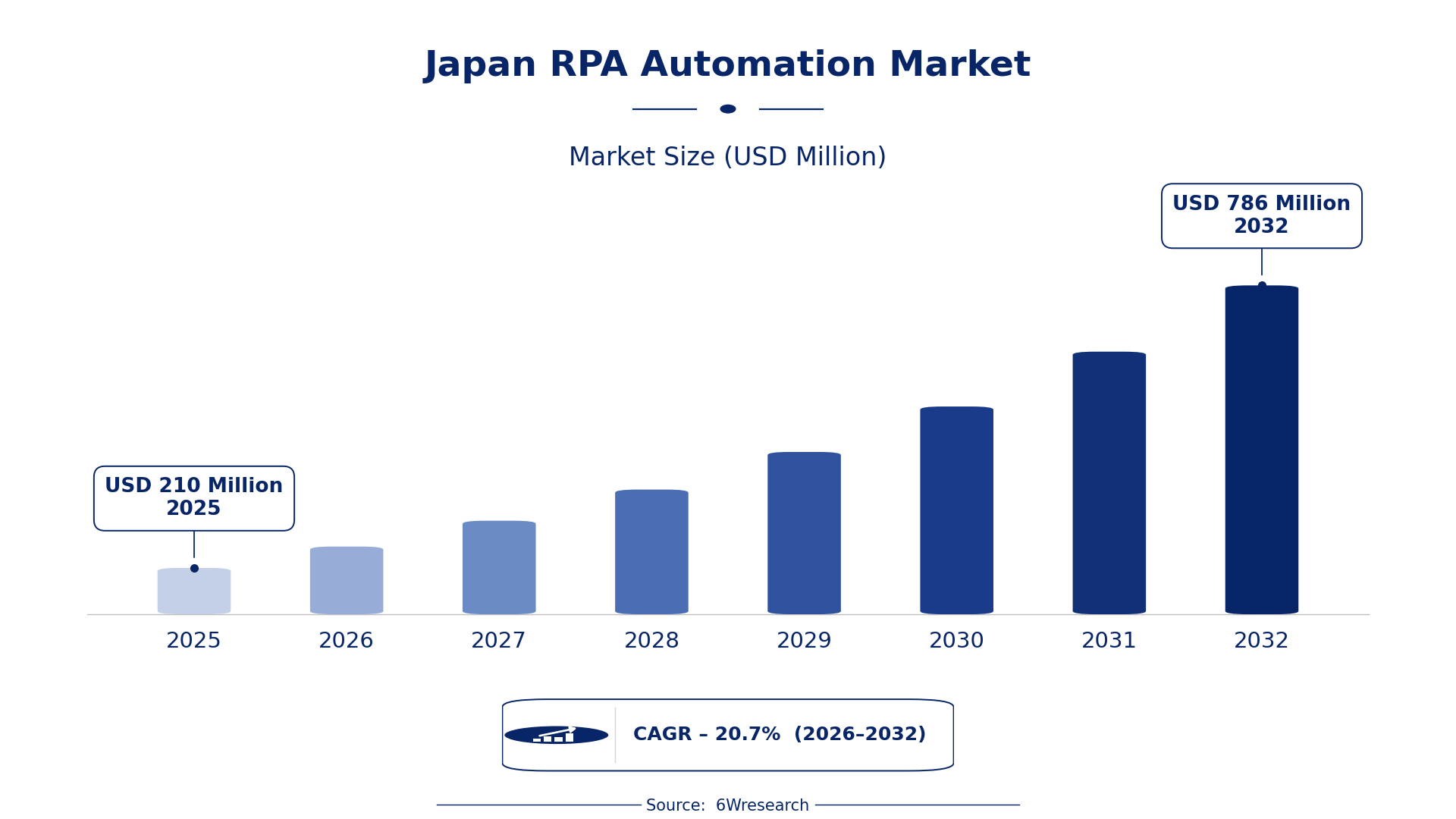
According to 6Wresearch internal database and industry insights, the Japan RPA Automation Market was valued at USD 210 Million in 2025 and is projected to reach USD 786 Million by 2032, growing at a CAGR of approximately 20.7% during 2026–2032.
Japan RPA Automation Market Highlights
| Report Metric | Details |
| Report Name | Japan RPA Automation Market (2026-2032) |
| Market Size 2025 | USD 210 Million |
| Market Size 2032 | USD 786 Million |
| Absolute Growth 2025–2032 | USD 576 Million |
| CAGR 2026–2032 | 20.7% |
| Peak Annual Growth | 23.0% in 2031 |
| Forecast Period | 2026–2032 |
| Historical Data | 2022–2025 |
| Base Year | 2025 |
| Leading Software Type, 2025 | Intelligent Automation (51% share) |
| Leading Automation Type, 2025 | AI-Enhanced RPA (42% share) |
| Leading Deployment Mode, 2025 | Cloud-Based (48% share) |
| Leading Application Area, 2025 | Customer Support (44% share) |
| Leading End User Segment, 2025 | Enterprises (39% share) |
| Fastest-Growing Automation Type | Autonomous Bots (22.5% CAGR) |
| Fastest-Growing Deployment Mode | SaaS (22.0% CAGR) |
| Fastest-Growing Application Area | Invoice Processing (26.6% CAGR) |
| Fastest-Growing End User Segment | SMEs (27.0% CAGR) |
| Growing Sector | Finance Departments |
| Key End Users | Enterprises, SMEs, Contact Centers, Finance Departments |
Japan RPA Automation Market Year-wise Growth Rate and Key Drivers (2022–2032)
This graph illustrates the annual growth rates of the market from 2022 to 2032, highlighting a steady upward trajectory and projected market expansion over the forecast period.
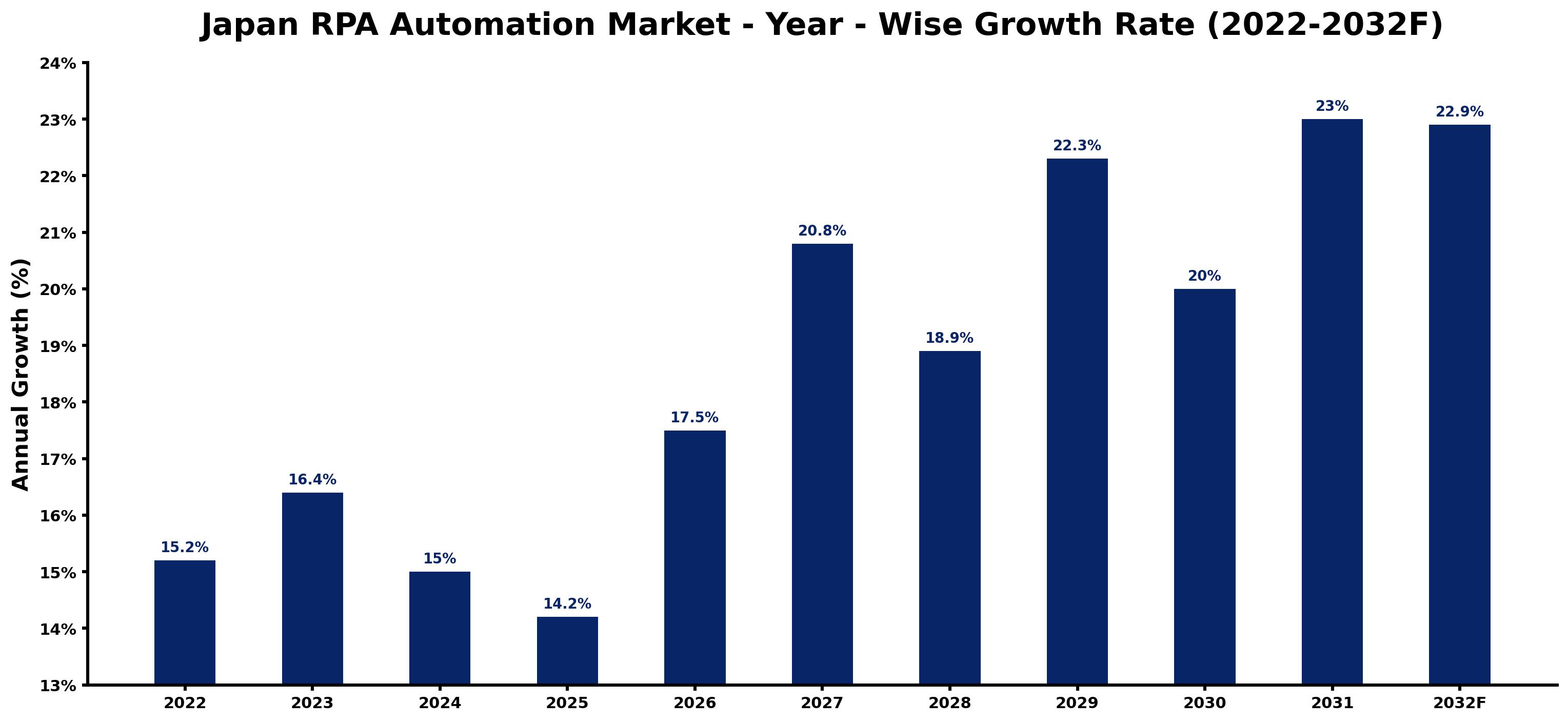
The table below sets out the estimated growth rate for each year and the main factor behind it.
| Year | Estimated Annual Growth (%) | Market Rationale |
| 2022 | 15.2 | The market exhibited solid growth as enterprises began to adopt automation technologies. |
| 2023 | 16.4 | Demand accelerated as more companies recognised the efficiency benefits of RPA solutions. |
| 2024 | 15.0 | Growth slowed as some enterprises faced challenges in scaling their automation efforts. |
| 2025 | 14.2 | The market continued to expand, albeit at a slower pace due to market saturation in some areas. |
| 2026 | 17.5 | Investment in RPA technologies is expected to increase as businesses seek to improve operational efficiency. |
| 2027 | 20.8 | Demand is projected to surge as enterprises aim for greater automation in their workflows. |
| 2028 | 18.9 | Growth is anticipated to decelerate slightly as the market matures and competition intensifies. |
| 2029 | 22.3 | A renewed focus on automation will drive demand higher as enterprises seek to optimise processes. |
| 2030 | 20.0 | The market is expected to experience a slowdown as enterprises reassess their automation strategies. |
| 2031 | 23.0 | Demand will peak as organisations fully embrace RPA technologies across various sectors. |
| 2032 | 22.9 | Growth is projected to moderate as the market stabilises, reflecting a mature adoption phase. |
Note: Market size estimations and growth projections presented in this report are based on 6Wresearch's proprietary forecasting methodology, utilizing the latest available industry data, government publications, and primary research inputs.
Japan RPA Automation Market Synopsis
RPA Automation, or Robotic Process Automation, automates repetitive tasks through software robots programmed to mimic human actions. This technology streamlines processes in customer support, finance, and HR, improving operational efficiency. The Japan RPA Automation Market is expanding as domestic enterprises and SMEs increasingly seek efficiency. With an adoption rate of around 30% as of 2023, initiatives like the 'Digital Agency' promote automation technologies, driving further demand and investment in RPA solutions.
Market Dynamics Impact Analysis (2026–2032)
| Factor | Type | Impact | Primary Segment Affected |
| Increased investment in automation technologies | Driver | High | RPA Tools |
| Growing need for operational efficiency in enterprises | Driver | High | Intelligent Automation |
| Rising demand for RPA in finance departments | Opportunity | High | Finance Departments |
| Expansion of RPA applications in customer support | Opportunity | Medium | Customer Support |
| Challenges in scaling RPA solutions | Restraint | High | Enterprises |
| Concerns regarding data security in RPA implementations | Restraint | Medium | RPA Tools |
| Limited skilled workforce for RPA implementation | Challenge | High | Intelligent Automation |
| High initial investment costs for RPA solutions | Challenge | Medium | SMEs |
Evaluation of Drivers in Japan RPA Automation Market (2026–2032)
Key forces behind demand, with the segment each one moves most, are listed below.
| Drivers | Primary Segment Affected | Why It Matters (Evidence) |
| Increased funding for digital transformation initiatives | RPA Tools | The Japanese government allocated 5 billion yen for digital transformation projects, encouraging enterprises to invest in RPA tools. |
| High demand for efficient financial workflows | Finance Departments | The adoption rate of RPA in finance departments is around 30%, with many organisations automating invoice processing to reduce errors. |
| Growing interest in customer service automation | Customer Support | RPA is utilised in over 50% of contact centers, improving service efficiency and response times. |
| Shift towards cloud-based solutions | Cloud-Based | Cloud-based RPA solutions are increasingly popular due to their scalability, with a growing number of enterprises adopting them. |
| Rising focus on operational efficiency | Intelligent Automation | The 'Future of Work' program aims to improve workforce efficiency, driving demand for intelligent automation solutions. |
The adoption rate of RPA in finance departments is around 30%, as many organisations automate invoice processing to reduce errors. RPA is utilised in over 50% of contact centers, improving service efficiency and response times. The demand for cloud-based RPA solutions is rising, as many enterprises seek scalability and flexibility in their operations. The focus on enhancing operational efficiency drives further interest in RPA technologies.
Evaluation of Restraints in Japan RPA Automation Market
The table below lists the restraints and the evidence behind each.
| Market Restraint | Primary Segment Affected | Why It Matters (Evidence) |
| Challenges in scaling RPA solutions | Enterprises | Many enterprises face difficulties in scaling RPA solutions effectively, resulting in underutilisation of their investments. |
| Concerns regarding data security in RPA implementations | RPA Tools | Data security issues can hinder the adoption of RPA tools, as companies prioritise protecting sensitive information. |
| Limited skilled workforce for RPA implementation | Intelligent Automation | A shortage of skilled professionals capable of implementing RPA solutions can restrict growth in intelligent automation, with only 30% of enterprises adopting RPA as of 2023. |
| High initial investment costs for RPA solutions | SMEs | Small and medium enterprises often struggle with the high upfront costs associated with RPA solutions, limiting their adoption. |
| Integration challenges with existing systems | Customer Support | Integrating RPA with legacy systems can pose challenges, delaying implementation in customer support, with costs exceeding JPY 5 million. |
Japan RPA Automation Market Challenges
In 2023, only 30% of Japanese enterprises adopted RPA, indicating a notable barrier to automation growth. Stringent data privacy regulations create complexities for buyers, leading to project delays that can extend timelines by up to six months. High competition among suppliers forces them to lower prices, impacting their capacity to invest in advanced technologies and innovate. Integration costs for RPA systems can surpass JPY 5 million, making it challenging for buyers to achieve operational efficiency and a satisfactory return on investment. Additionally, a shortage of skilled professionals in RPA compels clinics and enterprises to rely on external consultants, prolonging project completion.
Trends in the Japan RPA Automation Market
The trends below show where the Japan RPA Automation Market is heading.
- Acceleration of Cloud-Based RPA Adoption: The adoption of cloud-based RPA solutions is accelerating, with 48% of enterprises opting for this deployment mode. This shift allows for greater flexibility and scalability in automation, particularly in urban areas like Tokyo.
- Integration of AI in RPA: The rise of AI in RPA is transforming automation processes, improving decision-making. This trend is clear as AI-Enhanced RPA holds a 42% share in the market, reflecting its growing importance.
- Increased RPA Utilisation in Finance: RPA is increasingly used in finance departments, particularly for invoice processing, which is growing at a CAGR of 26.6%. This trend reflects the industry's push for efficiency and error reduction.
- Focus on Customer Support Automation: The customer support sector is seeing a surge in RPA adoption, with 44% of enterprises using it to improve service efficiency. This trend demonstrates the growing importance of automation in customer interactions.
Investment Opportunities in the Japan RPA Automation Market
The openings below show where demand in the Japan RPA Automation Market is visible and how suppliers can enter.
- Investment in RPA Tools: The demand for RPA tools is rising, particularly among finance departments, as the adoption rate is around 30%. Investing in this area can yield substantial returns, especially in major cities.
- Expansion of RPA in SMEs: With SMEs increasingly seeking affordable automation solutions, there is an opportunity to supply RPA tools tailored to their needs, especially given the 5 billion yen allocated for digital transformation.
- Collaborative Approaches for RPA Implementation: Partnering with local enterprises can facilitate RPA adoption, particularly in regions like Tokyo, where automation initiatives are strong. This strategy can help overcome barriers to entry.
- Support for Digital Transformation Projects: The ongoing support for digital transformation projects presents an opportunity to provide RPA solutions. The government's initiatives encourage enterprises to invest in automation technologies.
Government Initiatives in the Japan RPA Automation Market
The GX Promotion Act (2023) establishes a framework for promoting decarbonisation and digital transformation, building on previous measures like the New Robot Strategy (2015). This act encourages companies to adopt RPA technologies as part of their digital transformation efforts, improving efficiency and competitiveness in the market.
In 2022, the Ministry of Economy, Trade and Industry launched a program with a budget of 5 billion yen to support SMEs in adopting RPA. The Digital Agency oversees this initiative, aiming to improve automation capabilities across various sectors, thereby increasing the accessibility of RPA tools for smaller enterprises.
Future Insight of the Japan RPA Automation Market
By 2032, SMEs will increasingly embrace RPA, influenced by government support programmes like the 'Digital Agency' and the 'Future of Work' initiative. The anticipated JPY 150 trillion investment in decarbonisation will drive automation across various sectors, improving productivity. As RPA becomes more common in finance and HR, buyers will experience enhanced operational efficiencies. The adoption of standards such as ISO 27001 will strengthen data security, building greater trust in RPA applications.
Market Segmentation Analysis
Japan RPA Automation Market report covers a detailed analysis of the following market segments:
By Software Type – Intelligent Automation Leads and Records the Fastest Growth
According to Uttkarsh, Research Associate at 6Wresearch, Intelligent Automation took 51% of software type revenue in 2025, more than any other category. Intelligent Automation holds the largest share because it automates complex tasks, appealing to enterprises aiming for operational efficiency. For instance, many organisations in Tokyo have embraced this technology to streamline their processes and boost productivity. Its lead should widen, with a projected CAGR of 22.3% during 2026–2032, the highest in this split. The growth of Intelligent Automation is propelled by its ability to optimise task execution continuously, making it essential for enterprises facing changing demands. As more businesses recognise its effectiveness, this segment's lead will continue to widen due to increased adoption. Suppliers should prioritise developing robust Intelligent Automation solutions to meet the rising demand from enterprises.
By Automation Type – AI-Enhanced RPA Leads, Autonomous Bots Expected to Grow Fastest
The largest automation type category in 2025 was AI-Enhanced RPA, at 42% of revenue. AI-Enhanced RPA leads the market by enhancing decision-making across various processes, making it crucial for enterprises looking to optimise operations. This trend is evident as more companies in Japan implement advanced automation strategies to improve efficiency. Over 2026–2032, Autonomous Bots are expected to post the fastest growth, at a CAGR of 22.5%. The rapid growth of Autonomous Bots is driven by their capability to manage tasks independently, appealing to businesses aiming to reduce operational costs. With increasing adoption of these fully autonomous solutions, this segment will continue to gain momentum. Buyers should consider the potential of Autonomous Bots to streamline operations and effectively lower costs.
By Deployment Mode – Cloud-Based Leads, SaaS Expected to Grow Fastest
In 2025, Cloud-Based led the deployment mode split with a 48% share. Cloud-Based solutions dominate the market due to their flexibility and scalability, allowing enterprises to adapt quickly to changing needs. This is particularly relevant in Japan, where many businesses are transitioning to cloud infrastructures for their automation needs. SaaS are set to record the highest CAGR in this split, 22.0% over 2026–2032. SaaS is experiencing the fastest growth as it delivers RPA capabilities via subscription, making it accessible for a wider range of businesses. The increasing preference for subscription models indicates a shift towards more manageable operational costs. Suppliers must ensure their offerings are compatible with cloud and SaaS models to attract a broader customer base.
By Application Area – Customer Support Leads, Invoice Processing Expected to Grow Fastest
Customer Support accounted for 44% of the market by application area in 2025. Customer Support is the leading application area as RPA significantly enhances service efficiency and response times, which is vital for customer satisfaction. Numerous enterprises in Japan are integrating RPA into their customer service operations to improve interaction quality. Invoice Processing is projected to grow fastest, at a CAGR of 26.6% during 2026–2032. Invoice Processing is witnessing rapid growth due to its effectiveness in automating financial document handling, which greatly reduces errors and processing times. As organisations strive to enhance their financial workflows, this application area will see increased adoption. Buyers should focus on RPA solutions for invoice processing to improve accuracy and efficiency in financial operations.
By End User Segment – Enterprises Lead, SMEs Expected to Grow Fastest
With 39% of end user segment revenue in 2025, Enterprises was the largest category. Enterprises account for the largest share as they engage in extensive automation implementations to drive operational efficiency. The increasing adoption of RPA by large companies in urban areas like Tokyo highlights this trend. The quickest growth will come from SMEs, forecast to expand at a CAGR of 27.0% between 2026 and 2032. SMEs are the fastest-growing segment, attracted by cost-effective solutions that allow them to implement automation with minimal investment. As more SMEs recognise the advantages of RPA, this segment will continue to expand rapidly. Suppliers should customise their offerings to address the unique requirements of SMEs to capture this expanding market.
Key Attractiveness of the Report
- 10 Years of Market Numbers
- Historical Data Starting from 2022 to 2025
- Base Year 2025
- Forecast Data until 2032
- Key Performance Indicators Impacting the Market
- Major Upcoming Developments and Projects
Key Highlights of the Report:
- Japan RPA Automation Market Outlook
- Market Size of Japan RPA Automation Market, 2025
- Forecast of Japan RPA Automation Market, 2032
- Historical Data and Forecast of Japan RPA Automation Revenues & Volume for the Period 2022-2032F
- Japan RPA Automation Market Trend Evolution
- Japan RPA Automation Market Drivers and Challenges
- Japan RPA Automation Price Trends
- Japan RPA Automation Porter's Five Forces
- Japan RPA Automation Industry Life Cycle
- Historical Data and Forecast of Japan RPA Automation Market Revenues & Volume By Software Type for the Period 2022-2032F
- Historical Data and Forecast of Japan RPA Automation Market Revenues & Volume By Attended Automation for the Period 2022-2032F
- Historical Data and Forecast of Japan RPA Automation Market Revenues & Volume By Unattended Automation for the Period 2022-2032F
- Historical Data and Forecast of Japan RPA Automation Market Revenues & Volume By Intelligent Automation for the Period 2022-2032F
- Historical Data and Forecast of Japan RPA Automation Market Revenues & Volume By RPA Tools for the Period 2022-2032F
- Historical Data and Forecast of Japan RPA Automation Market Revenues & Volume By Automation Type for the Period 2022-2032F
- Historical Data and Forecast of Japan RPA Automation Market Revenues & Volume By Human-in-the-loop for the Period 2022-2032F
- Historical Data and Forecast of Japan RPA Automation Market Revenues & Volume By Autonomous Bots for the Period 2022-2032F
- Historical Data and Forecast of Japan RPA Automation Market Revenues & Volume By AI-Enhanced RPA for the Period 2022-2032F
- Historical Data and Forecast of Japan RPA Automation Market Revenues & Volume By Rule-Based Automation for the Period 2022-2032F
- Historical Data and Forecast of Japan RPA Automation Market Revenues & Volume By Deployment Mode for the Period 2022-2032F
- Historical Data and Forecast of Japan RPA Automation Market Revenues & Volume By On-Premise for the Period 2022-2032F
- Historical Data and Forecast of Japan RPA Automation Market Revenues & Volume By Cloud-Based for the Period 2022-2032F
- Historical Data and Forecast of Japan RPA Automation Market Revenues & Volume By Hybrid for the Period 2022-2032F
- Historical Data and Forecast of Japan RPA Automation Market Revenues & Volume By SaaS for the Period 2022-2032F
- Historical Data and Forecast of Japan RPA Automation Market Revenues & Volume By Application Area for the Period 2022-2032F
- Historical Data and Forecast of Japan RPA Automation Market Revenues & Volume By Customer Support for the Period 2022-2032F
- Historical Data and Forecast of Japan RPA Automation Market Revenues & Volume By Invoice Processing for the Period 2022-2032F
- Historical Data and Forecast of Japan RPA Automation Market Revenues & Volume By HR Onboarding for the Period 2022-2032F
- Historical Data and Forecast of Japan RPA Automation Market Revenues & Volume By Data Entry Tasks for the Period 2022-2032F
- Historical Data and Forecast of Japan RPA Automation Market Revenues & Volume By End User Segment for the Period 2022-2032F
- Historical Data and Forecast of Japan RPA Automation Market Revenues & Volume By Contact Centers for the Period 2022-2032F
- Historical Data and Forecast of Japan RPA Automation Market Revenues & Volume By Finance Departments for the Period 2022-2032F
- Historical Data and Forecast of Japan RPA Automation Market Revenues & Volume By Enterprises for the Period 2022-2032F
- Historical Data and Forecast of Japan RPA Automation Market Revenues & Volume By SMEs for the Period 2022-2032F
- Japan RPA Automation Import Export Trade Statistics
- Market Opportunity Assessment By Software Type
- Market Opportunity Assessment By Automation Type
- Market Opportunity Assessment By Deployment Mode
- Market Opportunity Assessment By Application Area
- Market Opportunity Assessment By End User Segment
- Japan RPA Automation Top Companies Market Share
- Japan RPA Automation Competitive Benchmarking By Technical and Operational Parameters
- Japan RPA Automation Company Profiles
- Japan RPA Automation Key Strategic Recommendations
Market Covered
This report examines the market across the segments below.
By Software Type
- Attended Automation
- Unattended Automation
- Intelligent Automation
- RPA Tools
By Automation Type
- Human-in-the-loop
- Autonomous Bots
- AI-Enhanced RPA
- Rule-Based Automation
By Deployment Mode
- On-Premise
- Cloud-Based
- Hybrid
- SaaS
By Application Area
- Customer Support
- Invoice Processing
- HR Onboarding
- Data Entry Tasks
By End User Segment
- Contact Centers
- Finance Departments
- Enterprises
- SMEs































