Japan Rubber Compound Market Size & Growth Rate
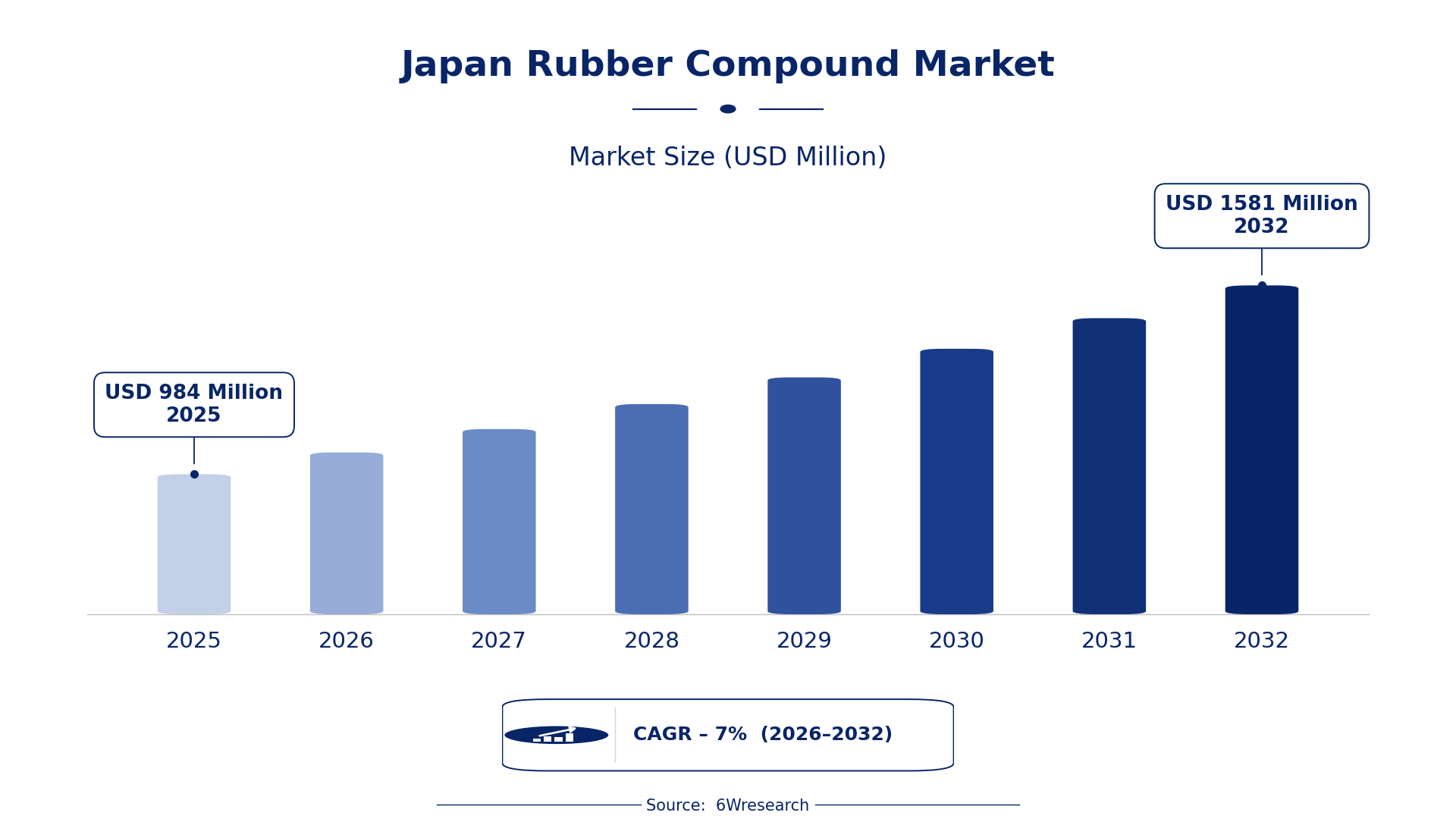
According to 6Wresearch internal database and industry insights, the Japan Rubber Compound Market was valued at USD 984 Million in 2025 and is projected to reach USD 1,581 Million by 2032, growing at a CAGR of approximately 7% during 2026–2032.
Japan Rubber Compound Market Highlights
| Report Metric | Details |
| Report Name | Japan Rubber Compound Market (2026-2032) |
| Market Size 2025 | USD 984 Million |
| Market Size 2032 | USD 1,581 Million |
| Absolute Growth 2025–2032 | USD 597 Million |
| CAGR 2026–2032 | 7% |
| Peak Annual Growth | 7.8% in 2026 |
| Forecast Period | 2026–2032 |
| Historical Data | 2022–2025 |
| Base Year | 2025 |
| Leading Rubber Type, 2025 | EPDM Rubber (36% share) |
| Leading End-User, 2025 | Tires (42% share) |
| Fastest-Growing Rubber Type | Silicone Rubber (9.7% CAGR) |
| Fastest-Growing End-User | Hose & Belting (9.3% CAGR) |
| Growing Sector | automotive |
| Key End Users | automotive manufacturers, construction companies, consumer goods producers |
Japan Rubber Compound Market Year-wise Growth Rate and Key Drivers (2022–2032)
This graph illustrates the annual growth rates of the market from 2022 to 2032, highlighting a steady upward trajectory and projected market expansion over the forecast period.
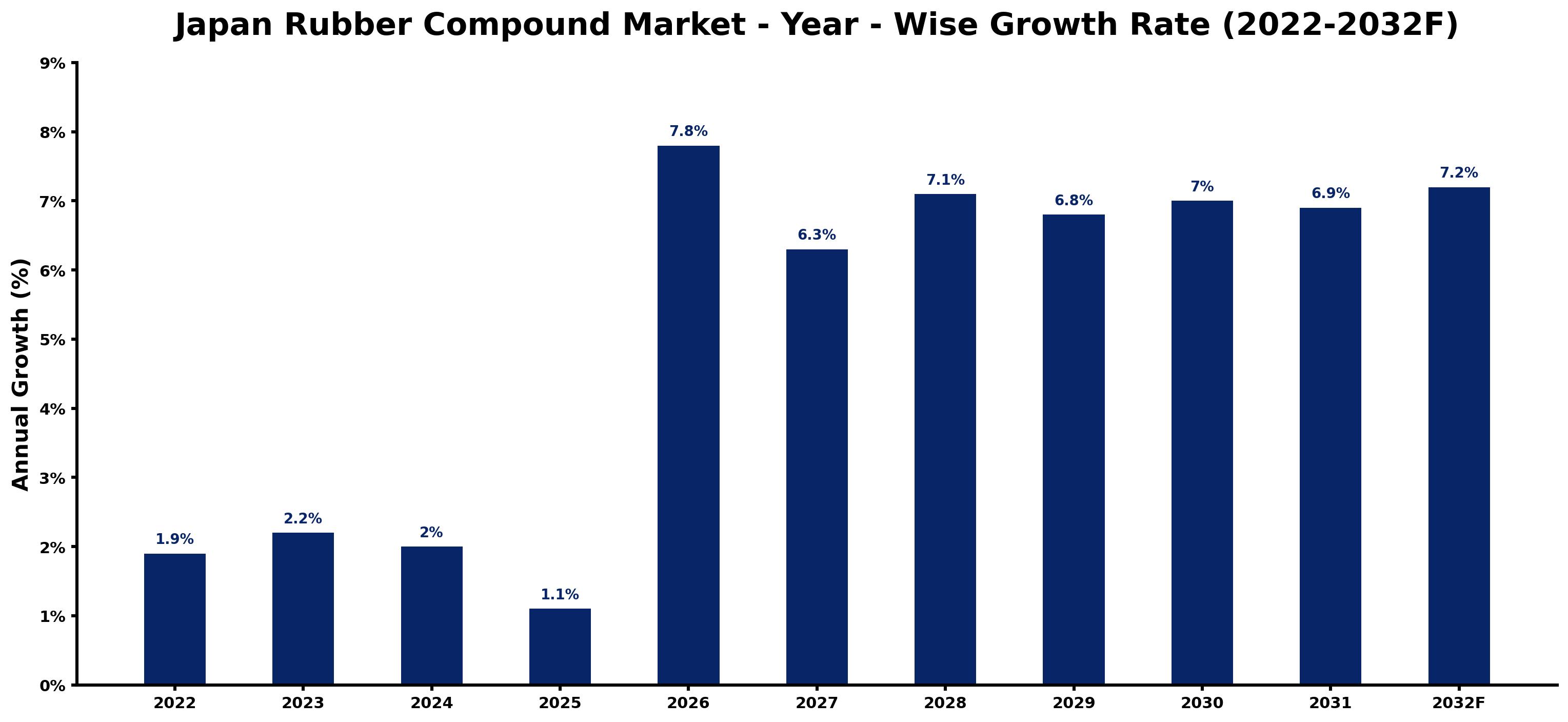
The yearly estimates that follow link every growth rate to its principal driver, so readers can see why the pace changed in each period.
| Year | Estimated Annual Growth (%) | Market Rationale |
| 2022 | 1.9 | The market experienced stable growth due to consistent demand from the automotive sector. |
| 2023 | 2.2 | Growth accelerated as tire manufacturers increased production to meet rising consumer demand. |
| 2024 | 2.0 | Growth slowed slightly as manufacturers adjusted to market saturation and inventory levels. |
| 2025 | 1.1 | The market continued to grow, albeit at a slower pace, as competition intensified among suppliers. |
| 2026 | 7.8 | Growth surged as investments in rubber recycling technologies boosted production capacity. |
| 2027 | 6.3 | A slight slowdown occurred as the market began to stabilise after rapid expansion. |
| 2028 | 7.1 | Growth picked up again as infrastructure projects increased the demand for rubber compounds. |
| 2029 | 6.8 | The market experienced a slowdown as manufacturers faced challenges in sourcing raw materials. |
| 2030 | 7.0 | Growth rebounded as technological advancements improved production efficiency. |
| 2031 | 6.9 | A slight slowdown was noted as the market adjusted to new regulatory standards. |
| 2032 | 7.2 | Growth accelerated as the automotive sector expanded with new electric vehicle models. |
Note: Market size estimations and growth projections presented in this report are based on 6Wresearch's proprietary forecasting methodology, utilizing the latest available industry data, government publications, and primary research inputs.
Japan Rubber Compound Market Synopsis
Rubber compounds are materials created by blending rubber with various additives to improve performance characteristics. These compounds find extensive application in the automotive, construction, and consumer goods industries, with the automotive sector, particularly tire manufacturing, driving demand. The Japan Rubber Compound Market is expanding due to rising automotive production, investments in rubber recycling technologies, and government initiatives promoting sustainable practices, which are increasing the demand for high-quality rubber compounds.
Market Dynamics Impact Analysis (2026–2032)
| Factor | Type | Impact | Primary Segment Affected |
| Increasing automotive production | Driver | High | Tires |
| Investment in rubber recycling technologies | Driver | High | EPDM Rubber |
| Growing demand for sustainable rubber sourcing | Opportunity | High | Fluoro Rubber |
| Expansion of infrastructure projects | Opportunity | Medium | Hose & Belting |
| Raw material price volatility | Restraint | High | Chloroprene Rubber |
| Regulatory compliance costs | Restraint | Medium | Silicone Rubber |
| Limited production capacity | Challenge | High | Others |
| Technological adaptation requirements | Challenge | Medium | Butyronitrile Rubber |
Evaluation of Drivers in Japan Rubber Compound Market (2026–2032)
The factors lifting demand, and the evidence behind each, are summarised below.
| Drivers | Primary Segment Affected | Why It Matters (Evidence) |
| Rising automotive production | Tires | The automotive industry accounts for 40% of rubber compound consumption, leading to increased tire manufacturing. |
| Investment in recycling technologies | EPDM Rubber | Investment in rubber recycling technologies reached $30 million in 2022, improving production efficiency and sustainability. |
| Growing infrastructure projects | Hose & Belting | Infrastructure projects are creating demand for hoses and belts, critical for various industries. |
| Technological advancements in production | Fluoro Rubber | Technological advancements are improving production processes, increasing demand from the chemical industry. |
| Sustainable sourcing initiatives | Silicone Rubber | Government programs promoting sustainable rubber sourcing are boosting demand for environmentally friendly products. |
Spending rises because the automotive industry, consuming 40% of rubber compounds, is expanding with new vehicle models. In 2022, Japan produced 1.5 million tons of rubber compounds, reflecting strong manufacturing capabilities. Investment in rubber recycling technologies reached $30 million in 2022, improving sustainability and production efficiency. The Tokyo metropolitan area is a hub for rubber processing facilities, enhancing supply chain responsiveness. Growing infrastructure projects are driving demand for hoses and belts, critical for construction and manufacturing sectors.
Evaluation of Restraints in Japan Rubber Compound Market
These are the pressures that could keep growth below its potential.
| Market Restraint | Primary Segment Affected | Why It Matters (Evidence) |
| Raw material price volatility | Chloroprene Rubber | Fluctuating raw material prices can impact production costs, affecting profitability for manufacturers. |
| Regulatory compliance costs | Silicone Rubber | Compliance with stringent regulations increases operational costs, particularly for manufacturers of specialty rubber products. |
| Limited production capacity | Others | Manufacturers face challenges in scaling production to meet rising demand, resulting in potential supply shortages. |
| Technological adaptation requirements | Butyronitrile Rubber | The need to adapt to new technologies can delay production timelines and increase costs for manufacturers. |
| Market saturation in certain segments | Tires | Saturation in the tire segment can restrict growth opportunities, forcing manufacturers to innovate or diversify. |
Japan Rubber Compound Market Challenges
Producers face supply disruptions due to reliance on specific additives, which can delay production timelines and increase costs for manufacturers. Local firms struggle against competition from international players offering lower prices, putting pressure on profit margins and threatening employment in the tire sector, which employs over 100,000 people. Many businesses contend with outdated technology that leads to inefficiencies and inflated operational costs for buyers. A shortage of skilled workers in advanced compounding techniques hampers production capabilities, forcing companies to divert funds for training instead of investing in growth opportunities.
Trends in the Japan Rubber Compound Market
These developments are changing demand patterns in the Japan Rubber Compound Market.
- Shift towards Sustainable Rubber Sourcing: Japan's rubber industry is increasingly focusing on sustainable sourcing practices, driven by government initiatives. In 2022, investment in sustainable rubber sourcing programs reached over $30 million, prompting manufacturers to adopt eco-friendly practices.
- Transition from Traditional to Advanced Rubber Compounds: Since 2021, the market has seen a shift towards advanced rubber compounds that offer improved performance. The adoption of ISO 9001 standards in production processes has improved quality and consistency.
- Emergence of High-Performance Rubber Applications: The demand for high-performance rubber applications has surged, particularly in automotive and industrial sectors. In 2022, the automotive sector employed over 100,000 people, reflecting the industry's growth.
- Increased Focus on Rubber Recycling Technologies: Investment in rubber recycling technologies has increased, with funding reaching $30 million in 2022. This trend supports environmental sustainability and meets regulatory requirements.
Investment Opportunities in the Japan Rubber Compound Market
Where to invest in the Japan Rubber Compound Market: the main openings are set out below.
- Rubber Recycling Technologies: Investing in rubber recycling technologies presents a prime opportunity, with funding reaching $30 million in 2022. Collaborating with local manufacturers can facilitate market entry and sustainability.
- Sustainable Rubber Products: There is a growing opportunity for sustainable rubber products, as government initiatives promote eco-friendly materials. Partnering with industry associations can facilitate market access and compliance with standards.
- Infrastructure Projects: Infrastructure projects are expanding, creating a demand for hoses and belts. The Kansai region is a key area for investment, offering opportunities for local partnerships.
- High-Performance Rubber Applications: The shift towards high-performance rubber applications is creating new market opportunities. Engaging with automotive manufacturers can help meet the rising demand for advanced materials.
Government Initiatives in the Japan Rubber Compound Market
The Electrical Appliance and Material Safety Act (1961; METI) regulates the safety of electrical materials, impacting rubber compounds used in electrical insulation. The Chemical Substances Control Law (1973; METI, MHLW and MoE) mandates the evaluation of chemical substances, ensuring safety and compliance in rubber manufacturing.
The Building Energy Efficiency Act (2015, amended 2022) requires energy-efficient materials in new constructions, benefiting buyers in the automotive sector. The Ministry of Economy, Trade and Industry supports rubber innovation programs, providing funding for projects that promote sustainability and efficiency.
Future Insight of the Japan Rubber Compound Market
Buyers in the automotive sector will experience shifts by 2032 as advancements in recycling technologies transform production processes. The implementation of ISO 9001 standards will improve quality assurance, ensuring consistent product performance. Government initiatives will drive the development of high-performance compounds, enhancing competitiveness in the market. As infrastructure projects expand, demand for hose and belting applications is expected to increase, creating new avenues for producers in the rubber compound sector.
Market Segmentation Analysis
Japan Rubber Compound Market report covers a detailed analysis of the following market segments:
By Rubber Type – EPDM Rubber Leads, Silicone Rubber Expected to Grow Fastest
According to Vasudha, AM at 6Wresearch, in 2025, EPDM Rubber led the rubber type split with a 36% share. EPDM rubber holds the largest share as it is extensively utilised in automotive parts, especially in the Kanto region, where the demand remains robust. Its critical role in roofing applications further solidifies its leading status in the market. Silicone Rubber is projected to grow fastest, at a CAGR of 9.7% during 2026–2032. Silicone rubber is experiencing rapid growth, particularly in high-performance applications like seals and gaskets, driven by increasing demand from the medical device sector. This trend indicates that its market position will continue to strengthen as industries seek advanced materials. Suppliers must focus on enhancing production capabilities for silicone rubber to align with the rising market demand.
By End-User – Tires Lead, Hose & Belting Expected to Grow Fastest
Tires took 42% of end-user revenue in 2025, more than any other category. Tires account for the largest market share, constituting 40% of rubber compound consumption, largely due to the strength of Japan's automotive industry. This sector's employment of over 100,000 people underscores its critical role in the economy. The quickest growth will come from Hose & Belting, forecast to expand at a CAGR of 9.3% between 2026 and 2032. Hose and belting applications are experiencing the fastest growth, driven by a surge in infrastructure projects that require durable materials for manufacturing. This trend signals a growing demand for rubber compounds across various industrial sectors. Buyers in the hose and belting sector must brace for intensified competition as demand for these products continues to rise.
Key Attractiveness of the Report
- 10 Years of Market Numbers
- Historical Data Starting from 2022 to 2025
- Base Year 2025
- Forecast Data until 2032
- Key Performance Indicators Impacting the Market
- Major Upcoming Developments and Projects
Key Highlights of the Report:
- Japan Rubber Compound Market Outlook
- Market Size of Japan Rubber Compound Market, 2025
- Forecast of Japan Rubber Compound Market, 2032
- Historical Data and Forecast of Japan Rubber Compound Revenues & Volume for the Period 2022-2032
- Japan Rubber Compound Market Trend Evolution
- Japan Rubber Compound Market Drivers and Challenges
- Japan Rubber Compound Price Trends
- Japan Rubber Compound Porter's Five Forces
- Japan Rubber Compound Industry Life Cycle
- Historical Data and Forecast of Japan Rubber Compound Market Revenues & Volume By Rubber Type for the Period 2022-2032
- Historical Data and Forecast of Japan Rubber Compound Market Revenues & Volume By Silicone Rubber for the Period 2022-2032
- Historical Data and Forecast of Japan Rubber Compound Market Revenues & Volume By Fluoro Rubber for the Period 2022-2032
- Historical Data and Forecast of Japan Rubber Compound Market Revenues & Volume By Butyronitrile Rubber for the Period 2022-2032
- Historical Data and Forecast of Japan Rubber Compound Market Revenues & Volume By EPDM Rubber for the Period 2022-2032
- Historical Data and Forecast of Japan Rubber Compound Market Revenues & Volume By Chloroprene Rubber for the Period 2022-2032
- Historical Data and Forecast of Japan Rubber Compound Market Revenues & Volume By Others for the Period 2022-2032
- Historical Data and Forecast of Japan Rubber Compound Market Revenues & Volume By End-User for the Period 2022-2032
- Historical Data and Forecast of Japan Rubber Compound Market Revenues & Volume By Tires for the Period 2022-2032
- Historical Data and Forecast of Japan Rubber Compound Market Revenues & Volume By Hose & Belting for the Period 2022-2032
- Historical Data and Forecast of Japan Rubber Compound Market Revenues & Volume By Roofing & Geo Membranes for the Period 2022-2032
- Historical Data and Forecast of Japan Rubber Compound Market Revenues & Volume By Footwear for the Period 2022-2032
- Historical Data and Forecast of Japan Rubber Compound Market Revenues & Volume By Wire & Cable Insulation for the Period 2022-2032
- Historical Data and Forecast of Japan Rubber Compound Market Revenues & Volume By Others for the Period 2022-2032
- Japan Rubber Compound Import Export Trade Statistics
- Market Opportunity Assessment By Rubber Type
- Market Opportunity Assessment By End-User
- Japan Rubber Compound Top Companies Market Share
- Japan Rubber Compound Competitive Benchmarking By Technical and Operational Parameters
- Japan Rubber Compound Company Profiles
- Japan Rubber Compound Key Strategic Recommendations
Market Covered
The following segment groups are covered in the report.
By Rubber Type
- Silicone Rubber
- Fluoro Rubber
- Butyronitrile Rubber
- EPDM Rubber
- Chloroprene Rubber
- Others
By End-User
- Tires
- Hose & Belting
- Roofing & Geo Membranes
- Footwear
- Wire & Cable Insulation
- Others































