Japan SaaS ERP Market Size & Growth Rate
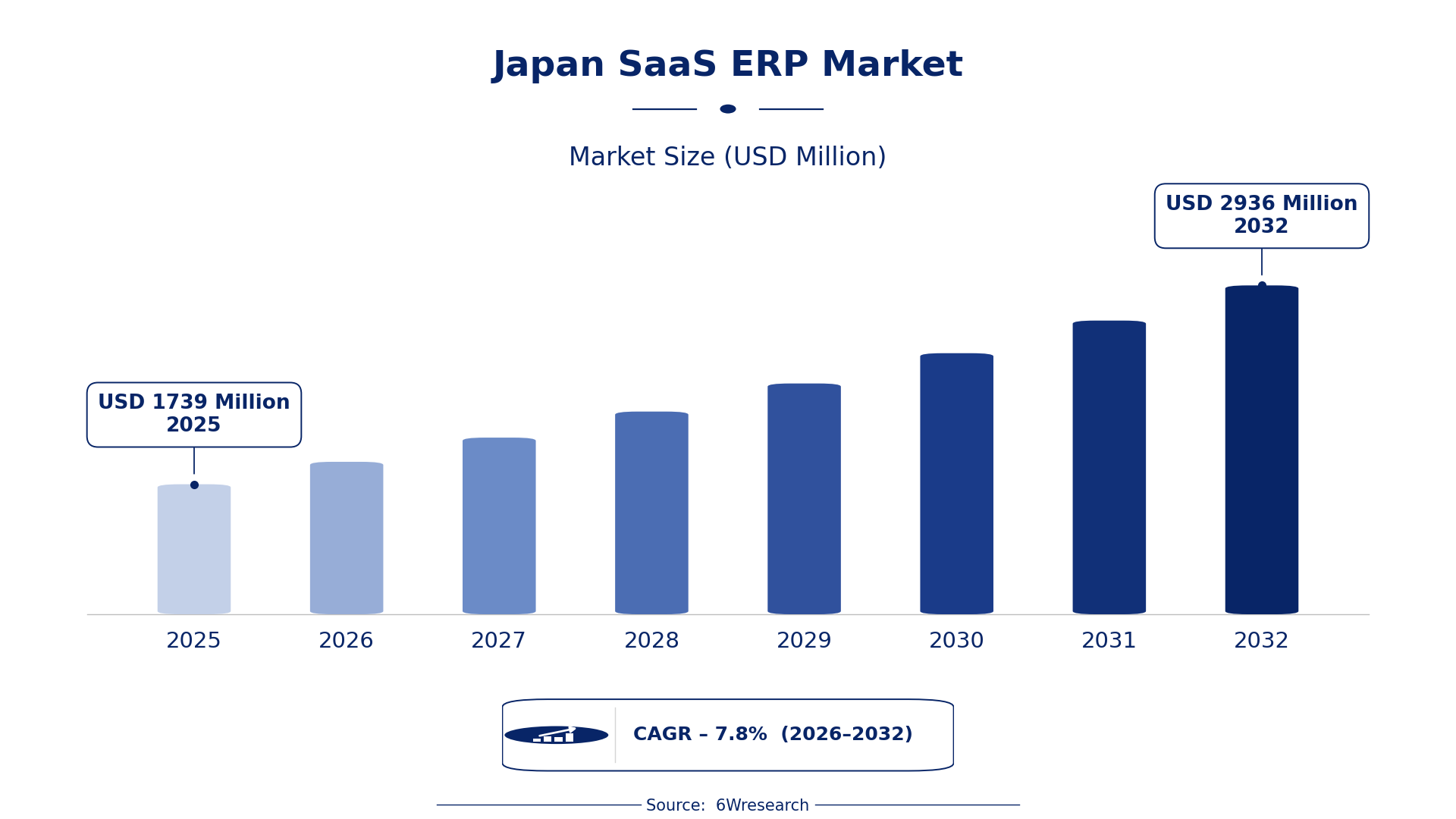
According to 6Wresearch internal database and industry insights, the Japan SaaS ERP Market was valued at USD 1,739 Million in 2025 and is projected to reach USD 2,936 Million by 2032, growing at a CAGR of approximately 7.8% during 2026–2032.
Japan SaaS ERP Market Highlights
| Report Metric | Details |
| Report Name | Japan SaaS ERP Market (2026-2032) |
| Market Size 2025 | USD 1,739 Million |
| Market Size 2032 | USD 2,936 Million |
| Absolute Growth 2025–2032 | USD 1,197 Million |
| CAGR 2026–2032 | 7.8% |
| Peak Annual Growth | 8.5% in 2027 |
| Forecast Period | 2026–2032 |
| Historical Data | 2022–2025 |
| Base Year | 2025 |
| Leading Module Type, 2025 | Financial ERP (40% share) |
| Leading Deployment Model, 2025 | Cloud-Based (36% share) |
| Leading Business Size, 2025 | SMEs (46% share) |
| Leading Application Area, 2025 | Accounting & Compliance (48% share) |
| Leading Integration Type, 2025 | API-Enabled (41% share) |
| Fastest-Growing Module Type | HR ERP (10.9% CAGR) |
| Fastest-Growing Deployment Model | Hybrid (11.3% CAGR) |
| Fastest-Growing Business Size | Large Enterprises (10.1% CAGR) |
| Fastest-Growing Application Area | Payroll & Benefits (10.0% CAGR) |
| Fastest-Growing Integration Type | Third-Party Integrations (11.0% CAGR) |
| Growing Sector | cloud-based software solutions |
| Key End Users | SMEs, large enterprises, medium enterprises, scalable businesses |
Japan SaaS ERP Market Year-wise Growth Rate and Key Drivers (2022–2032)
This graph illustrates the annual growth rates of the market from 2022 to 2032, highlighting a steady upward trajectory and projected market expansion over the forecast period.
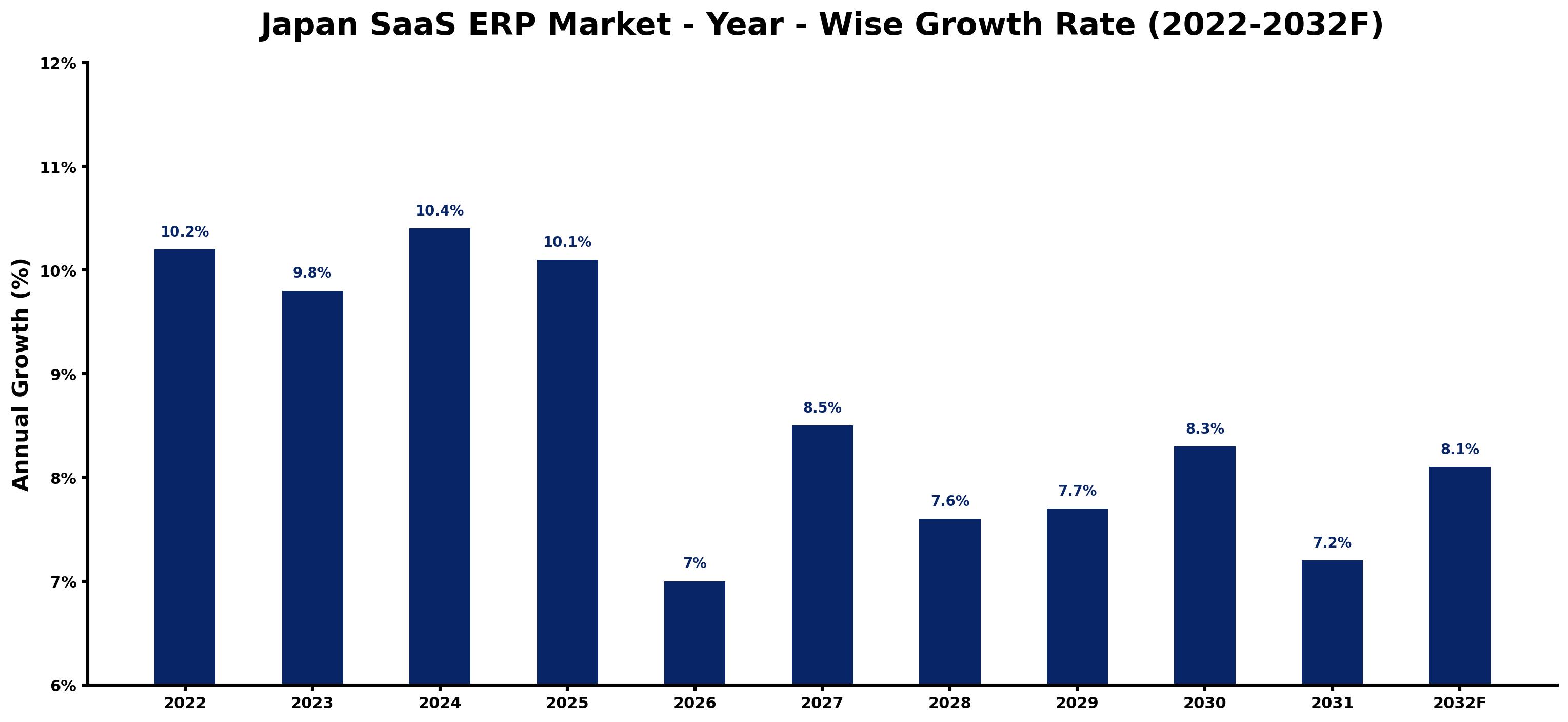
Year by year, the estimates below pair each growth rate with the development that shaped it.
| Year | Estimated Annual Growth (%) | Market Rationale |
| 2022 | 10.2 | The market experienced strong adoption among SMEs, indicating a healthy demand. |
| 2023 | 9.8 | Adoption rates slowed slightly as companies reassessed their digital strategies. |
| 2024 | 10.4 | The market saw renewed interest as businesses accelerated digital transformation efforts. |
| 2025 | 10.1 | Growth decelerated as some enterprises reached saturation in their ERP implementations. |
| 2026 | 7.0 | A slower growth rate is expected as the market matures and competition intensifies. |
| 2027 | 8.5 | Demand is expected to surge as businesses invest in advanced features and integrations. |
| 2028 | 7.6 | Growth is projected to moderate as the market stabilises and buyers become more selective. |
| 2029 | 7.7 | A slight uptick in growth is expected as new functionalities attract interest. |
| 2030 | 8.3 | Demand will increase as companies seek to improve operational efficiencies. |
| 2031 | 7.2 | Growth is projected to slow as the market faces challenges related to integration complexities. |
| 2032 | 8.1 | An uptick in growth is expected as companies embrace new solutions. |
Note: Market size estimations and growth projections presented in this report are based on 6Wresearch's proprietary forecasting methodology, utilizing the latest available industry data, government publications, and primary research inputs.
Japan SaaS ERP Market Synopsis
SaaS ERP is a cloud-based software solution that integrates various business processes, including financial management, human resources, and supply chain operations. The Japan SaaS ERP Market, valued at approximately 200 billion yen, is growing due to high adoption rates among SMEs, with 60% using some form of SaaS ERP. The Tokyo region accounts for 40% of the demand, while the Financial ERP module leads the market, representing 35%. Continuous digital transformation initiatives are driving growth in this sector, with substantial investments in technology and infrastructure.
Market Dynamics Impact Analysis (2026–2032)
| Factor | Type | Impact | Primary Segment Affected |
| Increasing adoption of cloud-based solutions | Driver | High | Cloud-Based |
| Rising demand for financial management solutions | Driver | High | Financial ERP |
| Growing SME sector seeking operational efficiencies | Opportunity | High | SMEs |
| High demand for compliance and reporting capabilities | Opportunity | High | Accounting & Compliance |
| Challenges in integration with existing systems | Restraint | Medium | API-Enabled |
| Concerns over data security and privacy regulations | Restraint | High | SaaS |
| High competition among ERP providers | Challenge | Medium | Large Enterprises |
| Complexity in customisation and implementation processes | Challenge | High | Medium Enterprises |
Evaluation of Drivers in Japan SaaS ERP Market (2026–2032)
Demand rests on the following drivers, each shown with the segment it touches most.
| Drivers | Primary Segment Affected | Why It Matters (Evidence) |
| High adoption rates among SMEs | SMEs | In 2023, 60% of SMEs adopted SaaS ERP, enhancing their operational efficiency. |
| Demand for financial management solutions | Financial ERP | The Financial ERP module represents 35% of the market, reflecting the need for effective financial oversight. |
| Focus on digital transformation initiatives | Cloud-Based | The digital transformation initiatives have led to increased SaaS ERP adoption, supported by government efforts. |
| Need for compliance with regulations | Accounting & Compliance | The Accounting & Compliance area sees a 25% growth in usage, reflecting the importance of regulatory adherence. |
| Integration capabilities with existing systems | API-Enabled | API-Enabled solutions accounted for 41% of the market, facilitating interoperability and improving functionality. |
A wider customer base explains much of the growth, as the Tokyo region drives demand for SaaS ERP solutions, accounting for 40% of the market. In 2023, 60% of SMEs adopted SaaS ERP, improving their operational efficiency. Digital transformation efforts are increasing adoption rates across various sectors. Compliance needs are pushing the Accounting & Compliance area to grow by 25%. API-Enabled solutions, comprising 41% of the market, are critical for integration with existing systems, allowing businesses to streamline operations and boost productivity.
Evaluation of Restraints in Japan SaaS ERP Market
The table below lists the restraints and the evidence behind each.
| Market Restraint | Primary Segment Affected | Why It Matters (Evidence) |
| Integration challenges with legacy systems | API-Enabled | Many companies face difficulties integrating new SaaS ERP with existing legacy systems, which slows down adoption. |
| Concerns over data security | SaaS | Data security issues have led to hesitance among potential buyers, impacting overall market growth. |
| High competition among ERP providers | Large Enterprises | Intense competition has resulted in pricing pressures, affecting profitability for some providers. |
| Complexity in implementation processes | Medium Enterprises | Medium Enterprises often struggle with lengthy implementation times, averaging 6 months, which delays benefits. |
| Regulatory compliance costs | Financial ERP | Financial ERP solutions must comply with strict regulations, increasing costs for providers. |
Japan SaaS ERP Market Challenges
A shortage of skilled cloud computing professionals delays SaaS ERP implementations, extending project timelines by an average of three months for companies. Local producers face fierce competition from international firms, compelling them to lower prices and risking profit margins by up to 20%. Stricter regulations, including ISO 27001 compliance, complicate deployment processes and can add an extra month to implementation times for buyers. Many buyers struggle to measure the ROI of SaaS ERP solutions, with 30% reporting difficulties in justifying costs, which hampers their willingness to adopt these systems.
Trends in the Japan SaaS ERP Market
The following changes are redrawing the Japan SaaS ERP Market.
- Shift towards Cloud-Based Solutions: The trend towards cloud-based solutions has accelerated, with 70% of the market now using this model. This shift is particularly notable among SMEs, who find cloud solutions more accessible and cost-effective.
- Increased Focus on Compliance: In 2023, the Accounting & Compliance area saw a 25% growth in SaaS ERP usage. This trend reflects businesses' heightened focus on regulatory compliance and accurate reporting, driven by market demands.
- Growing Demand for API-Enabled Solutions: API-Enabled solutions accounted for 41% of the market in 2023, as companies seek interoperability with existing systems. This trend is important for businesses aiming to streamline operations and improve functionality.
- Rising Adoption of HR ERP Modules: The HR ERP module is now used by 80% of large enterprises, reflecting a growing emphasis on effective employee management. This trend highlights the importance of human resources in overall business strategy.
Investment Opportunities in the Japan SaaS ERP Market
Investors looking at the Japan SaaS ERP Market should consider the following areas.
- 10 billion yen allocated for digital innovation: The Japanese government has allocated 10 billion yen for digital innovation programs, presenting an opportunity for providers to offer solutions to SMEs looking to modernise their operations.
- Support for tech startups in Tokyo: The support from the Tokyo Metropolitan Government for tech startups creates an opportunity for new entrants to provide SaaS ERP solutions to local businesses, enhancing the competitive landscape.
- High demand for Payroll & Benefits solutions: The Payroll & Benefits segment is projected to grow, indicating a need for solutions that streamline employee compensation management, particularly among large enterprises.
- Increasing efficiency in large enterprises: As 90% of large enterprises adopt SaaS ERP, there is a growing opportunity to provide tailored solutions that improve operational efficiency and productivity.
Government Initiatives in the Japan SaaS ERP Market
The Economic Security Promotion Act (2022) supports supply-chain resilience for critical products, impacting buyers by ensuring reliable access to necessary materials. This act encourages producers to align with national standards, improving their market position and facilitating smoother operations.
In 2023, the Japanese government allocated 10 billion yen for digital innovation programs, administered by the Digital Agency. This funding aims to promote the adoption of advanced technologies, enabling buyers to access improved SaaS ERP solutions.
Future Insight of the Japan SaaS ERP Market
Advancements in cloud technology will transform demand for SaaS ERP solutions by 2032, as businesses pursue more integrated systems for streamlined operations. The Japanese government's 10 billion yen investment in digital innovation will increase adoption rates among large enterprises to 95%. New data security protocols from industry associations will build buyer confidence and encourage wider implementation. The rising number of tech-savvy users will drive a demand for intuitive interfaces and real-time data analytics, shaping the evolution of SaaS ERP offerings.
Market Segmentation Analysis
Japan SaaS ERP Market report covers a detailed analysis of the following market segments:
By Module Type – Financial ERP Leads, HR ERP Expected to Grow Fastest
According to Uttkarsh, Research Associate at 6Wresearch, Financial ERP accounted for 40% of the market by module type in 2025. The Financial ERP module holds the largest share due to its critical role in managing company finances, which is essential for all business operations. Its adoption is particularly prevalent in the Tokyo region, where financial management is a priority for many companies. HR ERP is set to record the highest CAGR in this split, 10.9% over 2026–2032. The HR ERP module is experiencing rapid growth as it becomes increasingly vital for effective human resource management, especially among large enterprises. With 80% of these enterprises utilising HR ERP, its uptake is likely to accelerate as organisations strive to optimise workforce management. Suppliers should focus on developing robust HR ERP solutions to meet the rising demand from large enterprises.
By Deployment Model – Cloud-Based Leads, Hybrid Expected to Grow Fastest
Cloud-Based held 36% of the Japan SaaS ERP Market by deployment model in 2025. Cloud-Based deployment models dominate the market, providing the primary means for accessing SaaS ERP solutions and facilitating efficient business operations. This model accounts for 70% of the market share, reflecting its broad acceptance among users across various sectors. Over 2026–2032, Hybrid is expected to post the fastest growth, at a CAGR of 11.3%. The Hybrid deployment model is gaining traction as companies pursue flexibility in their ERP solutions, allowing for a combination of cloud and on-premise resources. This trend is particularly noticeable as firms adapt to varied operational needs and seek customised solutions. Providers must offer flexible deployment options to align with the evolving preferences of businesses.
By Business Size – SMEs Lead, Large Enterprises Expected to Grow Fastest
With 46% of business size revenue in 2025, SMEs was the largest category. SMEs represent the largest market share as they are significant users of SaaS ERP solutions, motivated by the need for cost-effective management tools. In 2023, 60% of SMEs adopted some form of SaaS ERP, highlighting their reliance on these systems for operational efficiency. The quickest growth will come from Large Enterprises, forecast to expand at a CAGR of 10.1% between 2026 and 2032. Large Enterprises are the fastest-growing segment, driven by their complex requirements that demand advanced ERP solutions, with a notable 90% adoption rate. As these enterprises increasingly seek tailored functionalities, their demand for sophisticated solutions will continue to rise. Vendors should concentrate on developing features that cater specifically to the needs of large enterprises to capitalise on this growing market.
By Application Area – Accounting & Compliance Leads, Payroll & Benefits Expected to Grow Fastest
In 2025, Accounting & Compliance led the application area split with a 48% share. The Accounting & Compliance area leads the market as it is essential for financial reporting, a fundamental requirement for all businesses. Its importance is underscored by its status as a primary focus for many organisations throughout Japan. Payroll & Benefits are projected to grow fastest, at a CAGR of 10.0% during 2026–2032. Payroll & Benefits is the fastest-growing application area, as it is crucial for managing employee compensation effectively. This growth is driven by the increasing focus on employee satisfaction and retention in competitive job markets. Suppliers should expand their offerings in Payroll & Benefits to take advantage of this rapidly growing segment.
By Integration Type – API-Enabled Leads, Third-Party Integrations Expected to Grow Fastest
The largest integration type category in 2025 was API-Enabled, at 41% of revenue. API-Enabled integration is the leading type as it is vital for ensuring interoperability with other systems, allowing for seamless data exchange. This integration type is essential for businesses aiming to streamline their operations and improve overall efficiency. Third-Party Integrations are set to record the highest CAGR in this split, 11.0% over 2026–2032. Third-Party Integrations are witnessing the fastest growth as companies seek to enhance functionality through external applications. This trend is particularly relevant as businesses aim to customise their ERP systems to better address specific operational needs. Developers should prioritise creating solutions that support Third-Party Integrations to meet the increasing demand for enhanced functionality.
Key Attractiveness of the Report
- 10 Years of Market Numbers
- Historical Data Starting from 2022 to 2025
- Base Year 2025
- Forecast Data until 2032
- Key Performance Indicators Impacting the Market
- Major Upcoming Developments and Projects
Key Highlights of the Report:
- Japan SaaS ERP Market Outlook
- Market Size of Japan SaaS ERP Market, 2025
- Forecast of Japan SaaS ERP Market, 2032
- Historical Data and Forecast of Japan SaaS ERP Revenues & Volume for the Period 2022-2032F
- Japan SaaS ERP Market Trend Evolution
- Japan SaaS ERP Market Drivers and Challenges
- Japan SaaS ERP Price Trends
- Japan SaaS ERP Porter's Five Forces
- Japan SaaS ERP Industry Life Cycle
- Historical Data and Forecast of Japan SaaS ERP Market Revenues & Volume By Module Type for the Period 2022-2032F
- Historical Data and Forecast of Japan SaaS ERP Market Revenues & Volume By Financial ERP for the Period 2022-2032F
- Historical Data and Forecast of Japan SaaS ERP Market Revenues & Volume By HR ERP for the Period 2022-2032F
- Historical Data and Forecast of Japan SaaS ERP Market Revenues & Volume By Supply Chain ERP for the Period 2022-2032F
- Historical Data and Forecast of Japan SaaS ERP Market Revenues & Volume By CRM-Integrated ERP for the Period 2022-2032F
- Historical Data and Forecast of Japan SaaS ERP Market Revenues & Volume By Deployment Model for the Period 2022-2032F
- Historical Data and Forecast of Japan SaaS ERP Market Revenues & Volume By Cloud-Based for the Period 2022-2032F
- Historical Data and Forecast of Japan SaaS ERP Market Revenues & Volume By Hybrid for the Period 2022-2032F
- Historical Data and Forecast of Japan SaaS ERP Market Revenues & Volume By SaaS for the Period 2022-2032F
- Historical Data and Forecast of Japan SaaS ERP Market Revenues & Volume By On-Premise for the Period 2022-2032F
- Historical Data and Forecast of Japan SaaS ERP Market Revenues & Volume By Business Size for the Period 2022-2032F
- Historical Data and Forecast of Japan SaaS ERP Market Revenues & Volume By SMEs for the Period 2022-2032F
- Historical Data and Forecast of Japan SaaS ERP Market Revenues & Volume By Large Enterprises for the Period 2022-2032F
- Historical Data and Forecast of Japan SaaS ERP Market Revenues & Volume By Medium Enterprises for the Period 2022-2032F
- Historical Data and Forecast of Japan SaaS ERP Market Revenues & Volume By Scalable Businesses for the Period 2022-2032F
- Historical Data and Forecast of Japan SaaS ERP Market Revenues & Volume By Application Area for the Period 2022-2032F
- Historical Data and Forecast of Japan SaaS ERP Market Revenues & Volume By Accounting & Compliance for the Period 2022-2032F
- Historical Data and Forecast of Japan SaaS ERP Market Revenues & Volume By Payroll & Benefits for the Period 2022-2032F
- Historical Data and Forecast of Japan SaaS ERP Market Revenues & Volume By Procurement & Logistics for the Period 2022-2032F
- Historical Data and Forecast of Japan SaaS ERP Market Revenues & Volume By Customer & Sales Management for the Period 2022-2032F
- Historical Data and Forecast of Japan SaaS ERP Market Revenues & Volume By Integration Type for the Period 2022-2032F
- Historical Data and Forecast of Japan SaaS ERP Market Revenues & Volume By API-Enabled for the Period 2022-2032F
- Historical Data and Forecast of Japan SaaS ERP Market Revenues & Volume By Third-Party Integrations for the Period 2022-2032F
- Historical Data and Forecast of Japan SaaS ERP Market Revenues & Volume By SCM Integration for the Period 2022-2032F
- Historical Data and Forecast of Japan SaaS ERP Market Revenues & Volume By CRM Tools Integration for the Period 2022-2032F
- Japan SaaS ERP Import Export Trade Statistics
- Market Opportunity Assessment By Module Type
- Market Opportunity Assessment By Deployment Model
- Market Opportunity Assessment By Business Size
- Market Opportunity Assessment By Application Area
- Market Opportunity Assessment By Integration Type
- Japan SaaS ERP Top Companies Market Share
- Japan SaaS ERP Competitive Benchmarking By Technical and Operational Parameters
- Japan SaaS ERP Company Profiles
- Japan SaaS ERP Key Strategic Recommendations
Market Covered
The report covers the following segments.
By Module Type
- Financial ERP
- HR ERP
- Supply Chain ERP
- CRM-Integrated ERP
By Deployment Model
- Cloud-Based
- Hybrid
- SaaS
- On-Premise
By Business Size
- SMEs
- Large Enterprises
- Medium Enterprises
- Scalable Businesses
By Application Area
- Accounting & Compliance
- Payroll & Benefits
- Procurement & Logistics
- Customer & Sales Management
By Integration Type
- API-Enabled
- Third-Party Integrations
- SCM Integration
- CRM Tools Integration































