Japan Self-Parking Vehicle Systems Market Size & Growth Rate
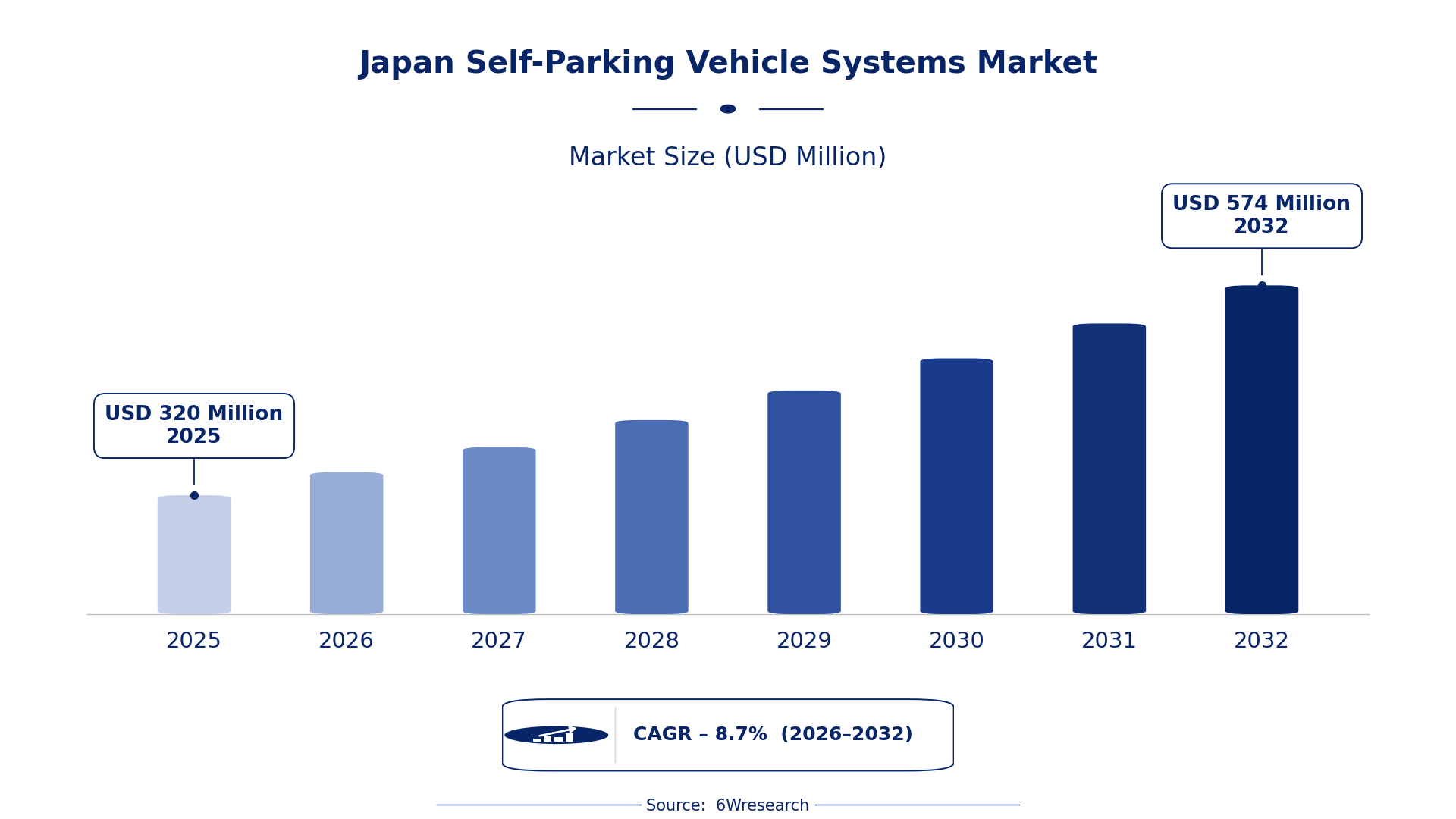
According to 6Wresearch internal database and industry insights, the Japan Self-Parking Vehicle Systems Market was valued at USD 320 Million in 2025 and is projected to reach USD 574 Million by 2032, growing at a CAGR of approximately 8.7% during 2026–2032.
Japan Self-Parking Vehicle Systems Market Highlights
| Report Metric | Details |
| Report Name | Japan Self-Parking Vehicle Systems Market (2026-2032) |
| Market Size 2025 | USD 320 Million |
| Market Size 2032 | USD 574 Million |
| Absolute Growth 2025–2032 | USD 254 Million |
| CAGR 2026–2032 | 8.7% |
| Peak Annual Growth | 9.4% in 2028 |
| Forecast Period | 2026–2032 |
| Historical Data | 2022–2025 |
| Base Year | 2025 |
| Leading Parking System Type, 2025 | Semi-Automatic (49% share) |
| Leading Sensor Type, 2025 | Ultrasonic + Camera (38% share) |
| Leading Vehicle Class, 2025 | Compact Sedans (42% share) |
| Leading End User, 2025 | Individual Car Owners (42% share) |
| Fastest-Growing Parking System Type | Fully Automatic (12.2% CAGR) |
| Fastest-Growing Sensor Type | Radar + AI (12.5% CAGR) |
| Fastest-Growing Vehicle Class | SUVs (11.5% CAGR) |
| Fastest-Growing End User | Premium Auto Brands (11.2% CAGR) |
| Growing Sector | automotive technology |
| Key End Users | individual car owners, premium auto brands, urban mobility services |
Japan Self-Parking Vehicle Systems Market Year-wise Growth Rate and Key Drivers (2022–2032)
This graph illustrates the annual growth rates of the market from 2022 to 2032, highlighting a steady upward trajectory and projected market expansion over the forecast period.
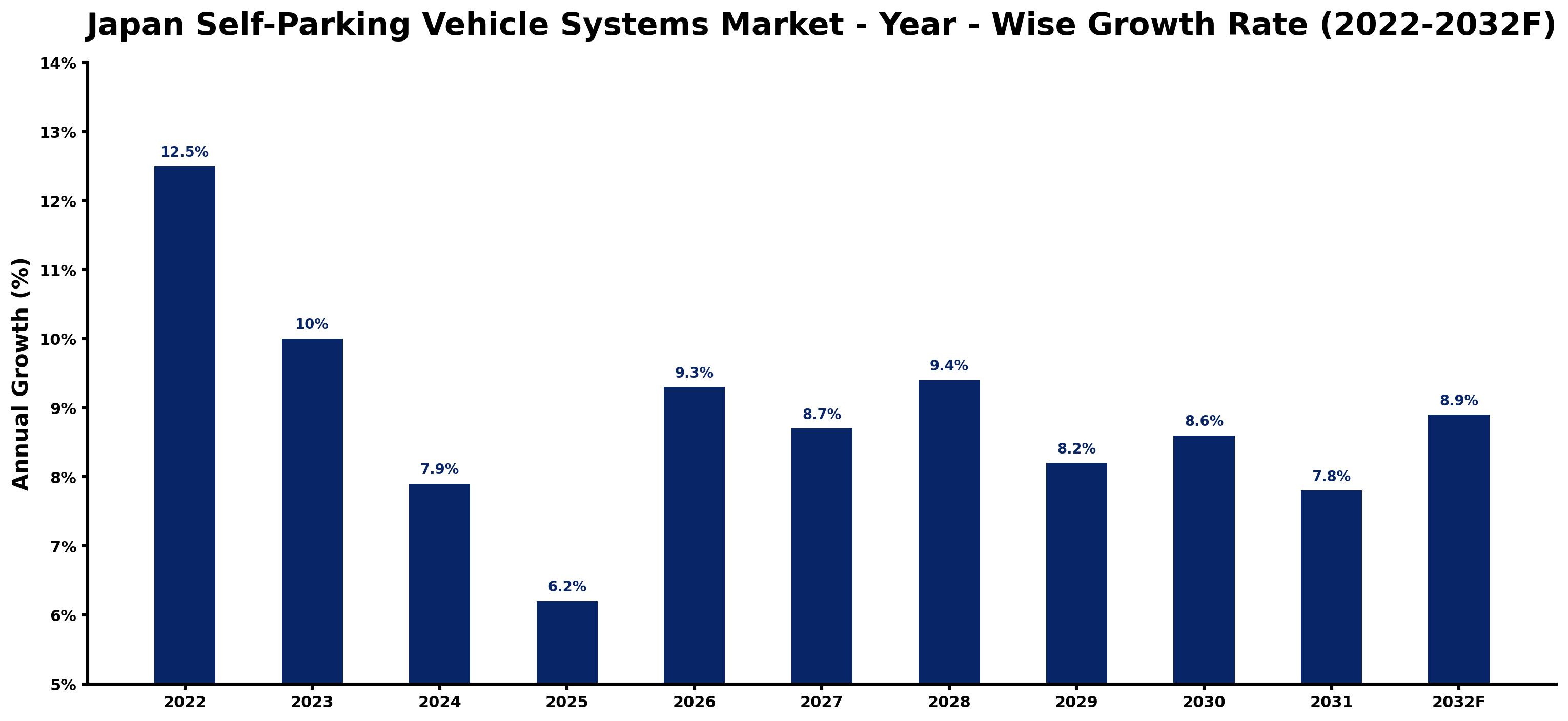
Year by year, the estimates below pair each growth rate with the development that shaped it.
| Year | Estimated Annual Growth (%) | Market Rationale |
| 2022 | 12.5 | The market experienced strong demand as new technologies improved parking efficiency. |
| 2023 | 10.0 | Growth slowed due to market saturation with many vehicles featuring parking assist technologies. |
| 2024 | 7.9 | Continued innovation in parking systems kept demand steady, although at a slower pace than before. |
| 2025 | 6.2 | Market growth decelerated further as consumer preferences shifted towards fully automated solutions. |
| 2026 | 9.3 | Demand is expected to rise again as advancements in fully automatic systems attract more buyers. |
| 2027 | 8.7 | Growth is projected to slow slightly as the market stabilises with increased competition. |
| 2028 | 9.4 | The market is set to peak as new features in self-parking systems gain traction. |
| 2029 | 8.2 | Growth is anticipated to slow again as the market adjusts to new technological standards. |
| 2030 | 8.6 | Demand will rise as electric vehicle adoption increases, necessitating advanced parking solutions. |
| 2031 | 7.8 | Growth is projected to slow as the market matures and competition intensifies. |
| 2032 | 8.9 | Demand is expected to rise again as urban mobility services expand their fleet capabilities. |
Note: Market size estimations and growth projections presented in this report are based on 6Wresearch's proprietary forecasting methodology, utilizing the latest available industry data, government publications, and primary research inputs.
Japan Self-Parking Vehicle Systems Market Synopsis
Self-parking vehicle systems are advanced technologies that enable cars to park autonomously with minimal driver intervention, utilising sensors and algorithms for obstacle detection. The Japan Self-Parking Vehicle Systems Market is expanding as urban vehicle registrations in Tokyo exceed 9 million, with a notable portion of new vehicles equipped with parking assist technologies. Growth is driven by smart city initiatives in Tokyo, increasing consumer demand for convenience, and the projected rise of electric vehicles, which are expected to reach 1 million by 2025. This convergence of factors positions the market for substantial growth in the coming years.
Market Dynamics Impact Analysis (2026–2032)
| Factor | Type | Impact | Primary Segment Affected |
| Rising urban vehicle registrations in Tokyo | Driver | High | Fully Automatic |
| Increased adoption of electric vehicles | Driver | High | Semi-Automatic |
| Growing demand for parking solutions in urban areas | Opportunity | High | Valet Parking Mode |
| Investment in autonomous vehicle technologies | Opportunity | Medium | Remote-Controlled |
| High urban parking fees affecting affordability | Restraint | High | Fully Automatic |
| Limited parking space availability in cities | Restraint | High | Semi-Automatic |
| Challenges in standardisation of safety regulations | Challenge | High | Valet Parking Mode |
| Technological integration issues with existing vehicle models | Challenge | Medium | Remote-Controlled |
Evaluation of Drivers in Japan Self-Parking Vehicle Systems Market (2026–2032)
The table below links each growth driver to the segment it affects and the evidence for it.
| Drivers | Primary Segment Affected | Why It Matters (Evidence) |
| Increased urban vehicle registrations | Fully Automatic | Tokyo has over 9 million registered vehicles, driving demand for efficient parking solutions. |
| Adoption of electric vehicles | Semi-Automatic | The number of electric vehicles is projected to reach 1 million by 2025, boosting demand for advanced parking systems. |
| Smart city initiatives in Tokyo | Valet Parking Mode | The Tokyo Metropolitan Government promotes smart city technologies, increasing the need for automated parking solutions. |
| Consumer preference for convenience | Remote-Controlled | As urban living becomes denser, individual car owners seek systems that simplify their parking experience. |
| Technological advancements in sensors | Ultrasonic + Camera | The combination of ultrasonic and camera technologies accounts for 38% of the sensor market, improving parking accuracy. |
Orders keep climbing as urban vehicle registrations in Tokyo surpass 9 million, creating a pressing need for efficient parking solutions. The number of electric vehicles is projected to reach 1 million by 2025, increasing demand for advanced parking technologies. As urban living becomes denser, car owners increasingly seek systems that simplify their parking experience. Advances in sensor technology, particularly ultrasonic and camera systems, are improving accuracy and user experience, leading to higher sales of self-parking systems.
Evaluation of Restraints in Japan Self-Parking Vehicle Systems Market
The main factors holding the market back are set out below.
| Market Restraint | Primary Segment Affected | Why It Matters (Evidence) |
| High urban parking fees affecting affordability | Fully Automatic | The average urban parking fee in Tokyo is around 400 JPY per hour, limiting consumer willingness to invest in new technologies. |
| Limited parking space availability in cities | Semi-Automatic | Urban areas average only 2.5 meters in parking space width, constraining the design of parking systems. |
| Challenges in standardisation of safety regulations | Valet Parking Mode | The JIS D 0201 standard for automotive safety systems complicates the implementation of new technologies. |
| Technological integration issues with existing vehicle models | Remote-Controlled | Many older vehicle models lack compatibility with advanced parking assist systems, hindering market growth. |
| Consumer resistance to new technologies | Ultrasonic + Camera | Some buyers remain hesitant to adopt self-parking systems due to unfamiliarity with the technology. |
Japan Self-Parking Vehicle Systems Market Challenges
Tokyo's parking crisis highlights a skills gap in self-parking system development, with only 20% of engineers specialising in advanced automotive technologies, delaying innovation for producers. Intense competition among automotive manufacturers sparks price wars, forcing suppliers to reduce costs, which can compromise system quality and reliability for buyers. Supply chain disruptions arise from reliance on imported components, with delays of up to six months impacting production timelines for producers. Stringent safety standards like JIS D 0201 create regulatory hurdles, raising compliance costs for manufacturers and slowing market entry for new technologies.
Trends in the Japan Self-Parking Vehicle Systems Market
Four trends stand out in the Japan Self-Parking Vehicle Systems Market.
- Shift from Manual to Fully Automatic Parking Systems: In 2023, demand for fully automatic parking systems surged as consumers sought greater convenience. This shift aligns with Tokyo's smart city initiatives, which promote advanced parking technologies.
- Transition from Traditional Parking to Valet Parking Mode: Valet parking mode is gaining popularity among urban mobility services, with usage projected to increase as cities become more congested. Urban mobility services are adopting automated solutions for fleet efficiency.
- Emergence of Radar and AI Technologies: Radar and AI technologies are becoming essential in parking systems, providing advanced sensing capabilities. This trend is supported by a 12.5% CAGR in the adoption of radar systems, improving overall parking safety.
- Integration of Electric Vehicles with Parking Solutions: The integration of electric vehicles with smart parking solutions is expected to grow. By 2025, the number of electric vehicles in Japan is projected to reach 1 million, driving demand for compatible parking technologies.
Investment Opportunities in the Japan Self-Parking Vehicle Systems Market
Investors looking at the Japan Self-Parking Vehicle Systems Market should consider the following areas.
- Tokyo as a Hub for Smart Parking Solutions: Tokyo's urban environment presents a unique opportunity for smart parking solutions, with over 9 million vehicles registered. The government allocated 5 billion JPY for research in automotive technologies, making it an ideal time to invest in self-parking systems.
- Growing Demand from Individual Car Owners: As individual car owners increasingly seek convenience in parking, there is an opportunity to supply advanced self-parking systems. The market for these technologies is expanding rapidly, driven by consumer preferences for ease of use.
- Investment in Autonomous Vehicle Technologies: With government support for autonomous vehicle technologies, there is a ripe opportunity for investment in self-parking systems. The Ministry of Land, Infrastructure, Transport and Tourism's programs are paving the way for innovation in this sector.
- Expansion of Valet Parking Services: Valet parking services are becoming more prevalent in urban areas, creating demand for automated parking solutions. This trend is supported by the increasing number of vehicles and the need for efficient parking management.
Government Initiatives in the Japan Self-Parking Vehicle Systems Market
The legal framework for self-parking vehicle systems is shaped by several key measures. The Green Growth Strategy aims for carbon neutrality by 2050, identifying growth sectors including automotive technologies. These laws support the development and adoption of self-parking systems in Japan. The Battery Industry Strategy targets 150 GWh of domestic battery manufacturing capacity by 2030, promoting innovation in the automotive sector.
The Ministry of Land, Infrastructure, Transport and Tourism plays a crucial role in approving and funding initiatives related to autonomous vehicle technologies. In 2023, the government allocated 5 billion JPY for research in automotive technologies, including self-parking systems. This funding aims to promote innovation and ensure safety standards are met, benefiting both producers and buyers in the market.
Future Insight of the Japan Self-Parking Vehicle Systems Market
The integration of advanced sensor systems will reshape demand for self-parking technologies by 2032, as vehicles equipped with these capabilities are expected to rise significantly. The government's 5 billion JPY investment in automotive research will accelerate the development of efficient parking solutions. Urban infrastructure improvements will support the adoption of self-parking systems within smart city initiatives, enhancing urban mobility. By 2025, the projected increase of electric vehicles to 1 million will further drive the need for sophisticated parking technologies.
Market Segmentation Analysis
Japan Self-Parking Vehicle Systems Market report covers a detailed analysis of the following market segments:
By Parking System Type – Semi-Automatic Leads, Fully Automatic Expected to Grow Fastest
According to Saurav Kr Singh, Senior Research Analyst at 6Wresearch, in 2025, Semi-Automatic led the parking system type split with a 49% share. Semi-Automatic systems hold the largest share as they allow drivers to assist in parking, which is particularly beneficial in densely populated areas like Tokyo. This blend of control and convenience meets the needs of urban drivers facing parking challenges. The quickest growth will come from Fully Automatic, forecast to expand at a CAGR of 12.2% between 2026 and 2032. The Fully Automatic segment is growing rapidly due to advancements in technology that enable vehicles to park without any driver input, appealing to consumers who prefer hassle-free solutions. Government initiatives supporting autonomous vehicle technologies are likely to further accelerate this growth. Suppliers should focus on enhancing Fully Automatic systems to meet the rising demand for convenience in urban parking.
By Sensor Type – Ultrasonic + Camera Leads, Radar + AI Expected to Grow Fastest
With 38% of sensor type revenue in 2025, Ultrasonic + Camera was the largest category. Ultrasonic + Camera systems dominate the market because they are essential for reliable obstacle detection during parking, ensuring user safety in tight spaces. This technology is particularly important in urban settings where precision is crucial for effective parking. Radar + AI is set to record the highest CAGR in this split, 12.5% over 2026–2032. Radar technology is experiencing rapid growth as it provides superior sensing capabilities, which are increasingly necessary for accurate parking assistance. The complexity of urban parking situations is driving demand for these advanced sensing features. Buyers should prioritise vehicles equipped with Radar systems to improve parking efficiency in crowded urban environments.
By Vehicle Class – Compact Sedans Lead, SUVs Expected to Grow Fastest
Compact Sedans held 42% of the Japan Self-Parking Vehicle Systems Market by vehicle class in 2025. Compact Sedans are the leading vehicle class for self-parking systems as they are popular among urban drivers seeking efficient parking solutions. Their smaller size makes them ideal for navigating tight spaces commonly found in cities like Tokyo. SUVs are projected to grow fastest, at a CAGR of 11.5% during 2026–2032. SUVs are rapidly gaining traction in the market due to their increasing popularity and demand for advanced parking aids. As more consumers opt for larger vehicles, the need for effective parking technologies will continue to rise. Suppliers should consider developing parking solutions tailored to the unique requirements of SUVs to capture this growing segment.
By End User – Individual Car Owners Lead, Premium Auto Brands Expected to Grow Fastest
Individual Car Owners took 42% of end user revenue in 2025, more than any other category. Individual Car Owners represent the largest segment for self-parking systems, as they benefit significantly from the convenience these technologies offer. This group is especially prevalent in urban areas where parking can be a daily challenge. Over 2026–2032, Premium Auto Brands are expected to post the fastest growth, at a CAGR of 11.2%. Premium Auto Brands are seeing the fastest growth as they incorporate advanced technologies into their vehicles, catering to customers who value innovation and convenience. Their focus on cutting-edge features is likely to shape market trends moving forward. Suppliers need to align their product offerings with the preferences of Premium Auto Brands to remain competitive in the evolving market.
Key Attractiveness of the Report
- 10 Years of Market Numbers
- Historical Data Starting from 2022 to 2025
- Base Year 2025
- Forecast Data until 2032
- Key Performance Indicators Impacting the Market
- Major Upcoming Developments and Projects
Key Highlights of the Report:
- Japan Self-Parking Vehicle Systems Market Outlook
- Market Size of Japan Self-Parking Vehicle Systems Market, 2025
- Forecast of Japan Self-Parking Vehicle Systems Market, 2032
- Historical Data and Forecast of Japan Self-Parking Vehicle Systems Revenues & Volume for the Period 2022-2032F
- Japan Self-Parking Vehicle Systems Market Trend Evolution
- Japan Self-Parking Vehicle Systems Market Drivers and Challenges
- Japan Self-Parking Vehicle Systems Price Trends
- Japan Self-Parking Vehicle Systems Porter's Five Forces
- Japan Self-Parking Vehicle Systems Industry Life Cycle
- Historical Data and Forecast of Japan Self-Parking Vehicle Systems Market Revenues & Volume By Parking System Type for the Period 2022-2032F
- Historical Data and Forecast of Japan Self-Parking Vehicle Systems Market Revenues & Volume By Semi-Automatic for the Period 2022-2032F
- Historical Data and Forecast of Japan Self-Parking Vehicle Systems Market Revenues & Volume By Fully Automatic for the Period 2022-2032F
- Historical Data and Forecast of Japan Self-Parking Vehicle Systems Market Revenues & Volume By Valet Parking Mode for the Period 2022-2032F
- Historical Data and Forecast of Japan Self-Parking Vehicle Systems Market Revenues & Volume By Remote-Controlled for the Period 2022-2032F
- Historical Data and Forecast of Japan Self-Parking Vehicle Systems Market Revenues & Volume By Sensor Type for the Period 2022-2032F
- Historical Data and Forecast of Japan Self-Parking Vehicle Systems Market Revenues & Volume By Ultrasonic + Camera for the Period 2022-2032F
- Historical Data and Forecast of Japan Self-Parking Vehicle Systems Market Revenues & Volume By Radar + AI for the Period 2022-2032F
- Historical Data and Forecast of Japan Self-Parking Vehicle Systems Market Revenues & Volume By Lidar + GPS for the Period 2022-2032F
- Historical Data and Forecast of Japan Self-Parking Vehicle Systems Market Revenues & Volume By Smartphone Integration for the Period 2022-2032F
- Historical Data and Forecast of Japan Self-Parking Vehicle Systems Market Revenues & Volume By Vehicle Class for the Period 2022-2032F
- Historical Data and Forecast of Japan Self-Parking Vehicle Systems Market Revenues & Volume By Compact Sedans for the Period 2022-2032F
- Historical Data and Forecast of Japan Self-Parking Vehicle Systems Market Revenues & Volume By SUVs for the Period 2022-2032F
- Historical Data and Forecast of Japan Self-Parking Vehicle Systems Market Revenues & Volume By Electric Cars for the Period 2022-2032F
- Historical Data and Forecast of Japan Self-Parking Vehicle Systems Market Revenues & Volume By Hatchbacks for the Period 2022-2032F
- Historical Data and Forecast of Japan Self-Parking Vehicle Systems Market Revenues & Volume By End User for the Period 2022-2032F
- Historical Data and Forecast of Japan Self-Parking Vehicle Systems Market Revenues & Volume By Individual Car Owners for the Period 2022-2032F
- Historical Data and Forecast of Japan Self-Parking Vehicle Systems Market Revenues & Volume By Premium Auto Brands for the Period 2022-2032F
- Historical Data and Forecast of Japan Self-Parking Vehicle Systems Market Revenues & Volume By Urban Mobility Services for the Period 2022-2032F
- Historical Data and Forecast of Japan Self-Parking Vehicle Systems Market Revenues & Volume By Tech Enthusiasts for the Period 2022-2032F
- Japan Self-Parking Vehicle Systems Import Export Trade Statistics
- Market Opportunity Assessment By Parking System Type
- Market Opportunity Assessment By Sensor Type
- Market Opportunity Assessment By Vehicle Class
- Market Opportunity Assessment By End User
- Japan Self-Parking Vehicle Systems Top Companies Market Share
- Japan Self-Parking Vehicle Systems Competitive Benchmarking By Technical and Operational Parameters
- Japan Self-Parking Vehicle Systems Company Profiles
- Japan Self-Parking Vehicle Systems Key Strategic Recommendations
Market Covered
The report covers the following segments.
By Parking System Type
- Semi-Automatic
- Fully Automatic
- Valet Parking Mode
- Remote-Controlled
By Sensor Type
- Ultrasonic + Camera
- Radar + AI
- Lidar + GPS
- Smartphone Integration
By Vehicle Class
- Compact Sedans
- SUVs
- Electric Cars
- Hatchbacks
By End User
- Individual Car Owners
- Premium Auto Brands
- Urban Mobility Services
- Tech Enthusiasts































