Japan Self-Piloted Aircraft Market Size & Growth Rate
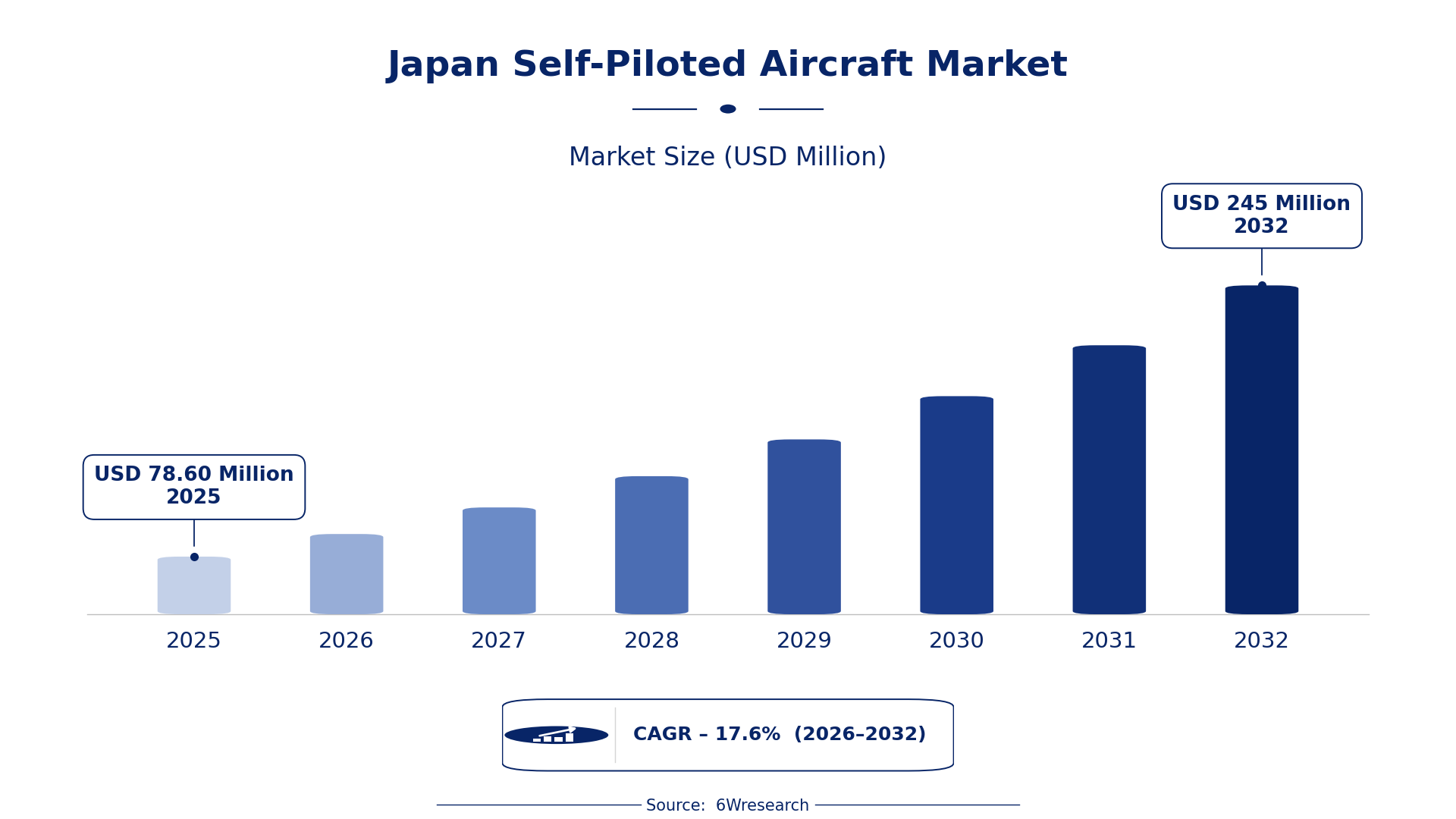
According to 6Wresearch internal database and industry insights, the Japan Self-Piloted Aircraft Market was valued at USD 78.60 Million in 2025 and is projected to reach USD 245 Million by 2032, growing at a CAGR of approximately 17.6% during 2026–2032.
Japan Self-Piloted Aircraft Market Highlights
| Report Metric | Details |
| Report Name | Japan Self-Piloted Aircraft Market (2026-2032) |
| Market Size 2025 | USD 78.60 Million |
| Market Size 2032 | USD 245 Million |
| Absolute Growth 2025–2032 | USD 166.40 Million |
| CAGR 2026–2032 | 17.6% |
| Peak Annual Growth | 18.8% in 2032 |
| Forecast Period | 2026–2032 |
| Historical Data | 2022–2025 |
| Base Year | 2025 |
| Leading Aircraft Type, 2025 | eVTOL Aircraft (41% share) |
| Leading Autonomy Level, 2025 | Full Autonomous (41% share) |
| Leading Power Source, 2025 | Electric Battery (49% share) |
| Leading End User, 2025 | Urban Air Mobility Firms (38% share) |
| Fastest-Growing Aircraft Type | Surveillance Drones (19.4% CAGR) |
| Fastest-Growing Autonomy Level | Semi-Autonomous (19.5% CAGR) |
| Fastest-Growing Power Source | Hybrid (20.2% CAGR) |
| Fastest-Growing End User | Military Agencies (22.6% CAGR) |
| Growing Sector | urban air mobility |
| Key End Users | urban air mobility firms, military agencies, civil aviation startups, defense forces |
Japan Self-Piloted Aircraft Market Year-wise Growth Rate and Key Drivers (2022–2032)
This graph illustrates the annual growth rates of the market from 2022 to 2032, highlighting a steady upward trajectory and projected market expansion over the forecast period.
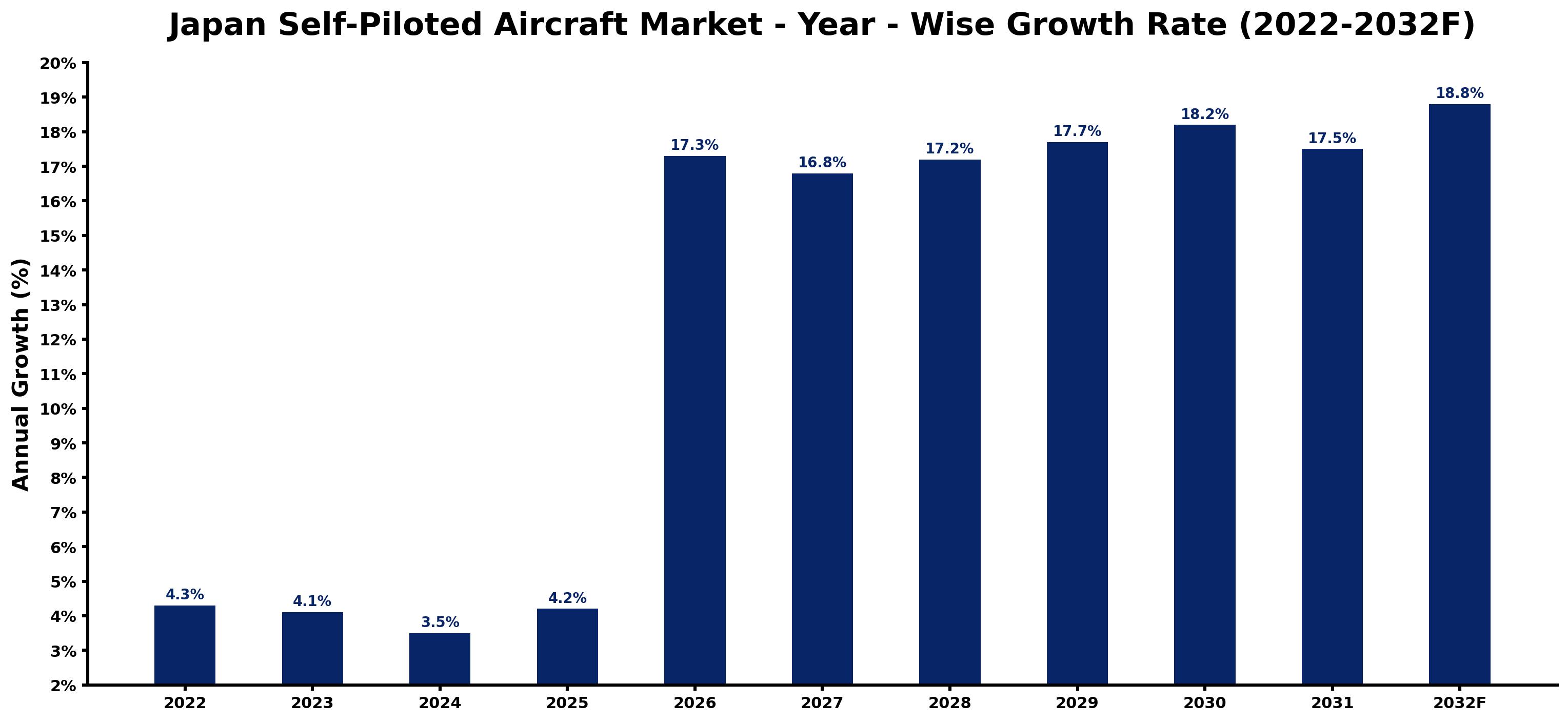
Below, each year's estimated growth is shown next to the factor that most influenced it.
| Year | Estimated Annual Growth (%) | Market Rationale |
| 2022 | 4.3 | The market experienced stable growth due to increased interest in urban air mobility solutions. |
| 2023 | 4.1 | Growth slowed slightly as companies adjusted to evolving technological requirements in aviation. |
| 2024 | 3.5 | Demand continued to grow, but at a slower pace as market players focused on regulatory compliance. |
| 2025 | 4.2 | Growth accelerated as pilot projects in urban air mobility gained traction across major cities. |
| 2026 | 17.3 | Demand surged due to rising investments in autonomous flight technologies and infrastructure. |
| 2027 | 16.8 | Growth slowed as the market adjusted to the rapid expansion of autonomous capabilities. |
| 2028 | 17.2 | Increased demand for surveillance drones drove growth as military agencies expanded their capabilities. |
| 2029 | 17.7 | The market continued to grow as urban air mobility initiatives expanded in metropolitan areas. |
| 2030 | 18.2 | Demand increased further, driven by the operational rollout of commercial air taxi services in select cities. |
| 2031 | 17.5 | Growth slowed slightly as the market matured and competition intensified among service providers. |
| 2032 | 18.8 | The market peaked as technological advancements and infrastructure investments reached new heights. |
Note: Market size estimations and growth projections presented in this report are based on 6Wresearch's proprietary forecasting methodology, utilizing the latest available industry data, government publications, and primary research inputs.
Japan Self-Piloted Aircraft Market Synopsis
Self-piloted aircraft, including eVTOLs and drones, are transforming aviation with advanced technologies such as AI and automation. These aircraft are primarily used for urban air mobility, surveillance, and reconnaissance missions. The Japan Self-Piloted Aircraft Market is expanding rapidly, driven by investments in infrastructure and technology. The urban air mobility market is projected to reach 1 trillion yen by 2030, supported by major initiatives in Tokyo and the Ministry of Land, Infrastructure, Transport and Tourism, which is increasing demand from military agencies and urban air mobility firms.
Market Dynamics Impact Analysis (2026–2032)
| Factor | Type | Impact | Primary Segment Affected |
| Growing investments in urban air mobility infrastructure | Driver | High | eVTOL Aircraft |
| Increased military interest in drone technologies | Driver | High | Surveillance Drones |
| Rising demand for urban air mobility solutions | Opportunity | High | Air Taxis |
| Expansion of electric battery technology in aviation | Opportunity | Medium | Electric Battery |
| Regulatory challenges in airspace integration | Restraint | High | Full Autonomous |
| Limited public acceptance of autonomous flight | Restraint | Medium | Semi-Autonomous |
| High development costs for advanced aircraft | Challenge | High | Reconnaissance Aircraft |
| Technological hurdles in achieving full autonomy | Challenge | Medium | AI Flight Control |
Evaluation of Drivers in Japan Self-Piloted Aircraft Market (2026–2032)
These are the developments adding the most demand over the forecast period.
| Drivers | Primary Segment Affected | Why It Matters (Evidence) |
| Increased investment in urban air mobility infrastructure | eVTOL Aircraft | Pilot projects in Tokyo are attracting funding, boosting demand for eVTOLs. |
| Growing military budgets for drone technology | Surveillance Drones | The Self-Defense Forces of Japan are increasing their budget for drone development by 15% in 2023. |
| Rising interest in air taxi services | Air Taxis | Japan aims to have commercial air taxi services operational by 2025 in select cities. |
| Advancements in battery technology | Electric Battery | The Battery Industry Strategy targets 150 GWh of domestic battery manufacturing capacity by 2030. |
| Expansion of autonomous flight capabilities | Full Autonomous | The Japan Aerospace Exploration Agency is developing technologies for autonomous flight operations. |
Behind the steady rise in orders sits the projected growth of Japan's urban air mobility market, expected to reach 1 trillion yen by 2030. This surge results from ongoing pilot projects attracting investments from urban air mobility firms seeking advanced transport solutions. Military budgets for drone technology are increasing, with a 15% rise in 2023, further boosting demand for surveillance drones.
Evaluation of Restraints in Japan Self-Piloted Aircraft Market
These restraints slow adoption and weigh on supplier margins.
| Market Restraint | Primary Segment Affected | Why It Matters (Evidence) |
| Regulatory hurdles in airspace integration | Full Autonomous | Compliance with safety standards set by the Japan Civil Aviation Bureau complicates operations for autonomous aircraft. |
| Public resistance to autonomous flight technology | Semi-Autonomous | Concerns about safety and privacy hinder acceptance of self-piloted aircraft among the general population. |
| High costs associated with advanced aircraft development | Reconnaissance Aircraft | Investments in advanced technologies strain budgets for military agencies and private firms alike. |
| Limited infrastructure for air taxi operations | Air Taxis | Insufficient investment in necessary landing and takeoff facilities restricts the growth of air taxi services. |
| Technological challenges in achieving full autonomy | AI Flight Control | Developing reliable AI systems for flight management presents significant engineering challenges. |
Japan Self-Piloted Aircraft Market Challenges
Japan's self-piloted aircraft market struggles with limited technology readiness, as many eVTOL prototypes remain untested, delaying commercial deployment for buyers seeking timely solutions. Supply chain disruptions arise from reliance on imported lightweight materials, potentially increasing costs by 20% for producers and restricting their ability to meet local demand. Buyers face high regulatory hurdles, with safety standards from the Japan Civil Aviation Bureau necessitating extensive testing, which can prolong time to market by 12 months. Shortages in skilled workers for advanced avionics and automation hinder manufacturers, limiting production capacity and innovation.
Trends in the Japan Self-Piloted Aircraft Market
These developments are changing demand patterns in the Japan Self-Piloted Aircraft Market.
- Shift from Traditional to Electric-Powered Aircraft: The trend towards electric-powered aircraft is growing as the Electric Battery segment captured 49% market share in 2025, driven by environmental concerns and efficiency. This shift aligns with Japan's strategy for sustainable aviation.
- Transition from Manual to Autonomous Flight Operations: The 2022 Urban Air Mobility Roadmap has accelerated the shift towards fully autonomous flight operations, with the Full Autonomous segment projected to lead the market. This transition enhances operational efficiency and safety.
- Emergence of Urban Air Mobility Initiatives: Tokyo is becoming a hub for urban air mobility initiatives, with several pilot projects underway. The city's investment in air taxi infrastructure is expected to support a thriving market, aligning with Japan's goal of operational air taxi services by 2025.
- Growth in Military Drone Applications: The Self-Defense Forces are increasingly adopting drone technologies for reconnaissance, with a 15% budget increase in 2023 aimed at enhancing surveillance capabilities. This trend is driving demand for advanced surveillance drones.
Investment Opportunities in the Japan Self-Piloted Aircraft Market
Investors looking at the Japan Self-Piloted Aircraft Market should consider the following areas.
- Urban Air Mobility Firms Seeking Advanced Solutions: Urban air mobility firms are actively seeking advanced aircraft solutions, with the market projected to reach 1 trillion yen by 2030. Collaborating with local manufacturers can facilitate entry into this growing sector.
- Investment in Air Taxi Infrastructure: With Tokyo investing in air taxi infrastructure, there is a significant opportunity for suppliers to provide necessary technology and services. The projected market growth supports investments in this area.
- Military Agencies Expanding Drone Capabilities: Military agencies are looking to enhance their drone capabilities, driven by increased budgets and technological advancements. Suppliers can engage through partnerships to meet this demand effectively.
- Emerging Demand for Hybrid Power Sources: As the Hybrid segment is projected to grow, suppliers can capitalize on this trend by investing in hybrid technology development. This aligns with Japan's push for sustainable aviation solutions.
Government Initiatives in the Japan Self-Piloted Aircraft Market
The Hydrogen Society Promotion Act, enacted in 2024, supports low-carbon hydrogen supply chains, complementing earlier laws that promote sustainable energy. This act encourages investment in hydrogen fuel technologies, which are important for future aviation applications, including self-piloted aircraft.
The Ministry of Land, Infrastructure, Transport and Tourism is actively implementing the 2022 Urban Air Mobility Roadmap, which facilitates the development of air taxi services. This initiative provides funding and support for urban air mobility firms, ensuring they meet safety standards and operational requirements.
Future Insight of the Japan Self-Piloted Aircraft Market
Investment in urban air mobility infrastructure will grow, generating strong demand for self-piloted aircraft. By 2032, the Tokyo Metropolitan Government's air taxi infrastructure will enable commercial operations, enhancing accessibility for urban commuters. The national strategy for hydrogen fuel in aviation will drive advancements in greener aircraft technologies, attracting environmentally conscious buyers. With the Ministry of Defense increasing its budget for drone technology development by 15%, suppliers will encounter expanded opportunities in the military sector.
Market Segmentation Analysis
Japan Self-Piloted Aircraft Market report covers a detailed analysis of the following market segments:
By Aircraft Type – eVTOL Aircraft Leads, Surveillance Drones Expected to Grow Fastest
According to Saurav Kr Singh, Senior Research Analyst at 6Wresearch, eVTOL Aircraft accounted for 41% of the market by aircraft type in 2025. eVTOL aircraft command the largest share due to their primary application in urban air mobility, particularly in major urban centres like Tokyo. The support from the Ministry of Land, Infrastructure, Transport and Tourism further solidifies their position as the preferred choice for modern transport solutions. Over 2026–2032, Surveillance Drones are expected to post the fastest growth, at a CAGR of 19.4%. Surveillance drones are experiencing rapid growth as military agencies increase their budgets for drone technology by 15% in 2023. This heightened investment highlights a focused effort on enhancing surveillance capabilities, ensuring sustained demand for these aircraft. Suppliers should prioritise the development of surveillance drone technology to effectively meet the increasing military demand.
By Autonomy Level – Full Autonomous Leads, Semi-Autonomous Expected to Grow Fastest
The largest autonomy level category in 2025 was Full Autonomous, at 41% of revenue. Full autonomous aircraft lead the market as they provide completely self-operating capabilities, which are essential for urban air mobility initiatives. Their advancement is supported by organisations like JAXA, which is dedicated to developing autonomous flight technologies. Semi-Autonomous is projected to grow fastest, at a CAGR of 19.5% during 2026–2032. Semi-autonomous systems are growing quickly because they allow for human oversight, appealing to users who seek a balance between automation and control. This flexibility is particularly attractive to military agencies exploring various drone applications. Buyers may favour semi-autonomous options for enhanced operational control, prompting suppliers to incorporate human oversight features into their products.
By Power Source – Electric Battery Leads, Hybrid Expected to Grow Fastest
With 49% of power source revenue in 2025, Electric Battery was the largest category. Electric battery technology is prevalent in modern self-piloted aircraft, offering efficient power solutions that are essential for urban air mobility. The push for sustainable aviation practices has further solidified its leading role in the market. Hybrid is set to record the highest CAGR in this split, 20.2% over 2026–2032. Hybrid power sources are rapidly gaining traction as they combine multiple energy types, providing flexibility in operations. This adaptability is particularly beneficial for various applications, including military and urban transport. Suppliers should consider expanding their hybrid technology offerings to cater to diverse operational needs.
By End User – Urban Air Mobility Firms Lead, Military Agencies Expected to Grow Fastest
Urban Air Mobility Firms held 38% of the Japan Self-Piloted Aircraft Market by end user in 2025. Urban air mobility firms are the primary market drivers, significantly influencing the demand for self-piloted aircraft as they focus on contemporary transport solutions. The Tokyo Metropolitan Government's investment in air taxi infrastructure underscores their pivotal role in this sector. The quickest growth will come from Military Agencies, forecast to expand at a CAGR of 22.6% between 2026 and 2032. Military agencies are the fastest-growing segment as they increasingly adopt advanced drone technologies for surveillance and reconnaissance. This trend indicates a strategic shift towards bolstering national security through innovative aerial solutions. Suppliers must tailor their product development to align with the specific needs of military agencies to capitalise on this expanding market segment.
Key Attractiveness of the Report
- 10 Years of Market Numbers
- Historical Data Starting from 2022 to 2025
- Base Year 2025
- Forecast Data until 2032
- Key Performance Indicators Impacting the Market
- Major Upcoming Developments and Projects
Key Highlights of the Report:
- Japan Self-Piloted Aircraft Market Outlook
- Market Size of Japan Self-Piloted Aircraft Market, 2025
- Forecast of Japan Self-Piloted Aircraft Market, 2032
- Historical Data and Forecast of Japan Self-Piloted Aircraft Revenues & Volume for the Period 2022-2032F
- Japan Self-Piloted Aircraft Market Trend Evolution
- Japan Self-Piloted Aircraft Market Drivers and Challenges
- Japan Self-Piloted Aircraft Price Trends
- Japan Self-Piloted Aircraft Porter's Five Forces
- Japan Self-Piloted Aircraft Industry Life Cycle
- Historical Data and Forecast of Japan Self-Piloted Aircraft Market Revenues & Volume By Aircraft Type for the Period 2022-2032F
- Historical Data and Forecast of Japan Self-Piloted Aircraft Market Revenues & Volume By eVTOL Aircraft for the Period 2022-2032F
- Historical Data and Forecast of Japan Self-Piloted Aircraft Market Revenues & Volume By Surveillance Drones for the Period 2022-2032F
- Historical Data and Forecast of Japan Self-Piloted Aircraft Market Revenues & Volume By Air Taxis for the Period 2022-2032F
- Historical Data and Forecast of Japan Self-Piloted Aircraft Market Revenues & Volume By Reconnaissance Aircraft for the Period 2022-2032F
- Historical Data and Forecast of Japan Self-Piloted Aircraft Market Revenues & Volume By Autonomy Level for the Period 2022-2032F
- Historical Data and Forecast of Japan Self-Piloted Aircraft Market Revenues & Volume By Full Autonomous for the Period 2022-2032F
- Historical Data and Forecast of Japan Self-Piloted Aircraft Market Revenues & Volume By Semi-Autonomous for the Period 2022-2032F
- Historical Data and Forecast of Japan Self-Piloted Aircraft Market Revenues & Volume By AI Flight Control for the Period 2022-2032F
- Historical Data and Forecast of Japan Self-Piloted Aircraft Market Revenues & Volume By Remote/AI Navigation for the Period 2022-2032F
- Historical Data and Forecast of Japan Self-Piloted Aircraft Market Revenues & Volume By Power Source for the Period 2022-2032F
- Historical Data and Forecast of Japan Self-Piloted Aircraft Market Revenues & Volume By Electric Battery for the Period 2022-2032F
- Historical Data and Forecast of Japan Self-Piloted Aircraft Market Revenues & Volume By Hybrid for the Period 2022-2032F
- Historical Data and Forecast of Japan Self-Piloted Aircraft Market Revenues & Volume By Hydrogen for the Period 2022-2032F
- Historical Data and Forecast of Japan Self-Piloted Aircraft Market Revenues & Volume By Jet-Fueled for the Period 2022-2032F
- Historical Data and Forecast of Japan Self-Piloted Aircraft Market Revenues & Volume By End User for the Period 2022-2032F
- Historical Data and Forecast of Japan Self-Piloted Aircraft Market Revenues & Volume By Urban Air Mobility Firms for the Period 2022-2032F
- Historical Data and Forecast of Japan Self-Piloted Aircraft Market Revenues & Volume By Military Agencies for the Period 2022-2032F
- Historical Data and Forecast of Japan Self-Piloted Aircraft Market Revenues & Volume By Civil Aviation Startups for the Period 2022-2032F
- Historical Data and Forecast of Japan Self-Piloted Aircraft Market Revenues & Volume By Defense Forces for the Period 2022-2032F
- Japan Self-Piloted Aircraft Import Export Trade Statistics
- Market Opportunity Assessment By Aircraft Type
- Market Opportunity Assessment By Autonomy Level
- Market Opportunity Assessment By Power Source
- Market Opportunity Assessment By End User
- Japan Self-Piloted Aircraft Top Companies Market Share
- Japan Self-Piloted Aircraft Competitive Benchmarking By Technical and Operational Parameters
- Japan Self-Piloted Aircraft Company Profiles
- Japan Self-Piloted Aircraft Key Strategic Recommendations
Market Covered
The study includes the following segmentation.
By Aircraft Type
- eVTOL Aircraft
- Surveillance Drones
- Air Taxis
- Reconnaissance Aircraft
By Autonomy Level
- Full Autonomous
- Semi-Autonomous
- AI Flight Control
- Remote/AI Navigation
By Power Source
- Electric Battery
- Hybrid
- Hydrogen
- Jet-Fueled
By End User
- Urban Air Mobility Firms
- Military Agencies
- Civil Aviation Startups
- Defense Forces































