Japan Self-Propelled Artillery Market Size & Growth Rate
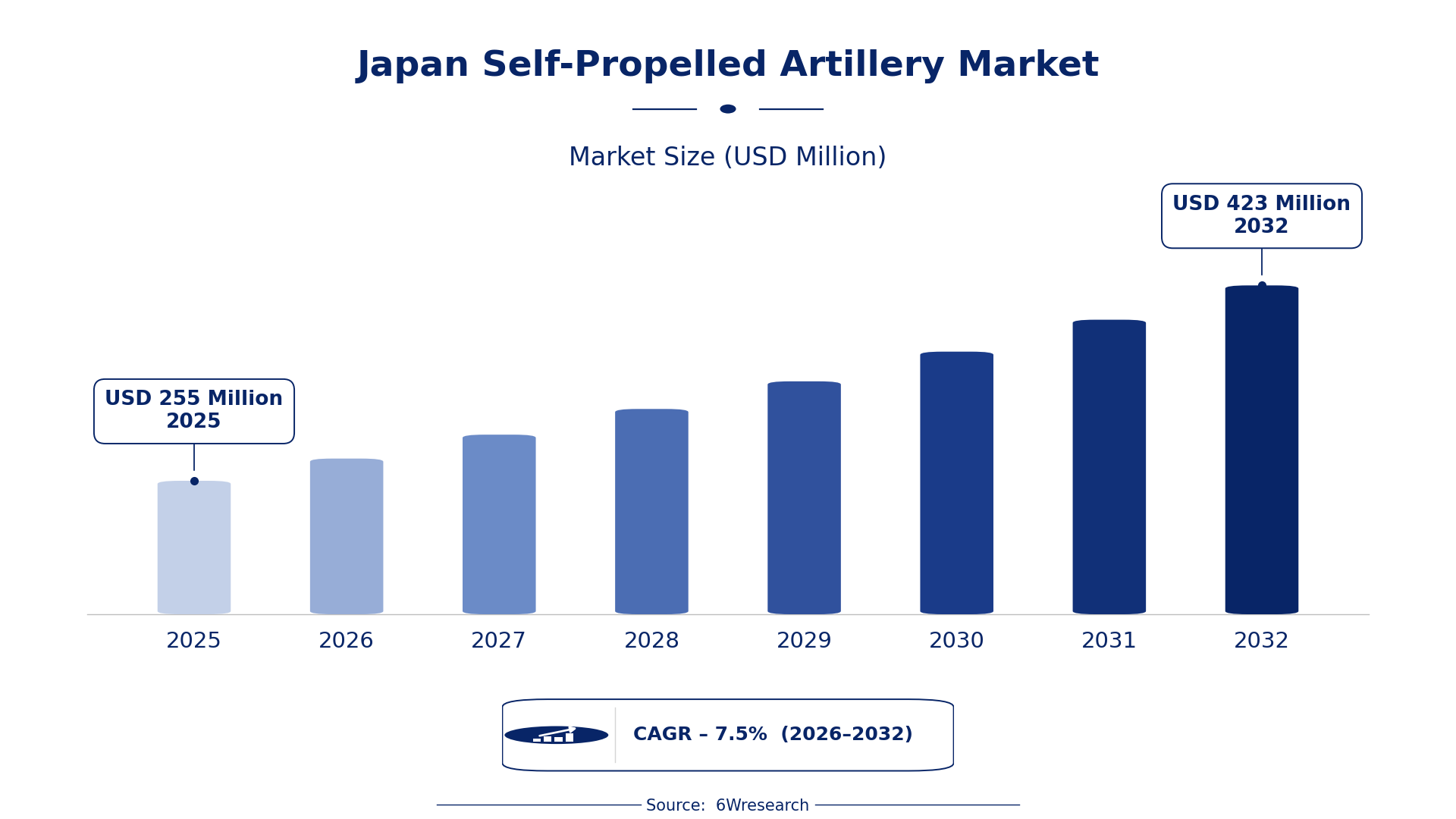
According to 6Wresearch internal database and industry insights, the Japan Self-Propelled Artillery Market was valued at USD 255 Million in 2025 and is projected to reach USD 423 Million by 2032, growing at a CAGR of approximately 7.5% during 2026–2032.
Japan Self-Propelled Artillery Market Highlights
| Report Metric | Details |
| Report Name | Japan Self-Propelled Artillery Market (2026-2032) |
| Market Size 2025 | USD 255 Million |
| Market Size 2032 | USD 423 Million |
| Absolute Growth 2025–2032 | USD 168 Million |
| CAGR 2026–2032 | 7.5% |
| Peak Annual Growth | 8.6% in 2030 |
| Forecast Period | 2026–2032 |
| Historical Data | 2022–2025 |
| Base Year | 2025 |
| Leading Artillery Type, 2025 | Howitzer-Based (37% share) |
| Leading Mobility Platform, 2025 | Tracked (45% share) |
| Leading Ammunition Type, 2025 | High-Explosive Shells (40% share) |
| Leading End User, 2025 | National Armies (48% share) |
| Fastest-Growing Artillery Type | Missile-Based Systems (10.9% CAGR) |
| Fastest-Growing Mobility Platform | Wheeled (11.4% CAGR) |
| Fastest-Growing Ammunition Type | Guided Missiles (11.1% CAGR) |
| Fastest-Growing End User | Military Forces (9.5% CAGR) |
| Growing Sector | National Defense |
| Key End Users | National Armies, Military Forces, Defense Contractors |
Japan Self-Propelled Artillery Market Year-wise Growth Rate and Key Drivers (2022–2032)
This graph illustrates the annual growth rates of the market from 2022 to 2032, highlighting a steady upward trajectory and projected market expansion over the forecast period.
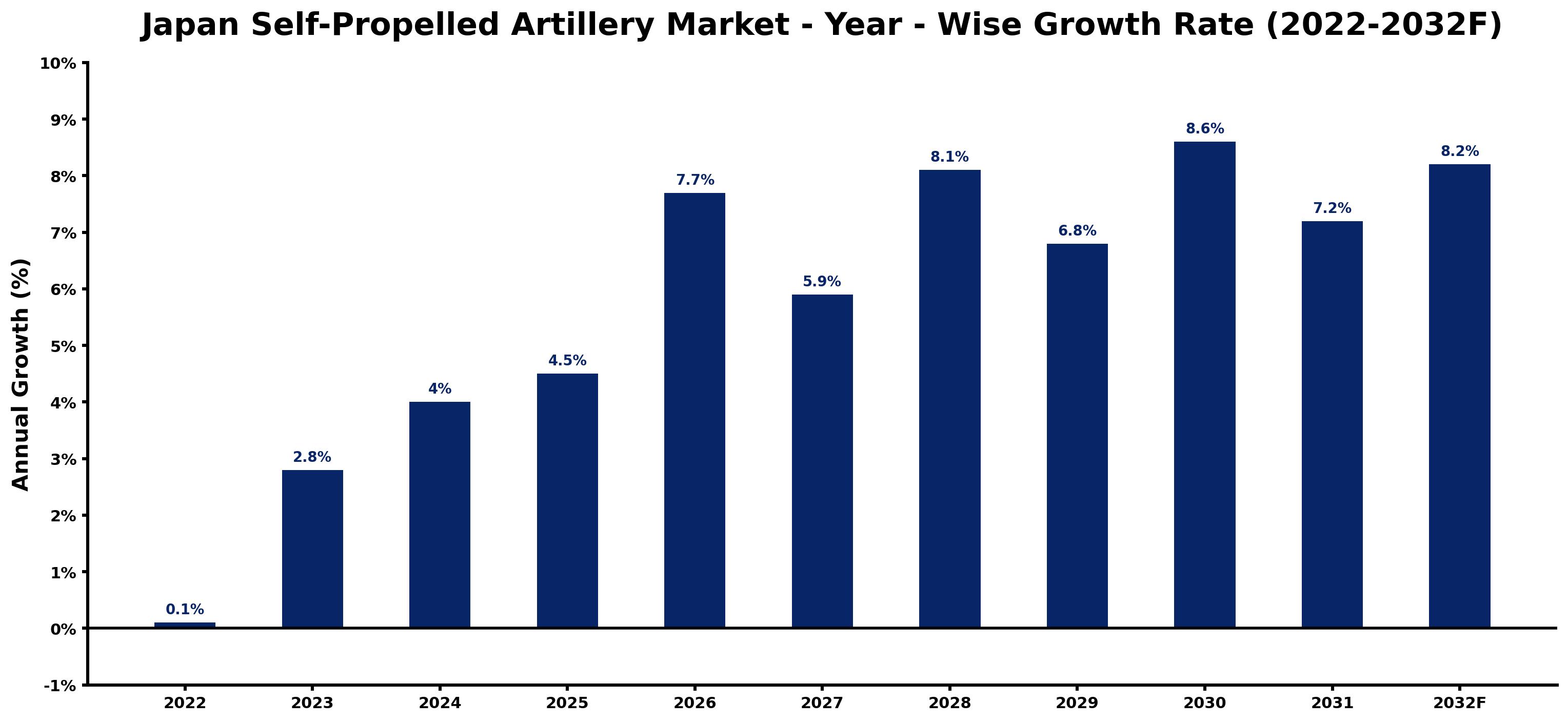
The table below sets out the estimated growth rate for each year and the main factor behind it.
| Year | Estimated Annual Growth (%) | Market Rationale |
| 2022 | 0.1 | The market showed minimal growth, reflecting ongoing adjustments in defense spending. |
| 2023 | 2.8 | Increased military exercises led to higher demand for self-propelled artillery systems. |
| 2024 | 4.0 | The introduction of advanced artillery technologies spurred further investment in capabilities. |
| 2025 | 4.5 | A modernization program initiated by the Ministry of Defense boosted procurement activities. |
| 2026 | 7.7 | Growing focus on joint operations with missile-based systems is expected to increase purchases. |
| 2027 | 5.9 | The market growth is expected to slow as budget allocations face scrutiny amid economic pressures. |
| 2028 | 8.1 | Rising tensions in the region are expected to prompt renewed interest in artillery capabilities. |
| 2029 | 6.8 | The market is projected to experience a slowdown as procurement cycles stabilise after previous spikes. |
| 2030 | 8.6 | Investments in advanced artillery systems are projected to drive peak growth this year. |
| 2031 | 7.2 | A slight slowdown is expected as the market adjusts to new operational strategies. |
| 2032 | 8.2 | Continued modernization efforts will sustain demand for artillery systems. |
Note: Market size estimations and growth projections presented in this report are based on 6Wresearch's proprietary forecasting methodology, utilizing the latest available industry data, government publications, and primary research inputs.
Japan Self-Propelled Artillery Market Synopsis
Self-propelled artillery is a mobile artillery solution with its own propulsion system, enabling rapid battlefield movement. It is primarily used for direct fire support, long-range bombardment, and quick responses to threats. The Japan Self-Propelled Artillery Market is expanding due to increased defense spending, with approximately 5 trillion yen allocated annually. Modernisation initiatives and a focus on joint operations with missile-based systems further drive demand from national armies and defense contractors, with the Type 99 self-propelled howitzer being a key asset.
Market Dynamics Impact Analysis (2026–2032)
| Factor | Type | Impact | Primary Segment Affected |
| Increased defense spending | Driver | High | Howitzer-Based |
| Modernization programs for artillery systems | Driver | High | Missile-Based Systems |
| Growing need for precision targeting | Opportunity | Medium | Guided Missiles |
| Emerging technologies in artillery systems | Opportunity | Medium | AI-Assisted Artillery |
| Budget constraints affecting procurement | Restraint | High | Tracked |
| Limited deployment of advanced technologies | Restraint | Medium | Hybrid Platforms |
| Challenges in integrating new systems | Challenge | High | Wheeled |
| Supply chain disruptions for critical components | Challenge | Medium | Tracked |
Evaluation of Drivers in Japan Self-Propelled Artillery Market (2026–2032)
The factors lifting demand, and the evidence behind each, are summarised below.
| Drivers | Primary Segment Affected | Why It Matters (Evidence) |
| Increased defense budget allocations | Howitzer-Based | The Ministry of Defense allocates approximately 5 trillion yen annually, boosting procurement of howitzers for ground support. |
| Modernization initiatives in the defense sector | Missile-Based Systems | The 2023 Defense Program Guidelines prioritise investments in missile-based systems, driving demand for advanced artillery capabilities. |
| Focus on joint operations with allied forces | Guided Missiles | The Self-Defense Forces aim to improve joint operations by 2025, increasing the need for precision-guided munitions. |
| Rising regional tensions and security concerns | Tracked | Heightened security threats prompt increased purchases of tracked artillery systems for rapid deployment. |
| Annual military exercises featuring artillery | Wheeled | Annual exercises conducted by the Japan Ground Self-Defense Force stimulate demand for wheeled artillery systems. |
Several shifts outside the market lift sales. Heightened regional tensions prompt the Self-Defense Forces to invest in tracked artillery for rapid deployment. Annual military exercises conducted by the Japan Ground Self-Defense Force further stimulate demand for wheeled artillery systems, showcasing operational capabilities and readiness.
Evaluation of Restraints in Japan Self-Propelled Artillery Market
Below are the constraints most often cited by buyers and suppliers, with the segment each affects.
| Market Restraint | Primary Segment Affected | Why It Matters (Evidence) |
| Budget constraints affecting procurement processes | Tracked | Budget scrutiny limits the ability of the Self-Defense Forces to procure new tracked artillery systems, impacting operational readiness. |
| Limited deployment of advanced technologies | Hybrid Platforms | The slow adoption of hybrid platforms hinders the expansion of capabilities, affecting overall effectiveness. |
| Challenges in integrating new systems into existing frameworks | Wheeled | Integration issues delay the deployment of new wheeled artillery, impacting training and operational efficiency. |
| Supply chain disruptions for critical components | Tracked | Disruptions in supply chains for tracked artillery components lead to delays in production and maintenance. |
| Regulatory hurdles for advanced systems | Missile-Based Systems | Stringent regulations surrounding missile-based systems complicate procurement and deployment processes. |
Japan Self-Propelled Artillery Market Challenges
Producers face high input costs due to the need for advanced materials in self-propelled howitzers, inflating production expenses by 20%. Technology integration issues arise as outdated systems hinder the adoption of modern artillery capabilities, delaying upgrades and reducing operational readiness for the Self-Defense Forces. Regulatory hurdles complicate procurement processes, with adherence to ISO 9001 standards extending timelines by several months for defense contractors. Competition among domestic manufacturers intensifies, leading to price wars that can cut profit margins by 15%, ultimately affecting investments in future technology development.
Trends in the Japan Self-Propelled Artillery Market
Several trends are reshaping the Japan Self-Propelled Artillery Market; the most important are set out below.
- Shift from Conventional to Precision Artillery: Since 2023, Japan has increasingly focused on precision artillery systems, with guided missiles projected to rise by 11.1% annually.
- Transition from Traditional to Hybrid Platforms: In 2026, military forces are exploring hybrid platforms that combine features of various systems, with missile-based systems expected to grow at 10.9%.
- Emergence of AI-Assisted Artillery: Interest in AI-assisted artillery has surged since 2022, indicating a shift towards advanced targeting capabilities in the defense sector.
- Prioritisation of Joint Operations: The focus on joint operations with allied forces has intensified since 2025, increasing investments in advanced artillery systems for interoperability.
Investment Opportunities in the Japan Self-Propelled Artillery Market
Several openings in the Japan Self-Propelled Artillery Market merit attention from investors.
- Timing for Investment in Guided Missiles: With a projected growth of 11.1%, now is the ideal time to invest in guided missile systems, particularly for national armies seeking precision capabilities.
- Demand from National Armies: National armies are currently seeking advanced artillery solutions, creating opportunities for suppliers to provide high-explosive shells and guided missiles.
- Supply of Advanced Artillery Systems: The modernisation of artillery systems is timely now, with the Ministry of Defense's budget supporting investments in high-tech artillery solutions.
- Gap in Hybrid Platforms: With hybrid platforms expected to grow, suppliers can enter the market by developing systems that combine traditional and advanced artillery features.
Government Initiatives in the Japan Self-Propelled Artillery Market
The Economic Security Promotion Act, enacted in 2022, enhances supply-chain resilience for critical defense products, including self-propelled artillery systems. This law mandates that producers ensure domestic sourcing of essential components, which strengthens local manufacturing capabilities. Additionally, the 2023 Defense Program Guidelines allocate significant funding for advanced artillery systems, aiming to modernise the Self-Defense Forces and improve operational efficiency. These measures collectively support the development and procurement processes for self-propelled artillery, ensuring compliance with national security objectives.
The Ministry of Defense utilises the Economic Security Promotion Act to streamline procurement for self-propelled artillery. By securing domestic supply chains, the Self-Defense Forces can reduce lead times for essential components, enhancing readiness. The Defense Agency oversees the implementation of these measures, ensuring that manufacturers adhere to quality standards while benefiting from government support. This approach not only strengthens local production but also aligns with Japan's strategic objectives for national defense and regional stability.
Future Insight of the Japan Self-Propelled Artillery Market
Investment in advanced artillery systems will increase, driven by a defence budget allocation of approximately 5 trillion yen annually. This will generate greater demand for self-propelled artillery as the Self-Defense Forces modernise their capabilities by 2025. New training programmes will emerge to support enhanced joint operations. The focus on rapid response capabilities will compel suppliers to innovate, ensuring Japan's defence remains effective against emerging threats.
Market Segmentation Analysis
Japan Self-Propelled Artillery Market report covers a detailed analysis of the following market segments:
By Artillery Type – Howitzer-Based Leads, Missile-Based Systems Expected to Grow Fastest
According to Saurav Kr Singh, Senior Research Analyst at 6Wresearch, with 37% of artillery type revenue in 2025, Howitzer-Based was the largest category. Howitzer-Based systems maintain the largest share due to their critical role in Japan's Self-Defense Forces, which operate over 100 self-propelled howitzers. This artillery type is vital for delivering direct fire support to ground troops during military operations. Missile-Based Systems are projected to grow fastest, at a CAGR of 10.9% during 2026–2032. Missile-Based Systems are rapidly gaining traction as they offer enhanced precision strikes and long-range capabilities, aligning with Japan's strategic focus on deterrence. The ongoing modernization program for artillery systems is expected to significantly increase the adoption of this segment. Suppliers should prioritise the development of advanced missile-based systems to cater to the increasing demand from military forces.
By Mobility Platform – Tracked Leads, Wheeled Expected to Grow Fastest
In 2025, Tracked led the mobility platform split with a 45% share. Tracked platforms dominate the market as they provide exceptional stability and mobility across various terrains, essential for Japan's diverse landscapes. This capability is crucial for the operational effectiveness of the Self-Defense Forces during exercises and real-world deployments. The quickest growth will come from Wheeled, forecast to expand at a CAGR of 11.4% between 2026 and 2032. Wheeled platforms are experiencing the fastest growth due to their capacity for quicker movement in urban areas and on roads, which is becoming increasingly important for modern military operations. The rising need for agility in troop movements is propelling this trend forward. Buyers should evaluate the advantages of wheeled platforms to enhance operational flexibility in urban settings.
By Ammunition Type – High-Explosive Shells Lead, Guided Missiles Expected to Grow Fastest
High-Explosive Shells accounted for 40% of the market by ammunition type in 2025. High-Explosive Shells are the primary ammunition type used by Japan's Self-Defense Forces, providing the explosive impact necessary for effective artillery operations. Their established use in military exercises underscores their importance in the arsenal. Guided Missiles are set to record the highest CAGR in this split, 11.1% over 2026–2032. Guided Missiles are growing rapidly as they allow for precision targeting and minimised collateral damage, which aligns with modern military strategies. The focus on advanced artillery systems in the defense budget supports this trend. Suppliers must prioritise the development of guided missile technologies to cater to the evolving needs of military forces.
By End User – National Armies Lead, Military Forces Expected to Grow Fastest
The largest end user category in 2025 was National Armies, at 48% of revenue. National Armies constitute the largest user group for self-propelled artillery, tasked with ensuring national defense and security in Japan. Their extensive operational requirements significantly drive the demand for sophisticated artillery systems. Over 2026–2032, Military Forces are expected to post the fastest growth, at a CAGR of 9.5%. Military Forces are the fastest-growing segment as they increasingly incorporate self-propelled artillery for training and operational readiness, indicating a shift towards comprehensive military preparedness. This trend is reinforced by the annual exercises conducted by the Self-Defense Forces. Suppliers should collaborate with military forces to offer tailored solutions that improve training and operational capabilities.
Key Attractiveness of the Report
- 10 Years of Market Numbers
- Historical Data Starting from 2022 to 2025
- Base Year 2025
- Forecast Data until 2032
- Key Performance Indicators Impacting the Market
- Major Upcoming Developments and Projects
Key Highlights of the Report:
- Japan Self-Propelled Artillery Market Outlook
- Market Size of Japan Self-Propelled Artillery Market, 2025
- Forecast of Japan Self-Propelled Artillery Market, 2032
- Historical Data and Forecast of Japan Self-Propelled Artillery Revenues & Volume for the Period 2022-2032F
- Japan Self-Propelled Artillery Market Trend Evolution
- Japan Self-Propelled Artillery Market Drivers and Challenges
- Japan Self-Propelled Artillery Price Trends
- Japan Self-Propelled Artillery Porter's Five Forces
- Japan Self-Propelled Artillery Industry Life Cycle
- Historical Data and Forecast of Japan Self-Propelled Artillery Market Revenues & Volume By Artillery Type for the Period 2022-2032F
- Historical Data and Forecast of Japan Self-Propelled Artillery Market Revenues & Volume By Howitzer-Based for the Period 2022-2032F
- Historical Data and Forecast of Japan Self-Propelled Artillery Market Revenues & Volume By Missile-Based Systems for the Period 2022-2032F
- Historical Data and Forecast of Japan Self-Propelled Artillery Market Revenues & Volume By Hybrid Platforms for the Period 2022-2032F
- Historical Data and Forecast of Japan Self-Propelled Artillery Market Revenues & Volume By AI-Assisted Artillery for the Period 2022-2032F
- Historical Data and Forecast of Japan Self-Propelled Artillery Market Revenues & Volume By Mobility Platform for the Period 2022-2032F
- Historical Data and Forecast of Japan Self-Propelled Artillery Market Revenues & Volume By Tracked for the Period 2022-2032F
- Historical Data and Forecast of Japan Self-Propelled Artillery Market Revenues & Volume By Wheeled for the Period 2022-2032F
- Historical Data and Forecast of Japan Self-Propelled Artillery Market Revenues & Volume By Tracked + Wheeled for the Period 2022-2032F
- Historical Data and Forecast of Japan Self-Propelled Artillery Market Revenues & Volume By Autonomous Fire Control for the Period 2022-2032F
- Historical Data and Forecast of Japan Self-Propelled Artillery Market Revenues & Volume By Ammunition Type for the Period 2022-2032F
- Historical Data and Forecast of Japan Self-Propelled Artillery Market Revenues & Volume By High-Explosive Shells for the Period 2022-2032F
- Historical Data and Forecast of Japan Self-Propelled Artillery Market Revenues & Volume By Guided Missiles for the Period 2022-2032F
- Historical Data and Forecast of Japan Self-Propelled Artillery Market Revenues & Volume By Smart Rounds for the Period 2022-2032F
- Historical Data and Forecast of Japan Self-Propelled Artillery Market Revenues & Volume By Sensor-Guided Ammunition for the Period 2022-2032F
- Historical Data and Forecast of Japan Self-Propelled Artillery Market Revenues & Volume By End User for the Period 2022-2032F
- Historical Data and Forecast of Japan Self-Propelled Artillery Market Revenues & Volume By National Armies for the Period 2022-2032F
- Historical Data and Forecast of Japan Self-Propelled Artillery Market Revenues & Volume By Military Forces for the Period 2022-2032F
- Historical Data and Forecast of Japan Self-Propelled Artillery Market Revenues & Volume By Defense Contractors for the Period 2022-2032F
- Historical Data and Forecast of Japan Self-Propelled Artillery Market Revenues & Volume By Border Defense Units for the Period 2022-2032F
- Japan Self-Propelled Artillery Import Export Trade Statistics
- Market Opportunity Assessment By Artillery Type
- Market Opportunity Assessment By Mobility Platform
- Market Opportunity Assessment By Ammunition Type
- Market Opportunity Assessment By End User
- Japan Self-Propelled Artillery Top Companies Market Share
- Japan Self-Propelled Artillery Competitive Benchmarking By Technical and Operational Parameters
- Japan Self-Propelled Artillery Company Profiles
- Japan Self-Propelled Artillery Key Strategic Recommendations
Market Covered
The report covers the following segments.
By Artillery Type
- Howitzer-Based
- Missile-Based Systems
- Hybrid Platforms
- AI-Assisted Artillery
By Mobility Platform
- Tracked
- Wheeled
- Tracked + Wheeled
- Autonomous Fire Control
By Ammunition Type
- High-Explosive Shells
- Guided Missiles
- Smart Rounds
- Sensor-Guided Ammunition
By End User
- National Armies
- Military Forces
- Defense Contractors
- Border Defense Units































