Japan Self-Service Banking Systems Market Size & Growth Rate
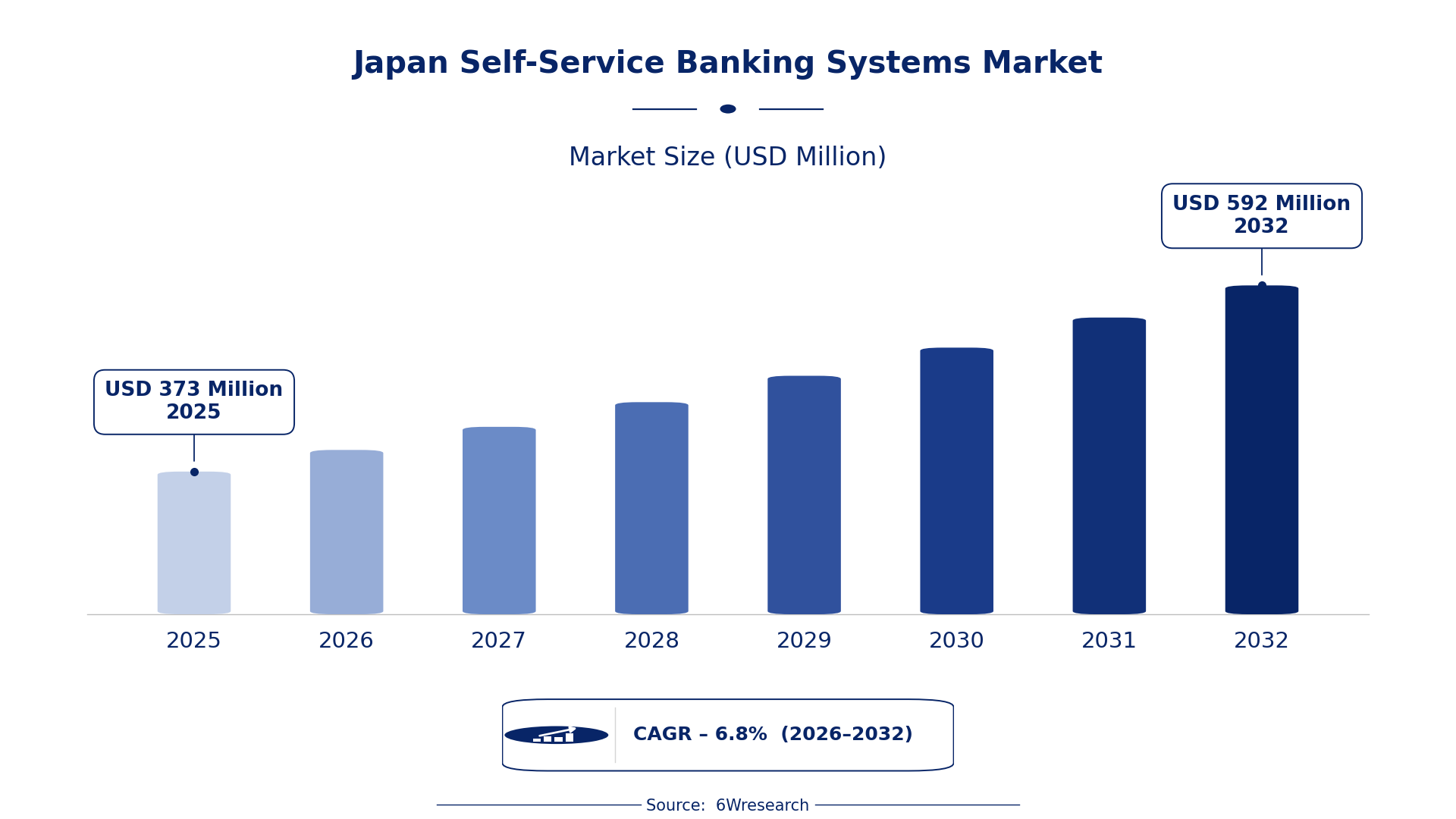
According to 6Wresearch internal database and industry insights, the Japan Self-Service Banking Systems Market was valued at USD 373 Million in 2025 and is projected to reach USD 592 Million by 2032, growing at a CAGR of approximately 6.8% during 2026–2032.
Japan Self-Service Banking Systems Market Highlights
| Report Metric | Details |
| Report Name | Japan Self-Service Banking Systems Market (2026-2032) |
| Market Size 2025 | USD 373 Million |
| Market Size 2032 | USD 592 Million |
| Absolute Growth 2025–2032 | USD 219 Million |
| CAGR 2026–2032 | 6.8% |
| Peak Annual Growth | 7.3% in 2028 |
| Forecast Period | 2026–2032 |
| Historical Data | 2022–2025 |
| Base Year | 2025 |
| Leading Machine Type, 2025 | ATM Machines (34% share) |
| Leading Services Offered, 2025 | Cash/Balance Inquiry (40% share) |
| Leading Access Mode, 2025 | Card-Based (35% share) |
| Leading End User, 2025 | General Public (39% share) |
| Fastest-Growing Machine Type | Kiosk Banking (10.0% CAGR) |
| Fastest-Growing Services Offered | Loan (9.9% CAGR) |
| Fastest-Growing Access Mode | Touchscreen/QR (9.1% CAGR) |
| Fastest-Growing End User | Rural Customers (8.8% CAGR) |
| Growing Sector | banking technology |
| Key End Users | urban banks, tech-enabled banks, general public, rural customers |
Japan Self-Service Banking Systems Market Year-wise Growth Rate and Key Drivers (2022–2032)
This graph illustrates the annual growth rates of the market from 2022 to 2032, highlighting a steady upward trajectory and projected market expansion over the forecast period.
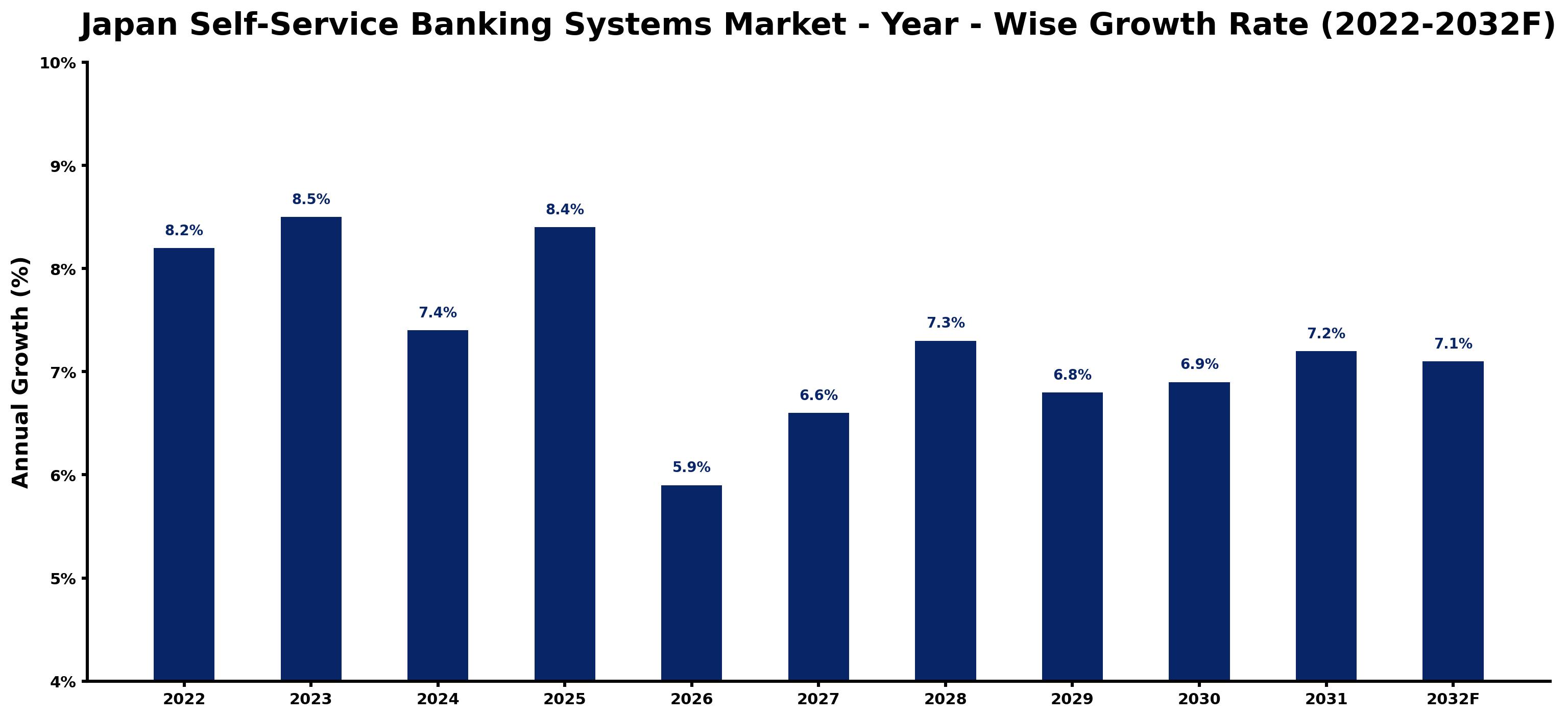
Each row of the following table gives one year's estimated growth and the event or demand shift that explains it.
| Year | Estimated Annual Growth (%) | Market Rationale |
| 2022 | 8.2 | The market experienced strong growth due to increased adoption of self-service technologies. |
| 2023 | 8.5 | Demand surged as urban banks expanded their self-service offerings. |
| 2024 | 7.4 | Growth slowed as market saturation began to impact new installations and upgrades. |
| 2025 | 8.4 | The market rebounded with renewed investments in self-service banking innovations. |
| 2026 | 5.9 | Growth is projected to decelerate as competition intensifies among existing service providers. |
| 2027 | 6.6 | An uptick is anticipated as rural customers increasingly seek convenient banking solutions. |
| 2028 | 7.3 | Growth is expected to accelerate again due to advancements in technology and user experience. |
| 2029 | 6.8 | Growth is likely to decelerate as the market matures and adoption rates stabilise. |
| 2030 | 6.9 | A slight rebound is anticipated as new technologies are introduced. |
| 2031 | 7.2 | Growth is projected to increase as the focus on financial inclusion drives demand for self-service systems. |
| 2032 | 7.1 | Growth is expected to decelerate as market conditions stabilise and competition intensifies. |
Note: Market size estimations and growth projections presented in this report are based on 6Wresearch's proprietary forecasting methodology, utilizing the latest available industry data, government publications, and primary research inputs.
Japan Self-Service Banking Systems Market Synopsis
Self-Service Banking Systems enable customers to perform transactions independently, such as cash withdrawals and balance inquiries, utilising advanced technology. The Japan Self-Service Banking Systems Market is expanding as urban banks and tech-enabled banks invest in new solutions. In 2023, the adoption rate of self-service kiosks in urban areas reached around 60%, driven by demand from the general public and rural customers seeking convenient banking options. Increased usage of self-service kiosks and technological advancements are propelling this growth.
Market Dynamics Impact Analysis (2026–2032)
| Factor | Type | Impact | Primary Segment Affected |
| Increased adoption of self-service technology by urban banks | Driver | High | ATM Machines |
| Growing demand for convenient banking solutions in rural areas | Driver | High | Kiosk Banking |
| Rising investments in financial technology development | Opportunity | High | Interactive Teller Machines |
| Expansion of self-service banking in rural regions | Opportunity | Medium | Mobile Self-Service Terminals |
| Market saturation limiting new installations | Restraint | High | ATM Machines |
| Intense competition among service providers | Restraint | Medium | Kiosk Banking |
| High costs associated with technology upgrades | Challenge | High | Interactive Teller Machines |
| Regulatory compliance requirements impacting operational costs | Challenge | Medium | Mobile Self-Service Terminals |
Evaluation of Drivers in Japan Self-Service Banking Systems Market (2026–2032)
Below are the drivers that matter most for revenue growth, with supporting evidence.
| Drivers | Primary Segment Affected | Why It Matters (Evidence) |
| Urban banks' investment in advanced self-service technologies | ATM Machines | This investment drives demand as over 100,000 ATMs support cash withdrawals and balance inquiries. |
| Increased usage of self-service kiosks by the general public | Kiosk Banking | The adoption rate reached 60% in urban areas, reflecting growing consumer reliance on self-service options. |
| Rural customers seeking convenient banking solutions | Interactive Teller Machines | The increase in usage of remote teller services by 20% since 2021 highlights this demand. |
| Technological advancements in user interfaces | Mobile Self-Service Terminals | Touchscreen interfaces are standard in 90% of machines, improving user experience. |
| Government initiatives promoting financial inclusion | Kiosk Banking | The government allocated ¥10 billion for financial technology development, supporting broader access. |
Several shifts outside the market lift sales. Urban banks have increased their investments in self-service technologies, facilitating cash withdrawals and balance inquiries. The adoption of self-service kiosks in urban areas reached approximately 60%, reflecting the general public's growing reliance on convenient banking solutions. Rural customers are increasingly utilising remote teller services, which have seen a rise in usage since 2021. Technological advancements, such as touchscreen interfaces standard in most machines, further improve user experience and drive demand.
Evaluation of Restraints in Japan Self-Service Banking Systems Market
The key brakes on demand, and where they bite hardest, are shown below.
| Market Restraint | Primary Segment Affected | Why It Matters (Evidence) |
| Market saturation limiting new installations | ATM Machines | With over 100,000 ATMs already in place, new installations face significant barriers. |
| Intense competition leading to price pressures | Kiosk Banking | The increasing number of service providers is driving down prices, affecting profit margins. |
| High costs associated with technology upgrades | Interactive Teller Machines | Upgrading systems to meet new standards can be prohibitively expensive for many banks. |
| Regulatory compliance costs impacting operational budgets | Mobile Self-Service Terminals | Compliance with regulations from the Financial Services Agency raises operational costs for banks. |
| Limited consumer awareness of new technologies | Kiosk Banking | Many potential users remain unaware of the benefits of self-service banking options. |
Japan Self-Service Banking Systems Market Challenges
Strict oversight from the Financial Services Agency delays installations of self-service banking systems by up to six months for banks. Urban banks face rising operational costs as the average age of ATMs is around seven years, leading to increased service fees for customers. A shortage of skilled technicians limits the implementation of advanced technologies, causing delays that negatively impact user experience for buyers. Competition from fintech solutions pressures traditional banks to innovate rapidly, risking market share losses if they fail to meet changing consumer expectations.
Trends in the Japan Self-Service Banking Systems Market
Several trends are reshaping the Japan Self-Service Banking Systems Market; the most important are set out below.
- Shift Towards Kiosk Banking: Urban banks are increasingly adopting kiosk banking solutions to improve customer engagement, with a 60% adoption rate in urban areas in 2023. This shift indicates a growing preference for self-service options among consumers.
- Emergence of Interactive Teller Machines: Interactive teller machines have gained traction, with 5,000 units installed nationwide in 2023. This trend reflects the demand for real-time interactions with bank representatives, improving customer service.
- Increased Adoption of Biometric Authentication: Biometric authentication is being implemented in 30% of new self-service systems, enhancing security and user confidence. This change aligns with the rising need for secure banking solutions.
- Growth in Remote Teller Services: Remote teller services have seen an increase in usage since 2021, showing a shift towards more accessible banking solutions. This trend is particularly beneficial for rural customers seeking convenience.
Investment Opportunities in the Japan Self-Service Banking Systems Market
The following opportunities in the Japan Self-Service Banking Systems Market pair current demand with a clear way in.
- Rising Demand for Financial Inclusion: With the government aiming to improve financial inclusion by 2025, there is an opportunity for investment in self-service systems. Rural customers are increasingly seeking convenient banking solutions.
- Expansion of Self-Service Kiosks: Now is the time to invest in self-service kiosks, as urban areas show a 60% adoption rate. Partnering with local banks can facilitate market entry and expansion.
- Investment in Interactive Teller Machines: The demand for real-time banking interactions creates opportunities for suppliers of interactive teller machines. Urban banks are actively seeking solutions to improve customer service.
- Technological Advancements in Banking Systems: The current focus on technology integration presents opportunities for suppliers of advanced self-service systems. Collaborating with tech-enabled banks can lead to successful market penetration.
Government Initiatives in the Japan Self-Service Banking Systems Market
Regulations from the Financial Services Agency impact self-service banking systems, ensuring compliance with security and operational standards. The agency oversees the implementation of ISO 20022 for electronic banking transactions, improving transaction efficiency and security for users. The government allocated a budget of ¥10 billion for financial technology development, supporting innovations in the sector.
The Ministry of Internal Affairs and Communications promotes advanced banking technologies, facilitating the adoption of self-service systems. Their initiatives aim to improve financial access for the general public, particularly in rural areas, by supporting technological advancements and funding projects.
Future Insight of the Japan Self-Service Banking Systems Market
The emergence of biometric authentication will redefine security in self-service banking systems, enhancing user confidence. By 2032, the adoption of ISO 20022 will streamline electronic transactions, benefiting both banks and customers. The government's financial technology budget will support advancements that improve access to services, especially in rural areas. Increased usage of QR code payments will attract a broader range of customers, driving demand for self-service banking solutions.
Market Segmentation Analysis
Japan Self-Service Banking Systems Market report covers a detailed analysis of the following market segments:
By Machine Type – ATM Machines Lead, Kiosk Banking Expected to Grow Fastest
According to Saurav Kr Singh, Senior Research Analyst at 6Wresearch, ATM Machines took 34% of machine type revenue in 2025, more than any other category. ATM machines lead the market due to their extensive deployment for cash withdrawals and balance inquiries. With over 100,000 ATMs installed across Japan, they serve a wide range of customers effectively. Kiosk Banking is projected to grow fastest, at a CAGR of 10.0% during 2026–2032. Kiosk banking is witnessing rapid growth as it provides a variety of banking services in a self-service format, appealing to users looking for convenience. The adoption rate of self-service kiosks in urban areas reached around 60% in 2023, indicating a shift towards this technology. Suppliers should focus on enhancing kiosk offerings to capture the growing demand in urban centres.
By Services Offered – Cash/Balance Inquiry Leads, Loan Expected to Grow Fastest
Cash/Balance Inquiry accounted for 40% of the market by services offered in 2025. Cash and balance inquiry services dominate the market as they are essential for customers at self-service points, enabling quick access to account information. This fundamental need drives high transaction volumes at ATMs and kiosks alike. Over 2026–2032, Loan is expected to post the fastest growth, at a CAGR of 9.9%. Loan services are experiencing rapid growth as they become more accessible through automated processes, catering to customers seeking quick financing options. The increasing automation in banking is making loan applications more user-friendly and efficient. Buyers will benefit from more streamlined loan application processes as banks enhance their self-service capabilities.
By Access Mode – Card-Based Leads, Touchscreen/QR Expected to Grow Fastest
Card-Based held 35% of the Japan Self-Service Banking Systems Market by access mode in 2025. Card-based access remains the preferred method for users, as it is a common and familiar way to interact with self-service systems. This method ensures security and convenience for the majority of transactions performed by customers. The quickest growth will come from Touchscreen/QR, forecast to expand at a CAGR of 9.1% between 2026 and 2032. Touchscreen and QR code interfaces are gaining popularity as the primary means of user interaction, reflecting a shift towards more intuitive technology. The rise in QR code payments by 25% in the last year exemplifies this trend. Suppliers should prioritise the development of touchscreen and QR code functionalities to meet evolving customer preferences.
By End User – General Public Leads, Rural Customers Expected to Grow Fastest
With 39% of end user revenue in 2025, General Public was the largest category. The general public constitutes the largest user group for self-service banking systems, as they seek convenient solutions for everyday banking needs. Their reliance on these systems for cash withdrawals and balance inquiries drives market stability. Rural Customers are set to record the highest CAGR in this split, 8.8% over 2026–2032. Rural customers are increasingly adopting self-service banking systems to improve access to financial services, particularly in remote areas. This trend is supported by government initiatives aimed at enhancing financial inclusion through technology by 2025. Suppliers should tailor their offerings to address the unique needs of rural customers to capitalise on this growing segment.
Key Attractiveness of the Report
- 10 Years of Market Numbers
- Historical Data Starting from 2022 to 2025
- Base Year 2025
- Forecast Data until 2032
- Key Performance Indicators Impacting the Market
- Major Upcoming Developments and Projects
Key Highlights of the Report:
- Japan Self-Service Banking Systems Market Outlook
- Market Size of Japan Self-Service Banking Systems Market, 2025
- Forecast of Japan Self-Service Banking Systems Market, 2032
- Historical Data and Forecast of Japan Self-Service Banking Systems Revenues & Volume for the Period 2022-2032F
- Japan Self-Service Banking Systems Market Trend Evolution
- Japan Self-Service Banking Systems Market Drivers and Challenges
- Japan Self-Service Banking Systems Price Trends
- Japan Self-Service Banking Systems Porter's Five Forces
- Japan Self-Service Banking Systems Industry Life Cycle
- Historical Data and Forecast of Japan Self-Service Banking Systems Market Revenues & Volume By Machine Type for the Period 2022-2032F
- Historical Data and Forecast of Japan Self-Service Banking Systems Market Revenues & Volume By ATM Machines for the Period 2022-2032F
- Historical Data and Forecast of Japan Self-Service Banking Systems Market Revenues & Volume By Kiosk Banking for the Period 2022-2032F
- Historical Data and Forecast of Japan Self-Service Banking Systems Market Revenues & Volume By Interactive Teller Machines for the Period 2022-2032F
- Historical Data and Forecast of Japan Self-Service Banking Systems Market Revenues & Volume By Mobile Self-Service Terminals for the Period 2022-2032F
- Historical Data and Forecast of Japan Self-Service Banking Systems Market Revenues & Volume By Services Offered for the Period 2022-2032F
- Historical Data and Forecast of Japan Self-Service Banking Systems Market Revenues & Volume By Cash/Balance Inquiry for the Period 2022-2032F
- Historical Data and Forecast of Japan Self-Service Banking Systems Market Revenues & Volume By Loan, Insurance for the Period 2022-2032F
- Historical Data and Forecast of Japan Self-Service Banking Systems Market Revenues & Volume By Remote Teller for the Period 2022-2032F
- Historical Data and Forecast of Japan Self-Service Banking Systems Market Revenues & Volume By Biometric for the Period 2022-2032F
- Historical Data and Forecast of Japan Self-Service Banking Systems Market Revenues & Volume By Access Mode for the Period 2022-2032F
- Historical Data and Forecast of Japan Self-Service Banking Systems Market Revenues & Volume By Card-Based for the Period 2022-2032F
- Historical Data and Forecast of Japan Self-Service Banking Systems Market Revenues & Volume By Touchscreen/QR for the Period 2022-2032F
- Historical Data and Forecast of Japan Self-Service Banking Systems Market Revenues & Volume By Video + Voice for the Period 2022-2032F
- Historical Data and Forecast of Japan Self-Service Banking Systems Market Revenues & Volume By Fingerprint/Face for the Period 2022-2032F
- Historical Data and Forecast of Japan Self-Service Banking Systems Market Revenues & Volume By End User for the Period 2022-2032F
- Historical Data and Forecast of Japan Self-Service Banking Systems Market Revenues & Volume By General Public for the Period 2022-2032F
- Historical Data and Forecast of Japan Self-Service Banking Systems Market Revenues & Volume By Rural Customers for the Period 2022-2032F
- Historical Data and Forecast of Japan Self-Service Banking Systems Market Revenues & Volume By Urban Banks for the Period 2022-2032F
- Historical Data and Forecast of Japan Self-Service Banking Systems Market Revenues & Volume By Tech-Enabled Banks for the Period 2022-2032F
- Japan Self-Service Banking Systems Import Export Trade Statistics
- Market Opportunity Assessment By Machine Type
- Market Opportunity Assessment By Services Offered
- Market Opportunity Assessment By Access Mode
- Market Opportunity Assessment By End User
- Japan Self-Service Banking Systems Top Companies Market Share
- Japan Self-Service Banking Systems Competitive Benchmarking By Technical and Operational Parameters
- Japan Self-Service Banking Systems Company Profiles
- Japan Self-Service Banking Systems Key Strategic Recommendations
Market Covered
The report covers the following segments.
By Machine Type
- ATM Machines
- Kiosk Banking
- Interactive Teller Machines
- Mobile Self-Service Terminals
By Services Offered
- Cash/Balance Inquiry
- Loan
- Insurance
- Remote Teller
- Biometric
By Access Mode
- Card-Based
- Touchscreen/QR
- Video + Voice
- Fingerprint/Face
By End User
- General Public
- Rural Customers
- Urban Banks
- Tech-Enabled Banks































