Japan Self-Testing Kits Market Size & Growth Rate
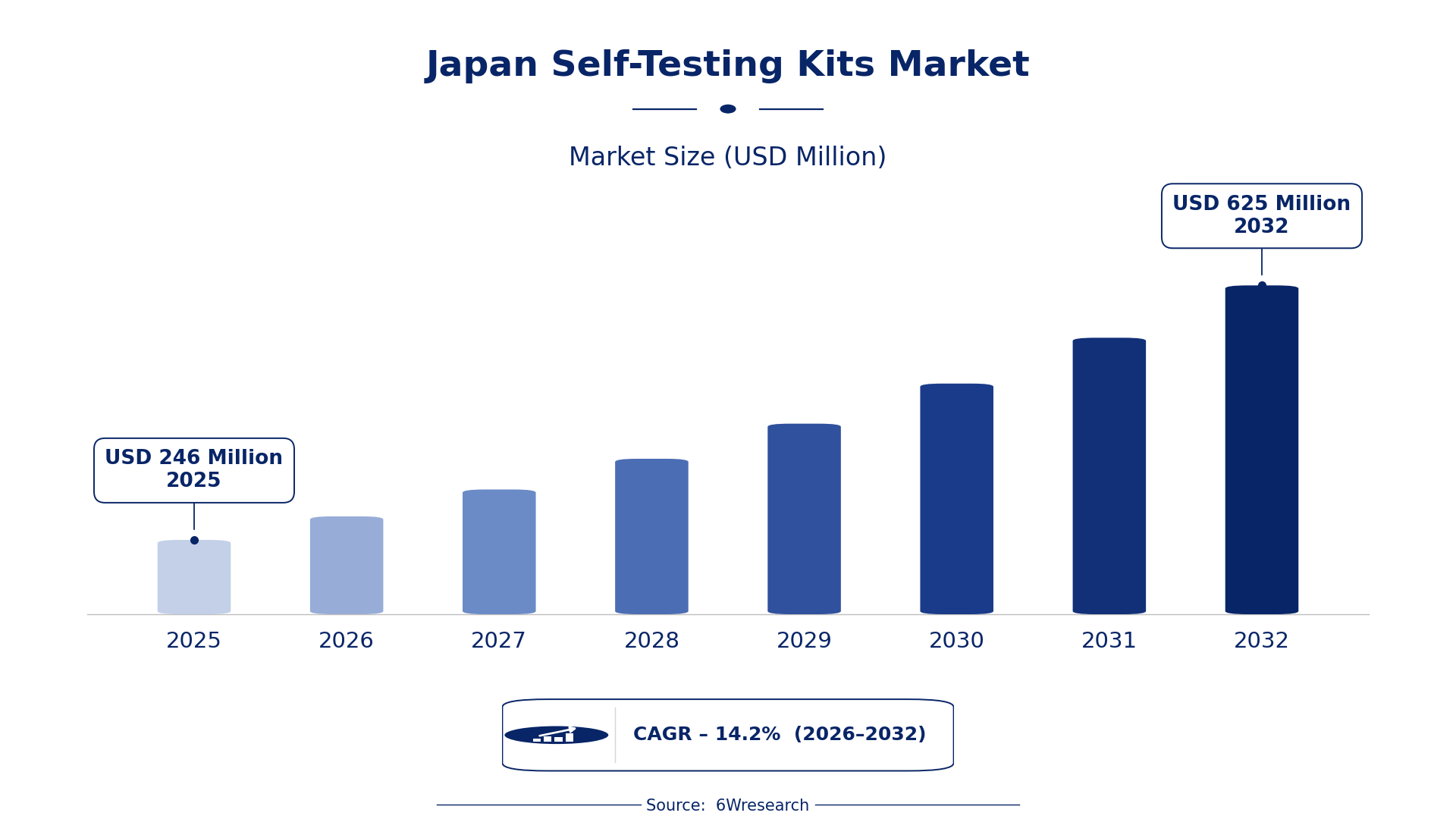
According to 6Wresearch internal database and industry insights, the Japan Self-Testing Kits Market was valued at USD 246 Million in 2025 and is projected to reach USD 625 Million by 2032, growing at a CAGR of approximately 14.2% during 2026–2032.
Japan Self-Testing Kits Market Highlights
| Report Metric | Details |
| Report Name | Japan Self-Testing Kits Market (2026-2032) |
| Market Size 2025 | USD 246 Million |
| Market Size 2032 | USD 625 Million |
| Absolute Growth 2025–2032 | USD 379 Million |
| CAGR 2026–2032 | 14.2% |
| Peak Annual Growth | 16.3% in 2026 |
| Forecast Period | 2026–2032 |
| Historical Data | 2022–2025 |
| Base Year | 2025 |
| Leading Test Type, 2025 | COVID-19 Test Kits (46% share) |
| Leading Sample Type, 2025 | Blood Drop (39% share) |
| Leading Distribution Channel, 2025 | Retail Pharmacies (43% share) |
| Leading End User, 2025 | General Consumers (53% share) |
| Fastest-Growing Test Type | HIV Self-Test Kits (19.1% CAGR) |
| Fastest-Growing Sample Type | Nasal Swab (19.6% CAGR) |
| Fastest-Growing Distribution Channel | Online Pharmacies (17.6% CAGR) |
| Fastest-Growing End User | At-Risk Groups (17.7% CAGR) |
| Growing Sector | health monitoring |
| Key End Users | General Consumers, Diabetic Patients, Women of Reproductive Age, At-Risk Groups |
Japan Self-Testing Kits Market Year-wise Growth Rate and Key Drivers (2022–2032)
This graph illustrates the annual growth rates of the market from 2022 to 2032, highlighting a steady upward trajectory and projected market expansion over the forecast period.
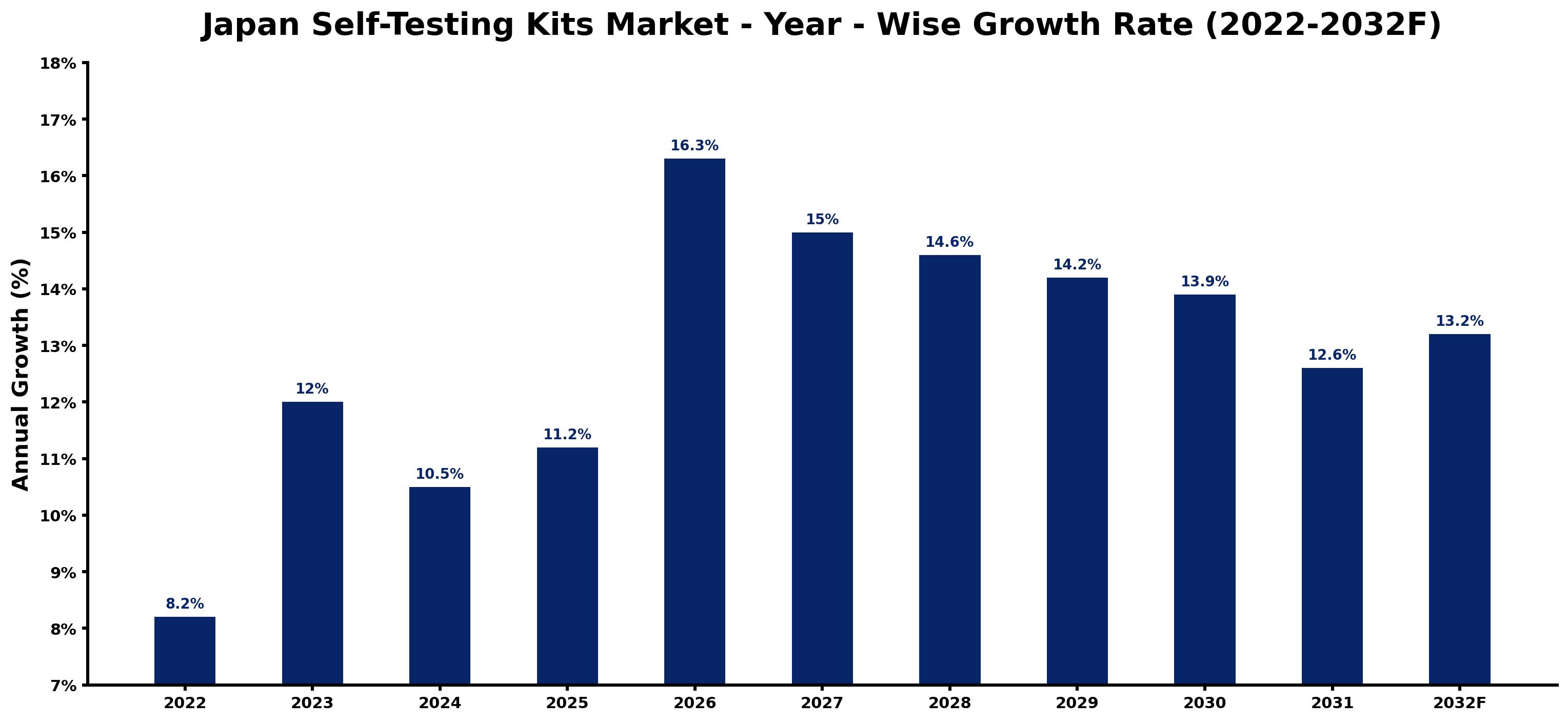
The following figures match every annual growth estimate with the main market development of that year, giving the reasoning behind each rise or slowdown.
| Year | Estimated Annual Growth (%) | Market Rationale |
| 2022 | 8.2 | The market experienced steady growth due to rising consumer awareness of health monitoring. |
| 2023 | 12.0 | Increased adoption of self-testing kits contributed to faster growth compared to the previous year. |
| 2024 | 10.5 | Growth slowed as market saturation began to impact new purchases. |
| 2025 | 11.2 | The introduction of new diabetes test kits spurred demand, leading to faster growth. |
| 2026 | 16.3 | Demand surged as health initiatives promoted self-testing, resulting in peak annual growth. |
| 2027 | 15.0 | Growth slowed slightly as the market stabilises after the peak in 2026. |
| 2028 | 14.6 | Continued consumer education on health monitoring contributes to a further slowdown in growth. |
| 2029 | 14.2 | The market maintains growth as awareness of self-testing kits remains high among consumers. |
| 2030 | 13.9 | Growth continues to slow as competition among suppliers increases. |
| 2031 | 12.6 | The market experiences another slowdown as consumer preferences begin to shift. |
| 2032 | 13.2 | Growth accelerates again due to renewed health campaigns and product innovations. |
Note: Market size estimations and growth projections presented in this report are based on 6Wresearch's proprietary forecasting methodology, utilizing the latest available industry data, government publications, and primary research inputs.
Japan Self-Testing Kits Market Synopsis
Self-testing kits are diagnostic tools enabling individuals to perform tests on themselves, commonly used for monitoring health conditions and detecting diseases. The Japan Self-Testing Kits Market is driven by increasing consumer awareness and the promotion of self-testing by healthcare institutions. The adoption rate is rising, with approximately 30% of women of reproductive age using pregnancy test kits annually. Endorsements from health associations further stimulate demand, contributing to market growth, as the population of Japan was approximately 125 million in 2022.
Market Dynamics Impact Analysis (2026–2032)
| Factor | Type | Impact | Primary Segment Affected |
| Rising consumer awareness of health monitoring | Driver | High | COVID-19 Test Kits |
| Increased availability through retail and online channels | Driver | High | Diabetes Test Kits |
| Growing demand for HIV self-testing kits among at-risk groups | Opportunity | High | HIV Self-Test Kits |
| Expansion of online pharmacies as a distribution channel | Opportunity | Medium | Online Pharmacies |
| Market saturation limiting new customer acquisition | Restraint | High | Pregnancy Test Kits |
| Regulatory hurdles affecting new product approvals | Restraint | Medium | Diabetes Test Kits |
| High costs associated with regulatory compliance | Challenge | High | HIV Self-Test Kits |
| Intense competition among suppliers leading to price wars | Challenge | Medium | COVID-19 Test Kits |
Evaluation of Drivers in Japan Self-Testing Kits Market (2026–2032)
The table below links each growth driver to the segment it affects and the evidence for it.
| Drivers | Primary Segment Affected | Why It Matters (Evidence) |
| Increased health awareness | Diabetes Test Kits | The prevalence of diabetes in Japan is around 7% of the adult population, driving demand for self-monitoring. |
| Government health initiatives | Diabetes Test Kits | The Japanese government launched a health initiative to promote self-testing, boosting usage rates. |
| Endorsements from health associations | HIV Self-Test Kits | HIV self-testing kits are endorsed by the Japan Association for HIV Prevention, increasing consumer trust. |
| Rising demand from general consumers | Pregnancy Test Kits | Approximately 30% of women of reproductive age use pregnancy test kits annually, driving steady demand. |
| Growth in online sales channels | Online Pharmacies | Online pharmacies reported a 15% increase in self-testing kit sales in 2023, expanding access. |
Purchasing is picking up as awareness of health conditions rises, particularly in Tokyo and Osaka, where self-testing kits are widely distributed. The prevalence of diabetes, affecting around 7% of the adult population, drives demand for diabetes test kits, prompting more purchases from diabetic patients. Online pharmacies reported a 15% increase in sales, reflecting changing consumer preferences and expanding access. Endorsements from health associations boost consumer confidence in HIV self-testing kits, resulting in higher demand among at-risk groups.
Evaluation of Restraints in Japan Self-Testing Kits Market
These are the pressures that could keep growth below its potential.
| Market Restraint | Primary Segment Affected | Why It Matters (Evidence) |
| Market saturation limiting new customer acquisition | Pregnancy Test Kits | As the market matures, fewer new customers are entering, impacting growth rates. |
| Regulatory hurdles affecting new product approvals | Diabetes Test Kits | Strict regulations delay the introduction of new self-testing products, limiting market expansion. |
| High costs associated with regulatory compliance | HIV Self-Test Kits | Producers incur high costs to meet compliance standards, affecting pricing strategies. |
| Intense competition among suppliers affecting profitability | Diabetes Test Kits | Competition drives prices down, impacting margins for suppliers in the market. |
| Consumer preference shifts towards more advanced testing technologies | Diabetes Test Kits | As consumers seek better accuracy, traditional kits may see reduced demand. |
Japan Self-Testing Kits Market Challenges
A major obstacle for producers lies in outdated technology for self-testing kits, as many still depend on traditional methods that slow innovation and extend product development timelines by up to six months. Distributors struggle with supply chain disruptions, particularly in sourcing raw materials, which can delay deliveries by three months and inflate costs for retailers. Regulatory hurdles complicate the approval process for new products, leading to waiting periods that can exceed a year and hinder market entry for suppliers. Competition from international brands intensifies pricing pressures, forcing local manufacturers to reduce margins and negatively impacting profitability for producers.
Trends in the Japan Self-Testing Kits Market
The following changes are redrawing the Japan Self-Testing Kits Market.
- Shift towards Online Pharmacies: In 2023, online pharmacies experienced a 15% increase in self-testing kit sales, reflecting changing consumer purchasing habits. This trend indicates a growing preference for convenience and accessibility, prompting suppliers to adapt their online offerings.
- Transition from Traditional to Self-Testing: The year 2022 marked a shift as self-testing kits gained popularity over traditional testing methods. This change is evident in the increased adoption rates among general consumers, particularly for diabetes tests.
- Emergence of Health Monitoring Initiatives: Health initiatives launched by the Japanese government in 2023 aimed to promote self-testing, resulting in heightened awareness and usage. This trend is expected to drive further growth in the self-testing kits market.
- Prioritisation of Consumer Education: The Japan Self-Monitoring Association has been active in educating consumers about self-testing. This focus on education is important for increasing adoption rates, particularly among at-risk groups.
Investment Opportunities in the Japan Self-Testing Kits Market
The following areas offer the clearest openings for investors and suppliers in the Japan Self-Testing Kits Market.
- Timing is right for investment in online channels: With a 15% increase in online sales in 2023, suppliers should invest in online pharmacy partnerships to capture this growing market segment.
- Supply of advanced self-testing products: The market gap for advanced diabetes self-testing kits presents an opportunity for suppliers to innovate and meet consumer demand, especially among diabetic patients.
- Growing need for HIV self-testing kits: As awareness of HIV self-testing rises, suppliers can focus on this segment, which is projected to grow due to endorsements from health associations.
- Expansion of health initiatives: The ongoing health initiatives by the government create a demand for educational materials and self-testing kits, presenting an opportunity for suppliers to engage with healthcare institutions.
Government Initiatives in the Japan Self-Testing Kits Market
The NHI drug price standard, revised regularly by the Ministry of Health, Labour and Welfare, sets reimbursement prices for self-testing kits, ensuring affordability for consumers. This policy encourages the adoption of self-testing kits by making them financially accessible, thereby increasing their use in health monitoring. The average age of diabetes patients in Japan is around 65 years, and the prevalence of diabetes is approximately 7% of the adult population.
The PMDA oversees the approval of self-testing kits, ensuring they meet safety and efficacy standards. This regulatory framework supports the market by providing a clear pathway for new products, which helps maintain consumer trust and encourages healthcare institutions to adopt these kits. The Japan Pharmaceutical Association regulates the sale of self-testing kits, ensuring compliance with national standards.
Future Insight of the Japan Self-Testing Kits Market
Consumers will increasingly adopt self-testing kits by 2032, driven by health initiatives that promote awareness and accessibility. The adoption of advanced technologies, such as molecular diagnostics, will improve accuracy and reliability in results. Health insurance plans will expand coverage for self-testing kits, making them more affordable for buyers. The Ministry of Health, Labour and Welfare's initiatives will further support the integration of self-testing into routine health monitoring, with an expected 25% increase in usage among adults.
Market Segmentation Analysis
Japan Self-Testing Kits Market report covers a detailed analysis of the following market segments:
By Test Type – COVID-19 Test Kits Lead, HIV Self-Test Kits Expected to Grow Fastest
According to Saurav Kr Singh, Senior Research Analyst at 6Wresearch, COVID-19 Test Kits accounted for 46% of the market by test type in 2025. COVID-19 test kits hold the largest share as they are crucial for immediate diagnosis during health crises. Their widespread use in densely populated areas like Tokyo, where health facilities are abundant, solidifies their dominance. Over 2026–2032, HIV Self-Test Kits are expected to post the fastest growth, at a CAGR of 19.1%. HIV self-test kits are experiencing accelerated growth due to increasing awareness among at-risk groups, supported by health initiatives that encourage self-screening. This trend is further amplified by endorsements from health organisations advocating for their use. Suppliers should focus on expanding their product lines to include HIV self-test kits to take advantage of this rapidly growing market segment.
By Sample Type – Blood Drop Leads, Nasal Swab Expected to Grow Fastest
Blood Drop took 39% of sample type revenue in 2025, more than any other category. Blood drop samples dominate the market as they are commonly used for diabetes testing, which is prevalent among the ageing population. The average age of diabetes patients in Japan, around 65 years, drives the demand for these kits. Nasal Swab is projected to grow fastest, at a CAGR of 19.6% during 2026–2032. Nasal swab samples are growing quickly due to their primary use in respiratory tests, particularly for COVID-19. The increasing incidence of respiratory illnesses has led to a surge in demand for this sample type. Buyers may benefit from a wider range of self-testing kits that utilise nasal swab samples as health concerns rise.
By Distribution Channel – Retail Pharmacies Lead, Online Pharmacies Expected to Grow Fastest
The largest distribution channel category in 2025 was Retail Pharmacies, at 43% of revenue. Retail pharmacies represent 40% of self-testing kit distribution, providing traditional access points for consumers in need of these products. Their established presence in local areas ensures reliable availability and fosters consumer trust. Online Pharmacies are set to record the highest CAGR in this split, 17.6% over 2026–2032. Online pharmacies are gaining traction, with a reported 15% increase in sales in 2023, as consumers increasingly prefer the convenience of purchasing health products online. This shift highlights a growing trend towards digital shopping for medical supplies. Suppliers need to strengthen their online presence to effectively engage with consumers who are shifting towards online pharmacy channels.
By End User – General Consumers Lead, At-Risk Groups Expected to Grow Fastest
With 53% of end user revenue in 2025, General Consumers was the largest category. General consumers form the largest segment of self-testing kit users, employing these tools for various health monitoring needs. The growing health consciousness among the population drives increased usage across different demographics. The quickest growth will come from At-Risk Groups, forecast to expand at a CAGR of 17.7% between 2026 and 2032. At-risk groups represent the fastest-growing segment, particularly for HIV self-testing kits, as health initiatives target these vulnerable populations. This focus will likely sustain growth in this area as awareness continues to expand. Suppliers should adapt their marketing efforts to effectively engage and support at-risk groups.
Key Attractiveness of the Report
- 10 Years of Market Numbers
- Historical Data Starting from 2022 to 2025
- Base Year 2025
- Forecast Data until 2032
- Key Performance Indicators Impacting the Market
- Major Upcoming Developments and Projects
Key Highlights of the Report:
- Japan Self-Testing Kits Market Outlook
- Market Size of Japan Self-Testing Kits Market, 2025
- Forecast of Japan Self-Testing Kits Market, 2032
- Historical Data and Forecast of Japan Self-Testing Kits Revenues & Volume for the Period 2022-2032F
- Japan Self-Testing Kits Market Trend Evolution
- Japan Self-Testing Kits Market Drivers and Challenges
- Japan Self-Testing Kits Price Trends
- Japan Self-Testing Kits Porter's Five Forces
- Japan Self-Testing Kits Industry Life Cycle
- Historical Data and Forecast of Japan Self-Testing Kits Market Revenues & Volume By Test Type for the Period 2022-2032F
- Historical Data and Forecast of Japan Self-Testing Kits Market Revenues & Volume By COVID-19 Test Kits for the Period 2022-2032F
- Historical Data and Forecast of Japan Self-Testing Kits Market Revenues & Volume By Diabetes Test Kits for the Period 2022-2032F
- Historical Data and Forecast of Japan Self-Testing Kits Market Revenues & Volume By Pregnancy Test Kits for the Period 2022-2032F
- Historical Data and Forecast of Japan Self-Testing Kits Market Revenues & Volume By HIV Self-Test Kits for the Period 2022-2032F
- Historical Data and Forecast of Japan Self-Testing Kits Market Revenues & Volume By Sample Type for the Period 2022-2032F
- Historical Data and Forecast of Japan Self-Testing Kits Market Revenues & Volume By Nasal Swab for the Period 2022-2032F
- Historical Data and Forecast of Japan Self-Testing Kits Market Revenues & Volume By Blood Drop for the Period 2022-2032F
- Historical Data and Forecast of Japan Self-Testing Kits Market Revenues & Volume By Urine for the Period 2022-2032F
- Historical Data and Forecast of Japan Self-Testing Kits Market Revenues & Volume By Oral Swab for the Period 2022-2032F
- Historical Data and Forecast of Japan Self-Testing Kits Market Revenues & Volume By Distribution Channel for the Period 2022-2032F
- Historical Data and Forecast of Japan Self-Testing Kits Market Revenues & Volume By Online Pharmacies for the Period 2022-2032F
- Historical Data and Forecast of Japan Self-Testing Kits Market Revenues & Volume By Retail Pharmacies for the Period 2022-2032F
- Historical Data and Forecast of Japan Self-Testing Kits Market Revenues & Volume By Supermarkets for the Period 2022-2032F
- Historical Data and Forecast of Japan Self-Testing Kits Market Revenues & Volume By Clinics & NGOs for the Period 2022-2032F
- Historical Data and Forecast of Japan Self-Testing Kits Market Revenues & Volume By End User for the Period 2022-2032F
- Historical Data and Forecast of Japan Self-Testing Kits Market Revenues & Volume By General Consumers for the Period 2022-2032F
- Historical Data and Forecast of Japan Self-Testing Kits Market Revenues & Volume By Diabetic Patients for the Period 2022-2032F
- Historical Data and Forecast of Japan Self-Testing Kits Market Revenues & Volume By Women of Reproductive Age for the Period 2022-2032F
- Historical Data and Forecast of Japan Self-Testing Kits Market Revenues & Volume By At-Risk Groups for the Period 2022-2032F
- Japan Self-Testing Kits Import Export Trade Statistics
- Market Opportunity Assessment By Test Type
- Market Opportunity Assessment By Sample Type
- Market Opportunity Assessment By Distribution Channel
- Market Opportunity Assessment By End User
- Japan Self-Testing Kits Top Companies Market Share
- Japan Self-Testing Kits Competitive Benchmarking By Technical and Operational Parameters
- Japan Self-Testing Kits Company Profiles
- Japan Self-Testing Kits Key Strategic Recommendations
Market Covered
This report examines the market across the segments below.
By Test Type
- COVID-19 Test Kits
- Diabetes Test Kits
- Pregnancy Test Kits
- HIV Self-Test Kits
By Sample Type
- Nasal Swab
- Blood Drop
- Urine
- Oral Swab
By Distribution Channel
- Online Pharmacies
- Retail Pharmacies
- Supermarkets
- Clinics & NGOs
By End User
- General Consumers
- Diabetic Patients
- Women of Reproductive Age
- At-Risk Groups































