Japan Semiconductor Chemicals Market Size & Growth Rate
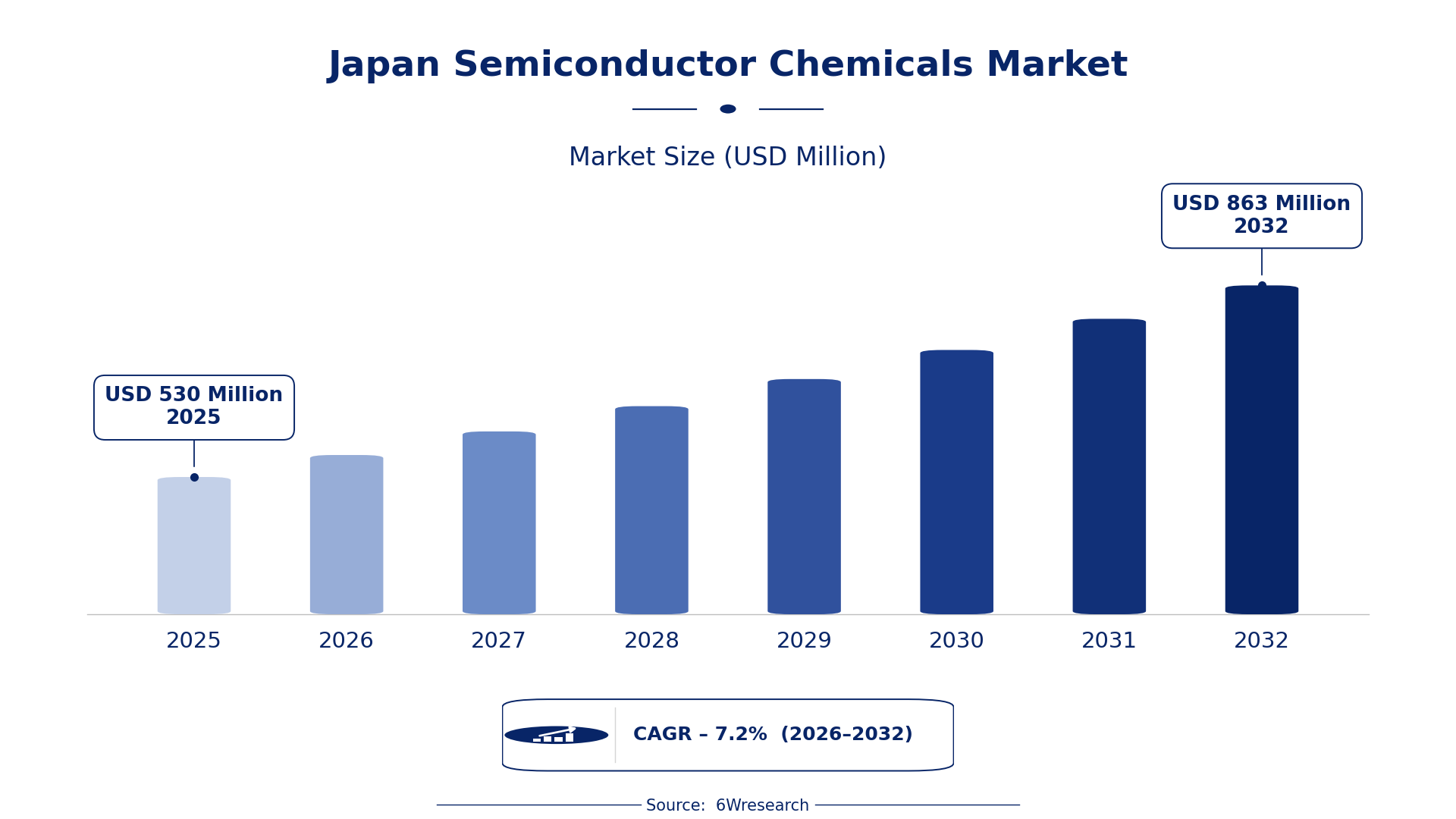
According to 6Wresearch internal database and industry insights, the Japan Semiconductor Chemicals Market was valued at USD 530 Million in 2025 and is projected to reach USD 863 Million by 2032, growing at a CAGR of approximately 7.2% during 2026–2032.
Japan Semiconductor Chemicals Market Highlights
| Report Metric | Details |
| Report Name | Japan Semiconductor Chemicals Market (2026-2032) |
| Market Size 2025 | USD 530 Million |
| Market Size 2032 | USD 863 Million |
| Absolute Growth 2025–2032 | USD 333 Million |
| CAGR 2026–2032 | 7.2% |
| Peak Annual Growth | 8.9% in 2027 |
| Forecast Period | 2026–2032 |
| Historical Data | 2022–2025 |
| Base Year | 2025 |
| Leading Chemical Type, 2025 | Etchants (44% share) |
| Leading Process Stage, 2025 | Etching Process (46% share) |
| Leading Purity Level, 2025 | Ultra-High Purity (43% share) |
| Leading End User, 2025 | Fab Facilities (55% share) |
| Fastest-Growing Chemical Type | Dopants (9.6% CAGR) |
| Fastest-Growing Process Stage | Doping/Implantation (9.8% CAGR) |
| Fastest-Growing Purity Level | 99.9999%+ (9.4% CAGR) |
| Fastest-Growing End User | Chip Foundries (9.3% CAGR) |
| Growing Sector | Chip Foundries |
| Key End Users | Fab Facilities, Chip Foundries, Wafer Manufacturers, Semiconductor Fabs |
Japan Semiconductor Chemicals Market Year-wise Growth Rate and Key Drivers (2022–2032)
This graph illustrates the annual growth rates of the market from 2022 to 2032, highlighting a steady upward trajectory and projected market expansion over the forecast period.
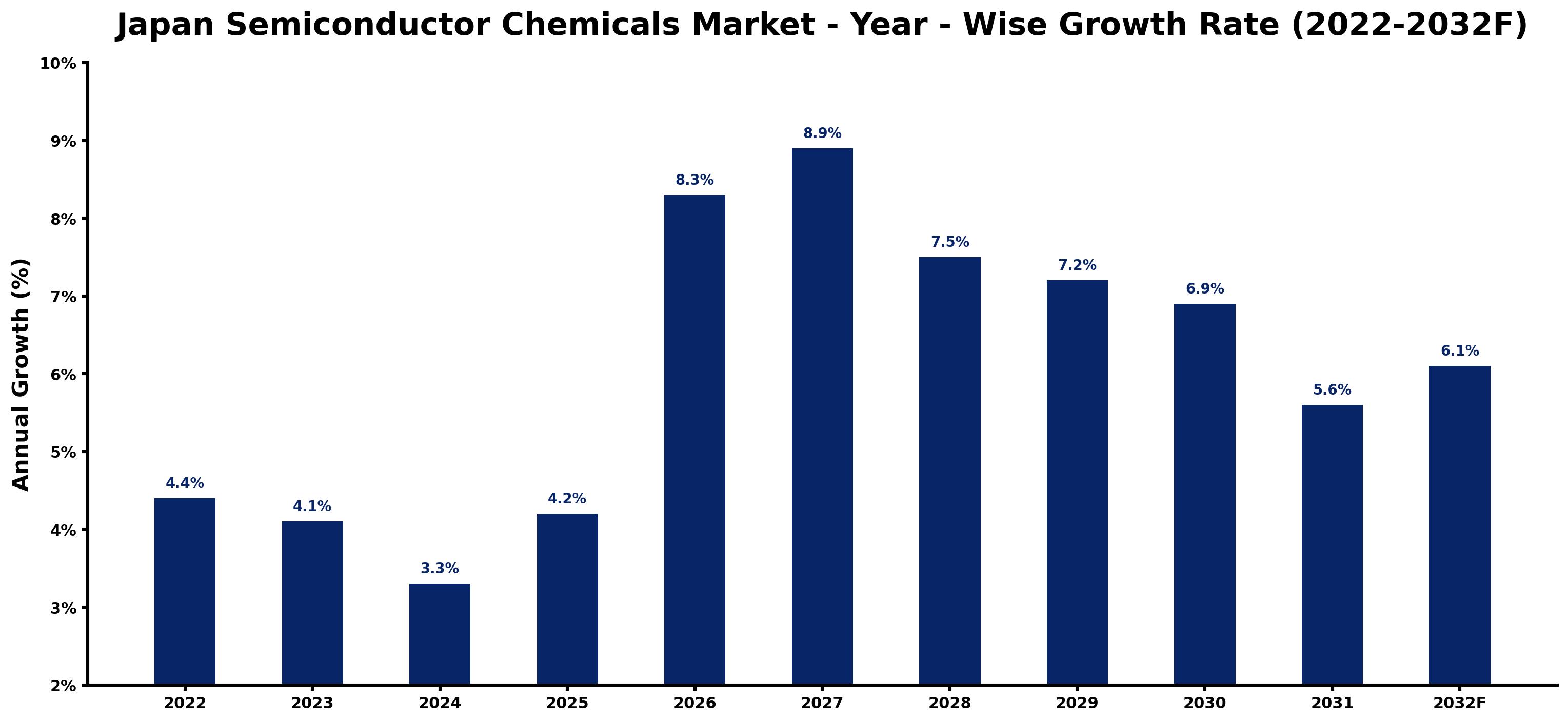
Annual growth estimates for each year appear below with the principal reason behind them, explaining the shifts that set the pace of the market.
| Year | Estimated Annual Growth (%) | Market Rationale |
| 2022 | 4.4 | The market showed strong activity, driven by domestic demand and exports. |
| 2023 | 4.1 | Growth slowed slightly due to market adjustments and increased competition. |
| 2024 | 3.3 | Market expansion continued but at a slower pace as firms consolidated operations. |
| 2025 | 4.2 | Demand increased as semiconductor manufacturers ramped up production capabilities. |
| 2026 | 8.3 | Growth is expected to accelerate with rising investments in advanced semiconductor technologies. |
| 2027 | 8.9 | The market is projected to peak as demand surges for high-performance semiconductor applications. |
| 2028 | 7.5 | Growth is anticipated to slow as the market stabilises following the peak demand period. |
| 2029 | 7.2 | The market will continue to grow, albeit at a reduced pace compared to previous years. |
| 2030 | 6.9 | Demand growth is expected to moderate as manufacturers adjust to market conditions. |
| 2031 | 5.6 | The market will maintain growth, driven by steady investments in technology. |
| 2032 | 6.1 | Growth is projected to pick up again as new semiconductor projects come online. |
Note: Market size estimations and growth projections presented in this report are based on 6Wresearch's proprietary forecasting methodology, utilizing the latest available industry data, government publications, and primary research inputs.
Japan Semiconductor Chemicals Market Synopsis
Semiconductor chemicals are essential materials for fabricating semiconductor devices, produced through complex chemical processes with high-purity standards. The Japan Semiconductor Chemicals Market is expanding due to increasing domestic demand and substantial investments in production capabilities. The government has initiated a ¥200 billion programme to support local semiconductor production, while the Semiconductor Industry Association of Japan promotes industry standards.
Market Dynamics Impact Analysis (2026–2032)
| Factor | Type | Impact | Primary Segment Affected |
| Rising investments in semiconductor manufacturing capacity | Driver | High | Etching Process |
| Growing demand for advanced semiconductor devices | Driver | High | Dopants |
| Increasing need for high-purity chemicals | Opportunity | High | Ultra-High Purity |
| Expansion of semiconductor fabs in key regions | Opportunity | High | Fab Facilities |
| High production costs for semiconductor chemicals | Restraint | Medium | Cleaning Agents |
| Stringent quality control requirements | Restraint | Medium | Photoresists |
| Limited availability of skilled workforce | Challenge | High | Chip Foundries |
| Compliance with environmental regulations | Challenge | Medium | Dopants |
Evaluation of Drivers in Japan Semiconductor Chemicals Market (2026–2032)
Key forces behind demand, with the segment each one moves most, are listed below.
| Drivers | Primary Segment Affected | Why It Matters (Evidence) |
| Increased production capacity in semiconductor fabs | Etching Process | This expansion leads to higher demand for etching chemicals used in device fabrication. |
| Technological advancements in semiconductor devices | Dopants | These advancements necessitate the use of specialized dopants to modify electrical properties, with the market for dopants projected to grow significantly. |
| Rising consumer electronics demand | Photoresists | The growth in electronics drives the need for high-resolution lithography processes, increasing the consumption of photoresists in fabrication. |
| Investment in local semiconductor manufacturing | Cleaning Agents | Local production initiatives increase the demand for cleaning agents used in over 90% of fabrication processes, enhancing operational efficiency. |
| Emerging technologies in semiconductor applications | Ultra-High Purity | These technologies require ultra-high purity chemicals to ensure optimal performance, with Japan producing chemicals exceeding 99.9999% purity. |
Most of the extra volume comes from increased production capacity in semiconductor fabs, which raises demand for etching chemicals essential for device fabrication. In 2023, Japan had over 100 operational semiconductor fabs, creating a substantial market for dopants that modify electrical properties. The rising consumer electronics demand, projected to grow steadily, drives the need for high-resolution lithography processes, increasing the consumption of photoresists. Advanced technologies in semiconductor applications are also driving the need for ultra-high purity chemicals, ensuring optimal performance in sophisticated devices.
Evaluation of Restraints in Japan Semiconductor Chemicals Market
These are the pressures that could keep growth below its potential.
| Market Restraint | Primary Segment Affected | Why It Matters (Evidence) |
| High production costs for semiconductor chemicals | Cleaning Agents | The costs limit the ability of manufacturers to offer competitive pricing in the market. |
| Stringent quality control requirements | Photoresists | These requirements increase operational costs and complicate the manufacturing process. |
| Limited availability of skilled workforce | Chip Foundries | The shortage of skilled workers affects production efficiency and capacity expansion. |
| Compliance with environmental regulations | Dopants | Adhering to regulations increases operational costs and complicates production processes. |
| Market saturation in certain chemical segments | Etching Process | Saturation limits growth opportunities and puts pressure on pricing strategies. |
Japan Semiconductor Chemicals Market Challenges
Delays in sourcing high-purity raw materials hinder producers, as stringent quality controls limit supplier options, increasing lead times for buyers by up to three months. Buyers are facing rising costs due to Japan's ambitious decarbonisation targets, which inflate semiconductor chemical prices by approximately 20%. Supply chain disruptions arise from the concentration of semiconductor fabs in Tokyo and Osaka, complicating demand fluctuations for suppliers and risking production halts. Technology adoption lags, with many facilities not yet implementing ISO 9001 standards, leading to inconsistent product quality and dissatisfaction among buyers.
Trends in the Japan Semiconductor Chemicals Market
The following changes are redrawing the Japan Semiconductor Chemicals Market.
- Shift from Traditional to Advanced Semiconductor Manufacturing: In 2023, Japan's semiconductor industry is moving towards advanced manufacturing techniques, particularly in fab facilities. This transition is driven by the need for higher efficiency and precision, with investments exceeding ¥150 trillion over the next decade.
- Emergence of Ultra-High Purity Chemicals: The demand for ultra-high purity chemicals is rising as semiconductor manufacturers aim for improved performance. In 2023, the market for these chemicals is projected to grow, reflecting the industry's focus on quality.
- Increased Focus on Environmental Sustainability: As of 2023, semiconductor manufacturers are prioritising environmentally sustainable practices, responding to Japan's target for a 46% cut in greenhouse gas emissions by 2030. This shift is influencing procurement strategies across the industry.
- Expansion of Semiconductor Fabs in Key Regions: Since 2023, there has been a notable increase in semiconductor fabs in Tokyo and Osaka, which are becoming critical hubs for production. This expansion is expected to drive demand for various semiconductor chemicals.
Investment Opportunities in the Japan Semiconductor Chemicals Market
The following opportunities in the Japan Semiconductor Chemicals Market pair current demand with a clear way in.
- Investment Gap in Semiconductor Chemicals: With Japan's semiconductor chemicals market valued at ¥1 trillion, there is a gap for investment in high-purity chemicals. Fab facilities are seeking reliable suppliers to meet quality standards.
- Growing Demand from Fab Facilities: Fab facilities are increasingly looking for suppliers of cleaning agents, especially as production ramps up. This demand presents an opportunity for new entrants to establish partnerships.
- Timing for Advanced Semiconductor Manufacturing: Now is an opportune time to invest in advanced semiconductor manufacturing technologies, as the market is set to grow. Collaboration with local research institutes can facilitate entry.
- Entry through Joint Ventures: Establishing joint ventures with local manufacturers can provide access to the growing semiconductor chemicals market, particularly in regions like Tokyo and Osaka, where demand is increasing.
Government Initiatives in the Japan Semiconductor Chemicals Market
The Economic Security Promotion Act (2022) supports supply-chain resilience for critical products, adding to existing laws like the Chemical Substances Control Law. This measure mandates stricter evaluations of chemical substances, ensuring safety and compliance in semiconductor chemical production, which benefits manufacturers by improving their operational standards. In 2023, the government allocated ¥200 billion to support semiconductor manufacturing, further boosting the industry’s competitiveness.
The Ministry of Economy, Trade and Industry oversees semiconductor policies, approving initiatives that fund local production capabilities. This funding is essential for enhancing the infrastructure needed for semiconductor chemicals, ensuring that local manufacturers can meet rising demand.
Future Insight of the Japan Semiconductor Chemicals Market
Japan's commitment to a 46% reduction in greenhouse-gas emissions by 2030 will drive investments in cleaner production technologies, benefiting suppliers who adapt early. The government initiative to enhance semiconductor capabilities will increase local supply for buyers. By 2032, advancements in semiconductor manufacturing processes will enable the production of more efficient devices, stimulating market growth. Collaborations with leading research institutes will drive innovation, ensuring Japan maintains its competitive edge in the global semiconductor chemicals market.
Market Segmentation Analysis
Japan Semiconductor Chemicals Market report covers a detailed analysis of the following market segments:
By Chemical Type – Etchants Lead, Dopants Expected to Grow Fastest
According to Saurav Kr Singh, Senior Research Analyst at 6Wresearch, Etchants accounted for 44% of the market by chemical type in 2025. Etchants hold the largest share in the market because they are essential for patterning semiconductor materials, a crucial aspect of the fabrication process. Their extensive use in over 90% of semiconductor fabrication processes in Japan highlights their indispensable role in the industry. The quickest growth will come from Dopants, forecast to expand at a CAGR of 9.6% between 2026 and 2032. Dopants are experiencing rapid growth due to their critical role in modifying the electrical properties of semiconductors, which is vital for the production of advanced devices. The increasing demand for high-performance electronics is driving this segment's swift expansion. Suppliers should focus on enhancing their dopant product lines to capitalise on the growing demand in this segment.
By Process Stage – Etching Process Leads, Doping/Implantation Expected to Grow Fastest
Etching Process took 46% of process stage revenue in 2025, more than any other category. The etching process leads the market as it is a fundamental step in semiconductor device fabrication, necessary for creating intricate patterns on silicon wafers. This process is employed in over 100 operational semiconductor fabs across Japan, underscoring its widespread use. Over 2026–2032, Doping/Implantation is expected to post the fastest growth, at a CAGR of 9.8%. Doping/implantation is the fastest-growing segment because it is integral for creating p-n junctions in semiconductors, essential for modern electronic devices. The increasing complexity of semiconductor designs is propelling this process stage's growth. Buyers should prioritise sourcing advanced doping chemicals to meet the demands of contemporary semiconductor manufacturing.
By Purity Level – Ultra-High Purity Leads, 99.9999%+ Expected to Grow Fastest
Ultra-High Purity held 43% of the Japan Semiconductor Chemicals Market by purity level in 2025. Ultra-high purity chemicals dominate the market as they are required for high-performance semiconductor applications, ensuring optimal device functionality. The stringent quality standards in Japan's semiconductor industry necessitate the use of these high-purity materials. 99.9999%+ is projected to grow fastest, at a CAGR of 9.4% during 2026–2032. The 99.9999%+ purity level is growing rapidly as it ensures minimal contamination in semiconductor processes, which is critical for the production of advanced devices. The push for smaller technology nodes is driving the demand for these ultra-pure chemicals. Suppliers must invest in refining their production processes to meet the increasing demand for higher purity levels.
By End User – Fab Facilities Lead, Chip Foundries Expected to Grow Fastest
The largest end user category in 2025 was Fab Facilities, at 55% of revenue. Fab facilities are the primary consumers of semiconductor chemicals, as they are directly involved in the fabrication of semiconductor devices. With over 100 operational semiconductor fabs in Japan, the demand from these facilities remains substantial. Chip Foundries are set to record the highest CAGR in this split, 9.3% over 2026–2032. Chip foundries represent the fastest-growing segment, as they manufacture semiconductor chips using these chemicals, propelled by the rising demand for chips in various electronic applications. The overall growth in the electronics market is significantly boosting this segment's development. Suppliers must adapt their offerings to meet the unique requirements of chip foundries to effectively seize market opportunities.
Key Attractiveness of the Report
- 10 Years of Market Numbers
- Historical Data Starting from 2022 to 2025
- Base Year 2025
- Forecast Data until 2032
- Key Performance Indicators Impacting the Market
- Major Upcoming Developments and Projects
Key Highlights of the Report:
- Japan Semiconductor Chemicals Market Outlook
- Market Size of Japan Semiconductor Chemicals Market, 2025
- Forecast of Japan Semiconductor Chemicals Market, 2032
- Historical Data and Forecast of Japan Semiconductor Chemicals Revenues & Volume for the Period 2022-2032F
- Japan Semiconductor Chemicals Market Trend Evolution
- Japan Semiconductor Chemicals Market Drivers and Challenges
- Japan Semiconductor Chemicals Price Trends
- Japan Semiconductor Chemicals Porter's Five Forces
- Japan Semiconductor Chemicals Industry Life Cycle
- Historical Data and Forecast of Japan Semiconductor Chemicals Market Revenues & Volume By Chemical Type for the Period 2022-2032F
- Historical Data and Forecast of Japan Semiconductor Chemicals Market Revenues & Volume By Etchants for the Period 2022-2032F
- Historical Data and Forecast of Japan Semiconductor Chemicals Market Revenues & Volume By Dopants for the Period 2022-2032F
- Historical Data and Forecast of Japan Semiconductor Chemicals Market Revenues & Volume By Photoresists for the Period 2022-2032F
- Historical Data and Forecast of Japan Semiconductor Chemicals Market Revenues & Volume By Cleaning Agents for the Period 2022-2032F
- Historical Data and Forecast of Japan Semiconductor Chemicals Market Revenues & Volume By Process Stage for the Period 2022-2032F
- Historical Data and Forecast of Japan Semiconductor Chemicals Market Revenues & Volume By Etching Process for the Period 2022-2032F
- Historical Data and Forecast of Japan Semiconductor Chemicals Market Revenues & Volume By Doping/Implantation for the Period 2022-2032F
- Historical Data and Forecast of Japan Semiconductor Chemicals Market Revenues & Volume By Lithography for the Period 2022-2032F
- Historical Data and Forecast of Japan Semiconductor Chemicals Market Revenues & Volume By Wet Process for the Period 2022-2032F
- Historical Data and Forecast of Japan Semiconductor Chemicals Market Revenues & Volume By Purity Level for the Period 2022-2032F
- Historical Data and Forecast of Japan Semiconductor Chemicals Market Revenues & Volume By Ultra-High Purity for the Period 2022-2032F
- Historical Data and Forecast of Japan Semiconductor Chemicals Market Revenues & Volume By 99.9999%+ for the Period 2022-2032F
- Historical Data and Forecast of Japan Semiconductor Chemicals Market Revenues & Volume By Advanced Resist Grade for the Period 2022-2032F
- Historical Data and Forecast of Japan Semiconductor Chemicals Market Revenues & Volume By Ultra-Low Metal for the Period 2022-2032F
- Historical Data and Forecast of Japan Semiconductor Chemicals Market Revenues & Volume By End User for the Period 2022-2032F
- Historical Data and Forecast of Japan Semiconductor Chemicals Market Revenues & Volume By Fab Facilities for the Period 2022-2032F
- Historical Data and Forecast of Japan Semiconductor Chemicals Market Revenues & Volume By Chip Foundries for the Period 2022-2032F
- Historical Data and Forecast of Japan Semiconductor Chemicals Market Revenues & Volume By Wafer Manufacturers for the Period 2022-2032F
- Historical Data and Forecast of Japan Semiconductor Chemicals Market Revenues & Volume By Semiconductor Fabs for the Period 2022-2032F
- Japan Semiconductor Chemicals Import Export Trade Statistics
- Market Opportunity Assessment By Chemical Type
- Market Opportunity Assessment By Process Stage
- Market Opportunity Assessment By Purity Level
- Market Opportunity Assessment By End User
- Japan Semiconductor Chemicals Top Companies Market Share
- Japan Semiconductor Chemicals Competitive Benchmarking By Technical and Operational Parameters
- Japan Semiconductor Chemicals Company Profiles
- Japan Semiconductor Chemicals Key Strategic Recommendations
Market Covered
The following segment groups are covered in the report.
By Chemical Type
- Etchants
- Dopants
- Photoresists
- Cleaning Agents
By Process Stage
- Etching Process
- Doping/Implantation
- Lithography
- Wet Process
By Purity Level
- Ultra-High Purity
- 99.9999%+
- Advanced Resist Grade
- Ultra-Low Metal
By End User
- Fab Facilities
- Chip Foundries
- Wafer Manufacturers
- Semiconductor Fabs































