Japan Semiconductor Components for Vehicles Market Size & Growth Rate
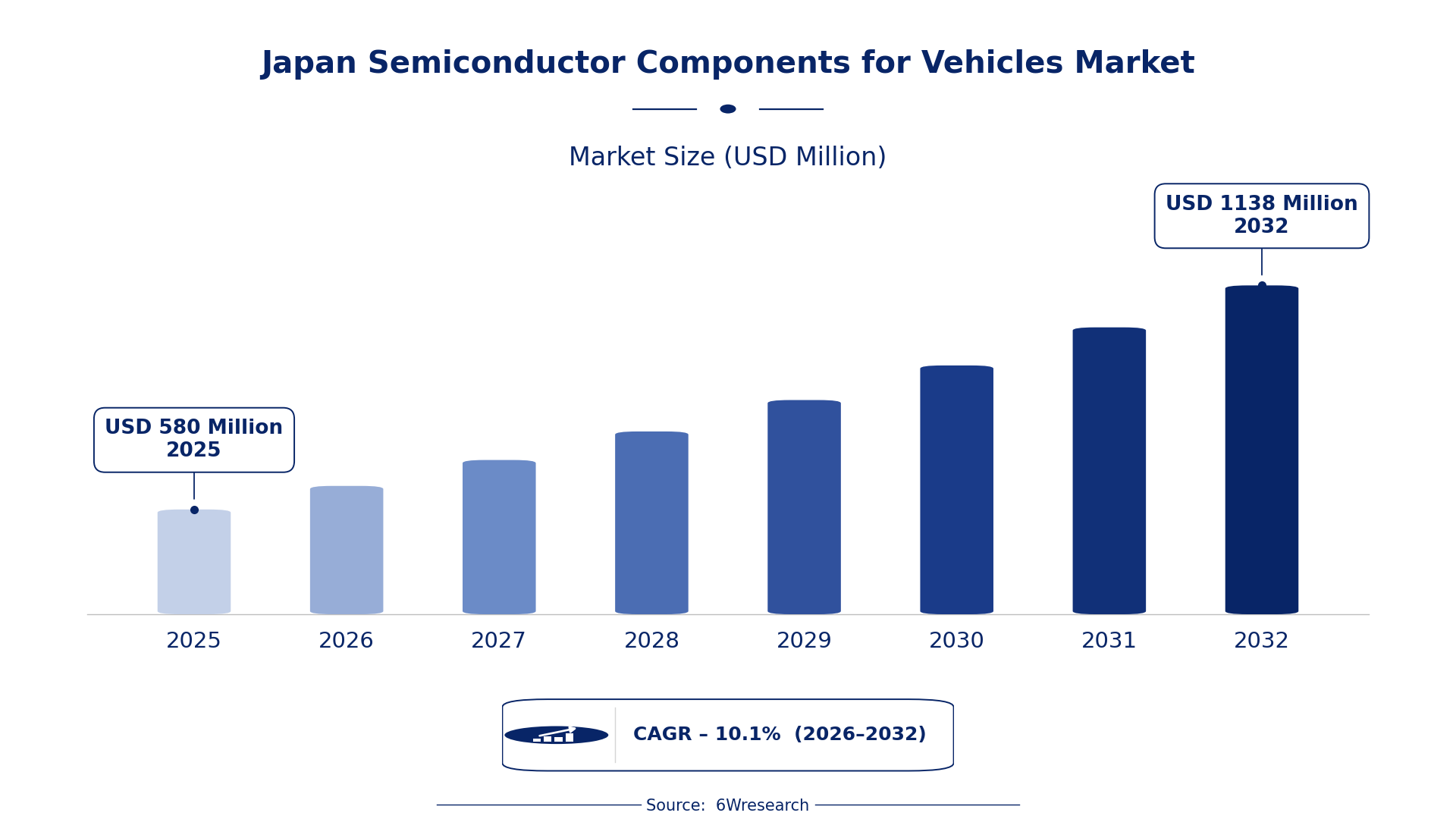
According to 6Wresearch internal database and industry insights, the Japan Semiconductor Components for Vehicles Market was valued at USD 580 Million in 2025 and is projected to reach USD 1,138 Million by 2032, growing at a CAGR of approximately 10.1% during 2026–2032.
Japan Semiconductor Components for Vehicles Market Highlights
| Report Metric | Details |
| Report Name | Japan Semiconductor Components for Vehicles Market (2026-2032) |
| Market Size 2025 | USD 580 Million |
| Market Size 2032 | USD 1,138 Million |
| Absolute Growth 2025–2032 | USD 558 Million |
| CAGR 2026–2032 | 10.1% |
| Peak Annual Growth | 11.4% in 2032 |
| Forecast Period | 2026–2032 |
| Historical Data | 2022–2025 |
| Base Year | 2025 |
| Leading Component Type, 2025 | Power ICs (34% share) |
| Leading Vehicle System, 2025 | EV Powertrain (52% share) |
| Leading Functionality, 2025 | Battery Management (35% share) |
| Leading End User, 2025 | Electric Vehicle Makers (47% share) |
| Fastest-Growing Component Type | Sensors (14.3% CAGR) |
| Fastest-Growing Vehicle System | ADAS (14.2% CAGR) |
| Fastest-Growing Functionality | Object Detection (13.7% CAGR) |
| Fastest-Growing End User | Automotive OEMs (13.1% CAGR) |
| Growing Sector | Electric Vehicles |
| Key End Users | Electric Vehicle Makers, Automotive OEMs, Telematics Providers |
Japan Semiconductor Components for Vehicles Market Year-wise Growth Rate and Key Drivers (2022–2032)
This graph illustrates the annual growth rates of the market from 2022 to 2032, highlighting a steady upward trajectory and projected market expansion over the forecast period.
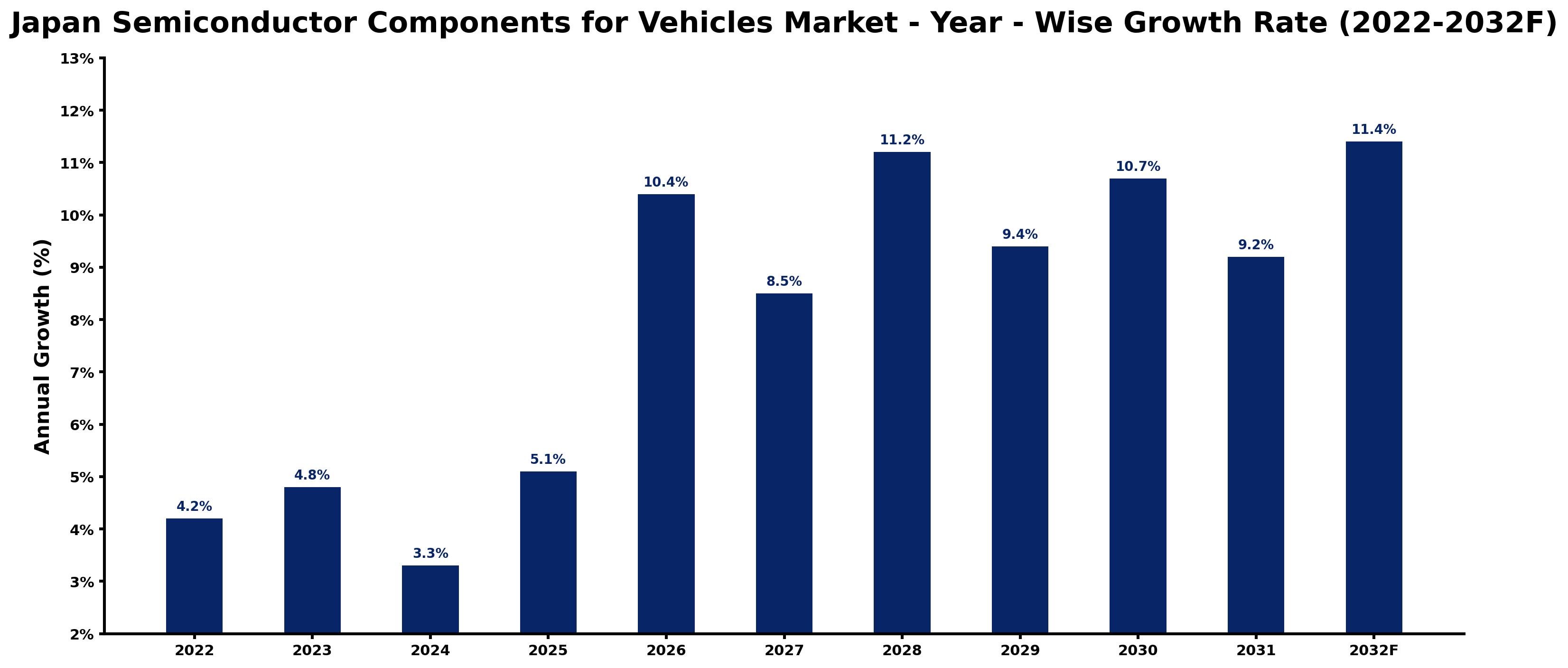
The yearly estimates that follow link every growth rate to its principal driver, so readers can see why the pace changed in each period.
| Year | Estimated Annual Growth (%) | Market Rationale |
| 2022 | 4.2 | Demand from electric vehicle makers supported growth in semiconductor components. |
| 2023 | 4.8 | A 10% increase in semiconductor demand from the automotive sector drove faster growth. |
| 2024 | 3.3 | Growth slowed due to market adjustments following the previous year's surge. |
| 2025 | 5.1 | The automotive sector's investment in semiconductor technology spurred growth. |
| 2026 | 10.4 | A surge in electric vehicle production is expected to drive demand. |
| 2027 | 8.5 | Growth slows as the market stabilises after rapid expansion in previous years. |
| 2028 | 11.2 | Increased adoption of ADAS technologies is projected to boost demand for semiconductor components. |
| 2029 | 9.4 | Growth slows as the market adjusts to new production capacities. |
| 2030 | 10.7 | Continued investments in battery management systems will sustain demand. |
| 2031 | 9.2 | Demand remains strong as electric vehicle adoption continues to rise. |
| 2032 | 11.4 | The market peaks as technology innovations drive further adoption of semiconductors. |
Note: Market size estimations and growth projections presented in this report are based on 6Wresearch's proprietary forecasting methodology, utilizing the latest available industry data, government publications, and primary research inputs.
Japan Semiconductor Components for Vehicles Market Synopsis
Semiconductor components for vehicles are electronic devices that control and manage vehicle functions, crucial for performance, safety, and connectivity. The Japan Semiconductor Components for Vehicles Market is growing due to rising demand from domestic electric vehicle makers and automotive OEMs, alongside expected investments in semiconductor technology reaching $1 billion by 2025. This expansion is driven by increased electric vehicle production and the adoption of advanced driver-assistance systems, which require sophisticated semiconductor solutions.
Market Dynamics Impact Analysis (2026–2032)
| Factor | Type | Impact | Primary Segment Affected |
| Rising electric vehicle production | Driver | High | EV Powertrain |
| Increased adoption of advanced driver-assistance systems | Driver | High | ADAS |
| Growing demand for electric vehicles | Opportunity | High | Electric Vehicle Makers |
| Investment in semiconductor technology | Opportunity | High | Automotive OEMs |
| Supply chain disruptions | Restraint | High | Microcontrollers |
| High production costs for semiconductor components | Restraint | Medium | Power ICs |
| Limited domestic semiconductor manufacturing capacity | Challenge | High | Sensors |
| Intense competition in the semiconductor market | Challenge | Medium | Memory Chips |
Evaluation of Drivers in Japan Semiconductor Components for Vehicles Market (2026–2032)
The main growth drivers and the segments they affect most are set out below.
| Drivers | Primary Segment Affected | Why It Matters (Evidence) |
| Increased electric vehicle production | EV Powertrain | The installed base of electric vehicles reached 1.5 million in 2022, driving demand for semiconductor components. |
| High adoption of ADAS technologies | ADAS | ADAS technologies are integrated into 70% of new vehicles, increasing the need for semiconductor components. |
| Growing battery management system requirements | Battery Management | Battery management systems are critical for the 600,000 electric vehicles sold in 2022, boosting semiconductor demand. |
| Investment in technology by automotive OEMs | Microcontrollers | The automotive sector is expected to invest $1 billion in semiconductor technology by 2025, improving production capabilities. |
| Expansion of semiconductor development in Tokyo | Sensors | The Tokyo region is a hub for automotive semiconductor development, attracting investments and innovation. |
Several shifts outside the market boost sales. The installed base of electric vehicles reached 1.5 million in 2022, creating strong demand for semiconductor components. In 2023, the automotive sector reported a 10% increase in semiconductor demand, driven by the integration of advanced technologies in new vehicles. The automotive sector is projected to invest $1 billion in semiconductor technology by 2025, further stimulating demand. The focus on semiconductor development in Tokyo is attracting more investments, improving local production capabilities.
Evaluation of Restraints in Japan Semiconductor Components for Vehicles Market
The table below lists the restraints and the evidence behind each.
| Market Restraint | Primary Segment Affected | Why It Matters (Evidence) |
| Supply chain disruptions affecting production | Microcontrollers | Disruptions in the supply chain have led to delays in production schedules, impacting automotive OEMs' ability to meet demand. |
| High production costs for semiconductor components | Power ICs | Rising costs of raw materials have increased production expenses, limiting profit margins for manufacturers. |
| Limited domestic manufacturing capacity | Sensors | Japan's semiconductor manufacturing capacity is insufficient to meet the growing demand from the automotive sector. |
| Regulatory hurdles in semiconductor production | Memory Chips | Strict regulations can delay product approvals, affecting the time-to-market for new semiconductor technologies. |
| Competition from international semiconductor manufacturers | ADAS | Intense competition from global players can pressure local manufacturers to lower prices, impacting profitability. |
Japan Semiconductor Components for Vehicles Market Challenges
Buyers of semiconductor components for vehicles face supply chain disruptions caused by global shortages, delaying production timelines by up to six months for automotive OEMs. A shortage of skilled workers in advanced fabrication techniques limits manufacturers' ability to meet demand, potentially leading to revenue losses of approximately $200 million annually for local firms. Regulatory requirements under the JIS X 0212 standard complicate product development, resulting in additional delays of up to three months for new launches. Rising raw material costs, driven by increased electric vehicle production, have led to price hikes of around 15% for automotive buyers.
Trends in the Japan Semiconductor Components for Vehicles Market
Below are the shifts with the largest effect on the Japan Semiconductor Components for Vehicles Market.
- Tokyo Emerging as a Semiconductor Development Hub: The Tokyo region is becoming a key centre for automotive semiconductor development, with investments increasing by 10% in 2023, reflecting its growing importance.
- Shift Towards Advanced Driver-Assistance Systems: The integration of ADAS technologies in vehicles is increasing, with 70% of new vehicles featuring these systems. This trend is driving demand for semiconductor components, particularly in safety applications.
- Transition from Traditional to Electric Vehicles: The automotive sector is rapidly transitioning to electric vehicles, with 1.5 million EVs on the road as of 2022. This shift is creating a surge in demand for semiconductor components, particularly in power management.
- Growing Importance of Battery Management Systems: Battery management systems are becoming critical for electric vehicle efficiency, with 600,000 EVs sold in 2022. This trend is boosting demand for semiconductor components that support battery technology.
Investment Opportunities in the Japan Semiconductor Components for Vehicles Market
The following areas offer the clearest openings for investors and suppliers in the Japan Semiconductor Components for Vehicles Market.
- Investment Gap in Semiconductor Technology: With the automotive sector expected to invest $1 billion in semiconductor technology by 2025, there is an opportunity for suppliers to provide advanced components.
- Joint Ventures for Semiconductor Production: Establishing joint ventures with local manufacturers can facilitate entry into the semiconductor market, especially for automotive OEMs seeking to improve production capabilities.
- Supply of Advanced Power Management ICs: The increasing production of electric vehicles creates a demand for advanced power management ICs, particularly from electric vehicle makers looking to improve efficiency.
- Expansion of Charging Infrastructure: The growth of electric vehicle charging stations, which exceeded 30,000 in 2023, presents opportunities for suppliers of semiconductor components used in charging technology.
Government Initiatives in the Japan Semiconductor Components for Vehicles Market
The Semiconductor and Digital Industry Strategy, introduced by the Ministry of Economy, Trade and Industry in June 2021, aims to secure domestic semiconductor manufacturing. This strategy is vital for ensuring a stable supply of semiconductor components for the automotive sector. The Economic Security Promotion Act of 2022 supports supply-chain resilience for critical products, which helps maintain the flow of semiconductor components necessary for vehicle production.
Various schemes overseen by the Ministry of Economy, Trade and Industry support semiconductor production. For instance, funding initiatives under the Battery Industry Strategy aim to boost domestic battery manufacturing capacity significantly by 2030, benefiting electric vehicle makers and strengthening the semiconductor supply chain.
Future Insight of the Japan Semiconductor Components for Vehicles Market
Emerging technologies will significantly alter demand for semiconductor components, especially with the integration of smart systems in vehicles. The Japanese government's programme supporting EV technology innovation will improve production capabilities, contributing to the 1.5 million electric vehicles already on the road. Investment in semiconductor technology is set to reach $1 billion by 2025, boosting efficiency for suppliers. Adoption of ISO/IEC standards will streamline compliance, facilitating faster market entry for new products.
Market Segmentation Analysis
Japan Semiconductor Components for Vehicles Market report covers a detailed analysis of the following market segments:
By Component Type – Power ICs Lead, Sensors Expected to Grow Fastest
According to Prakhar Dixit, Senior Research Analyst at 6Wresearch, in 2025, Power ICs led the component type split with a 34% share. Power ICs lead the market because they are essential for power management in various vehicle types. Their critical role in the growing electric vehicle segment, particularly among local manufacturers, reinforces their dominant position. The quickest growth will come from Sensors, forecast to expand at a CAGR of 14.3% between 2026 and 2032. The surge in sensor adoption is propelled by the increasing focus on safety and automation features in vehicles, with ADAS technologies now standard in 70% of new models. This trend will continue as the market shifts towards more electric vehicles. Suppliers should invest in advanced sensor technologies to cater to the heightened demand for safety and automation in vehicles.
By Vehicle System – EV Powertrain Leads, ADAS Expected to Grow Fastest
EV Powertrain accounted for 52% of the market by vehicle system in 2025. The EV Powertrain leads the segment as it is central to the operation of electric vehicles, which are gaining traction among consumers in Japan. The installed base of 1.5 million electric vehicles highlights the growing reliance on this system. Over 2026–2032, ADAS is expected to post the fastest growth, at a CAGR of 14.2%. ADAS is experiencing the fastest growth due to the increasing integration of advanced safety features in new vehicles, with 70% of them now incorporating such technologies. This trend is likely to continue as consumer safety expectations rise. Automotive OEMs must invest in ADAS technologies to remain competitive and meet regulatory standards.
By Functionality – Battery Management Leads, Object Detection Expected to Grow Fastest
Battery Management took 35% of functionality revenue in 2025, more than any other category. Battery Management systems hold the largest share due to their essential role in optimising electric vehicle performance and efficiency. With 1.5 million electric vehicles in Japan as of 2022, the demand for these systems is substantial. Object Detection is projected to grow fastest, at a CAGR of 13.7% during 2026–2032. Object Detection technology is experiencing rapid growth as it enhances vehicle safety through real-time analysis of surroundings. The integration of this technology into 70% of new vehicles indicates a strong upward trend in demand. Suppliers should prioritise the development of Object Detection technologies to align with safety regulations and consumer expectations.
By End User – Electric Vehicle Makers Lead, Automotive OEMs Expected to Grow Fastest
Electric Vehicle Makers held 47% of the Japan Semiconductor Components for Vehicles Market by end user in 2025. Electric Vehicle Makers represent the largest segment of buyers for semiconductor components, as they directly utilise these technologies in their vehicle designs. The production of 600,000 electric vehicles in 2022 exemplifies their critical role in the semiconductor market. Automotive OEMs are set to record the highest CAGR in this split, 13.1% over 2026–2032. Automotive OEMs are the fastest-growing user group, driven by the necessity to innovate and comply with evolving market regulations. Their commitment to investing in semiconductor technology will further accelerate growth in this segment. Suppliers need to tailor their products to meet the specific requirements of Automotive OEMs to capitalise on emerging opportunities.
Key Attractiveness of the Report
- 10 Years of Market Numbers
- Historical Data Starting from 2022 to 2025
- Base Year 2025
- Forecast Data until 2032
- Key Performance Indicators Impacting the Market
- Major Upcoming Developments and Projects
Key Highlights of the Report:
- Japan Semiconductor Components for Vehicles Market Outlook
- Market Size of Japan Semiconductor Components for Vehicles Market, 2025
- Forecast of Japan Semiconductor Components for Vehicles Market, 2032
- Historical Data and Forecast of Japan Semiconductor Components for Vehicles Revenues & Volume for the Period 2022-2032F
- Japan Semiconductor Components for Vehicles Market Trend Evolution
- Japan Semiconductor Components for Vehicles Market Drivers and Challenges
- Japan Semiconductor Components for Vehicles Price Trends
- Japan Semiconductor Components for Vehicles Porter's Five Forces
- Japan Semiconductor Components for Vehicles Industry Life Cycle
- Historical Data and Forecast of Japan Semiconductor Components for Vehicles Market Revenues & Volume By Component Type for the Period 2022-2032F
- Historical Data and Forecast of Japan Semiconductor Components for Vehicles Market Revenues & Volume By Power ICs for the Period 2022-2032F
- Historical Data and Forecast of Japan Semiconductor Components for Vehicles Market Revenues & Volume By Sensors for the Period 2022-2032F
- Historical Data and Forecast of Japan Semiconductor Components for Vehicles Market Revenues & Volume By Microcontrollers for the Period 2022-2032F
- Historical Data and Forecast of Japan Semiconductor Components for Vehicles Market Revenues & Volume By Memory Chips for the Period 2022-2032F
- Historical Data and Forecast of Japan Semiconductor Components for Vehicles Market Revenues & Volume By Vehicle System for the Period 2022-2032F
- Historical Data and Forecast of Japan Semiconductor Components for Vehicles Market Revenues & Volume By EV Powertrain for the Period 2022-2032F
- Historical Data and Forecast of Japan Semiconductor Components for Vehicles Market Revenues & Volume By ADAS for the Period 2022-2032F
- Historical Data and Forecast of Japan Semiconductor Components for Vehicles Market Revenues & Volume By Infotainment for the Period 2022-2032F
- Historical Data and Forecast of Japan Semiconductor Components for Vehicles Market Revenues & Volume By Navigation Systems for the Period 2022-2032F
- Historical Data and Forecast of Japan Semiconductor Components for Vehicles Market Revenues & Volume By Functionality for the Period 2022-2032F
- Historical Data and Forecast of Japan Semiconductor Components for Vehicles Market Revenues & Volume By Battery Management for the Period 2022-2032F
- Historical Data and Forecast of Japan Semiconductor Components for Vehicles Market Revenues & Volume By Object Detection for the Period 2022-2032F
- Historical Data and Forecast of Japan Semiconductor Components for Vehicles Market Revenues & Volume By Data Processing for the Period 2022-2032F
- Historical Data and Forecast of Japan Semiconductor Components for Vehicles Market Revenues & Volume By Data Storage for the Period 2022-2032F
- Historical Data and Forecast of Japan Semiconductor Components for Vehicles Market Revenues & Volume By End User for the Period 2022-2032F
- Historical Data and Forecast of Japan Semiconductor Components for Vehicles Market Revenues & Volume By Electric Vehicle Makers for the Period 2022-2032F
- Historical Data and Forecast of Japan Semiconductor Components for Vehicles Market Revenues & Volume By Automotive OEMs for the Period 2022-2032F
- Historical Data and Forecast of Japan Semiconductor Components for Vehicles Market Revenues & Volume By Telematics Providers for the Period 2022-2032F
- Historical Data and Forecast of Japan Semiconductor Components for Vehicles Market Revenues & Volume By Auto Component Suppliers for the Period 2022-2032F
- Japan Semiconductor Components for Vehicles Import Export Trade Statistics
- Market Opportunity Assessment By Component Type
- Market Opportunity Assessment By Vehicle System
- Market Opportunity Assessment By Functionality
- Market Opportunity Assessment By End User
- Japan Semiconductor Components for Vehicles Top Companies Market Share
- Japan Semiconductor Components for Vehicles Competitive Benchmarking By Technical and Operational Parameters
- Japan Semiconductor Components for Vehicles Company Profiles
- Japan Semiconductor Components for Vehicles Key Strategic Recommendations
Market Covered
This report examines the market across the segments below.
By Component Type
- Power ICs
- Sensors
- Microcontrollers
- Memory Chips
By Vehicle System
- EV Powertrain
- ADAS
- Infotainment
- Navigation Systems
By Functionality
- Battery Management
- Object Detection
- Data Processing
- Data Storage
By End User
- Electric Vehicle Makers
- Automotive OEMs
- Telematics Providers
- Auto Component Suppliers































