Japan Semiconductor Dopant Market Size & Growth Rate
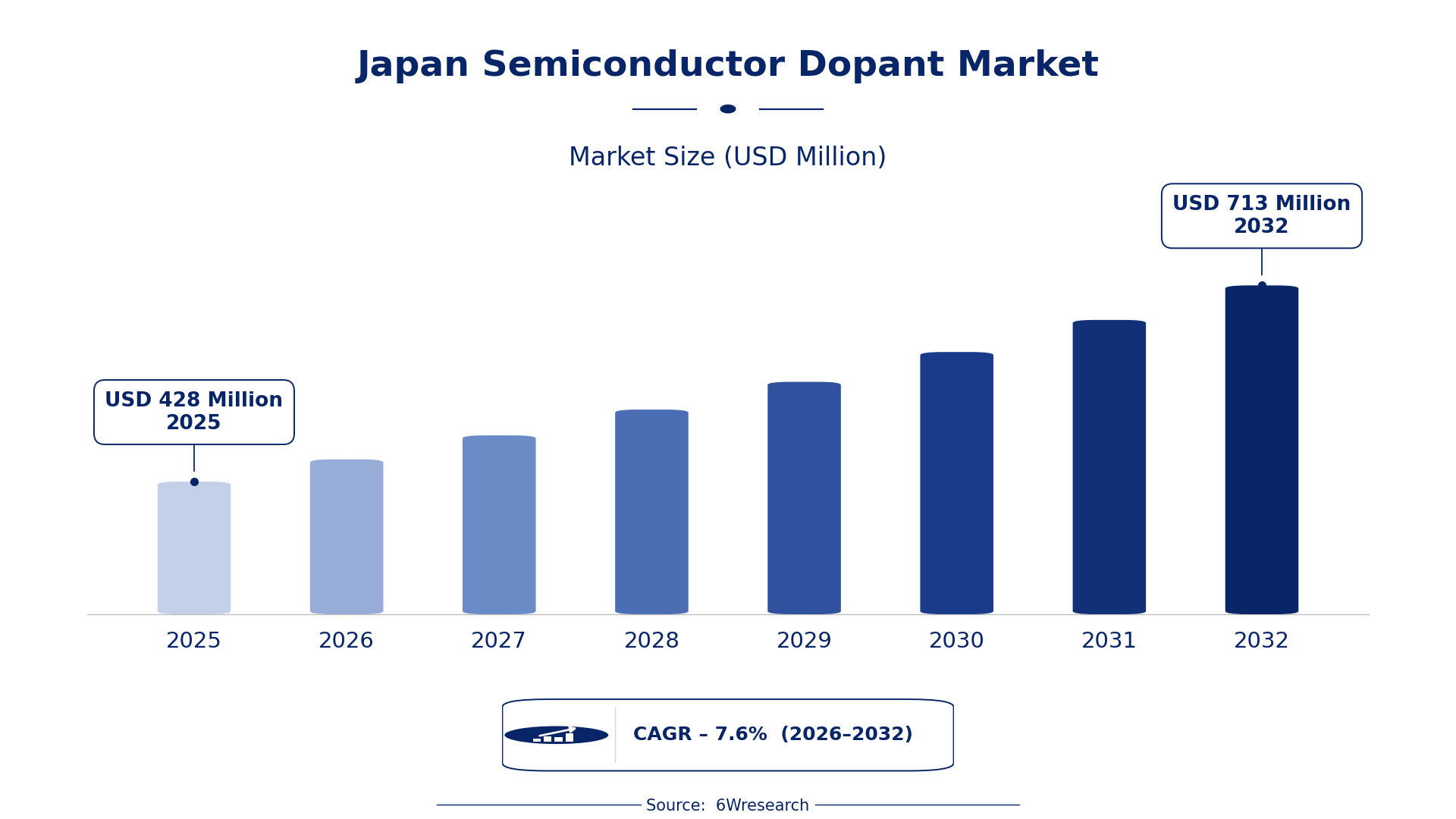
According to 6Wresearch internal database and industry insights, the Japan Semiconductor Dopant Market was valued at USD 428 Million in 2025 and is projected to reach USD 713 Million by 2032, growing at a CAGR of approximately 7.6% during 2026–2032.
Japan Semiconductor Dopant Market Highlights
| Report Metric | Details |
| Report Name | Japan Semiconductor Dopant Market (2026-2032) |
| Market Size 2025 | USD 428 Million |
| Market Size 2032 | USD 713 Million |
| Absolute Growth 2025–2032 | USD 285 Million |
| CAGR 2026–2032 | 7.6% |
| Peak Annual Growth | 8.7% in 2029 |
| Forecast Period | 2026–2032 |
| Historical Data | 2022–2025 |
| Base Year | 2025 |
| Leading Dopant Type, 2025 | Boron (49% share) |
| Leading Conductivity Type, 2025 | P-type (40% share) |
| Leading Application Stage, 2025 | Ion Implantation (53% share) |
| Leading End User, 2025 | Silicon Foundries (40% share) |
| Fastest-Growing Dopant Type | Phosphorus (10.7% CAGR) |
| Fastest-Growing Conductivity Type | N-type (11.3% CAGR) |
| Fastest-Growing Application Stage | Diffusion (10.3% CAGR) |
| Fastest-Growing End User | Semiconductor Manufacturers (10.4% CAGR) |
| Growing Sector | Semiconductor Manufacturing |
| Key End Users | Silicon Foundries, Semiconductor Manufacturers, Logic Chip Producers |
Japan Semiconductor Dopant Market Year-wise Growth Rate and Key Drivers (2022–2032)
This graph illustrates the annual growth rates of the market from 2022 to 2032, highlighting a steady upward trajectory and projected market expansion over the forecast period.
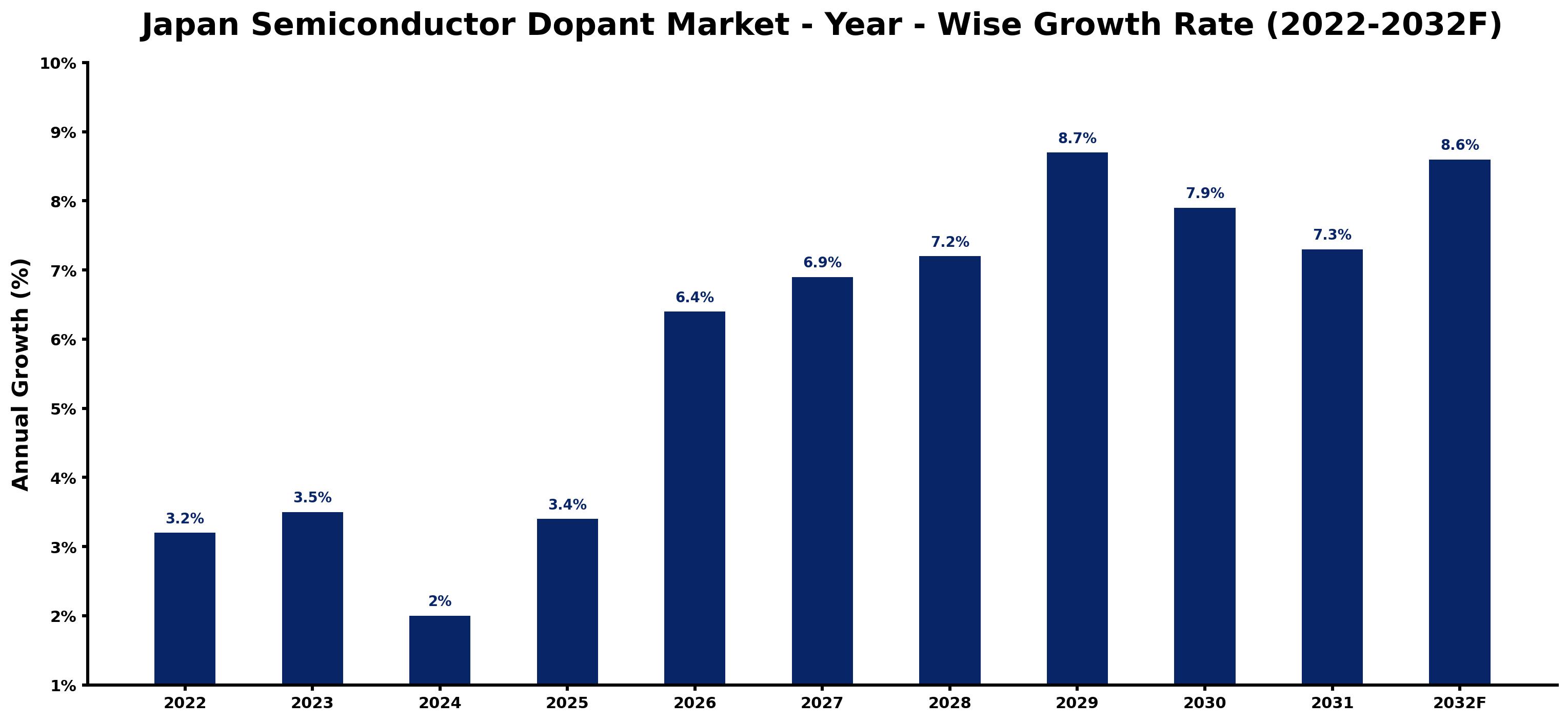
Below, each year's estimated growth is shown next to the factor that most influenced it.
| Year | Estimated Annual Growth (%) | Market Rationale |
| 2022 | 3.2 | The market experienced steady growth, driven by ongoing semiconductor production needs. |
| 2023 | 3.5 | Demand for semiconductor dopants increased due to rising production of silicon wafers. |
| 2024 | 2.0 | Growth is expected to slow as manufacturers adjust to supply chain challenges and market saturation. |
| 2025 | 3.4 | Market growth is projected to accelerate again as semiconductor manufacturers expand their operations. |
| 2026 | 6.4 | The introduction of advanced technologies is anticipated to lead to increased demand for precision doping. |
| 2027 | 6.9 | Rising adoption of 5G technology will further stimulate the need for advanced semiconductors. |
| 2028 | 7.2 | Growth is anticipated to continue as semiconductor manufacturers invest in new production capabilities. |
| 2029 | 8.7 | The peak growth year will be driven by advancements in semiconductor technology. |
| 2030 | 7.9 | Growth is expected to slow slightly as the market begins to stabilise after rapid expansion. |
| 2031 | 7.3 | The market will maintain growth, although at a slower pace due to maturation effects. |
| 2032 | 8.6 | Demand is expected to rise again as new technologies emerge and drive innovation. |
Note: Market size estimations and growth projections presented in this report are based on 6Wresearch's proprietary forecasting methodology, utilizing the latest available industry data, government publications, and primary research inputs.
Japan Semiconductor Dopant Market Synopsis
Semiconductor dopants modify the electrical properties of semiconductors, primarily adjusting conductivity in silicon wafers. The Japan Semiconductor Dopant Market is growing due to rising domestic demand, spurred by the expansion of silicon foundries and the adoption of advanced technologies. With the semiconductor industry valued at over 3 trillion JPY, manufacturers are investing in precision doping techniques and adapting to new production standards to satisfy this demand.
Market Dynamics Impact Analysis (2026–2032)
| Factor | Type | Impact | Primary Segment Affected |
| Rising demand for advanced semiconductors | Driver | High | N-type |
| Expansion of silicon foundries | Driver | High | Silicon Foundries |
| Growing need for precision doping | Opportunity | High | N-type (Precision) |
| Increased investment in semiconductor R&D | Opportunity | High | Silicon Foundries |
| Supply chain disruptions affecting materials | Restraint | High | Boron |
| Fluctuating global semiconductor prices | Restraint | Medium | Boron |
| High operational costs for manufacturers | Challenge | High | Boron |
| Technological advancements requiring constant adaptation | Challenge | Medium | Boron |
Evaluation of Drivers in Japan Semiconductor Dopant Market (2026–2032)
The factors lifting demand, and the evidence behind each, are summarised below.
| Drivers | Primary Segment Affected | Why It Matters (Evidence) |
| Increased production of silicon wafers | Silicon Foundries | Approximately 1.5 million silicon wafers were produced in 2022, leading to higher dopant consumption. |
| Adoption of 5G technology | N-type | The rollout of 5G networks is driving demand for advanced semiconductors, increasing dopant requirements. |
| Investment in semiconductor technology development | Boron | The government allocated 100 billion JPY for semiconductor technology in 2023, boosting production capabilities across the sector. |
| Expansion of advanced node fabs | N-type (Precision) | Advanced node fabs are increasingly adopting precision doping techniques to meet high-performance standards, driving demand. |
| Growing collaboration within the semiconductor industry | Silicon Foundries | Industry associations promote collaboration, improving production efficiency and driving demand for dopants. |
Most of the extra volume comes from the increased production of silicon wafers, with approximately 1.5 million produced in 2022, which has led to higher demand for dopants. The rollout of 5G technology is driving the need for advanced semiconductors, boosting N-type dopant consumption. In 2023, the allocation of 100 billion JPY for semiconductor technology development is expected to improve production capabilities. Collaboration within the semiconductor industry is promoting efficiency and driving demand for dopants.
Evaluation of Restraints in Japan Semiconductor Dopant Market
The main factors holding the market back are set out below.
| Market Restraint | Primary Segment Affected | Why It Matters (Evidence) |
| Supply chain disruptions affecting materials availability | Boron | Manufacturers faced challenges sourcing high-purity materials, impacting production timelines and causing delays of up to 15%. |
| Fluctuating global semiconductor prices impacting budgets | Boron | Price volatility in the semiconductor market has led to budget constraints for manufacturers, increasing costs by approximately 10%. |
| High operational costs for manufacturers | Boron | Rising energy and material costs have increased operational expenses for semiconductor producers, affecting profitability. |
| Technological advancements requiring constant adaptation | Boron | Manufacturers must continuously invest in new technologies to remain competitive, straining financial resources. |
| Limited availability of skilled workforce | Boron | A shortage of skilled professionals in semiconductor manufacturing has hindered production capabilities and efficiency. |
Japan Semiconductor Dopant Market Challenges
Producers in Japan encounter supply disruptions as many semiconductor dopants are imported, resulting in production delays that can extend timelines by up to three months for manufacturers. Local competition intensifies with the entry of international suppliers, compelling domestic producers to lower prices, which can compromise quality for buyers. Rising semiconductor costs, which increased by approximately 10% last year, directly affect buyers, straining budgets and extending project timelines. Skills shortages in advanced doping techniques impede production efficiency, forcing manufacturers to invest in training programmes that may take up to six months to yield qualified technicians.
Trends in the Japan Semiconductor Dopant Market
The shifts below are changing how Japan Semiconductor Dopant Market products are bought and supplied.
- Shift towards Precision Doping Techniques: The adoption of precision doping techniques began in 2023 as advanced node fabs sought to improve device performance. This shift is reflected in the increasing use of N-type (Precision) dopants, crucial for high-end devices.
- Emergence of Advanced Semiconductor Manufacturing: In 2022, Japan's semiconductor industry experienced a notable rise in advanced manufacturing capabilities. This trend is backed by a government investment of 100 billion JPY in technology development, enhancing competitiveness.
- Growing Demand for N-type Dopants: The N-type dopant market is set for growth, with an expected increase by 2025. This demand is fuelled by the expansion of silicon foundries and the need for advanced semiconductor applications.
- Increased Focus on Domestic Semiconductor Production: The Semiconductor and Digital Industry Strategy launched in 2021 prioritises securing domestic semiconductor manufacturing. This initiative aims to strengthen supply chains and enhance local production capabilities.
Investment Opportunities in the Japan Semiconductor Dopant Market
Below are the investment opportunities with the strongest case in the Japan Semiconductor Dopant Market.
- Silicon Foundries Expanding Operations: Silicon foundries are currently expanding to meet global demand, anticipating an increase in production capacity. This creates an opportunity for dopant suppliers to establish partnerships and grow their market presence.
- Investment in Advanced Node Fabs: The demand for advanced node fabs is rising, particularly in regions like Tokyo and Osaka. Suppliers can penetrate this market by forming joint ventures with local manufacturers to provide necessary dopants.
- Entry into Precision Doping Market: With the increasing need for precision doping, suppliers can invest in developing high-quality N-type dopants. Collaborating with semiconductor manufacturers will facilitate market entry and growth.
- Timing for R&D Investment: Now is an ideal time for investment in semiconductor R&D, especially with government support. Engaging with the Semiconductor Technology Research Association can yield valuable insights and partnerships.
Government Initiatives in the Japan Semiconductor Dopant Market
The Semiconductor and Digital Industry Strategy, established in June 2021, aims to secure domestic semiconductor manufacturing by promoting R&D and investment. This strategy includes measures to improve production capabilities and ensure a stable supply of semiconductor materials, which directly benefits producers and buyers in the semiconductor dopant market. The government allocated 100 billion JPY for semiconductor technology development in 2023, which is expected to improve local production.
The Economic Security Promotion Act, enacted in 2022, supports supply-chain resilience for critical products, including semiconductor materials. This act encourages manufacturers to invest in local production and ensures that buyers can rely on a stable supply of essential dopants. The Ministry of Economy, Trade and Industry oversees the implementation of this act, promoting collaboration and investment in the semiconductor sector.
Future Insight of the Japan Semiconductor Dopant Market
By 2032, the demand for semiconductor dopants will shift significantly, driven by the widespread adoption of 5G technology and the need for high-performance devices. The government has committed 100 billion JPY to semiconductor technology development, promoting innovation and improving production processes. Precision doping techniques will become standard, streamlining manufacturing operations. Collaborative efforts among industry players will establish new standards, creating a more efficient environment for both buyers and suppliers.
Market Segmentation Analysis
Japan Semiconductor Dopant Market report covers a detailed analysis of the following market segments:
By Dopant Type – Boron Leads, Phosphorus Expected to Grow Fastest
According to Saurav Kr Singh, Senior Research Analyst at 6Wresearch, with 49% of dopant type revenue in 2025, Boron was the largest category. Boron is fundamental for producing P-type semiconductors, which are integral to various electronic applications. Its widespread use in Japan's semiconductor industry, particularly in key regions like Tokyo and Osaka, solidifies its leading market share. Phosphorus is set to record the highest CAGR in this split, 10.7% over 2026–2032. Phosphorus is essential for N-type semiconductor doping, which is increasingly important in advanced manufacturing processes. The projected growth in the N-type dopant market by 2025 highlights the rising demand for this material. Suppliers should focus on ensuring phosphorus availability to meet the growing market needs.
By Conductivity Type – P-type Leads, N-type Expected to Grow Fastest
The largest conductivity type category in 2025 was P-type, at 40% of revenue. P-type conductivity is vital for the functionality of semiconductors, making it crucial in the production of numerous electronic devices. The extensive installed base of P-type semiconductors in Japan's manufacturing facilities reinforces its leading position. Over 2026–2032, N-type is expected to post the fastest growth, at a CAGR of 11.3%. N-type conductivity is key for enhancing semiconductor performance, especially with the rise of advanced technologies like 5G. The increasing adoption of N-type semiconductors indicates a trend towards more efficient electronic devices. Buyers need to consider sourcing N-type materials to remain competitive in the semiconductor industry.
By Application Stage – Ion Implantation Leads, Diffusion Expected to Grow Fastest
Ion Implantation held 53% of the Japan Semiconductor Dopant Market by application stage in 2025. Ion implantation is the primary method for introducing dopants into silicon, ensuring precise control over doping levels. Its prevalent use in Japan's semiconductor manufacturing facilities underscores its leadership in the application stage. Diffusion is projected to grow fastest, at a CAGR of 10.3% during 2026–2032. Diffusion remains a traditional method for doping silicon wafers, yet its efficiency is being recognised as demand for semiconductor devices grows. The ongoing reliance on diffusion techniques suggests a stable future for this application stage. Suppliers should maintain a diverse portfolio of doping methods to cater to varying production needs.
By End User – Silicon Foundries Lead, Semiconductor Manufacturers Expected to Grow Fastest
In 2025, Silicon Foundries led the end user split with a 40% share. Silicon foundries are the primary consumers of dopants for wafer production, generating significant demand in Japan's semiconductor market. Their extensive operations across the country greatly contribute to the prominence of this end user segment. The quickest growth will come from Semiconductor Manufacturers, forecast to expand at a CAGR of 10.4% between 2026 and 2032. Semiconductor manufacturers rely on dopants for device fabrication, and the growth of silicon foundries is increasing their requirements. This interdependence between foundries and manufacturers is expected to drive further growth in this segment. Buyers should establish strong partnerships with silicon foundries to ensure a consistent supply of essential dopants.
Key Attractiveness of the Report
- 10 Years of Market Numbers
- Historical Data Starting from 2022 to 2025
- Base Year 2025
- Forecast Data until 2032
- Key Performance Indicators Impacting the Market
- Major Upcoming Developments and Projects
Key Highlights of the Report:
- Japan Semiconductor Dopant Market Outlook
- Market Size of Japan Semiconductor Dopant Market, 2025
- Forecast of Japan Semiconductor Dopant Market, 2032
- Historical Data and Forecast of Japan Semiconductor Dopant Revenues & Volume for the Period 2022-2032F
- Japan Semiconductor Dopant Market Trend Evolution
- Japan Semiconductor Dopant Market Drivers and Challenges
- Japan Semiconductor Dopant Price Trends
- Japan Semiconductor Dopant Porter's Five Forces
- Japan Semiconductor Dopant Industry Life Cycle
- Historical Data and Forecast of Japan Semiconductor Dopant Market Revenues & Volume By Dopant Type for the Period 2022-2032F
- Historical Data and Forecast of Japan Semiconductor Dopant Market Revenues & Volume By Boron for the Period 2022-2032F
- Historical Data and Forecast of Japan Semiconductor Dopant Market Revenues & Volume By Phosphorus for the Period 2022-2032F
- Historical Data and Forecast of Japan Semiconductor Dopant Market Revenues & Volume By Arsenic for the Period 2022-2032F
- Historical Data and Forecast of Japan Semiconductor Dopant Market Revenues & Volume By Antimony for the Period 2022-2032F
- Historical Data and Forecast of Japan Semiconductor Dopant Market Revenues & Volume By Conductivity Type for the Period 2022-2032F
- Historical Data and Forecast of Japan Semiconductor Dopant Market Revenues & Volume By P-type for the Period 2022-2032F
- Historical Data and Forecast of Japan Semiconductor Dopant Market Revenues & Volume By N-type for the Period 2022-2032F
- Historical Data and Forecast of Japan Semiconductor Dopant Market Revenues & Volume By N-type (High Density) for the Period 2022-2032F
- Historical Data and Forecast of Japan Semiconductor Dopant Market Revenues & Volume By N-type (Precision) for the Period 2022-2032F
- Historical Data and Forecast of Japan Semiconductor Dopant Market Revenues & Volume By Application Stage for the Period 2022-2032F
- Historical Data and Forecast of Japan Semiconductor Dopant Market Revenues & Volume By Ion Implantation for the Period 2022-2032F
- Historical Data and Forecast of Japan Semiconductor Dopant Market Revenues & Volume By Diffusion for the Period 2022-2032F
- Historical Data and Forecast of Japan Semiconductor Dopant Market Revenues & Volume By Doping Process for the Period 2022-2032F
- Historical Data and Forecast of Japan Semiconductor Dopant Market Revenues & Volume By Thermal Diffusion for the Period 2022-2032F
- Historical Data and Forecast of Japan Semiconductor Dopant Market Revenues & Volume By End User for the Period 2022-2032F
- Historical Data and Forecast of Japan Semiconductor Dopant Market Revenues & Volume By Silicon Foundries for the Period 2022-2032F
- Historical Data and Forecast of Japan Semiconductor Dopant Market Revenues & Volume By Semiconductor Manufacturers for the Period 2022-2032F
- Historical Data and Forecast of Japan Semiconductor Dopant Market Revenues & Volume By Logic Chip Producers for the Period 2022-2032F
- Historical Data and Forecast of Japan Semiconductor Dopant Market Revenues & Volume By Advanced Node Fabs for the Period 2022-2032F
- Japan Semiconductor Dopant Import Export Trade Statistics
- Market Opportunity Assessment By Dopant Type
- Market Opportunity Assessment By Conductivity Type
- Market Opportunity Assessment By Application Stage
- Market Opportunity Assessment By End User
- Japan Semiconductor Dopant Top Companies Market Share
- Japan Semiconductor Dopant Competitive Benchmarking By Technical and Operational Parameters
- Japan Semiconductor Dopant Company Profiles
- Japan Semiconductor Dopant Key Strategic Recommendations
Market Covered
The following segment groups are covered in the report.
By Dopant Type
- Boron
- Phosphorus
- Arsenic
- Antimony
By Conductivity Type
- P-type
- N-type
- N-type (High Density)
- N-type (Precision)
By Application Stage
- Ion Implantation
- Diffusion
- Doping Process
- Thermal Diffusion
By End User
- Silicon Foundries
- Semiconductor Manufacturers
- Logic Chip Producers
- Advanced Node Fabs































